

Quick Answer
A BAER test for dogs (brainstem auditory evoked response) measures electrical activity in the brain when clicks are played into each ear, which is the only reliable way to catch one-sided deafness. The BAER test for dogs usually takes 10 to 15 minutes and often runs $60 to $201 for a single dog depending on the clinic, with lower per-puppy prices for litters. Most puppies can be tested starting around 5 to 6 weeks old, and a single properly performed test covers the dog for life, since hearing loss from this cause does not develop later. Breeds with white or merle coats, including Dalmatians, Australian Cattle Dogs, and Bull Terriers, are the dogs most likely to need one.
Key Takeaways: baer test for dogs
- The BAER test for dogs checks each ear separately, so it finds unilateral (one-ear) deafness that clapping or whistle tests cannot detect.
- Prices in 2026 range from about $60 at a university lab to $201 for a full appointment with sedation at an academic hospital.
- Breeder litter pricing drops sharply per puppy, sometimes to $70 per dog for groups of three or more.
- Puppies can be tested from 35 days of age once ear canals are open, though many clinics test around 5 to 6 weeks.
- A single BAER test is good for the dog’s lifetime; congenital deafness does not appear later if the ears tested normal.
- Dalmatians, Australian Cattle Dogs, English Setters, Bull Terriers, and Catahoulas carry the highest documented rates of congenital deafness tied to white or merle coat genes.
- Sedation is often brief and reversible, used mainly for wiggly puppies rather than every dog.
- The Orthopedic Foundation for Animals keeps a public database of BAER results for breeding dogs.

Why are you testing?
Tap an option to see the answer.
What is a BAER test for dogs?
A BAER test for dogs is a diagnostic procedure that records the brain’s electrical response to clicking sounds played into one ear at a time through a small foam earphone. Electrodes placed on the scalp pick up signals traveling from the cochlea through the auditory nerve to the brainstem, and a computer averages hundreds of clicks to pull a readable waveform out of background noise, according to Louisiana State University’s School of Veterinary Medicine.
The resulting waveform has peaks labeled with Roman numerals. Peak I reflects activity in the cochlear nerve near the ear itself. Later peaks reflect the same signal moving farther into the brainstem. A normal pattern of peaks on one side confirms that ear hears. A flat line on that side means it does not, no matter how the dog behaves around the house.
This distinction matters because dogs compensate well with a single working ear. They rely on vibration, air movement, and visual cues, so owners frequently miss unilateral deafness until a formal BAER test for dogs uncovers it. A dog that turns its head at a doorbell or barks at a mail truck is not proof both ears work; it only proves one does.
How much does a BAER test cost?
A BAER test for dogs in 2026 typically costs between $60 and $201 for one dog, with the final price shaped by sedation needs, whether a physical exam is bundled in, and how many puppies from a litter get tested at the same visit.
Documented benchmarks, price checked 2026:
- University of Florida: BAER testing through the neurology service is offered as part of broader diagnostic workups; owners should call ahead for current pricing since university teaching hospitals often adjust fees by semester, per UF’s veterinary neurology service.
- UC Davis: $167 for the BAER test plus $34 for examination and sedation, totaling $201, run through a clinic that meets roughly every other Thursday for otherwise healthy dogs.
- St. Francis Veterinary Hospital: $189 for one dog, dropping to $100 per dog for two, and $70 per dog for three or more, with most puppies and kittens tested at 5 to 6 weeks.
- University of Cincinnati FETCHLAB: $60 for a single diagnostic test, or $60 for the first three puppies plus $10 per additional puppy in a litter.
Common mistake: assuming a quoted BAER test for dogs price includes everything. Many listings skip sedation drugs, a full veterinary exam, or the fee to submit results to the Orthopedic Foundation for Animals database. Call ahead and ask what’s bundled before booking.
Decision rule: testing a single puppy means expecting the higher end of the range. Testing a full litter as a breeder means asking about group pricing first, since it can cut the per-puppy cost by more than half.
Which dog breeds need BAER testing?
Breeds with white or merle coat genetics need BAER testing most, because the same pigment genes linked to white fur and blue eyes are also linked to malformed structures in the inner ear. Dalmatians, Australian Cattle Dogs, English Setters, Bull Terriers, and Catahoulas carry the highest documented rates of congenital deafness among dog breeds, according to the Canadian Veterinary Medical Association.
Other breeds and situations where testing is worth considering:
- Any dog, regardless of breed, born with extreme white markings on the head or body
- Merle-coated dogs in breeds like Australian Shepherds, where double-merle breeding raises deafness risk substantially
- Litters from parents with a known history of unilateral or bilateral deafness
- Rescue dogs of unknown background that show inconsistent responses to sound
Breeders of high-risk lines commonly test entire litters before placing puppies, and buyers of a white or merle puppy from any breed should simply ask whether testing was done before bringing the dog home. Readers managing a merle-coated breed may want the Australian Shepherd guide for background on how merle genetics intersect with hearing risk.
Is the BAER test painful for dogs?
No, a BAER test for dogs is not painful. The electrodes used are extremely small surface or needle-style sensors placed just under the skin, and most dogs show no reaction to placement at all, according to LSU’s veterinary school.
The clicking sounds delivered through the foam earphone are not loud enough to cause discomfort; they’re closer to a soft tapping noise than anything jarring. The main source of stress for most dogs is holding still, not the test itself. That’s why many clinics offer brief, reversible sedation for wiggly puppies or anxious adult dogs rather than forcing a calm dog to sit through something uncomfortable. A dog that tolerates nail trims or ear cleanings at home typically tolerates a BAER test without issue.

What age can puppies get BAER tested?
Puppies can be BAER tested starting at 35 days of age, once the ear canals have fully opened, according to the Orthopedic Foundation for Animals. Many clinics prefer to wait until 5 to 6 weeks for practical reasons.
Waiting a bit longer gives puppies more size and physical stability for electrode placement, and it allows for light sedation if the puppy is too active to stay still for the full procedure. There’s no downside to testing closer to 6 weeks instead of the earliest possible date, and breeders often schedule BAER testing the same week as the first vaccination visit to save a trip.
Decision rule: if a litter is going home to new owners by 8 weeks, schedule BAER testing between 5 and 6 weeks so results are finalized and documented before puppies leave.
Where can I get a BAER test for my dog?
A BAER test for dogs typically requires specialized recording equipment that most general veterinary offices don’t stock, so testing usually happens at university veterinary hospitals, veterinary neurology specialty practices, or scheduled breed-club clinics.
Starting points for finding a testing location:
- Ask a general veterinarian for a referral to the nearest university veterinary teaching hospital
- Search the Orthopedic Foundation for Animals database or contact them directly for a list of approved testing sites
- Check with national or regional breed clubs for Dalmatians, Australian Cattle Dogs, or other high-risk breeds, since many organize group BAER clinics
- Contact nearby veterinary schools directly, since many run recurring BAER clinics (UC Davis runs one roughly every other Thursday)
Common mistake: calling a standard small-animal clinic and expecting same-day BAER testing. Most will need to refer out, so it’s worth calling ahead rather than showing up expecting the service on-site.
What does it mean if my dog fails the BAER test?
A failed BAER test for dogs means no electrical response was detected in one or both ears, which confirms deafness on that side. A dog that fails on one ear is unilaterally deaf; a dog that fails on both is bilaterally deaf.
Before accepting a failed result as final, it’s worth confirming the test conditions were clean:
- Ask whether the dog moved excessively during recording, since movement artifact can sometimes mimic a poor response
- Ask whether earwax, debris, or an active ear infection may have interfered with earphone fit or sound transmission
- Request a retest under light sedation if the first attempt involved a highly uncooperative puppy
Once a flat waveform is confirmed under good test conditions, it’s a reliable result. The Orthopedic Foundation for Animals notes that a properly performed BAER test does not need to be repeated later, since congenital deafness is present from birth and does not develop afterward.
How accurate is the BAER test?
The BAER test for dogs is considered the gold standard for diagnosing congenital deafness in dogs, because it tests each ear independently using objective electrical measurements rather than relying on a dog’s behavior. The British Veterinary Association and veterinary neurology programs across the US rely on it as the accepted screening method for breed health schemes.
Accuracy depends on a few practical factors:
- Clean ear canals free of wax or debris that could block sound transmission
- Proper electrode placement by an experienced technician
- A still dog, either naturally calm or lightly sedated, since excessive movement can create artifact that muddies the reading
- Correct earphone seal in the ear canal during each side’s testing
When these conditions are met, a BAER test produces a clear, repeatable result that doesn’t change over the dog’s lifetime for congenital causes.
Can I do a BAER test at home?
No, a BAER test cannot be done at home, because it requires specialized electrode and recording equipment to measure brainstem electrical activity, something no consumer product currently replicates. What owners can do at home is a basic behavioral hearing check, which is useful but limited.
A home hearing check involves making a sudden sound (a clap, a whistle, a dropped pan) outside the dog’s field of vision and watching for a reaction like an ear flick, head turn, or startle. It costs nothing and can catch obvious, complete deafness in a dog that shows no response at all.
The problem is that a dog with one working ear often reacts normally to a home test. The sound reaches the functioning ear, the dog turns its head, and the owner assumes hearing is fine on both sides. Only a BAER test, which isolates each ear with a dedicated earphone, catches that gap reliably.
Decision rule: use a home clap test as a rough first screen if cost is a barrier, but treat a “pass” with caution in any high-risk breed. If a head tilt shows up alongside any hearing concern, it’s worth reading about why dogs tilt their heads, since a tilt can point to a balance or inner-ear issue separate from hearing loss itself.
BAER test vs other dog hearing tests
A BAER test is the only method that measures each ear’s hearing independently with objective electrical readings; other hearing checks rely on observing a dog’s behavioral response to sound, which cannot isolate a single ear.
| Method | Catches unilateral deafness? | Cost |
|---|---|---|
| BAER test | Yes, tests each ear separately | $60 to $201 |
| Home clap/whistle test | No, dog can compensate with one ear | Free |
| General vet exam/otoscope check | No, checks ear structure, not hearing function | Varies, often bundled into a visit |
Edge case: a dog can pass a home test and still be unilaterally deaf, because the working ear compensates well enough that owners never notice a gap. Only the BAER test catches that scenario reliably.
Do all dogs need BAER testing?
No, not all dogs need BAER testing. Dogs without white or merle coat genetics, and without a family history of deafness, carry a much lower baseline risk and typically don’t require the test unless a veterinarian notices a specific concern.
BAER testing is strongly recommended for:
- Puppies born with white or merle coats, especially in breeds already known for deafness risk
- Breeding dogs in programs following health screening guidelines from organizations like the British Veterinary Association
- Any dog showing behavioral signs of possible hearing loss, such as failing to wake to loud noise or ignoring a recall cue consistently from one direction
Dogs with solid-colored coats and no known risk factors rarely need testing. Decision rule: test if the dog has any white or merle pigment pattern, has a parent with documented deafness, or shows real-world signs of reduced hearing. Skip it for low-risk solid-colored breeds unless a vet raises a specific concern.
The short answer: what the BAER test for dogs is
A BAER test records the brain’s electrical response to a series of clicks played into one ear at a time through a small foam earphone. Electrodes placed on the scalp pick up signals from the cochlea, the auditory nerve, and the brainstem, and a computer averages hundreds of clicks to pull a readable waveform out of the noise.
The waveform has peaks labeled with Roman numerals. Peak I reflects the cochlear nerve close to the ear. Later peaks reflect the signal traveling farther into the brainstem. A normal pattern of peaks on one side means that ear hears. A flat line means it does not, regardless of whether the dog turns its head at a doorbell or barks at the mail carrier using the ear that works fine.
This matters because dogs are very good at faking normal hearing with one working ear. They pick up vibration, air movement, and visual cues, and owners often miss unilateral deafness entirely until a formal test reveals it.
Real cost: what owners and breeders pay
The real cost of a BAER test in 2026 ranges from about $60 for a basic diagnostic test to $201 for a full university appointment that includes examination and sedation. Price depends heavily on whether the dog needs sedation, whether the clinic bundles a physical exam, and how many puppies from a litter are tested at once.
A few documented benchmarks, price checked 2026:
- UC Davis: $167 for the BAER test plus $34 for examination and sedation, totaling $201, run through a clinic that meets roughly every other Thursday for otherwise healthy dogs.
- St. Francis Veterinary Hospital: $189 for one dog, dropping to $100 per dog for two, and $70 per dog for three or more, with most puppies and kittens tested at 5 to 6 weeks.
- University of Cincinnati FETCHLAB: $60 for a single diagnostic test, or $60 for the first three puppies plus $10 per additional puppy in a litter.
Common mistake: assuming the quoted BAER price includes everything. Many listings do not include sedation drugs, a full veterinary exam, or the fee to submit results to OFA. Call ahead and ask what is bundled before booking.
Decision rule: if you are testing a single puppy, expect to pay toward the higher end of the range. If you are a breeder testing a full litter, ask about group pricing first; it can cut the per-puppy cost by more than half.
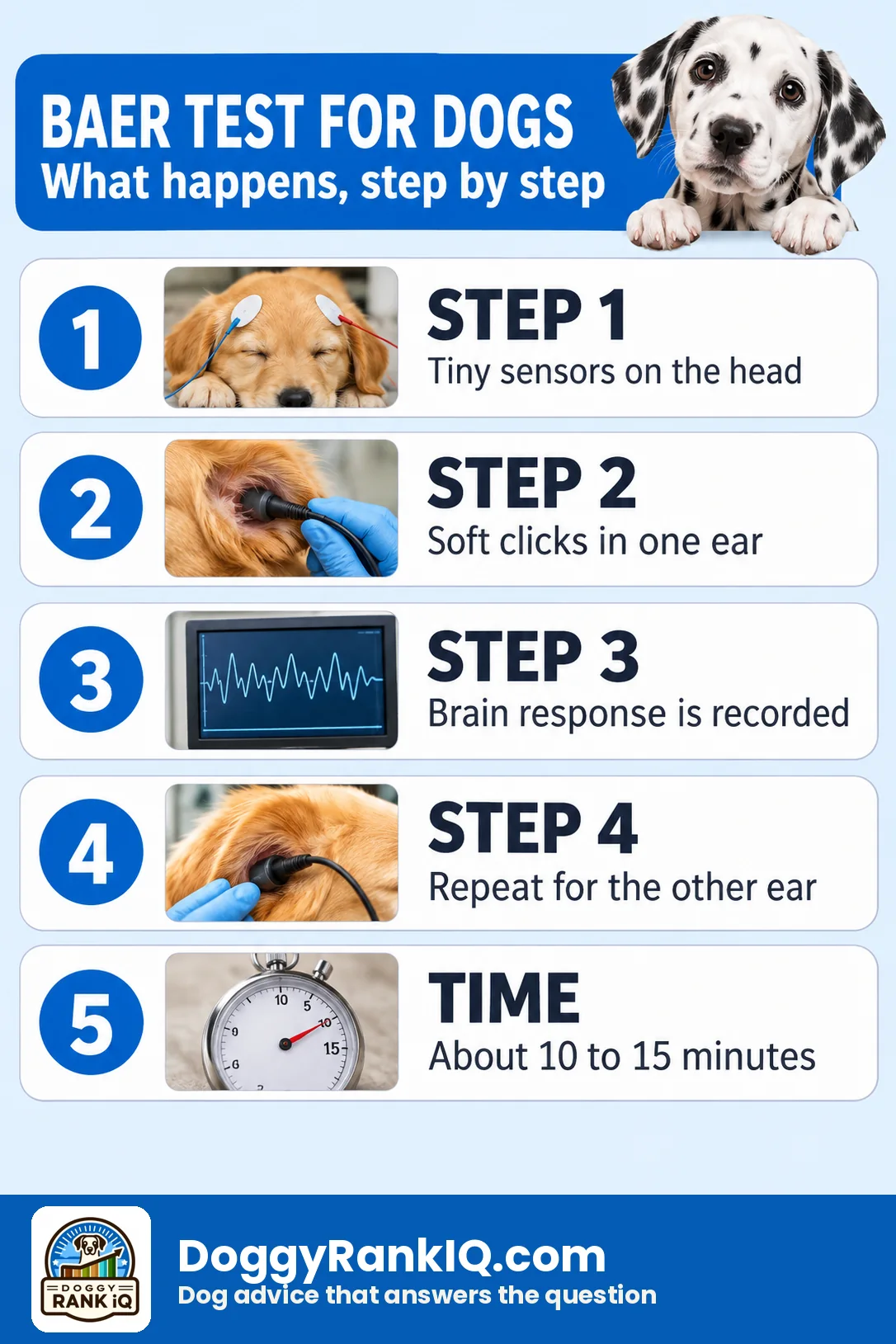
What happens: the test step by step
1Intake and ear examination
The veterinarian checks the ears and general health first, especially if sedation is planned. This step also rules out wax, infection, or debris that could interfere with the earphone fit.
2Positioning and electrode placement
The dog is usually positioned on its sternum or side, in a comfortable spot. Small needle or surface electrodes go on the scalp, typically near each ear and along the midline, with a ground electrode near the neck or shoulders. Most dogs show no pain from placement.
3Clicks and recording
A foam earphone delivers repeated clicks to one ear while the other ear may be masked. The computer records the brain’s electrical response and averages many repetitions to separate real auditory signal from muscle twitches and background noise.
4Switching ears
The process repeats on the second ear. Testing each side independently is what makes a BAER test different from a clap test, since it produces a separate printout for the right and left ear.
5Reading the waveform
The veterinarian or technician reviews the peaks for each ear. A normal waveform with identifiable peaks means that ear hears; a flat line means it does not. The whole click-and-record portion often takes 10 to 15 minutes, though the full appointment with intake, sedation, and recovery runs longer.
Facts table: BAER results explained
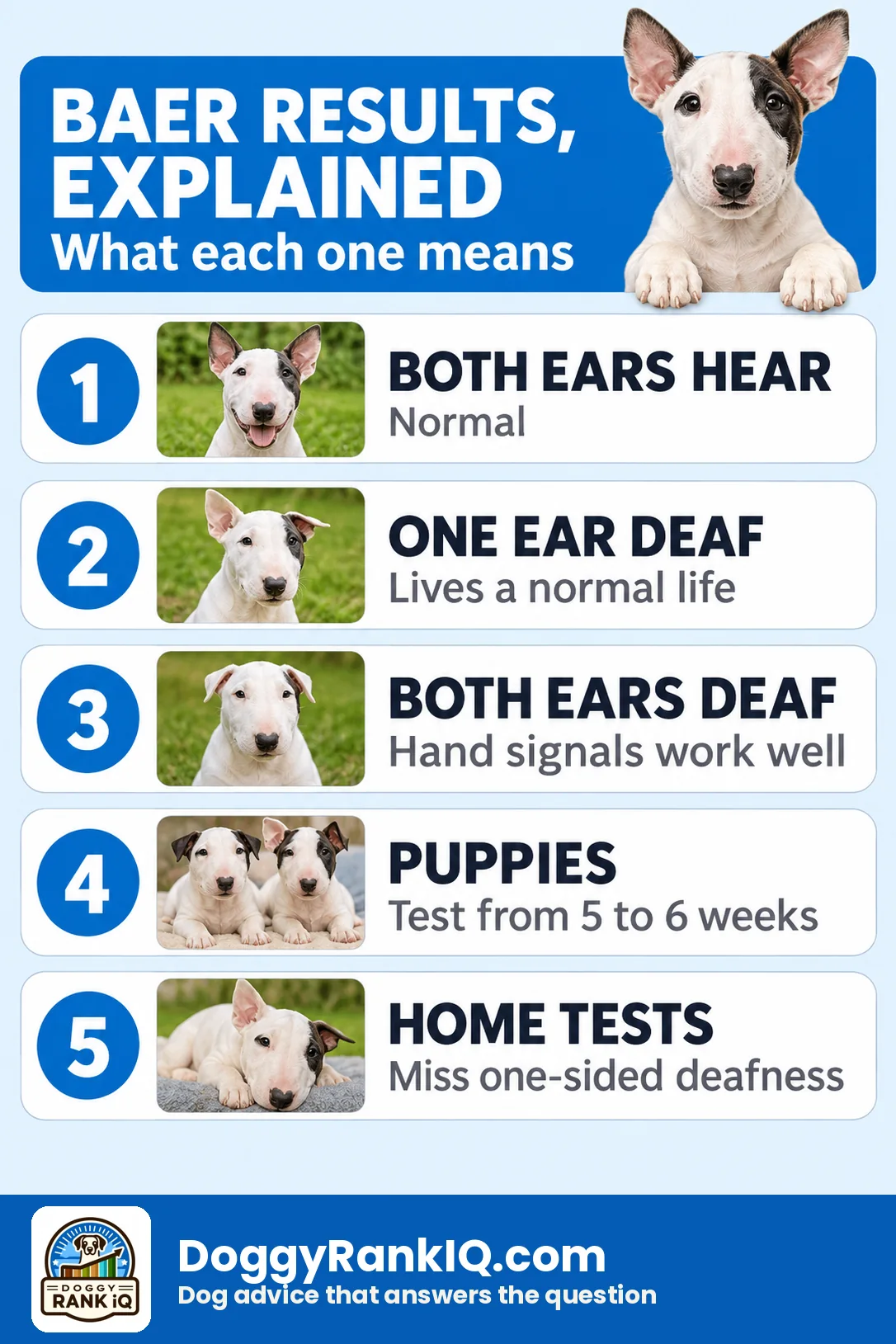
| Result | What it means | What owners notice |
|---|---|---|
| Bilaterally hearing | Normal waveform in both ears | Responds to sound from either side, no detectable loss |
| Unilaterally deaf | One ear shows a normal waveform, the other is flat | Often undetectable at home, may have trouble locating sound direction |
| Bilaterally deaf | No response in either ear | Does not react to sound, sleeps through loud noise |
Edge case: a dog can pass a home test and still be unilaterally deaf, because the working ear compensates well enough that owners never notice a gap.
Which dogs should be tested, and at what age
Dogs with white or merle coat genetics, especially Dalmatians, Australian Cattle Dogs, English Setters, Bull Terriers, and Catahoulas, are the clearest candidates for a BAER test. Breeders of these lines commonly test entire litters before placing puppies, and individual buyers of a white or merle puppy from any breed should ask whether testing was done.
Testing can start at 35 days of age, once the ear canals are open. Many clinics prefer 5 to 6 weeks, which gives puppies enough size and stability for electrode placement and, if needed, light sedation.
Choose testing now if you breed, buy, or rescue a Dalmatian, an Australian Cattle Dog, a Bull Terrier, or any white or merle puppy. A related concern worth checking is ear health generally. Readers raising one of these breeds may also want a guide on cleaning a dog’s ears and a roundup of the best dog ear cleaners, since infections and wax buildup can complicate any hearing evaluation.
Living with a deaf or one-ear-deaf dog
A dog with confirmed deafness, partial or total, can still live a full, well-adjusted life once owners adjust how they communicate. Hand signals replace verbal cues, vibration collars replace recall whistles, and visual attention games build a dog that checks in by eye rather than by ear.
Unilaterally deaf dogs usually need the least adjustment since one working ear still picks up plenty of sound; owners may simply notice the dog startles more easily from the deaf side. Bilaterally deaf dogs need a more deliberate routine: consistent hand signals taught early, caution around blind corners and traffic since they cannot hear approaching cars, and gentle methods for waking a sleeping dog, usually a light touch on the body rather than a surprise from above.
Confirm any training approach with your veterinarian or a qualified trainer, particularly if the dog shows signs of startling aggressively when woken. Readers managing a related breed-specific concern may find the Australian Shepherd guide useful, since merle genetics in that breed carry similar hearing considerations to Australian Cattle Dogs.
Helpful tools for deaf dogs
A few products make daily communication with a deaf or partially deaf dog easier, without relying on sound at all.
Dog Vibration Collar with Controller, No Shock (rel=”sponsored”) sends a vibration cue instead of a sound cue, which many owners use in place of a recall whistle once a dog learns to associate the buzz with “come here.” Check the current price (rel=”sponsored”), $39.99, price checked 2026.
No Shock Dog Training Collar with Remote, Vibration and Beep Only (rel=”sponsored”) adds a beep option for dogs with partial hearing on one side, useful for unilaterally deaf dogs who can still detect certain tones on the working ear. Check the current price (rel=”sponsored”), $39.99, price checked 2026.
Pet Health Record Book for Dogs (rel=”sponsored”) gives owners and breeders a simple place to log BAER results, vaccination dates, and vet visits in one record, which is handy when submitting results to OFA or sharing history with a new owner. Check the current price (rel=”sponsored”), $8.49, price checked 2026.
Doggie Language: A Dog Lover’s Guide to Understanding Your Best Friend (rel=”sponsored”) is a visual guide to canine body language that becomes more relevant, not less, once a dog relies on sight and touch over sound. Check the current price (rel=”sponsored”), $8.99, price checked 2026.
None of these replace a conversation with your veterinarian about a specific dog’s needs. For broader training reading, consider the 5 essential commands every puppy should learn, many of which adapt easily to hand signals for deaf or partially deaf dogs. If sound sensitivity becomes a concern during recovery from sedation, a guide on ear protection options like Happy Hoodie versus Rex Specs may also help. Always confirm any ear or hearing concern with a veterinarian before trying a product-based fix.
FAQ
The bottom line
A BAER test gives a clear, ear-by-ear answer that a home clap test simply cannot provide, and in 2026 it remains the accepted way to document congenital deafness in high-risk breeds. Expect to pay somewhere between $60 and $201 depending on the clinic and whether sedation and an exam are bundled in, and remember that one properly performed test covers the dog for life.
If you own or breed a Dalmatian, an Australian Cattle Dog, a Bull Terrier, or any white or merle puppy, call a university veterinary hospital or specialty clinic near you, ask exactly what the quoted price includes, and book the test around 5 to 6 weeks of age. A flat waveform is not the end of a good life with a dog; it is the start of a clearer plan for one.
Doggy Rank IQ is reader supported. As an Amazon Associate we earn from qualifying purchases, at no extra cost to you.