

Quick Answer
Dog ear protection falls into two different jobs that often get mixed up in product reviews. A fabric band like the Happy Hoodie compresses the ears for calming and grooming control, while a built earmuff like Rex Specs Ear Pro is made to reduce sound exposure in loud, sustained environments. If your dog just needs help staying still for a blow dryer or nail trim, dog ear protection in the form of a soft wrap is usually enough. If your dog works around gunfire, engines, or fireworks shows for hours, the acoustic foam design in Rex Specs has published attenuation data that the Happy Hoodie does not.
Key Takeaways: dog ear protection
- Dog ear protection is not one product category. Compression wraps and acoustic earmuffs solve different problems.
- Rex Specs Ear Pro publishes real-ear sound booth testing: about 18 to 24 dB(A) reduction at 20 to 120 Hz, using 95 dB(A) white noise, per the manufacturer’s performance report. (whole-dog-journal.com)
- The Happy Hoodie does not publish a decibel reduction number. It’s built as a stretch compression wrap, not an acoustic device. (dognotebook.com)
- Price gap is large: Happy Hoodie runs roughly $9.99 to $17.99 depending on size and pack, while Rex Specs Ear Pro sits near $92.99 to $99.99, price checked 2026. (rexspecs.com)
- No universal testing standard exists for verifying dog earmuff performance, according to veterinary behaviorist Leslie Sinn. (businessinsider.com)
- Fit matters more than brand reputation. A loose earmuff leaks sound. A tight one gets pawed off within minutes.
- Neither product is a substitute for veterinary-guided anxiety treatment in severely noise-phobic dogs.
- Ear protection works best paired with desensitization, not used as a standalone fix.

How loud is it?
Check the current price
Tap an option to see the answer.
When does a dog need ear protection?
A dog needs ear protection when sound exposure is either frightening or physically risky, and those are two separate triggers worth telling apart. A frightened dog during fireworks or thunder needs calming and reduced startle. A working or sporting dog near gunfire, motorcycles, or power equipment needs actual sound attenuation.
Common situations where owners reach for dog ear protection:
- Fireworks and thunderstorms. Sudden loud, unpredictable noise triggers panting, pacing, hiding, and destructive behavior in noise-sensitive dogs.
- Grooming and bathing. Blow dryers and clippers run close to a dog’s head at a volume many dogs find unpleasant.
- Veterinary visits. Exam rooms can be loud, chaotic, and full of unfamiliar smells on top of sound.
- Hunting, shooting ranges, and field trials. Gunfire produces sudden, high-intensity sound close to the dog.
- Riding along on a motorcycle, ATV, or boat. Sustained engine noise over hours is a different exposure pattern than one loud bang.
- Concerts, parades, and crowded events. Working dogs or service dogs accompanying owners into loud public spaces.
Decision rule: choose compression wraps for anxiety and grooming control, and choose acoustic earmuffs for sustained loud environments or occupational-style noise. A dog who only panics twice a year during Fourth of July fireworks has a different need than a dog riding a tractor every weekend.
Edge case: some dogs show real fear during bathing, not because of water, but because of the dryer’s motor pitch. Checking whether the dryer itself is the trigger, rather than the water, helps decide whether dog ear protection or a quieter dog blow dryer solves more of the problem.
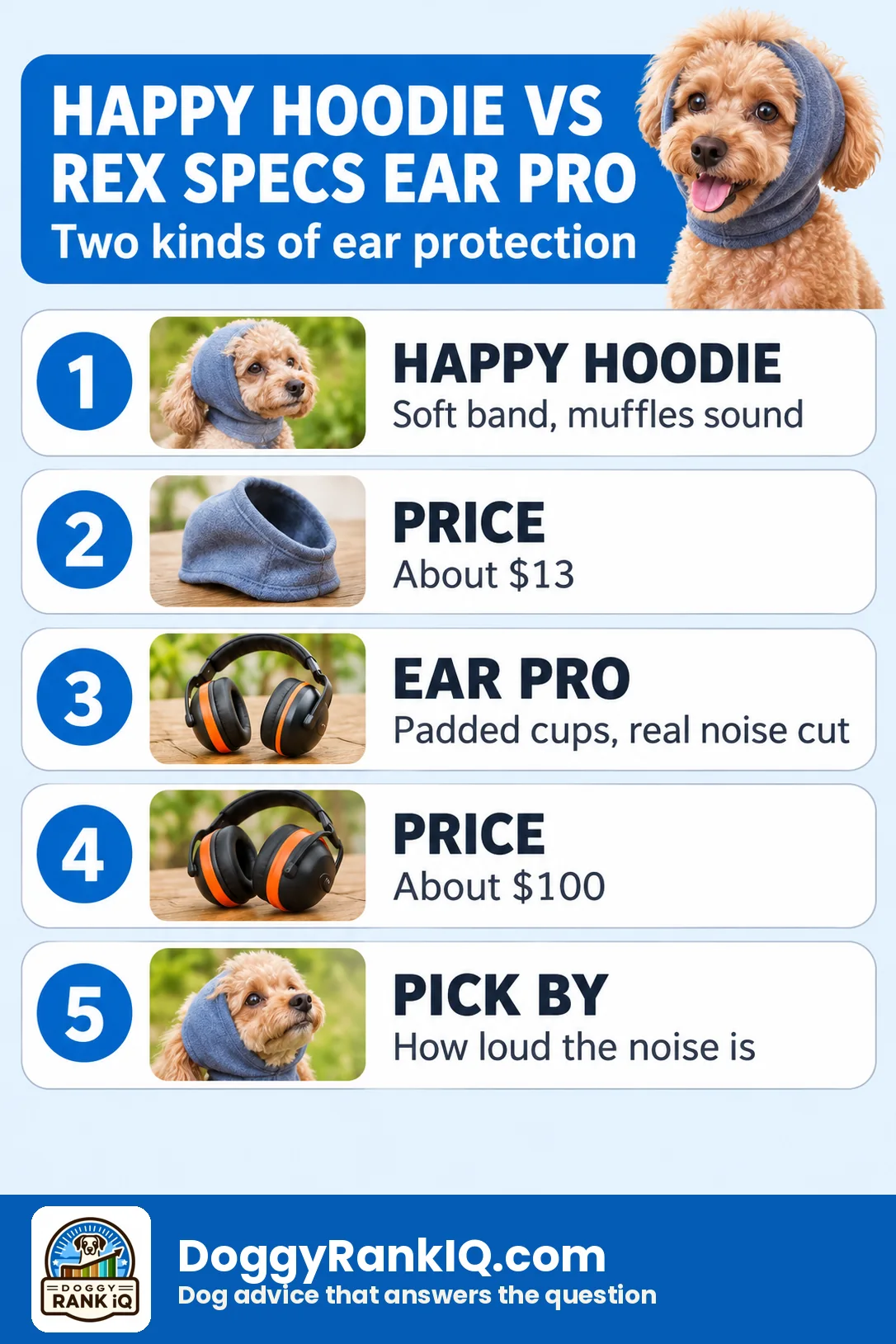
 Happy Hoodie vs Rex Specs Ear Pro
 Happy Hoodie vs Rex Specs Ear Pro
The short version: Happy Hoodie is a soft calming wrap built for grooming and mild noise anxiety, and Rex Specs Ear Pro is a structured earmuff built for sustained loud environments with published lab data behind it.
Choose the Happy Hoodie Original Calming Band if the goal is a calmer dog on the grooming table or during a quick thunderstorm. Choose Rex Specs Ear Pro if the dog spends real time around engines, gunfire, or industrial-level noise.
Check the current price for Happy Hoodie.
Check the current price for Rex Specs Ear Pro, size 03.
A common mistake: assuming the pricier product automatically works better for every dog. A dog who refuses to tolerate a structured earmuff gets zero benefit from its lab numbers. Fit and acceptance decide real-world performance more than the spec sheet.
Dog ear muffs for fireworks: what helps and what does not
Dog ear muffs for fireworks reduce some sound, but sound is only part of what scares a dog during a fireworks show. Dogs also feel the concussive vibration through the ground and their bodies, which neither a compression wrap nor an earmuff blocks.
What tends to help:
- Starting before the show begins. Desensitization and counterconditioning, ideally weeks ahead, work better than any product applied in the moment. (rei.com)
- An enclosed, familiar space. A crate or interior room with closed windows and curtains reduces both sound and flashing light. (rei.com)
- Background noise. A fan, television, or white noise machine can mask some of the sharper frequencies.
- A properly fitted earmuff or compression wrap, used alongside the above, not instead of it.
What tends not to help on its own:
- Putting ear covers on a dog for the first time during the actual fireworks show. New sensations plus panic is a bad combination.
- Expecting a fabric band to meaningfully block low frequency booms. Bioacoustics expert Peter M. “Skip” Scheifele has noted that products like the Happy Hoodie may calm a dog through compression but are not built to block low-frequency sound such as thunder or fireworks concussions. (businessinsider.com)
- Assuming any product replaces veterinary guidance for a dog with severe noise phobia. The British Veterinary Association’s 2026 fireworks guidance recommends an early vet consultation, and medication or pheromone support where appropriate, for dogs with a documented fear response. (rei.com)
Decision rule: if a dog merely startles and resettles, a Happy Hoodie plus a quiet room is often enough. If a dog drools, destroys furniture, or tries to escape during fireworks, book a veterinary consultation before the next holiday season, not during it.
Dog ear protection for bathing and blow drying
Dog ear protection for bathing works mainly through compression and water exclusion rather than noise reduction, since the main stressor during a bath is often motor pitch from the dryer, not the water itself. A snug compression band keeps water and loose hair out of the ear canal while also applying light pressure that many dogs find settling.
Practical notes for the bathing and grooming use case:
- Many groomers slide a Happy Hoodie down to cover the ears before using a dog grooming vacuum attachment or standard dryer, since the sound source sits close to the dog’s head.
- Rex Specs Ear Pro is not marketed or built for routine bathing. Its cups and strap system are heavier than most owners want for a five-minute bath.
- If the real trigger is ear sensitivity from irritation rather than noise, a wrap will not fix the underlying problem. Chronic head shaking or odor during baths is worth checking with a dog ear cleaner routine and a veterinary look, since compression products are not treatment for infection.
Confirm with your veterinarian before relying on ear covers if a dog has a current ear infection, recent ear surgery, or chronic ear sensitivity. A compression wrap over an inflamed ear can add discomfort rather than relieve it.
Common mistake: leaving a wet compression band on after the bath. Damp fabric sitting against the ear canal can trap moisture, which works against the goal of keeping ears dry and healthy.
🎧 Dog ear protection for hunting, range days and small planes
Fireworks get the attention because they arrive on a calendar. Gunfire and engine noise are the louder problem, and they come with a dog who is expected to work through it.
A shotgun or rifle blast is an impulse sound: one sharp spike, far above the level that damages human hearing, and it is over before a dog can turn away. Gun dogs take that spike again and again across a season, usually from a spot beside or slightly ahead of the muzzle. Vets who examine older retrievers and pointers often find reduced hearing, and noise is a likely contributor alongside age. No agency publishes a safe exposure limit for dogs the way workplace rules do for people, so nobody can hand you a number of shots per day. What you can control is distance and angle. Sound pressure drops as you move away from the source, and the area in front of the muzzle is the loudest place to stand. A dog held at heel behind the shooter gets less than a dog sitting forward of the barrel.
“Behind the shooter is the quietest seat on the range.”
Over-ear muffs help on a range day, where the dog waits on a mat between drills. They are harder to keep on a dog crashing through cattails. (The muffs will lose that argument.) For field work, most handlers rely on positioning, shorter sessions and a rest in the truck between runs, then save the muffs for the tailgate and the trap line.
✈️ Flying with a dog in a small plane
Mutt Muffs, one of the best-known brands, were designed by a pilot for dogs riding in small aircraft. A piston-engine cabin is loud enough that the people on board wear headsets for the whole flight, and the dog in the back seat hears the same engine with no headset at all. Over-ear muffs with a snug strap are the standard answer here. Put them on before engine start and check the fit again once you level off.
Airline cabins and cargo holds are a different case. A crated dog cannot have anything strapped to the head unsupervised, since a slipped strap becomes a chewing or tangling hazard. Skip the muffs there and ask your vet about the trip instead.
📏 A 60-second fit check for any dog ear protection
Measure around the head at the widest point, over the ears and under the jaw, and match that number to the maker’s size chart. Guessing by weight is how a Beagle ends up in a Labrador’s muffs.
Once it is on, run through four things:
- The ear flap lies flat and natural inside the cup or sleeve, with no fold pinching the edge.
- Two fingers slide under the strap or fabric at the throat.
- The dog can pant with a fully open mouth. A hoodie that pulls the jaw shut is too small or sitting too far forward.
- Eyes and whiskers are clear, and the dog is not pawing at one side more than the other.
Take it off after the noisy part ends. Ears covered for hours get warm and damp, and a warm, damp ear canal is where yeast and bacteria do well. If your dog already has a head tilt, odor, dark discharge or scratching, sort that out with a vet first. Covering a sore ear makes a dog hate the gear, and the next training session starts from behind.

⭐ Top 5 Features We Love
- Rex Specs Ear Pro’s published lab testing. A real-ear sound booth test using 95 dB(A) white noise, with 18 to 24 dB(A) reduction reported at 20 to 120 Hz, gives buyers an actual number to weigh instead of a marketing claim. (whole-dog-journal.com)
- Happy Hoodie’s low price of entry. At roughly $9.99 to $17.99, it’s an easy first try for an owner who isn’t sure yet whether their dog needs ear coverage at all.
- Rex Specs’ low-profile, strap-free pressure distribution. The manufacturer describes a design built to avoid the single-strap pinch points common on older earmuff designs. (rexspecs.com)
- Happy Hoodie’s broad size range. The stretch fabric fits a wide span of head shapes without needing an exact measurement first.
- Size options on Rex Specs. Sizes 02, 03, and 04 let owners match the fit to actual head measurements instead of a generic small, medium, large guess.
⚠️ Things to Look Out For
- No decibel number from Happy Hoodie. It is reasonable to use it for calming, but don’t expect it to function like a certified hearing protector. (dognotebook.com)
- No universal testing standard for dog earmuffs. Veterinary behaviorist Leslie Sinn has pointed out there’s no accepted official system for verifying efficacy across brands, so manufacturer numbers should be read as that manufacturer’s own test, not an industry-wide benchmark. (businessinsider.com)
- Backorder risk on some Rex Specs sizes. The manufacturer’s site has shown backorder notices on certain sizes and colors as of 2026, so check availability before planning around a specific event date. (rexspecs.com)
- Price jump between products. At nearly 7 to 10 times the cost of a Happy Hoodie, Rex Specs is a real investment that only pays off if the dog actually tolerates wearing it.
- Fit sensitivity. A loose earmuff lets sound leak around the edges, undoing the attenuation numbers on the spec sheet. Trainer Alexandra Bassett has stressed that correct fit is necessary for both comfort and any real sound reduction. (businessinsider.com)
Getting a dog to accept something over the ears
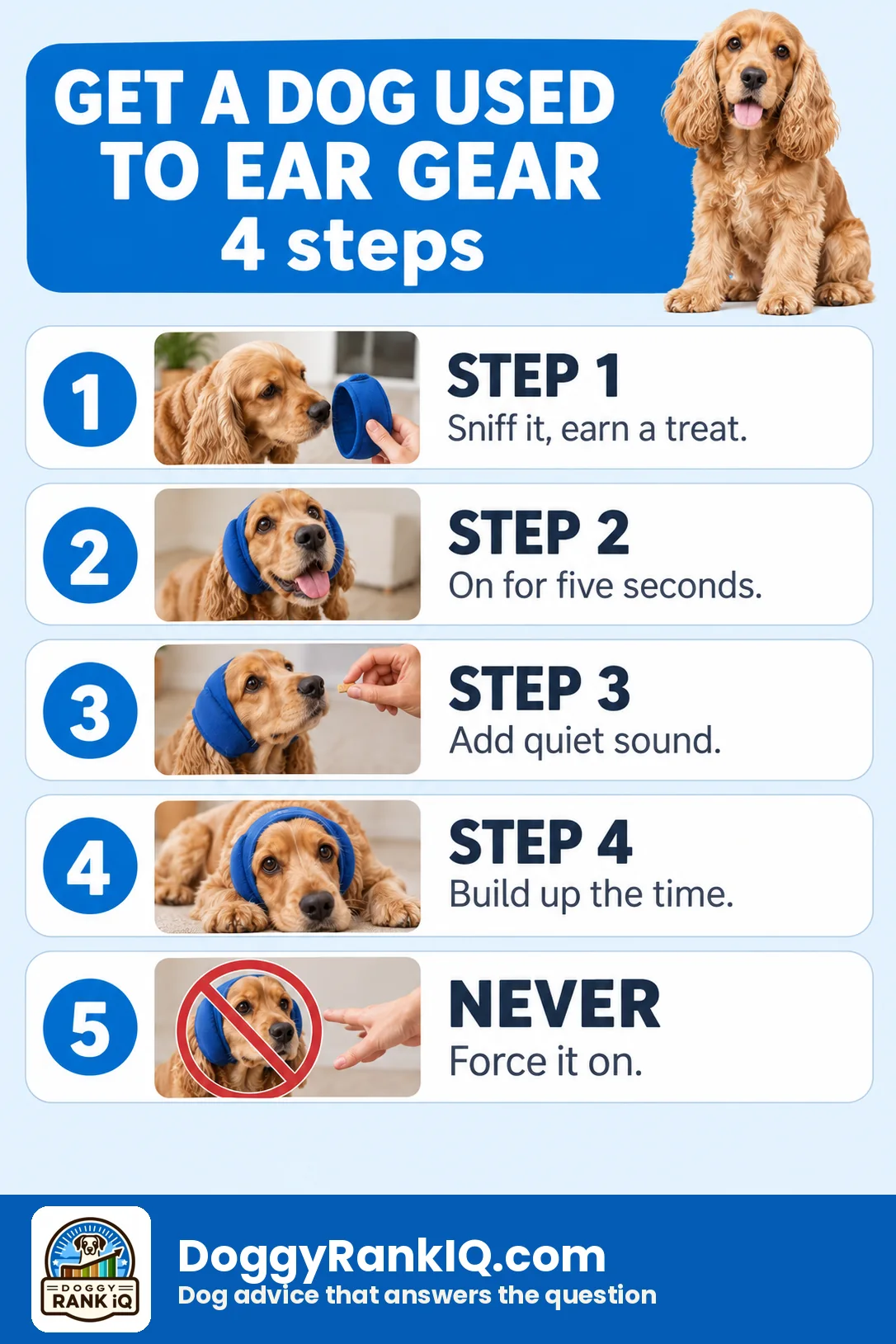
Most dogs need a gradual introduction before ear coverage becomes tolerable, and skipping that step is the single biggest reason owners give up on a product within a week. Certified trainer Amanda Farah has noted that comfort is foundational: a dog pawing at a product or trying to remove it gets little benefit from it, regardless of what the product claims to do. (businessinsider.com)
A simple introduction plan:
- Let the dog sniff and investigate the item first, with treats scattered near it, no pressure to wear it yet.
- Touch the ears gently with hands before introducing fabric, so the sensation of ear contact isn’t brand new.
- Drape the item loosely for a few seconds, reward, remove it, and repeat across several short sessions.
- Gradually extend wear time in a calm, low-stress setting, such as during a relaxed couch session, not right before a fireworks show.
- Pair it with something the dog already enjoys, like a stuffed lick mat, so the ear covering becomes associated with something pleasant.
Common mistake: forcing a dog into full wear time on day one, then concluding the product “doesn’t work” when the dog fights it off. Humane training principles apply here the same as any other new equipment: short sessions, positive association, and no forcing a struggling dog to stay still.
Edge case: dogs with very floppy ears, such as Basset Hounds or Cocker Spaniels, sometimes need the fabric folded or adjusted so the ear leather sits flat rather than bunched, since bunched ear leather under a tight band is a common source of discomfort and head shaking.
FAQ
The bottom line
Dog ear protection only works when the product matches the actual problem. A Happy Hoodie handles grooming stress and mild noise anxiety at a price that makes it an easy first try. Rex Specs Ear Pro handles sustained loud environments with manufacturer lab data behind the design, at a price that reflects that engineering.
Neither product replaces a veterinary consultation for a dog with severe noise phobia, and neither works well if forced onto a dog who hasn’t been introduced to it slowly. Start with the lower-cost option if you’re unsure which category your dog falls into, watch how the dog responds, and upgrade to a structured earmuff only if the use case genuinely calls for sustained sound reduction. If ear sensitivity, odor, or head shaking shows up alongside the noise concern, check the dimensions of your dog’s actual ear anatomy and loop in a veterinarian before assuming a wrap or earmuff will fix it.
Related reading: compare fit and coverage further in the Rex Specs dog goggles guide, and review routine ear care basics in the best dog ear cleaner guide.
Doggy Rank IQ is reader supported. As an Amazon Associate we earn from qualifying purchases, at no extra cost to you.