Quick Answer
Is fresh dog food better than kibble? Not automatically. The strongest study in the fresh food camp shows why: a 2021 peer reviewed feeding trial in Translational Animal Science found three cooked fresh diets were significantly more digestible than an extruded kibble, and it did not measure whether that changed any dog’s health, weight, or lifespan.
For a healthy adult dog, both formats can work. What matters more than the format is whether the label carries an AAFCO nutritional adequacy statement for the right life stage, whether your dog maintains a healthy weight on it, and whether you can afford it every week for years. Fresh food generally wins on moisture, palatability, and measured digestibility. Kibble generally wins on cost, portioning, and storage. Guidance checked October 2026.
Key Takeaways: Is Fresh Dog Food Better Than Kibble?
- No format is automatically better. Veterinary nutrition sources say the decisive long-term evidence does not exist yet for healthy adult dogs.
- Fresh food is measurably more digestible in short studies. A 2021 trial recorded higher apparent digestibility of protein, fat, dry matter, and calories versus kibble, with adjusted P values below 0.001.
- More digestible does not mean healthier. The researchers called the findings preliminary, and veterinary reviewers note the long-term effects are unknown.
- Cost is the real deciding factor for most households. Compare cost per 1,000 kcal, not price per bag or per box.
- Fresh means cooked, not raw. UC Davis veterinary nutrition states raw diets have no documented nutritional advantage, and the benefits owners want can be achieved with a properly formulated cooked diet.
- Refrigeration does not prevent recalls. FDA recall activity in 2026 has involved fresh, frozen, raw, and canned products alike.
- Some fresh products are not complete diets. Check whether the package says complete and balanced or intermittent and supplemental feeding only.
- Mixing the two is fine for most healthy dogs if the total calories are counted once, not twice.
What is fresh dog food, and how is it different from kibble?
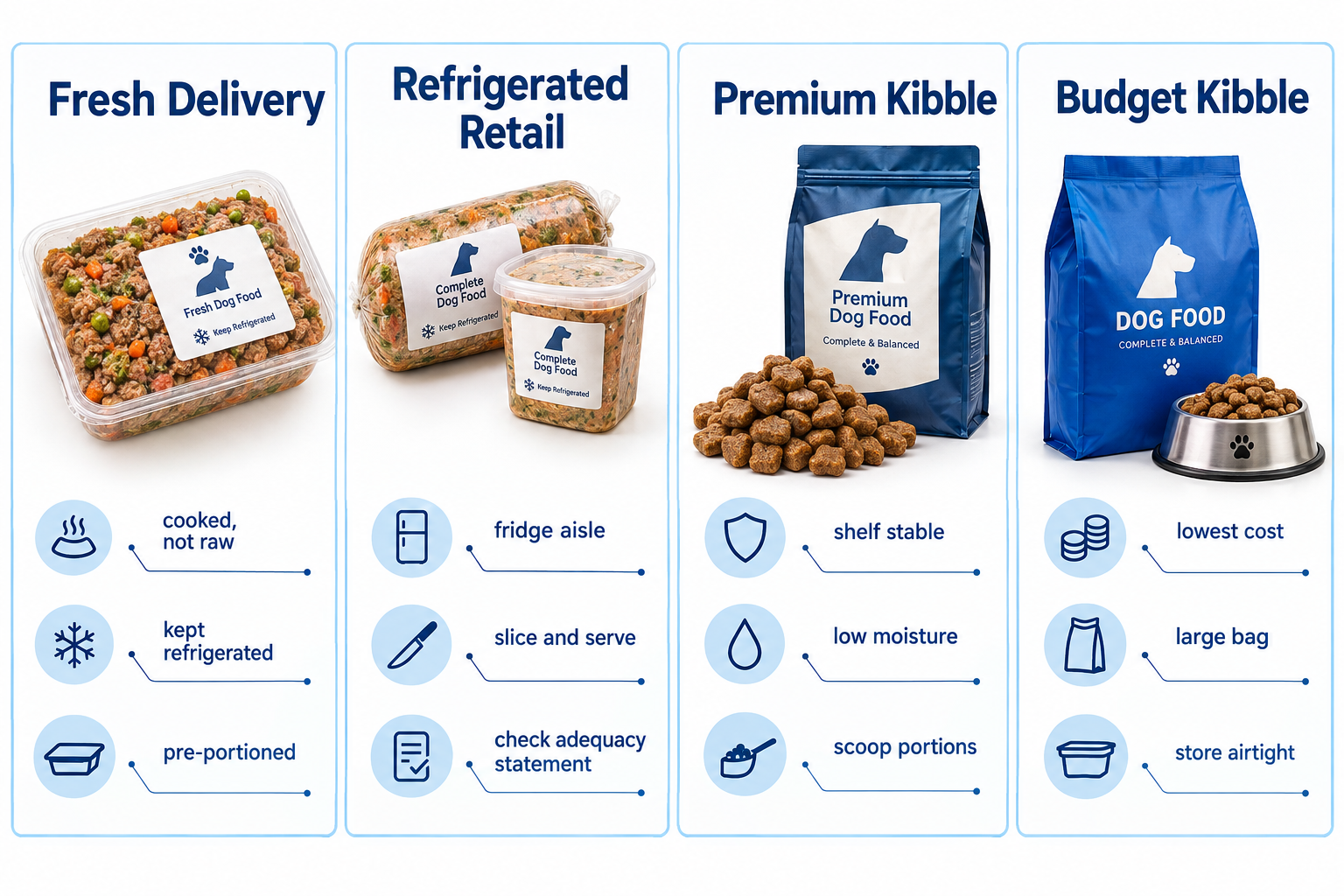
Fresh dog food is gently cooked food, kept chilled or frozen, sold either by subscription delivery or in a supermarket fridge. Kibble is the same basic category of nutrients run through an extruder at high heat and dried to roughly 10 percent moisture so it survives a cupboard for a year. The nutrients can be nearly identical on paper. The water content, the shelf life, and your monthly bill are not.
The practical differences:
- Moisture. Fresh food usually sits around 65 to 75 percent water. Kibble sits near 10 percent. That matters for dogs who drink poorly.
- Processing heat. Fresh diets are cooked once at lower temperatures. Extrusion is hotter and faster, which is why synthetic vitamins and amino acids are often added back afterwards.
- Portioning. Subscription fresh food arrives in packs calculated for your dog’s weight. Kibble is scooped, and the scoop is where most quiet weight gain begins.
- Storage. Fresh food owns fridge shelf space. Kibble owns a cupboard.
- Price per calorie. This is usually the largest gap, and it is the one most product pages avoid stating plainly.
If you want the format breakdown across every option, including the shelf stable middle ground, see the comparison of air-dried and fresh dog food against dry kibble.
Is kibble nutritionally complete for dogs?
Yes, if the bag carries a nutritional adequacy statement saying the food is complete and balanced for your dog’s life stage. That sentence is the single most useful line on any dog food label, and AAFCO identifies it as one of the most important parts. A food can read like a farmers market and still be labeled for intermittent and supplemental feeding only, which means it is a topper, not a diet.
Feeding only kibble is fine for most healthy dogs. Millions of dogs live long, boring, well lubricated lives on it. The label matters more than the texture. If reading labels makes your eyes slide, the plain guide to how to read a dog food label and what AAFCO means covers the exact wording to look for.
Is kibble bad for dogs’ teeth?
No, and it is not a toothbrush either. The idea that kibble scrapes teeth clean is oversold. Most standard kibble shatters on contact with a molar rather than scrubbing the gumline, and plaque builds up along the gum margin where crunching never reaches.
What the evidence supports is narrower: specific dental diets with larger, fibre-aligned pieces and products carrying a recognised veterinary dental seal are designed to reduce plaque or tartar, and they are tested for it. A regular bag of dry food is not one of those. Fresh food does not cause dental disease by itself either, though soft food leaves more residue, so brushing matters more. Brushing, chews with a dental claim backed by testing, and professional cleanings do the work. Food choice is a minor player.
What does the research say about fresh dog food vs kibble?
The research supports one clear finding and does not support the bigger claims built on top of it. Fresh cooked diets have been measured as more digestible than extruded kibble in controlled short-term studies. No study has shown that eating a fresh diet makes a healthy dog live longer or get sick less often.
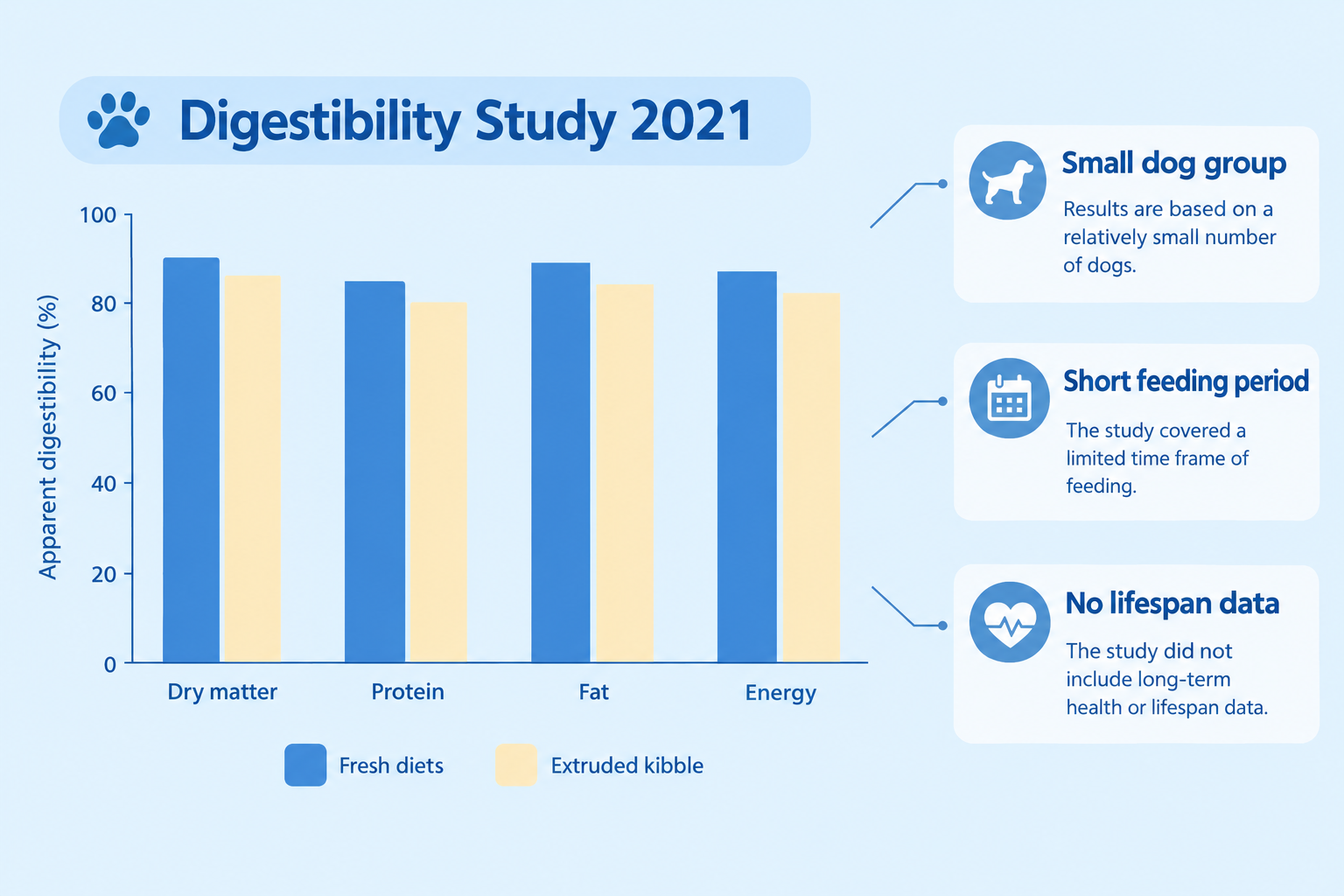
The 2021 study published in Translational Animal Science compared three commercial fresh diets against an extruded kibble in healthy adult dogs under controlled feeding conditions. Apparent digestibility of dry matter, protein, fat, nitrogen-free extract, and calories was significantly higher in the fresh diets, with adjusted P values below 0.001 for each comparison. Owners of fresh fed dogs often notice the downstream version of this: smaller, firmer stools.
What the study did not establish is the part that gets dropped from the marketing. It did not follow the dogs for years. It did not track disease rates, body condition over a lifetime, or longevity. It used a small number of dogs and specific products, so results do not transfer automatically to every fresh brand or every kibble. Related work on minimally processed diets has also reported shifts in stool quality and gut bacteria populations, which is interesting and not the same as a health outcome. A different microbiome is a different microbiome. Better is a claim that needs an outcome attached.
Is fresh dog food better than kibble for nutrient absorption?
On the measurements taken in short studies, yes, fresh cooked diets absorbed more of what was in the bowl. That means a dog can need fewer grams of food, and sometimes fewer calories of waste come out the other end.
It also means the nutrient content on the label and the nutrient content your dog actually uses are two different numbers in both formats. This is one argument for not stacking a huge pile of toppers onto an already complete diet. If you add food, add it with a plan, which is the whole point of the guide to dog food toppers and what to skip.
Does fresh dog food have more nutrients than dry kibble?
Usually no. A complete kibble and a complete fresh diet are both formulated to meet the same AAFCO nutrient profiles, so the nutrient targets are the same. Comparing the panels directly is misleading because of water: a fresh food with 8 percent protein as fed can hold more protein than a kibble with 26 percent protein once you remove the moisture from both.
Where fresh food does differ is in the form the nutrients arrive in and the amount of added synthetic vitamins needed after cooking. Whether that difference changes anything measurable for a healthy dog is still open. For the arithmetic behind label panels, see the explainer on protein, fat and carbs in dog food and what the numbers mean.
| Format | Relative cost per 1,000 kcal | Complete food statement | Storage | Convenience |
|---|---|---|---|---|
| Fresh subscription delivery (cooked, pre-portioned) | Highest of the four | Usually complete and balanced; confirm life stage | Fridge plus freezer space, delivery schedule | No measuring, poor travel flexibility |
| Refrigerated retail fresh (rolls, tubs) | High, below subscription | Mixed; some lines are supplemental only | Fridge, short window after opening | Buy as needed, slice and serve |
| Premium kibble | Moderate | Nearly always complete and balanced | Cupboard, airtight, weeks of shelf life | Easy to scoop, travel, and board |
| Budget kibble | Lowest of the four | Usually complete and balanced; check the statement | Cupboard, large bags, keep sealed | Widely stocked, simple to replace |
Prices are shown as relative bands on purpose. Brand pricing changes constantly, promotional first boxes distort the picture, and your dog’s calorie needs change the result. Run your own numbers below.
How much more does fresh dog food cost?
Fresh food typically costs several times more per calorie than kibble, and subscription boxes are usually the most expensive option of all. The only fair comparison is cost per 1,000 kcal, because fresh food is mostly water and kibble is mostly not. Comparing a 5 pound fresh pack to a 5 pound bag of kibble makes the fresh food look cheaper than it is.
Fresh dog food vs kibble: which is cheaper?
Kibble, almost always, and the gap grows with the dog. A 10 pound terrier on fresh food is a manageable line item. A 70 pound Labrador on the same brand is a second phone bill. Budget kibble is the cheapest complete option per calorie, premium kibble sits in the middle, and refrigerated retail fresh usually undercuts subscription delivery because you are not paying for cold chain shipping.
Three costs people forget to count: the shipping or delivery fee, the first box discount that disappears in month two, and the freezer space you now rent to your dog.
Is fresh dog food worth the extra cost?
It is worth it when it solves a problem you actually have. It is not worth it as insurance against a vague future illness, because that benefit has not been demonstrated.
Choose fresh if:
- Your dog refuses dry food and is losing weight or skipping meals.
- A vet has asked you to increase water intake.
- Portion control has failed repeatedly and pre-measured packs would fix it.
- The cost fits your budget for the next two years, not the next two months.
Stay with a good kibble if the fresh food budget would come out of savings, vet care, or pet insurance. A well chosen kibble plus a funded emergency vet account beats a premium bowl and an empty one. The subscription maths is broken down further in fresh dog food delivery and whether a subscription is worth it.
Best fresh dog food brands compared with kibble: how to judge them
No brand gets a blanket recommendation here, because the right answer depends on your dog’s size, life stage, health, and your fridge. Judge any fresh brand, and any kibble, with the same four checks that WSAVA’s nutrition guidance points owners toward:
- Does the label say complete and balanced for your dog’s life stage, or is it supplemental only?
- Who formulated it? A qualified nutritionist on staff, with credentials you can name.
- Where is it made, and what quality control and testing does the company describe when asked directly?
- Can the company tell you the calorie content per package without you doing detective work?
A brand that answers all four in plain language is a reasonable candidate. A brand that answers with photographs of vegetables is not. The same filter applies to dry food, laid out in what vets actually look for in a dog food.
Can fresh dog food go bad quickly? Storage, shelf life and recalls
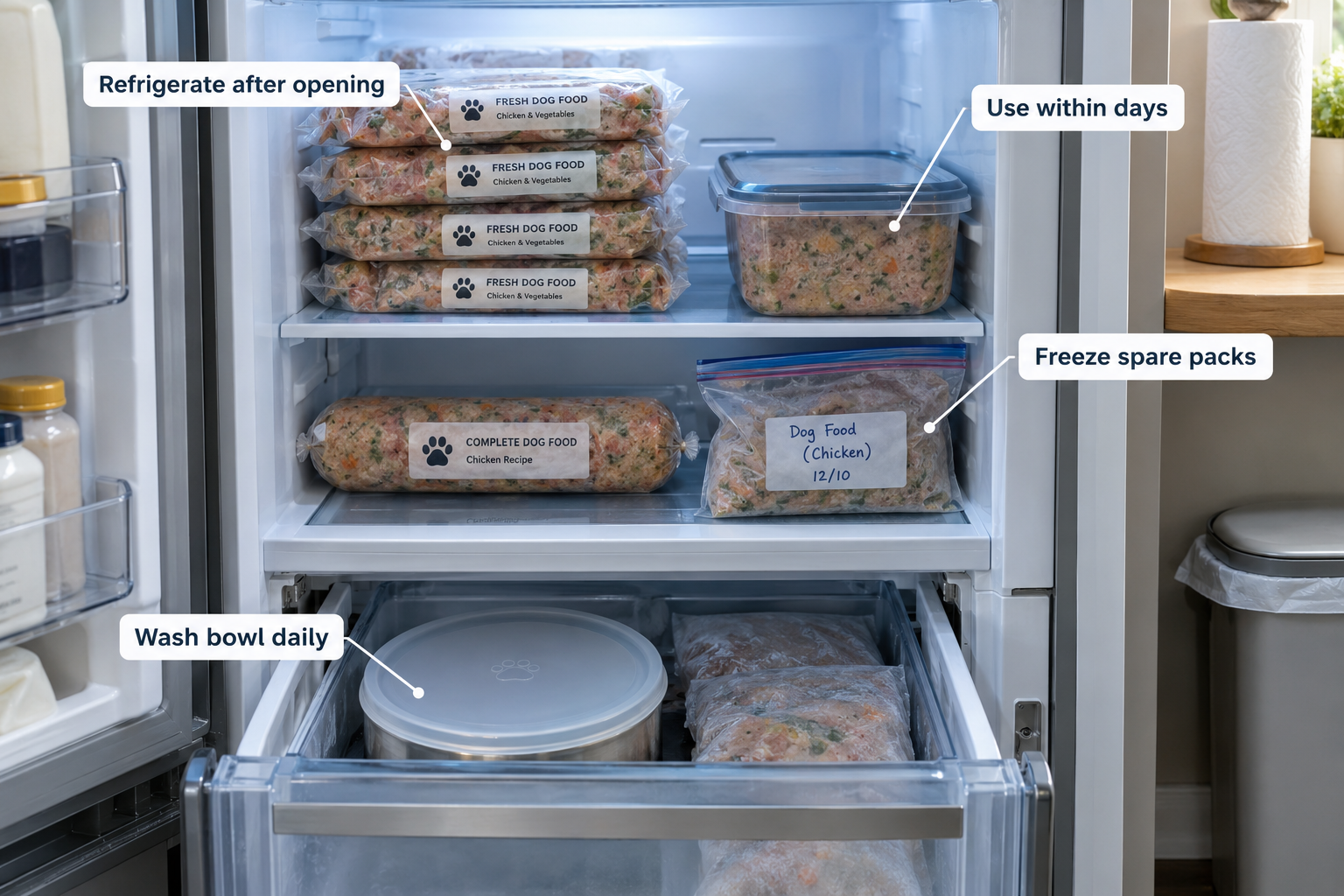
Yes. Fresh food spoils like the cooked food in your own fridge, which is why it ships frozen or chilled. Most fresh diets need to be used within a few days of opening, kept refrigerated, and thrown out if left in a bowl at room temperature.
Practical handling rules:
- Keep unopened packs frozen until a day or two before you need them, then thaw in the fridge.
- Follow the use-within window printed on the pack after opening, usually a small number of days.
- Do not leave fresh food down for hours. Lift uneaten portions and wash the bowl daily.
- Wash hands, scoops, and surfaces after handling, especially if anyone in the house is pregnant, elderly, very young, or immunosuppressed.
- Kibble is not immune to spoilage. Keep it in its original bag inside an airtight container, since the bag liner protects the fats from going rancid.
Refrigeration is not a safety guarantee, and neither is a premium price. FDA recall and advisory records in 2026 include a May 22, 2026 expanded warning not to feed eight lots of Raaw Energy dog food after contamination with Listeria, Salmonella, E. coli O157, and Campylobacter, an August 21, 2026 Fromm recall of selected canned lots over possible metal contamination, and an August 28, 2026 Northwest Naturals recall of selected raw products over possible Salmonella or Listeria. Two of those three involve raw or lightly processed food. For handling and cold storage specifics, see frozen and raw dog food storage, safety and cost.
Sign up for FDA recall alerts for whatever you feed. It takes two minutes and applies to every format.
What do vets say about fresh dog food?
Mainstream veterinary sources are deliberately format-neutral. They support properly formulated commercial diets of either type for healthy dogs, they ask for a nutritional adequacy statement, and they decline to claim fresh food is superior because the long-term studies do not exist yet.
Is fresh dog food better than kibble, according to vets?
Veterinary guidance stops short of saying yes. VCA Animal Hospitals treats a commercial fresh diet as a reasonable choice when it carries a nutritional adequacy statement, and warns that homemade or natural-sounding diets can be deficient in essential nutrients unless a veterinary nutritionist formulated them. A veterinary-reviewed comparison from Vetstreet concludes both properly formulated fresh food and kibble can meet a healthy dog’s daily requirements, with fresh ahead on moisture and palatability and kibble ahead on cost, convenience, and shelf stability.
For a dog with a diagnosed condition, the answer is often neither. Kidney disease, pancreatitis, urinary stones, and food-responsive gut disease may need a therapeutic diet with controlled phosphorus, fat, minerals, protein, or fibre. VCA’s guidance on home-prepared diets is clear that a commercial fresh food should not replace a prescribed therapeutic diet without veterinary direction. More on that in vet recommended dog food for specific health problems.
Who should stick with kibble, and who might benefit from fresh?
Stick with kibble if cost, storage, or travel are real constraints, and your dog is thriving. Consider fresh if your dog is fussy, underweight, dehydrated, or recovering, and the budget holds.
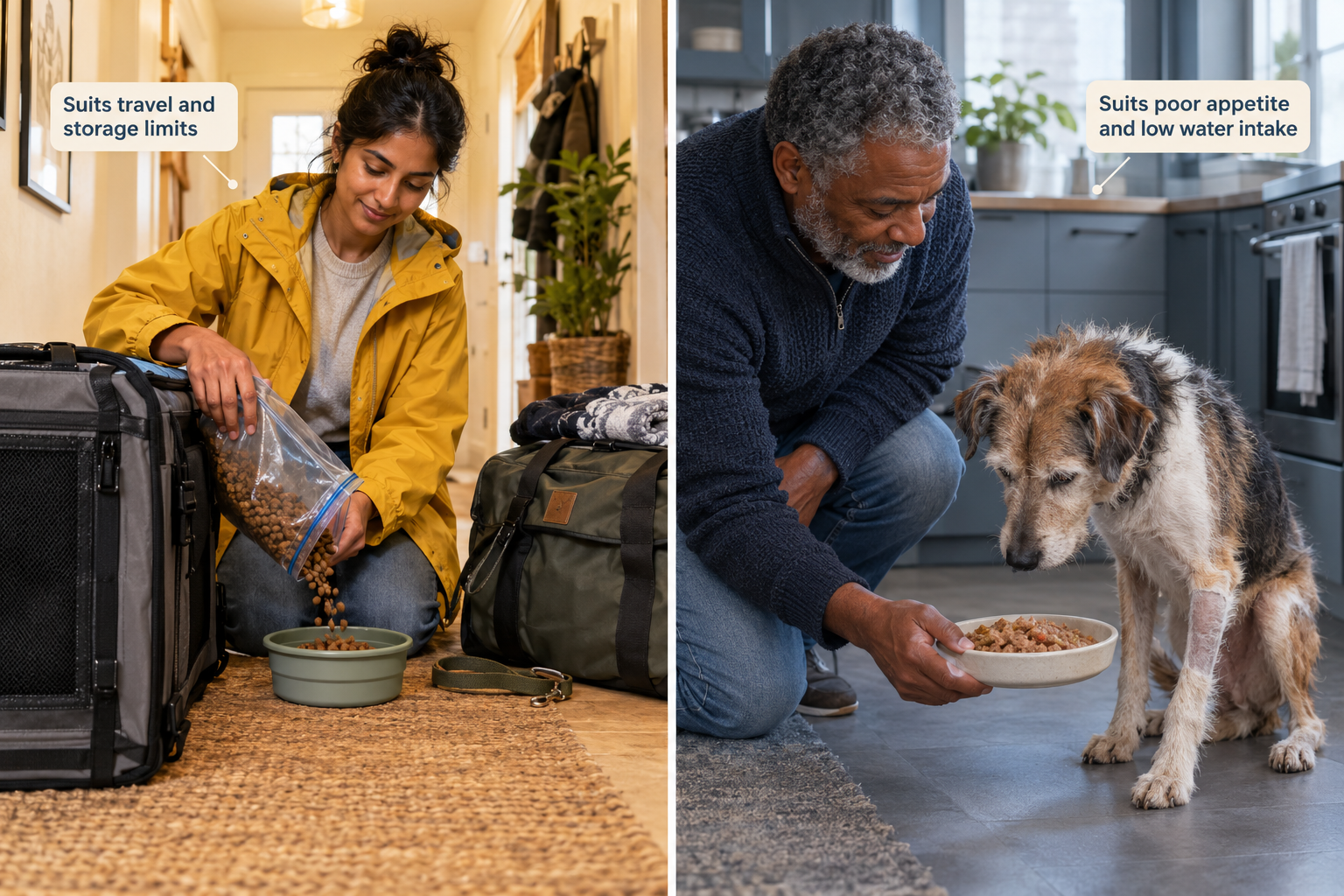
Kibble suits:
- Large and giant breed dogs, where fresh food costs scale brutally with body weight
- Households without freezer or fridge capacity, including small apartments
- Owners who travel, board, or use multiple caregivers and need simple instructions
- Dogs using food for training, where a dry kibble doubles as reward currency
- Anyone whose fresh food budget would come out of the vet fund
Fresh may help:
- Dogs with poor appetite, including some seniors with reduced sense of smell
- Dogs who drink very little and need more water in the bowl
- Picky eaters who have lost weight, after a vet has ruled out medical causes
- Dogs recovering from illness where getting calories in is the whole job
- Owners who keep overfeeding by eye and would do better with pre-portioned packs
Edge case worth naming: a puppy. Growing dogs need the adequacy statement to cover growth, and large breed puppies need controlled calcium. Do not improvise here. The life stage differences are set out in dog food for puppies, adults and seniors.
Can you mix fresh food and kibble?
Yes, for most healthy dogs, as long as you count the calories once. Mixing is the common sense middle: a scoop of kibble for the bulk of the calories, a measured spoon of fresh on top for moisture and interest. The mistake is leaving the kibble portion at full size and adding fresh food on top, which quietly adds a few hundred calories a day.
How to do it cleanly:
- Find your dog’s daily calorie target from your vet or the feeding guide.
- Decide the split, for example 75 percent kibble and 25 percent fresh.
- Work out the grams of each from the kcal figures on both labels.
- Weigh portions with a kitchen scale for the first week until your eye calibrates.
- Reweigh your dog in three to four weeks and adjust.
If both products are complete and balanced for the same life stage, the combined bowl stays close to balanced. If the fresh product is labeled supplemental only, keep it under 10 percent of daily calories so it stays a topper.
How to transition your dog from kibble to fresh food
Go slow. A seven to ten day change over gives the gut time to adjust:
- Days 1 to 3: about 25 percent new food, 75 percent old
- Days 4 to 6: roughly half and half
- Days 7 to 9: about 75 percent new food
- Day 10: full switch, assuming stools are normal
Dogs with a history of gut trouble may need two to three weeks. The full method is in how to switch dog food without upsetting their stomach.
Fresh dog food side effects and digestive issues
The most common problems are loose stools in the first week, gas, and weight gain from overfeeding. Soft stools during a transition usually settle. Loose stools that continue past a week, or any vomiting, blood, lethargy, or loss of appetite, need a vet, not another week of patience.
Weight gain catches people out because fresh food is more digestible and more palatable at once. A dog who used to leave three kibbles in the bowl now licks the bowl, then the floor around the bowl.
FAQ
Is fresh dog food better than kibble for all dogs?
No. Both formats can be complete diets, and the published evidence does not show one produces better long-term health in healthy adult dogs. Dogs with diagnosed conditions may need a therapeutic diet instead of either.
Is it okay to feed your dog only kibble?
Yes, if the bag carries an AAFCO nutritional adequacy statement for your dog’s life stage and your dog keeps a healthy body condition on it. Add water to the bowl or offer wet food alongside if your dog drinks poorly.
Does fresh dog food make dogs live longer?
There is no published evidence showing that. The 2021 digestibility findings were described by the researchers as preliminary, and veterinary reviewers note that the long-term effects of greater digestibility on disease risk and lifespan remain unknown.
Do vets recommend Freshpet dog food?
Veterinary sources do not endorse brands as a group. Refrigerated retail fresh food can be a reasonable choice when the specific product says complete and balanced for your dog’s life stage. Some products in refrigerated ranges are labeled for intermittent and supplemental feeding, so check the package in your hand.
Is fresh dog food AAFCO approved?
AAFCO does not approve or certify foods. It publishes nutrient profiles and labeling rules, and a food can state that it is complete and balanced according to AAFCO profiles or feeding trials. Many commercial fresh diets carry that statement. Some fresh toppers do not.
How long does fresh dog food last once opened?
Usually a few days in the fridge, with the exact window printed on the pack. Unopened packs keep for months in the freezer. Do not leave served food out at room temperature, and wash the bowl daily.
Can switching to fresh food cause diarrhea?
It can during the change over. A seven to ten day gradual transition reduces the risk. Diarrhea lasting more than a few days, or coming with vomiting, blood, or lethargy, needs veterinary assessment.
What is the most affordable way to try fresh food?
Buy a refrigerated retail option rather than a subscription, use it as a measured topper on a complete kibble, and remove the equivalent calories from the kibble portion. That gives you the moisture and the palatability at a fraction of the full-diet cost.
Conclusion
Is fresh dog food better than kibble? On digestibility, in short studies, yes. On long-term health, nobody has shown it, and the veterinary sources that would say so if they could are still saying the data is thin. The decision comes down to your dog, your budget, and your fridge, not the ingredient photography.
Next steps:
- Find the nutritional adequacy statement on whatever you feed right now. Confirm it covers your dog’s life stage.
- Run both candidate foods through the cost per 1,000 kcal calculator above using your own receipts and labels.
- Get your dog’s daily calorie target from your vet, then weigh portions for one week.
- Sign up for FDA recall alerts, whichever format you choose.
- If your dog has a diagnosed condition, ask your vet before switching anything. A fresh diet does not replace a therapeutic one.
Feeding a complete, affordable food consistently and keeping your dog lean will do more for them than any format upgrade. If fresh food fits your life and solves an actual problem, it is a fair choice. If it does not, a good kibble and a funded vet account is not a compromise.