
This post contains affiliate links. If you buy through one we may earn a commission at no extra cost to you. As an Amazon Associate I earn from qualifying purchases.
Quick Answer: The best chew toys for aggressive chewers are dense natural rubber rings or reinforced nylon shapes sized to the dog’s actual bite force, not just its weight. A toy that flexes slightly under pressure, like the Monster K9 Ring Ball, spreads bite load better than hard plastic or antler, while a wide cross-section (2 inches or more for large dogs) prevents full bite-through. No chew toy is truly indestructible, so weekly inspection and prompt replacement matter as much as the material itself.
Key Takeaways
- Natural rubber rings like the Monster K9 Ring Ball ($20 to $35) handle crushing bite force better than foam or plush for dogs that destroy soft toys.
- The ASPCA’s position statement on dog chews says product choice should match the dog’s size and chewing behavior, with active supervision during use.
- Veterinary dental sources outline why antlers, bones, and other rock-hard chews carry a real fracture risk for canine teeth, according to VCA Animal Hospitals.
- Dr. Kelly Ballantyne, a board-certified veterinary behaviorist cited by Business Insider, warns against antlers and bones for aggressive chewers because of fracture risk, favoring dense rubber instead.
- KONG’s Extreme line, priced roughly $9 to $27 depending on size, recommends sizing up when a dog chews unusually hard.
- Goughnuts rings run about $22 to $50 across sizes and use a visible red core on some models as a built-in discard signal.
- The thumbnail test, pressing a fingernail into the material, remains a quick screening check before you hand over any chew, a method also recommended by The Spruce Pets.
- The Center for Pet Safety flags broken-off fragments and compressed chews as leading causes of dog toy related vet visits.
1. Best Chew Toys for Aggressive Chewers
The best chew toys for aggressive chewers match the dog’s specific bite style rather than chasing the toughest marketing label on the shelf. A dog that shreds plush toys in ten minutes needs a different answer than a dog that cracks everything with raw jaw pressure, and buying the wrong category wastes money on toys that get destroyed in a single sitting.

Forbes and Whole Dog Journal both arrive at the same conclusion after testing heavy-chewer products: material thickness and shape decide durability more than brand name does. A $40 toy with a thin wall will still fail faster than a $20 toy with a thick, solid cross-section.
For shredders, look at dense woven rope or layered rubber that resists tearing at the seams. For crushers, a solid rubber ring or a weighted bone shape spreads bite force across a wider surface instead of concentrating it on one edge. For dogs that do both, a multi-texture toy, something with a rubber core and a textured exterior, gives the jaw something to work on without a single failure point.
The Benebone Wishbone Dog Chew Toy for Aggressive Chewers, Real Bacon, Medium ($15 to $25) is built from nylon with a bacon flavor baked into the material, shaped so the dog can get a molar grip from multiple angles without the toy skating across the floor. (Benebone product listing) The shape matters here. A flat chew slides on hardwood or tile. A wishbone shape stays put under pressure, which reduces the frustrated gnawing that leads a dog to attack the edges instead of the body of the toy. Owners looking into the best dog food choices recommended by veterinarians often find that chewing behavior and diet questions come up together during the same vet visit.
Best chew toys for aggressive chewers: What makes a dog an aggressive chewer
An aggressive chewer is a dog that destroys standard toys quickly, generates enough bite force to crack hard plastic or rubber, or swallows chunks instead of slowly wearing material down. This has little to do with breed size alone and more to do with jaw strength, chewing frequency, and whether the dog treats chewing as a stress outlet or pure entertainment.
Signs that point to aggressive chewing:
- A plush or thin rubber toy lasts under one sitting rather than days or weeks
- The dog has chipped a tooth on a hard chew in the past
- Fragments end up missing, not just worn down, suggesting pieces are being swallowed
- The dog chews with a crushing or grinding motion strong enough to flatten a standard Kong
A 15 pound terrier can be an aggressive chewer just as easily as a 70 pound mastiff. The difference is in bite pattern, not just pounds on a scale.
Best chew toys for aggressive chewers: Material and fit
Fit is not a size chart glanced at once. It is a weekly check on whether the toy still matches the dog doing the chewing, since jaw strength and chewing habits change as a dog ages or recovers from dental work.
Natural rubber flexes slightly under bite pressure, which is part of why dense rubber rings survive aggressive chewers better than plastic. Goughnuts rings use a cross-section near 2.19 inches on their large models, built wide enough that a 60 to 100 pound dog cannot get a full bite through the material in one pass. That width is the actual safety feature. A thin rubber ring on a strong jaw is a liability. A thick one is a workout.
Nylon is harder and holds an edge longer, which suits dogs that grind rather than crack. It does not flex, so a dog with weaker enamel or a history of broken teeth may do better on rubber. This is where the dog’s chew style decides the material, not the other way around.
Rope fiber toys are genuinely risky for aggressive chewers if they shred the strands and swallow them. Are rope toys safe for aggressive chewers? Generally no, not unsupervised, because loose fibers can cause intestinal blockages that a vet visit will not fix with a simple exam, a concern the ASPCA raises directly in its chew guidance. Rope works fine as a supervised tug toy for a dog that does not actually destroy it.
Compressed chews like the SPOT Bam-Bones Plus T-Bone Dog Chew, Beef, 6in ($10 to $18) sit in a middle category. They are firmer than rubber but designed to wear down gradually rather than splinter, which makes them a reasonable option for a 30 to 60 pound heavy chewer who needs something between rubber softness and bone hardness. (SPOT product listing)
Natural chew toys for dogs that destroy everything, think bully sticks, antlers, and hooves, come with their own tradeoffs. Antlers and hooves are frequently flagged by veterinary sources for tooth fracture risk because they do not give at all under bite pressure. Bully sticks wear down and get smaller, which creates a swallowing risk near the end rather than a dental one. Neither is automatically the safer choice. Both need the same rule: watch the size of what is left.
Are nylon or rubber chew toys better for heavy chewers
Rubber is generally the better default for heavy chewers because it flexes slightly under force, while nylon is better suited to dogs that grind steadily rather than crack hard. Choose rubber if your dog has ever chipped a tooth or crushes toys in a few bites. Choose nylon if your dog wears things down slowly over days without applying a sudden crushing force.
A common mistake is assuming “hardest material wins.” A dog that cracks a nylon bone in one session is not a candidate for a harder nylon bone. It is a candidate for a rubber ring with more give.
What materials are safest for aggressive chewers
The safest materials for aggressive chewers are thick natural rubber, reinforced nylon shaped to resist sliding, and compressed chews designed to wear gradually rather than splinter. Avoid materials that shatter into sharp edges (hard plastic, some antlers) or that shred into swallowable strands (loose rope, thin plush stuffing).
VCA Animal Hospitals recommends checking any chew toy for a slight give when pressed with a fingernail, since a rigid, unyielding surface is more likely to crack a tooth than a toy with some flex.
Doggy Rank IQ Tool
Chewer Profile and Toy Retire Checker

Match the chew style to a material class, then get the rule for when a toy goes in the trash.
Best chew toys for aggressive chewers: Best chew toys for large dogs that destroy everything
For large dogs that destroy everything, the best chew toys for aggressive chewers are wide-diameter rubber rings sized up from the standard chart, paired with rotation so no single toy absorbs constant bite pressure all day. A German Shepherd, Pit Bull mix, or Mastiff type dog generates more crushing force than a Beagle or Corgi, so cross-section width matters even more.
- Choose a ring or bone with a cross-section of at least 2 inches for dogs over 60 pounds
- Rotate two or three toys so no single one takes repeated crushing bites all week
- Skip anything marketed as “small/medium” sized down for cost, since undersized rubber flattens fast under a large jaw
The Monster K9 Ring Ball, Natural Rubber Dog Toy, 5.5 in fits this category directly, built for dogs that have already flattened a standard Kong or cracked a plastic bone. (Monster K9 product listing)
Best chew toys for aggressive chewers: How long do durable chew toys actually last
Durable best chew toys for aggressive chewers typically last anywhere from two weeks to several months, depending on the dog’s bite force, how often the toy is used, and whether it is rotated with other toys. There is no fixed lifespan number that applies to every dog, so weekly inspection matters more than any printed durability claim.

A toy used for unsupervised all-day chewing wears out far faster than the same toy used for 20 minute supervised sessions. Owners who rotate three or four toys report longer life per toy than owners who leave one chew out permanently, since no single product takes continuous bite pressure.
Best chew toys for aggressive chewers: Can you give rawhide to aggressive chewers
Rawhide is not a strong recommendation for aggressive chewers because it softens with saliva and can be torn into pieces large enough to choke on or swallow whole. A dog that chews steadily and gently may do fine with rawhide under supervision, but a dog that tears and gulps is a poor match for this material.
If rawhide is used at all, it should be a pressed or compressed style rather than a thin rolled strip, and only under direct supervision until the remaining piece is small enough to discard.
Best chew toys for aggressive chewers: What do vets recommend for dogs that chew a lot
Veterinary sources generally recommend matching chew toy hardness and size to the dog’s actual bite behavior, supervising new chews, and avoiding materials that do not give at all under pressure. VCA Animal Hospitals suggests the thumbnail test: if a fingernail cannot make a small dent in the surface, the material may be too hard for a dog’s teeth.
Dr. Kelly Ballantyne, a board-certified veterinary behaviorist, has specifically warned against antlers and bones for aggressive chewers because of fracture risk, favoring dense rubber instead, according to reporting from Business Insider. The ASPCA’s position statement adds that supervision during chewing sessions, not just product selection, reduces the risk of choking or dental injury.
Best chew toys for aggressive chewers: How much should I spend on indestructible chew toys
Expect to spend $15 to $35 per toy for a genuinely durable option, with premium rubber rings running up to $50 for the largest sizes. No chew toy sold at any price is truly indestructible, so budget for replacement rather than a single permanent purchase.
- Budget tier ($10 to $18): compressed chews like SPOT Bam-Bones, best for moderate chewers
- Mid tier ($15 to $27): KONG Extreme and Benebone products, solid for most gnawers and moderate crushers
- Premium tier ($20 to $50): Goughnuts and Monster K9 rubber rings, built for dogs that have already destroyed cheaper options
Spending more does not guarantee a longer-lasting product if the size does not match the dog. A $45 ring sized for a 20 pound dog will still get destroyed quickly by a 70 pound crusher.
Top 5 Features That Decide the Purchase
Cross-section thickness. A wider body resists full bite-through better than a thin one. Goughnuts large rings run roughly 2.19 inches, built specifically for 60 to 100 pound dogs who can otherwise flatten thinner rubber.
Shape stability during a bite. The Benebone Wishbone’s angled ends keep the toy anchored under the paw, so the dog chews the material instead of chasing a sliding toy across the floor.
Material give, not just hardness. Natural rubber in the Monster K9 Ring Ball flexes slightly, which spreads bite pressure and reduces the all-or-nothing crack that hard plastic or antler can produce.
A visible wear or retirement signal. Some Goughnuts models build in a colored inner layer that shows through once the outer material wears down, giving owners a concrete signal instead of a guess.
Size relative to the dog’s mouth, not just its weight. KONG’s own sizing guidance says the widest part of the toy should exceed the width across the back of the dog’s mouth, which matters more for swallowing risk than the weight number alone.
Comparison Table: Best Chew Toys for Aggressive Chewers by Dog Type
| Product | Price Band | Material | Best For |
|---|---|---|---|
| Benebone Wishbone Dog Chew Toy for Aggressive Chewers, Real Bacon, Medium | around $15 to $25 | Nylon with flavor core | Gnawers, medium dogs |
| SPOT Bam-Bones Plus T-Bone Dog Chew, Beef, 6in | around $10 to $18 | Compressed bone-style chew | 30 to 60 lb crushers |
| Monster K9 Ring Ball, Natural Rubber Dog Toy, 5.5 in | around $20 to $35 | Natural rubber | Shredders and heavy crushers |
Which Pick Fits Which Dog and Owner?
A 15 pound terrier that shreds every stuffed toy within an afternoon does not need the same product as a 75 pound pit bull mix that flattens rubber Kongs. Here is how the three featured picks line up by dog and household, each representing a different answer to the question of the best chew toys for aggressive chewers depending on size and style.
The Benebone Wishbone suits a medium dog, roughly 20 to 50 pounds, that gnaws steadily rather than crushing in short aggressive bursts. It also suits apartment owners who want something that does not roll under furniture mid-chew, since the wishbone shape sits flat.
The SPOT Bam-Bones Plus T-Bone is the budget pick here, priced lower than the rubber options while still offering a firmer chew than most plush or thin nylon products. It fits owners managing a 30 to 60 pound dog on a tighter monthly budget who still want something sturdier than a basic pet-store bone.
The Monster K9 Ring Ball fits the true power chewer, a large breed or a dog with a documented history of cracking rubber Kongs or plastic bones. Chew toys for large breed dogs vs small dogs really comes down to this kind of cross-section math: a small dog does not generate the jaw pressure to need a 5.5 inch ring, and giving one to a small dog anyway just means they ignore it. For owners weighing breed-specific needs more broadly, the guide on best guard dog breeds covers several breeds that also tend to be heavy chewers.
How do I know if my dog is an aggressive chewer? Look at the timeline, not the dog’s size. A dog that destroys a standard toy within one sitting, chips teeth on hard plastic, or swallows chunks rather than slowly wearing material down qualifies, regardless of breed. If your dog destroys every toy you buy, the fix is usually not a harder toy. It is a correctly sized rubber or nylon product matched to the specific behavior above, rotated with supervised enrichment so the dog is not relying on one toy to survive an entire afternoon alone.
What breed dogs need the toughest chew toys
Breeds commonly associated with the need for tougher chew toys include Pit Bull type dogs, German Shepherds, Mastiffs, Rottweilers, Belgian Malinois, and Labrador Retrievers, largely due to their jaw strength and chewing drive. This is a tendency, not a guarantee. Plenty of individual dogs from smaller breeds chew just as destructively.
Owners researching breed temperament and household fit more broadly may find the America’s favorite dog breed overview or the best dogs for first-time owners guide useful context when matching a breed’s chewing tendency to a household routine.
Do puzzle toys work for aggressive chewers
Puzzle toys can reduce destructive chewing by giving a dog a mental outlet, but they are not a substitute for a durable chew if the dog also has strong jaw pressure, since many puzzle toys use plastic components that crack under force. Use food-dispensing puzzle toys for mental enrichment alongside, not instead of, a properly sized durable chew. The Spruce Pets notes that puzzle toy durability varies widely by brand, so check reviews specifically from owners of heavy chewers before buying one for a dog with a strong bite.
Why does my dog chew so aggressively and how do I stop it
Dogs chew aggressively for a mix of reasons: boredom, teething in puppies, stress relief, and natural jaw exercise needs that some breeds have more of than others. Reducing destructive chewing usually means adding structured outlets, not eliminating chewing altogether, since chewing itself is a normal and healthy behavior.
Steps that help:
- Rule out a medical cause (dental pain, gum disease) with a vet visit if chewing increased suddenly
- Add daily physical exercise before leaving a dog alone with a chew toy
- Rotate two or three appropriately sized chews so none gets constant unsupervised pressure
- Supervise a new toy for the first session to see how the dog actually handles it before trusting it unsupervised
Dogs recovering from separation anxiety or under-exercised dogs often show a spike in destructive chewing that improves once the underlying cause is addressed, not just the toy.
Are Kong toys good enough for heavy chewers
KONG’s Extreme line, priced roughly $9 to $27, holds up well for many heavy chewers but is not automatically strong enough for every dog, which is why KONG itself recommends sizing up when a dog chews unusually hard. A dog that has already cracked a standard Classic Kong needs the Extreme black rubber version, not a repeat of the same product in the same size.

Choose KONG Extreme if your dog chews moderately hard and benefits from the hollow shape for stuffing treats. Choose a solid rubber ring like Goughnuts or Monster K9 if your dog has already destroyed a KONG Extreme, since a solid shape has no hollow cavity to crack through.
Can aggressive chewing damage my dog’s teeth
Yes, chewing on materials that do not give at all under bite pressure, like antlers, hard nylon, cow hooves, and ice, can fracture canine teeth, particularly the premolars that take the most crushing force. VCA Animal Hospitals recommends the thumbnail test precisely because a fingernail cannot dent a material hard enough to crack a tooth.
Warning signs of a chewing-related dental injury include reluctance to chew on one side, bleeding from the mouth, visible chips on a tooth, or sudden refusal of a previously favorite chew toy. Any of these warrant a vet dental check rather than waiting to see if it resolves on its own. Owners curious about broader dental care options can also review the guide to anesthesia-free dog teeth cleaning for related maintenance questions.
Things to Watch Out For
Kong vs Nylabone vs bully sticks for heavy chewers is not a single winner question. Kong’s Extreme rubber line, priced roughly $9 to $27, holds up well for crushers but still needs sizing up for unusually strong jaws, per the company’s own sizing guidance. Nylabone-style hard nylon lasts longer against grinding but is harder on teeth already weakened by age or prior dental work. Bully sticks wear down to a swallowable size and need to be pulled before that point, not after.
What materials are toxic in dog chew toys? Avoid products with no material disclosure, strong chemical odor, or loose dye that rubs off on your hands. Stick to brands that publish what the product is made from. The Center for Pet Safety report on pet toy dangers specifically flags unlabeled imported products as higher risk for undisclosed fillers and dyes. Mistakes people make buying toys for aggressive chewers usually come down to three things: buying based on marketing language like “indestructible” without checking the actual cross-section, skipping the thumbnail test, and leaving a new toy with the dog unsupervised on day one before confirming how the dog actually handles it.
What should I avoid giving aggressive chewers
Avoid cooked bones (which splinter), antlers and hooves (which do not flex and can fracture teeth), thin rope toys left unsupervised, cheap hollow plastic, and any chew small enough to be swallowed whole once worn down. These categories show up repeatedly in veterinary and consumer safety guidance as the most common causes of chewing-related injuries.
A dog with a known history of swallowing fragments should also avoid stuffed plush toys entirely unless supervised, since stuffing and squeakers are a choking hazard separate from the dental risk posed by hard chews.
How often should I replace dog chew toys
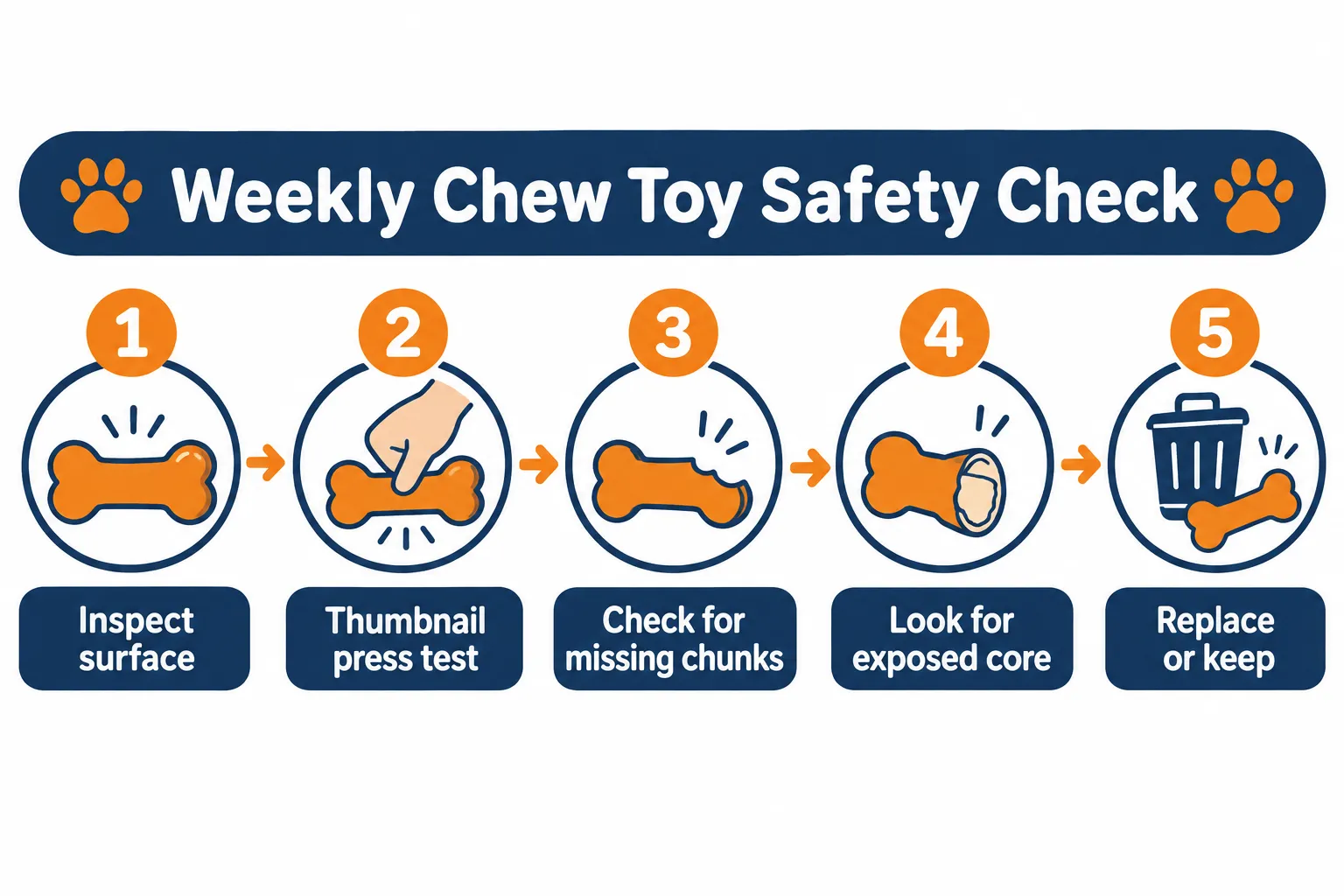
There is no fixed calendar for replacing chew toys. Instead, check weekly for a chunk missing larger than a quarter, an exposed inner core, or a surface that fails the thumbnail press test (the nail leaves a deep dent or the material flakes off). A toy that passes these checks can keep going. One that fails any of them should be thrown out that day, not saved for later.
Heavy chewers used daily may need replacement every two to six weeks. Lighter or supervised-only use can stretch a quality rubber toy for several months. Rotating two or three toys at once tends to extend the useful life of each one, since no single toy takes constant pressure.
FAQ
What makes a dog an aggressive chewer? A dog qualifies as an aggressive chewer if it destroys standard toys quickly, generates enough force to crack hard rubber or plastic, or swallows chunks rather than wearing material down slowly. Breed size is a factor but not the deciding one.
Are rubber or nylon chews better for a dog that chips teeth? Rubber is generally safer for a dog with a history of chipped teeth because it flexes slightly under pressure, while rigid nylon does not give at all and can concentrate force on a single tooth surface.
Can I give my aggressive chewer a bully stick? Yes, but only under supervision, and the piece should be pulled and discarded once it gets small enough to be a choking hazard, typically when it is smaller than the width of the dog’s muzzle.
What is the best chew toy material for a 70 pound dog that crushes rubber Kongs? A thicker rubber ring with a cross-section near 2 inches, like the Monster K9 Ring Ball or a Goughnuts large model, holds up better than a standard Kong because the wider body resists full bite-through.
Do vets recommend antlers for aggressive chewers? No. Veterinary behaviorists including Dr. Kelly Ballantyne specifically caution against antlers and bones for aggressive chewers due to tooth fracture risk, recommending dense rubber instead.
How do I know when to throw a chew toy away? Replace it if a chunk larger than a quarter is missing, the inner core is exposed, or the surface fails a thumbnail press test. Check weekly rather than waiting for an obvious failure.
Is a more expensive chew toy always more durable? Not necessarily. Price does not guarantee durability if the size does not match the dog’s bite force. A premium ring sized too small for a large crusher will still fail quickly.
Can puzzle toys replace a durable chew toy for a heavy chewer? No. Puzzle toys add mental enrichment but many use plastic parts that crack under heavy bite force. Use them alongside, not instead of, a properly sized durable chew.