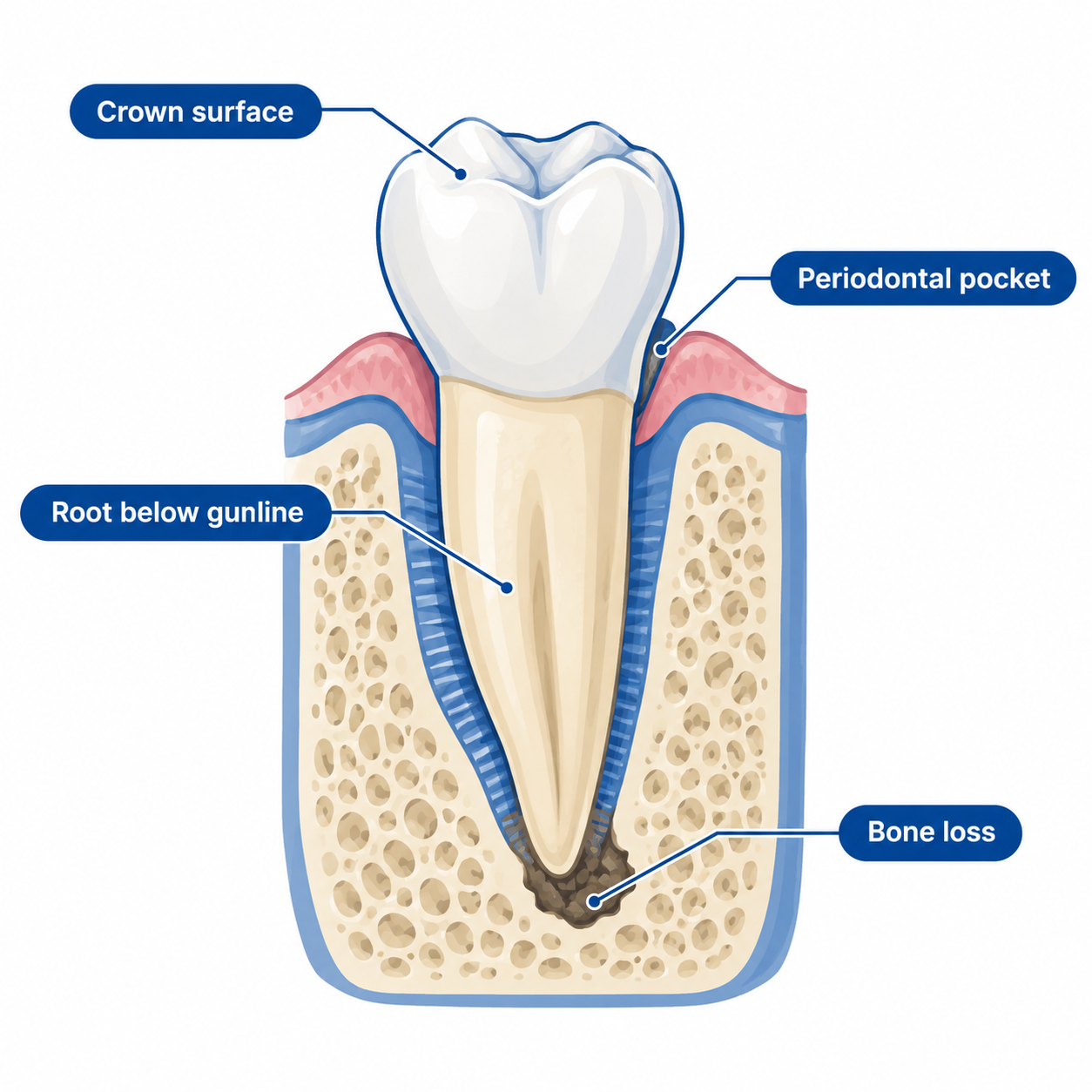
Anesthesia free dog teeth cleaning sells a very appealing story: a tidy mouth, no sedation, no big bill, your dog home in an hour. The appeal is real and so is the worry behind it, especially if your dog is twelve years old and the words “general anesthesia” make your stomach drop. The problem is what the scraper cannot reach. Roughly 60% of each tooth sits below the gumline, where AAHA’s guidance on anesthesia and dental cleaning says root disease, bone loss and abscesses hide. An awake dog does not hold still for that part.
Quick answer
Anesthesia free dog teeth cleaning, which veterinary dentists call nonprofessional dental scaling, removes visible tartar from the crowns of the teeth while the dog is held awake. It cannot clean or examine below the gumline, cannot take dental X-rays, and cannot treat painful disease. A peer reviewed study published in JAVMA in 2026 found no demonstrable medical benefit from anesthesia free dentistry for periodontal disease control. The four risks veterinarians flag most often are missed disease under the gums, physical trauma and pain, false reassurance that delays real treatment, and stress or injury during restraint. This is general information, not a diagnosis for your dog. Professional guidance checked October 2026.
Key Takeaways: Anesthesia Free Dog Teeth Cleaning
- Awake scaling only reaches what you can already see. AAHA states an awake procedure can remove tartar above the gumline, and nothing more.
- The 2026 JAVMA comparison of 46 dogs found periodontal test strip scores averaging 0.087 after anesthetized dentistry versus 4.35 after anesthesia free dentistry, and concluded the awake version offered no medical benefit.
- The American Veterinary Dental College calls it “nonprofessional dental scaling,” not dentistry, because an awake dog cannot permit full examination, probing, radiographs or subgingival treatment.
- A cosmetic result can hide progressing disease. Clean white crowns above an infected root look reassuring and buy time the dog does not have.
- Age is not a disease. A healthy senior dog with current bloodwork, monitored anesthesia, IV fluids and local nerve blocks is often a reasonable candidate for a real dental.
- Cost gap is real but smaller than it looks. An awake session is cheap because it leaves the expensive, painful problems untouched.
- Check your state rules. Veterinary dentistry falls under state practice acts, and Nevada proposed tightening its rules further in 2026.
What is anesthesia free dog teeth cleaning?
Anesthesia free dog teeth cleaning is the manual scraping of visible tartar from a conscious dog’s teeth, usually with a hand scaler, while a handler restrains the dog on a table or in their lap. No sedation, no intubation, no X-rays, no probing of the gum pockets. Sessions typically run 30 to 60 minutes and are often offered at grooming salons, pet stores, mobile vans and some clinics.
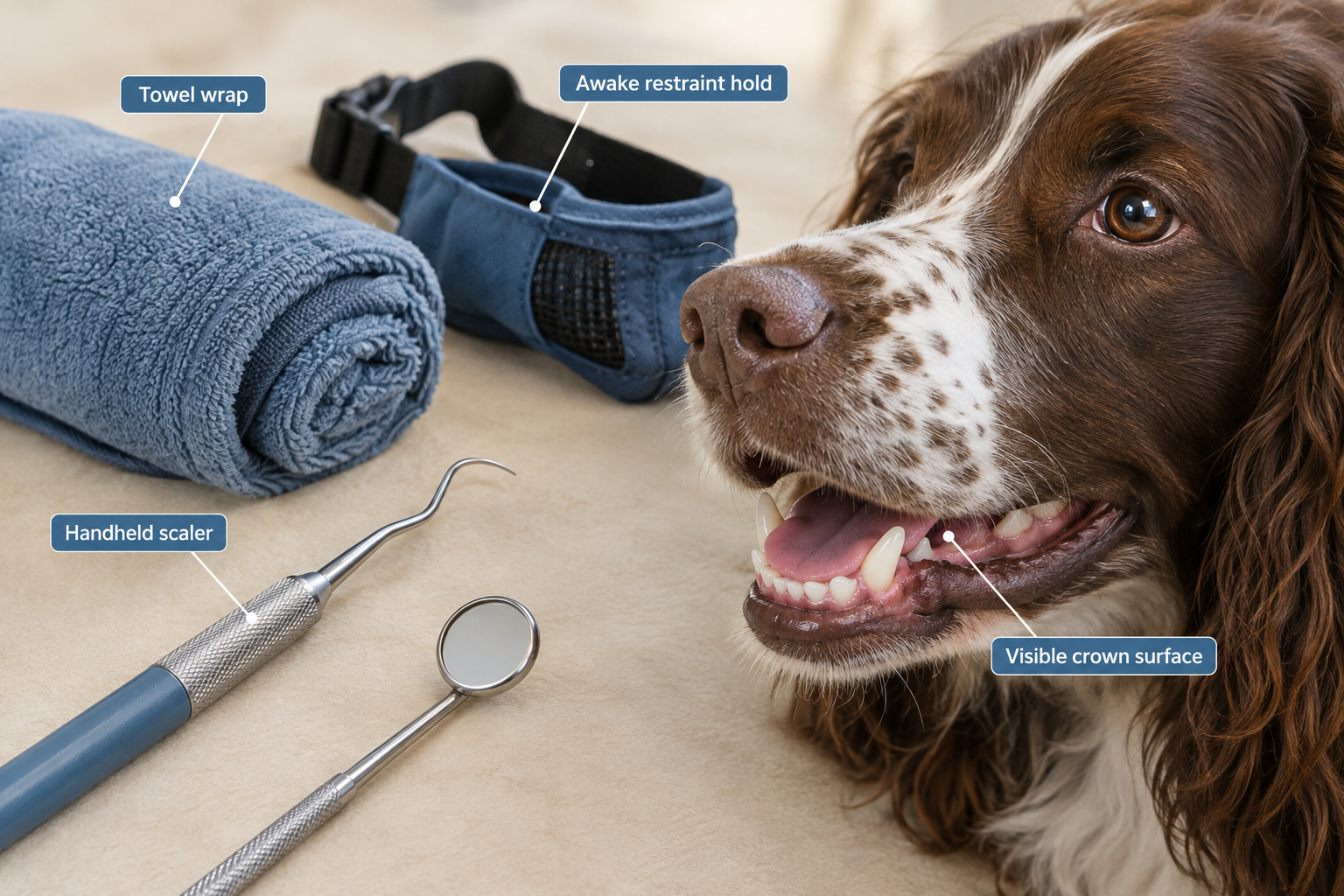
The American Veterinary Dental College prefers a blunter name. Its position statement on dental scaling without anesthesia calls the practice nonprofessional dental scaling or anesthesia free tooth scraping, and says it does not constitute dental care, because an awake dog cannot permit a complete oral examination, intraoral radiography, periodontal probing or treatment under the gumline.
How does anesthesia free teeth cleaning work on dogs?
A typical session follows the same short sequence, and the limits are built into every step.
- Restraint. The dog is wrapped, cradled or held against the handler’s body. Calm dogs tolerate it. Anxious dogs are talked through it, and some are turned away.
- Hand scaling. A curved scaler scrapes tartar off the outer surfaces of the teeth. The outer surfaces of the big chewing teeth and the front teeth are the easy wins.
- The awkward bits. The inner surfaces facing the tongue, the back molars and anything tucked under the gum get partial attention at best.
- No polishing, in most cases. Scaling leaves microscopic grooves in enamel. In an anesthetized cleaning, polishing smooths them so plaque has less to grab.
- Finish and photos. Many providers show before and after shots. The after shot is genuinely whiter. That is the part that sells the service.
Nothing in that list is dishonest on its own. The gap is between what the procedure does and what owners believe it did.
The 4 hidden risks vets flag with anesthesia free dog teeth cleaning
The four problems veterinarians raise most are missed subgingival disease, oral trauma and pain, false reassurance that delays treatment, and the physical and emotional cost of restraint. None of them show up in a before and after photo, which is exactly why they count as hidden.
Risk 1: The disease you cannot see goes untreated
The AVMA’s pet dental care guidance says most dental disease occurs where owners cannot see it, which is why thorough evaluation and cleaning depend on anesthesia. AAHA puts a number on the hidden part: about 60% of each tooth sits below the gumline. Periodontal pockets, resorbing roots, dead teeth, bone loss and quiet abscesses live down there.
An awake scrape removes the mineral shelf above the gum. The bacterial film in the pocket stays. So does the bone loss. The 2026 JAVMA study put that difference on paper: after treatment, dogs in the anesthetized group scored a mean 0.087 on periodontal diagnostic test strips, while the anesthesia free group averaged 4.35.
Risk 2: Sharp instruments and a moving dog
A hand scaler has a point. A conscious dog has opinions. If the dog pulls back at the wrong moment, the instrument can cut gum tissue, the cheek, the tongue or the lip, or gouge the enamel surface. Veterinary sources that discuss awake procedures, including MedVet’s explanation of why anesthesia free dental cleanings fall short, list injury and pain among the main objections.
There is a second pain problem that is less obvious. A dog with a cracked carnassial tooth or an exposed root may be in real discomfort already. Scraping near it without local nerve blocks or sedation means working on an untreated painful mouth, then sending the dog home still in pain.
Risk 3: False reassurance, which is the expensive one
This is the risk owners rarely see coming. White crowns look healthy. The owner relaxes, cancels the dental their vet suggested, and comes back eighteen months later with a dog who has stopped chewing on one side. By then the fix is not a cleaning. It is extractions.
A clean looking tooth tells you about the surface of the tooth. It tells you nothing about the bone holding it in.
AAHA’s guidance on nonanesthetic dentistry in the AAHA Dental Care Guidelines treats this as a core objection: a procedure that looks like treatment but is not treatment can delay actual care.
Risk 4: Stress, restraint and the chance your dog gets hurt or sick
Can my dog get sick from anesthesia free teeth cleaning? Serious illness is not the common outcome, but the plausible problems are worth naming: bleeding gums, soreness, reluctance to eat for a day, aspiration of water and tartar debris in a dog with no airway protection, and a lasting fear of having its mouth handled. A dog that learns the mouth equals struggle gets harder to brush at home, which makes the long game worse.
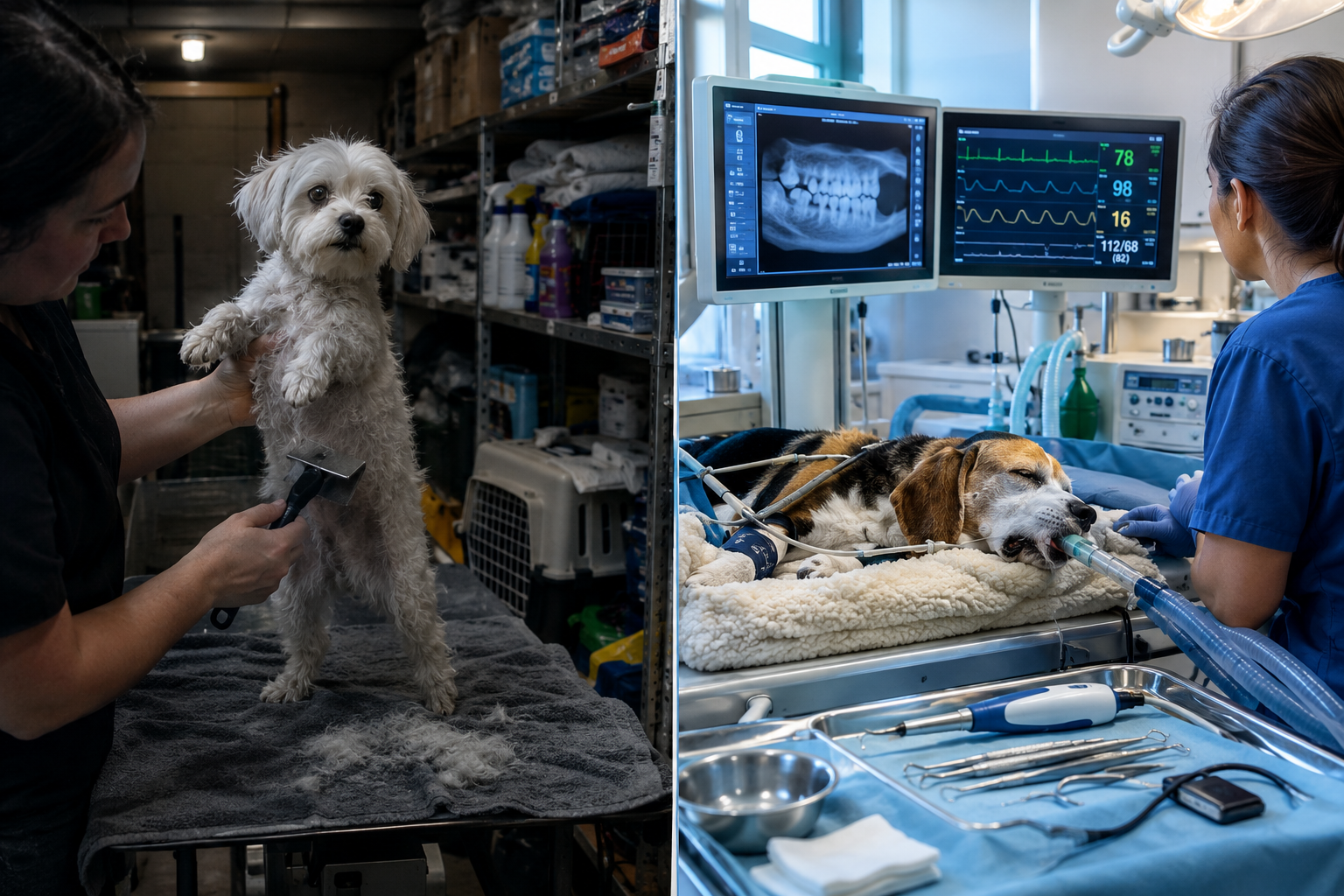
There is also a practical gap. If something goes wrong in a pet store back room, there is no intubated airway, no monitoring, and often no veterinarian in the building.
Is anesthesia free dog teeth cleaning safe, and does it actually work?
It is safer than anesthesia in the narrow sense that no drugs are involved, and much less effective at the thing owners are paying for. The 2026 JAVMA study by Niemiec, Kangas and Ribka compared 23 dogs who had recent anesthesia free dentistry with 23 controls and concluded the practice was not a viable alternative for periodontal disease control. AAHA, whose public guidance was updated July 2, 2025, calls anesthesia free dentistry unacceptable on safety, efficacy and ethical grounds.
What the sourced numbers say
60%
of each tooth sits below the gumline, out of reach of awake scaling (AAHA)
0.087 vs 4.35
mean periodontal test strip scores, anesthetized versus anesthesia free, 46 dogs (JAVMA, 2026)
46 dogs
in the peer reviewed comparison, 23 per group, published online October 29, 2025
Nov 3, 2025
date the AVMA veterinary dentistry policy was last updated
Can anesthesia free teeth cleaning remove tartar on dogs?
Yes, above the gumline, and that is the whole sentence. AAHA states plainly that an awake procedure can remove only tartar visible above the gumline. Subgingival calculus, the kind sitting in the pocket driving inflammation and bone loss, stays where it is. The AKC’s overview of anesthetic free dental procedures for dogs makes the same distinction for owners.
Decision rule: if your dog’s teeth look slightly dull but the gums are pink and tight and your vet found no pockets at the last exam, a cosmetic scrape changes very little that matters. If your dog has red gum margins, bad breath, a loose tooth or is dropping food, a cosmetic scrape changes nothing that matters.
Anesthesia free vs regular dog teeth cleaning: what each one actually does
The honest comparison is not cheap versus expensive. It is surface cleaning versus diagnosis and treatment. One removes a deposit. The other finds and fixes disease, under general anesthesia, with a protected airway, X-rays and pain control.
Why do vets not recommend anesthesia free dog teeth cleaning?
Veterinarians object on three grounds: it cannot diagnose or treat disease, it can hurt the dog, and in many places it edges into procedures that practice acts reserve for veterinary medicine. The objection is about scope, not about disliking affordable care.
What the major bodies say, as of October 2026:
- AAHA, in guidance updated July 2, 2025, describes anesthesia free dentistry as unacceptable for reasons of safety, efficacy and ethics.
- AVDC uses the term nonprofessional dental scaling and says the procedure does not amount to dental care.
- AVMA, in its veterinary dentistry policy updated November 3, 2025, states that periodontal probing, intraoral radiography, scaling and extractions should be performed under anesthesia when the oral examination justifies them, and that veterinary dentistry must comply with state practice laws.
- The 2026 JAVMA study supplies the measured outcome rather than the opinion.
Is it even legal where you live?
Anesthesia free does not mean unregulated. Veterinary dentistry sits under state and provincial practice acts, and the rules differ. California treats the use of dental instruments and scaling as veterinary procedures requiring appropriate veterinary supervision under its Veterinary Medicine Practice Act. Nevada went further in 2026: a proposed Nevada regulation would remove an existing allowance for certain cleanings above the gumline without general anesthesia, generally require veterinary dentistry under general anesthesia with a cuffed endotracheal tube, and require a licensed veterinarian to perform and document a full oral health assessment.
Edge case worth knowing: some veterinary practices offer awake tartar removal as a cosmetic add-on for a dog already under their care, with a vet exam and charting behind it. That is a different arrangement from a van in a pet store parking lot, and it is fair to ask which one you are being offered.
How much does anesthesia free dog teeth cleaning cost, and is it worth it?
Anesthesia free sessions are usually priced like a grooming service and cost a fraction of an anesthetized dental. That gap exists because the cheaper service skips the anesthesia team, the X-rays, the monitoring, the pain control and any actual treatment. These are estimates based on published pet care cost guides, and prices move with region, dog size and what the vet finds once the mouth is open.
| What you are paying for | Anesthesia free session | Dental cleaning with anesthesia |
|---|---|---|
| Headline price | Grooming-tier, usually under $150 by most published estimates | Mid hundreds of dollars before extras, per cost guides for dog teeth cleaning |
| Pre-anesthetic bloodwork | Not included | Usually included or added separately |
| Full mouth X-rays | Not possible | Standard in a full assessment |
| Extractions and treatment | Not performed | Added per tooth, the main cost driver |
| Pain medication | None | Nerve blocks and take-home analgesia |
Is non anesthetic dog teeth cleaning worth it? As a treatment, the evidence says no. The JAVMA comparison found no medical benefit for periodontal disease control. As pure cosmetics for a healthy young mouth with a cooperative dog and no gum disease, it is a whitening service. Pay for it with that understanding, or do not pay for it at all.
If budget is the barrier, the better moves are: ask your clinic about staged treatment and payment plans, ask what a dental assessment alone costs so you know what you are dealing with, check veterinary teaching hospitals and nonprofit clinics in your area for low cost dental programs, and start brushing tonight so the next dental is smaller.
Searching anesthesia free dog teeth cleaning near me? Check these first
Before you book any awake scaling service, get five answers. Providers vary wildly, and some are far more careful than others.
- Is a licensed veterinarian on site and does one examine your dog first? No exam, no charting, no idea what is under the gum.
- What happens if they find a loose or broken tooth? The honest answer is a referral, not a scrape.
- Are you given a written record of what was and was not assessed?
- How is your dog restrained, and what is the policy if the dog struggles? A provider who stops is a good sign.
- Does your state allow it? Ask them directly, then check your state veterinary board.
If the answer to question one is no, treat the service as cosmetic grooming. Not as dental care, and not as a reason to skip a vet exam.
Is my dog a good candidate for anesthesia free teeth cleaning, especially a senior?
Few dogs are good candidates, and senior dogs are usually the weakest candidates of all, which is the reverse of how the service is marketed. Older dogs are the ones most likely to have advanced periodontal disease, painful roots and resorbing teeth, exactly the problems awake scaling cannot find or fix.
A dog might reasonably tolerate an awake cosmetic scrape if all of these are true: young or middle aged, pink healthy gums at a recent vet exam, no probing pockets, no loose or fractured teeth, eating normally, calm about mouth handling, and the owner knows it is cosmetic.
A dog should skip it if any of these apply: red or receding gums, visible tartar under the gumline, bad breath that has changed, pawing at the face, chewing on one side, a heart murmur or other condition that needs a real plan, any history of mouth pain, or anxiety about restraint.
Age alone is not a disease
The fear is understandable and the framing is worth correcting. A dog is not disqualified from anesthesia by a birthday. Organ function, hydration, cardiac status and body condition matter. A healthy eleven year old can be a lower risk anesthetic patient than an obese five year old with untreated disease.
Modern practice has moved toward better monitoring rather than avoiding anesthesia. The AVMA reported in April 2025 that updated anesthesia monitoring guidelines address cardiovascular function, oxygenation, ventilation, body temperature, neuromuscular blockade and anesthetic depth in dogs and cats.
How many dogs die from teeth cleaning? Published figures for anesthetic death in dogs are low, and the honest answer is that the number varies by study, by patient health and by the practice doing the work. No reliable source supports a single headline percentage you can apply to your own dog. Ask your clinic how they screen patients, who monitors anesthesia, and how many dental procedures they perform each week. A practice that answers those specifically is giving you better information than any statistic.
Also weigh the other side of the ledger. Untreated periodontal disease is painful, chronic and progressive. Choosing no treatment is also a choice with a risk attached.
What are the alternatives to anesthesia free dog teeth cleaning?
The real alternatives are a veterinary oral exam, an anesthetized cleaning when the exam calls for one, and daily home care that slows the whole problem down. Home care is the part owners control, and it does more over a year than any single salon visit.
- Brushing, most days. A soft brush and dog toothpaste along the gum margin. Thirty seconds beats a perfect two minutes you never do.
- Chews and products with accepted plaque or tartar claims. Look for the Veterinary Oral Health Council seal rather than packaging adjectives.
- Dental diets and food texture. Kibble shape and texture can help a little, and wet food is not automatically a dental villain. Our breakdown of wet versus dry dog food, including the teeth question explains where the evidence ends.
- Water additives and wipes for dogs who refuse a brush. Modest effect, better than nothing.
- A dental assessment on a schedule your vet sets, not when the breath finally becomes unignorable.
Diet does not replace brushing, but it is part of the background. If you are rethinking food anyway, see what vets actually look for in a dog food, our budget dog food picks that still stack up, and the label red flags worth checking. For portions, timing and water, our vet informed feeding guide covers the routine side.
FAQ
Can the vet clean my dog’s teeth without anesthesia? Some veterinary practices offer awake tartar removal above the gumline, but it is cosmetic, not a dental cleaning. The AVMA says scaling, probing, radiography and extractions should be done under anesthesia when the oral exam justifies them.
Does anesthesia free dog teeth cleaning actually work? It removes visible tartar and nothing more. The 2026 JAVMA study of 46 dogs found no medical benefit for periodontal disease control, with mean post treatment test strip scores of 4.35 in the anesthesia free group against 0.087 in the anesthetized group.
Is anesthesia free dog teeth cleaning safe for my dog? There is no anesthetic risk, but there are other risks: cuts to gums, cheek or tongue, pain if diseased teeth are scraped, stress during restraint, and missed disease that progresses untreated. AAHA considers the practice unacceptable on safety, efficacy and ethical grounds.
How much does anesthesia free dog teeth cleaning cost compared with anesthesia? Awake sessions are usually priced like a grooming add-on, commonly under $150 by published estimates, while an anesthetized cleaning typically runs into the mid hundreds before X-rays and extractions. The gap reflects the diagnostics and treatment the cheaper option leaves out.
What are the main older dog teeth cleaning risks? For seniors, the bigger risks are untreated painful periodontal disease, hidden root infection and delayed diagnosis. Anesthetic risk is managed with a pre-anesthetic exam, bloodwork, IV fluids, warming, trained monitoring and local nerve blocks.
Where can I find low cost dog teeth cleaning that is still real dental care? Ask your clinic about staged treatment, assessment-only pricing and payment plans, then check veterinary teaching hospitals and nonprofit or municipal clinics in your region. A cheap awake scrape is not a cheaper version of a dental, because it treats nothing.
Can my dog get sick from anesthesia free teeth cleaning? Serious illness is uncommon, but sore or bleeding gums, a day of poor appetite, aspiration of debris with no airway protection, and new fear of mouth handling are all plausible outcomes. Call your vet if your dog stops eating or paws at its face afterward.
Conclusion
Anesthesia free dog teeth cleaning gives you a whiter photo and leaves the part that matters untouched, which is a strange thing to pay for and an expensive thing to believe in. The four risks veterinarians keep flagging are the disease under the gums, the trauma of sharp tools near a moving dog, the false reassurance that delays treatment, and the stress of restraint without monitoring or pain control. Age is not the deciding factor. Health status, a current exam and the quality of the anesthesia protocol are.
Your next three steps:
- Book a veterinary oral exam and ask directly whether your dog needs X-rays and a cleaning under anesthesia, or watchful waiting.
- Run the senior dental checklist in the comparison tool above at that appointment. Bloodwork, monitoring, IV fluids, a dedicated monitor, nerve blocks.
- Start brushing tonight, even badly. The dental you are dreading gets smaller every week you do.
This article is general information and does not diagnose or treat any individual dog. Professional guidance referenced here was checked in October 2026.