
Quick Answer
Is pet insurance worth it? For most dog owners, yes, but not for the reason the ads suggest. Insurance is not a way to come out ahead on average. It is a way to make sure a $10,065 emergency does not become a decision between your dog and your credit limit. Consumer Reports found that around two thirds of policyholders said the coverage was worth the cost, while 40 percent spent more on premiums and deductibles than they got back. Both of those things are true at once. That gap is the whole story, and it is what this article works through with actual numbers.
This is general information, not financial advice. Policy terms vary by insurer, state and dog. Guidance and company details here were checked in October 2026.
Key Takeaways: Is Pet Insurance Worth It?
- Insurance buys liquidity, not profit. Deciding whether is pet insurance worth it comes down to one question: could you pay a $10,000 bill next Tuesday without borrowing?
- The average U.S. accident and illness premium for a dog hit $836 a year in 2025, about $69.67 a month, up roughly 11.5 percent from $749 in 2024, according to the NAPHIA 2026 State of the Industry Report.
- Pre-existing conditions are excluded almost everywhere. Enroll before the limp, the lump or the loose stool, not after.
- Only 44 percent of policyholders told Consumer Reports they received full reimbursement at their policy’s stated level on their most recent claims. Exclusions, deductibles and reimbursement formulas do the damage.
- Most dog plans let you use any licensed vet in the U.S. You pay, then claim. Direct-to-vet payment exists but is the exception.
- Routine care is usually an add-on, often priced close to what the services cost. It smooths budgeting more than it saves money.
- Older dogs are the hard case. Premiums climb with age, pre-existing conditions pile up, and some plans restrict new enrollment or drop hereditary coverage after a certain age.
- Self-insuring works only if you actually fund it. A dedicated savings account with real monthly deposits beats a policy you cancel in month four.
What does pet insurance actually cover?
Standard dog policies cover unexpected accidents and illnesses: the swallowed sock, the torn cruciate, the sudden pancreatitis, the mass that turns out to be mast cell. They do not cover anything that started before your coverage did, and they rarely cover routine care unless you buy a separate add-on.
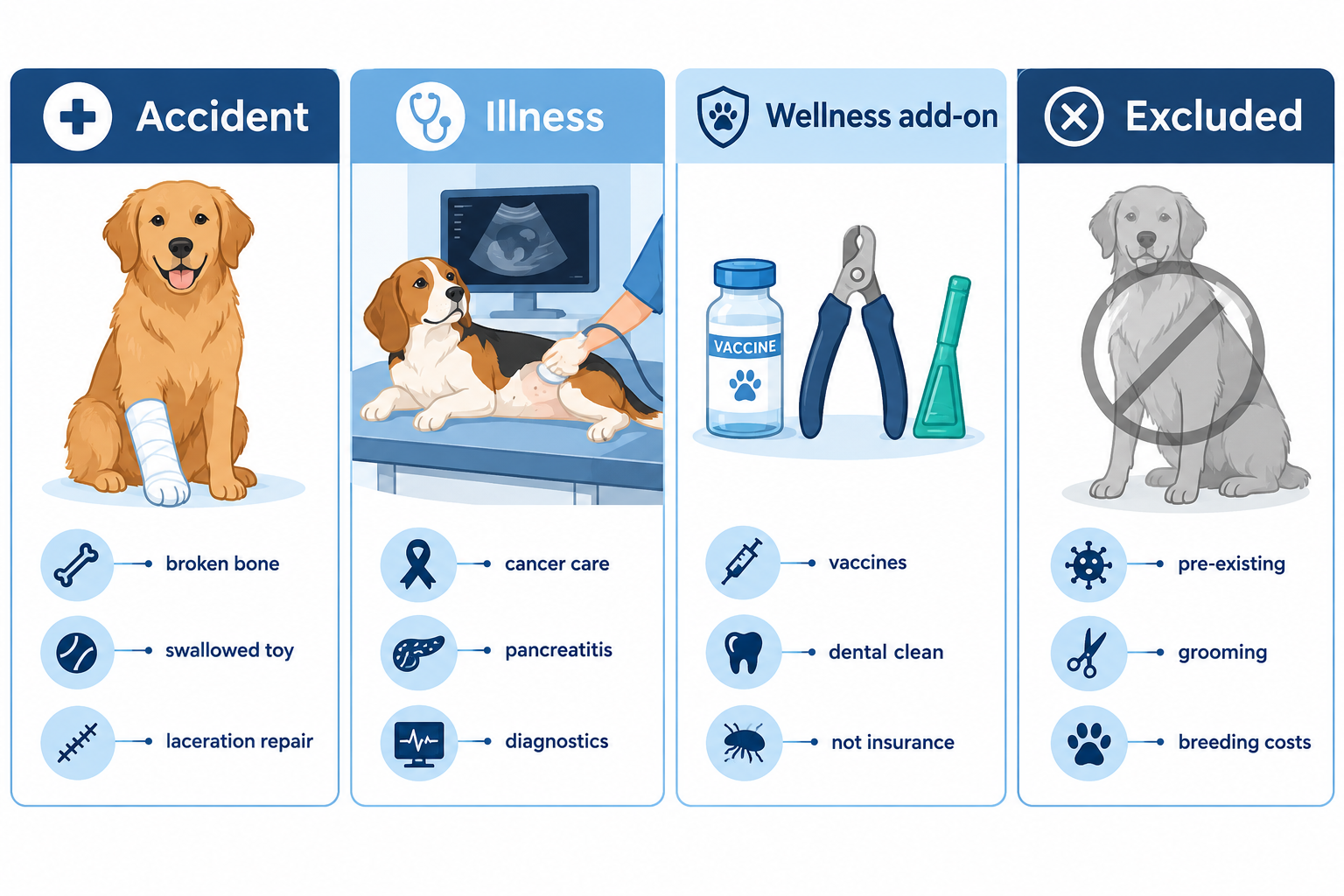
Accident and illness coverage
This is the core product, and it is the only part doing real financial work. Typical covered items:
- Emergency exams, hospitalization and overnight monitoring
- Diagnostics: bloodwork, x-rays, ultrasound, CT, biopsy
- Surgery, including foreign body removal and orthopedic repair
- Cancer treatment, including chemotherapy and radiation at referral hospitals
- Prescription medications tied to a covered condition
- Chronic illness management, as long as the condition first appeared after your waiting period ended
Some plans include the sick-visit exam fee and some do not, which sounds small until you add up four specialist consults. Embrace and Fetch both market exam fee coverage as a feature, which tells you it is not universal.
Does pet insurance cover routine care like vaccines?
Not under the base policy. Vaccines, annual exams, dental cleanings, flea and tick preventives and spay or neuter surgery sit inside optional wellness or preventive care riders, which are usually reimbursement schedules rather than insurance. You pay roughly $10 to $30 a month and get back a fixed allowance per service.
The honest math on wellness riders: they are a budgeting tool. If the rider costs $240 a year and reimburses up to $250 of routine care you were going to buy anyway, you have moved money around rather than saved it. The NAIC Pet Insurance Model Act specifically addresses disclosures separating insurance from wellness programs, which is a fair hint about how often buyers confused the two.
Worth adding if: you want the cleanings and preventives spread evenly across the year and you will use every benefit. Skip if: you track your own spending and would rather put that $240 toward the deductible.
What are common exclusions in pet insurance?
Read this list before you read any marketing page. Commonly excluded or limited:
- Pre-existing conditions, including anything noted in records before enrollment or during the waiting period
- Breeding, pregnancy and whelping costs
- Cosmetic and elective procedures, including ear cropping and tail docking
- Grooming, boarding, food and supplements, even therapeutic diets in many plans
- Behavioral treatment, included by some insurers and excluded or capped by others
- Dental disease, frequently limited to accidental fracture unless the plan names dental illness
- Hereditary and congenital conditions, covered by most mainstream plans now but often with age-of-enrollment conditions attached
- Preventable illness where required vaccinations were not given
NAIC examination guidance for regulators instructs state examiners to check whether insurers clearly disclose exclusions for pre-existing, hereditary, congenital and chronic conditions along with waiting periods. Regulators are looking at this because owners kept getting surprised.
Pet insurance for pre-existing conditions
Almost no insurer will cover a condition that existed before your policy started. That is the single most consequential rule in the category.
Two distinctions matter:
- Curable versus incurable. Some insurers will reconsider a resolved condition, such as a one-off urinary tract infection or a skin infection, after a defined symptom-free period. Diabetes, allergies, cancer and orthopedic disease are treated as permanent exclusions once documented.
- Bilateral conditions. If your dog tore the left cruciate before enrollment, expect the right knee to be excluded too. Insurers treat paired structures as one condition.
The practical consequence is blunt. The best day to buy coverage is the day you bring the dog home, and the second best day is today. If you are still choosing a dog, breed risk belongs in that decision as much as temperament does, which is why our breed guides discuss health demands alongside behavior. See our piece on the French Bulldog, America’s most popular and most debated breed for an example of how a breed’s airway and spinal risks change the ownership budget.
Is pet insurance worth it? The math on a $10,065 emergency bill
Here is the scenario the whole category exists for. A post in r/DogAdvice titled “If you’re on the fence about pet insurance” describes an owner facing a $10,065 veterinary bill and crediting their policy with making the treatment decision possible. It is an owner-reported account, not a verified claim file, so treat the $10,065 as the figure the owner reported and nothing more. The number is still useful, because emergency specialty care at that scale is ordinary now, not exotic.
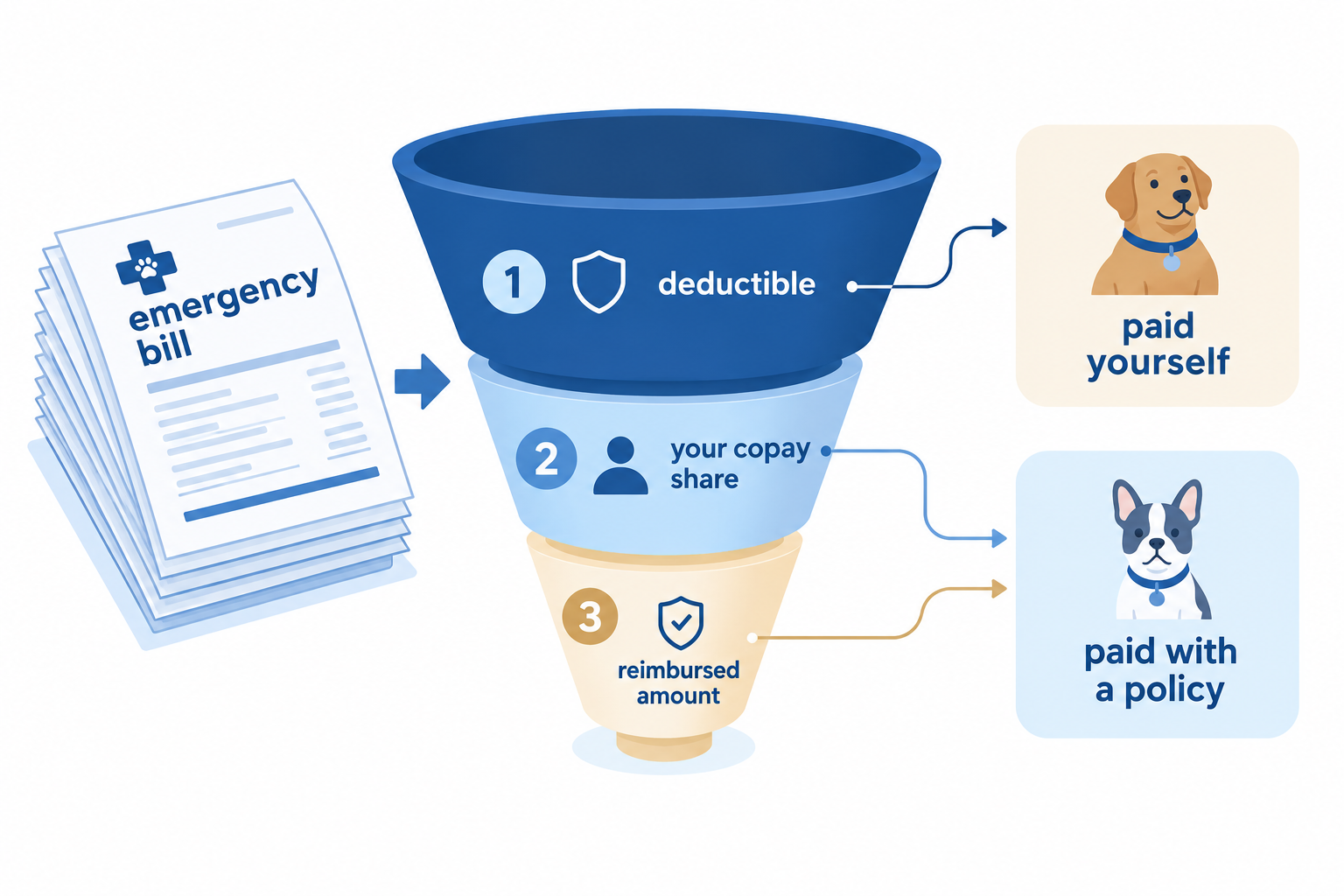
So run it. Below is a worked example using stated assumptions, not a quote from any insurer.
Assumptions: $70 monthly premium (close to the 2025 NAPHIA average of $69.67), $500 annual deductible, 80 percent reimbursement, $15,000 annual limit, one $10,065 bill in the policy year, every line item covered.
| Step | Calculation | Amount |
|---|---|---|
| Premiums paid for the year | $70 x 12 | $840 |
| Deductible you pay first | fixed | $500 |
| Eligible for reimbursement | $10,065 minus $500 | $9,565 |
| Insurer reimburses at 80% | $9,565 x 0.80 | $7,652 |
| Your 20% copay | $9,565 x 0.20 | $1,913 |
| Your total cost with insurance | $840 + $500 + $1,913 | $3,253 |
| Your total cost without insurance | full bill | $10,065 |
| Difference in that year | $6,812 in your favor |
Now the uncomfortable version. Change one assumption: the dog is nine, premiums are $150 a month, and the insurer excludes $1,800 of the bill as related to a pre-existing joint problem. Premiums become $1,800. Eligible drops to $7,765 after the deductible. Reimbursement at 80 percent is $6,212. Your total becomes $1,800 plus $500 plus $1,553 plus the $1,800 excluded, or $5,653. Still better than $10,065, and still $2,400 worse than the clean version.
That is why Consumer Reports found satisfaction and financial loss sitting side by side. In a year with no big claim, you are down $840 and you have bought nothing but the option to say yes. In the year the ultrasound shows something, the policy pays for itself several times over. Insurance is priced so that most policyholders lose a little and a minority avoid a disaster.
The policy does not make the bill smaller. It makes the bill survivable.
Run your own version below with your real premium quote and your real deductible. Nothing is pre-filled, because the right numbers are the ones on your quote, not an average.
Best pet insurance companies: what to compare in 2026
There is no single best insurer, because the right plan depends on your dog's age, your state, your cash position and how much paperwork you tolerate. What follows is a neutral structural comparison of widely sold dog plans, with the details most likely to change your decision. Terms vary by state and change often, so confirm everything on the current policy wording. Structures below were checked in October 2026.
| Insurer | How it pays | Deductible structure | Worth checking | Who it suits |
|---|---|---|---|---|
| Lemonade | Reimbursement, app-based claims | Annual, selectable in app | Availability: 44 states plus DC after the Kentucky launch on September 22, 2026 | Younger dogs, owners who want to set limits and rates themselves |
| Healthy Paws | Reimbursement, photo claim upload | Annual | Age at enrollment affects available rates and hip dysplasia coverage | Owners prioritizing simple accident and illness cover without payout caps |
| Trupanion | Can pay participating hospitals directly at checkout | Per-condition lifetime, not annual | Exam fees generally not covered; direct pay depends on the clinic | Owners who cannot float a five-figure bill while awaiting reimbursement |
| ASPCA Pet Health Insurance | Reimbursement | Annual, multiple tiers | Separate preventive care add-on; annual limit choices are capped | Multi-pet households wanting a familiar brand and tiered pricing |
| Embrace | Reimbursement | Annual, reduces each claim-free year | Wellness Rewards is an allowance, not insurance; age limits apply to new accident and illness policies | Healthy adult dogs whose owners expect few claims early on |
| Fetch | Reimbursement | Annual | Markets sick-visit exam fees and dental illness as included; verify the current wording | Owners who want exam fees and dental illness inside the base policy |
Also worth quoting alongside these: Pets Best, Nationwide, Spot and MetLife Pet. Nationwide announced a pet telemedicine program with FirstVet in September 2026, saying nearly half of its pet policyholders could reach a licensed vet virtually. Useful for triage at 11pm. It does not replace coverage for surgery or hospitalization.
When is pet insurance not worth it?
Insurance stops making sense when the premium plus the exclusions eat most of the benefit, or when you already have the cash to absorb a bad year without flinching. Three situations stand out: a well-funded saver, an older dog with a thick medical file, and a premium that has climbed past what the policy can plausibly return.

Pet insurance vs saving money yourself
Saving works if you have already accumulated enough to cover a five-figure emergency and you keep contributing. It fails if the account is aspirational.
Jennifer Quammen, president of the American Veterinary Medical Association, framed it as a liquidity question in September 2026 reporting by MarketWatch: a dedicated savings account can do the job for owners who already hold enough cash to absorb a major bill and who keep adding to it, while insurance offers more protection when an unexpected expense would cause real financial strain. AVMA money guidance for pet owners pushes the same two-part approach: keep emergency savings, and consider insurance before the dog gets sick.
Decision rule. Put $70 a month into a separate high-yield account for 12 months. If the balance is still there at month 12 and you could add another $9,000 tomorrow from existing cash, self-insuring is defensible. If you spent it in March on a transmission, buy the policy.
The quiet advantage of the policy is behavioral. A premium leaves your account whether or not you feel like contributing.
Is pet insurance worth it for older dogs?
For a dog over about eight, insurance is often still worth it, but the value shrinks fast and the fine print matters more than the brand. Three things work against you at once: premiums rise steeply with age, most age-related conditions already in the record become pre-existing exclusions, and several insurers restrict new accident and illness enrollment or drop hereditary condition coverage past a set age.
Before buying for a senior dog:
- Pull your dog's full medical records and read every note. Anything described there is probably excluded.
- Ask in writing how hereditary and chronic conditions are treated for dogs enrolled at that age.
- Check whether the annual limit is high enough to matter after your copay.
- Compare the premium against a realistic senior care budget: dental work, arthritis management, bloodwork twice a year.
If your dog already has a managed chronic condition, insurance will not pay for it, and your money may do more good in a dedicated care fund plus a supportive diet plan. Our guide to dog food for weight, joint, skin and gut problems covers the nutrition side of that, and how feeding changes from puppy to senior is worth reading as dogs age into different needs.
What happens if you can't afford a vet bill without insurance?
You still have options, and asking early gives you more of them. Speak to the practice before treatment begins, not after the estimate is signed.
- Ask for a staged treatment plan. Many hospitals will sequence diagnostics so you are not paying for everything in one visit.
- Request an itemized estimate and a written range. Specialty hospitals often quote a low-to-high band.
- Payment plans and third-party credit. CareCredit and similar medical credit lines are widely accepted, usually with a promotional interest-free window followed by a high rate. Read the deferred interest terms closely.
- Charitable funds. Breed-specific rescues, local humane societies and condition-specific funds assist in some cases, often with income or diagnosis criteria.
- Veterinary teaching hospitals. Sometimes lower cost for complex cases, with longer waits.
- Second opinion at a general practice when the condition is stable enough for the specialist referral to wait.
Alternatives to pet insurance for vet costs
- A dedicated emergency savings account, auto-funded monthly and used for nothing else
- A veterinary wellness or care plan sold by your own clinic, which usually bundles routine care at a monthly rate and is not insurance
- A medical credit line kept open and unused as a backstop
- Self-insuring with a credit card ceiling you have actually verified, which is the weakest option because the rate applies on day one
One future wrinkle to watch rather than count on: the PAW Act, H.R. 1842, introduced on March 4, 2025, would let certain veterinary expenses qualify for HSA or FSA treatment. It was referred to the House Ways and Means Committee and has not become law. Do not build a plan around it.
How much is pet insurance for dogs per month in 2026?
Expect roughly $30 to $100 a month for accident and illness coverage on a healthy adult dog, with the 2025 U.S. average sitting at $69.67 a month according to NAPHIA. Puppies of small mixed breeds sit near the bottom. Large breeds, brachycephalic breeds and dogs enrolled after age seven sit well above the average, and premiums in high-cost metro areas run higher again.
What actually moves your quote:
| Factor | Effect on premium |
|---|---|
| Age at enrollment | Largest single driver; rises every year and accelerates after about seven |
| Breed and size | Larger dogs and breeds with documented hereditary risk cost more |
| ZIP code | Priced to local veterinary costs, so metro quotes run higher |
| Deductible chosen | Higher deductible lowers the premium |
| Reimbursement rate | 90 percent costs more than 70 percent |
| Annual limit | Unlimited or high limits cost more than a $5,000 cap |
| Add-ons | Wellness, dental and behavioral riders add monthly cost |
Two things to expect at renewal. First, premiums generally increase as your dog ages even without claims. Second, category-wide increases happen: the NAPHIA average rose about 11.5 percent in a single year. Budget for the policy getting more expensive, because a cancelled policy in year five converts every diagnosis your dog has collected into a permanent pre-existing exclusion. Cost comparisons from NerdWallet, Forbes Advisor and Sniffspot's dog insurance cost breakdown are useful for sense-checking a quote that looks strange.
If you are still choosing a dog, these numbers belong in the decision. Our guide to the best dogs for first time owners and the large versus giant breed weight chart both bear on what you will pay for the next decade, in premiums and in food.
How do you pick a plan?
Set the deductible and reimbursement rate to match the worst month you could survive, then check the annual limit, the waiting periods and whether your clinic is covered. Those five variables decide almost everything. Brand loyalty decides very little.
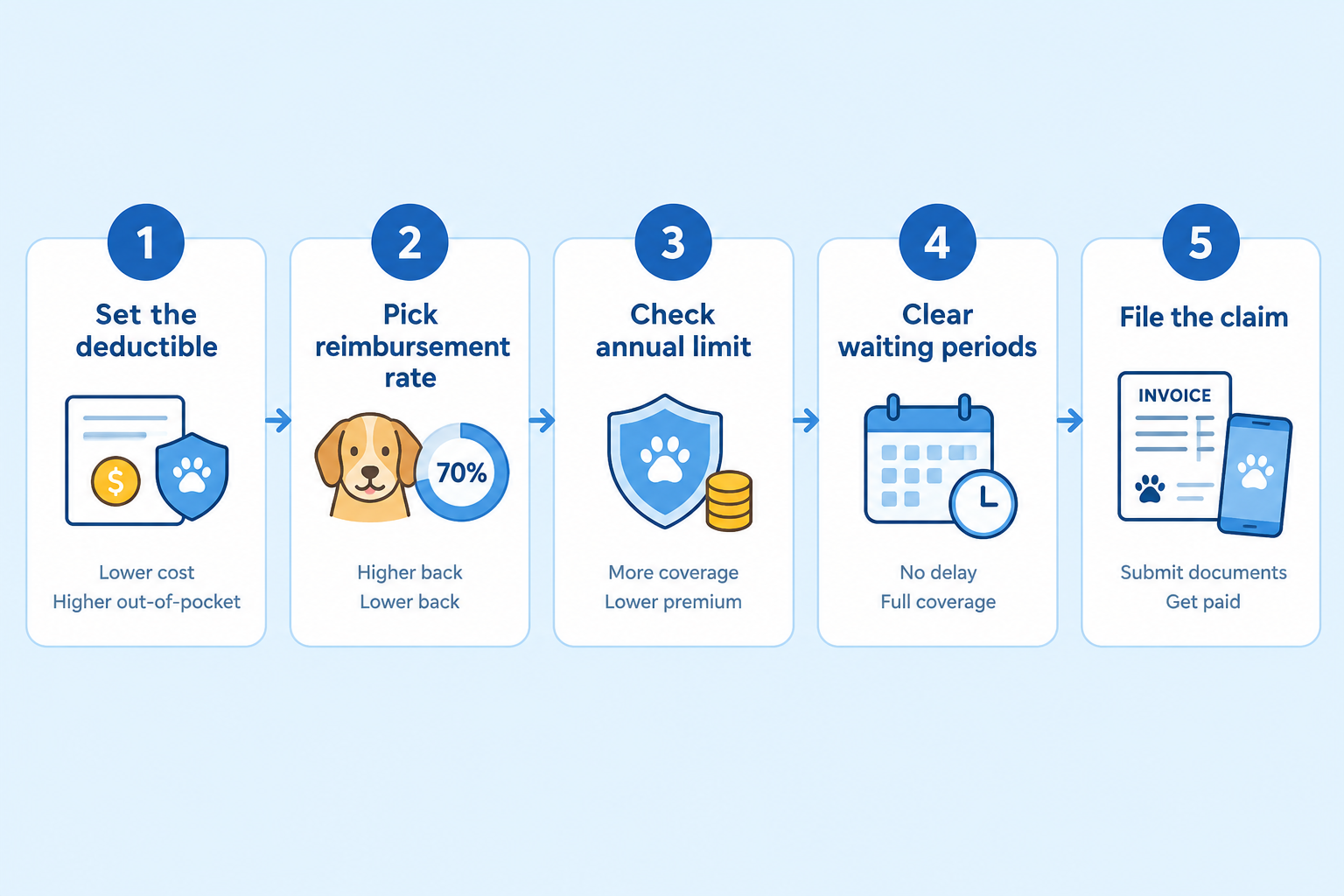
Pet insurance deductible: how does it work?
A deductible is the amount you pay out of pocket before reimbursement starts. Most dog plans use an annual deductible: you clear it once per policy year, then the insurer reimburses its stated percentage on eligible costs for the rest of the year. Trupanion uses a per-condition lifetime deductible instead, so each new diagnosis has its own threshold that you clear only once ever.
Which suits you:
- Choose a higher annual deductible ($750 to $1,000) if you can absorb that amount from savings and want the lowest premium.
- Choose a lower deductible ($100 to $250) if a sudden $1,000 would go on a credit card.
- Per-condition deductibles favor dogs with one long-running chronic condition. Annual deductibles favor dogs with several unrelated incidents in the same year.
Can you use any vet with pet insurance?
With most U.S. dog policies, yes. Reimbursement plans let you see any licensed veterinarian, including emergency hospitals and specialists, because you pay the clinic and then claim from the insurer. There is no network in the human-health sense.
Two caveats. Direct payment to the hospital, which Trupanion offers at participating practices, depends on your clinic being set up for it. And treatment outside the U.S. and Canada is often excluded or limited, so check before a long trip.
Pet insurance claim process: how long does it take?
Most insurers advertise claim decisions within a few days to a few weeks, with faster turnaround on simple app-submitted claims and slower handling on first claims or complex cases where medical records are needed. Payment follows by direct deposit or check.
What speeds a claim up:
- Submit the itemized invoice, not the receipt total.
- Send your dog's full medical history at enrollment, so the insurer is not requesting it mid-claim.
- Use the app or portal rather than email.
- Flag the diagnosis clearly, including whether it is a continuation of an approved condition.
Common mistake: assuming an approved claim means full reimbursement. Consumer Reports found only 44 percent of policyholders said they got back the full stated level on recent claims. The usual culprits are exam fees, excluded line items, the deductible not yet met and sub-limits on specific conditions.
When should you get pet insurance for your pet?
As early as possible, ideally in the first weeks of ownership, before any symptom enters the medical record. Waiting periods make the point clearly: coverage typically begins a few days after purchase for accidents and roughly two weeks for illnesses, with longer windows, sometimes six months, for orthopedic conditions like cruciate injury and hip dysplasia.
Enrollment timing also fixes some terms for life, including eligibility for hereditary condition coverage at certain insurers. A policy bought at four months old and kept continuously is a different product from the same policy bought at age nine.
FAQ
Is pet insurance worth it for a puppy?
Usually yes, and puppies are the best value in the category. Premiums are at their lowest, nothing is pre-existing yet, and puppies swallow things. Enrolling early also locks in continuous coverage before any condition appears in the record.
Does pet insurance cover pre-existing conditions?
Almost never. Anything documented before your policy started or during the waiting period is excluded. Some insurers will reconsider a curable condition after a defined symptom-free period, but chronic and incurable conditions stay excluded for life.
What is a deductible in pet insurance?
The amount you pay yourself before reimbursement begins. Most dog plans use an annual deductible, cleared once per policy year. Trupanion applies a lifetime deductible per condition instead.
Is pet insurance worth it according to Reddit?
Reddit threads lean positive, but they are a biased sample: people post after a large claim was paid, not after five quiet years of premiums. The r/DogAdvice $10,065 post is a real owner account and a useful illustration of scale. It is not evidence about average outcomes, which is what the Consumer Reports survey data is for.
Is Lemonade pet insurance worth it?
It suits owners who want to set their own deductible, reimbursement rate and annual limit inside an app, and it is available in 44 states plus Washington, D.C. following the Kentucky launch on September 22, 2026. Compare its exclusions and exam fee treatment against Fetch and Embrace before deciding, since those details vary more than the price does.
Does pet insurance cover vaccines and dental cleanings?
Not in the base accident and illness policy. Routine care sits in an optional wellness rider that reimburses a fixed allowance per service. It helps spread costs evenly; it rarely saves money overall.
Can my insurer drop my dog or raise the premium after a big claim?
Insurers generally cannot cancel for filing claims, but premiums do rise with your dog's age and with broad rate increases. The NAIC Pet Insurance Model Act addresses disclosure of these terms, though it binds only in states that adopt it.
Is pet insurance worth it if I already have savings?
If you hold enough cash to pay a $10,000 bill without borrowing and you keep adding to that fund, self-insuring is reasonable. If that bill would go on credit, the policy is doing work your savings account cannot.
Conclusion: the one thing to do next
Get a real quote for your actual dog, then run your own numbers in the calculator above using that premium, your chosen deductible and a $10,000 bill. Not an average dog. Yours, with its age, breed and ZIP code attached. Five minutes of arithmetic will tell you more than another hour of reading reviews.
Then make the decision on the right question. Not "will this pay off," because across all policyholders it mostly will not. The question is whether a $10,065 estimate at 2am would change what you are able to say yes to. If the answer is yes, buy the coverage before anything appears in the medical record. If the answer is no, open a separate account today, automate $70 a month into it, and leave it alone.
For more practical care and cost guidance, browse our health and care hub, and if you are weighing where else your dog budget does the most good, our look at whether premium dog food is actually worth paying more for applies the same kind of math to the food bowl.
Dog Advice That Actually Answers the Question. Guidance and company details above checked October 2026. General information only, not financial advice.