Quick Answer
A double dog leash no tangle design only earns that name because of one part: a junction that spins. The branch that goes to each dog has to rotate freely around the handle side, so when your dogs swap positions the leash unwinds instead of braiding. Of the five options compared here, the iYoShop Dual Dog Leash is the strongest all-round pick for two similar-sized dogs, the Mighty Paw BungeeX2 is the best choice when you want gear matched to your dogs’ actual weight, and a plain coupler is enough for calm sidewalk walks. If one dog outweighs the other by a lot, or both pull hard, two separate leashes stay the safer setup. Guidance checked October 2026.
Key Takeaways: Double Dog Leash No Tangle
- The anti-tangle part is a 360 degree metal swivel at the split. Plastic junctions that stop turning under load are the usual reason a “no tangle” leash still tangles.
- Two main shapes exist: a coupler (a short Y that clips onto the leash you already own) and an integrated dual-handle leash with built-in swivel and bungee branches.
- Do the swivel test before you buy, and again after ten minutes of real walking. Spin the barrel, spin it under light tension, cross the branches, then check for a braid.
- A double dog leash no tangle setup suits dogs of similar size, pace, and leash manners. It does not suit reactive dogs in active behavior work.
- Mighty Paw sells the BungeeX2 in three weight tiers, which is the clearest sizing system found in this comparison (per the Mighty Paw BungeeX2 listing).
- Budget swivel couplers from brands like AUTOWT, Snagle Paw and SMARTUS sit at the low end of the market, while hands-free and premium systems sit at the top (compare the options in Amazon’s double leash category).
- Retractable twin leashes such as the Wigzi Dual Doggie and Flexi Duo carry the same hazards as single retractables: thin cord, lock failure, line burns, and much less control at distance.
- No swivel fixes two dogs circling each other. That part is training.
How does a no tangle double dog leash work? (360 degree swivel, coupler vs dual handle)
A no tangle double dog leash takes one handle and splits it into two leads at a junction that rotates. When your left dog crosses to the right and your right dog crosses to the left, the two branches turn around that junction instead of twisting together into a rope. A fixed Y with no rotation stores every crossover as a half twist, which is why ordinary double leads end up looking like a friendship bracelet by the end of the block.
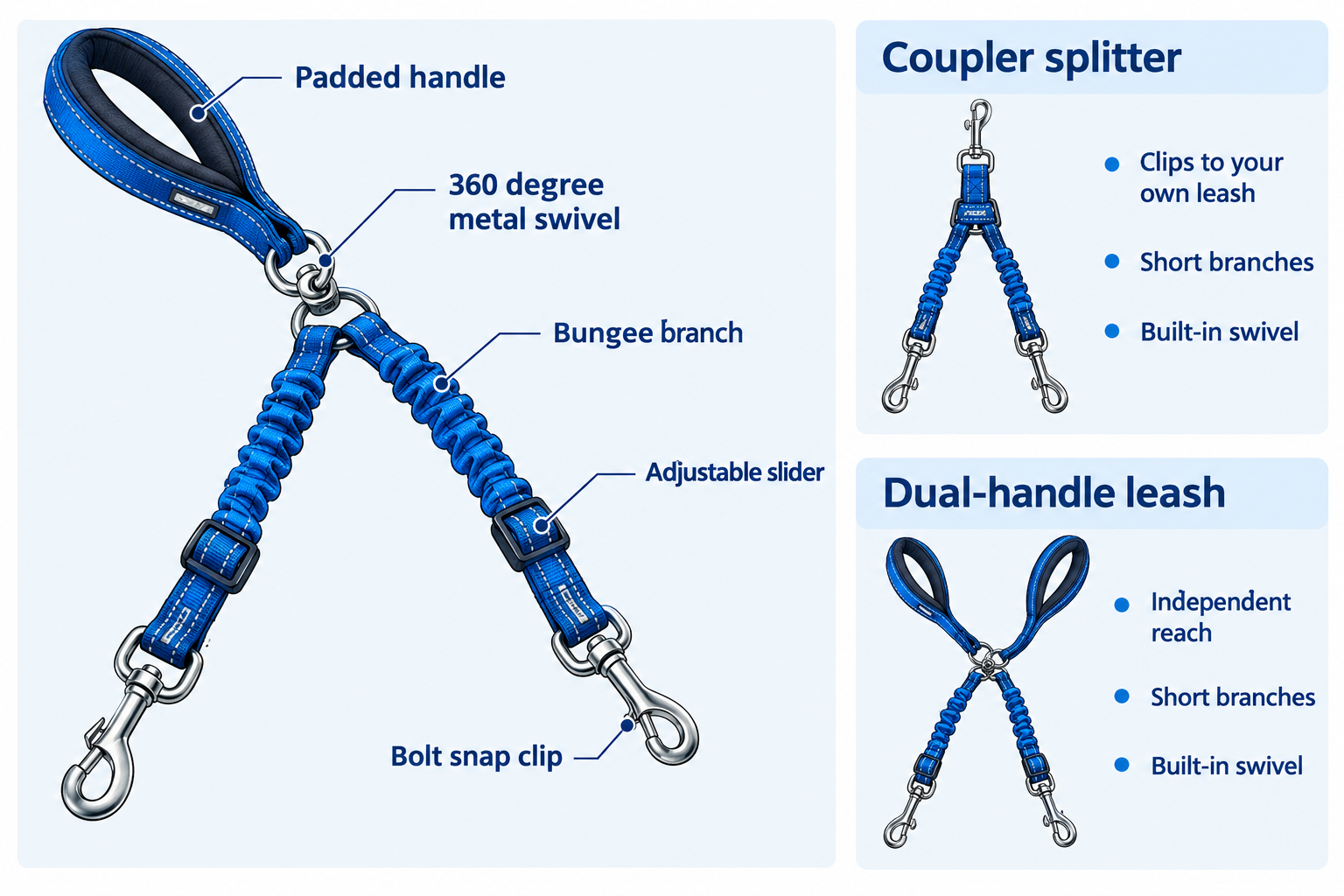
The two designs you will actually see:
- Coupler (splitter). A short Y, usually 10 to 18 inches per branch, with a swivel ring in the middle and a clip at the top for your own leash. Cheapest option, smallest to store, least adjustable. The branches are short, so the dogs walk close together.
- Dual-handle double leash. One complete leash with the swivel built in, two branches (often bungee), padded handles, and reflective stitching on better versions. More control, more cost, more bulk.
What to inspect on either type:
- Swivel material. Metal barrel, not moulded plastic.
- Branch adjustment. Sliders let you shorten the branch for the dog who crowds you.
- Clip type. Bolt snaps and trigger clips are both fine, but each clip should swivel at its own base too.
- Stitching. Bar tacks at every load point. Check that a bar tack has not been sewn across the swivel, which locks rotation.
One edge case worth saying plainly: a swivel solves twisting at the junction. It does not stop one dog from walking a full circle around the other.
Double dog leash no tangle vs a regular double leash: what actually changes
The difference is rotation and independence. A regular double leash is a fixed Y, so every position swap adds a twist and you have to stop and unwind it. A double dog leash no tangle version adds a spinning junction, and most of them also add independent branch length so each dog can be set to a different reach.
| Feature | Regular double leash | No tangle version |
|---|---|---|
| Junction | Fixed stitched or riveted Y | Rotating metal swivel |
| Crossovers | Store as twists | Unwind on their own |
| Branch length | Usually equal and fixed | Often adjustable per dog |
| Shock absorption | Rare | Bungee common |
| Cost | Low | Low to midrange |
Choose a fixed Y only if your two dogs walk reliably on the same side, which is uncommon outside well-practised pairs. Otherwise the swivel pays for itself in the first week.
Why does my double dog leash keep tangling?
Most of the time it is one of six causes, and only two of them are the leash’s fault. Work through them in order before you buy anything new.
- The swivel is cosmetic. Plastic junctions and cheap stamped rings seize as soon as there is tension on both branches. They spin beautifully in your hand in the shop and not at all on the pavement.
- The swivel is dirty. Grit, sand, mud and hair pack the barrel. Rinse it, dry it, and work it loose.
- The branches are too long. Long branches give each dog more room to orbit the other. Shorten them.
- Your dogs swap sides to sniff. Normal behavior, and the main source of tangles. Training and treat placement change this more than hardware does.
- Size or pace mismatch. A dog who walks 20 percent faster will cut across the slower one, again and again.
- The clips do not rotate. Even with a good central swivel, a non-swivelling clip at the collar end stores twist at the dog.
Common mistake: untwisting the leash while still walking. The dogs keep moving, you add new twists at the far end, and the braid migrates. Stop, let both dogs stand, and let the swivel unwind with no tension on it.
What is the swivel test, and how do you do it before buying?
The swivel test is a quick check of whether a leash’s anti-tangle claim survives real movement. A good test does more than rotate the clasp by hand. It checks whether the leash stays usable when two dogs cross left and right, change pace, circle each other, stop suddenly, and reverse direction.
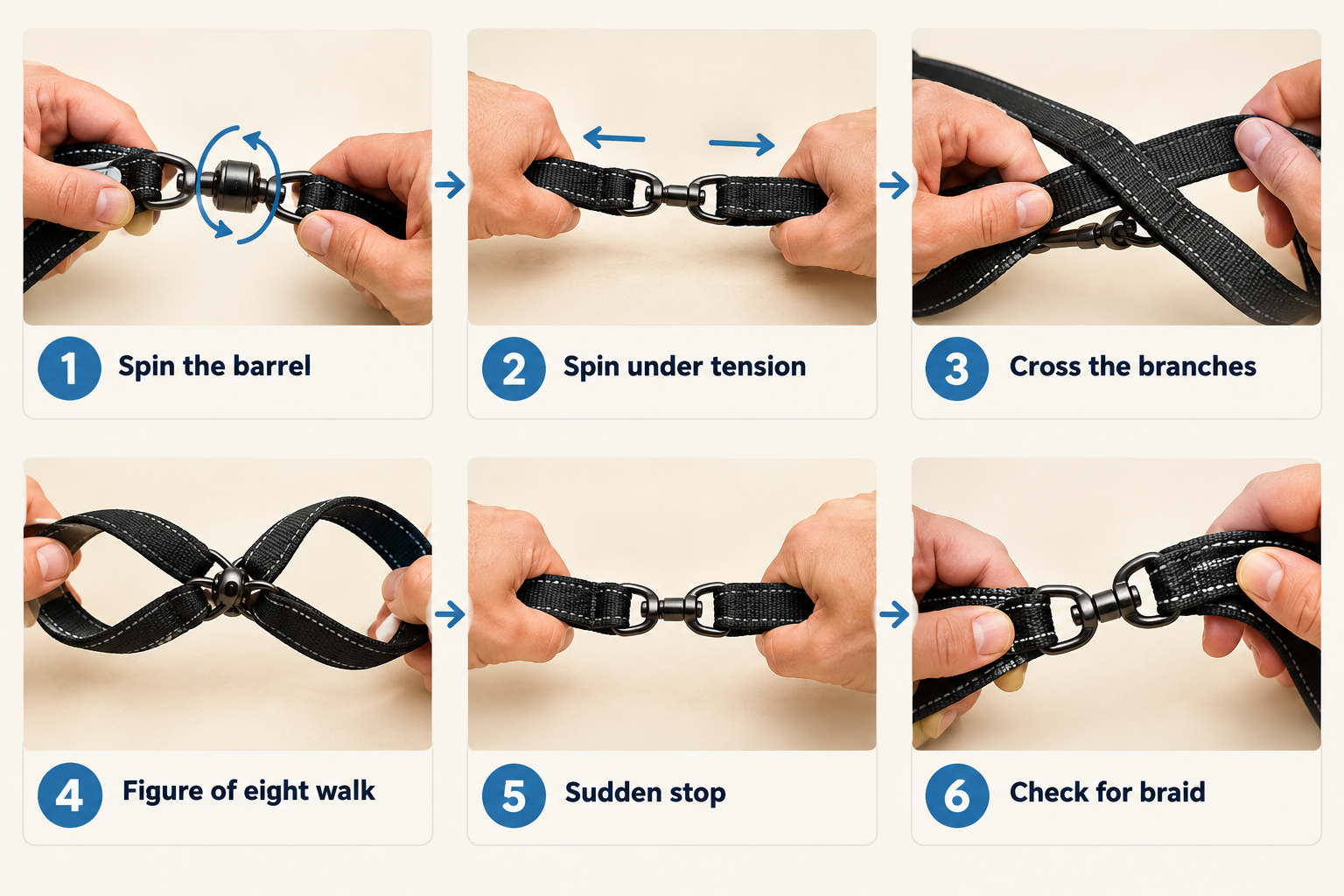
The six-step swivel test
- Spin the barrel dry. Hold the handle side, turn the junction. It should make several full rotations smoothly, with no grinding or catching.
- Spin it under tension. Pull both branches apart with light, steady pressure and try again. This is the step that fails on plastic junctions, and it is the step that matters on a walk.
- Cross the branches. Twist them over each other three times, then let go. A working swivel sheds most of that twist by itself.
- Walk a figure of eight. With both dogs attached, walk two slow figure-of-eight loops in a car park or garden. Crossovers are the whole point of the test.
- Stop and reverse. Halt suddenly, then turn and walk back the way you came. Watch whether the branches reset or stack up.
- Check at ten minutes. Look at the junction after a normal ten-minute walk. If there is a braid above the split, the swivel is decoration.
Edge case: some swivels only rotate when fully unloaded, which looks fine in a shop test and fails on every walk. Step 2 is the one most buyers skip.
Review method: this comparison uses published manufacturer specifications, retail listing details, and owner review patterns. No hands-on testing is claimed for these five products. Prices and listings checked October 2026 and they change often, so verify before you buy. Some links on this page are affiliate links, which means Doggy Rank IQ may earn a commission at no extra cost to you. The order below follows fit and evidence, not commission.
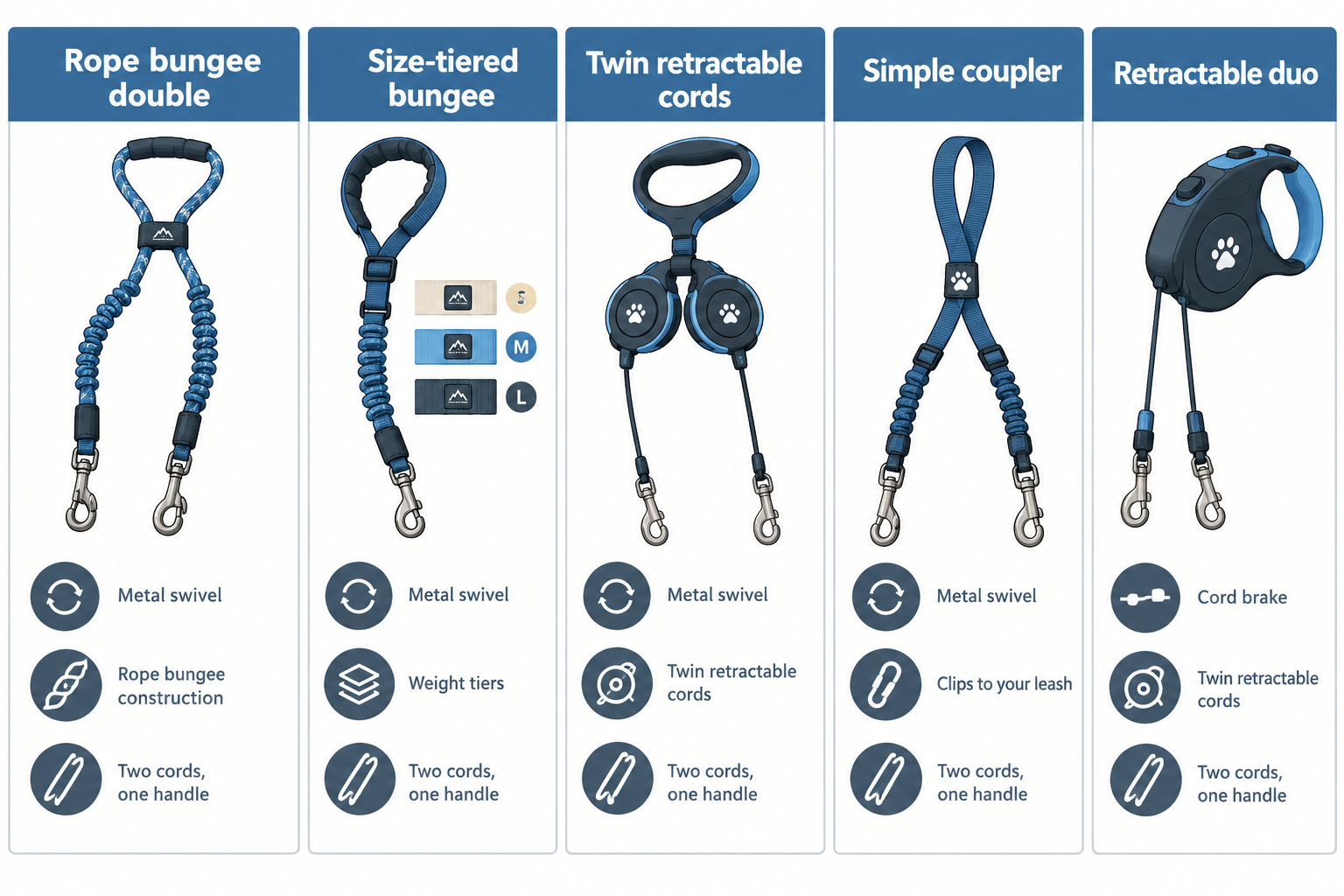
Here is how the five picks compare.
| Pick | Design | Dog size fit | Anti-tangle mechanism | Price band, checked Oct 2026 |
|---|---|---|---|---|
| iYoShop Dual Dog Leash | Rope lead, two bungee branches, padded handle | Two medium or large dogs at similar pace; 150 lb stated capacity | 360 degree metal swivel at the split | Midrange |
| Mighty Paw BungeeX2 | Bungee double leash in three weight tiers | 1 to 10 lb, 10 to 30 lb, or 30 to 100 lb per dog | Swivel splitter plus independent bungee branches | Midrange |
| Wigzi Dual Doggie | Two independently retracting cords in one gel handle | Check the version’s listed combined weight limit | Separate cord reels, marketed as tangle-free | Mid to upper, verify listing |
| KONG double dog coupler | Short Y splitter for your existing leash | Sold by brand size range, match the larger dog | Central swivel ring, hardware varies by version | Budget |
| Flexi Duo | Retractable duo casing feeding two cords or belts | Check the stated combined limit for your model | Separate retraction per dog, each braked at the handle | Upper, verify listing |
The 5 best picks for a double dog leash no tangle setup
Each pick below gets a verdict, who it suits, and the drawback that would make a different option better.
1. iYoShop Dual Dog Leash: best overall for two similar dogs
Verdict: the most complete package at a sensible price. iYoShop’s listed specifications describe a 360 degree metal swivel, a 31-inch climbing-rope main lead, bungee branches adjustable from roughly 20 to 35 inches, and a stated capacity up to 150 lb, with the swivel designed to rotate when dogs cross paths. A September 2026 multi-dog line comparison reported more than 23,000 reviews and a 4.6 out of 5 rating for the model, making it one of the most widely reviewed no-tangle double leashes on the market.
Who it suits: two medium or large dogs who walk at a similar pace, on sidewalks or mixed terrain.
Drawbacks: one size covers a very wide weight range, so a 25 lb dog gets the same hardware as a 70 lb dog. The 31-inch main lead keeps dogs close, which is control for some owners and crowding for others. Bungee gives a determined puller a few extra inches of runway.
2. Mighty Paw BungeeX2: best size-specific choice
Verdict: the sizing system is the reason to buy it. Mighty Paw lists three versions: X-Lite for roughly 1 to 10 lb per dog, Lite for 10 to 30 lb, and Standard for 30 to 100 lb, with the Standard using a 1-inch-wide nylon bungee that extends from about 24 to 36 inches. Reflective stitching and weather-resistant nylon are part of the design.
Who it suits: owners who want load and bulk matched to their dogs rather than a single oversized leash for everything.
Drawbacks: you have to buy the right tier, and a growing puppy will outgrow one. Bungee stretch is not a pulling fix, and the branch length means two large dogs still walk shoulder to shoulder.
3. Wigzi Dual Doggie: best when both dogs want their own reach
Verdict: Wigzi’s dual doggie design puts two separately retracting cords in one handle, each with its own brake, and is marketed as tangle-free because the cords never share a channel. That gives each dog an independent length without you managing two handles.
Who it suits: open parks and quiet lanes, two small to medium dogs with reliable recall, owners who already prefer retractable cords.
Drawbacks: every single-retractable hazard applies here, and doubles. Thin cord can cause line burns and cuts, locks can fail or get knocked, and a dog at full extension is far outside your control. Check the listed combined weight limit and treat it as a sunny-day open-space tool, not a sidewalk leash.
4. KONG double dog coupler: best minimal and budget option
Verdict: a plain splitter that clips to the leash you already like. KONG’s coupler versions are sold by size range, so match the larger dog and check the swivel on the exact item in your hand.
Who it suits: two calm dogs on short neighbourhood or sidewalk walks, and anyone who already owns a good leash and just needs the junction. Comparable budget couplers from AUTOWT, Snagle Paw and SMARTUS do the same job.
Drawbacks: short branches mean the dogs bump into each other. No shock absorption, no padding, and quality control varies between batches, so apply the swivel test on arrival.
5. Flexi Duo: best only if you already trust retractables
Verdict: the Duo feeds two cords or belts from one casing with separate braking, which keeps the two lines from winding at the handle. It is well made and genuinely convenient in open space.
Who it suits: owners committed to the retractable format, with two lighter dogs, walking in wide areas.
Drawbacks: the casing is bulky in one hand, the stated combined load limit is a hard ceiling you must verify for your model, and a simultaneous lunge from two dogs on retractable lines is the hardest situation on this page to physically manage. For most readers, a bungee double leash is the better buy.
Also worth knowing: the SparklyPets hands-free double leash adds a 360 degree swivel splitter, bungee sections, padded handles, reflective stitching and a waist-belt option. Useful for jogging or carrying treats. A waist system also increases fall risk if both dogs lunge at once, so it suits practised pairs rather than a first attempt.
23,000+
Reviews reported for the iYoShop dual leash, at 4.6 out of 5 (DogNotebook comparison, September 2026)
3 tiers
Mighty Paw BungeeX2 weight ranges: 1 to 10 lb, 10 to 30 lb, and 30 to 100 lb per dog (Mighty Paw listing)
150 lb
Capacity stated by iYoShop for its dual leash, a manufacturer figure for steady load, not a two-dog lunge
24 to 36 in
Branch extension range on the Standard BungeeX2, with a 1-inch-wide nylon bungee (Mighty Paw listing)
How much does a good no tangle double dog leash cost?
Across current retail listings checked in October 2026, three price bands show up consistently. Basic swivel couplers sit around $10 to $20. Midrange bungee or padded dual-handle systems sit around $25 to $35. Hands-free belts and premium retractable duos reach roughly $45 to $70. Prices shift weekly, so check the live listings in the double leash category before buying.
What the extra money buys, in order of usefulness:
- Metal hardware and a sealed swivel that keeps turning under tension.
- Bungee sections that soften the jolt when one dog accelerates.
- Adjustable branch sliders for two dogs who need different reach.
- Padded handles and reflective stitching, which matter most for dark morning walks.
Decision rule: if both dogs already walk on a loose leash, spend at the bottom of the range and put the difference toward training sessions. If either dog pulls, spend on hardware and stitching, not on padding.
Which no tangle double dog leash suits large dogs, small dogs, and pullers?
Match the leash to the heavier dog, the faster dog, and the one with the worse leash manners. That one dog sets the requirement for the whole setup.
No tangle double dog leash for large dogs
Look for a stated combined capacity, a metal swivel barrel, webbing at least three quarters of an inch wide, and bolt snaps rather than lightweight trigger clips. iYoShop states 150 lb for its dual leash, and the Mighty Paw Standard covers 30 to 100 lb per dog. Treat those as manufacturer figures for steady load. Two 70 lb dogs lunging at a squirrel at the same instant produce a brief force no listing accounts for, so keep the branches short and your wrist out of the loop.
Best no tangle double dog leash for small dogs
Weight of hardware is the issue here. A splitter built for 100 lb dogs puts a heavy metal junction swinging near a 7 lb dog’s chest. The Mighty Paw X-Lite tier at 1 to 10 lb per dog is the clearest answer among the picks compared. Keep branches short so the dogs are not stepping over each other’s lines, and attach to a body fitting rather than a collar, which spreads the load across the chest. Small-dog owners in flats will also find the coupler format easiest in a lift, which pairs with the practical side of life with a dog in an apartment.
No tangle double dog leash for dogs that pull
Bungee takes the sting out of a sudden pull, and it also hands a puller a few extra inches of acceleration before the line goes tight. That trade works for a mild puller and backfires for a strong one. For a dog mid-training, the better setup is a separate leash plus front-clip walking gear such as the Ruffwear Front Range or a Rabbitgoo no-pull fitting, both of which redirect forward force sideways rather than letting the dog lean into it. Add the double leash back once the pulling is manageable on its own.
What are the downsides of a double dog leash? (size mismatch, pullers, reactive dogs)
The main disadvantage is simple: one leash, one hand, two independent animals. Every advantage of convenience comes with less individual control.
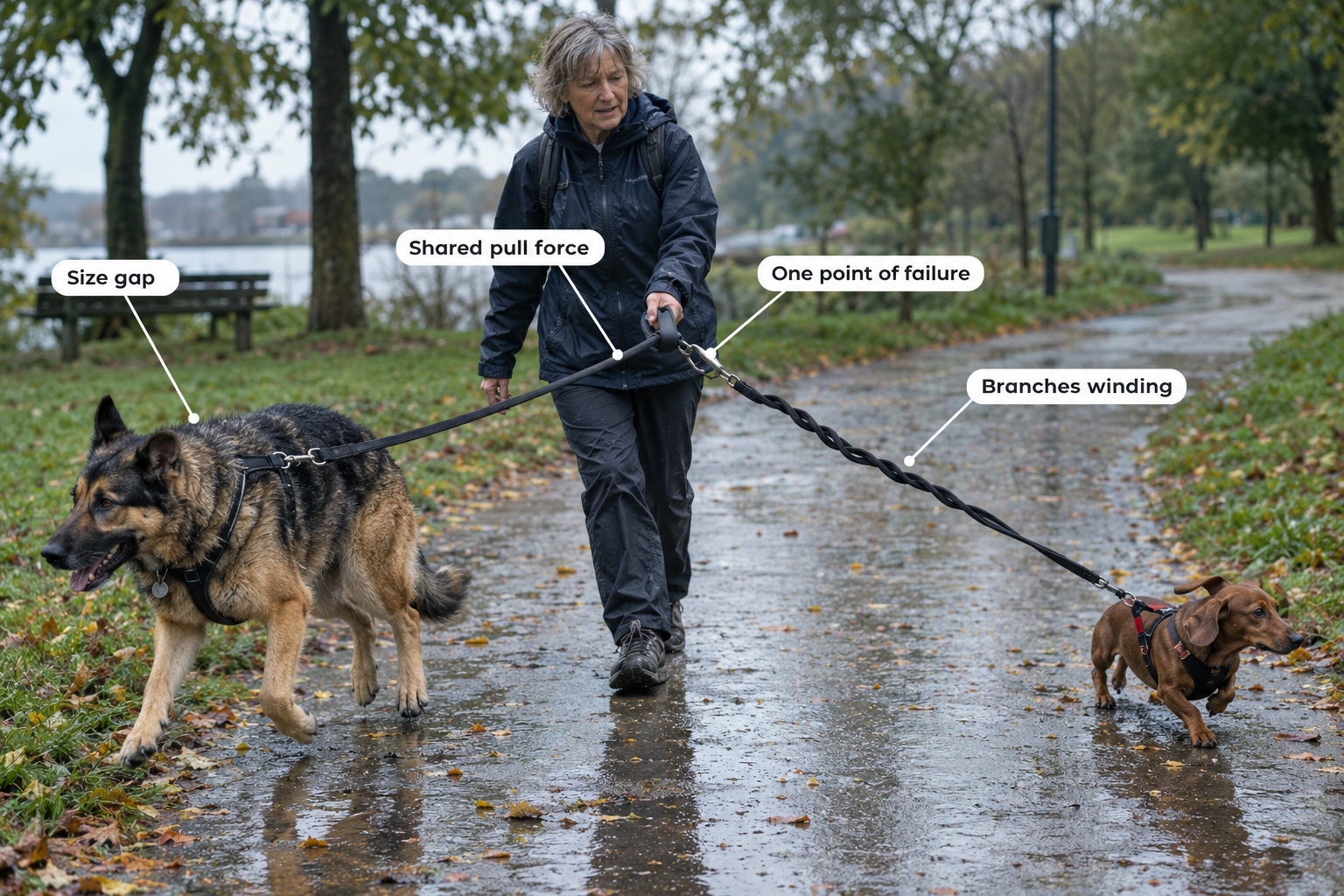
- Shared force. When one dog lunges, the other feels it through the junction. A 15 lb dog can be pulled sideways by a 60 lb dog’s decision.
- One point of failure. A single clip, ring or stitch line now carries both dogs.
- No separate feedback. You cannot slow one dog without slowing the other, which makes loose-leash work harder.
- Hazards on street furniture. Two dogs passing either side of a pole, bin or pushchair stops you immediately.
- Cleaning. Bungee and rope hold mud and smell. Check the care instructions before you buy, since not every bungee leash takes a machine wash.
Double dog leash no tangle for reactive dogs
For a dog in active behavior work, a double leash is generally the wrong tool. Reactivity management depends on distance, early exits, and the ability to move one dog without dragging the other. A shared junction removes all three. Use two separate leashes, walk the reactive dog alone where possible, and work with a qualified trainer or veterinary behavior professional rather than relying on equipment. Humane training and distance do the work. Hardware only carries it.
Can you use a no tangle double dog leash for one dog?
Yes, with a caveat. Clip one branch to the dog and the spare branch out of the way, or clip both branches to a body fitting’s chest and back rings for two-point control, which some owners prefer for steering. A loose spare branch can drag, catch on your ankle, or get chewed, so secure it. A single leash is still the better everyday tool for one dog, and a double is a reasonable backup rather than a replacement.
How do you prevent tangling with a double dog leash?
Shorten the branches, keep the dogs on assigned sides, and stop to reset instead of untwisting while walking. Those three habits remove most tangles that hardware cannot.
- Set different branch lengths. The faster dog gets the shorter branch.
- Reward on the outside. Deliver treats on each dog’s outer flank so neither dog drifts across the other to reach your hand.
- Teach a direction cue. A simple “this way” said before every turn gives both dogs a half second to adjust.
- Keep your pace steady. Stop-start walking invites crossovers.
- Clean the swivel weekly. Rinse, dry, and spin. Grit is the quiet reason a good swivel stops working.
- Use two colors. Different colored branches make it obvious at a glance which dog crossed, and in which direction.
How do you train two dogs to walk together?
Train each dog separately first, then join them for short, boring walks before anything interesting happens. The common mistake is making the first joint walk a trip to the park, where excitement is highest and your hands are fullest.
A practical sequence:
- Solo loose-leash practice. Each dog, one at a time, five to ten minutes, rewarding position beside your leg.
- Side assignment. Decide which dog walks where and keep it consistent for a few weeks.
- Short joint walks. Start with three minutes on a quiet street. End while both dogs are still settled.
- Turn drills. Walk slow figure-of-eight loops in a garden or car park so crossovers happen where you can calmly reset them.
- Add distraction last. Parks, other dogs and busy pavements come after the plain version is reliable.
Progress looks like fewer position swaps and a slack leash between you and the junction. Difficulty usually shows up as one dog consistently forging, which is a single-dog training problem wearing a two-dog costume. Trainability differs between individuals and between breeds, with wide individual variation inside any breed, and how trainable different breeds tend to be is useful background if you are still choosing a second dog. If either dog growls, freezes, or snaps during joint walks, pause the pairing and get qualified help.
Are no tangle double dog leashes worth it?
Worth it for two dogs of similar size, pace and leash manners, especially for daily short walks where carrying two handles is the actual annoyance. Not worth it when one dog is much heavier, when both pull, or when either dog is reactive, because the shared junction removes the control you most need in those situations.
A reasonable path: buy a budget swivel coupler first and test it with the six-step swivel test on your own dogs. If the pairing works and you want shock absorption and adjustable reach, move up to a bungee dual-handle leash. If the pairing does not work, you have spent very little to learn that two separate leashes are the right answer for your household.
No tangle double dog leash alternatives and similar products
If a double leash is not the fit, these options solve the same problem differently.
- Two separate leashes. Most control, most hands. Sturdy rope leashes from brands like BAAPET are a common choice for a strong dog in training.
- Hands-free waist belt with two tethers. Good for jogging, with a real fall risk if both dogs lunge together.
- Coupler plus one separate leash. Pair the two easy dogs and keep the third, or the trickiest one, on its own line.
- Front-clip walking gear. Ruffwear Front Range and Rabbitgoo no-pull fittings reduce leaning force on each dog individually.
- Long line for one dog in open space, short leash for the other, where local rules allow.
Still assembling your walking kit? Our rundown of where to buy dog gear is a reasonable starting point, and if a second dog is still a plan rather than a reality, matching a breed to your actual routine will matter more than any leash.
FAQ
Does a 360 degree swivel stop all tangling?
No. It stops twisting at the junction when dogs swap sides. It does nothing about one dog walking a full circle around the other, which is a training issue.
What length should each branch be?
Short enough that the dogs cannot cross behind you. Adjustable systems commonly run from about 20 to 36 inches per branch, and shorter is easier in traffic and on narrow pavements.
Is a coupler or a dual-handle leash better for a double dog leash no tangle setup?
A coupler is better for calm, similar dogs on short walks and for anyone who already owns a leash they like. A dual-handle leash is better for trails, different reach per dog, and shock absorption.
Are retractable twin leashes safe?
They carry the same hazards as single retractables, including thin cord, line burns, lock failure and reduced control at distance, with two dogs instead of one. Reserve them for open space and reliable dogs.
Can two dogs of very different sizes share one leash?
Not comfortably. The smaller dog absorbs the larger dog’s pulls through the junction. Use two separate leashes until size, pace and manners are closer.
How do I know my swivel has failed?
Hold the handle, pull both branches apart with light tension, and turn the junction. If it will not rotate under that tension, it has failed, no matter how smoothly it spins unloaded.
What should I check before the first joint walk?
Clip integrity, stitching at the junction, branch lengths set for each dog, and a quiet route. Check the dimensions of your usual doorway and lift too, because two dogs on one leash take up more lateral space than you expect.
Conclusion
One next step, and it costs nothing: take whatever double leash or coupler is already in your hallway and run the six-step swivel test on it today. Spin the barrel dry, spin it under tension, cross the branches, walk two figure-of-eight loops, stop and reverse, then look at the junction after ten minutes of real walking. If a braid appears, the swivel is decoration and a $15 coupler with a metal barrel will fix your mornings. If it passes and the walks are still a mess, the problem is position, not product, and three minutes of side-assignment practice per day will do more than any upgrade.
Pick the leash for the walk you actually take, with the puddle, the pigeon, and the two dogs who have their own ideas about which side is best. That is dog advice that actually answers the question.