
The seven year rule has no parent. No study, no veterinary committee, no founding paper anyone can produce on request. It survives because the arithmetic is easy and the chart fits on a fridge magnet.
Quick Answer
Converting dog years to human years takes more than one multiplication. For a medium sized dog, the first year is worth roughly 15 human years, the second adds about nine more, and each year after that adds about four to five, according to the dog age chart published by the American Kennel Club. A DNA based formula from UC San Diego researchers puts it as human age = 16 x ln(dog age) + 31, which works for dogs aged one year and up and was built on 104 Labrador Retrievers. Body size changes the answer after about age five, with giant breeds aging fastest. Guidance checked October 2026.
Key Takeaways: Dog Years to Human Years
- The 7x rule is a rough average that is wrong at both ends. A one year old dog can reproduce. No seven year old human can.
- The first dog year counts for about 15 human years, the second for about nine more, and later years for roughly four to five each for a medium sized dog, per AKC’s dog age guidance.
- The DNA based formula from the UC San Diego team (Tina Wang, Trey Ideker and colleagues) is human age = 16 x ln(dog age) + 31, and it replaced “multiply by 7” with a curve.
- That formula came from 104 Labrador Retrievers, so treat it as a strong starting point rather than a verdict on your Chihuahua.
- Size matters more as dogs get older. A 10 year old small dog lands near 56 human years on the chart. A 10 year old giant breed lands near 79.
- Senior status arrives earlier for big dogs: roughly 10 to 12 years for small dogs, 6 to 7 for giant breeds.
- Chronological age is a planning tool, not a health report. The American Animal Hospital Association life stage framework ties care decisions to life stage, not birthdays alone.
- Translating dog years to human years helps most when it changes something practical: exam frequency, bloodwork, weight checks, joint care, floor traction.
Is it really 7 dog years to 1 human year? Where the myth came from
No. The 7x rule is a crude average that nobody has traced to a real study, and it misreads dog aging at both ends of life. It survives on convenience.
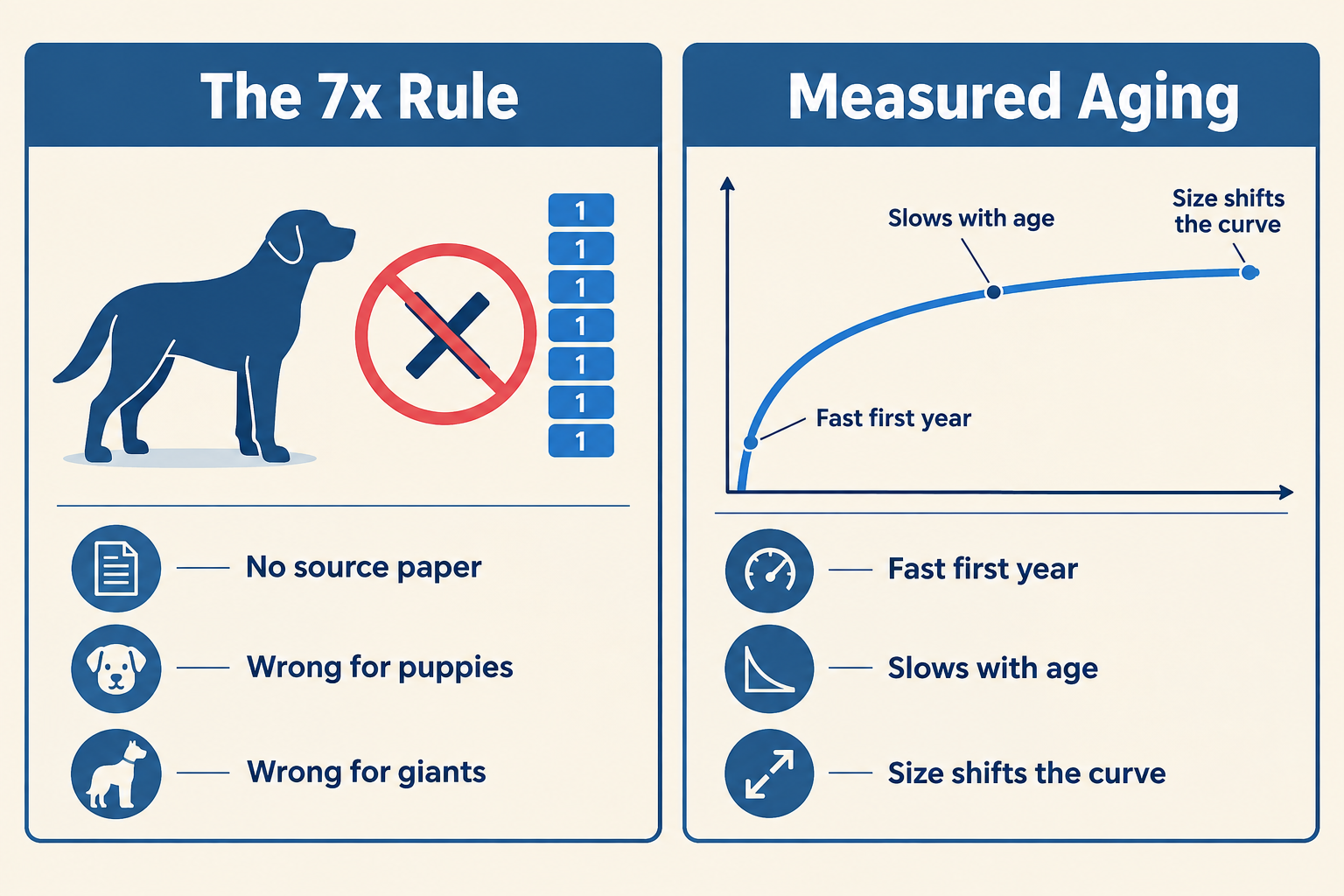
The most believable origin is simple division. If a person lives about 70 years and a dog lives about 10, the ratio is seven to one. Other explanations circulate too: a 13th century inscription in Westminster Abbey, a veterinary marketing idea to encourage yearly checkups. None of them come with a verifiable source document, and the publications that repeat them say the same thing. A-Z Animals’ review of the rule treats it as folklore that the science has moved past.
Where the myth breaks down is easy to see at home.
- At one year old, most dogs have finished growing, reached sexual maturity, and lost their baby teeth. The 7x rule calls that a second grader.
- At eight weeks, a puppy is closer to a nine month old human baby, which is the comparison NIH used when it reframed dog and human aging.
- At twelve years old, a Great Dane and a Jack Russell are not the same age in any practical sense, and the 7x rule gives both of them 84.
One multiplication cannot describe a species where adult weight ranges from four pounds to two hundred. The rule is not evil. It is just a very old placeholder that everyone kept using.
The 7x rule is a fridge magnet, not a finding. Use it to start a conversation, not to plan a senior care schedule.
How do you convert dog years to human years by size? (AVMA and AKC charts)
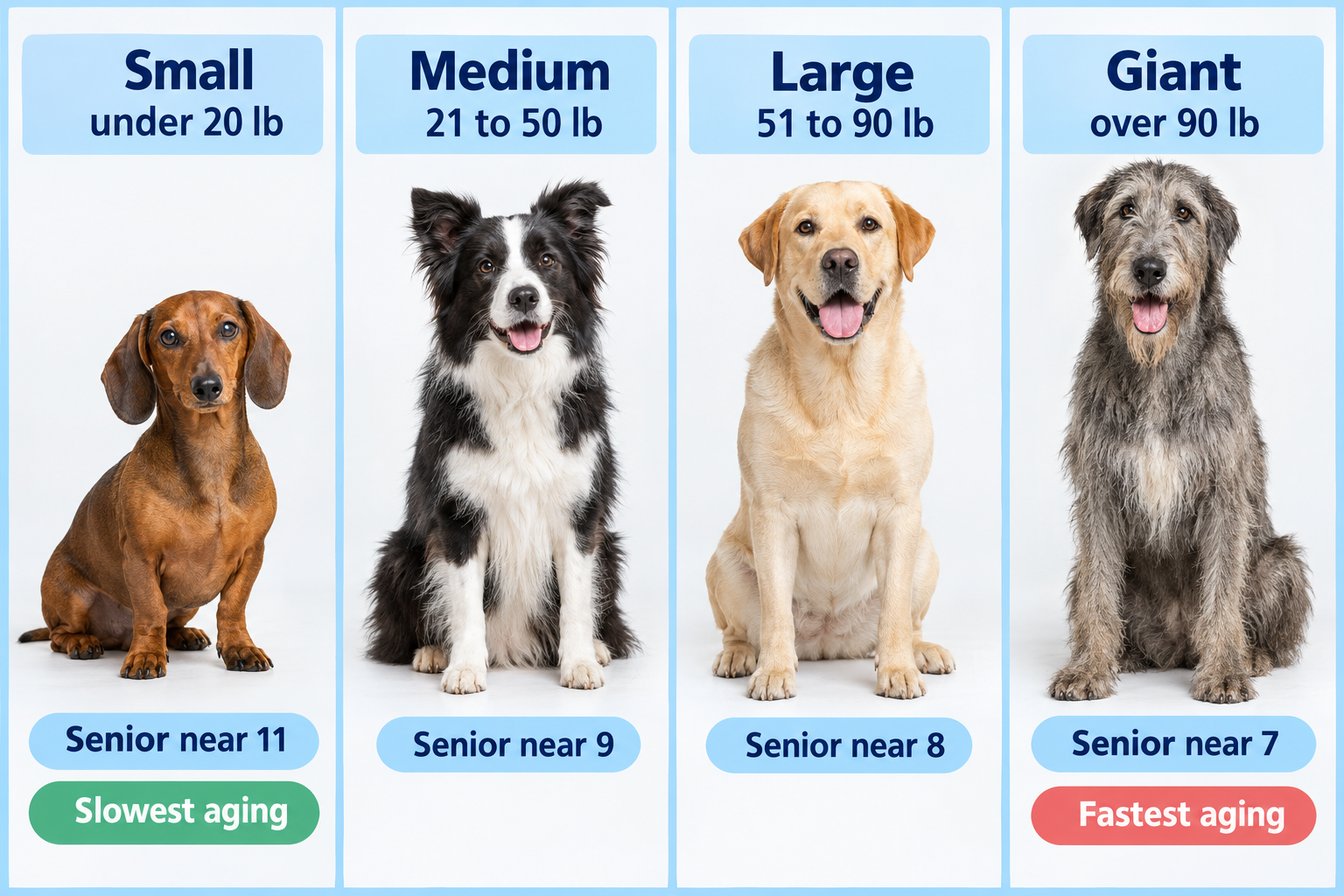
Use the staged method: about 15 human years for the first dog year, about nine more for the second, then roughly four to five human years for every year after that, adjusted upward for bigger dogs. This is the approach favored by veterinary bodies and reproduced in the AKC dog age chart and in consumer references such as Chewy’s dog years to human years guide and WebMD’s explainer on calculating a dog’s age.
What is the dog years to human years formula?
In plain steps, for a dog one year or older:
- Year one: count 15 human years.
- Year two: add nine, so a two year old dog sits near 24.
- Every year after: add four for a small dog, about five for a medium dog, and more for large and giant breeds.
Weight groups follow the familiar bands: small under 20 lb, medium 21 to 50 lb, large 51 to 90 lb, giant over 90 lb. If you are unsure which band your dog belongs to, our guide to large versus giant breed weight ranges sorts it out by adult weight rather than by looks.
Dog years to human years chart by size
| Dog’s age | Small (under 20 lb) | Medium (21 to 50 lb) | Large (51 to 90 lb) | Giant (over 90 lb) |
|---|---|---|---|---|
| 1 year | 15 | 15 | 15 | 12 |
| 2 years | 24 | 24 | 24 | 22 |
| 3 years | 28 | 28 | 28 | 31 |
| 4 years | 32 | 32 | 32 | 38 |
| 5 years | 36 | 36 | 36 | 45 |
| 6 years | 40 | 42 | 45 | 49 |
| 7 years | 44 | 47 | 50 | 56 |
| 8 years | 48 | 51 | 55 | 64 |
| 10 years | 56 | 60 | 66 | 79 |
| 12 years | 64 | 69 | 77 | 93 |
| 14 years | 72 | 78 | 88 | 107 |
| 16 years | 80 | 87 | 99 | 121 |
Chart values follow the published AKC dog age chart. Notice the first five rows: size barely matters early on. The columns only separate after about age five, and then they separate fast.
How old is a 5 year old dog in human years?
About 36 human years for a small, medium, or large dog, and about 45 for a giant breed. A five year old Yorkshire Terrier and a five year old Labrador are near the same point on the chart. A five year old Mastiff is a decade ahead of both.
Quick reference for the ages people search most:
- 1 year: about 15 human years, except giant breeds at about 12
- 2 years: about 24, the same across size groups
- 12 years: 64 (small) to 93 (giant)
- 14 years: 72 (small) to 107 (giant)
- 15 years: 76 (small) to 114 (giant)
Dog age calculator by breed: how far can you take it?
Breed-level calculators exist, and they are only as good as the lifespan data behind them. Breed tendencies shift expected lifespan in a general direction, but they do not predict an individual dog. A well cared for Dane can outlive the average. A small breed with a heart condition may not reach the average at all. Compare individual dogs, not labels, the same way we treat breed trait rankings as tendencies rather than guarantees.
If your dog’s birthdate is unknown, two DNA companies come up often. Embark sells a methylation based age estimate alongside its breed and health panels. Wisdom Panel focuses on breed ancestry and genetic health screening rather than an age readout. Either can narrow a guess for a rescue dog of unknown history. Neither replaces a veterinarian’s look at teeth, eyes, coat, and joints, which remains the standard first estimate.
Common mistake: choosing a size column based on current weight for a dog still growing. A four month old Rottweiler is not a small dog. Use projected adult weight, and if you are in that first year, the useful reading is a feeding and growth guide for the first year, not an age chart.
What is the DNA (epigenetic clock) formula, and how does it work? (UC San Diego 2019)
Researchers at UC San Diego, including Tina Wang and Trey Ideker, working with Elaine Ostrander and Danika Bannasch, compared chemical marks on DNA in dogs and humans. Their conversion, first posted as a preprint in 2019 and published in Cell Systems in 2020, is human age = 16 x ln(dog age) + 31. It is a curve, not a straight line.
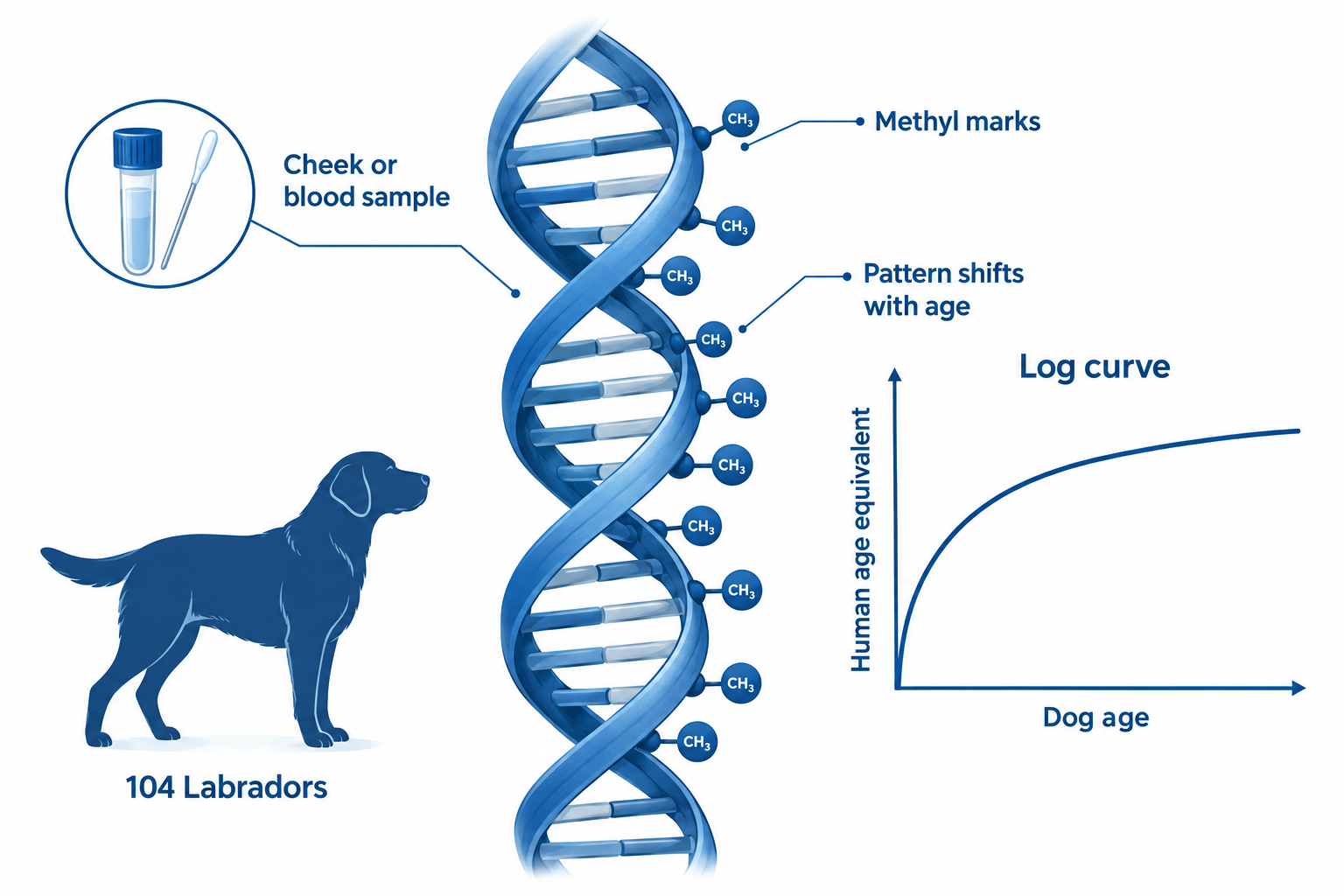
The mechanism is called methylation. Over a lifetime, small methyl groups attach to DNA at predictable spots. That pattern shifts with age in a way that can be read from a blood sample, which is why the same approach is used in human aging research. The team lined up dog methylation patterns against published human data and solved for the match.
Run the formula and the curve becomes obvious: a one year old dog lands at 31, a two year old at 42, a five year old at 57, a twelve year old at 71, and a sixteen year old at 75. Early life moves quickly, then the pace slows.
Where the facts end
The study population was almost entirely Labrador Retrievers, so the equation carries Labrador aging into every answer it gives. It does not adjust for body size, which is the single clearest predictor of how fast a dog’s later years pass. Methylation age also reflects molecular change, not clinical health. A seven year old dog with a perfect methylation profile can still have a torn cruciate ligament and bad teeth.
Use the DNA formula for perspective on the early years, where it beats the chart. Use the size chart for the later years, where size dominates.
Why do big dogs age faster than small dogs?
Large and giant breeds age faster because they grow faster, reach adult size later, and show age related disease earlier. A mouse-to-elephant logic would predict the opposite, since big species usually live longer than small ones. Within dogs, the pattern flips.
The leading explanation involves growth rate. Rapid early growth, linked to higher circulating growth factors, appears to come with a biological cost: earlier onset of age related disease, including some cancers. Researchers describe this as an association observed across breeds rather than a proven mechanism in individual dogs. The honest summary is that size predicts the pace reliably and the reason behind it is still being worked out.
What this looks like in practice:
- A 7 year old Great Dane is often managed as a senior patient. See why giant breeds like the Irish Wolfhound carry shorter lifespans.
- A 7 year old Miniature Poodle is usually still middle aged.
- Joint load, body condition, and dental disease compound the difference. Weight control is the lever owners have the most control over, which is why diets aimed at weight and joint support are discussed earlier for big dogs.
What is the average lifespan of a dog?
Around 10 to 13 years across all dogs, with small breeds at the top of that range and giant breeds below it. A 2024 analysis in Scientific Reports covering 584,734 dogs in the United Kingdom reported a median life expectancy of roughly 12.5 years across the sample, with small, long nosed breeds living longest and large flat faced breeds the shortest. That study described a national population, so it describes a pattern rather than a prediction for one household.
Why do some dogs live longer than others?
Several factors, with size and breed genetics at the front:
- Adult size. The strongest single predictor of pace.
- Breed specific risks. Certain cancers, heart conditions, and airway problems cluster in particular breeds.
- Body condition. Excess weight loads joints and shortens comfortable years.
- Preventive care. Dental treatment, parasite control, vaccination, early bloodwork.
- Luck. Accidents and unexpected disease ignore every chart on this page.
The Dog Aging Project continues long term tracking of aging in privately owned pet dogs, including research on interventions such as rapamycin. Those are research programs, not consumer tools. Separately, the biotech company Loyal announced on September 16, 2026 that the FDA had accepted its efficacy package for LOY-003, a drug aimed at extending healthy lifespan in large and giant breed dogs. It is not approved and not for sale. Worth watching, not worth planning around.
When is a dog considered a senior, and what changes at the vet?
Most dogs enter the senior stage in the final quarter of their expected lifespan: roughly 10 to 12 years for small dogs, 8 to 10 for medium dogs, 7 to 8 for large dogs, and 6 to 7 for giant breeds. The AAHA canine life stage framework sorts dogs into puppy, young adult, mature adult, and senior, and ties monitoring to the stage rather than to the birthday alone.
What usually changes once a dog is classed as senior:
- Exams twice a year instead of once, because six months is a bigger slice of a senior dog’s remaining life.
- Baseline bloodwork and urinalysis, so a later result has something to be compared against.
- Weight and muscle checks, since muscle loss can hide under a steady number on the scale.
- Pain and mobility screening, including questions about stairs, slick floors, and getting into the car.
- Dental assessment, which is the care item most often postponed and most often productive.
How to know if your dog is getting old
Age shows up in behavior before it shows up on a chart. Patterns worth noting:
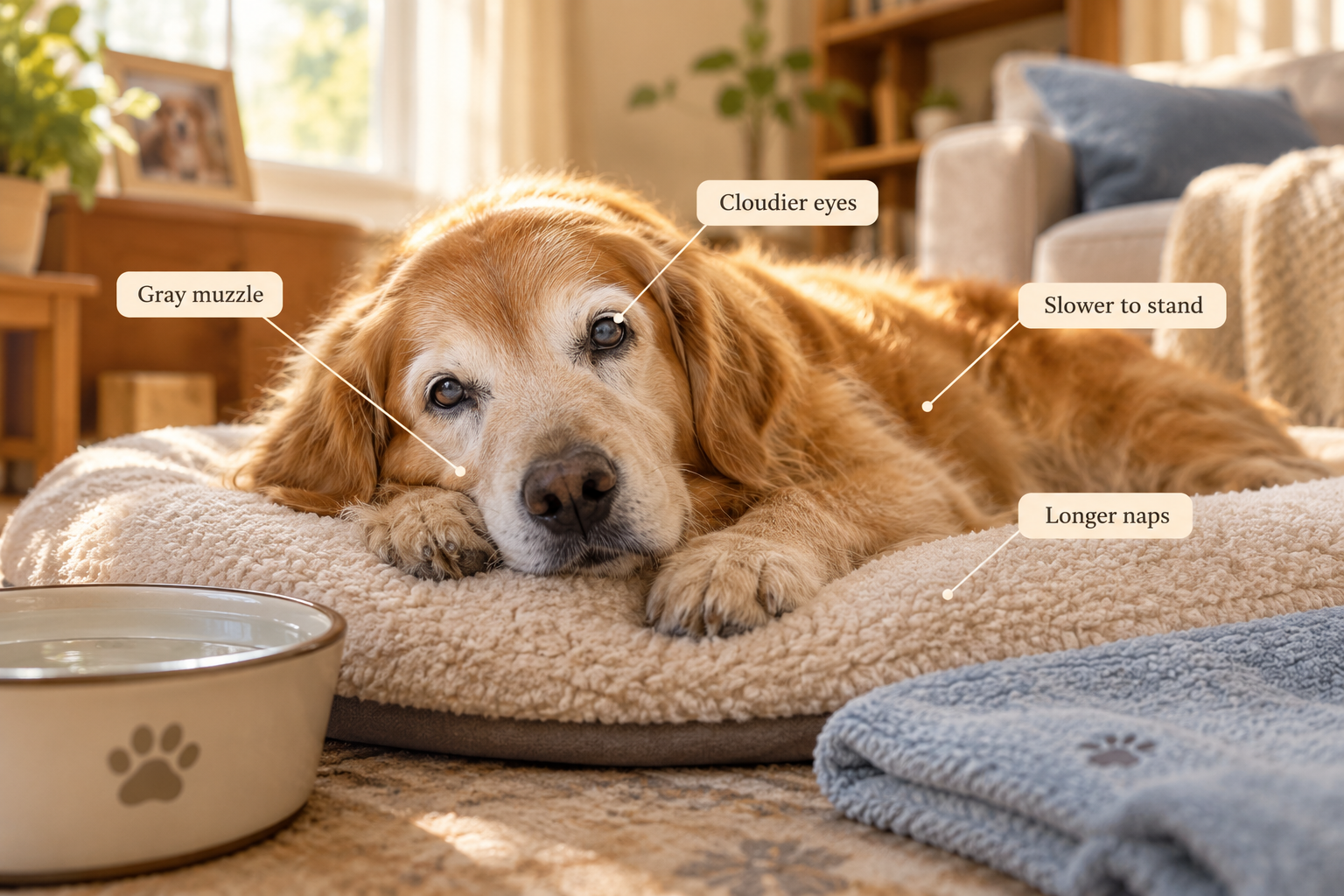
- Slower to stand, or a pause at the bottom of the stairs
- Longer and deeper sleep, which can be normal or a change worth reporting. Our piece on how much sleep is typical for dogs gives the baseline
- A cloudier look to the eyes, or bumping furniture in dim light
- Not responding to a call from another room
- Gray hairs spreading from the muzzle, which is cosmetic on its own
- New night waking, pacing, or confusion in familiar rooms
Edge case worth naming: sudden changes are not aging. Weight loss over a few weeks, increased drinking, a new limp, or a change in breathing deserves a veterinary appointment rather than a chart lookup. Gradual is aging. Abrupt is a symptom. Our health and care section covers what to prepare before the visit.
FAQ
How many dog years equal one human year?
There is no single ratio. The first dog year is worth about 15 human years, the second about nine, and later years roughly four to five for a medium sized dog, more for large and giant breeds.
Is it 7 dog years to 1 human year?
No. The 7x rule averages away the fast first year and the accelerated later years of big dogs. It has no identified source study and veterinary references treat it as outdated.
How old is 1 in dog years?
About 15 human years for small, medium, and large dogs, and about 12 for giant breeds, per the published AKC chart. The DNA based formula puts a one year old dog at 31 human years, reflecting molecular rather than developmental age.
What is 2 years in dog years?
About 24 human years across size groups. The size columns only begin to diverge after roughly age five.
How old is a 12 year old dog in human years?
Around 64 for a small dog, 69 for a medium dog, 77 for a large dog, and 93 for a giant breed. NIH’s Labrador example places a 12 year old at roughly 70 human years.
How old is a 14 year old dog?
About 72 human years if small, 78 if medium, 88 if large, and 107 if giant. Most giant breeds do not reach 14, which is why that column climbs so steeply.
What is 15 in dog years?
Roughly 76 to 114 human years depending on size. A 15 year old small dog is doing well. A 15 year old large dog is exceptional.
Is there a human years to dog years calculator that works in reverse?
You can invert the DNA formula (dog age = e raised to the power of (human age minus 31) divided by 16), but reverse conversions are a novelty. Nothing practical changes based on your own age in dog years.
Conclusion
The honest answer on converting dog years to human years is that the curve beats the multiplication, and body size beats both once a dog passes about five years old. Read the chart for the size band your dog actually falls into, use the DNA formula for perspective on the early years, and retire the 7x rule to trivia night.
Your next step: run your dog’s age and weight band through the calculator above, write down the senior start age it gives you, and put that date in your calendar next to a note to book a wellness exam. If that date has already passed, book the exam instead. The chart is interesting. The exam is useful.