Quick Answer
Most bites are preceded by minutes of polite warnings that look like nothing. Dog body language works as a set of small signals first and loud ones last, so the signs owners miss are the quiet ones: whale eye, repeated lip licking, an out of place yawn, a head turn, a freeze, a tucked tail, pinned ears, raised hackles, a high stiff wag, a lifted paw, a dry shake off, and a low growl. Read the whole dog plus the situation, not one body part, and respond by adding distance before the dog has to escalate.
Key Takeaways: Dog Body Language
- Dog body language is a package deal. Eyes, ears, mouth, tail, weight, and movement have to be read together, along with what just changed in the room.
- A wagging tail reports arousal, not mood. A high, fast, small wag with a stiff body is a different message from a loose sweep that moves the hips.
- Veterinary behavior specialist Dr Gabrielle Carter describes an escalation sequence that can start with lip licking, yawning, looking away, lowered posture, a tucked tail, and backing away, and she notes that not every dog shows every stage. Do not wait for a growl.
- Carter estimates roughly 95% of the aggression cases she sees are motivated by fear or anxiety, a clinical estimate rather than a population figure. Threat displays are usually attempts to create distance.
- A sudden change in tolerance deserves a vet exam before a training plan, since pain, vision or hearing loss, and cognitive decline can all make a steady dog defensive.
- Punishing a growl removes the warning without changing the fear underneath it.
- Children and dogs should never be left unsupervised, including with the family dog who has never done anything wrong.
- Saved charts are popular for a reason, but a chart is a memory aid. Context decides the meaning.
How do you read dog body language?
Read the whole dog, then read the room. A single body part can mean three different things depending on what the rest of the body is doing and what just happened, so the useful method is to check eyes, ears, mouth, tail, weight distribution, and movement together, then ask what changed in the last ten seconds. Guidance from veterinary resources on canine communication treats context as part of the signal, not a footnote.
Three habits make this easier.
Know your own dog’s baseline. Some dogs pant at rest. Some carry a naturally high tail. Some have ears that sit half back all day. The signal that matters is the change from normal, which is why strangers at the dog park are harder to read than the dog asleep on your floor.
Name what you can see, not what you assume. “Tail high and stiff, mouth closed, weight forward” is an observation. “He’s being protective” is a story. Behavior guidance from shelter dog behavior programs leans on the first kind of sentence for good reason.
Use the escalation idea, but loosely. Kendal Shepherd’s Canine Ladder of Aggression is a widely taught diagram that arranges signals from subtle appeasement up through growling, snapping, and biting. It fits the clinical description Carter gives of a sequence running from lip licking and yawning through to air snapping, with the warning that dogs skip rungs. Turid Rugaas popularized the term calming signals for the lower end of that range. Both are frameworks for noticing, not guarantees of order.
What is the difference between a relaxed dog and a tense dog?
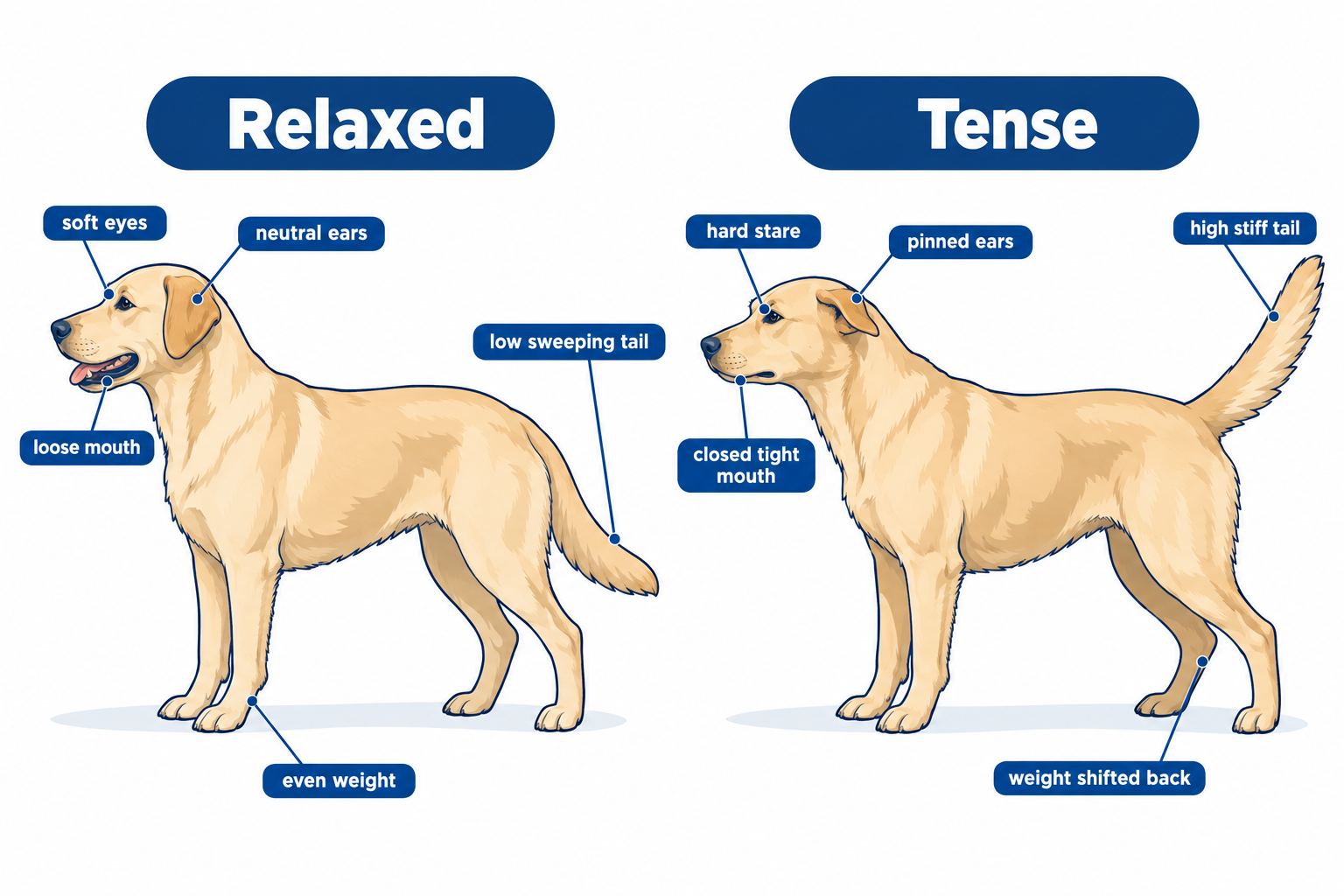
A relaxed dog is loose and curved. A tense dog is still and straight. In a relaxed dog, you see soft eyes, an open easy mouth, ears in their usual position, a tail hanging or swinging with the hips, weight spread evenly, and a body that wiggles when it moves. In a tense dog, muscle tone goes up, the body shortens or stiffens, the mouth closes, the tail position changes, and the movement gets slower or stops.
Quick check: can you see the dog’s body moving in more than one place at once? Loose dogs ripple. Tense dogs hold.
How can you tell if your dog is stressed or anxious?
Stressed dog body language usually shows up as displacement behavior: actions that look normal but appear at odd times. Sudden scratching, a big stretch, licking a paw, sniffing the ground in a tense moment, yawning in a vet waiting room, shaking off when dry, pacing, drooling without food nearby, or a panting mouth with tight corners.
Longer term stress tends to look like changes in habit. Food left in the bowl, broken sleep, more barking at ordinary noises, hiding, or a dog who stops asking for attention. A treat camera such as the Furbo Dog Camera can show you what your dog actually does while you are out, which is useful raw footage, though the camera records behavior rather than interpreting it.
What are signs a dog is about to bite?
The closest signals are stillness, a hard stare, a closed tense mouth, a stiffened body with weight shifted forward or back, a lifted lip, a growl, a snarl, and an air snap. Air snapping is a dog telling you the next one may land.
Carter and RSPCA NSW animal care leader Georgie Caspar draw a line between a dog “being aggressive” as an identity and a dog showing aggressive behavior in a context, with fear, pain, frustration, genetics, learning history, and environment all contributing. If escape is blocked, a frightened dog can learn that lunging works, because it makes the scary thing leave. If this pattern sounds familiar at home, our guide on why dogs bite their own owners and how to prevent it covers the household version in more detail.
How do you know if a dog is scared or aggressive?
Look at where the weight is going. A scared dog moves away from the trigger: leaning back, tail tucked, ears flat, head low, body shrinking, often trying to exit. A dog showing offensive threat moves into the trigger: weight forward, tail high and stiff, ears pushed ahead, body tall.
The uncomfortable part is that both can bite, and fear bites are common. Carter’s clinical estimate that around 95% of her aggression caseload is fear or anxiety driven suggests most threatening behavior is a distance request, which is why cornering a frightened dog is the worst available option. Breed guesses are not much help here either, as our review of breed specific aggression myths checked against data explains.
What are the 12 warning signals owners often miss?
These twelve are the signals that get overlooked, explained away, or photographed and posted. Each one is a request for space, information, or relief. None is a diagnosis on its own.
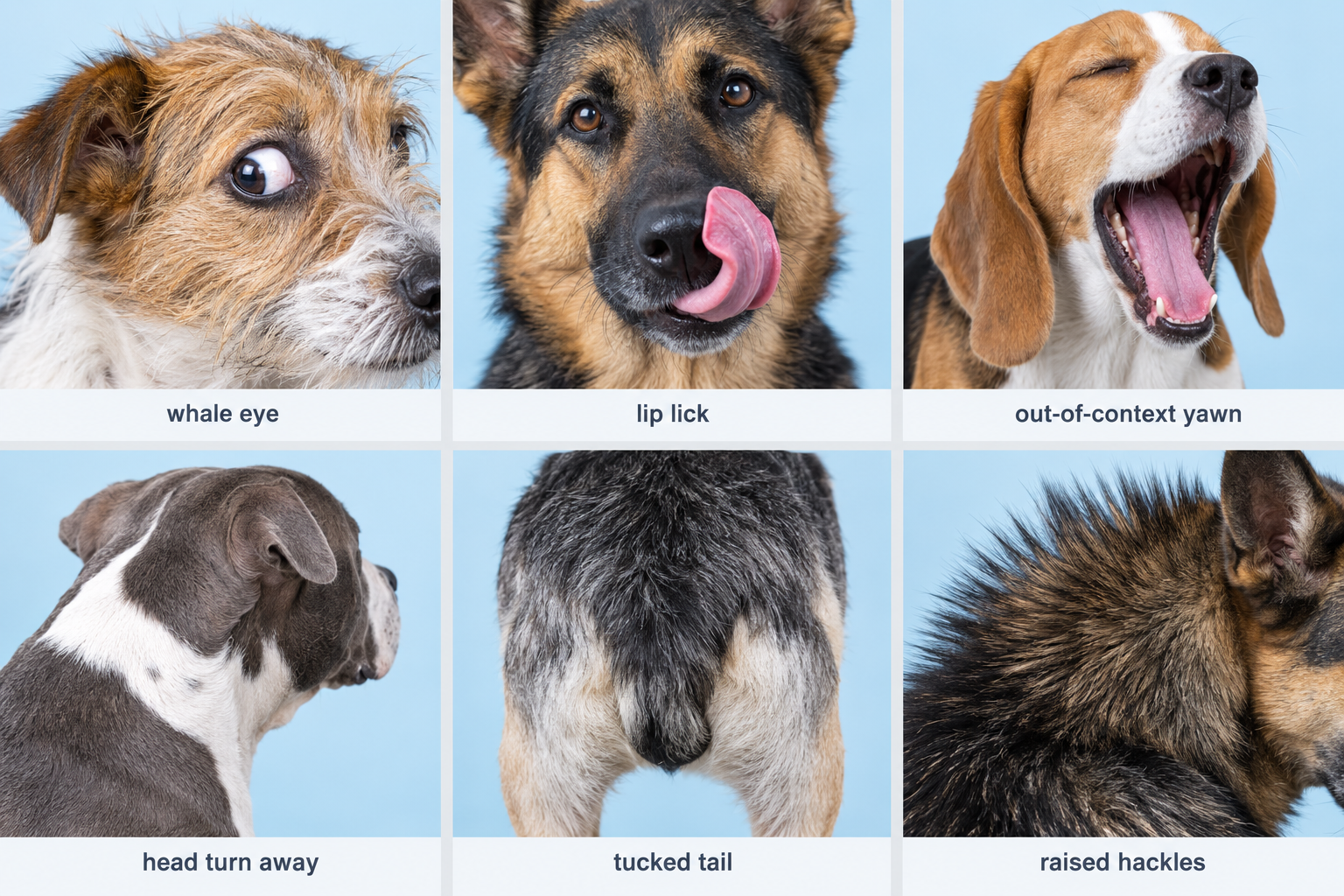
Whale eye. The dog turns the head away while the eyes stay on you, showing a crescent of white at one corner. It often appears during hugs, during grooming, or over a chew. Stop what you are doing and move back rather than leaning in for the photo.
Repeated lip or nose licking. A flick of the tongue over the nose with no food in the room. Guidance from Dogs Trust on canine body language treats repeated licking outside a food context as possible discomfort or an attempt to reduce social pressure, and notes it is not diagnostic alone. Check whether the dog is also avoiding eye contact, stiffening, or trying to leave.
Out of context yawning. A long yawn from a wide awake dog in a tense moment is conflict, not sleepiness. Vet lobbies, nail trims, a visiting toddler, a raised voice. Yawning while a child drapes over the dog is a signal worth acting on immediately.
Turning the head or body away. The dog breaks eye contact, angles the shoulder, or walks a small curve around a person or another dog. This is one of the most polite things a dog can do and one of the most ignored. Let the dog complete the move.
Freezing. Everything stops. Chewing pauses, breathing shallows, the body goes quiet mid motion. A freeze over food, a bone, or a resting spot is a late signal and deserves immediate distance. Do not reach in to take the item.
A tucked tail. Pulled tight under the belly, often with a lowered body and flattened ears. Fear, not guilt. Tail carriage varies by build, so compare with the dog’s own normal rather than a generic dog tail position chart.
Pinned ears, and the forward version. Ears flattened back and low usually mean fear or appeasement. Ears pushed hard forward with a stiff body and a hard stare mean the dog has locked on to something and arousal is high. Ears that swivel back briefly while the body stays loose are closer to mild uncertainty or listening behind. Breed shape matters, so a cropped or heavily feathered ear needs more attention to the rest of the body. If you want the adjacent question, we looked at why dogs tilt their heads and what it can really mean.
Raised hackles. The hair along the shoulders or the base of the tail stands up. It is largely involuntary and indicates arousal, which can be excitement, alarm, or conflict. Hackles up plus a loose wiggly body is a different situation from hackles up plus a freeze.
The stiff, high, fast wag. Tail held above the spine, ticking in short rapid arcs, hips still. Tension in a wagging tail is the single most misread item in dog body language, which is why it gets its own section below.
A lifted front paw. One paw raised while standing or sitting. Often uncertainty or appeasement, sometimes the start of a pacing pattern, and sometimes a dog taking weight off a sore limb. Watch whether it happens on one side only, every time, on hard ground.
Shaking off while completely dry. The full body shake you see after a bath, performed with no bath involved. It commonly appears at the end of a tense interaction, a handling session, or a greeting. Treat it as a reset marker and a hint that the previous thirty seconds were more than the dog wanted.
The low growl. The one owners most want to correct. A growl is information. Educational material from Fear Free Pets in September 2026 framed a growl in a veterinary setting as useful data about the dog’s emotional state, handling tolerance, and perceived threat, with the recommended response being a changed handling plan rather than suppression of the sound. Punish the growl and you keep the fear while deleting the smoke alarm.
| Body part | Relaxed | Stressed | Fearful | Warning |
|---|---|---|---|---|
| Eyes | Soft, blinking | Scanning, wide | Whale eye, looking away | Hard fixed stare |
| Ears | Neutral, mobile | Flicking back and forth | Pinned flat and low | Pushed hard forward |
| Mouth | Loose, open, easy pant | Lip licking, yawning | Tight corners, closed | Lifted lip, growl, snap |
| Tail | Loose sweep, hips move | Low, uncertain wag | Tucked under belly | High, stiff, fast ticking |
| Posture | Curved, weight even | Pacing, shake offs | Crouched, leaning away | Still, stiff, weight forward |
Can you tell if a dog is in pain from their posture?
Posture can raise the question, but it cannot answer it. Body language of a dog in pain often includes a hunched or tucked abdomen, a lowered head, reluctance to lie down or get up, shifting weight off one limb, a stiff short stride, flinching when touched in one area, restlessness at night, and a new sensitivity to handling that used to be fine.
The signal that matters most is novelty. Veterinary guidance on reading canine body language recommends treating a sudden behavior change as a possible medical problem, since pain, impaired vision or hearing, neurological disease, aging, and cognitive dysfunction can all make a previously tolerant dog defensive. Carter estimates roughly 30% of her current behavior caseload involves an underlying pain issue. That is her clinical caseload rather than a general prevalence figure, and it still argues for a vet exam before a training plan.
Decision rule: if growling, snapping, handling sensitivity, withdrawal, or sleep changes are new within the last few weeks, book the vet first. Grooming is a common place these signs surface, since it involves handling every part of the body, and our beginner’s guide to dog grooming covers how to keep sessions short and readable.
How do dogs show they are uncomfortable with people?
Dogs usually show discomfort with people by trying to end the interaction politely: leaning away, turning the head, licking the lips, freezing, moving behind furniture or an owner’s legs, or standing with a stiff tail and a closed mouth while tolerating a stroke they never asked for.
Common human triggers worth watching:
- Hugging, kissing the face, or lying on the dog
- Reaching over the head to pet, especially from a stranger
- Approaching a dog who is resting, eating, or holding a chew
- Crouching face to face and making direct eye contact
- Fast approaches from children at head height
Bite prevention guidance for families from the Animal Medical Center and from MedVet’s family safety advice both put adult supervision at the center of the household rules. Children and dogs should never be left alone together, and that applies to the gentle family dog who has never growled. Teach the consent test instead: pet for three seconds, stop, and see whether the dog asks for more. If the dog moves away, the answer was no.
Training approaches should match that logic. Singapore’s Animal and Veterinary Service published a dog trainer welfare code on October 3, 2026, reported by CNA, built on a Least Intrusive, Minimally Aversive framework that puts positive reinforcement first and requires trainers to address health, environment, and triggers before anything more intrusive. The same update asks groomers to identify fear, stress, and distress and respond, which treats body language reading as a professional competency. If you are starting from scratch with a young dog, the best ways to train your puppy follows the same humane training principles.
Does a wagging tail mean a happy dog?
No. A wagging tail signals arousal and a willingness to interact, and the emotion behind it depends on height, speed, stiffness, and everything else the body is doing. A loose sweep that carries the hips along reads very differently from a high, tight, rapid tick with a frozen spine.
Four things to check before you trust a wag:
- Height. Above the spine means higher arousal. Below means uncertainty or appeasement. Mid height and loose is the easy one.
- Amplitude. Big slow arcs tend to be friendly. Small fast ticks tend to be tense.
- Body involvement. If the whole rear end is moving, the dog is probably loose. If only the tail moves, be careful.
- Breed build. A pug, a greyhound, and a husky all carry tails differently at rest. Compare against the individual.
That last number is the interesting one for a different reason. Owners are clearly hungry for a dog body language chart they can pin to the fridge, and Lili Chin’s illustrated book Doggie Language plus the handout style popularized by the late veterinarian Dr Sophia Yin both made these signals easier to picture. Charts are a good memory aid and a poor substitute for watching the dog in front of you.
What does dog-to-dog body language look like at the park?
Good dog to dog body language is loose, curved, and reciprocal. Dogs approach in arcs rather than straight lines, take turns, pause, and shake off between bouts. Trouble looks straight, stiff, and one sided: one dog advancing head on, the other freezing, flattening, or repeatedly trying to leave while the first keeps going.
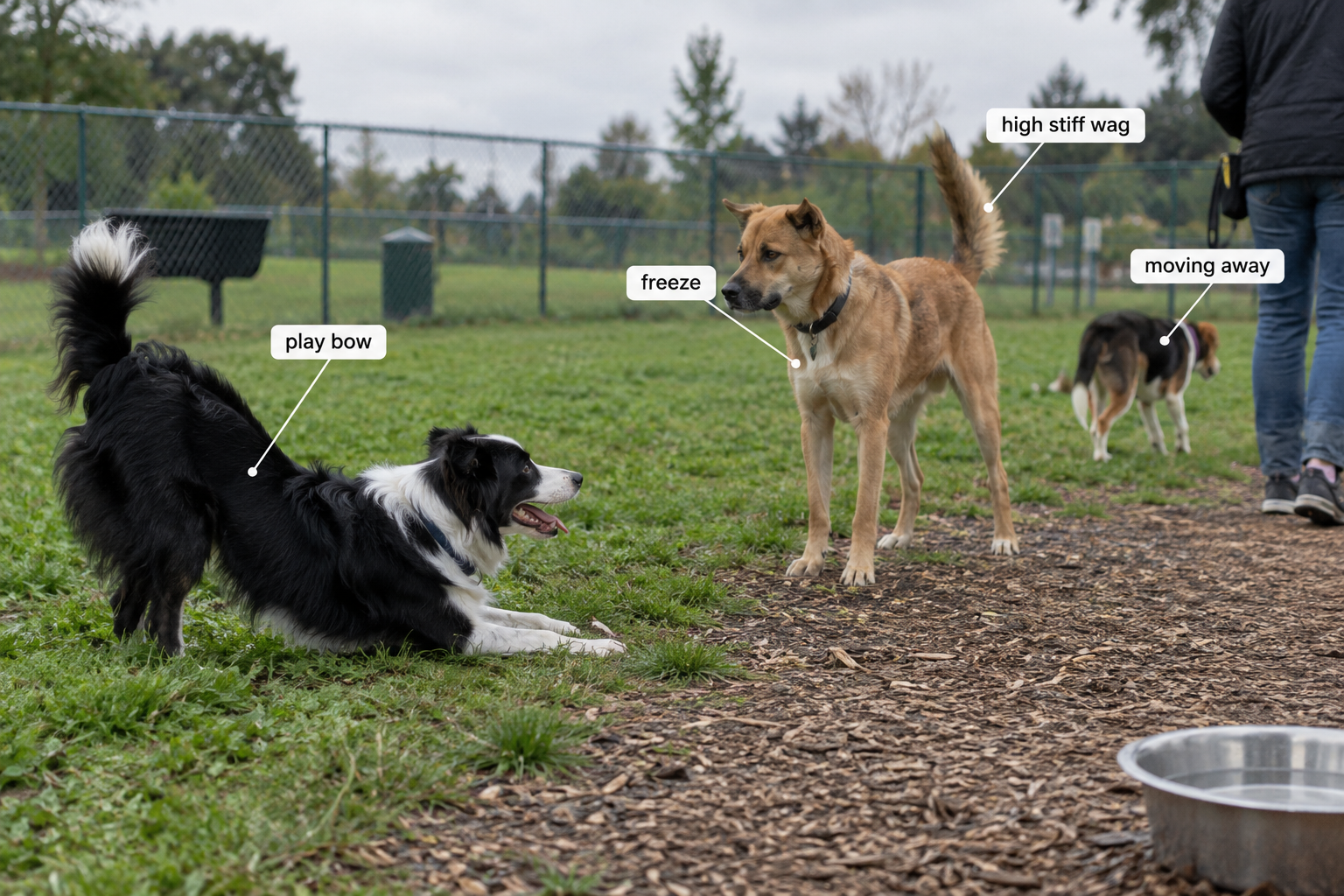
Signals worth scanning for in a group:
- Curved approach, sniff, disengage. Normal greeting. Three seconds is plenty.
- Self interruption. Both dogs pause, then re-engage. Good sign.
- Role reversal. The chaser becomes the chased. Good sign.
- One sided pursuit with a stiff tail. Call your dog and create space.
- A dog hiding under a bench or behind your legs. That dog is done. Leave.
Carrying treats into a crowded enclosure tends to pull every dog toward your pockets, which stacks arousal in one spot. Breed tendencies can shape play style without predicting any individual, and our piece on dog on dog aggression and which breeds start fights sets out what the data does and does not support.
What is the difference between a play bow and a fear posture?
A play bow is front elbows down, rear end up, tail loose and often wagging, face relaxed with an open mouth, and the dog springs back up to continue. A fear crouch lowers the whole body at once, with the tail tucked, ears back, weight shifted away from the trigger, and no bounce afterward.
The tell is what follows. Play bows lead into movement and more interaction. Fear crouches lead into stillness or retreat. Research summaries on canine body language and play signals treat the bow as a play invitation that helps keep rough games readable between dogs.
Researchers at the Family Dog Project in Budapest have spent decades studying dog behavior, cognition, and the human-dog bond, and their work is a reasonable place to look for how these questions get tested rather than guessed.
What should you do when you see warning signals?
Add distance first, then change the situation. Interpreting dog body language is only useful if the next thirty seconds get easier for the dog, so the response order is space, trigger, exit, then professional help if the pattern repeats.
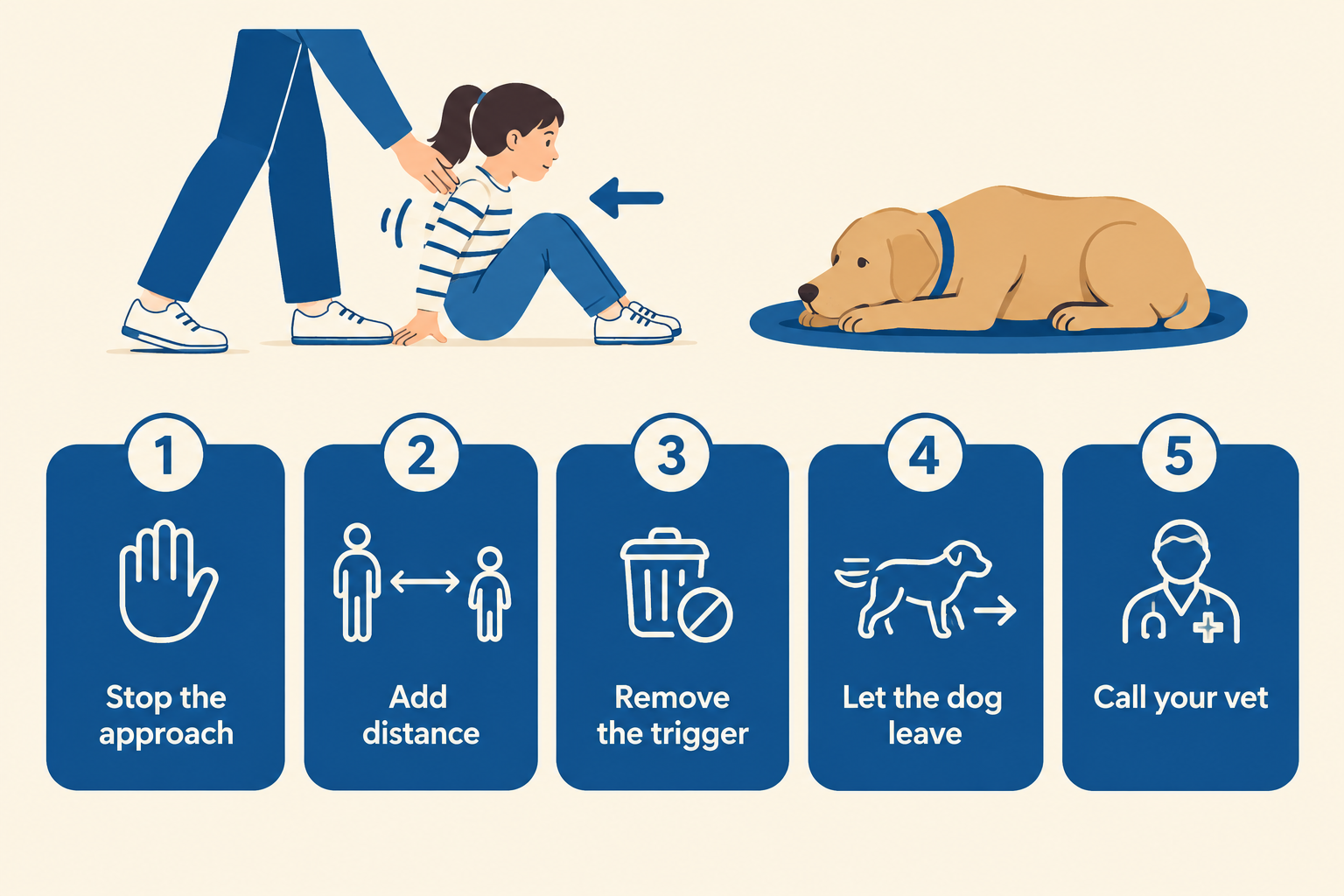
- Stop the approach. Whoever is reaching, leaning, hugging, or crowding stops moving. This includes you.
- Increase distance. Step back, call the dog away, or move the child. Distance does more than any verbal cue.
- Remove the trigger if you can. Put the chew away later, not now. Close the door. Pause the nail trim.
- Give the dog an exit. A dog who can leave rarely needs to escalate. Blocked escape is where fear turns into lunging.
- Book a vet exam for anything new. Then a qualified professional for a behavior plan, ideally a veterinary behaviorist or a trainer working within a least intrusive, minimally aversive framework consistent with American Veterinary Society of Animal Behavior position statements and the welfare based approaches promoted by organizations such as the ASPCA and Fear Free Pets.
Common mistake: correcting the growl. It suppresses the signal and leaves you with a dog who skips to the snap.
Edge case: the “happy” greeter who jumps, wags high, and mouths hands. High arousal and friendliness can occur together, and so can high arousal and a bite. Lower the intensity before deciding which one you have.
Quick example of the sequence in order: a dog on a bed licks his lips when a toddler approaches, then yawns, then turns his head away, then freezes. Four polite warnings. The useful moment to act was the first one.
A note on technology: a September 2026 report on canine behavior research described rising interest in using artificial intelligence to analyze animal communication, including vocalizations. Nothing available now is a consumer ready dog translator. Interpretation still needs context and individual assessment, which means your eyes and your dog’s history remain the best available tools.
FAQ
What does it mean when a dog’s ears go back?
Ears pulled back and flattened low usually indicate fear, appeasement, or stress, especially alongside a tucked tail, lip licking, or a lowered body. Ears briefly swiveling back on a loose, wiggly dog can simply mean listening or mild uncertainty. Ear shape differs by breed, so compare with that dog’s resting position.
Why is my dog yawning so much?
Frequent yawning in an alert dog, particularly in a tense setting such as a vet visit or during handling, is commonly read as stress or conflict rather than tiredness. If the yawning happens at rest, repeatedly, with other changes such as lethargy or appetite loss, treat it as a medical question and call your vet.
What does it mean when a dog licks their lips repeatedly?
Repeated lip or nose licking with no food present often signals discomfort, uncertainty, or an attempt to reduce social pressure. It is not diagnostic alone. Check whether the dog is also turning away, stiffening, showing whale eye, or trying to leave, and if so, stop the interaction.
Do dog sleeping positions mean anything?
Sleeping positions mostly reflect temperature, comfort, and surface. A curled ball conserves heat, a side sprawl and an exposed belly suggest the dog feels safe enough to relax, and a tucked tense curl can indicate cold or unease. A new refusal to lie flat or difficulty settling can point to pain and deserves a vet check. For context on normal rest, see why dogs sleep so much and what the research found.
What is nooking in a dog?
Nooking is an owner term for a suckling or nuzzling behavior, often on a blanket or soft toy, reported most commonly in Weimaraners. It is usually described as self soothing and harmless. Worth a vet conversation if it becomes compulsive, damages teeth or gums, or replaces normal activity.
Is a dog body language chart reliable?
Charts are useful for learning the vocabulary and useless as a verdict. They show typical signals in isolation, while real meaning depends on the whole body, the context, and the individual dog’s baseline. Use a chart to learn names for what you see, then watch your own dog.
Should I ever punish a growl?
No. A growl is a warning that gives you time to act, and suppressing it tends to produce a dog who escalates without notice. Respond by adding distance and changing the situation, then get a vet exam if the growling is new and a qualified behavior professional if it repeats.
Conclusion
Reading dog body language comes down to one habit: watch the quiet signals and respond before the loud ones arrive. The twelve on this list are the ones that get missed because they look like nothing, which is exactly what makes them valuable. Whale eye during a cuddle. A yawn in the vet lobby. A dry shake off after the kids walk past.
One next step, tonight: spend five minutes watching your dog while nothing is happening, and write down three things about their relaxed state. Ear position, tail height, mouth. That is your baseline, and it is the thing that lets you spot the change tomorrow. If something has already changed and you are not sure why, start with the vet rather than the training plan.
That is dog advice that actually answers the question.