
Quick Answer
A dog nose print is the pattern of ridges, beads and creases on the leathery skin of a dog’s nose, and research so far suggests those patterns are individually distinctive, much like a human fingerprint. A 2021 peer-reviewed study of 180 nose images from 60 dogs across 18 breeds reported patterns distinctive enough for identification, and a separate study of 10 beagles photographed monthly found the pattern appeared fully formed by around two months of age and stayed stable through the study. That said, a homemade dog nose print belongs in a frame, a pendant or a tattoo reference folder, not in place of a microchip. Guidance here was checked in October 2026.
Key Takeaways: Dog Nose Print
- A dog nose print records the ridge and crease pattern on the nasal skin, the same way an ink pad records a finger.
- The uniqueness idea has real support: 60 dogs, 18 breeds, 180 images in a 2021 study, plus a 10-beagle stability study. Small samples, promising results.
- One 2021 deep-learning paper reported average Rank-1 identification accuracy of 98.972% on research datasets. That is a controlled benchmark, not a smudged print on printer paper.
- A different, smaller experiment identified 18 of 20 dogs correctly, which shows how much image quality and method change the outcome.
- Microchips remain the standard identification, because scanners and registries such as AKC Reunite already exist everywhere. There is no public canine nose-print database comparable to human fingerprint systems.
- Inkless clean-touch pads are the easiest home method: gentle contact for 2 to 3 seconds, transfer to cardstock, then about 2 hours of drying.
- Air-dry clay gives a raised three-dimensional impression and needs roughly 24 hours to set before painting or sealing.
- Use only pet-safe, non-toxic materials. Skip human art ink, permanent markers and solvent-based products, and wipe the nose clean straight afterward.
- Flat-faced breeds, heavy droolers and wiggly puppies are the hardest subjects. A calm adult dog with a broad nose is the easiest.
- Nose print jewelry and tattoos usually start from a clean photograph, not from the paper print itself.
Is every dog nose print unique?
Probably, based on the evidence available in 2026, but “probably” is doing real work in that sentence. The nose patterns studied so far have been distinctive enough to tell individual dogs apart, and they form early and stay put. What nobody has shown is that the pattern holds up across every breed, age, skin condition and camera angle, in the way a fingerprint database has been tested for a century.
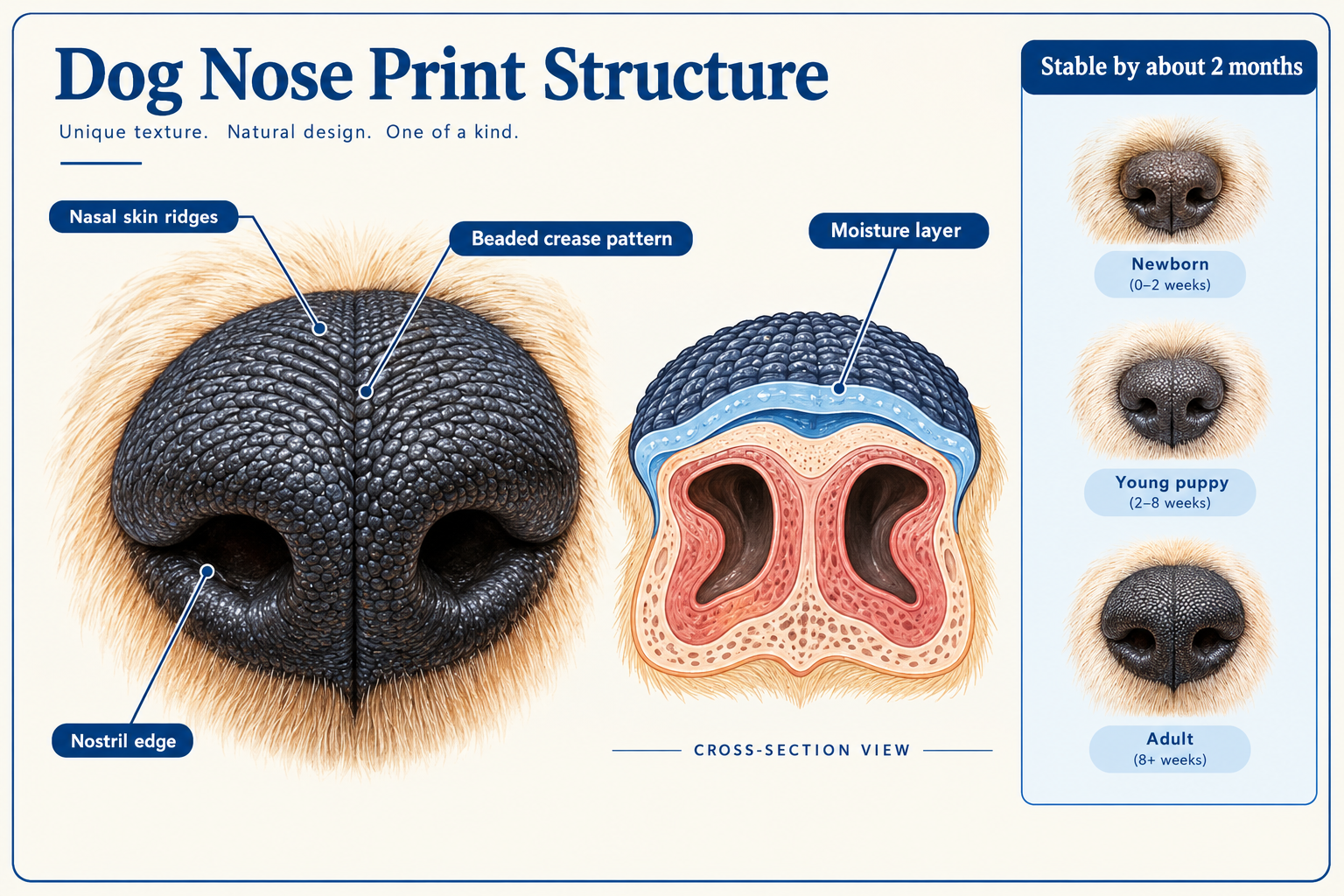
)
What a dog nose print is and how it works
The nose leather, called the rhinarium, is not smooth. Look closely at a dog asleep on the sofa and you can see a surface broken into tiny raised beads separated by fine grooves, with larger creases running toward the nostrils. That texture forms while the dog is developing, and it is the dog nose print you are copying when you press a nose onto paper.
Two things make the nose different from a paw pad. The pattern is finer, and the surface is usually damp. Moisture is the single biggest reason home prints come out as a dark blob instead of a readable pattern.
What the research found
- A 2021 peer-reviewed study analyzed 180 nose images from 60 dogs covering 18 breeds, with images captured at three separate times roughly three to four months apart. The patterns were distinctive enough to support identification across those sessions.
- A longitudinal study of 10 beagles, photographed monthly from two months to 11 months old, reported the nose pattern was fully formed by about two months and did not change during the study.
- A 2021 deep-learning paper reported average Rank-1 accuracy of 98.972% across several datasets and cross-validation runs.
- A smaller image-processing system using YOLO, SIFT and FLANN correctly identified 18 of 20 dogs, about 90%.
Where the facts end
VCA Animal Hospitals describes the nose-print research as limited, while noting the 2021 findings support the underlying idea. Sixty dogs is a reasonable pilot. Ten beagles is a hint, not a law of nature. None of this work tells you whether a scarred nose, a depigmented nose, a sunburned nose or an eight-week-old puppy nose photographed by a shaking hand in a dim hallway will behave the same way.
The pattern looks individual. The paper print you make at home is a keepsake, and the microchip is the identification.
If you enjoy this kind of “the science says yes, with conditions” territory, the same logic shows up in our explainer on what colors dogs can actually see and in why dogs sleep as much as they do.
How are nose prints used to identify dogs?
Nose prints are used mainly through smartphone apps that photograph the nose and match it against a registered image, not through ink on paper. Apps including Petnow have built consumer pet identification around nose-image matching, and Megvii, a Chinese computer vision company, has published work on dog nose recognition. Both approaches depend on a clear, well-lit photo of a reasonably steady nose.
)
Can you use dog nose prints for identification?
In a limited, app-based way, yes. As your main proof of ownership, no. There is no widely established public canine nose-print database equivalent to the AFIS system used for human fingerprints, so a print or photo you store at home only helps if a shelter, vet or app happens to use the same system.
The Canadian Kennel Club question
You will see claims online that the Canadian Kennel Club accepts nose prints as official dog identification. No current policy document confirming that was found while checking this topic in October 2026, so treat it as unverified folklore rather than a fact to rely on. If registration identification matters to you, ask the registry directly which methods they currently accept.
Dog nose print vs dog microchip: which is better?
For getting a lost dog home, the microchip wins, and it is not close. A microchip is permanent, readable by any standard scanner at a clinic or shelter, and linked to a registry such as AKC Reunite. A nose print needs an app, a prior registration, a clear image and someone who thinks to try it.
Where nose imaging has an edge: it is contactless, it needs no implant, and it can work as a second check if a chip migrates or goes unscanned.
Dog nose print alternatives for pet identification
- Microchip plus up-to-date registry details. The registry entry is the part people forget. A chip linked to an old phone number is a dead end.
- Engraved ID tag. Instantly readable by a neighbor with no equipment. Also the thing that falls off in a hedge.
- GPS or Bluetooth tracker on the collar. Useful while the collar is still on the dog.
- Clear recent photographs, including both sides of the body, any markings, and yes, a straight-on nose shot.
- Nose-image app registration as a backup layer.
- DNA record through a breeder or testing service, slow but hard to dispute.
Keep the chip. Add the nose print because you want it.
Which dog nose print method should you choose?
Four methods cover almost everything people actually do at home. The table compares mess, detail and best use so you can pick before you buy anything.
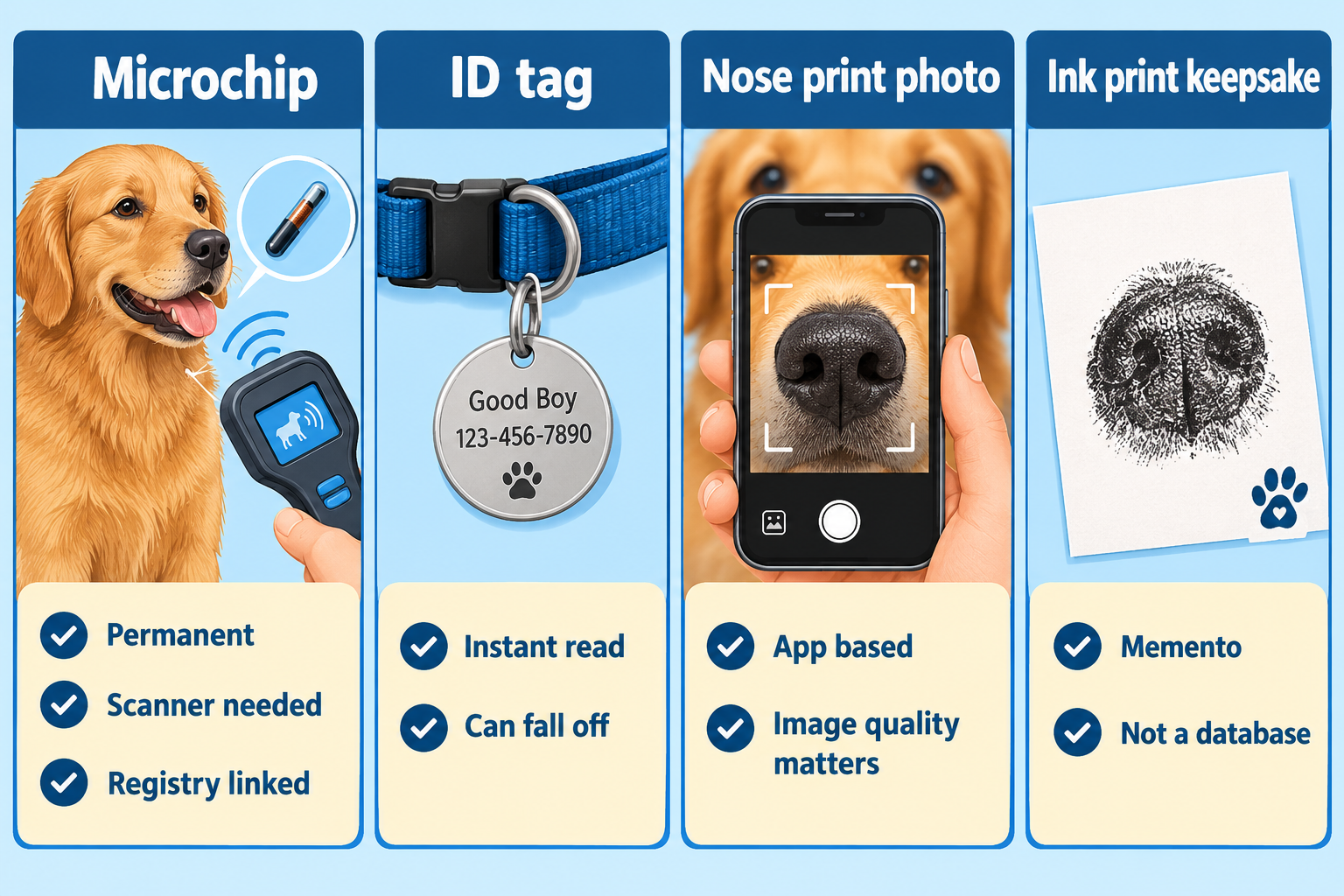
A September 2026 consumer comparison of keepsake kits favored clean-touch inkless pads for the clearest two-dimensional print, which matches what the format is built to do: the dog touches a transfer membrane, not wet pigment.
How do you get a dog nose print at home?
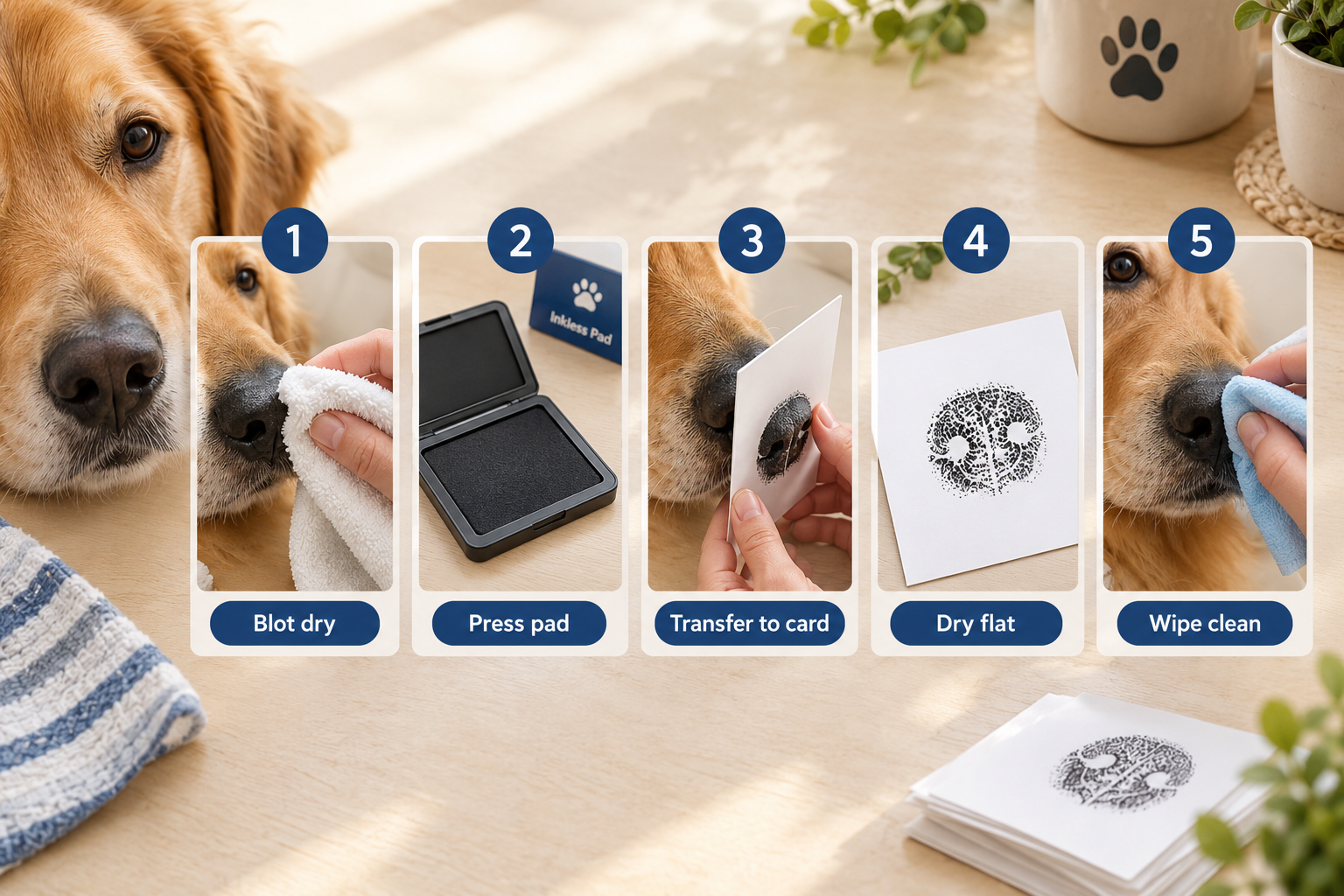
Blot the nose dry, press a pet-safe inkless pad or a thin layer of food coloring against it for a second or two, then transfer the pattern to white cardstock and clean the nose. The whole thing takes under five minutes if the dog is relaxed and roughly four attempts if the dog thinks something interesting is happening.
)
Use the picker below to see the supplies, steps, handling tip and safety note for each method.
Sourced figures worth knowing
180
nose images from 60 dogs across 18 breeds in the 2021 distinctiveness study
2 months
age at which the pattern appeared fully formed in a 10-beagle monthly study
98.972%
average Rank-1 accuracy in a 2021 deep-learning paper, on research datasets
18 of 20
dogs correctly identified in a smaller image-processing experiment, about 90%
2 hours
typical drying time after transferring an inkless print to cardstock
24 hours
approximate air-dry clay setting time before painting or sealing
Where can you buy a dog nose print kit, and what does a professional print cost?
Most buyers get a nose print as part of a paw print keepsake kit rather than a nose-only product, and the honest answer on professional pricing is that no verified standard rate was found, because this is sold as a bespoke service by individual makers rather than a listed procedure.
Places to look, with neutral fit notes:
- Pearhead pet nose print kit and the Pearhead Pawprints kit. Widely stocked and beginner friendly. A retailer listing for the Pawprints four-pack, checked in July 2026, states the non-toxic black ink does not touch the pet’s paws. That clean-touch design is exactly what makes the format appealing for noses too.
- The Nose Print Co Forever Nose Print Kit, one of the few products built specifically for noses rather than paws. See the Forever Nose Print Kit product page for what is included.
- Combination kits such as the MYPAWLETS kit reviewed in September 2026, pairing an inkless pad for a flat print with air-dry clay for a raised one, so the same pattern survives in two formats.
- General marketplaces. Browse dog nose print kits on Amazon or the broader paw print keepsake listings, and compare the options on pad size, number of attempts included, and whether cardstock is supplied.
- Independent reviews. A roundup of the best dog nose print kits and a separate guide to the best dog paw print kits are useful for narrowing the field before you buy.
- Your veterinary clinic. Some practices offer ink nose or paw prints as a memorial service, a practice described in this veterinary guide to ink nose prints. Ask directly, especially around end-of-life appointments.
- DIY from the kitchen. Food coloring and white paper cost almost nothing, and salt dough paw print tutorials adapt easily to a nose impression.
Affiliate note: some links on Doggy Rank IQ earn a commission at no extra cost to you. Our disclosure page explains how that works. Commission never decides a verdict.
Review method for this section: specification and listing comparison plus published consumer guides, checked October 2026. No hands-on product testing was performed for this article, and no kit here is called safe for all dogs.
Why won’t my dog nose print work?
Nine times out of ten the answer is moisture. A wet nose spreads pigment sideways and you get a dark oval with no pattern. Blot first, work fast, and expect several attempts.
Common mistakes to avoid
- Skipping the dry blot. The single biggest cause of blurred prints.
- Too much pigment. A thin film records ridges. A thick coat fills the grooves.
- Pressing the paper too hard, which flattens the beads into a smear.
- Chasing a moving dog. Bring the card to the nose, not the nose to the card.
- Using glossy or coated paper, which will not absorb. Plain white cardstock works better.
- Lifting the card sideways. Lift straight away from the muzzle.
- One attempt only. Set out five cards and treat the first two as practice.
- Forgetting the cleanup. Wipe the nose with a damp cloth as soon as you are done.
How long does a dog nose print last?
The print itself lasts as long as the paper does. Keep it out of direct sunlight, in a sleeve or behind glass, and an inkless print should stay readable for years. Clay impressions last longer once sealed, though they chip if dropped.
The dog’s pattern is a different question. The beagle study found stability from two to 11 months, which is encouraging but short. Scarring, pigment loss and illness can all change nose skin, so a print taken at age two is a record of age two.
What breeds are best for nose printing?
Breed matters less than muzzle shape and temperament. Easiest: calm adult dogs with a broad, accessible nose and a reliable stand, which covers a lot of Labradors, Goldens, hounds and mixed breeds. Harder: puppies who treat the card as prey, heavy droolers whose noses rewet instantly, and very small dogs with tiny nose surfaces.
Flat-faced breeds deserve extra care. If you live with a French Bulldog, Pug or other brachycephalic breed, never press anything against the nose in a way that could block airflow, even briefly. Use the photo method for jewelry and skip the contact print.
A dog who already has a solid stand and a reliable “stay” makes this far easier, which is a quiet argument for the basics covered in our guide to five essential commands every puppy should learn.
How do you turn a nose print into jewelry or a tattoo?
Most jewelers and tattoo artists work from a clear photograph or a high-resolution scan, not the original paper. Take the best print you can get, scan it at 600 dpi or photograph it flat in daylight, then send the digital file.
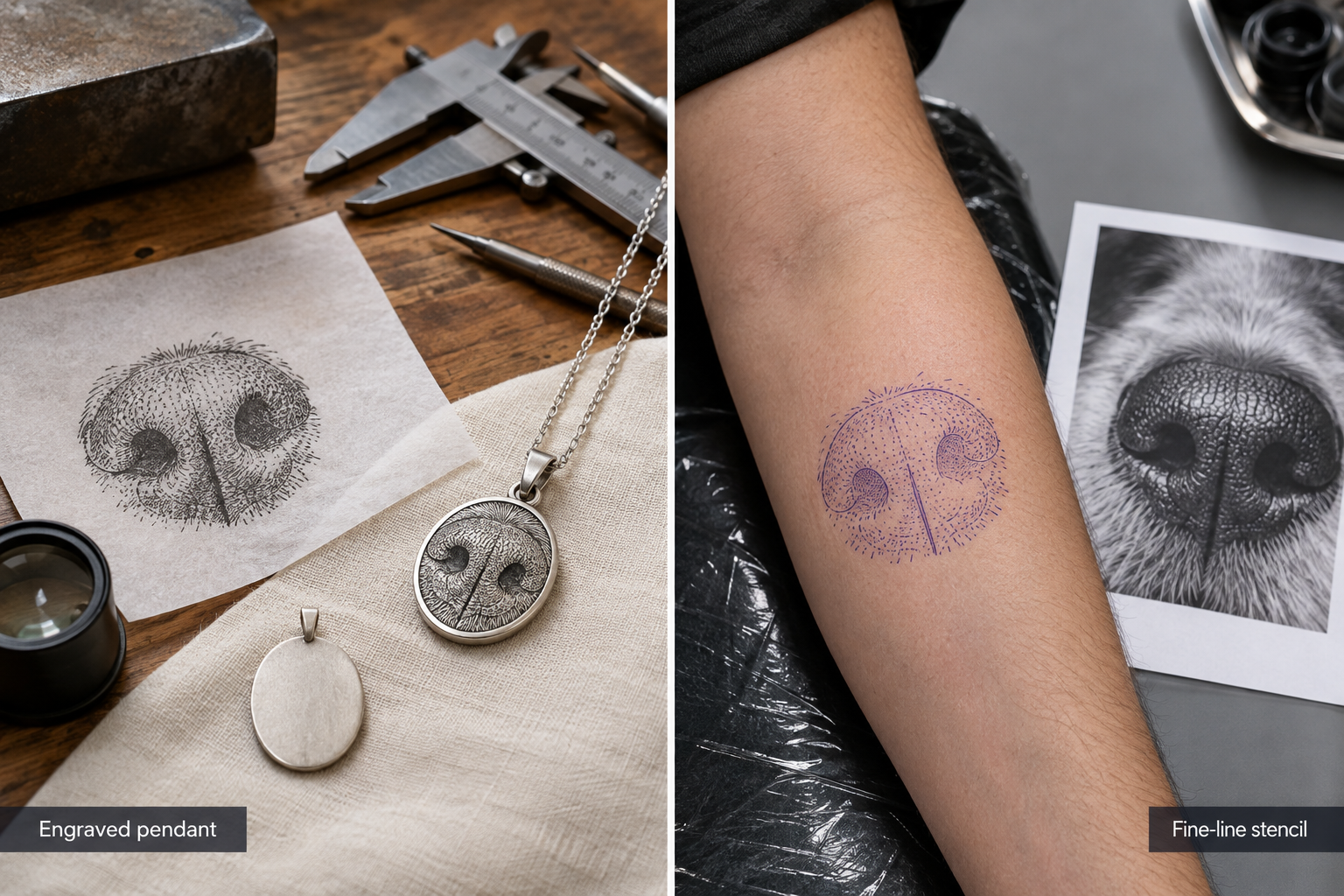
)
What to expect by format:
- Nose print necklace or pendant. Usually laser engraved onto silver, gold-fill or stainless steel. Oval and dog-tag blanks suit the nose shape well. The engraver may clean up the outline, so ask how much they will alter before approving the proof.
- Nose print ring. Smaller engraving surface, so fine beading often gets simplified. Ask for a mockup at actual size.
- Nose print tattoo. Artists typically turn the print into a fine-line or dotwork stencil. Bring both the print and a sharp straight-on photo of the nose so the artist can check the pattern against reality.
- Custom nose print jewelry on Etsy. Many independent makers accept a photo of a print you make at home. Compare proof policies, turnaround and metal options, and ask whether they work from your file or redraw it. Etsy nose print jewelry makers vary widely in how much artistic interpretation they apply.
Pinterest save data collected in 2026 by ScrapeCreators shows nose print keepsake and jewelry pins pulling hundreds of saves, with the strongest around 400. People clearly want this. Sentiment, not science.
Decision rule: choose the engraved pendant if you want the pattern readable, the ring if you want it subtle, and the tattoo if you want an artist’s interpretation rather than a literal copy.
Is it safe to put ink or paint on a dog’s nose?
Only with pet-safe, non-toxic materials used briefly on healthy skin, and even then a clean-touch inkless pad is the gentler choice because the dog contacts a transfer membrane rather than exposed pigment. Human art inks, permanent markers and solvent-based products do not belong on a nose.
Best ink for dog nose prints
Ranked by how much contact the dog has with pigment:
- Clean-touch inkless pads sold for pet prints. No visible pigment on the dog, best detail, easiest cleanup.
- Food coloring, the cheapest route, used in a very small amount and wiped off at once.
- Non-toxic pet-safe stamp pads such as those included in paw print kits. Check the label yourself, since “non-toxic” on a box is a manufacturer or retailer claim, not a veterinary clearance.
- Nothing at all. The photo method keeps the dog’s nose completely untouched.
Avoid anything near the nostril openings, and stop if the skin is cracked, raw, scabbed or depigmented. Ask your vet first if the nose looks unusual.
Is dog nose printing painful or stressful for dogs?
It should not be painful. A dry pad touching nose skin for two seconds is less invasive than a nail trim. Stress is the real variable, and it depends on the dog in front of you rather than the method.
Signs to stop immediately: head turning away, lip licking, whale eye, freezing, backing up, yawning out of context. Humane training applies here too. Reward the approach, keep sessions under two minutes, and accept a messy print over a worried dog. Pairing this with regular gentle grooming handling practice makes the whole thing easier next time.
Never restrain the head, never do it while the dog is sedated for another procedure without the vet’s agreement, and never hold a flat-faced dog’s nose closed.
FAQ
Do dogs have unique nose prints?
Current evidence points that way. A 2021 study of 180 images from 60 dogs across 18 breeds found patterns distinctive enough for identification, and a 10-beagle study found the pattern formed by about two months and stayed stable. Sample sizes are small, so individual distinctiveness is supported but not proven across all dogs.
Can a dog nose print replace a microchip?
No. A microchip is permanent, scannable anywhere and linked to registries such as AKC Reunite. A dog nose print has no equivalent public database and works only through specific apps where the dog was registered in advance.
How accurate is nose print identification?
It depends heavily on image quality. A 2021 deep-learning paper reported 98.972% average Rank-1 accuracy on research datasets, while a smaller image-processing experiment correctly identified 18 of 20 dogs, around 90%. A blurred print on printer paper is nowhere near either figure.
What is the easiest way to make a dog nose print at home?
Blot the nose dry, use a clean-touch inkless pad for 2 to 3 seconds, transfer immediately to white cardstock, and let it dry for about 2 hours. Food coloring on plain white paper works as a cheaper backup.
At what age can I take a puppy’s nose print?
The beagle study suggests the pattern is formed by around two months, so a young puppy’s print should already show real detail. Practically, puppies rarely hold still, so expect more attempts and shorter sessions.
Is it safe to use regular ink on my dog’s nose?
Skip it. Use only pet-safe non-toxic pads or food coloring, avoid permanent markers and solvent-based inks, keep everything clear of the nostrils, and wipe the nose clean afterward. Check the nose with your vet first if the skin looks cracked or sore.
Do nose print tattoos need the paper print?
Usually not. Most artists work from a sharp digital scan or straight-on photograph, then build a fine-line or dotwork stencil from that file.
Will the pattern change as my dog ages?
Possibly. Stability was observed from two to 11 months in one small study, which does not cover a whole life. Scarring, pigment loss or skin disease can alter nose skin, so treat a print as a record of that date.
Conclusion
The science behind the dog nose print is genuinely interesting and genuinely incomplete. Individually distinctive, stable early, promising in computer vision trials, and still a long way from a forensic database. Keep the microchip registration current for identification, and take the nose print because you want the pattern of your particular dog on paper, around your neck, or on your forearm.
One next step: blot your dog’s nose dry, set out five sheets of white cardstock, and take five attempts tonight with a pet-safe inkless pad or a dab of food coloring. Keep the best one, bin the other four, and scan the keeper at 600 dpi before anything gets spilled on it.
If you want more of this sort of thing, our dog science and breed guides hub covers the rest. Dog Advice That Actually Answers the Question.
#dognoseprint #dogscience #petkeepsake