
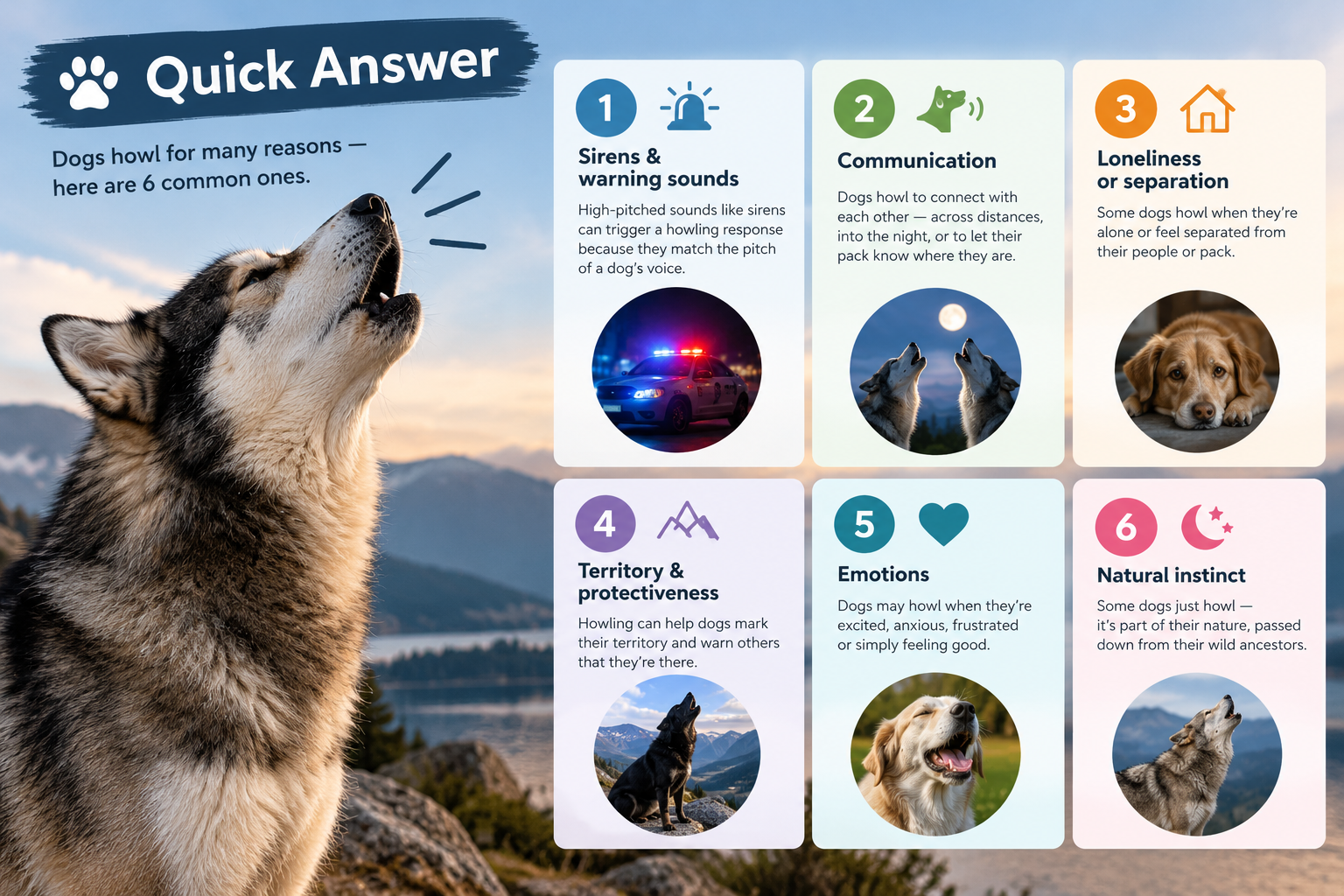
Quick Answer
A howl is a long distance contact call. Wolves use it to find each other and announce their presence, and dogs kept the equipment. So when owners ask why do dogs howl, the useful answer is six overlapping reasons: inherited group communication, a response to siren-like sounds, joining in with music or a human voice, distress at being left alone, learned attention seeking, and discomfort or age-related changes in the brain and hearing. Most howling stops when the trigger stops. Howling that goes on for hours, starts suddenly in an older dog, or comes with destruction and house soiling is the kind worth a veterinary conversation.
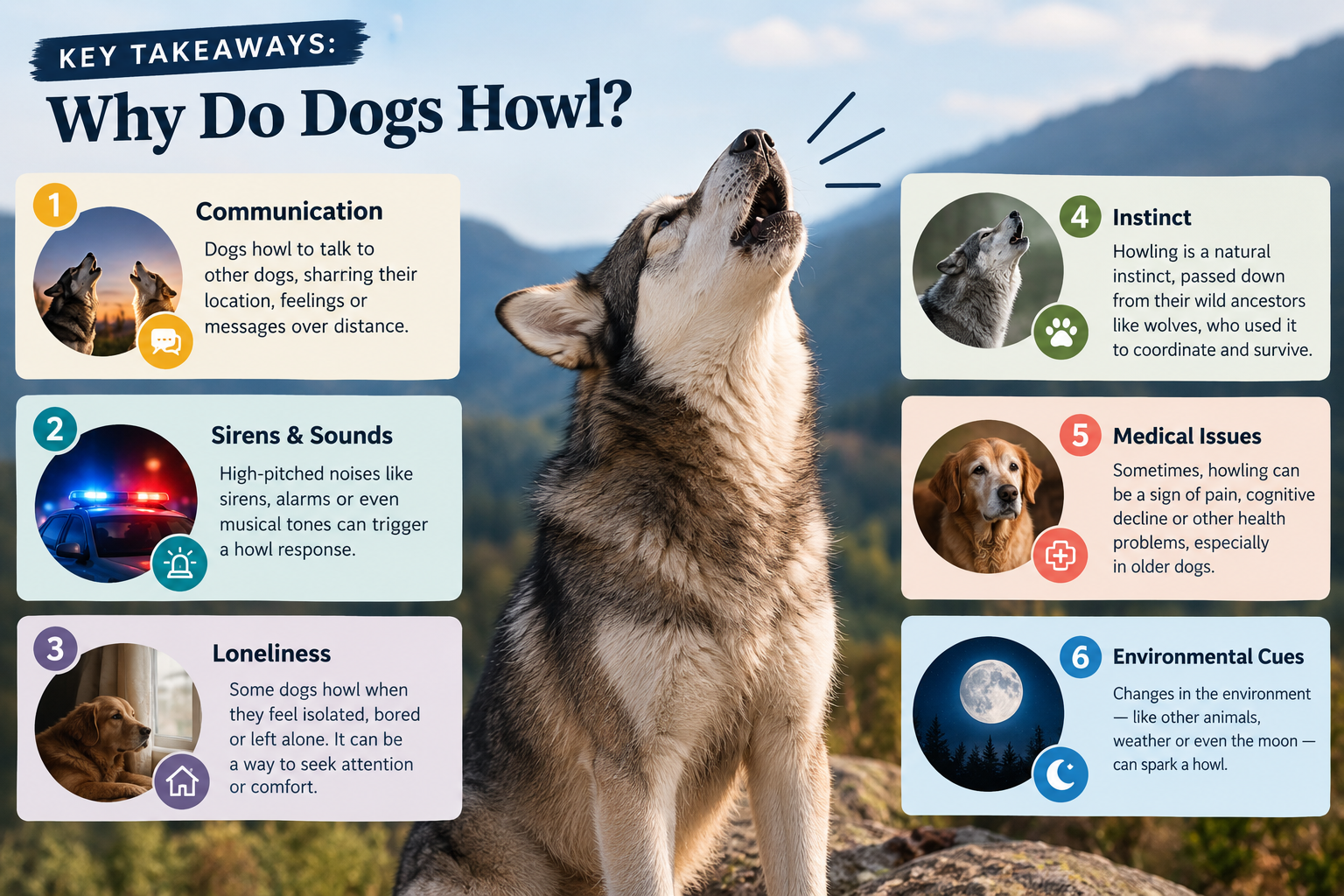
Key Takeaways: Why Do Dogs Howl?
- Howling carries further than barking. It is built for distance, not for the room you are standing in.
- Sirens, alarms, harmonicas and held singing notes share the acoustic shape of a howl, which is the leading explanation for the roadside performance, according to the American Kennel Club’s guide to howling.
- In a 2023 playback study from Eötvös Loránd University led by Fanni Lehoczki, 57.4% of 68 dogs tested made some vocal response to recorded wolf howls, and breeds genetically closer to wolves howled for longer.
- Breed tendencies are real and still individual. A Siberian Husky is more likely to be vocal than a Whippet, which does not promise anything about your specific dog.
- Howling when you leave the house is a different problem from howling at an ambulance. One is distress, one is usually conversation.
- Dogs can howl in their sleep. Twitching, muffled woofs and soft howls during REM are normal.
- New howling in a senior dog deserves a vet visit before a training plan. Hearing loss, pain and cognitive decline all show up as vocal changes.
- No, a howling dog is not announcing a death in the neighborhood. That belief has folklore behind it and no evidence in front of it.
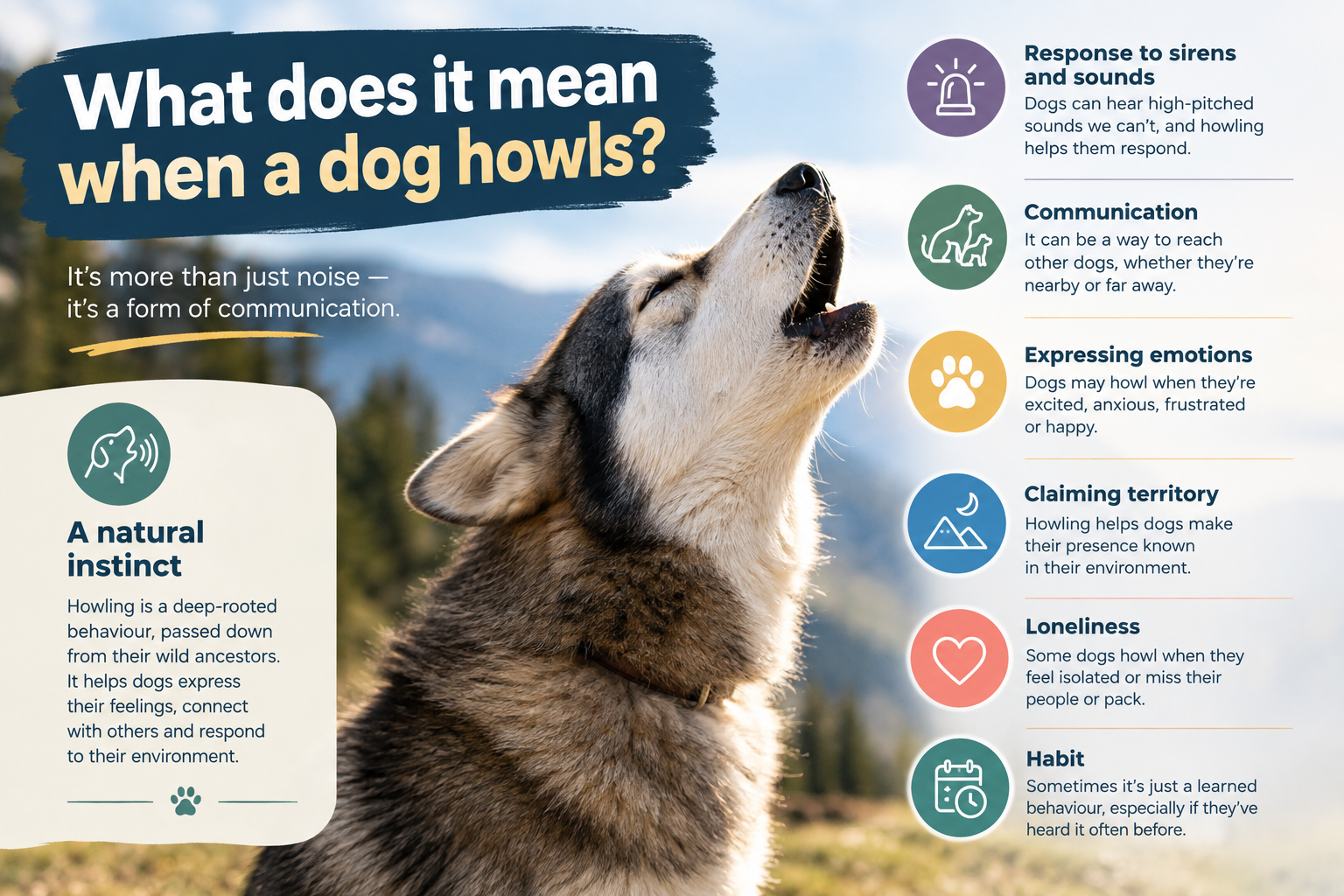
What does it mean when a dog howls?
A howl means “I am here, and something has my attention.” It is a signal designed to travel, so the message is almost always social: locate me, answer me, or back off. The specific meaning depends entirely on what happened in the five seconds before the howl started.
That is why context beats translation apps. The same long note can mean a fire truck went past, or that the dog has been alone since 8am. Veterinary behavior guidance from VCA Animal Hospitals notes a useful pattern: dogs usually stop howling when the triggering sound stops. A howl that outlasts its trigger by an hour is telling you something else.
What’s the difference between howling and barking in dogs?
Barking is short, repeated and close range. Howling is long, tonal and built for distance. Think of a bark as a doorbell and a howl as a flare.
- Barking: sharp, rapid bursts. Alerting, demanding, playing, warning off a courier.
- Howling: sustained notes, often with a rising and falling pitch. Contact, cohesion, answering another howl-like sound.
- Baying: a hound’s drawn out, rolling version, selected in scent breeds so a handler could follow a dog through cover.
- Whining and whimpering: closer range, often about immediate need, frustration or pain.
The 2023 Eötvös Loránd University research found something tidy here: more modern breeds were more likely to bark at wolf howl recordings, while breeds closer to wolf ancestry were more likely to howl back. Same sound, two different answers. If you enjoy reading dogs this closely, the same logic applies to why dogs tilt their heads and what it can actually mean.
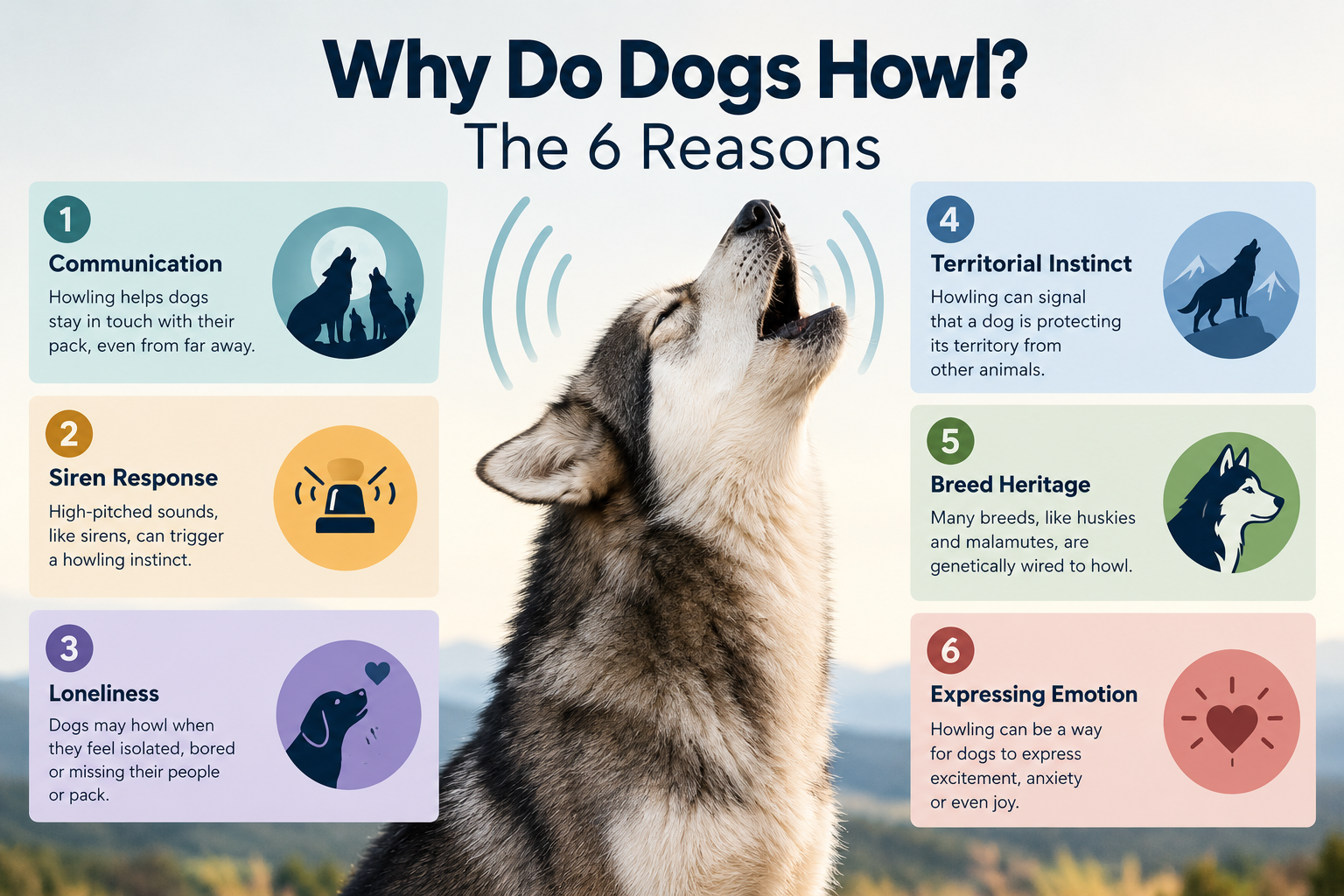
Why do dogs howl? The 6 reasons
Six causes cover nearly all of it. They overlap, and plenty of dogs run two or three at once.
1. Wolf ancestry and long distance contact
Howling is a long range communication signal in wolves and other canids, with functions that include locating group members, keeping a group together, and advertising territory or presence. A 2023 paper in Communications Biology describes those localization, cohesion and territorial roles in canid howling.
Dogs did not get a redesign. The vocal behavior came along with everything else, just applied to a world with doorbells and delivery vans.
Why do dogs howl together in a pack? Group howling keeps scattered animals in contact and makes a group sound larger and more established to outsiders. In pet dogs it is mostly contagious. One dog in a street starts, a second answers, and within thirty seconds three gardens are involved. Kennels and boarding facilities see the same chain reaction. It is social, not a crisis.
2. Sirens and other high, sustained sounds
The siren is the famous one, so it gets its own section below. Short version: a long rising and falling tone resembles a howl closely enough that many dogs respond as though they have been called.
Smoke alarm low-battery chirps, reversing beepers, violins, harmonicas, and a toddler’s recorder can all do it. Hill’s Pet notes that sirens and similar sustained sounds can read as howl-like to dogs, which is why the response often looks instant and automatic rather than fearful.
There is a second explanation that sits alongside the first: alerting. PetMD describes howling at sirens as possible territorial or alerting behavior, with the dog announcing that something unusual has entered the area. Because the emergency vehicle always leaves, the dog gets a flawless record. The howl works every time. If you have ever wondered which dogs take neighborhood monitoring most seriously, the same instinct shows up in territorial breeds who guard the house.
3. Music, singing, and when you howl back
Why do dogs howl at music? Held notes and sliding pitches are the closest thing most living rooms have to a canine vocalization. Sung vowels, brass, strings and wind instruments produce sustained tones with changing pitch, which is the acoustic signature a howl carries.
Why do dogs howl when you howl? Because you started it, and howling is a reply-type behavior. In the Eötvös Loránd University playback work, 26.5% of the dogs produced reply-type vocalizations, including howls, bark-howls, moans and yelps. Those were responses to recorded wolf howls, not human impressions, so treat the human version as plausible rather than proven. Most dogs who answer a human howl are being sociable. A small number get agitated. If your dog’s body goes tense, the tail tucks, or the dog leaves the room, stop doing the bit.
Imagined dog dialogue, clearly labeled as a joke: “Heard you. Unclear what we are doing. Participating anyway.”
4. Loneliness and separation
Why do dogs howl when left alone? Because a howl is the call you use when the group has gone somewhere without you. The ASPCA’s guidance on howling describes howling that happens mainly in the owner’s absence, often with pacing, destruction near exits and house soiling, as a possible sign of separation anxiety.
That cluster matters. A dog who howls for four minutes after you leave and then sleeps is bored or mildly unsettled. A dog who howls for ninety minutes, scratches the door frame to splinters, drools onto the mat and cannot settle is distressed, and training the quiet alone will not fix it.
Signs that point to separation distress rather than casual complaint:
- Howling begins within minutes of departure, every time
- Panting, drooling or trembling on video
- Damage focused on doors, windows and crate edges
- Urinating or defecating indoors despite reliable house training
- No interest in a stuffed food toy left behind
A camera settles this argument fast. The Furbo Dog Camera and Petcube both offer bark and howl alerts with timestamped clips, which turns “the neighbor says he cries all day” into usable data. Who it suits: owners who need to know whether howling lasts four minutes or four hours, and when it starts. What the evidence supports: cameras document behavior. They do not treat it. Compare the options on subscription cost and alert sensitivity before buying, and check whether you actually need two-way audio, which some dogs find more unsettling than silence.
5. Attention and learned howling
Some howling is simply a behavior that worked. The dog howled, a human appeared, and a pattern was born.
Dogs are excellent at noticing which of their noises produces staff. If howling has previously earned eye contact, a told-off, a biscuit to shut him up, or a door being opened, the howl has a reinforcement history. Attention-seeking howling tends to happen when you are present but occupied: on a call, cooking, or watching something you wanted to hear.
The decision rule: if the howling happens mostly when a person is in the room and stops the moment attention arrives, treat it as learned. If it happens most when nobody is home, do not.
6. Pain, illness, or cognitive decline
Is dog howling a sign of illness or pain? It can be, especially when it is new. Howling or prolonged vocalizing that appears suddenly, happens at odd hours, or comes with changes in movement, appetite, toileting or sleep deserves a veterinary exam before anything else.
Things that show up as vocal changes:
- Pain, particularly joint, dental, ear or abdominal pain
- Hearing loss, which can make a dog vocalize more loudly and less predictably
- Cognitive dysfunction in senior dogs, often with night waking, pacing and disorientation
- Side effects of a new medication, worth raising with your vet rather than guessing
A 2026 study using behavioral observation audiometry tested untrained dogs with meaningful sounds including a siren, dog barks, dog cries and a plate crash. It reported that older dogs, particularly those over 10, had higher hearing thresholds than younger dogs. Practical meaning: a senior dog’s changing response to sirens, or to your voice, may be about what the ears are receiving. If sleep patterns are also shifting, our explainer on why dogs sleep so much and what the research found is a useful companion read.
Why do dogs howl at sirens? What the research shows
Dogs howl at sirens mainly because a siren sounds like a howl. The tone is long, loud, and sweeps up and down in pitch, which is the acoustic pattern dogs are wired to answer. A second factor is alerting: an unfamiliar moving sound entering the territory gets announced.
What the research found, and where the facts end: nobody has published a controlled study that plays emergency sirens to dogs and measures howling against a matched control sound. As of October 2026, the siren explanation rests on acoustic reasoning plus studies of how dogs respond to real howls. Most online veterinary articles repeat the same four mechanisms: communication, arousal, territorial response and anxiety.
The best available evidence is the 2023 Eötvös Loránd University work led by Fanni Lehoczki. Researchers played roughly three minutes of recorded wolf howls, averaging 50 dB with peaks near 60 dB, to 68 purebred dogs from 28 breeds. Thirty-nine dogs, 57.4%, produced some vocal response. Reply-type vocalizations such as howls, bark-howls, moans and yelps came from 26.5%. Older dogs from breeds closer to wolf ancestry howled longer and showed more stress-related behavior, while more modern breeds tended to bark.
That supports the idea that dogs retain a response to howl-like sounds. It does not prove a dog mistakes a fire engine for a Labrador two streets away. The playback was a wolf, not a Pierce pumper.
A dog who howls at a passing ambulance and then lies back down has told you about the sound. A dog who howls for an hour after the ambulance has gone is telling you about himself.
What breeds are most likely to howl, and do all dog breeds howl the same way?
No, breeds do not howl the same way. Sled dog types tend to produce long, tonal howls with a wide pitch range. Scent hounds bay, which is shorter, rolling and relentless. Many terriers and toy breeds mostly bark. The table below describes typical tendencies, with plenty of individual variation inside every row.
| Breed | Typical vocal style | Why it shows up | Notes for owners |
|---|---|---|---|
| Siberian Husky | Long, musical howls, talkative | Ancient breed group, strong social vocal repertoire | Vocal by default. Hard fit for thin-walled apartments |
| Alaskan Malamute | Deep howls, woos, low barking | Working sled ancestry, group living | Carries a long way. Needs heavy daily exercise |
| Beagle | Bay, plus a sharp alert bark | Selected to signal while trailing scent | Triggered by scent and by other dogs baying |
| Basset Hound | Low, drawn out bay | Trailing hound with a carrying voice | Lower energy than the volume suggests |
| Bloodhound | Heavy, resonant bay | Bred for long distance tracking work | Large, strong and loud. Check local noise rules |
| Coonhound types | Open trailing bay, treeing bark | Selected to vocalize continuously on a trail | Night vocalizing is common without daily work |
Breed is a starting point, not a prediction. Plenty of Huskies are quieter than the neighbor’s Chihuahua. If noise tolerance is part of your decision, our guide to the best dogs for first time owners is a more honest filter than a breed stereotype, and dog size categories explained helps if a Malamute is on your shortlist.
Four numbers worth knowing
57.4%
of 68 dogs made some vocal response to wolf howl playbacks (Lehoczki et al., 2023)
28 breeds
represented in that study, tested at about 50 dB average volume (Communications Biology)
160 dogs
in the controlled noise aversion field study behind a 2026 FDA approval (DVM360, 2026)
Age 10+
dogs showed higher hearing thresholds in a 2026 behavioral audiometry study using siren and bark stimuli (PMC, 2026)
Why do dogs howl at the moon, and does howling mean death?
Dogs do not howl at the moon. They howl at night, and the moon happens to be there. Moonlight makes a howling dog visible, which is how a striking image became an explanation.
Night howling has ordinary causes: sounds carry further in cool, still air, other dogs answer, the household has gone quiet, the dog is under-exercised, or something hurts. Older dogs with disrupted sleep may vocalize more after dark. None of that requires lunar involvement.
When a dog howls, does it mean death? No. The belief appears in folklore across several cultures and has no evidentiary support. Dogs have good hearing and a strong sense of smell, and they notice changes in a household before people do, which may be where the story started. Noticing is not predicting. If your dog’s vocalizing has changed suddenly, the useful response is a vet appointment, not a superstition. Dogs perceive the world differently from us in measurable ways, which is worth understanding properly: see what colors dogs can see, and what the research actually shows.
Are dogs happy or sad when they howl?
Neither label fits every howl. Howling is a communication tool, and tools are emotionally neutral until you see the body using them. A relaxed dog joining a siren and a panicked dog alone in a hallway are both howling, and they are not having the same day.
Read the rest of the dog:
Relaxed or sociable howling
- Loose body, soft eyes, easy tail
- Stops when the trigger stops
- Dog returns to normal activity within a minute
- Sometimes approaches you mid-howl, tail moving
Distress howling
- Tucked tail, flattened ears, panting, trembling
- Pacing, scratching at exits, drooling
- Continues long after any trigger
- Will not take food or engage with a toy
Is howling normal dog behavior or should I be worried? Howling itself is normal. Worry about frequency, duration, context and change. A once-a-week siren answer is normal. Daily hour-long howling, howling that appeared in the last month for no clear reason, or howling in a dog who seems otherwise off, is worth investigating.
How do you stop excessive howling kindly?
Start by identifying the trigger, then change the trigger or the dog’s response to it. Punishment suppresses noise without addressing the cause, and in a distressed dog it tends to make everything worse.
A practical sequence:
- Log it for one week. Date, time, duration, what happened immediately before, who was home. Three lines in a notes app is enough. Patterns usually appear by day four.
- Rule out pain and hearing changes. Especially in dogs over seven, and in any dog whose howling is new. This step comes before training, not after it.
- Reduce the trigger where you reasonably can. White noise or a fan can soften distant sirens. Moving a bed away from a street-facing window helps. Replacing a chirping smoke alarm battery costs almost nothing.
- Reward the quiet. Mark and feed the moment the howling pauses, then gradually extend the quiet interval before the reward. For siren-triggered howling, start feeding at the first distant note so the sound predicts food instead of a vocal duty.
- Remove the payoff for attention howling. No eye contact, no talking, no snack while howling. Then reinforce calm heavily when it appears. Expect a few louder days before it drops, because the dog will test the old method first.
- Add real enrichment. Sniffing walks, food puzzles, scatter feeding, chew time and short training sessions. Under-exercised hounds and sled dogs are reliably loud dogs.
- Call in qualified help for separation distress, suspected pain, or howling that is affecting neighbors and your sleep.
Can you train a dog not to howl?
You can reduce howling substantially and teach a reliable quiet cue. You cannot delete the behavior, and nobody honest will promise that. Howling is a normal part of canine vocal communication, and in breeds selected for it the voice is part of the package.
Reasonable goals: shorter episodes, fewer triggers, a dog who settles on cue, and nights that stay quiet. Unreasonable goals: a Bloodhound who never bays.
A note on gear. Shock collars and citronella collars are sold as howling fixes. They work by making the dog uncomfortable, which can increase anxiety and create new problems, including fear of the situations where the collar fired. Humane training and veterinary behavior support are the better route, and they address the cause rather than the volume.
When should you call a vet about excessive howling?
Call your vet when howling is new, intense, or accompanied by other changes. Specifically:
- Howling that began in the last few weeks with no obvious trigger
- A senior dog howling at night, pacing, or seeming disoriented
- Howling alongside limping, reluctance to be touched, appetite change, vomiting or increased drinking
- Howling when alone with destruction, drooling or indoor soiling
- Any dog who seems unable to calm down after the sound has passed
- A dog who has stopped responding to familiar sounds, which may indicate hearing loss
Your vet can rule out pain and medical causes, then refer to a veterinary behaviorist or a qualified behavior professional if needed. Treatment plans may combine environment changes, behavior modification and, in some cases, medication.
One 2026 development worth knowing about: on May 6, 2026, the US Food and Drug Administration approved Tessie (tasipimidine oral solution), described as the first drug approved for both canine noise aversion and separation anxiety. It is prescription only and given about an hour before a predictable trigger. Supporting evidence included a controlled field study of 160 dogs with noise aversion and an eight-week study of 224 dogs with separation anxiety. Two limits matter. The approval is not siren-specific, and ordinary siren howling does not call for medication. Orion Animal Health has indicated US availability is expected by mid-2027, so an approval date is not a pharmacy date. Guidance checked October 2026.
FAQ
Why do dogs howl in their sleep?
Dogs dream, and during REM sleep the brain can activate vocal and muscle patterns. Sleep howls, muffled barks, twitching paws and soft whimpers are normal. Leave the dog alone unless the episode looks like a seizure, with rigid limbs, loss of bladder control, or confusion on waking, which needs a vet.
Why do dogs howl at night?
Usually because sound travels further in still night air, other dogs answer, the household has gone quiet, or the dog has unspent energy. In senior dogs, night vocalizing can signal pain, hearing changes or cognitive decline and should be checked by a vet.
Why do husky dogs howl so much?
Siberian Huskies belong to an ancient breed group with a broad social vocal repertoire, and the 2023 Eötvös Loránd University study found breeds genetically closer to wolves howled for longer in response to howl playbacks. Individual variation still applies, so some Huskies are far quieter than their reputation.
Why do dogs howl when you howl at them?
Howling is a reply-type behavior, so a howl-like sound invites an answer. Most dogs who join in are being sociable. Stop if the dog shows tension, a tucked tail, or leaves the room.
Do dogs howl because they are lonely?
Sometimes. Loneliness and separation distress are among the six main reasons dogs howl, and the pattern to look for is howling that begins soon after you leave and continues, often with pacing, scratching at exits or indoor accidents. Howling at a siren while you are sitting on the sofa is not loneliness.
Why do dogs howl when another dog howls?
Group howling maintains contact and advertises presence in wild canids, and it is contagious in pet dogs. One dog starting often sets off several others within earshot, which is why kennels can go from silent to deafening in seconds.
Will a bark collar stop howling?
It may suppress the sound while adding discomfort or fear, and it does nothing about the cause. Trainers and veterinary behavior professionals generally advise against aversive collars for vocalizing. Identify the trigger, use humane training, and get a veterinary assessment if distress or pain is possible.
Is it bad to let my dog howl at sirens?
For most dogs, no. If the dog settles once the siren passes, the howl is simply an answer to a sound. Intervene if the episodes are long, if the dog appears frightened, or if neighbors are affected.
Conclusion: one clear next step
Howling is one of the oldest things a dog does, and most of the time it means your dog heard something and answered it. The research supports a response to howl-like sounds, strong effects of breed ancestry and age, and a clear line between a sound-triggered howl and distress when left alone. What the evidence does not support is a single universal cause, a moon connection, or anything to do with death.
Your next step takes a week and costs nothing: keep a howling log. Date, time, how long it lasted, what happened right before, and whether anyone was home. Bring that page to your vet if the howling is new, if your dog is 10 or older, or if it happens mainly when you are out. A dated log turns a vague complaint into something a professional can actually work with, which is how you get dog advice that actually answers the question.
#dogbehavior #whydodogshowl #humanetraining