
What colors can dogs see? Mostly blue and yellow, not the red and green that dominate a human’s view of the world.
Quick Answer
Dogs see a narrower range of color than humans because their eyes have two types of color-sensing cones instead of three. Research from Neitz, Geist, and Jacobs found peak sensitivity near 429 nanometers (blue-violet) and 555 nanometers (yellow-green). That means dogs likely see blues and yellows clearly, while reds and greens often blur toward gray, brown, or dull yellow. The question of what colors can dogs see has a specific scientific answer, and it is not “none.”
Key Takeaways
- Dogs are dichromats, meaning they have two cone types instead of the human three, according to a 2017 study of 16 domestic dogs by Siniscalchi and colleagues.
- Peak cone sensitivity sits near 429 nm and 555 nm, based on the 1989 behavioral study by Neitz, Geist, and Jacobs.
- A 2025 study of 134 free-ranging Indian dogs found dogs preferred yellow objects over blue or gray, with no preference between blue and gray.
- Dog visual acuity is commonly estimated around 20/75, meaning detail that a person sees clearly at 75 feet, a dog needs to be about 20 feet away to see with similar sharpness.
- A 2026 review of touchscreen studies found dogs can sometimes pass red-green discrimination tasks when lighting and stimulus design are controlled carefully.
- “Dogs see only black and white” is not accurate. The correct description is limited color vision, not complete color blindness.
What colors can dogs see?
Dogs see color, just fewer hues than people do. Their vision leans on blue and yellow tones, with red and green landing somewhere between gray, brown, and dull yellow depending on lighting.
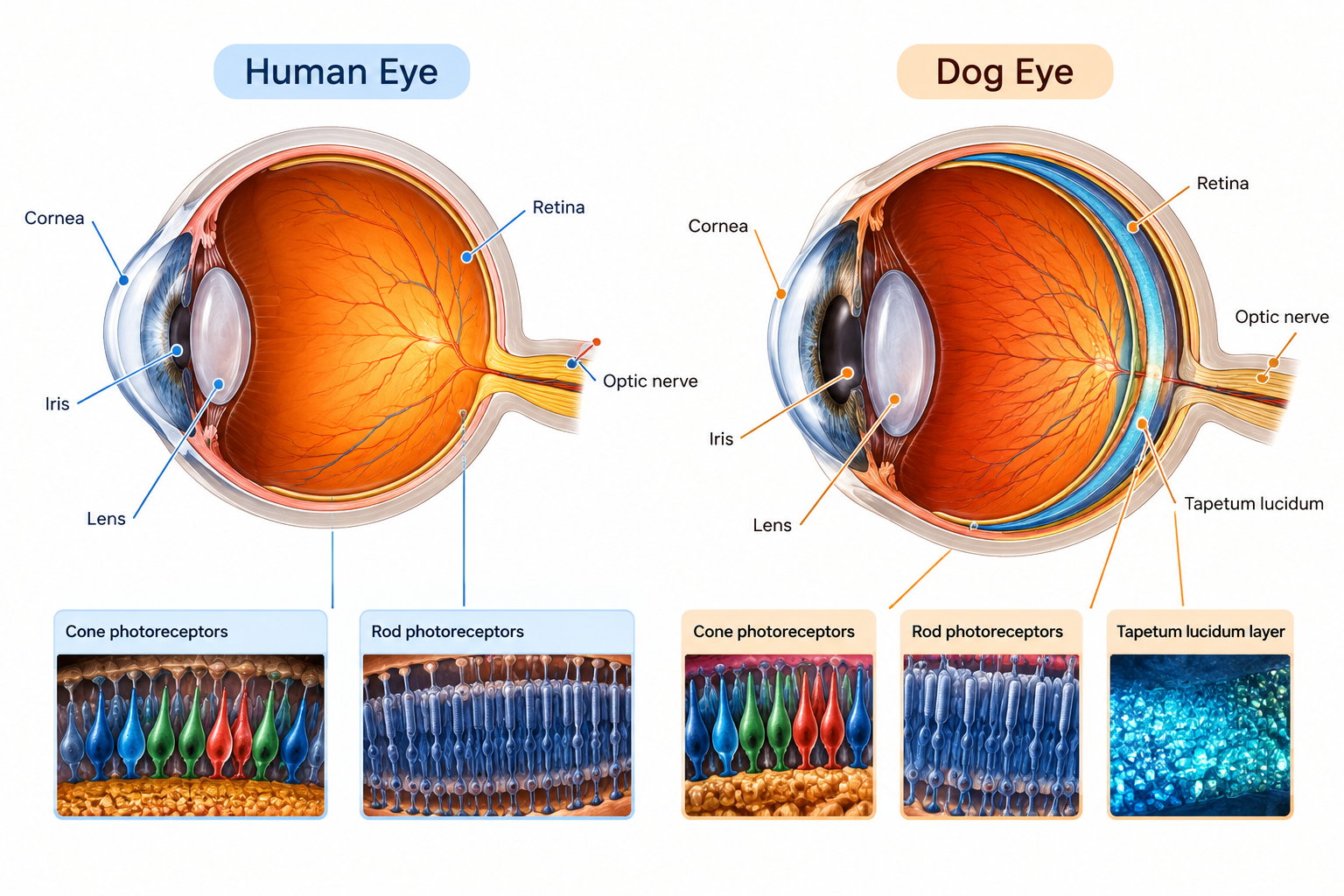
The scientific term is dichromatic vision. Human eyes typically run on three cone photopigment types, tuned roughly to blue, green, and red wavelengths. Dogs run on two. One cone type responds best to short wavelengths around 429 nanometers, which humans would call blue or blue-violet. The other responds best to medium and long wavelengths around 555 nanometers, landing in the yellow-green to yellow range.
That gap between two cone types and three changes everything downstream. A green tennis ball dropped in green grass is not a color puzzle to a dog. It is closer to matching gray socks on a gray carpet. The dog is not confused about where the ball is because it looked. It is confused because the color contrast that helps a human spot the ball instantly barely exists for the dog. Motion and scent close that gap fast, which is a separate story covered further down.
Understanding what colors can dogs see is not trivia. It changes toy choice, training gear, and even how a person interprets a dog’s confused pause at a red frisbee lying on the lawn.
How does a dog’s eye differ from a human eye?
A dog’s eye differs from a human eye in cone count, rod density, and a reflective layer called the tapetum lucidum that humans do not have. Those three differences explain both the color limits and the strong night vision dogs are known for.
Human retinas carry three cone types (short, medium, and long wavelength), which is what makes trichromatic color vision possible. Dog retinas carry two cone types, producing dichromatic vision. Cones handle color and fine detail in bright light. Rods handle motion and low-light sensitivity, and dogs have far more of them relative to cones than humans do.
The tapetum lucidum sits behind the retina like a small mirror, bouncing light back through the photoreceptors a second time. It is the reason a dog’s eyes seem to glow in headlights. It boosts low-light performance and comes at a mild cost to sharpness, since bounced light scatters slightly.
Human vision vs. dog vision
| Trait | Human vision | Dog vision |
|---|---|---|
| Color range | Trichromatic (blue, green, red cones) | Dichromatic (blue-violet and yellow-green cones) |
| Cone types | 3 | 2 |
| Night vision | Weaker, no tapetum lucidum | Stronger, aided by tapetum lucidum |
| Motion detection | Good, cone-dominant in daylight | Very strong, rod-dominant retina |
| Visual acuity | 20/20 baseline | Roughly 20/75, varies by breed and eye shape |
That table is a fast way to see the trade. Dogs give up color range and fine detail in exchange for motion sensitivity and low-light performance. It is a fair trade for an animal built to track a moving rabbit at dusk, less useful for spotting a red toy against green grass at noon.
Why do dogs see blue and yellow but not red or green?
Dogs see blue and yellow clearly because their two cone types are tuned closest to those wavelengths. Red and green fall in a range where dog cones respond similarly to both colors, so the contrast that separates red from green for a human mostly disappears for a dog.
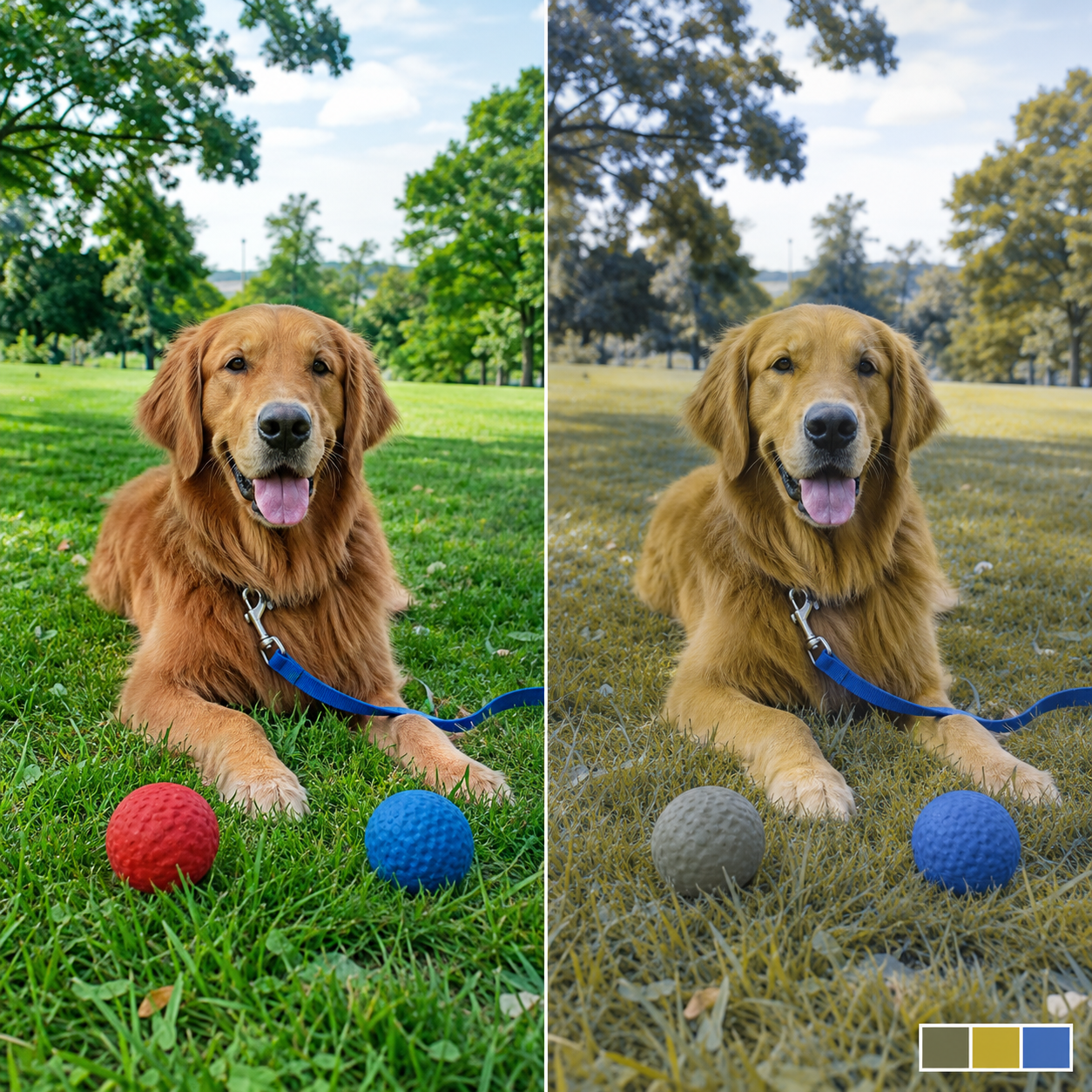
Here is the breakdown, cone by cone.
429 nm cone (blue-violet): This is the short-wavelength cone. It responds strongly to blue and blue-violet light. Objects in this range should look distinctly colored to a dog, similar to how a human sees blue.
555 nm cone (yellow-green): This is the medium-to-long wavelength cone. It responds to yellow-green through yellow light. A yellow ball should register as a clear, high-contrast color for most dogs.
The red-green gap: Because there is no third cone tuned to long-wavelength red light, red and green often stimulate the dog’s two cones in overlapping ways. That does not erase red and green entirely, it just flattens the contrast between them.
A few named numbers worth keeping in mind:
- 429 nm and 555 nm: the two peak sensitivities reported by Neitz, Geist, and Jacobs in their 1989 dichromatic vision study.
- 16 dogs: the sample size in Siniscalchi and colleagues’ 2017 study using modified Ishihara-style red-green stimuli, which found dog responses resembling human red-green color deficiency.
- 134 dogs: the sample in a 2025 study of free-ranging Indian dogs, which found a preference for yellow objects over blue or gray, and no preference between blue and gray.
Do dogs see in black and white or color?
Dogs see in color, not black and white. The old idea that dogs see a grayscale world is a myth that outlived the science that disproved it. What dogs lack is the third cone type that would let them separate red from green the way people do.
Are dogs colorblind completely or partially?
Dogs are partially colorblind in the sense that matters for red-green discrimination, but not completely colorblind. A 2026 review of touchscreen behavior studies found that under controlled conditions with careful lighting and stimulus placement, some dogs could pass red-green discrimination tasks. That finding does not overturn the dichromatic model. It shows the “cannot tell red from green, ever” claim is an oversimplification, not that dogs suddenly see red the way people do.
What does the world look like through a dog’s eyes?
The world through a dog’s eyes leans toward blues, yellows, grays, and browns, with reduced sharpness compared to a human’s view and reduced color separation in the red-green range.
A useful, deliberately playful way to picture it: if a dog could leave a one-line review of a red ball sitting in green grass, it might read something like this (imagined, not a real quote): “location confirmed, texture excellent, cannot confirm redness.” That is humor, not data. The real data says the ball probably reads as a muted, low-contrast shape against the lawn rather than the bright red pop a person notices from across the yard.
Can dogs see ultraviolet light?
The sources reviewed for this article do not confirm ultraviolet sensitivity in dogs with the same certainty as the blue and yellow-green findings, so that claim is left out here rather than guessed at. What is confirmed is the two-cone dichromatic system centered on 429 nm and 555 nm. If a reader sees a claim about dog ultraviolet vision elsewhere, it is worth checking whether that claim traces to a named, linkable study.
How does color vision change what toys, gear, and training cues work best for dogs?
Color vision changes toy and gear choice mainly around contrast, not around picking a dog’s “favorite” color. A blue or yellow toy against green grass gives a dog usable contrast. A red toy on green grass often does not.

Practical picks:
- Fetch toys: Blue or yellow tends to stand out against grass and dirt better than red, orange, or green for a dog relying on dichromatic vision.
- Training targets: A yellow marker or blue mat gives clearer visual contrast against most floor and ground colors than a red one.
- Leashes and harnesses in low light: Since color contrast fades at dusk anyway (rods take over from cones), reflective material matters more than hue at night.
None of this means a dog “prefers” blue emotionally. The 2025 study of 134 free-ranging dogs found a preference for yellow over blue or gray, and no preference between blue and gray, which suggests preference and visibility are not the same question. A dog might like a toy because it is easy to spot, easy to carry, or associated with a good game, not because of the color alone.
Enrichment planning benefits from this same logic. A blue snuffle mat or yellow puzzle feeder is simply easier for a dog to visually locate in a cluttered room than a red one, which matters more for a dog that relies partly on sight indoors under weaker lighting.
Why do vets use certain colored charts for dogs?
Veterinary practices sometimes use blue or yellow-based visual materials for dog-facing enrichment or behavioral testing because those colors sit closest to a dog’s strongest cone sensitivities, making them easier for a dog to distinguish from background colors during an exam or test setup. This is a practical extension of the same cone data, not a separate discovery.
Can dogs see in the dark, and how well do they track movement?
Dogs generally see better than humans in dim light and track fast movement better too, largely because of a rod-dominant retina and the tapetum lucidum reflective layer. Color becomes almost irrelevant in low light for both species, since rods (which detect motion and brightness) do not process color the way cones do.
This is why a dog can spot a squirrel bolt across a dim backyard at dusk far faster than a person standing next to it can. The trade-off already mentioned applies here directly: fewer color-sensing cones, many more motion-and-light-sensing rods. A dog built for finding movement at low light is not the same dog built for spotting a red toy at noon, and that is a fair description of the actual biology, not a personality trait.
What the research does not tell us
The research on canine color vision is solid on the big picture but thinner on individual and breed-level detail. A few limits are worth stating plainly.
- Breed differences are not well established. No source reviewed here confirms that specific breeds see color meaningfully differently from each other. Eye shape and acuity vary by breed, but that is a sharpness question, not a color-range question.
- Individual variation exists but is understudied. Just as some humans have stronger or weaker color perception within normal trichromatic vision, dogs likely vary too, but there is no large dataset breaking this down by individual dog.
- Sample sizes are small. The foundational 1989 study tested three dogs. The 2017 red-green study tested 16 dogs. The 2025 preference study tested 134 dogs, which is a meaningful improvement but still one study, one region, one dog population (free-ranging dogs in India).
- Preference is not the same as visibility. A dog choosing yellow over blue does not automatically mean blue is invisible to it.
If a dog owner notices unusual visual behavior, such as bumping into furniture, hesitating on stairs, or reluctance to play at dusk, that pattern points toward a vision or lighting issue worth mentioning to a veterinarian rather than a color-vision question specifically. Color perception differences are not something an owner can diagnose by watching toy preference alone.
For readers comparing gear and food choices while they are already thinking about a dog’s daily experience, related buying guides worth a look include what makes a dog food good, dog size categories explained, and best dogs for first time owners.
Comparing the color-contrast picture
Fast contrast guide for gear shoppingHigh contrast for dogs: blue toys on green grass, yellow toys on dark floors, blue mats on tan carpet.
Low contrast for dogs: red toys on green grass, green toys on green grass, orange toys on brown dirt.
Based on dichromatic cone sensitivity near 429 nm and 555 nm.
Frequently asked questions
Are dogs completely color blind? No. Dogs have dichromatic vision with two cone types, not zero. They see blue and yellow-green tones clearly, and red and green with reduced contrast, which is different from seeing no color at all.
Can dogs see orange? Orange sits close to the red-yellow boundary, so it likely reads as a duller yellow to a dog rather than a fully distinct orange, based on the same two-cone sensitivity data (429 nm and 555 nm).
Do dogs see TV screens the way humans do? The sources here do not include a dedicated TV-perception study, so this stays limited to what is known: dog color perception is dichromatic and acuity is lower (roughly 20/75), which would likely make screen detail and some colors look less sharp and less varied than a human sees, though flicker and motion sensitivity may make movement on screen noticeable.
Can dogs see red laser pointers? Dogs can likely detect a red laser dot mainly through motion and brightness contrast against the surface, rather than through red as a distinct color, given their two-cone system’s weaker red-green separation.
Do dogs see better than humans at night? Yes, generally. A rod-dominant retina and the tapetum lucidum reflective layer give dogs stronger low-light and motion detection than humans, though this comes with a color-processing trade-off since rods do not carry color information.
How do I know if my dog has color vision problems beyond typical dichromatic vision? There is no simple home test for this, and the research reviewed here does not describe a clinical diagnostic for color-specific problems separate from general vision issues. A veterinarian is the right resource if a dog shows sudden vision changes, bumping into objects, or hesitation in normal lighting.
Do all dog breeds see colors the same way? The core dichromatic model (two cone types, peaks near 429 nm and 555 nm) applies broadly across the species based on existing studies, but no source reviewed here breaks this down by breed, so breed-specific color claims should be treated as unproven rather than confirmed.
Conclusion
The honest answer to what colors can dogs see is blue and yellow with real clarity, red and green with far less contrast, and the whole picture running through a lower-resolution, motion-focused lens than a human’s. The practical move for any dog owner: when buying toys, training targets, or agility markers, reach for blue and yellow first, save red and green for humans who actually benefit from that contrast, and trust that a dog finding its favorite ball in the grass is doing most of the work with its nose and its motion detection anyway.
References
- pmc.ncbi.nlm.nih.gov/articles/PMC5717654
- www.rctn.org/bruno/animal-eyes/dog-vision-miller-murphy.pdf
- www.vin.com/apputil/content/defaultadv1.aspx?id=3866640&pid=11268&print=
- pmc.ncbi.nlm.nih.gov/articles/PMC3730601
- www.akc.org/expert-advice/health/can-dogs-see-color
- www.carecredit.com/well-u/pet-care/what-colors-dogs-see
- www.chewy.com/education/dog/health-and-wellness/can-dogs-see-color
- vcahospitals.com/know-your-pet/do-dogs-see-color