Why do dogs sleep so much comes down to biology, not boredom.
A dog stretched across the same sunbeam for the third time before noon looks like the picture of laziness. It isn’t. Sleep is when a dog’s brain files away the morning’s smells, replays the walk, and gives muscles and immune cells time to repair themselves. Adult dogs spend roughly half their day asleep, and puppies and seniors spend even more, because growth and recovery both run on rest. The short answer to why do dogs sleep so much is that dogs are built to sleep in short, frequent bouts across day and night, and that pattern adds up to a total that looks excessive by human standards but is completely ordinary for a dog.
Key takeaways
- Adult dogs typically sleep around 12 to 14 hours a day, according to PetMD’s review of canine sleep patterns .
- Puppies can sleep 15 to 20 hours a day during rapid growth phases, per the Sleep Foundation .
- Senior dogs often sleep 12 to 15 hours daily, with some reaching 16 to 18 hours, according to the American Kennel Club .
- Dogs sleep in a polyphasic pattern: many short bouts across day and night rather than one long block, as described by the IAABC Foundation Journal .
- Sudden jumps in sleep, especially past a dog’s normal baseline, are a documented reason to check for lethargy or illness, per PetMD and the AKC .
- Puppy brain development research using EEG recordings has tracked age-related changes in sleep architecture between roughly 2 and 6 months old .
- Chewy’s veterinary-reviewed guidance places typical senior dog sleep needs in a similar range to AKC’s findings, reinforcing that aging itself raises rest requirements .
Why do dogs sleep so much?
Dogs sleep so much because their bodies use sleep for growth, memory, and recovery, and because their sleep is naturally broken into many short bouts rather than one long stretch. An adult dog resting for half the day isn’t underachieving. It’s running a normal biological schedule.
Domestic dogs are not nocturnal or fully diurnal. They are polyphasic sleepers, meaning they doze in cycles throughout a 24 hour period instead of committing to one long overnight sleep the way most adult humans do . A dog might nap after breakfast, doze through a quiet afternoon, wake for dinner and a walk, then settle into a longer stretch overnight. Add up those separate naps and the daily total climbs past what looks reasonable to someone used to eight hours in one go.
There’s also a metabolic argument buried in the boredom-looking behavior. Dogs that spend less time expending energy on hunting or sustained activity (which describes most house dogs) still need the same recovery processes their wild relatives use, just with less physical work to recover from. Sleep fills that gap. So does the couch. Genuinely, is it normal for dogs to sleep all day? For most healthy adult dogs, yes, provided the sleep is broken up by normal wake periods for eating, elimination, and some activity, rather than one dog lying motionless from sunrise to sunset without engagement.
How much sleep do dogs need by age?
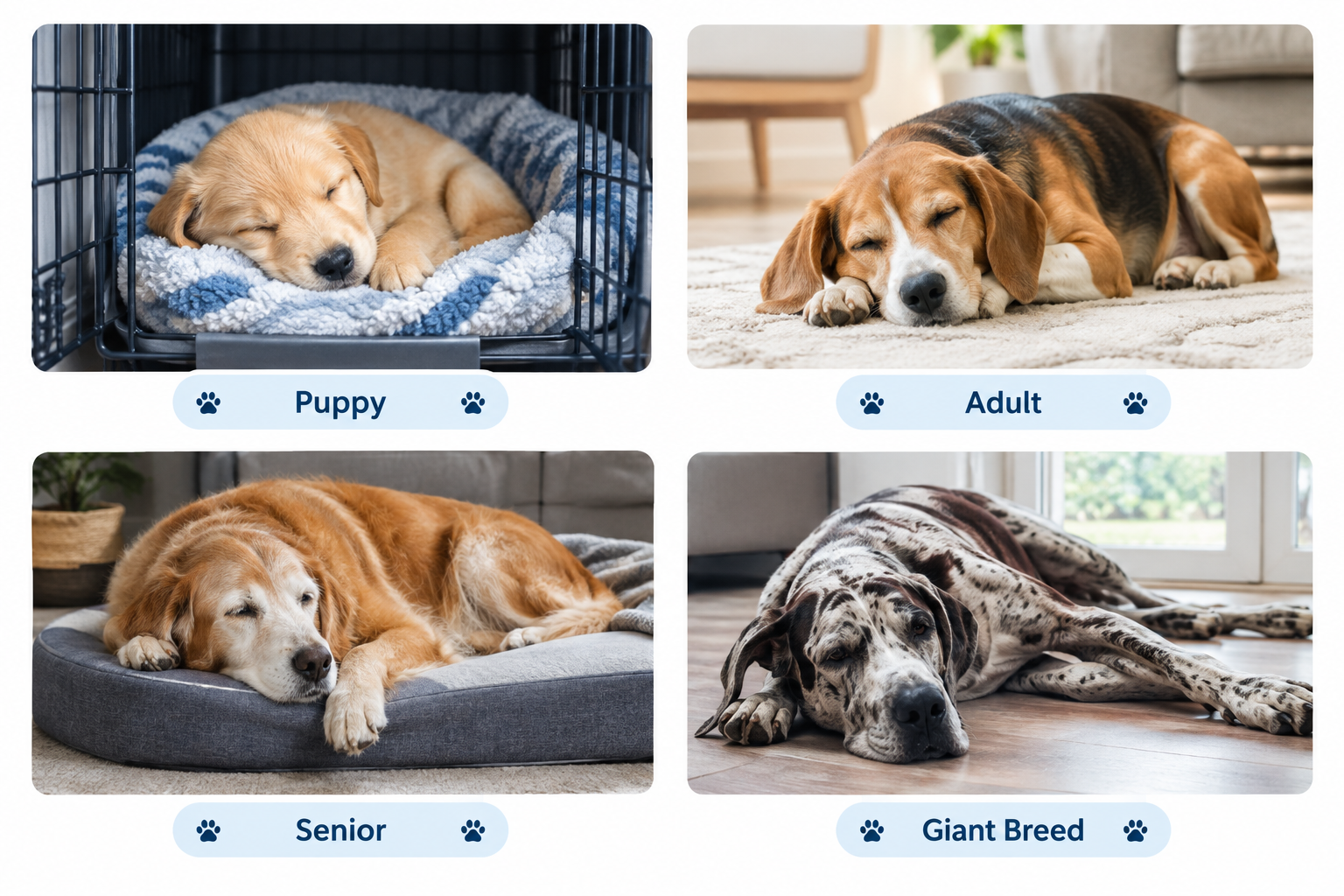
Sleep needs shift with age: puppies need the most sleep for development, adult dogs settle into a stable daily average, and senior dogs often need more rest again as their bodies slow down. How many hours should dogs sleep per day depends heavily on which of these three stages a dog is in.
- Puppies commonly sleep 15 to 20 hours a day, with some sleeping close to the top of that range during growth spurts, according to the Sleep Foundation .
- Adult dogs average 12 to 14 hours daily, per PetMD’s breakdown of canine sleep by life stage .
- Senior dogs frequently return to 12 to 15 hours, and some healthy seniors sleep 16 to 18 hours, according to AKC’s reporting on senior dog sleep .
- Working and high-drive breeds may sleep on the lower end of the adult range when active, but still need consolidated rest to recover from exertion .
- Giant breeds (Great Danes, Mastiffs, and similar) tend to sleep more than average-sized adult dogs, often landing closer to the senior range even at a younger age.
Comparison: sleep needs by life stage and body type
| Life stage / type | Typical hours per day | Notes |
|---|---|---|
| Puppy (under 6 months) | 15 to 20 hrs | Growth, learning, and nervous system development drive the high total |
| Adult, average breed | 12 to 14 hrs | Broken into multiple naps plus a longer overnight stretch |
| Working / high-drive breed | 10 to 13 hrs when active | Shorter daytime naps, longer recovery sleep after exertion |
| Giant breed | 16 to 18 hrs | Larger body mass and faster aging increase recovery needs |
| Senior (7+ years) | 12 to 18 hrs | Range widens with individual health; sudden change beyond baseline needs attention |
Curious how a specific breed’s size and build affect its rest needs? Our dog size categories guide breaks down how small, medium, large, and giant classifications connect to everyday care, including how much downtime a bigger dog’s body actually needs.
What does a puppy sleep schedule look like in the first year?
A puppy sleep schedule starts heavy on sleep and light on structure, then gradually shifts toward adult patterns by around 12 months old. Why do puppies sleep more than adult dogs is mostly a construction-site answer: bones, muscle, the nervous system, and the immune system are all being built at once, and building takes energy that sleep helps supply.
In the first few months, a puppy might be awake for an hour of play and exploration, then asleep for two or three hours, repeated through the day. That’s not a training failure. It’s the same pattern the Sleep Foundation describes as typical for puppies logging 15 to 20 hours of sleep daily . Puppy brain research using EEG recordings has also tracked how sleep architecture itself changes with age, following puppies from roughly 2 to 6 months old and documenting shifts in the proportion of REM sleep as they mature . In plain terms: a 10-week-old puppy’s sleep isn’t a smaller version of an adult dog’s sleep. It’s a different pattern that’s still finishing construction.
Feeding also plays into the schedule. A puppy on a consistent feeding routine tends to settle into naps more predictably, which is one reason good puppy nutrition in year one matters beyond the obvious growth benefits. Full puppies nap. Hungry puppies whine at the door of the pantry at 2 a.m.
By 6 to 12 months, most puppies are trending down toward the adult range, though large and giant breed puppies often keep sleeping heavily longer, because they have more growing left to do.
Why do dogs twitch, run, or bark in their sleep?
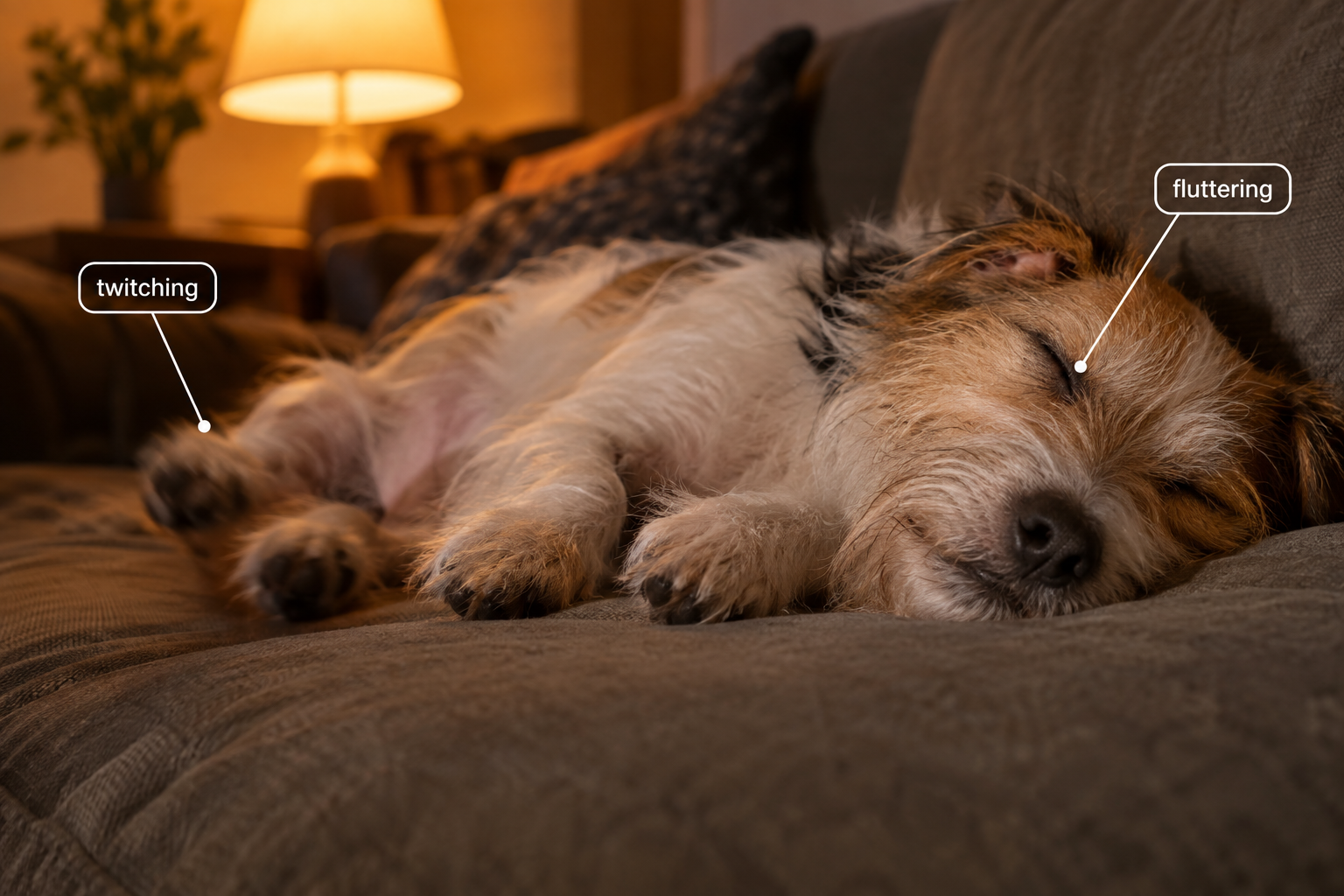
Dogs twitch, kick, and sometimes vocalize during sleep because they’re in REM sleep, the stage associated with dreaming-like brain activity and muscle movement. It’s a normal part of the sleep cycle, not a sign of distress, in the vast majority of cases.
During REM, a dog’s brain activity resembles waking activity in some ways, while the body stays mostly relaxed. Small movements slip through: a paw twitch, a soft huff, eyelids fluttering, an occasional muffled bark. The IAABC Foundation Journal describes this as a normal feature of canine sleep cycling that alternates with deeper, quieter non-REM stages throughout a sleep session . Dogs move through these cycles many times across a single sleep period, which is part of why total sleep time adds up the way it does; short cycles, repeated often, rather than one uninterrupted stretch.
A few numbers worth knowing:
- 12 to 14 hours: the typical adult dog daily sleep total that includes multiple REM and non-REM cycles .
- 15 to 20 hours: puppy sleep totals during the growth window when brain development is most active .
- 2 to 6 months: the age window studied in EEG puppy research tracking how REM proportions shift as puppies mature .
- 16 to 18 hours: the upper range some senior dogs and giant breeds reach .
Occasional twitching is ordinary. Movement that looks violent, involves the dog seeming to thrash, injure itself, or wake disoriented and distressed, is different and worth mentioning to a veterinarian, since that pattern can point to something other than typical REM activity .
Why does my dog sleep at my feet or against me?
Dogs sleep pressed against their owners or at their feet mainly for warmth, security, and closeness to a trusted member of their social group. It’s a comfort behavior rooted in the human-dog bond rather than a random habit.
A dog choosing the narrow strip of floor next to the bed instead of the dog bed three feet away isn’t confused about furniture. Proximity to a person during sleep, the most vulnerable state an animal enters, reflects trust. Some breeds lean into this more visibly than others; dogs with strong guarding instincts may position themselves near an exit or against an owner specifically because part of their instinct is oriented toward monitoring the space. If that sounds familiar, the tendency shows up clearly in breeds discussed in our guide to territorial and guarding dog breeds, where proximity-seeking and alertness often travel together.
There’s a simpler explanation too, and it doesn’t cancel out the first one: body heat. A sleeping human radiates warmth, and a dog curled against a leg or foot gets some of it for free.
When is too much sleep a problem worth a vet visit?
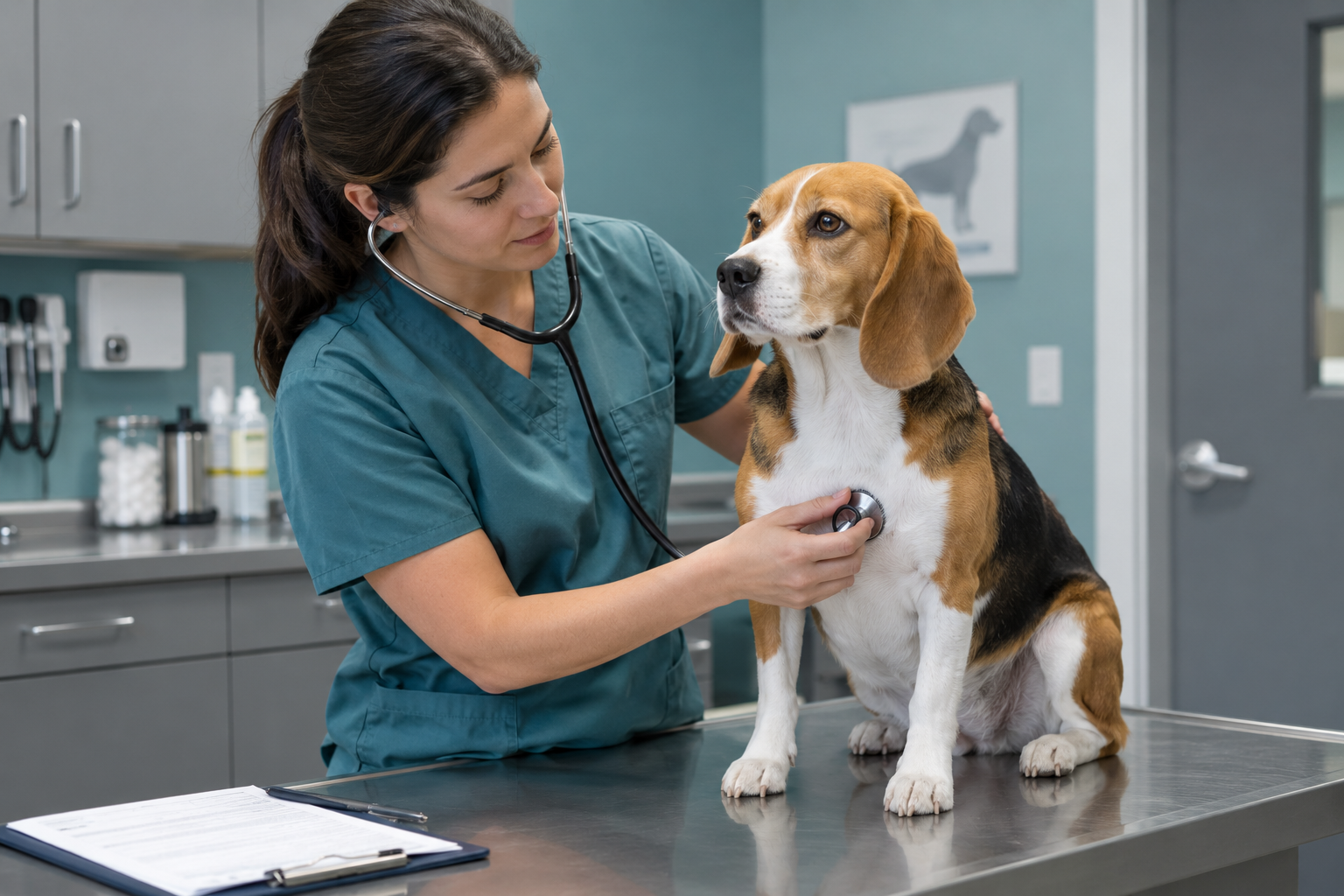
Excess sleep becomes a medical concern when it appears suddenly, exceeds a dog’s normal baseline by a wide margin, or comes with other changes such as appetite loss, limping, confusion, or reluctance to move. A stable, high sleep total that hasn’t changed is generally less concerning than a sudden shift.
This section stays direct because the stakes are real. What causes excessive sleeping in dogs isn’t always dramatic; it ranges from ordinary aging and hot weather to pain, thyroid issues, anemia, and other conditions that a veterinarian needs to evaluate directly .
Signs your dog is sleeping too much and should see a vet:
- Sleeping noticeably more than the dog’s own established pattern, not just more than some general average .
- Difficulty waking, or seeming groggy and unsteady once awake.
- Skipping meals or showing less interest in food alongside the increased sleep .
- Limping, stiffness, or visible discomfort when getting up from rest .
- Sudden onset (why is my dog suddenly sleeping more than usual is a different question than “my dog has always slept a lot,” and it deserves faster attention) .
- Pale gums, labored breathing, or any sign that looks acute rather than gradual.
Is your dog sick if they sleep a lot? Not automatically. A dog that sleeps 14 hours a day, eats normally, plays during waking hours, and moves comfortably is very likely healthy. A dog whose sleep total climbs noticeably over days or weeks, especially paired with any sign above, needs a veterinary visit rather than a wait-and-see approach. Lethargy that mimics extra sleep, meaning a dog is awake but flat and uninterested, is its own red flag covered by PetMD and Chewy’s veterinary-reviewed guidance on lethargy in dogs .
What the research does not settle
Individual variation in canine sleep is large enough that no single number fits every dog, and breed, health status, and daily activity all shift the picture in ways researchers haven’t fully mapped for every breed. Do different dog breeds have different sleep needs? Almost certainly, based on the body-size and activity patterns described across sources like PetMD’s hours-by-breed-type discussion , but a precise number for every recognized breed doesn’t exist in a single reliable dataset.
What’s established with reasonable confidence: sleep totals rise in puppyhood and again in the senior years, dogs sleep in a polyphasic pattern rather than one long block , and sudden departures from a dog’s own baseline are worth investigating . What’s less settled: exactly how much individual temperament, indoor versus outdoor living, and specific breed lines shift the numbers within the broad ranges already described. A working line Border Collie living an active outdoor life and a Border Collie living as an apartment companion could land at different points on the same general range, and matching a dog’s household to its actual energy needs starts with choosing well in the first place. That’s part of why guides like best dogs for first-time owners and best dogs for kids who want to play matter before adoption day, not after.
How can you build a healthy sleep schedule for a dog that won’t settle?
A healthy dog sleep schedule comes from consistent wake times, a predictable feeding routine, enough daytime activity to earn real rest, and a sleep space the dog actually wants to use. A dog that won’t sleep is often a dog whose day lacks a rhythm, not a dog with a sleep disorder.
Practical steps:
- Keep meal and walk times close to the same window every day. Dogs settle faster around predictable routines, and consistent feeding and treat timing supports that rhythm rather than working against it.
- Give the dog a real physical and mental outlet earlier in the day, since under-stimulated dogs often nap erratically instead of settling into longer, more useful sleep blocks.
- Choose a sleep spot that’s actually comfortable (check the dimensions against the dog’s stretched-out size, not curled-up size).
- Avoid exciting play right before the intended bedtime window.
- If a normally settled dog suddenly won’t sleep, treat that as information worth mentioning at a vet visit rather than a training problem to push through alone.
Enrichment matters here too. A bored dog paces instead of napping, and pacing at 11 p.m. is rarely a mystery once the day’s activity gets reviewed honestly.
FAQ
How many hours do dogs sleep a day? Adult dogs typically sleep about 12 to 14 hours a day, according to PetMD . Puppies and seniors usually sleep more, sometimes reaching 15 to 20 hours depending on age and health .
Do dogs dream? Dogs experience REM sleep with the twitching, paw movement, and occasional vocalizing associated with dream-like brain activity, as described in canine sleep research on REM cycling . Whether the content resembles a human dream can’t be measured directly with current methods.
Is it normal for a dog to sleep 18 hours a day? It can be normal for senior dogs and some giant breeds, since AKC’s reporting places upper senior sleep ranges around 16 to 18 hours . For a young, otherwise active adult dog, 18 hours daily would be worth mentioning to a veterinarian, since it sits well above typical adult ranges .
Why does my dog sleep on their back? Sleeping on the back with paws in the air usually signals a relaxed dog comfortable enough to expose its belly, a vulnerable position dogs generally avoid unless they feel secure.
Do older dogs sleep more? Yes. Senior dogs often sleep 12 to 15 hours daily, with some healthy seniors reaching 16 to 18 hours, according to AKC and Chewy’s veterinary-reviewed guidance . A sudden jump beyond a senior dog’s own baseline still warrants a check rather than an assumption that it’s “just age.”
Do dogs need as much sleep as cats? Cats are commonly reported to sleep similarly high totals, but the two species’ sleep architecture and daily rhythms differ enough that direct comparison isn’t especially useful for care decisions. Focus on the individual dog’s own baseline instead.
Why do dogs sleep so much compared to humans? Dogs sleep in short, repeated cycles across day and night rather than one long overnight block, and their baseline need runs higher than the typical adult human’s 7 to 9 hours. That polyphasic pattern, documented in canine sleep behavior research, is the core reason why do dogs sleep so much looks excessive by human standards while being biologically normal for a dog .
What’s the difference between dog sleep and human sleep? Dogs cycle through shorter sleep periods spread across 24 hours, while most adult humans consolidate sleep into one nighttime block. Dogs also reach REM sleep faster and cycle through it more frequently within a given sleep session .
Conclusion
The next time a dog claims the same sunny patch of floor for a third nap before lunch, there’s no need to worry about laziness. Why do dogs sleep so much has a straightforward answer: growth, memory processing, and recovery all run on sleep, and dogs are built to take it in short, frequent doses rather than one long block. Track the pattern that’s normal for this particular dog, not a generic number, and treat a sudden, unexplained jump in sleep, especially with appetite loss or trouble moving, as a reason to call the vet rather than wait it out.
References
- www.petmd.com/dog/symptoms/lethargy-in-dogs
- www.sleepfoundation.org/animals-and-sleep/how-much-do-dogs-sleep
- www.petmd.com/dog/general-health/how-many-hours-does-dog-sleep-day
- www.akc.org/expert-advice/health/senior-dog-sleep-too-much
- www.akc.org/expert-advice/health/lethargy-in-dogs
- journal.iaabcfoundation.org/let-sleeping-dogs-lie
- www.pdsa.org.uk/pet-help-and-advice/pet-health-hub/symptoms/low-energy-lethargy-
- www.chewy.com/education/dog/health-and-wellness/lethargy-in-dogs
- www.chewy.com/education/dog/training-and-behavior/how-much-should-senior-dogs-sl
- pmc.ncbi.nlm.nih.gov/articles/PMC12608857