
Why do dogs tilt their heads? Usually, it is a brief sign of attention: your dog is trying to make sense of a sound, word, face, or situation. But a head tilt is not always a charming listening pose. A tilt that is sudden, constant, or paired with balance problems can point to an ear, vestibular, or neurological issue.
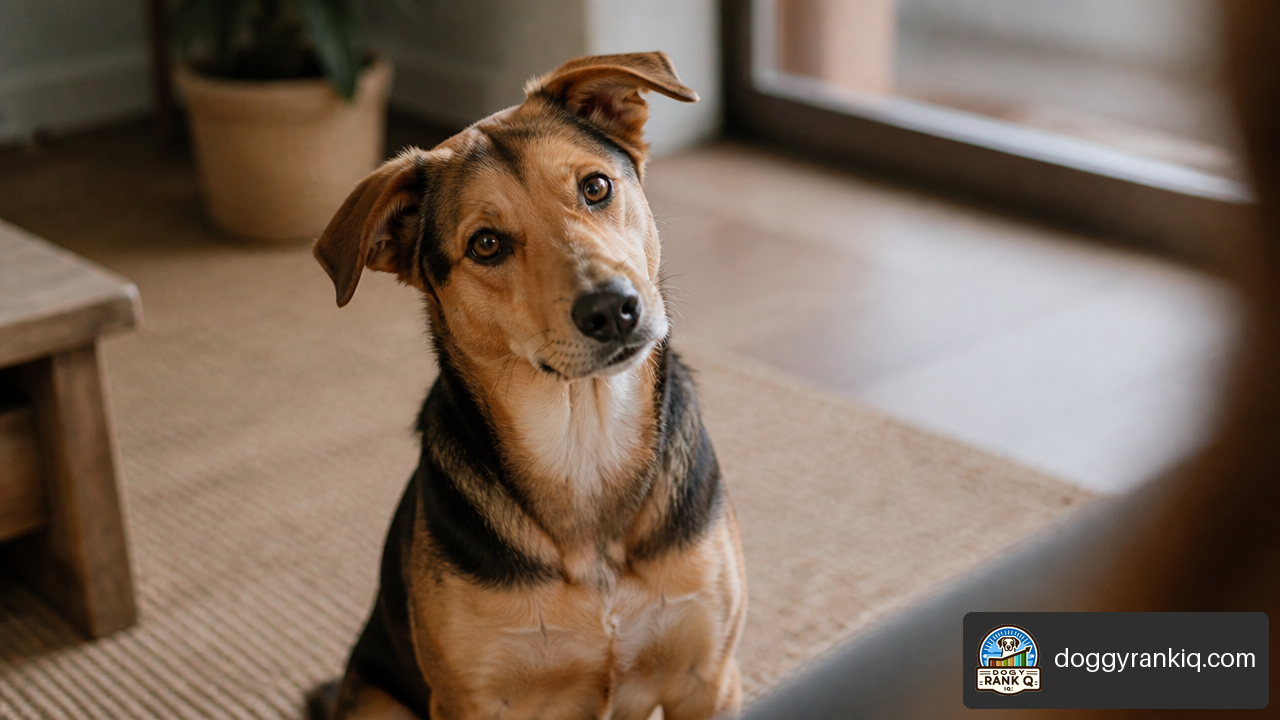
Table Of Contents
- Why Dogs Tilt Their Heads During Everyday Moments
- What Canine Cognition Research Says About Head Tilting
- How To Tell A Normal Tilt From A Medical Head Tilt
- Key Takeaways
- Frequently Asked Questions
- Sources And References
Why Dogs Tilt Their Heads During Everyday Moments
A dog’s head tilt is a piece of body language, not a single message with one universal meaning. The same dog may tilt their head when hearing a squeaky toy, when you say “walk,” or when they are trying to understand an unfamiliar noise outside. In these moments, the tilt is often short, flexible, and connected to a clear trigger.
They May Be Locating A Sound More Precisely
Dogs have highly mobile outer ears, called pinnae, but their ear flaps can still partly cover the entrance to the ear canal. Changing the angle of the head may alter how sound enters each ear. That can give the dog more information about a sound’s direction, distance, or quality.
VCA Animal Hospitals explains that ear anatomy and sound detection may help explain why dogs tilt their heads. Put simply, a tilt may be part of a dog’s sound localization process: the brain compares small differences in timing and intensity between the two ears to estimate where a sound began.
Think about a soft click from behind a chair. Your dog may turn one ear, pause, and tip their head before deciding whether the sound deserves a closer look. That is different from a dog holding their head crooked for hours without any sound or interaction involved.
They May Be Looking Around Their Muzzle
Vision may play a role, too. A dog with a longer or broader muzzle may need to change head position to get a clearer view of a person’s mouth, hands, or an object being held close to the face. This is plausible, but it is not a complete explanation for every dog.
For instance, if you hold a treat near your chest and speak at the same time, your dog may tilt to watch your facial expression while also listening to your voice. The tilt could improve the visual angle, sharpen attention to the sound, or do both at once.
That is why it is risky to reduce the behavior to “better hearing” or “better seeing.” Dogs gather information through several senses at the same time. The head tilt may be the visible part of a larger processing moment.
They May Be Responding To Your Voice And Body Language
Dogs are skilled at noticing human speech patterns, facial movement, hand gestures, and emotional tone. A higher pitched voice, an unusual sound, or a phrase that often predicts something enjoyable can capture attention quickly.
A dog may tilt at “treat,” “car ride,” or “where’s your ball?” because those sounds have learned meaning. Yet the dog is not necessarily translating every word as a human would. They may be responding to a familiar sound pattern, your excited tone, what happened after that phrase in the past, or all three.
Temperament can shape how obvious this behavior looks. Social, expressive dogs may offer more visible listening signals, while quieter dogs may focus with still ears and steady eye contact instead. Breed labels do not predict every individual dog, but readers exploring friendliest dog breeds may notice that sociable dogs can show their engagement in many different ways.
What Canine Cognition Research Says About Head Tilting
The familiar “cute head tilt” is not fully explained by one proven mechanism. Research supports the idea that, in some dogs, tilting is linked to focused processing of meaningful information. That is more interesting than the simple claim that dogs tilt at any sound they recognize.
Meaning Matters More Than Familiarity Alone
A 2021 exploratory study looked at dogs that had learned the names of many toys. The researchers found that head tilting was associated with meaningful object labels, not merely with sounds the dogs had heard before. The study also suggested that the tilt may reflect attention during cross modal matching: connecting a heard word with a stored visual image or memory of an object.
The study’s findings are described in this exploratory analysis of head tilting in dogs. Familiarity alone was not enough to account for the behavior. That distinction matters.
Consider two situations. Your dog may hear their name dozens of times a day, while “find the green rope” may require more concentrated recall if that phrase is tied to a specific toy. The second cue asks the dog to connect sound, memory, and action. A tilt may appear when the mental task becomes more meaningful.
This does not mean every head tilt proves that a dog understands language in a humanlike way. The study focused on a small group of dogs with unusual object label knowledge. It does, however, challenge the idea that every tilt is only about ear position.
Brain Lateralization May Be Part Of The Picture
Newer research adds another layer. In a 2025 study, dogs responding to human speech showed right sided head tilt behavior consistent with left hemisphere lexical processing. In people, the left hemisphere is often associated with language functions; in dogs, this finding suggests some head tilts may reflect how the brain processes speech related cues.
Research on brain lateralization and sex differences in dogs’ responses to human speech supports that specific connection. It does not mean owners can diagnose brain function by watching which direction a dog tilts. The finding describes a group pattern, not a home test.
The useful takeaway is simpler: a head tilt can be a sign of concentration. Some dogs may tilt more often while sorting out speech, especially when a cue is meaningful enough to cross their attention threshold.
Why Some Dogs Tilt Constantly And Others Rarely Do
Individual differences are expected. A dog’s hearing, face shape, learning history, emotional style, and willingness to visibly respond to people can all affect whether you see a tilt.
• A dog that loves toy names may tilt often during games.
• A dog with floppy ears may use ear movement and head movement differently from a dog with upright ears.
• A short muzzled dog and a long muzzled dog may have different sightlines when looking at a person’s face.
• A calm dog may listen closely without offering any obvious body language.
• A puppy may seem more tilty because so many sounds and routines are new, but puppies do not need to tilt for their learning to be normal.
Do not try to train a dog to tilt repeatedly for photos if the dog looks uncertain or stressed. Rewarding a brief, voluntary trick is one thing. Pressuring a dog who is confused by repeated noises is another. Their comfort matters more than a camera ready pose.
How To Tell A Normal Tilt From A Medical Head Tilt
The practical question is not simply, “Does my dog tilt?” It is, “What does the rest of my dog look like while tilting?” A normal attention tilt is usually brief and situation specific. A clinical head tilt tends to persist, recur without an obvious cue, or appear with other changes.
Compare The Context, Not Just The Angle
| What You Notice | More Consistent With Attention | More Concerning For Illness |
|---|---|---|
| Timing | Happens after a sound, word, or visual cue | Begins suddenly or remains when nothing is happening |
| Duration | Lasts seconds and resets naturally | Lasts minutes, hours, or continues through rest |
| Movement | Dog walks, turns, and plays normally | Stumbling, falling, circling, or reluctance to move |
| Eyes | Normal eye position and tracking | Rapid, jerking, or unusual eye movement |
| General behavior | Alert, comfortable, interested | Nausea, vomiting, pain, confusion, or marked lethargy |
The vestibular system is the inner ear and brain network that helps control balance, posture, orientation, and eye movement. When it is disrupted, a dog may hold the head to one side because their sense of balance is distorted. The tilt is not a choice or a listening gesture.
PetMD’s overview of dog head tilt causes notes that vestibular disease, ear problems, and neurological conditions are among the possible medical causes. These possibilities are exactly why a persistent tilt deserves more attention than a momentary response to “Want dinner?”
Symptoms That Change The Urgency
Contact a veterinarian promptly if a new tilt is persistent, especially if your dog has one or more of the following signs:
• Vomiting, drooling, or signs of nausea
• Staggering, falling, rolling, or walking in circles
• Rapid side to side or up and down eye movements
• Sudden weakness, collapse, confusion, or behavior changes
• Ear odor, discharge, scratching, swelling, or pain when the ear is touched
• Head trauma, suspected toxin exposure, or a seizure
A sudden head tilt with severe balance loss, collapse, or other major neurological signs should be treated as urgent. Call an emergency veterinary service rather than waiting to see if a favorite word fixes it.
Why “Still Alert” Does Not Rule Out A Problem
Fair warning: some dogs with ear or vestibular problems remain bright, hungry, and responsive at first. An alert dog can still have a meaningful medical issue. The deciding factor is whether the posture is persistent or abnormal for that dog, not whether they are wagging their tail.
PDSA’s guidance on persistent head tilt emphasizes that it can signal ear disease, vestibular disease, or other serious conditions requiring veterinary attention.
Do not put drops, cleaners, cotton swabs, or leftover medication into the ear unless a veterinarian has instructed you to do so. If an eardrum is damaged or the problem is deeper in the ear, the wrong product or technique can make matters worse.
What To Record Before The Appointment
A short video can help a veterinary team see the pattern if the tilt comes and goes. Record your dog walking from the side and front, then note when it began and whether it followed ear scratching, a fall, medication, illness, or a new exposure.
Bring a simple timeline:
- Note the first time you saw the tilt.
- Write down whether it happens only with sounds or remains during quiet rest.
- Record eating, drinking, vomiting, bathroom habits, and activity changes.
- List medicines, supplements, recent grooming, ear products, and possible toxin exposure.
- Share videos without trying to make the dog tilt on command.
Key Takeaways
A brief tilt that appears with a meaningful sound and disappears right away is often attentive body language. A persistent or sudden tilt without a clear trigger is a health question first.
• Dogs may tilt their heads to refine sound localization, see around the muzzle, or show concentration during social interaction.
• Research suggests meaningful object words, rather than simple familiarity alone, can trigger more tilting in some unusually word skilled dogs.
• Not every dog tilts, and frequent tilting does not automatically mean a dog is smarter, friendlier, or more affectionate.
• Watch the full picture: duration, balance, eye movement, nausea, ear discomfort, and behavior changes matter more than the angle of the head.
• Seek veterinary guidance for a new, repeated, or persistent tilt, especially when it appears with neurological or balance related signs.
A dog’s expressiveness can also take many forms beyond head tilting. Dogs known for close social bonds may communicate through leaning, eye contact, following, or relaxed body posture; this guide to most affectionate dog breeds offers a useful look at those broader relationship patterns.
Frequently Asked Questions
Why Do Dogs Tilt Their Heads When You Talk To Them?
They may be focusing on your voice, trying to locate the sound, reading your face, or processing a learned cue. A brief tilt that stops when the conversation stops is usually consistent with attention. It is not proof that your dog understands every sentence.
Is Head Tilting In Dogs Normal?
Yes, brief and occasional tilting can be normal, especially around interesting sounds, toys, or familiar routines. It becomes less reassuring when the head stays tilted, appears suddenly without a trigger, or comes with balance, eye, ear, or behavior changes.
Does A Dog Tilt Its Head To Hear Better?
Possibly. Adjusting head position can change how sound reaches the ears and may help a dog judge where a sound comes from. But hearing is only one likely factor. Some tilts also seem connected to attention and meaningful cue processing.
Do Dogs Tilt Their Heads To See Better?
They may, particularly when their muzzle blocks part of their view of a person’s mouth, hands, or a nearby object. Still, this explanation has limits. A dog can tilt while looking at something that is not visually blocked, so sight does not explain every case.
Why Does My Dog Tilt Their Head At “Walk” Or “Treat”?
Those words often predict rewarding events. Your dog may react to the sound pattern, your excited tone, the routine that follows, or the word’s learned meaning. Research suggests simple familiarity alone may not be enough to explain all tilts, especially in dogs that know specific object labels.
Can Head Tilting Mean A Dog Is Confused?
Sometimes it can signal uncertainty or concentration, such as when a dog hears a new sound and pauses to assess it. But confusion should be brief. If the dog seems disoriented, cannot walk normally, or keeps the head tilted, treat it as a possible medical problem rather than ordinary puzzlement.
When Is A Dog’s Head Tilt A Vet Emergency?
Treat it as urgent when it begins suddenly and is paired with collapse, inability to stand, repeated vomiting, severe disorientation, seizure activity, suspected poisoning, trauma, or abnormal eye movements. For a persistent tilt without those severe signs, contact your veterinarian promptly for advice.
Sources And References
- PMC, An exploratory analysis of head-tilting in dogs
- PMC, What Does That Head Tilt Mean? Brain Lateralization and Sex Differences in Dogs’ Response to Human Speech
- VCA Animal Hospitals, Why Dogs Tilt Their Heads
- PetMD, Dog Head Tilt: Causes, Symptoms and Treatment
- PDSA, Head tilt in dogs: causes and when to contact your vet