
Quick Answer
Periodontal disease in dogs is inflammation and destruction of the tissues that hold teeth in place, and most of the damage happens below the gumline where you cannot see it. Veterinary dentists stage it from 1 to 4, tooth by tooth, based on how much attachment has been lost. Stage 1 (gingivitis) is reversible with professional cleaning and daily home care. Stages 2 to 4 involve permanent bone loss, so treatment aims to stop progression, save what is salvageable, and remove the source of pain. Dogs rarely cry about it. They chew on one side, drop food, and go quiet instead. Guidance in this article was checked October 2026 and is general information, not a diagnosis.
Key Takeaways on Periodontal Disease in Dogs
- Staging is per tooth. One dog can have stage 1 at the front, stage 3 on a molar, and stage 4 on a loose canine, as described in the AVDC staging criteria reproduced in the 2026 WSAVA global dental guidelines.
- Gingivitis is reversible. Periodontitis is not. The American Veterinary Dental College explains that early treatment can restore oral health, while later treatment aims to slow damage and relieve pain.
- A normal appetite proves nothing. In a 2026 analysis of owner questionnaires, dogs with periodontal disease were more often described as fearful, timid, stressed, reserved, or low energy, with no significant link to reduced food motivation.
- You cannot stage a mouth by looking at it. Full-mouth dental X-rays under general anesthesia are how bone loss gets measured.
- Anesthesia-free scaling is rejected by WSAVA, the AVMA, AAHA and the AVDC because it cannot treat disease below the gumline and can leave a mouth looking clean while infection continues.
- Small and toy breeds carry more risk, including Yorkshire terriers, Papillons and American cocker spaniels.
- Prevention is daily, not annual. Brushing removes plaque before it hardens. Nothing you buy will rebuild lost bone.
What Is Periodontal Disease in Dogs and How Does It Start?
Periodontal disease in dogs starts as a soft bacterial film on the tooth surface and ends, if nobody interrupts it, with the loss of the bone that anchors the tooth. The process runs in one direction: plaque, inflamed gum, pocket, bone loss, mobile tooth.
Here is the sequence, in the order it happens:
- Plaque forms within hours of a clean tooth surface. It is a living film of bacteria and saliva proteins.
- The gum reacts. The immune response creates redness and swelling at the gum margin. This stage is gingivitis, and it is confined to the gum.
- Plaque mineralizes into tartar, which gives new plaque a rough surface to colonize and pushes the whole process deeper.
- The attachment starts to fail. Inflammation moves into the periodontal ligament, the cementum, and the alveolar bone. Now it is periodontitis. The Merck Veterinary Manual describes periodontal disease as the most common dental condition in dogs, and the step from gingivitis to periodontitis is the one that changes everything.
- A pocket deepens between tooth and gum. Oxygen drops, the bacterial population shifts, and the pocket becomes a place you can neither see nor brush.
That fifth step is the part owners miss. The crown of the tooth can look acceptable while the root loses its support. Brushing after dinner does not reach a six millimetre pocket.
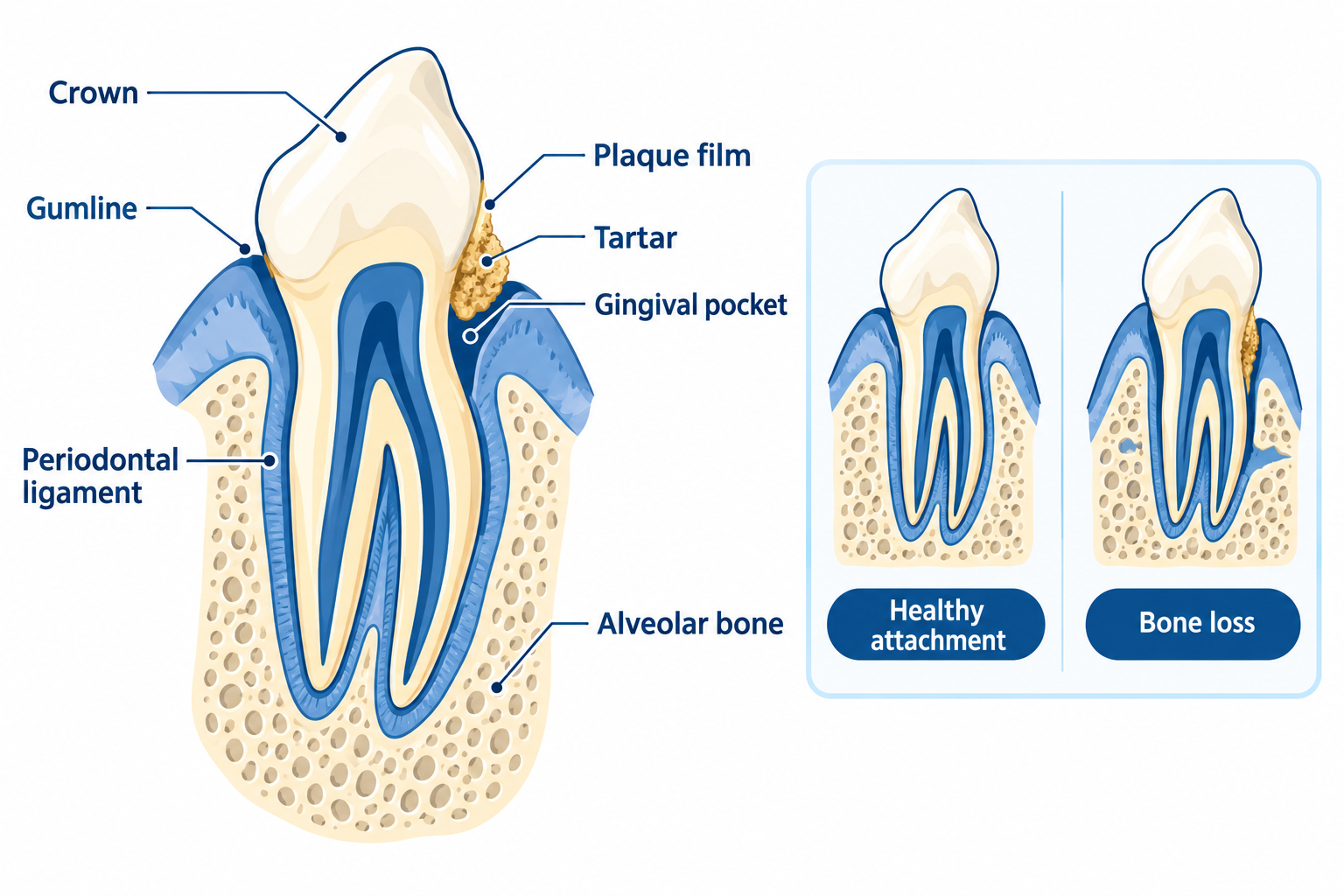
What is the difference between plaque and tartar in dogs?
Plaque is the soft, sticky bacterial film you can brush off. Tartar (also called calculus) is plaque that has hardened with mineral from saliva, and it will not come off with a toothbrush, a wipe, a water additive, or a dental chew.
Practical difference for you:
- Plaque is your job. Daily removal at home is what prevention actually means.
- Tartar is the clinic’s job. It needs mechanical scaling, and the tartar below the gumline needs an anesthetized patient to reach it.
- Tartar is a clue, not the disease. Heavy tartar signals long-standing plaque. A dog can also have significant bone loss with modest visible tartar, which is why staging needs radiographs.
What Are the 4 Stages of Periodontal Disease in Dogs?
The four stages are graded by percentage of attachment loss on an individual tooth: stage 1 is gingivitis with no attachment loss, stage 2 is under 25%, stage 3 is 25 to 50%, and stage 4 is more than 50%. These are the AVDC criteria carried into the 2026 WSAVA global dental guidelines published in the Journal of Small Animal Practice.
50.5%
of dogs with recorded periodontal status had diagnosed disease in a 2026 analysis of more than 12,000 US and Canadian owner questionnaires (Waltham Petcare Science Institute with NomNomNow)
10.8 vs 7.6
mean age in years of affected dogs versus dogs without recorded periodontal disease, same 2026 questionnaire analysis
>50%
attachment loss defines stage 4 (PD4) advanced periodontitis under AVDC criteria, as set out in the 2026 WSAVA dental guidelines
Stage 1
is the only stage considered reversible, because attachment and bone are still intact (AVDC, 2026)
Stage 1 (PD1), gingivitis only. Inflamed gum margins, no attachment loss, normal bone on radiographs. Professional cleaning including subgingival plaque removal, plus consistent home care, can return the mouth to health.
Stage 2 (PD2), early periodontitis. Less than 25% attachment loss, or no more than stage 1 furcation involvement on a multi-rooted tooth. Treatment is professional periodontal cleaning, root surface debridement, polishing, and serious daily plaque control at home. Some defects are candidates for periodontal surgery.
Stage 3 (PD3), moderate periodontitis. Attachment loss of 25 to 50%, or stage 2 furcation involvement. The tooth may be retainable, and the decision turns on mobility, pocket shape, remaining bone support, how useful the tooth is, whether periodontal surgery is available, and whether daily home care is realistic in your house. Extraction is often the kinder choice when it is not.
Stage 4 (PD4), advanced periodontitis. More than 50% attachment loss, stage 3 furcation involvement, deep pockets, severe mobility, or major bone destruction on X-ray. Extraction is usually the most predictable treatment. A board-certified veterinary dentist can sometimes save selected teeth with advanced periodontal surgery.
One thing to hold onto: a stage 4 diagnosis usually describes a tooth, not a prognosis for your dog.
How Can I Tell If My Dog Has Periodontal Disease?
You can suspect it at home, but you cannot stage it at home. Lift the lip in good light and look at the gum margin along the upper cheek teeth, which is where disease usually shows first. Red or swollen gum edges, visible tartar, receding gums, or breath that clears a room all justify a veterinary oral exam.
Signs to check for, roughly in order of how early they appear:
- Breath odour that is new, sour, or getting worse
- A red line along the gum margin, especially at the upper fourth premolar
- Tan or brown tartar near the gumline rather than on the tip of the tooth
- Bleeding when you brush or when the dog chews a toy
- Gum recession with a visible root surface
- Any tooth that moves, or a gap where teeth used to meet
- Swelling below the eye, or a draining spot on the cheek
Decision rule: if you can see tartar touching the gum margin, or any bleeding, book a veterinary oral exam rather than buying another chew. Chews do not treat existing disease.
Common mistake: judging the mouth by the front teeth. The incisors are easy to see and usually the least affected. The molars and the carnassial teeth at the back carry most of the trouble.
What Are the Hidden Signs of Pain in Dogs With Gum Disease?
Dogs with painful mouths usually change their behavior rather than show obvious distress, so the signs look like personality shifts, not toothache. In the 2026 questionnaire analysis of more than 12,000 owners, dogs with diagnosed periodontal disease were more often described as fearful, timid, stressed, reserved, or low in energy, while there was no significant association with aggression or with enthusiasm for food.
That last part is the one worth repeating to anyone who says the dog cannot be in pain because he still eats like a vacuum cleaner. He can. Many do.
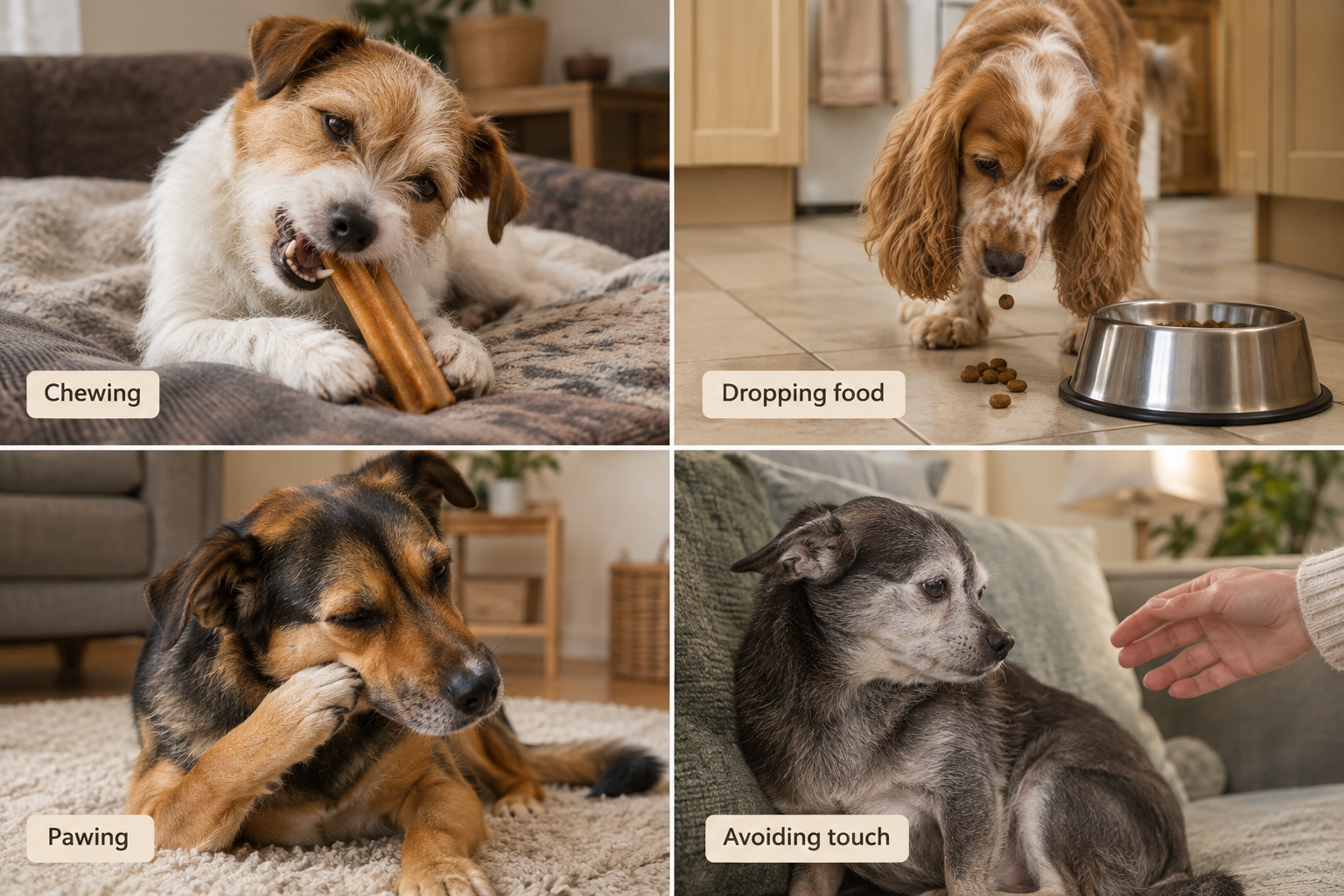
Hidden signs reported by owners and worth mentioning at the exam:
- Chewing on one side or taking a chew and putting it down again
- Dropping food beside the bowl, or swallowing kibble whole
- Pawing at the mouth, face rubbing on carpet, or head shaking
- Turning away from the lip-lift, flinching, or licking lips when you reach for the muzzle
- Less play with tug toys and a preference for soft toys
- Drooling, sometimes tinged pink, or a damp patch where the head rests
- Withdrawal: more sleeping, less greeting, a quieter dog in a familiar house
Two honest limits on that evidence. The questionnaire data shows an association, not proof that gum disease caused each behavior change, and older dogs have other reasons to slow down. If you are weighing up whether more sleep is normal aging, our piece on why dogs sleep so much and what the research found covers the baseline.
Edge case worth taking seriously: a previously tolerant dog who starts snapping when handled near the head may be guarding a painful mouth. Pain changes handling tolerance, which we also discuss in our guide to why dogs bite their own owners and how to reduce the risk. Treat it as a medical question first.
Is Professional Teeth Cleaning Necessary, and Why Do Dental X-Rays Matter?
Yes, for any dog with established periodontal disease. The disease lives below the gumline, and subgingival scaling, probing, and full-mouth dental radiographs all require general anesthesia. The 2026 WSAVA guidelines explicitly reject anesthesia-free dental cleaning, a position also held by the AVMA, AAHA, the AVDC, and European veterinary dental organizations.
Their stated reasons are concrete: awake scaling cannot reliably assess or treat disease under the gum, cannot produce full-mouth radiographs, may leave infection in place, and can cause pain, fear, and aspiration risk, while giving owners the impression the problem has been treated.
Radiographs do the work your eyes cannot. They show bone height, the shape of the bone loss, furcation involvement, root fractures, resorptive lesions, and retained roots. Two teeth that look identical on the surface can differ by 40% of attachment. Only one of them needs to come out.
| Option | What it can do | What it cannot do | Guidance status |
|---|---|---|---|
| Dental cleaning under general anesthesia | Probe pockets, scale below the gumline, take full-mouth X-rays, extract or treat diseased teeth, control pain | Replace daily home care, or regrow lost bone without advanced surgery | Standard of care in the 2026 WSAVA dental guidelines |
| Anesthesia-free scaling | Remove some visible tartar from crowns | Assess or treat subgingival disease, take radiographs, relieve existing pain | Rejected by WSAVA, AVMA, AAHA and the AVDC |
| Daily toothbrushing at home | Remove plaque before it mineralizes, slow new disease, support post-treatment maintenance | Remove tartar, clean deep pockets, reverse attachment loss | Recommended home care in WSAVA guidance |
| Dental chews, diets and water additives | Add mechanical or chemical plaque control between brushings | Substitute for cleaning or treat diagnosed periodontitis | Supporting role only; check for independent efficacy review |
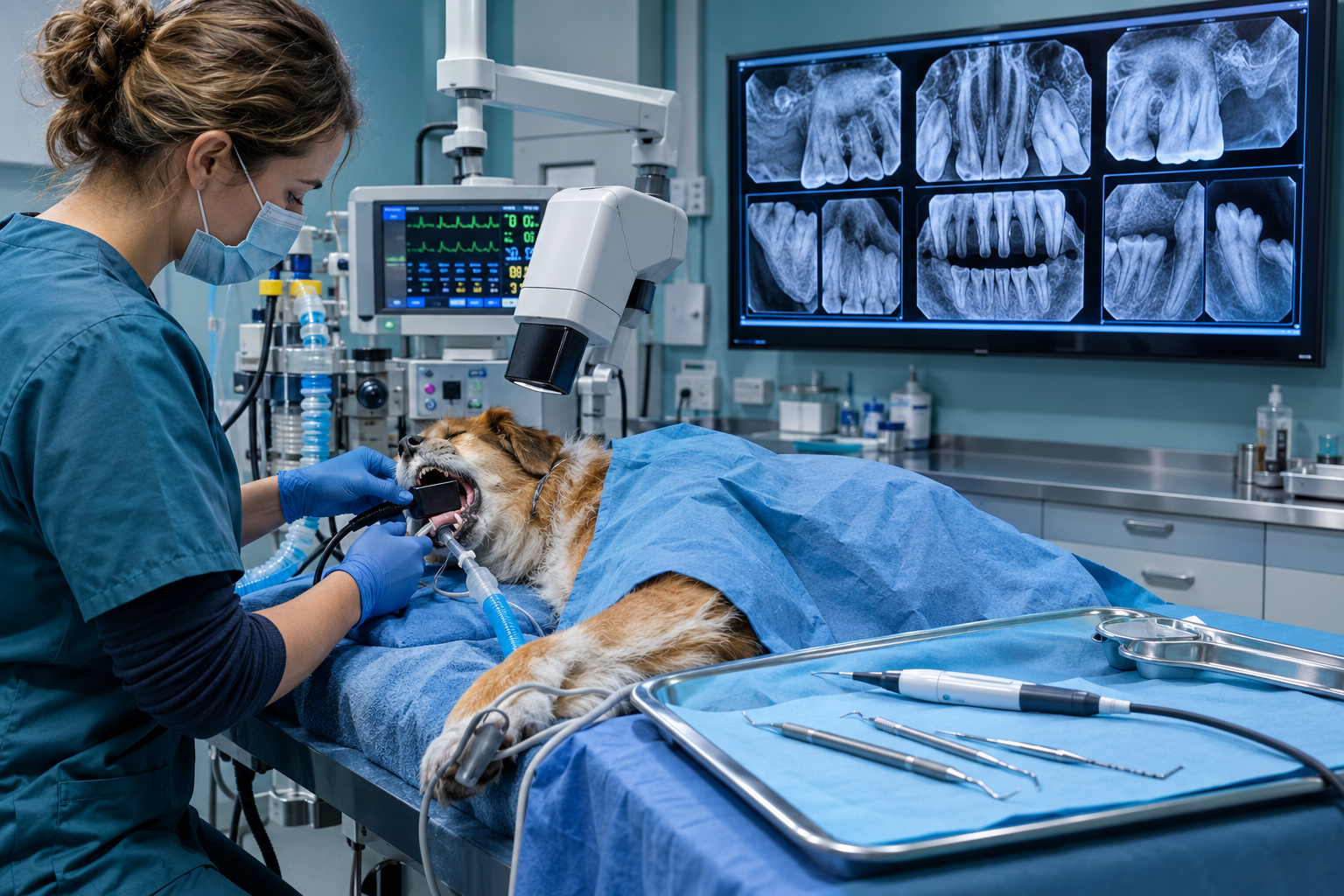
Anesthesia worry is reasonable. Ask for pre-anesthetic bloodwork, a dedicated person monitoring, intravenous fluids, blood pressure and capnography monitoring, warming, and a written pain plan. Those are the questions that change outcomes, far more than the dog’s age on paper.
How Much Does It Cost to Treat Periodontal Disease in Dogs?
Costs vary so widely by country, region, clinic type, and the number of teeth involved that any single figure would mislead you. What stays constant is the line items, so ask for an itemized written estimate and compare the options on what is included rather than the headline total.
Expect the estimate to list:
- Oral exam and consultation
- Pre-anesthetic bloodwork
- Intravenous catheter and fluids
- General anesthesia and monitoring time
- Full-mouth dental radiographs
- Scaling, subgingival debridement, polishing
- Extractions, priced per tooth, with surgical extractions costing more than simple ones
- Local nerve blocks, injectable and take-home pain relief
- Antibiotics where indicated
- Suture material, and the recheck visit
Two things drive the variation: how many teeth need extraction and how complicated those extractions are. A multi-rooted carnassial tooth with bone loss takes a surgical flap, sectioning, and closure. That is oral surgery, and it is priced like surgery.
Decision rule on budget: if the full plan is out of reach, ask your veterinarian to stage it by pain priority rather than skipping the X-rays. Treating the mouth with no radiographs is how retained roots and missed abscesses happen. Also ask whether a local veterinary teaching hospital offers a lower-cost dental service.
Early care is the cheap version. The AVDC makes the timing point directly: catching disease at the gingivitis stage changes the goal from damage control to actual recovery.
Can Periodontal Disease in Dogs Be Reversed or Cured?
Stage 1 gingivitis can be reversed. Periodontitis cannot, because the lost attachment and alveolar bone do not grow back on their own. Once the periodontal ligament, cementum, and bone are destroyed, the 2026 WSAVA guidelines describe that loss as generally irreversible without advanced regenerative treatment.
What treatment realistically achieves at each point:
- Stage 1: full return to a healthy mouth, if home care continues afterwards
- Stage 2: disease arrested, inflammation resolved, the tooth kept with maintenance
- Stage 3: either a retained tooth under a real maintenance plan, or a planned extraction
- Stage 4: pain removed and infection cleared, usually by extraction, with selected teeth occasionally saved by a specialist
A dog with twelve teeth extracted and a pain-free mouth is in better shape than a dog with a full set of teeth and chronic infection. Dogs eat well without teeth. They are remarkably unsentimental about it.
What Happens If You Don’t Treat Periodontal Disease in Dogs?
Untreated periodontal disease progresses. Pockets deepen, bone recedes, teeth loosen and are lost, and pain continues in the meantime. The documented local consequences include periodontal abscess, oronasal fistula (an opening between mouth and nose, often behind chronic one-sided nasal discharge), tooth root infection, and pathological jaw fracture in small breeds whose mandibles lose too much bone around the first molar.
Those are the outcomes with the strongest support, and they are reason enough.
Can periodontal disease affect a dog’s heart or other organs?
Periodontal disease produces repeated bacteremia and ongoing inflammation, and associations between oral disease and changes in heart, kidney, and liver tissue have been reported in dogs. The Merck Veterinary Manual covers these systemic associations, and this is where the facts end: association is not the same as proof that gum disease caused a specific dog’s heart or kidney problem. Treat the mouth because the mouth hurts and the damage is measurable. The possible systemic benefit is a bonus nobody can promise you.
Are Certain Dog Breeds More Prone to Periodontal Disease?
Yes. Toy and small breeds are consistently over-represented. The 2026 questionnaire analysis found disease especially associated with Yorkshire terriers, Papillons, and American cocker spaniels, and affected dogs were also more likely to have gone without a veterinary visit in the previous two years.
Why small mouths struggle more:
- Full-size tooth counts in smaller jaws means crowding and rotated teeth, which trap plaque
- Thinner alveolar bone, so the same amount of loss is proportionally worse
- Brachycephalic breeds often have crowded or displaced teeth from the jaw shape
- Retained deciduous teeth in small breeds create plaque-holding gaps
Age matters as well. In that analysis, affected dogs had a mean age of 10.8 years compared with 7.6 years for dogs without recorded disease, which fits a slow, cumulative process rather than a sudden one.
Breed tendency is a reason to start home care early, not a prediction about your individual dog. Individual variation is large, and a well-brushed Yorkshire terrier beats a neglected Labrador mouth. If you are sizing up risk before choosing a dog, our explainer on dog size categories from small to giant is a useful starting point, and new owners may also want our guide to choosing a first dog.
What Should I Do If My Dog Has Bad Breath and Loose Teeth?
Book a veterinary appointment, not a pet store trip. Bad breath with any tooth movement suggests periodontitis that is already past the reversible stage, and a loose tooth is a painful tooth.
A sensible order of operations:
- Call the clinic today and say the words “bad breath and a loose tooth”. That phrasing gets the right appointment type.
- Stop hard chews and bones until the mouth has been assessed. A loose tooth plus a hard antler is a bad combination.
- Soften meals temporarily by adding warm water to kibble so the dog is not forced to crunch. Our guide to what to add to kibble and what to skip has sensible options that will not upset a sore mouth.
- Do not brush an actively painful mouth. Start brushing after treatment, once your veterinarian clears it.
- Expect a plan with radiographs. Ask for full-mouth X-rays and an itemized estimate before the day.
- Ask about pain relief now, while you wait for the dental appointment.
Red flags that mean call sooner: facial swelling, a draining tract under the eye, refusing all food, one-sided nasal discharge, or a dog who will not let anyone near the head.
How Do You Prevent Periodontal Disease in Dogs?
Prevention is daily plaque removal plus a yearly oral exam. Brushing with a dog-safe toothpaste is the measure with the best support, and the schedule matters more than the equipment, because plaque re-forms within a day.
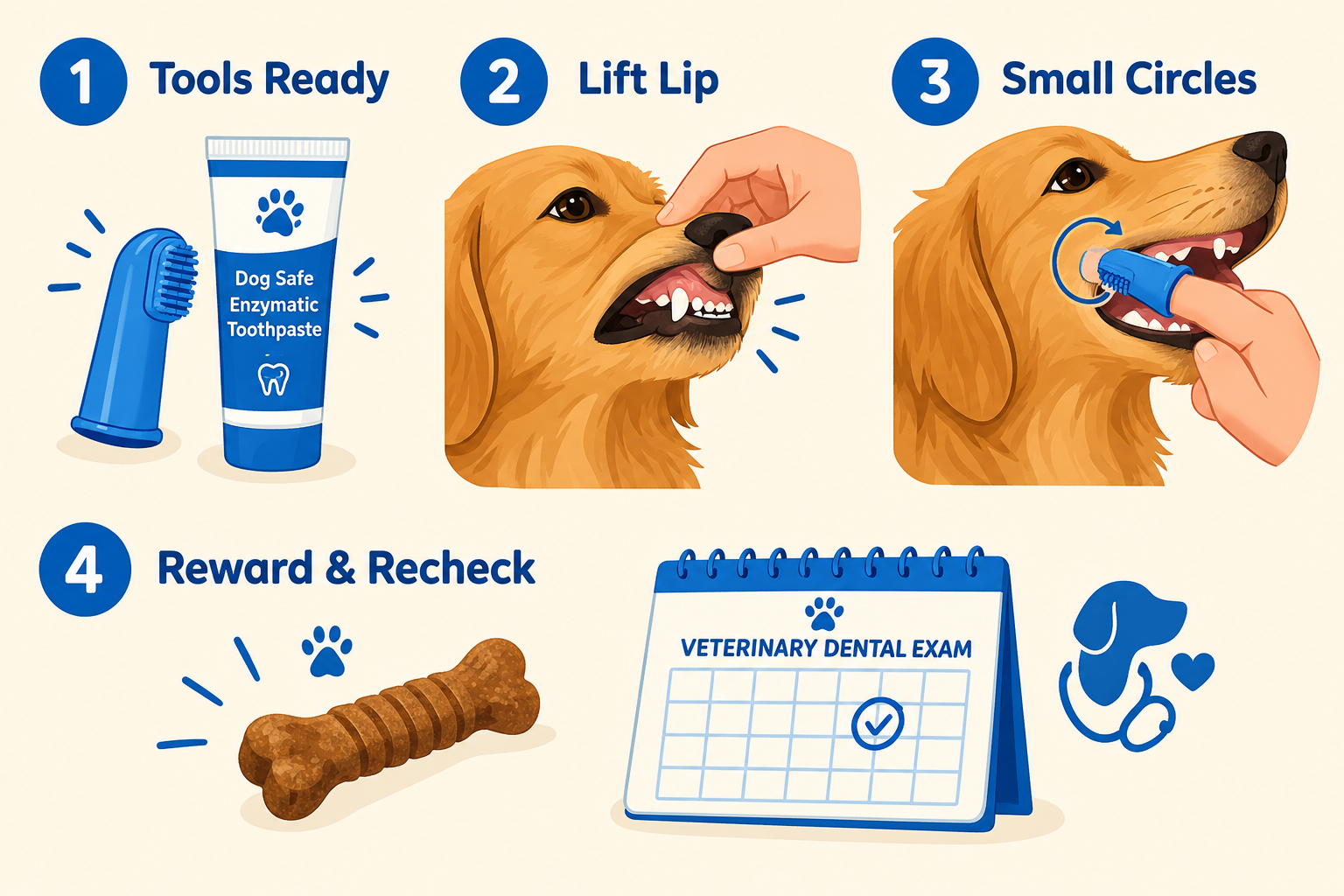
A workable routine:
- Pick one time of day and attach it to something you already do, like the post-walk towel-off.
- Start with a finger and paste only. A few seconds. Reward. Stop before the dog wants to stop.
- Aim at the gumline of the upper cheek teeth, in small circles, at roughly 45 degrees. The inner surfaces matter far less.
- Build to 30 to 60 seconds daily over a couple of weeks using humane training steps and food rewards.
- Add a reviewed dental chew or diet for the days life goes sideways, not as a replacement.
- Book an annual oral exam, or twice yearly for small breeds and seniors.
Never use human toothpaste. Many contain xylitol, which is toxic to dogs, and fluoride is not meant to be swallowed. Our list of foods and ingredients dogs cannot eat covers xylitol in more detail.
Do home remedies help dog gum disease?
Some home measures genuinely slow new plaque. None of them reverse attachment loss, and no rinse, oil, or powder removes tartar or cleans a periodontal pocket.
What the evidence supports, and what it does not:
- Daily brushing: the most useful home measure. Prevention, not treatment.
- Dental chews and dental diets: can reduce plaque and tartar accumulation. Look for independent efficacy review rather than packaging claims.
- Water additives and gels: modest supporting role at best. They do not replace brushing.
- Raw bones: sometimes recommended, and they carry real risks of tooth fracture, obstruction, and contamination. Fractured carnassial teeth are a common sequel.
- Coconut oil, baking soda, turmeric, apple cider vinegar: no reliable evidence that any of these treat periodontal disease. Baking soda is high in sodium, and vinegar is acidic.
- Food changes alone: diet affects plaque accumulation modestly. Choosing good food, like the options in our puppy feeding guide for the first year, supports general health and does not substitute for dental care.
The honest summary: home care is excellent at keeping a healthy mouth healthy, and powerless against bone that has already gone.
FAQ
Is stage 4 periodontal disease in dogs an emergency? Not usually a same-hour emergency, but it is urgent. Stage 4 means more than 50% attachment loss on affected teeth, with pain and active infection. Facial swelling, refusal to eat, or a draining tract warrants a same-day call.
What is the life expectancy for a dog with stage 4 periodontal disease? There is no reliable published life expectancy figure for stage 4 periodontal disease, because it is a tooth-level diagnosis rather than a systemic illness. Most dogs do well after treatment and extractions. Untreated chronic pain and infection are what harm quality of life.
Can periodontal disease in dogs be treated without anesthesia? No. Subgingival scaling, probing, dental radiographs, and extractions all require general anesthesia. WSAVA, the AVMA, AAHA, and the AVDC all reject anesthesia-free dental cleaning for assessing or treating periodontal disease.
Will my dog be able to eat after multiple extractions? Most dogs eat softened food within a day or two and return to normal meals after healing. Dogs with few or no teeth manage well, often with more appetite than before, because the pain source is gone.
How often should dogs have professional dental cleaning? It depends on the mouth, not the calendar. Small breeds, brachycephalic dogs, and dogs with a history of periodontitis often need yearly cleaning. Larger dogs with good home care may go longer. Your veterinarian sets the interval after the oral exam.
Does bad breath always mean periodontal disease? No. Oral tumours, foreign bodies lodged in the mouth, kidney disease, and diabetes can also change breath odour. Persistent bad breath is a reason for an oral exam rather than a diagnosis on its own.
Can a dog have periodontal disease with clean-looking teeth? Yes. Attachment loss happens below the gumline, and some dogs with modest visible tartar have significant bone loss on radiographs. This is the main reason staging requires X-rays under anesthesia.
Conclusion
Periodontal disease in dogs is common, progressive, and mostly silent, and the single most useful thing you can do this week is lift your dog’s lip in daylight and look at the gum margin along the back teeth. Stage 1 is the only stage you get to undo. Everything after that is about stopping the damage and taking the pain away.
Your next steps:
- Check the gumline today, both sides, upper cheek teeth.
- Book an oral exam if you see redness, tartar touching the gum, bleeding, recession, or any movement.
- Ask for full-mouth dental radiographs and an itemized estimate before the dental appointment, and ask about the monitoring and pain plan.
- Start a 30-second daily brush with dog-safe toothpaste once your veterinarian clears it.
- Write down behavior changes you have noticed, including one-sided chewing, dropped food, and a quieter dog. Hand that list to your vet. It is useful information, and owners are better observers than they think.
Guidance referenced here was checked October 2026. This article is general information and not a diagnosis. Your veterinarian examines the actual mouth, which is the part that matters.