
Quick answer: A veterinary behaviorist is a veterinarian with specialty board certification in behavior who can examine your dog, diagnose behavioral and medical disorders, prescribe medication, and write a treatment plan. A dog trainer teaches skills and can carry out a behavior plan, but cannot diagnose disease or prescribe anything. If your dog is biting, panicking to the point of injury, changing suddenly, refusing food, stalling after months of honest training, or showing signs that could be pain, the problem may not be a training gap at all. Guidance in this article was checked in October 2026 and is general information, not a diagnosis.
Key takeaways
- A board certified veterinary behaviorist (DACVB) finishes a veterinary degree, a clinical internship, and a behavior residency of roughly three to five years, then passes a board exam, according to veterinary-authored guidance from VCA.
- The dividing line is diagnostic authority. Diagnosis, medical rule-outs, and prescriptions belong to a veterinarian. Skills, timing, and practice belong to a good trainer.
- The word “behaviorist” on its own is marketing, not a credential. Look for DACVB, CAAB, CBCC-KA, CDBC, or CPDT-KA.
- Aggression, severe fear, panic, and separation distress usually need environmental management, behavior modification, and sometimes medication together, per the AVSAB humane dog training position statement.
- Sudden or out of character behavior change gets a veterinary exam first. House soiling from a urinary tract infection will not respond to better cues.
- Fees vary widely by region and specialist availability, and there is no national price list. Ask for the fee in writing before booking.
- Medication is a legitimate early tool used alongside behavior work, not a sign that training failed.
What is a veterinary behaviorist, and what do they do?
A veterinary behaviorist is a licensed veterinarian who completed specialty residency training in animal behavior and passed the board examination of the American College of Veterinary Behaviorists. The credential letters are DACVB, meaning Diplomate of the ACVB. In practice, that person does four things a trainer cannot: examines the dog as a patient, orders and interprets diagnostics, assigns a behavioral diagnosis such as noise phobia or separation anxiety, and prescribes medication when the case calls for it.
VCA’s veterinary-authored explainer describes the path: veterinary degree, clinical internship, a behavior residency that typically runs three to five years, a board exam, then certification. That residency is where the medical and behavioral halves get stitched together, which is the whole point of the specialty.
)
What a consult actually produces is usually a written plan. The San Francisco SPCA’s behavior service describes building its consults from history, prior records, video you captured at home, low-pressure observation, a diagnosis, a safety plan, and a written treatment plan. Hands-on practice happens later, with you and often a trainer running the drills.
3 to 5 years
Typical length of a veterinary behavior residency after the veterinary degree and internship.
Source: VCA Animal Hospitals
From $150
Published starting fee for a 15 minute vet-to-vet behavior consultation at one US specialty service.
Source: San Francisco SPCA, fee listed October 2026
1 drug
Fluoxetine is the only medication FDA approved specifically for canine separation anxiety, used with behavior modification.
Source: Veterinary Practice News, 2026
3 credentials
CCPDT now offers CPDT-KA, CPDT-KSA, and CBCC-KA, with CBCC-KA aimed at fear, aggression, and phobia cases.
Source: Certification Council for Professional Dog Trainers
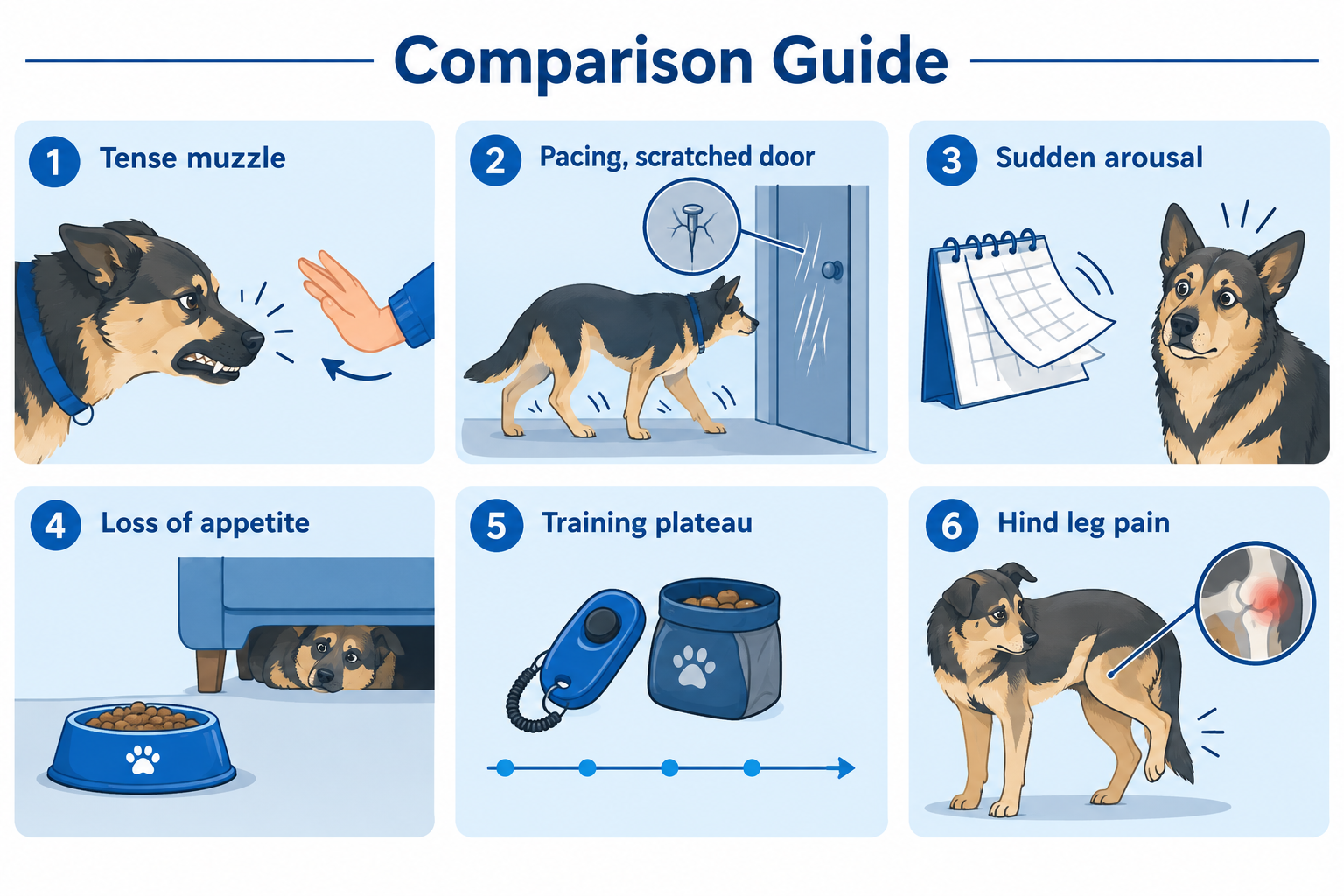
The 6 signs training won’t fix the problem
These are the patterns that most often mean the case has outgrown a group class or a six week package. One sign is enough to justify a vet visit. Two or more, and a referral to a veterinary behaviorist is a reasonable ask.
1. There has been a bite, or a near miss
Teeth on skin changes the category. So does the lunge that stopped two inches short because the leash held. A trainer can teach management and skills, but aggression cases carry legal, insurance, and household safety weight, and the first question should be whether pain or illness is feeding the behavior. AVSAB is direct that aggression generally needs a plan combining environmental management, behavior modification, and sometimes medication. If you are trying to understand why a familiar dog escalated at home, our guide to why dogs bite their own owners covers the common triggers.
2. Panic causes physical self injury
Broken nails on a door frame. Worn teeth from crate bars. Raw paw pads after a thunderstorm. A dog who injures himself trying to escape something is not being stubborn, and no amount of cue practice touches that level of arousal. This is clinical territory.
3. The behavior started suddenly or seems out of character
A sudden change is a medical question until proven otherwise. VCA gives the plain example of house soiling caused by a urinary infection, and notes that pain, neurologic disease, endocrine disease, and sensory decline can all alter behavior. A trainer cannot rule any of that out. Nobody should expect them to.
Decision rule: if the behavior appeared over days or weeks in a dog who was previously fine, book the vet before you book the trainer.
4. Fear is interfering with eating or sleeping
Dogs who skip meals, wake repeatedly, pant through the night, or will not settle in any room are showing you a baseline problem rather than a situational one. Appetite and sleep are two of the easiest things to track at home, which makes them useful evidence to bring to a consult.
5. You have run a reward based plan for months with no real progress
A plateau after a few weeks is normal. A plateau after four months of consistent, reward based work, with the triggers managed and the criteria kept low, suggests the dog’s emotional state is the bottleneck. That is a plan problem or a medical problem, not an effort problem. Honest trainers say this out loud and refer.
6. There are hints of pain or a medical cause
Limping, flinching when touched, scratching, stiffness on stairs, new reluctance to jump onto the sofa, new noise sensitivity in an older dog. Pain makes dogs less tolerant of handling, other dogs, and surprises. Our health and care section has more on tracking changes worth reporting.
If more training would have fixed it, four months of good training would have shown something by now. A plateau is information, not a verdict on you.
An illustrative scene, not a specific dog: a six year old spaniel starts growling when lifted off the bed. The owner books three private sessions on handling cues. Progress is thin. A vet exam finds lumbosacral pain. The growl was a sentence about the spine, and it took a physical exam to translate it.
What is the difference between a veterinary behaviorist and a dog trainer?
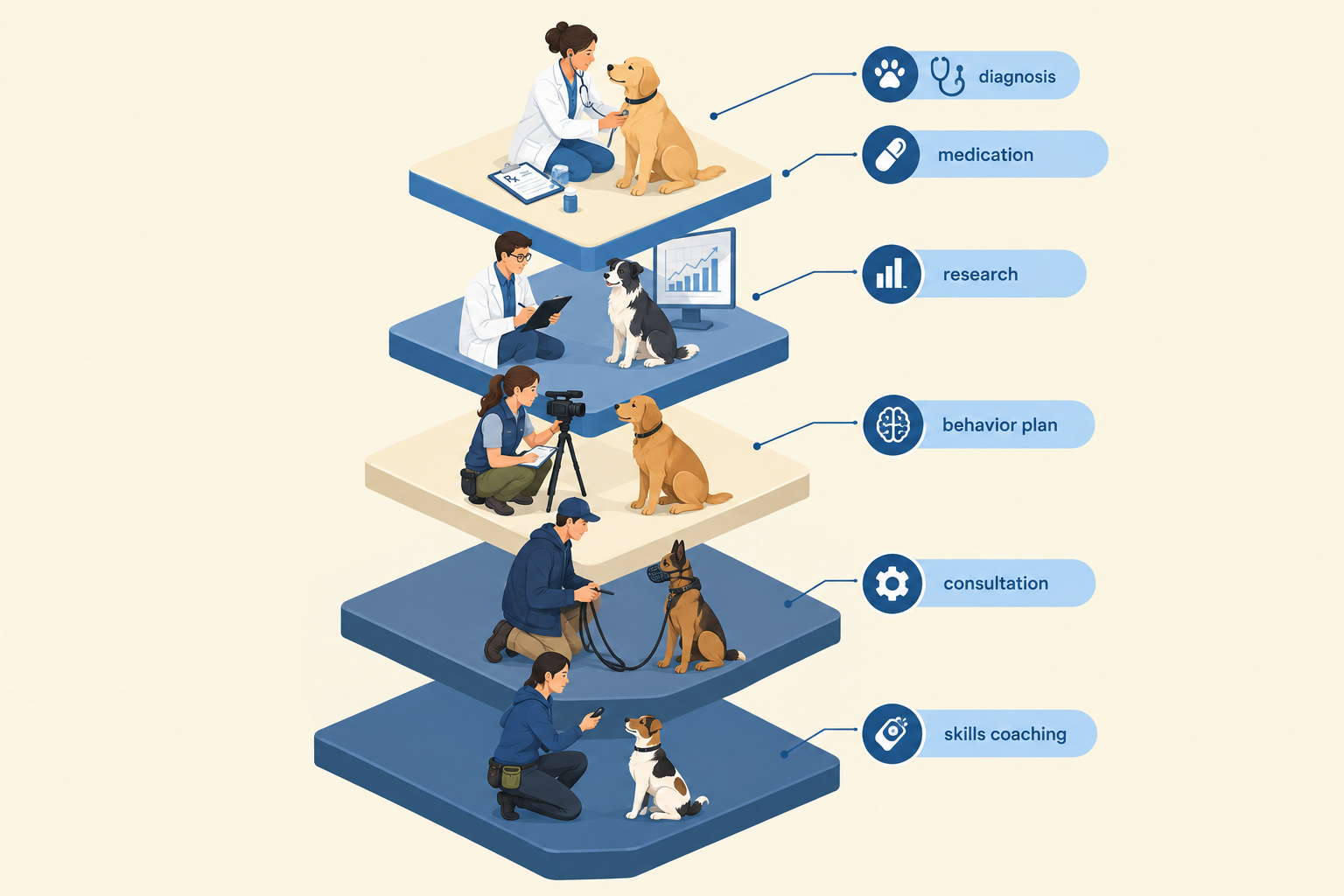
The difference is medical authority and scope. A veterinary behaviorist diagnoses, prescribes, and designs the treatment plan. A trainer teaches the dog and the owner the skills that make the plan work. Good cases often use both at the same time.
)
VCA also warns that “behaviorist” and “behavior consultant” get used by people with very different education and experience. Check letters, not adjectives.
| Credential | Background | Can diagnose or prescribe? | Best fit for |
|---|---|---|---|
| DACVB (veterinary behaviorist) | Veterinary degree, internship, 3 to 5 year behavior residency, ACVB board exam | Yes, both | Aggression, panic, phobias, separation distress, sudden change, suspected medical cause |
| CAAB / ACAAB (certified applied animal behaviorist) | Graduate degree in animal behavior, supervised case experience; usually not a veterinarian | No prescribing; works with your vet | Complex behavior modification plans, research-informed casework |
| CBCC-KA (CCPDT behavior consultant) | Experienced consultant, assessed exam in behavior consulting | No | Fear, aggression, separation anxiety, phobias, alongside veterinary care |
| CDBC (IAABC dog behavior consultant) | Case study and exam based certification in behavior consulting | No | Reactivity, resource guarding, multi-dog households, plan implementation |
| CPDT-KA / CPDT-KSA (certified trainer) | Assessed knowledge, plus hands-on skills assessment for KSA | No | Manners, recall, loose leash walking, puppy foundations, maintaining a plan |
What credentials should a veterinary behaviorist have?
Only one set counts for this role: a veterinary license plus DACVB, awarded by the American College of Veterinary Behaviorists. Anyone using the title without board certification is describing an interest, not a specialty. Ask directly: “Are you a Diplomate of the ACVB?” The answer is a yes or a no.
Can a dog trainer fix behavioral problems, or do you need a veterinary behaviorist?
A skilled trainer can resolve a great deal, including leash pulling, poor recall, jumping, mouthing, crate fuss, and mild household reactivity. What a trainer cannot do is rule out disease or treat a clinical anxiety disorder with cues alone.
Use a certified trainer when:
- The dog is physically well and the issue is a missing skill or a management gap.
- You need foundations built properly. Our puppy training guide and the wider training hub cover the groundwork.
- You already have a veterinary plan and need help running it week to week.
Escalate to a veterinary behaviorist when:
- Safety is involved, including bites, near misses, or children in the home.
- Panic, phobia, or separation distress is severe enough to affect eating, sleeping, or safety.
- Behavior changed suddenly, or pain is plausible.
- Progress stalled for months on a sound reward based plan.
On methods, the evidence is one-sided enough that it is worth saying plainly. AVSAB states there is no evidence that aversive methods are necessary and advises against shock collars, prong collars, leash jerks, flooding, and forced submission. Dominance-based explanations also fail to match what research shows about social behavior in dogs. If a fearful dog is “corrected” into silence, you have changed the display, not the fear. Context on where breed tendencies fit, and where they do not, is in our pieces on territorial guarding and dog on dog aggression.
What behavioral problems are caused by medical issues in dogs?
Many behaviors that look like disobedience have physical drivers. VCA’s example of a urinary tract infection presenting as house soiling is the classic one, and the broader list includes pain, neurologic disease, endocrine disease, and sensory decline.
Watch for these pairings:
| What you see | Medical possibilities worth ruling out |
|---|---|
| New indoor urination | Urinary tract infection, bladder stones, kidney or endocrine disease |
| Growling when touched or lifted | Orthopedic or spinal pain, dental pain, ear infection, skin pain |
| New noise fear in a senior dog | Hearing or vision loss, pain, cognitive decline |
| Night pacing and restlessness | Pain, gastrointestinal discomfort, cognitive dysfunction |
| Snapping during grooming | Ear, skin, or nail bed pain, prior injury |
| Sudden irritability with other household dogs | Pain, thyroid or other endocrine disease, vision loss |
This table lists possibilities to investigate, not diagnoses. Only an exam and appropriate testing can sort them out.
How much does a veterinary behaviorist cost?
There is no national fee schedule, and costs vary by region, clinic type, specialist availability, and whether the visit is in person or virtual. The honest answer is to ask for the fee in writing before booking, including follow-ups and medication costs.

)
One published figure gives a sense of structure rather than a universal price: the San Francisco SPCA lists a 15 minute vet-to-vet consultation starting at $150, where your own veterinarian consults the specialist on your behalf. That model matters in areas with few specialists, because your vet can get specialist input without a full referral appointment.
What usually sits inside the total:
- Initial consultation. Longest appointment, often 90 minutes or more, with history review and a written plan.
- Diagnostics. Bloodwork, urinalysis, imaging, or a pain trial when a medical cause is on the table.
- Medication. Ongoing monthly cost, plus recheck visits for monitoring.
- Follow-ups. Shorter and cheaper than the first visit, and where plan adjustments happen.
- Trainer time. Often the practical arm of the plan, billed separately.
Two ways to reduce spend without cutting corners: ask your regular veterinarian about the vet-to-vet route first, and ask whether follow-ups can be virtual where law permits.
How do I find a certified veterinary behaviorist near me, including online options?
Start with your own veterinarian, who can refer and share records. For independent searching, the American College of Veterinary Behaviorists maintains a public directory of board certified diplomates on its official website, and the AVSAB member directory lists veterinary professionals with behavior interest and training.
A practical search order:
- Ask your veterinarian for a referral and for copies of recent records.
- Check the ACVB diplomate directory for the nearest DACVB.
- Ask whether the practice offers virtual consults or vet-to-vet consults.
- If no DACVB is reachable, ask your vet to work with a CAAB, CBCC-KA, or CDBC consultant while your vet handles the medical side.
- Confirm the fee, the appointment length, and what you need to send in advance.
Virtual and telemedicine options have grown. The San Francisco SPCA model is an in-person initial evaluation followed by virtual follow-ups where legally permitted. Rules on prescribing by telemedicine differ by state and country, so a first appointment may still need to be in person for medication to be an option. Ask about that before you book a video call.
What happens at the first consult, and how long until results?
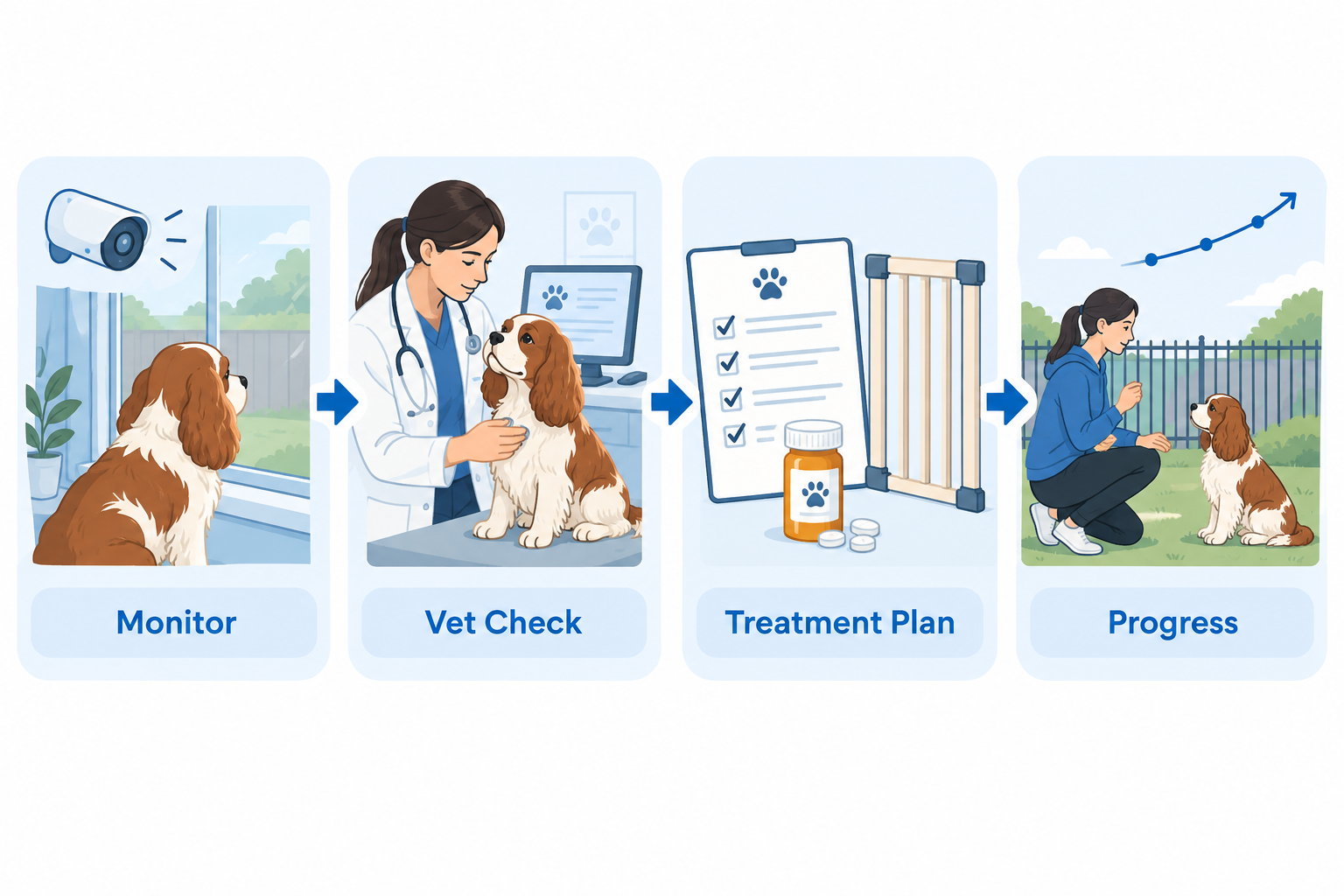
The first appointment is an assessment and planning visit, not a training lesson. Expect a long history interview, record review, video review, a gentle physical exam, a diagnosis, a safety plan, and a written treatment plan you take home.
)
Bring these:
- Two to four short home videos of the behavior, filmed from a safe distance without provoking the dog.
- A two week log of incidents: date, time, trigger, distance, recovery time.
- Vet records, current medications, and supplements.
- Food, feeding times, sleep patterns, exercise, and enrichment routine.
- Household details: other pets, children, stairs, gates, yard fencing, apartment hallways.
On timelines, be skeptical of promises. Medication effects on serotonin-based drugs are commonly assessed over weeks rather than days, and behavior change depends on how consistently triggers are managed. Realistic checkpoints look like this: safety measures working within days, early emotional change over four to eight weeks, and plan revisions at follow-ups. Some dogs improve markedly. Some improve enough to live comfortably with management. A few stay difficult, and a good specialist will tell you that rather than selling you a cure. Individual variation is real here, and it is the part marketing copy usually skips.
Can medication help with dog behavior problems?
Yes, for the right cases, and it is used alongside behavior modification rather than instead of it. Medication can lower the baseline arousal that makes learning impossible, which is why a dog who cannot eat a treat near the trigger sometimes becomes trainable once treated.
Veterinary Practice News reported in August 2026 that fluoxetine remains widely used in veterinary behavior work and is the only medication FDA approved specifically for canine separation anxiety when combined with behavior modification, marketed as Reconcile. Other drugs are used off label at a veterinarian’s discretion, including situational medications for storms, fireworks, and vet visits.
What medication does not do: replace management, teach skills, or work on its own. AVSAB’s framing of serious cases as management plus behavior modification plus medication where needed is the model to expect. Never give human medication or another dog’s prescription. Dosing and drug choice depend on the diagnosis, the dog’s organ function, and other medications on board.
FAQ
What is the difference between a certified applied animal behaviorist and a veterinary behaviorist? A certified applied animal behaviorist (CAAB or ACAAB) holds a graduate degree in animal behavior with supervised case experience and is usually not a veterinarian, so they cannot diagnose disease or prescribe. A veterinary behaviorist (DACVB) is a veterinarian with specialty board certification who can do both.
Is my dog’s behavior a training issue or a medical issue? If the behavior appeared suddenly, changed in character, involves pain signs, or affects eating, sleeping, or toileting, treat it as a medical question first and book a veterinary exam. If the dog is physically well and simply has not learned the skill, start with a certified trainer.
Can a dog trainer diagnose anxiety in my dog? No. Diagnosis is a veterinary act. A trainer can describe behavior, flag concerns, and refer, which is exactly what a well qualified trainer should do.
How do I verify a veterinary behaviorist’s credentials? Ask whether they are a Diplomate of the American College of Veterinary Behaviorists and check the ACVB diplomate directory on the college’s official site. Titles like “behaviorist” or “behavior expert” are not certifications.
Do veterinary behaviorists offer online consultations? Many do. Common models are an in-person initial evaluation with virtual follow-ups, or a vet-to-vet consultation where your own veterinarian gets specialist input. Prescribing rules for telemedicine vary by state and country, so confirm the format before booking.
Will medication change my dog’s personality? The goal is a dog who is less frightened, not a flat or sedated dog. Side effects are possible, which is why dose, drug choice, and recheck schedules are set by a veterinarian and adjusted based on what you report.
My trainer uses a prong collar for reactivity. Should I continue? AVSAB advises against pain, intimidation, shock collars, prong collars, leash jerks, flooding, and forced submission, and states there is no evidence aversive methods are necessary. For a fearful or aggressive dog, ask for a reward based plan and a veterinary assessment instead.
How quickly should I act after a bite? Immediately. Put safety management in place the same day, including separation, gates, and avoiding the trigger, then book a veterinary exam and ask for a referral to a veterinary behaviorist.
Conclusion: your next three steps
The useful question is not whether you have tried hard enough. It is whether anyone has examined the dog. A trainer teaches behavior. A veterinary behaviorist treats the patient. Serious fear, panic, and aggression usually need both, running at the same time, with management holding the line while treatment takes effect.
Do this next:
- Run a two week log and film two short videos. Date, time, trigger, distance, recovery. This is the single most useful thing you can bring to any appointment.
- Book a veterinary exam if any of the six signs apply. Ask directly about pain, dental, ear, skin, thyroid, and neurologic rule-outs, and ask about a referral or a vet-to-vet consult.
- Put safety management in place today. Gates, separation, a muzzle trained with rewards, shorter walks at quiet hours, and a trigger-free rest space.
Then keep reading on the behavior side. Our dog behavior section covers the everyday patterns behind the big ones, and the next right move is usually one phone call rather than one more training package.