
Quick Answer
Why are grapes toxic to dogs? Call first, read second. If your dog has swallowed grapes, raisins, sultanas or currants, phone your vet or an animal poison control line now, before any symptoms appear. The leading explanation is tartaric acid and its salt potassium bitartrate, which dogs appear to process poorly and which can injure the kidneys. No safe dose has ever been established, sensitivity varies between individual dogs, and early stomach decontamination ordered by a vet is the step most strongly linked with survival in the largest dataset published so far.
Key Takeaways: Why Are Grapes Toxic to Dogs?
- Act on the exposure, not the symptoms. Vomiting and kidney injury can start hours after the grapes are gone.
- Tartaric acid is the best-supported culprit, identified by ASPCA Animal Poison Control Center toxicologists after a cream of tartar case pointed them at it.
- Dried grapes carry far more of it. A 2026 laboratory analysis measured about five times the tartaric acid by weight in dried grapes compared with fresh.
- There is no antidote. Treatment is decontamination plus intravenous fluids and kidney monitoring.
- Most dogs survive, which is not the same as safe. Across 31,425 probable canine grape exposures reported to a poison control centre, mortality was 0.9%.
- Cooking does not fix it. Raisins baked at 200C held on to their tartaric acid in a 2026 pilot test.
- Do not induce vomiting at home unless a vet or poison control professional tells you to and talks you through it.
What should I do if my dog ate grapes?
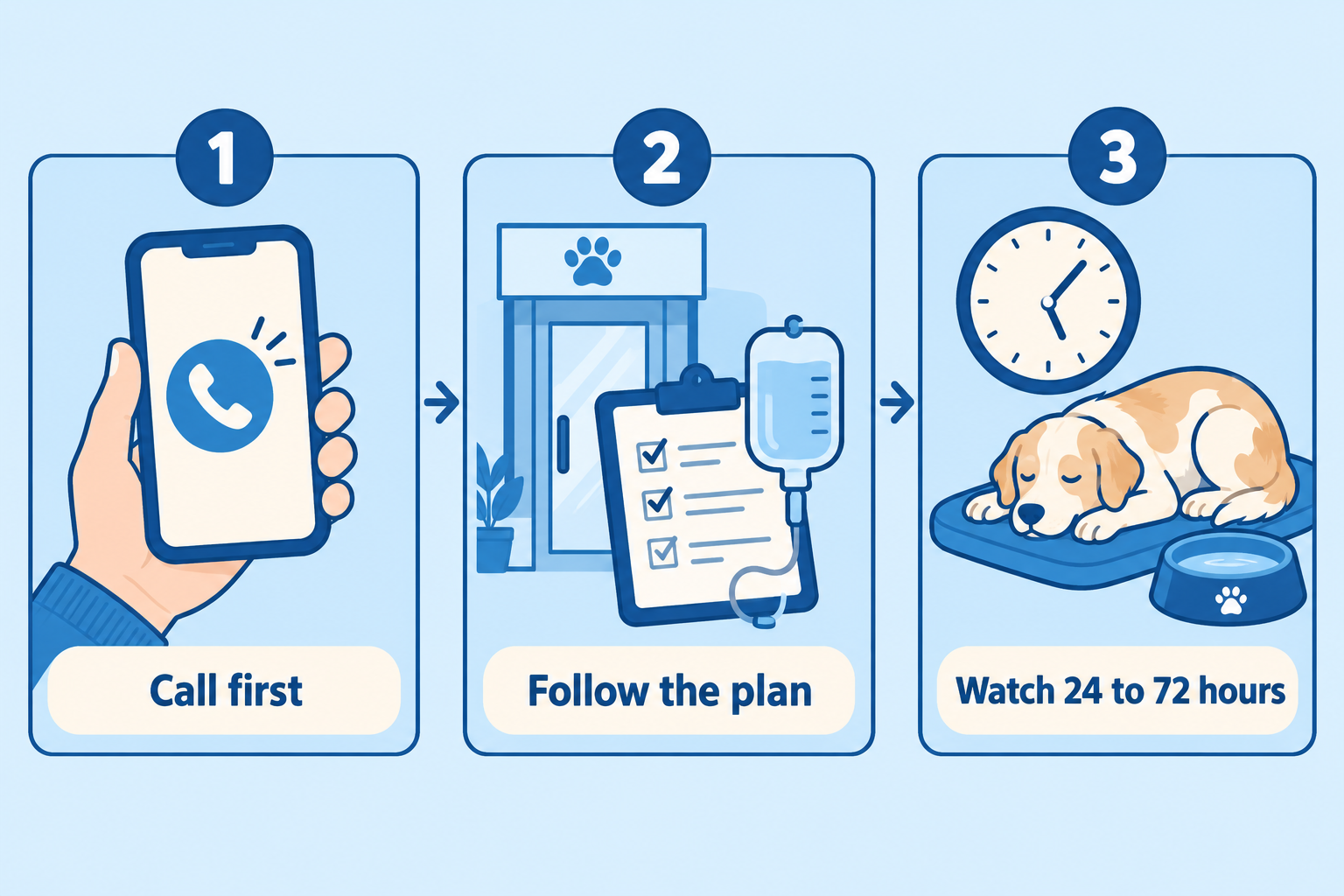
Call a vet or an animal poison control line immediately, give them the details, and follow their instructions. Do not wait to see whether your dog looks unwell, because the window where stomach decontamination helps closes fast.
)
Have these ready when you call:
- What was eaten. Fresh grapes, raisins, sultanas, currants, a slice of fruit cake, trail mix, grape jelly.
- Roughly how much. Count what is left in the bag or on the counter if you can.
- When it happened. Even a rough window helps.
- Your dog’s weight, age, and any existing kidney, liver or heart conditions.
- Anything already vomited up, and whether grape pieces were visible.
In the 31,425 probable canine grape exposures analysed in the 2026 multicenter study published in Frontiers in Veterinary Science, gastrointestinal decontamination, meaning vet-induced vomiting and activated charcoal, was the variable most strongly associated with survival. That is an observational association from poison control records, not a controlled trial proving one treatment caused the outcome. It still points the same direction every emergency vet points: get the fruit out early.
One common mistake: searching forums instead of dialling. A post on the r/DogAdvice forum is titled “Puppy ate a grape, this subreddit saved her.” The title alone tells you the shape of that night, and it also tells you what the useful advice in those threads always is. Call someone qualified. Forum reassurance is not a clinical assessment, and a small dog with one raisin is exactly the case where owners feel silliest phoning and benefit most.
Why are grapes toxic to dogs? What the research found
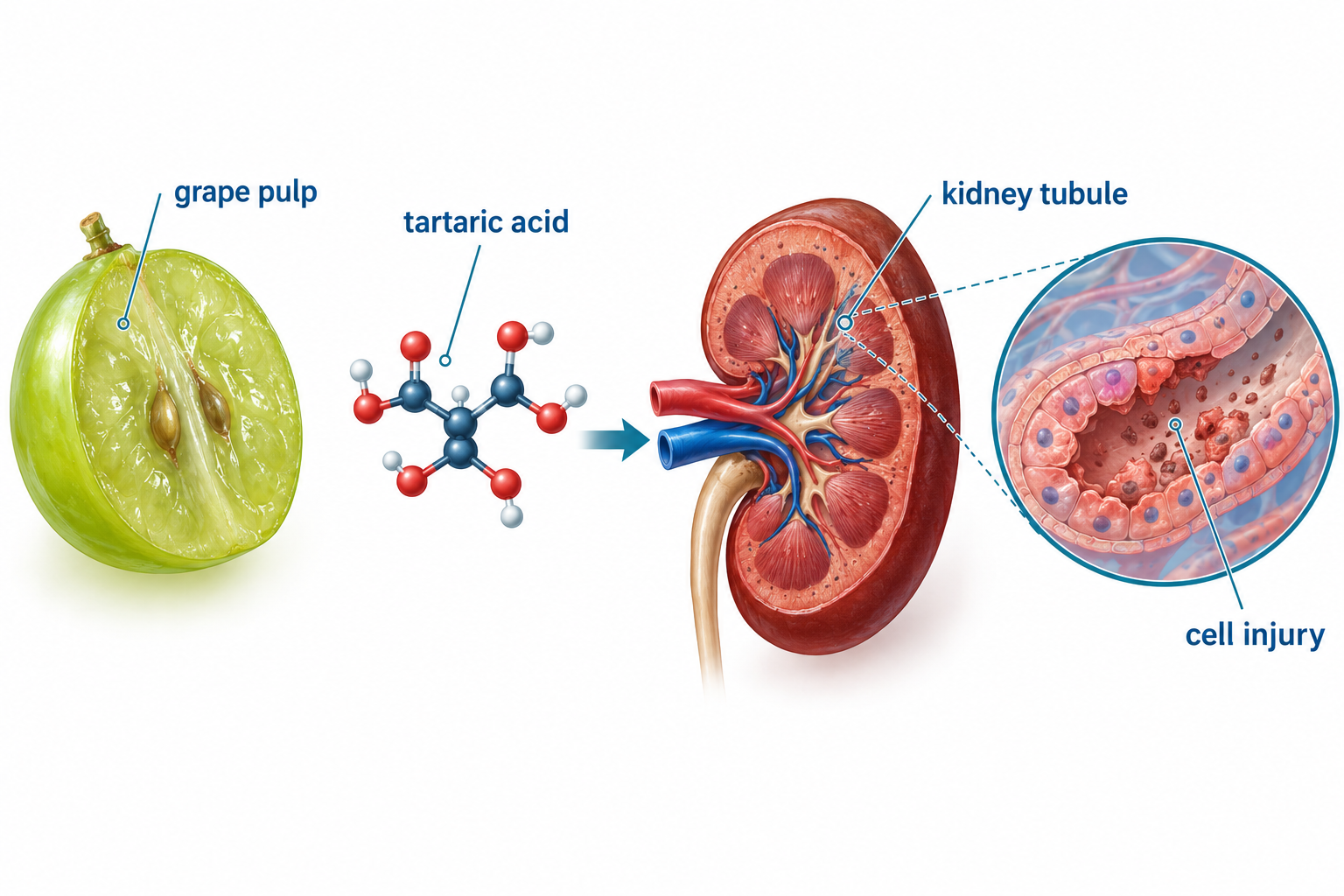
Why are grapes toxic to dogs, in mechanical terms? The best-supported answer is tartaric acid, an organic acid naturally present in grapes, along with its potassium salt potassium bitartrate, better known in the baking aisle as cream of tartar. Dogs appear to handle this acid poorly, and in susceptible dogs it damages the kidney tubules, which can progress to acute kidney injury.
)
The detective work is the good part. Grapes had been linked to kidney failure in dogs since the late 1980s, with no identified toxin for over three decades. Then ASPCA Animal Poison Control Center toxicologists worked a case involving homemade play dough containing cream of tartar, saw clinical signs that looked like grape poisoning, and connected the two. Their 2021 identification of tartaric acid and potassium bitartrate as the likely toxic component, published as a letter in JAVMA, reframed the whole question.
Supporting evidence came from dogs that had never eaten a grape. The MSD Veterinary Manual now groups grape, raisin and tamarind toxicosis together, because tamarind and cream of tartar exposures produced vomiting, kidney injury and tissue changes that resembled grape cases. A small 2022 case series of tamarind and cream of tartar exposures included dogs that stopped producing urine despite intravenous fluids and supportive care.
Where the facts end: tartaric acid is a hypothesis with strong supporting evidence, not a closed case. No study has yet established a reliable toxic dose per kilogram, and nobody can tell you in advance which dogs are sensitive.
Three decades of “unknown toxin,” solved by a batch of play dough. The science is clearer now. The safe amount still is not.
What compound in grapes is poisonous to dogs?
Tartaric acid, and the potassium bitartrate salt that comes with it. Both occur naturally in grapes, raisins and tamarinds, which is why all three now sit in the same toxicology chapter.
)
A clinical research analysis presented to BSAVA on June 11, 2026 measured tartaric acid content in grape and dried-grape samples using high-performance liquid chromatography. Fresh grapes ranged from 4.54 to 8.08 g/kg, averaging roughly 5.95 g/kg. Dried grapes came in around 28.84 g/kg, about five times higher by weight. The researchers also saw variation linked to whether grapes were commercial or non-commercial and seeded or seedless. That was a pilot laboratory analysis, not a validated dose-prediction tool for live dogs, so it tells you which products concentrate the acid, not how many your spaniel can survive.
0.9%
Mortality across 31,425 probable canine grape exposures (Frontiers in Veterinary Science, 2026)
~5.95 g/kg
Average tartaric acid in fresh grape samples (BSAVA clinical research, 2026)
~28.8 g/kg
Tartaric acid in dried grapes, roughly five times fresh (BSAVA clinical research, 2026)
22.0%
Share of canine cases reported in December (Frontiers in Veterinary Science, 2026)
Can dogs eat one grape, or is any amount dangerous?
No amount of grape is considered safe for dogs, and that includes one. Many dogs eat a single grape without becoming ill, and some dogs have developed kidney failure after small amounts, which is exactly why veterinary toxicology treats every ingestion as a reportable exposure.
How much does it take to poison a dog? Nobody can answer that in grapes per kilogram, because the published dose data are inconsistent. Cornell’s Riney Canine Health Center notes in its guidance on grape and raisin toxicity that the toxic amount varies and that individual sensitivity is unpredictable. What is reasonable to say:
- Smaller dogs are at higher risk from the same number of grapes, since the dose relative to body weight is larger.
- Dried products pack more acid per gram, so a handful of raisins is a bigger exposure than a handful of grapes.
- Previous tolerance proves nothing. A dog that ate grapes last summer and was fine has not earned immunity.
Decision rule: if you know or strongly suspect your dog swallowed any grape product, call. If you are unsure whether the dog or the toddler ate the fallen raisins, call anyway and say so. Treating a non-exposure costs you a phone call and possibly an unnecessary clinic visit. Missing a real one costs a kidney.
)
What are the symptoms of grape toxicity in dogs, and how quickly do they appear?
Vomiting is usually the earliest sign, often within a few hours. Kidney-related changes tend to show up later, over 24 to 72 hours, which is why vets keep monitoring after the dog looks settled.
A typical reported progression:
| Window | What owners may see |
|---|---|
| 0 to 6 hours | Vomiting, retching, drooling, grape or raisin pieces in vomit, restlessness |
| 6 to 24 hours | Lethargy, loss of appetite, diarrhoea, belly tenderness, increased thirst |
| 24 to 72 hours | Reduced urination or none at all, weakness, dehydration, signs of acute kidney injury |
The tricky part is that lethargy in a dog who naps 12 hours a day is easy to talk yourself out of. If you are second-guessing what normal rest looks like, our piece on how much sleep is normal for dogs and what the research found is a useful baseline. The signs that need a same-hour phone call are vomiting, refusing water or food, and any change in urine volume.
Edge case: a dog can vomit early, appear completely fine by bedtime, and still be developing kidney injury. Bloodwork on day one and a recheck 48 to 72 hours later is a common plan for exactly that reason.
Are raisins and currants toxic to dogs like grapes?
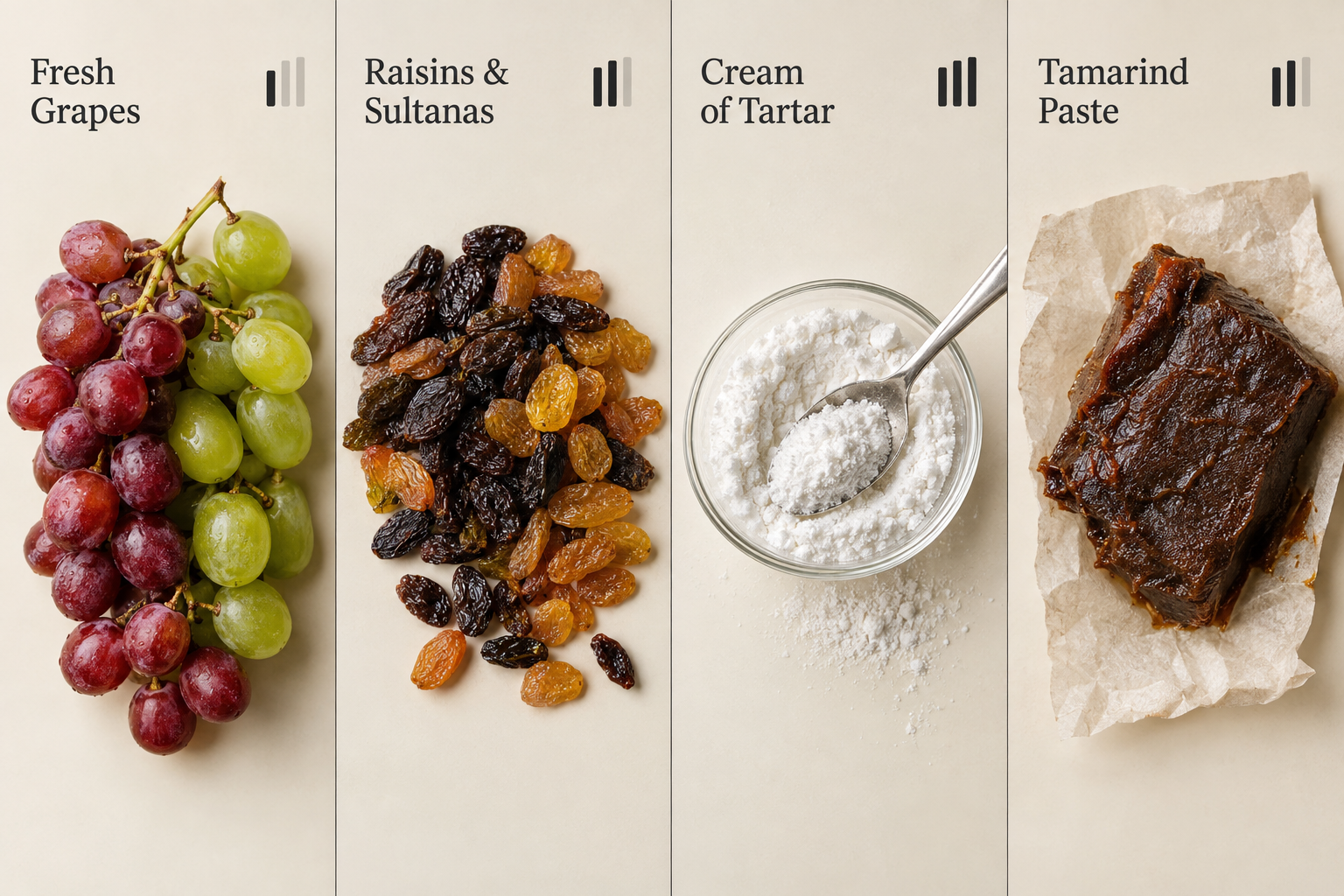
Yes, and by weight they are a more concentrated exposure. Raisins, sultanas and currants are dried grapes, so the same tartaric acid comes along in a smaller package.
| Item | Tartaric acid picture | Why it matters | If eaten |
|---|---|---|---|
| Fresh grapes (seeded or seedless) | 4.54 to 8.08 g/kg measured in 2026 lab samples | Higher mortality risk than processed fruit in the 2026 dataset, relative risk 3.47 | Call poison control or a vet now |
| Raisins and sultanas | Around 28.8 g/kg, roughly five times fresh | Small volume, large dose, easy to under-report | Count what is missing, then call |
| Currants (dried Zante grapes) | Dried grape product, same acid | Hidden in cakes, scones, mince pies, cereal | Treat as a raisin exposure |
| Tamarind paste and cream of tartar | Contain tartaric acid or potassium bitartrate | Linked to grape-like kidney injury in reported cases | Call, and name the exact product |
| Grape juice, jelly and raisin bread | Variable, often diluted or baked | Dose is hard to estimate from a label | Call with the ingredient list in hand |
Is grape juice toxic to dogs?
Treat grape juice, grape jelly and grape-flavoured preserves made from real grapes as an exposure and call for advice. Juice contains tartaric acid from the fruit, the concentration depends on processing and dilution, and no one has published a safe threshold for it. Candy that is only grape-flavoured is a different problem: check instead for xylitol and chocolate, which carry their own risks. For a wider list of pantry items that cause trouble, see our rundown of foods dogs cannot eat and why each one is a problem.
Can cooking grapes make them safe for dogs?
No. In the 2026 BSAVA pilot work, raisins baked at 200C retained tartaric acid concentrations similar to uncooked raisins. Heat does not reliably break the compound down, so a slice of fruit cake, a hot cross bun, a raisin cookie and a stollen all count as exposures. The Christmas baking shelf is the most dangerous shelf in the house for a counter-surfing dog.
Why are some dogs fine after eating grapes?
Because individual variation is real, and because most reported exposures do not end in death. In the 2026 analysis of poison control records, canine mortality was 0.9%, compared with 11.8% among 1,030 feline exposures. That is survival of reported cases, not evidence that grapes are harmless.
A few things explain the gap between “my dog ate grapes and was fine” and “my neighbour’s dog nearly died”:
- Dose relative to body weight. One grape in a 35 kg retriever is a different exposure than three raisins in a 4 kg chihuahua.
- Treatment. Many of those survivors were decontaminated and put on fluids quickly, which the data link with better outcomes.
- Reporting bias. Owners whose dogs are fine often never call anyone, so the mildest cases are missing from the dataset, and the scariest ones are over-represented in your memory.
- Unexplained susceptibility. Veterinary sources still describe sensitivity as unpredictable at the individual level.
Interestingly, the same 2026 study found fresh-fruit ingestion carried a higher mortality risk than processed-fruit exposure, with a relative risk of 3.47 in dogs, while processed fruit was reported far more often (61.6% versus 31.2% of canine cases). Reported frequency and actual danger are two separate measurements.
What is the difference between grape toxicity in dogs and humans?
Humans eat tartaric acid routinely and clear it without harm. Cream of tartar sits in millions of kitchen cupboards, and tartaric acid is a standard food additive. Dogs appear to handle the same acid differently, and that species difference is the working explanation for the whole problem.
Veterinary discussion of canine grape toxicosis describes a species-specific and form-specific issue with L-tartaric acid, involving impaired clearance at the kidney and interference with normal cell metabolism in the tubules. A 2026 paper on tartaric acid stereochemistry added more mechanistic detail, pointing at reduced transporter-mediated removal of the acid and inhibition of an enzyme in the cell’s energy cycle. That level of detail is satisfying to read and still does not produce a household safe dose, because the step from mechanism to milligrams per kilogram has not been validated in live dogs.
Practical meaning: a food that is safe on your plate can be an emergency in your dog’s bowl. The same logic applies across plenty of other foods, which is why the list of fruits and vegetables dogs can eat safely is worth reading once, properly, before the next time someone offers your dog a snack from the fruit bowl. Blueberries are a reasonable swap, covered in our guide to blueberries, broccoli and other dog-safe superfoods.
Do all dog breeds react the same way to grapes?
There is no reliable evidence that breed predicts who gets sick. Veterinary guidance treats every dog as potentially susceptible regardless of breed, size, age or past tolerance, and no breed has been shown to be immune.
What does change the risk picture:
- Body weight. Lower weight means a higher dose per kilogram from the same number of grapes.
- Existing kidney disease. Less reserve to absorb an insult, so talk to your vet about monitoring thresholds.
- Access and appetite. A dog who hoovers anything off the floor will meet grapes more often than a fussy one. Breed tendencies affect scavenging habits, not toxic sensitivity.
Choose caution if your dog is small, older, or already on medication that affects the kidneys. Anyone selling you a breed-specific “safe amount” is inventing it.
Is there an antidote for grape poisoning in dogs?
No antidote exists. Treatment is supportive and time-sensitive: decontamination, then intravenous fluids and kidney monitoring, with dialysis reserved for severe cases at referral centres.
What a typical plan looks like:
- Vet-induced vomiting if the ingestion was recent and the dog is a suitable candidate.
- Activated charcoal, sometimes repeated, to limit further absorption.
- Intravenous fluids, commonly for 24 to 48 hours, to support kidney perfusion and urine output.
- Bloodwork and urine checks, including kidney values, at baseline and again at 48 to 72 hours.
- Escalation if urine output drops, which may mean referral for advanced care.
Cost and time vary by clinic and region, so ask for an estimate when you arrive. A phone consultation with a poison control service may carry a fee, and it still tends to be the cheapest decision in the sequence.
How do you stop the next grape incident?
Store grapes and dried fruit the way you would store medication, and read the ingredient list on anything baked that enters the house. In the 2026 poison control dataset, 22.0% of canine cases clustered in December, which matches a season of fruit cake, mince pies, trail mix and bowls of grapes left out for guests.
Small habits that work:
- Grapes go in the fridge, never in a fruit bowl on a reachable counter.
- Raisin boxes and trail mix live in a closed cupboard, not a handbag on the floor.
- Tell visiting family the rule out loud, including the relative who treats your dog as a bin.
- Keep poison control numbers saved in your phone before you need them.
- If a child is eating raisins, assume the dog is downstream of the spillage.
Food habits matter in the ordinary direction too. If you build treats from the bowl rather than the biscuit tin, our notes on human foods dogs can eat safely and in what amounts will cover most of the day-to-day questions.
FAQ
My dog ate one grape and seems fine. Do I still need to call? Yes. Call a vet or an animal poison control line and report the exposure. Looking fine in the first hours does not rule out kidney injury developing over the next 24 to 72 hours, and no safe dose has been established.
Can one grape kill a dog? Fatal outcomes from very small amounts have been reported, which is why guidance treats any ingestion as significant. Most reported canine cases survive. Across 31,425 probable exposures in the 2026 Frontiers study, mortality was 0.9%, with early decontamination the factor most strongly associated with survival.
How long after eating grapes will a dog get sick? Vomiting often appears within a few hours. Lethargy and appetite loss can follow within 24 hours, and kidney-related changes such as reduced urination usually show up between 24 and 72 hours after ingestion.
Should I make my dog vomit at home? Not unless a veterinarian or poison control professional instructs you to and guides the method. Home remedies can cause aspiration or chemical injury, and they are not appropriate for every dog or every exposure.
Are grape seeds or skins the problem? Current evidence points to tartaric acid in the fruit itself rather than seeds or skins. The 2026 laboratory analysis found variation between seeded and seedless grapes, so both types count as exposures.
Is grape toxicity worse in cats? Reported feline cases are far fewer but more often fatal. The 2026 analysis found 11.8% mortality across 1,030 feline exposures, compared with 0.9% in dogs. Cats also eat grapes less often, so the data are thinner.
Will my dog need blood tests? Frequently, yes. Vets commonly run kidney values at presentation and repeat them 48 to 72 hours later, because the earliest bloodwork can look normal while injury is still developing.
Conclusion: the one action that matters tonight
Why are grapes toxic to dogs? Tartaric acid and potassium bitartrate, present in grapes, raisins and tamarinds, and apparently handled badly by dogs in a way humans are not. The ASPCA toxicologists who solved a thirty-year mystery deserve the credit, and the 2026 laboratory work on dried grapes explains why a small box of raisins is a bigger problem than a bowl of fruit.
What to do next, in order:
- If grapes were eaten in the last few hours, stop reading and call. ASPCA Animal Poison Control: (888) 426-4435. Pet Poison Helpline: (855) 764-7661. A consultation fee may apply.
- If this is research for later, save both numbers and your nearest emergency clinic to your phone now.
- Move the grapes and the dried fruit out of reach before December arrives again.
- Read labels on baked goods, trail mix and cereal bars that come into the house.
Guidance checked October 2026. This article is general information, not a diagnosis or a treatment plan for your individual dog. Your vet and your poison control line know your dog’s weight, history and exposure. Call them first, every time.
Related reading: what vets actually look for in a dog food.