
This post contains affiliate links. If you buy through one we may earn a commission at no extra cost to you. As an Amazon Associate I earn from qualifying purchases.
Quick Answer
The best dog frisbee for most owners is a rubber or soft nylon disc, like the KONG Flyer or Chuckit! Paraflight, because a flexible rim is easier on a dog’s teeth and easier to grab off grass. Dogs that snatch confidently mid-air and have open space to run do better with a rigid competition disc such as the Hyperflite MaxQ Jawz, which trades bite comfort for distance and a cleaner flight line. Pick based on your dog’s mouth style, your yard size, and your own throwing accuracy, not on whichever disc claims the longest flight on the packaging.
Key Takeaways
- The KONG Flyer uses natural rubber built for a softer bite, priced in the $10 to $20 band depending on size.
- The Chuckit! Paraflight floats and uses a multilayer nylon body with soft rubber edges, priced around $10 to $15.
- Hyperflite’s MaxQ Jawz is an 8.5 inch, 150 gram competition disc built for puncture resistance and long flight.
- The Hyperflite K-10 ships as a six pack of 8.75 inch discs with grip texture on both sides for wet conditions.
- Jacksonville hosted a regional K9 Frisbee Worldwide Championship event in September 2026, a sign the competitive disc dog scene is still active.
- Most “long distance” marketing claims ignore the owner’s own throwing technique, which matters as much as the disc itself.
- A soft rubber or nylon rim beats a rigid plastic one for dogs that pick discs up off the ground instead of snatching mid-air.
- Puppies under about a year old should avoid repeated hard mid-air jumps for a disc because of joint and growth plate stress.
Doggy Rank IQ Tool
Dog Frisbee Matcher

Pick by how your dog catches and where you throw. Then get the safety note on hard plastic.
Best Dog Frisbee: The Short Answer
A rubber or fabric rim disc is easier for most dogs to pick up off grass and gentler on teeth than a rigid plastic disc. If your dog snatches toys mid-air and sprints hard, look for something stiff enough to hold a flight line without being hard enough to crack a tooth on a bad catch. If your dog mostly chases a disc down after it lands, a soft rim matters more than distance.
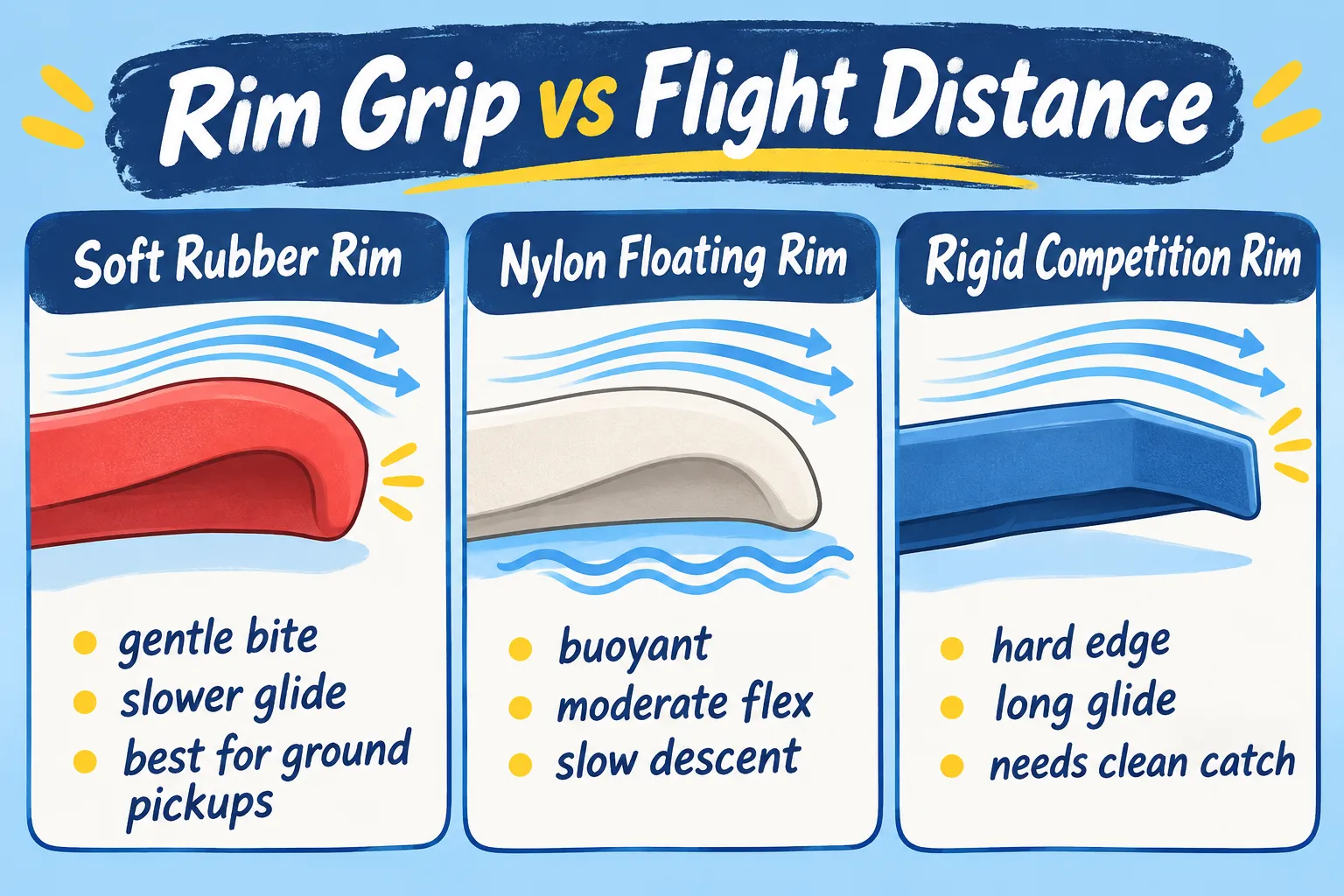
That tradeoff, rim softness against throwing distance, is the whole category in one sentence. Rigid competition discs like the Hyperflite line fly farther and straighter because a stiff edge cuts air more cleanly, a principle covered in detail by Verywell Fit’s testing of flying discs. Soft rubber and nylon discs fly shorter but forgive a clumsy catch, a face first retrieval, and a mouth that was never built for precision snatching. Neither is the single best dog frisbee for every dog. The right pick is shaped around your dog’s mouth, your yard size, and how accurately you throw.
Three questions settle this before you spend a dollar:
- Mouth style. Does your dog leap and snatch, or trot over and nose the disc off the ground?
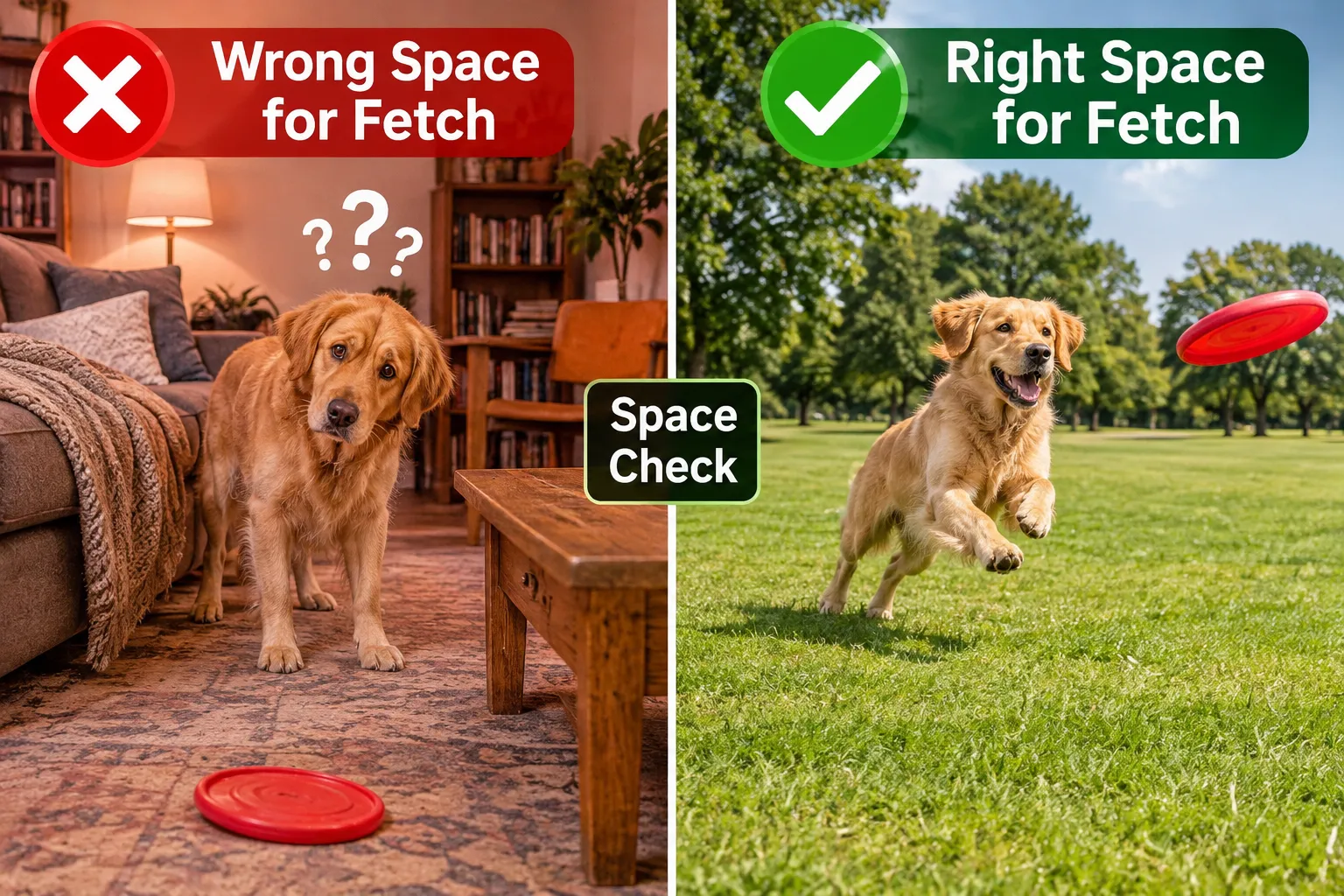
- Space. An apartment dog visiting a city park doesn’t need a 150 gram competition disc meant for wide open fields.
- Your arm. A disc engineered for 100 foot flights is wasted, and often frustrating, in the hands of someone who has never thrown a proper backhand.
Disc Matcher: Find the Right Fit Fast
Disc Matcher
function cgMatch(){ var size=document.getElementById(‘cg-size’).value; var mouth=document.getElementById(‘cg-mouth’).value; var space=document.getElementById(‘cg-space’).value; var pick=”KONG Flyer”; var note=”Soft rubber rim, gentle on teeth, best for ground pickups and small spaces.”; if(space===”water”){pick=”Chuckit! Paraflight”;note=”Floats on water and holds up to repeated large-dog retrieves.”;} else if(mouth===”snatch” && space===”park” && size!==”small”){pick=”Hyperflite MaxQ Jawz”;note=”Rigid competition disc for long, accurate throws. Safety note: hard plastic discs raise tooth-chip risk on bad mid-air catches, so skip this for dogs that mistime jumps.”;} var out=document.getElementById(‘cg-result’); out.style.display=”block”; out.innerHTML=”Suggested pick: “+pick+”“+note; }
What Makes a Good Dog Frisbee?
A good dog frisbee balances four things: a rim your dog’s mouth can close around safely, enough rigidity to hold a flight line, a size matched to the dog’s head and jaw, and a material that survives repeated bites without cracking or shredding. Miss any one of these and the disc ends up in a drawer.
Material matters most. The KONG Flyer’s natural rubber construction gives a softer bite surface that most dogs tolerate better over repeated sessions than hard plastic. Weight and diameter matter too: a disc under 8 inches often suits small and medium dogs better than the 10 inch discs built for large breed competition play, since an oversized disc can be awkward for a smaller jaw to control mid-catch. Flex matters for landing safety: a disc that gives slightly on impact reduces the jarring shock on a dog’s teeth and neck compared to one that stays perfectly rigid.
Choose a good dog frisbee by matching these traits to your dog rather than chasing the longest advertised flight distance. A disc with excellent distance but a rim that bruises gums is not a good disc for that particular dog, no matter how far it flies.
Rim Grip and Throwing Distance: Why Does It Matter?
Rim grip is the edge your dog’s teeth and lips close around, and it directly trades off against how far the same disc can fly. A rounded, flexible rim, like the rubber lip on the KONG Flyer, lets a dog’s mouth wrap and seal around the disc the way it would around a ball. A sharp, rigid rim, like the one on a Hyperflite competition disc, is built to cut through air efficiently, not to feel good in a mouth, and that stiffness is exactly what gives it distance.
Air resistance along a thin, hard edge is lower than along a soft, rounded one, so a rigid disc holds its glide longer before it drops. This is the tradeoff that rarely makes it onto packaging: rim softness and throwing distance move in opposite directions. Hyperflite’s MaxQ Jawz, an 8.5 inch, 150 gram disc, is built specifically for puncture resistance and long flight, using a stiffer profile to get there, a design approach also noted by Dogster’s roundup of disc dog gear. The K-10 goes further, with textured grip on both the top and underside so it stays catchable in wet grass or water, which matters for competitive handlers since tournaments don’t pause for weather.
Soft discs lose some of that glide on purpose. The Chuckit! Paraflight uses a multilayer nylon body with soft rubber edges, and its slower, more gradual descent gives a dog more time to track the disc in the air rather than demanding split second timing, a point echoed in product detail from The Vet Shed’s Chuckit! Paraflight listing. That’s a real design choice, not a compromise born of cheaper materials. A dog that struggles with fast mid-air judgment does better with a disc that floats down slowly than one that rockets and drops.
Throwing distance is also, bluntly, about the thrower. Thomas Acres makes a point worth repeating: most products advertising long distance flight never account for a bad release ruining any disc’s potential, and products like the Starmark EasyGlide DuraFoam market themselves as forgiving of poor technique, built to fly straight and level without an advanced throw. If your backhand throw wobbles, a $25 competition disc won’t fix that. A forgiving foam disc, or ten minutes practicing a low release, usually will.
Top 5 Features That Decide the Purchase
Rim material and flex. This is the single biggest factor in whether your dog enjoys fetch or avoids it. The KONG Flyer’s natural rubber construction gives a softer bite surface that most dogs tolerate better over repeated sessions than hard plastic.
Flight distance versus descent speed. The Hyperflite MaxQ Jawz trades bite comfort for distance and puncture resistance, aimed at dogs that chase hard and catch cleanly. The Chuckit! Paraflight trades top end distance for a slower, more trackable descent.
Buoyancy for water play. If your dog swims, the disc needs to float, full stop. The Chuckit! Paraflight is built to float, which matters for lake and pool retrieves where a sinking disc just ends the game.
Texture and wet weather grip. The Hyperflite K-10’s low profile texture on both sides keeps it grippable when grass is damp or the disc has already been in a dog’s mouth once.
Durability under repeated puncture. A disc that flattens on the first hard bite is a disc you’ll replace in a month. Puncture resistance, the feature Hyperflite leans on hardest, decides whether a disc survives a summer or a single afternoon.
Each feature pulls the decision a different direction, which is why one best dog frisbee answer doesn’t exist across every dog. The best dog frisbee for a water loving Labrador is not the best dog frisbee for a Border Collie doing flyball style catches in a dry field.
Comparison Table: Grip, Flex, and the Low Throw Drill
| Model | Price band | Rim type | Best for |
|---|---|---|---|
| KONG Flyer | around $10 to $20 | Soft natural rubber | Ground pickups, sensitive mouths, short yard throws |
| Chuckit! Paraflight | around $10 to $15 | Nylon body, soft rubber edges | Water play, floating retrieves, slower trackable flight |
| Hyperflite MaxQ Jawz | around $20 to $30 | Rigid, puncture resistant, two-sided texture | Experienced catchers, long yard or park distance |
The low throw drill that fixes most “my dog won’t catch” problems: crouch, hold the disc near knee height, and release it with a flat sidearm motion so it skims a few feet above the grass instead of launching upward. Dogs that struggle with overhead catches almost always do better tracking a disc that stays near their own eye level. Build distance gradually once your dog reliably tracks a low, flat throw.
Best Dog Frisbee for Small Dogs
The best dog frisbee for a small dog under about 25 pounds is a lightweight disc around 7 to 8 inches wide with a soft rim, since a wide, heavy disc can be hard for a smaller jaw to grip and control mid-catch. Look for soft rubber or foam construction over rigid plastic, since a small dog’s jaw and neck absorb more relative shock from a hard landing than a large dog’s would.

A Chihuahua or terrier mix doesn’t need a 150 gram competition disc built for open field distance. A smaller, lighter rubber disc thrown on a flatter, lower trajectory works better and reduces the risk of neck strain from a dog leaping awkwardly to meet a fast moving disc.
Best Dog Frisbee for Large Dogs
The best dog frisbee for a large dog over 60 pounds is one built with puncture resistant materials and a rim stiff enough to survive a strong bite without crushing flat, such as the Hyperflite MaxQ Jawz or K-10 line. Large breeds generate more bite force, so discs marketed for small or medium dogs often get destroyed within a few sessions.
Choose a disc with reinforced edges if your large dog bites down hard on retrieval rather than carrying the disc gently. If your large dog is more of a gentle retriever that carries the disc back softly, a mid-range nylon disc like the Chuckit! Paraflight can still hold up fine and is considerably cheaper to replace.
Dog Frisbee That Floats
If your dog swims, the disc needs to float on its own, and the Chuckit! Paraflight is built specifically for that with a multilayer nylon body that stays on the surface of lake or pool water. A sinking disc ends a water retrieve game immediately and can be genuinely hard to find again in murky water or a lake with any current.
Not every disc marketed as water friendly actually floats under a full bite load. Test any new disc in shallow, calm water before trusting it in a lake with your dog swimming out 20 or 30 feet, and always supervise water retrieves regardless of how buoyant a disc claims to be.
Most Durable Dog Frisbee for Heavy Chewers
For a dog that chews aggressively even after a catch, a rigid puncture resistant disc like the Hyperflite MaxQ Jawz holds up far longer than soft rubber or foam options, which tend to tear or flatten under sustained chewing pressure. Hyperflite discs are the materials most competitive disc dog handlers trust precisely because tournament play puts them through thousands of catches per season.
If your dog is a known destroyer of toys generally, consider rotating two discs so neither gets constant chew pressure, and inspect any disc weekly for small punctures that can grow into full tears. A disc with a visible crack along the rim should be retired before it fails mid-catch.
Best Dog Frisbee for Beginners
For a dog or owner new to disc play, the best dog frisbee for beginners is a soft, forgiving disc with a slower descent, since both dog and thrower are still learning timing. The Chuckit! Paraflight and KONG Flyer both fit this role well because their flight is easier to predict than a rigid competition disc’s fast, flat glide.
Beginners should also start with the low throw drill described above rather than trying for distance right away. A dog that has never caught a disc before will have far more success tracking a slow, low, flat throw than an overhead launch that demands split second timing it hasn’t developed yet. For general training fundamentals that make fetch games easier to teach, the guide to essential puppy commands covers the recall and drop cues that make disc retrieval sessions manageable.
My Dog Won’t Catch the Frisbee
If your dog won’t catch the frisbee, the most common causes are a disc that flies too fast and flat for your dog to track, an overhead throw that demands precise timing, or a dog that simply hasn’t learned the game yet. Switch to a slower, softer disc and a low, flat throw before assuming your dog “just isn’t a frisbee dog.”

Three fixes, in order of priority:
- Switch the throw, not the dog. Use the low throw drill: crouch, release near knee height, flat sidearm motion so the disc skims a few feet off the ground.
- Switch the disc. A soft nylon or rubber disc with a slower descent, like the Chuckit! Paraflight, gives more reaction time than a rigid competition disc.
- Shorten the distance. Start at 5 to 10 feet and build up only once your dog reliably tracks and catches at close range.
A common mistake is throwing hard and far on the first session to “test” the dog’s drive. Most dogs need several short, slow sessions before they understand that the disc is something to chase and grab rather than something flying unpredictably overhead.
How to Teach Your Dog to Catch a Frisbee
Teaching a dog to catch a frisbee works best as a short, staged process rather than a single long session, and most dogs with decent prey drive pick up the basics within one to two weeks of brief daily practice. Start with ground rolls before ever throwing the disc in the air.
- Roll it on the ground first. Roll the disc a few feet and let your dog chase and grab it. This builds interest before timing becomes a factor.
- Add the low, flat throw. Once your dog chases a rolling disc confidently, switch to the low throw drill: crouch, release at knee height, flat sidearm so the disc stays low.
- Raise the trajectory gradually. Only once your dog catches low throws consistently should you raise the arc slightly toward chest height.
- Keep sessions short. Five to ten throws per session, two or three times a day, beats one long exhausting session, especially for a dog still learning.
- End on a win. Stop the session after a successful catch rather than after a miss, so the dog associates the game with success.
A dog that mistimes jumps repeatedly, especially a young or large breed dog, should be given more ground level practice before any overhead catching is introduced, since repeated hard landings put real stress on joints still developing.
Dog Frisbee vs Rope Toy
A disc rewards a dog with strong chase and air tracking instincts, while a rope toy rewards a dog that prefers tug and ground level play, so the better choice depends on what your dog naturally enjoys rather than one being objectively better. Herding breeds and retrievers often gravitate toward discs because the game mimics a chase and capture sequence. Terriers and dogs that love tug-of-war often prefer rope.
Choose a disc if your dog already chases moving objects with enthusiasm and has open space to run. Choose a rope toy if your dog prefers interactive play with you directly, has limited space, or shows any hesitation around fast moving airborne objects. Many owners keep both and rotate based on the dog’s mood and the available space that day.
Best Dog Frisbee Under 20 Dollars
Both the KONG Flyer and the Chuckit! Paraflight typically sit in the $10 to $20 price band, making either a reasonable starting point before spending more on a competition grade disc. At this price, you’re buying a disc that solves the most common problem new owners run into: a dog that can’t comfortably grip a hard plastic edge.
A disc under 20 dollars won’t match the puncture resistance or flight distance of a $25 to $30 competition disc like the Hyperflite MaxQ Jawz, but for casual backyard or park play, that tradeoff rarely matters. Save the upgrade for a dog that’s already shown real drive and catching skill with a budget disc.
Dog Frisbee for Puppies: Is It Safe?
Frisbee is generally not recommended for puppies under about a year old, especially large breeds still developing growth plates, because repeated hard landings from jumping catches put real stress on joints that haven’t finished forming. The landing impact, not the catch itself, is the main concern at this age.
Instead of disc catching, puppies do better with soft tug games, ground based scent and food puzzle enrichment, and basic recall training. The beginner’s guide to puppy training covers age appropriate games that build engagement without the jumping impact a disc game requires. Once a vet confirms growth plates have closed, typically somewhere between 12 and 18 months depending on breed size, low, gentle disc introduction using the ground roll method described above is a reasonable next step.
Softest Dog Frisbee That Won’t Hurt Teeth
The softest widely available option for sensitive mouths is a natural rubber disc like the KONG Flyer, which flexes under bite pressure instead of transferring that force directly into the teeth and jaw the way rigid plastic does. This matters most for senior dogs, dogs with existing dental wear, or any dog that has shown hesitation before catching a harder disc.
Foam discs, such as the Starmark EasyGlide DuraFoam referenced by Thomas Acres, are even softer but trade some durability and distance for that extra give. For a dog with known dental sensitivity, softness should outweigh every other feature on the list, including flight distance and price.
Where to Buy the Best Dog Frisbee
Amazon and Chewy both carry the KONG Flyer, Chuckit! Paraflight, and most Hyperflite models, and both platforms offer return policies that matter if your dog turns out to dislike a particular disc after the first session. Buying from a retailer with easy returns is worth more than chasing a few dollars of savings from an unfamiliar seller.
Specialty disc dog retailers also sell the Hyperflite line directly, often in multi-packs like the K-10’s six pack, which is useful if you expect to lose discs in tall grass, water, or neighboring yards. For most casual owners, a mainstream retailer with a flexible return window is the simpler, lower risk choice.
Dog Frisbee Alternatives and Other Fetch Toys
If your dog shows no interest in discs after a fair trial, several alternatives deliver a similar chase and retrieve experience. Rope toys suit dogs that prefer tug. Rubber chuck-style fetch balls suit dogs that track rolling or bouncing objects better than airborne ones. Flirt poles, which simulate prey movement on the ground, work well for dogs with strong chase drive but little interest in catching things overhead.
A dog that struggles specifically with air tracking but loves to chase might do better with a ball launcher, since the trajectory and bounce pattern of a ball is often easier to predict than a disc’s glide and drop. For dogs recovering from joint issues or who are simply older, low impact ground based games are a safer long term option than repeated jumping catches regardless of the toy involved.
Which Pick Fits Which Dog and Owner?
For a dog that snatches toys out of the air with confidence and has room to run, something with real flight characteristics earns its keep. The KONG Flyer handles that job for most backyard and park sessions without the rigidity that worries owners of enthusiastic, slightly reckless catchers.
For a dog that swims, wades, or just lives for a lake weekend, the Chuckit! Paraflight solves a problem rubber discs do not: it floats, and the large size gives bigger dogs something substantial to grip without waterlogging into mush.
For the owner chasing serious distance and accuracy, particularly anyone circling the idea of disc dog sport after watching the Jacksonville regional event connected to the K9 Frisbee Worldwide Championship, the Hyperflite MaxQ Jawz and K-10 are the actual tools competitors use, not marketing dressed up as one.
Budget pick: the KONG Flyer sits in the lowest price band of the three and solves the most common problem, a dog that cannot comfortably pick a disc off the ground. Start there before spending more on a disc your dog may never bond with.
Things to Watch Out For
Rigid plastic discs can chip a tooth if a dog catches the edge wrong, especially a young dog still learning to time a jump or a dog with existing dental wear. Supervise early sessions with any hard rim disc and stop if your dog hesitates before a catch, which can be a sign of a sore mouth rather than disinterest.
Fabric and foam discs wear out faster on rough terrain. Gravel, pavement edges, and thorny brush will shred a soft disc’s surface in a handful of sessions. Keep soft discs for grass and sand, and expect to replace them more often than a hard competition model.
Floating discs are not automatically safe for strong currents or open water with boat traffic. A floating disc still needs a supervised, calm body of water, not an assumption that buoyancy equals safety.
Who Should Skip This
Owners of dogs with existing dental damage, a diagnosed bite issue, or a vet flagged jaw sensitivity should skip hard plastic discs entirely and ask a veterinarian before resuming any fetch style retrieving game. A disc that’s fine for most dogs is not automatically fine for one with a specific medical history.
Owners who don’t have at least a small patch of open, obstacle free space should also reconsider. A disc, even a soft one, needs enough room for a dog to sprint and stop safely. A cramped hallway or a yard full of furniture turns a fun game into a collision risk.
Puppies under roughly a year old, especially large breeds still developing growth plates, do better with soft tug and ground based enrichment and puppy training basics than repeated hard mid-air jumps for a disc, since the landing impact matters more than the catch itself at that age.
Frequently Asked Questions
Is a rubber or fabric rim disc easier for your dog to pick up? Yes, for most dogs. A flexible rim lets the mouth close and seal around the edge the way it would around a ball, which is harder to do with a rigid plastic lip. Dogs that pick discs up off the ground rather than snatching mid-air benefit the most from a soft rim.
Which disc makes sense for short throws on grass in a small yard? The KONG Flyer is built for exactly this scenario. Its soft rubber rim and compact size make it easy to grip and gentle on teeth, and its flight distance is modest enough that it won’t overshoot a small yard on a decent throw.
What is the best dog frisbee for a dog that swims? The Chuckit! Paraflight is the clearest pick for water play because its nylon body is built to float, and it holds up to repeated wet retrieves without waterlogging the way some foam discs do. Always supervise water sessions regardless of the disc’s buoyancy claims.
Can a frisbee hurt my dog’s teeth? Yes, particularly rigid plastic discs caught at a bad angle or with mistimed jumps. Soft rubber or nylon discs significantly reduce this risk. Watch for hesitation before a catch, which can signal a sore mouth, and consult a vet if you notice chipped or worn teeth after disc play.
How far should a beginner dog be able to catch a frisbee? Most beginner dogs should start at 5 to 10 feet using a low, flat throw and build distance gradually over several sessions. Jumping straight to long throws is a common mistake that leads to missed catches and frustration for both dog and owner.
Is the best dog frisbee always the one that flies the farthest? No. The best dog frisbee for your situation balances rim softness, your dog’s mouth style, available space, and your own throwing accuracy. A disc engineered for 100 foot competition throws is wasted on a dog that mostly picks discs up off the ground in a small yard.
What age can puppies start playing frisbee? Most puppies should wait until growth plates have closed, generally somewhere between 12 and 18 months depending on breed size, before attempting jumping catches. Ground roll games and basic recall training are safer alternatives in the meantime.
Do floating discs work in rivers or lakes with currents? Floating discs are designed for calm water and still require supervision. A strong current or boat traffic adds risk that buoyancy alone doesn’t solve, so stick to calm, enclosed water for disc retrieves.
How do I know if my dog actually likes frisbee or just tolerates it? Watch for enthusiasm cues: does your dog bring the disc back eagerly, or walk away after a few throws? A dog that shows little interest after several fair attempts with a soft, slow disc may simply prefer a different toy, such as a rope or ball launcher.