
This post contains affiliate links. If you buy through one we may earn a commission at no extra cost to you. As an Amazon Associate I earn from qualifying purchases.
Quick answer: A dog booster seat will only work correctly if you measure your dog’s weight and length against the seat’s internal bed dimensions, confirm the seat actually matches your vehicle seat shape (bench, bucket, or console), and check where the tether anchors. Most booster seats are comfort and visibility products, not crash-tested restraints, and buyers who skip the measuring step end up with a seat that slides, tips, or offers almost no protection in a sudden stop.
Key Takeaways
- Only 6 of 10 booster seats reviewed by Thomas Acres published an actual elevation figure, and those that did landed around 5 to 6 inches .
- The Center for Pet Safety’s Pet Travel Seat Pilot Study found several booster products failed during testing through seat rotation, anchor release, tearing, or tether failure.
- The Kurgo Skybox failed its seat connections during CPS pilot testing and became a projectile, yet it is still sold for dogs up to 30 pounds with an integrated harness tether.
- Center for Pet Safety’s advisory recommends against extension tethers and zipline devices because they increase excursion distance and injury risk.
- AAA Club Alliance recommends securing pets for every car trip, not just long drives, since most incidents happen close to home.
- No booster design has shown crash protection superior to a properly fitted, crash-tested harness clipped directly to the vehicle’s seatbelt system.
- There is no U.S. performance standard for pet travel seats comparable to child-restraint regulation.
- A the booster should be tested empty first, pushed and rocked on the actual vehicle seat, before a dog ever sits in it.
What is a dog booster seat and how does it work?
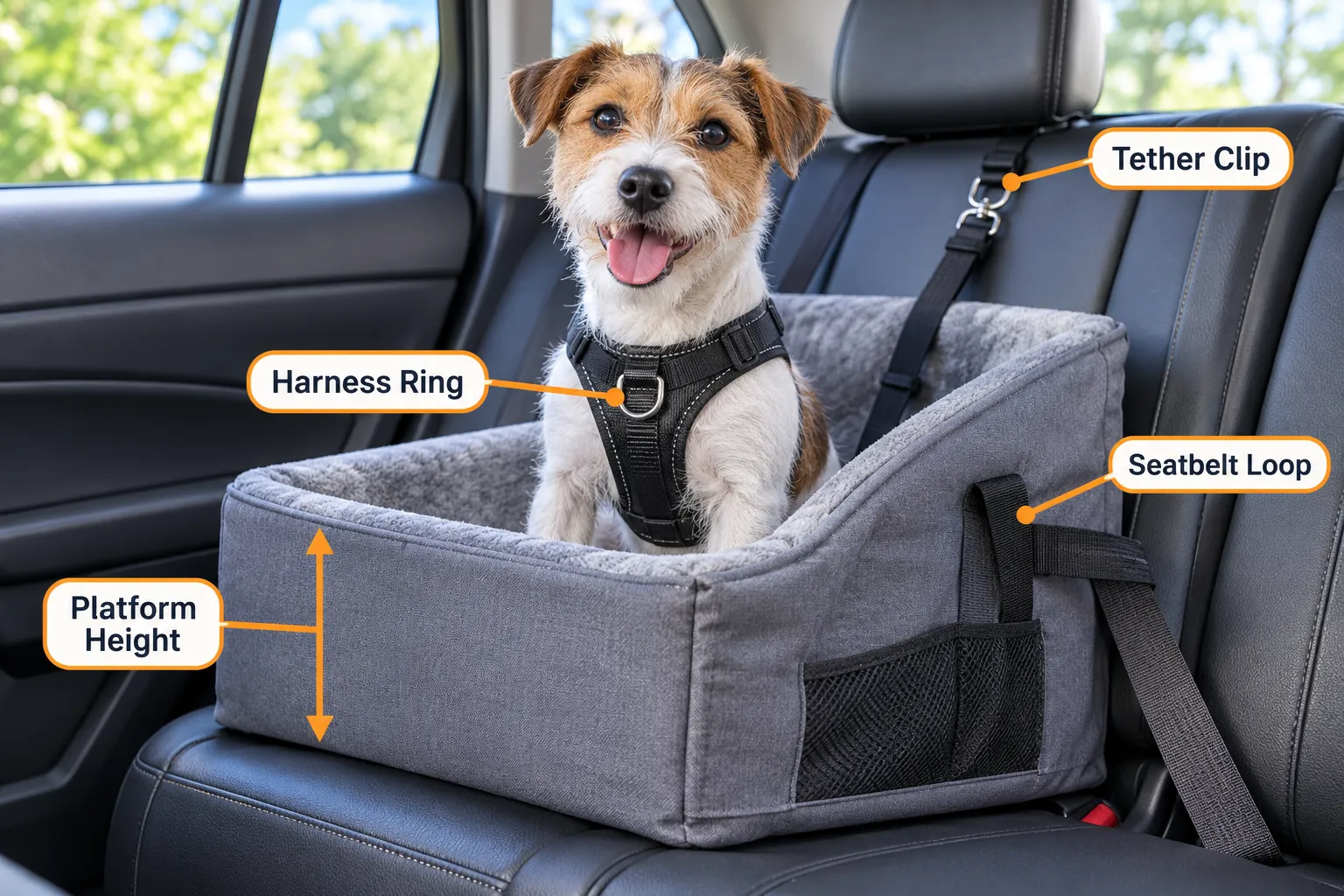
A the booster is a raised platform, usually bucket- or box-shaped, that lifts a small or medium dog closer to window height and gives it a defined, padded spot in the car. It typically includes a short tether that clips to the dog’s harness, and it belts or straps into the vehicle seat to keep the platform itself from sliding.
The mechanism is simple: foam or a rigid insert raises the dog’s body, side walls (on bucket-style models) keep the dog from rolling off during turns, and the attached tether limits how far the dog can move forward or sideways. That is the entire job. A the booster does not absorb crash energy the way a car seat built to federal child-restraint standards does, because no comparable federal standard exists for pet products.
Owners sometimes assume the word “booster” means the same regulatory backing as a child car seat. It does not. Webvet’s guide to crash-tested dog car seats draws a clear line: elevation and a tether are comfort and containment features, and the harness clipped into the seatbelt system is what actually does restraint work, if anything does. Check the dimensions and the tether anchor point before worrying about color or cup holders.
Doggy Rank IQ Tool
Dog Booster Seat Fit and Claim Checker

Most booster seats are comfort products with a tether. Check fit, then read the label honestly.
Fit, Height and Attachment: How Do You Know a Dog Booster Seat Will Work?
A the booster works only when three separate things line up: the dog’s body fits the bed, the seat’s base fits your actual vehicle seat, and the tether clips to something that can actually bear load. Most buyers check only the weight limit printed on the box and skip the other two.
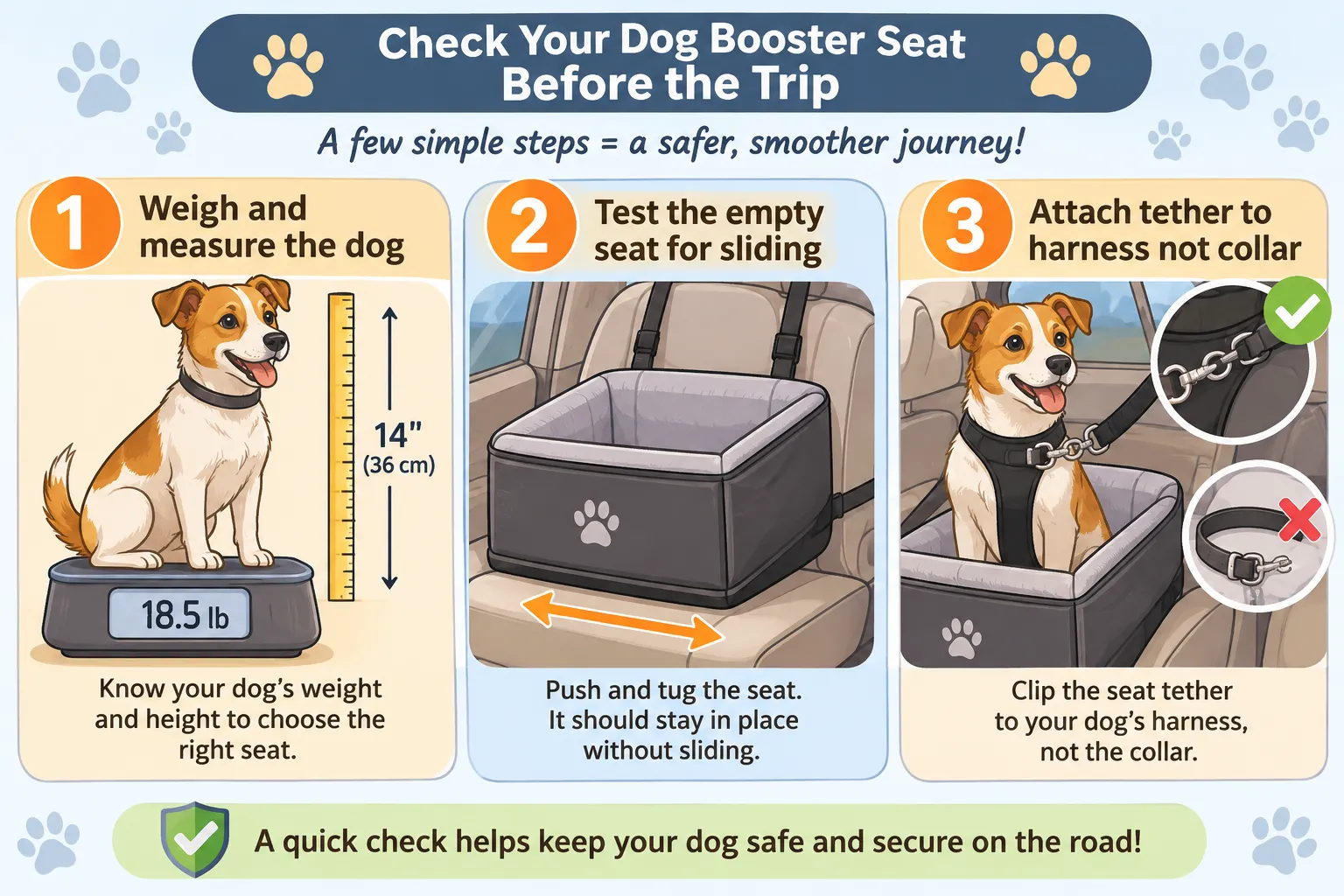
Fit to the dog. Weight capacity is a floor, not a guarantee. A 20 pound dachshund and a 20 pound terrier mix sit very differently in the same platform because of body length and leg proportion. Measure your dog nose to tail base, add a few inches for natural shifting, and compare that number to the seat’s internal bed length, which is usually buried in the product description rather than the headline bullet points.
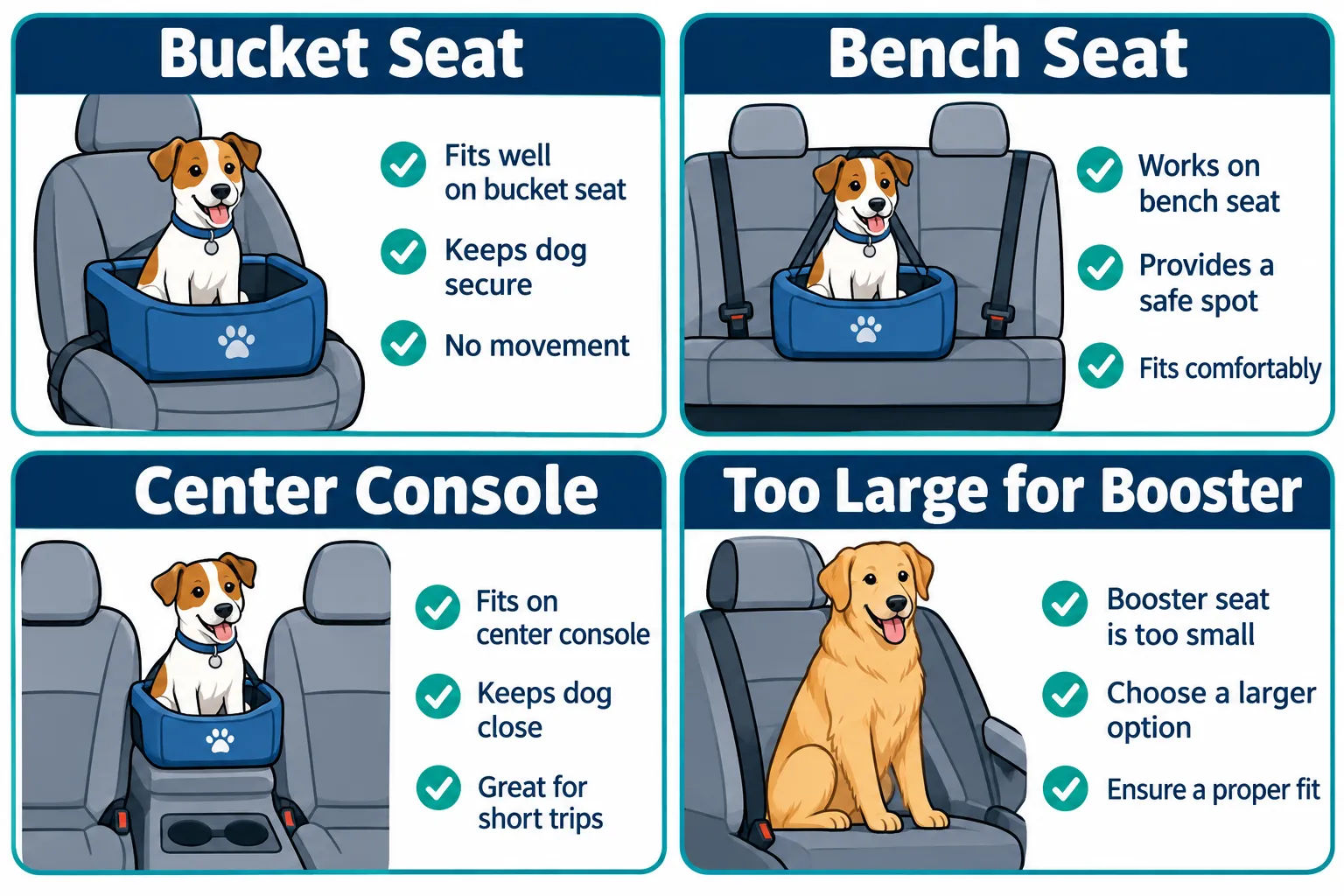
Fit to the vehicle seat. This is the step owners skip most often. A booster built for a bucket seat with raised side bolsters can rock side to side on a flat bench seat because it has nothing to wedge against. A console-style booster depends entirely on having a center console or armrest at the right height between two seats, and it will not sit flat in a vehicle without one. Business Insider’s dog car seat guide recommends buckling the empty seat in and physically pushing on it to test for sliding and tipping before the dog ever gets near it.
Attachment claims. “Includes safety tether” appears on nearly every box, but the meaning varies enormously. Some tethers clip to a D-ring sewn into the seat fabric, with zero connection to the vehicle’s own restraint system. Others route through a headrest strap or the seatbelt itself. The tether should clip to a harness chest ring, never a collar, because a collar under sudden braking force concentrates pressure on the dog’s neck instead of spreading it across the chest and shoulders, a point echoed by AAA’s guide to keeping your dog safe in the car.
None of these three checks substitutes for the others. A seat that fits the dog perfectly but tips on your bench seat is a wasted purchase. A seat that fits the vehicle but has a tether sewn only into decorative fabric offers a false sense of security.
Common mistake: buying based on the weight limit alone and skipping a trial fit in the actual car. A seat rated for 30 pounds can still rock loose on a bench seat with no center hump to brace against.
Top 5 Features That Decide the Purchase
1. Published elevation height. Thomas Acres found only 6 of 10 reviewed seats stated an actual height figure, and those that did were generally in the 5 to 6 inch range . The JOEJOY Elevated Dog Car Seat{rel=”sponsored nofollow”} is one of the few models that lists its platform specs clearly, which matters when you’re comparing window-height outcomes instead of guessing from a product photo.
2. Vehicle seat compatibility. A seat designed for a bucket seat behaves differently from one built for a console gap. The SlowTon Console Dog Car Seat{rel=”sponsored nofollow”} is purpose-built for the console position between two front or rear bucket seats and will not sit correctly on a flat bench.
3. Tether attachment point. Check whether the tether clips to a harness ring or only to a collar loop. A tether that only works with a collar should be treated as a comfort leash, not a safety feature.
4. Weight and length capacity together. The BurgeonNest Dog Car Seat{rel=”sponsored nofollow”} states a capacity under 25 pounds, which rules it out for most medium dogs even though the bed itself looks roomy in photos.
5. Cover washability and seatbelt routing. How the seat belts into the vehicle, over the top or through built-in loops, affects both stability and how quickly you can pull the cover for a wash after a muddy walk or a carsick afternoon.
Best Dog Booster Seats for Small Dogs
For dogs under 25 pounds, the three options worth comparing are a bench/bucket hybrid with storage pockets, a straightforward bucket-seat booster, and a console wedge for narrow-bodied small breeds. Choose based on your vehicle’s seat shape first and your dog’s exact weight second.
| Model | Price Band | Weight Capacity | Vehicle Seat Type | Attachment Claim | Independent Testing |
|---|---|---|---|---|---|
| JOEJOY Elevated Dog Car Seat{rel=”sponsored nofollow”} | Around $40 to $60 | Up to 35 lbs | Bench or bucket | Dual safety belts, harness tether, storage pockets | None identified; manufacturer claim only |
| BurgeonNest Dog Car Seat{rel=”sponsored nofollow”} | Around $30 to $50 | Under 25 lbs | Bucket seat | Side straps, harness tether loop | None identified; manufacturer claim only |
| SlowTon Console Dog Car Seat{rel=”sponsored nofollow”} | Around $25 to $40 | Under 11 lbs | Center console | Console wedge fit, short tether | None identified; manufacturer claim only |
None of the three models above appear on the Center for Pet Safety’s Certified product list, which is the closest thing the U.S. market has to independent crash evidence for pet travel gear. That does not mean these seats are unsafe for their intended comfort purpose. It means their restraint claims rest on manufacturer description rather than a published crash test, a pattern that holds across the booster seat category broadly, including the Kurgo Skybox, a seat with an integrated tether that still failed during CPS pilot testing.
Dog Booster Seat vs. Dog Car Harness: Which Is Safer?
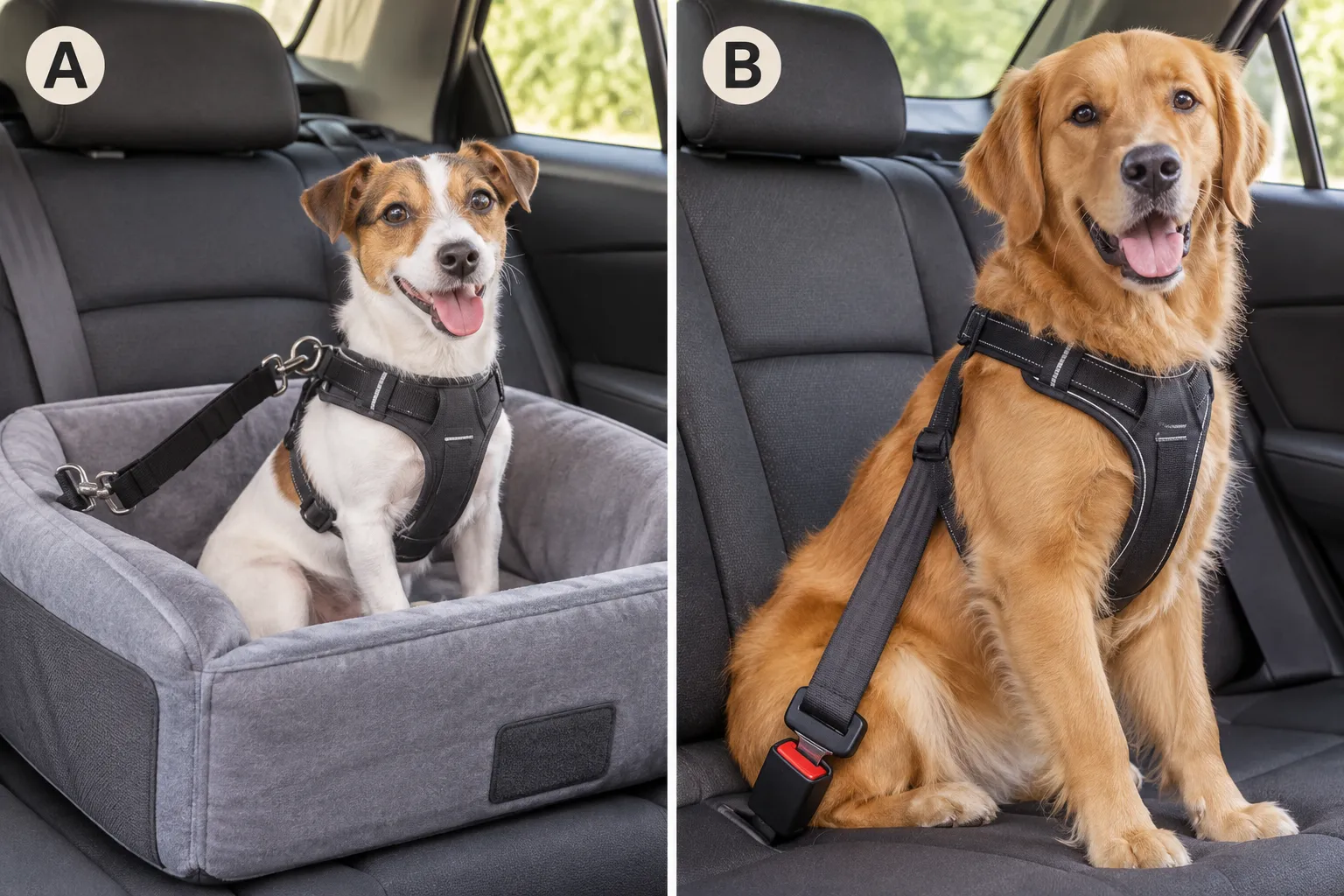
A crash-tested harness clipped directly to the vehicle’s seatbelt system is the safer option for most dogs, especially those over 25 pounds, because it has actually been put through sled testing that mimics a crash, while almost no booster seat on the market has. A the booster can still be the right pick for comfort and visibility in dogs under that weight who do not pull hard against restraint.
Think of it this way: a booster raises and contains, a harness restrains. The two are not interchangeable even though many listings use the word “safety” for both. Snout Hive’s harness research and AVMA’s general guidance on pet safety in vehicles both point toward crash-tested harnesses as the stronger baseline, with a booster seat layered on top for comfort if the dog’s size allows it.
Choose a booster seat if your dog is small, calm in the car, and you mainly want it off the floor and visible out the window. Choose a crash-tested harness alone, or a harness combined with a booster, if your dog is over 25 pounds, pulls or lunges at sudden stops, or if you drive on highways regularly.
How Much Do Dog Booster Seats Cost?
Most the boosters run between $25 and $60 depending on size, materials, and included features like storage pockets or memory foam padding. Console-style models tend to sit at the lower end of that range, around $25 to $40, because they use less material and serve a narrower size of dog, while larger bench or bucket boosters with padded sides and dual belts climb toward $50 to $60.
Spending more does not automatically buy crash protection, since none of the reviewed models here carry independent certification regardless of price. The extra money at the higher end typically buys thicker padding, a washable cover, storage pockets, and sometimes a sturdier internal frame that resists sagging over months of use, not a documented safety upgrade.
Do I Actually Need a Dog Booster Seat?
You need a the booster if your dog is small enough to ride comfortably at floor level but gets anxious or overstimulated without a view out the window, or if you simply want a defined, contained spot for a dog that otherwise climbs between seats. You do not strictly need one if your dog already rides calmly in a crash-tested harness and does not show signs of car anxiety.
A booster seat is a quality-of-life upgrade more than a required safety purchase. For dogs under about 20 pounds who get carsick looking only at seat backs or floor mats, elevation can genuinely reduce stress, which USA Today’s pet travel safety guide notes is a real factor in how well pets tolerate car rides during hot-weather travel season. If your main goal is restraint in a crash, a harness does that job better on its own.
Will My Dog Get Motion Sickness in a Dog Booster Seat?
A the booster can reduce motion sickness for some dogs by letting them see a stable horizon through the window instead of a moving floor, but it will not cure motion sickness caused by inner-ear sensitivity or anxiety. Dogs that already get carsick at floor level sometimes improve with elevation, and dogs that are fine at floor level rarely get worse.
If your dog still drools, paces, or vomits once raise, the booster seat is not the fix. Veterinary guidance on gradual car exposure, short practice trips, and withholding a full meal within two hours of travel addresses the underlying cause more directly than seat height alone. Combine a booster with the same car-anxiety training used for crate-trained dogs: short trips first, calm praise, and gradually longer drives.
Dog Booster Seat Won’t Stay Secure: What Do I Do?
If a the booster slides, tips, or rotates once installed, the most common cause is a mismatch between the seat’s base shape and your vehicle seat type, not a defective product. Stop using it with the dog inside until you’ve diagnosed and fixed the specific failure point.
Work through these steps in order:
- Remove the dog and test the empty seat by pushing it from multiple angles the way Business Insider recommends before ever loading it.
- Check whether your vehicle has bucket seats with bolsters, a flat bench, or a console gap, and confirm that matches the booster’s intended seat type.
- Re-route the main seatbelt through the booster’s built-in loops exactly as the manual shows. A seatbelt run over the top instead of through the loop is the single most common installation error.
- Tighten any underseat straps or anchor points fully; a loose strap lets the whole unit shift laterally even if the seatbelt itself is tight.
- If it still rocks after a correct installation, the base shape genuinely does not match your seat, and no amount of adjustment will fix that. Return it for a model built for your seat type instead.
Can You Use a Dog Booster Seat for Large Dogs?
No. The boosters are built for small to medium dogs, generally under 35 pounds, and none of the widely sold models on the market today are rated for large breeds. Dogs over roughly 30 pounds should move to a crash-tested harness connected directly to the seatbelt system instead of looking for a booster workaround.
Even the upper end of booster capacity, around 30 to 35 pounds on models like the JOEJOY seat, sits well above what any independent crash evidence supports for that product category. A large dog in a booster seat also raises the center of gravity of an already heavy, moving mass, which increases rather than decreases risk during a sudden stop or rollover. For dogs in the 25 to 50 pound range, a properly fitted harness is the better baseline, with a travel crate as another solid alternative for dogs that do well confined.
How to Train Your Dog to Sit in a Dog Booster Seat
Most dogs adjust to a new booster seat within a handful of short car trips if the introduction happens gradually and with positive reinforcement, rather than being placed in it cold for a long drive. Start with the seat parked in the driveway before ever turning the key.
- Let the dog sniff and step into the stationary booster seat at home or in a parked car, rewarding calm behavior with a treat.
- Clip the harness tether and let the dog sit for a few minutes without the engine running.
- Take a five-minute drive around the block, then build up to 15 and 30 minute trips over a week or two.
- Keep a familiar blanket or toy in the booster seat so the space smells and feels consistent across trips.
- Avoid forcing a dog that resists; a few extra days of short sessions beats a single stressful long drive that creates a lasting negative association.
Owners working through general obedience basics alongside car training may find it useful to review essential commands every puppy should learn, since a dog that reliably responds to “sit” and “stay” settles into a booster seat routine faster than one without any baseline training.
Alternatives to Dog Booster Seats for Car Travel
The main alternatives to a the booster are a crash-tested harness clipped to the seatbelt, a hard-sided or soft travel crate secured against the cargo area or back seat, and a vehicle-spanning cargo barrier for dogs that ride loose in a hatchback or SUV trunk. Each suits a different dog size and temperament.
- Crash-tested harness: best for dogs over 25 pounds or dogs that pull against restraint; clips directly into the existing seatbelt buckle.
- Travel crate: best for dogs that already enjoy a den-like space, particularly anxious dogs or those prone to chewing a tether; needs to be strapped down, not left loose.
- Cargo barrier: best for larger dogs riding in the back of an SUV or wagon, keeping them contained without elevation or a tether at all.
- Booster seat: best for small dogs under 25 to 30 pounds who want visibility and a defined, padded spot, paired with a harness tether rather than used alone.
Owners weighing crate training in general, not just for car travel, can review broader guidance on dog training basics to decide which containment style fits a particular dog’s temperament.
Are Dog Booster Seats Actually Safe in Accidents?
Most the boosters sold today have not undergone independent crash testing, and the Center for Pet Safety’s pilot study found several failed through seat rotation, anchor release, tearing, or tether failure during testing. That means the honest answer is that safety in an accident depends on the specific model and its tether’s connection point, not on the word “safety” printed on the packaging.
The Kurgo Skybox is the clearest documented example: it failed its seat connections during CPS pilot testing and became a projectile despite having an integrated harness tether and a marketed capacity up to 30 pounds. None of the three models compared in this guide (JOEJOY, BurgeonNest, SlowTon) appear on CPS’s Certified product list either, which means their crash performance is unverified rather than proven safe or proven unsafe.
Edge case: a booster seat with a tether that clips into the actual seatbelt buckle, rather than only into the seat’s own fabric D-ring, offers meaningfully more restraint value than one that does not, even without formal crash certification. Checking that single detail matters more than the brand name on the box.
Best Dog Booster Seat for Anxious or Nervous Dogs
For anxious or nervous dogs, a bucket-style booster seat with high side walls tends to work better than an open bench-style platform, because the enclosed sides create a den-like feeling that can reduce pacing and jumping. The BurgeonNest Dog Car Seat{rel=”sponsored nofollow”} fits this profile for dogs under 25 pounds who do better with visible boundaries on both sides.
Pair the seat with a short, non-extendable tether clipped to a harness chest ring, since extension tethers and zipline-style attachments increase the range of motion an anxious dog has to pace or climb, which can heighten rather than calm anxiety during a drive. Short, frequent trips during the training phase described earlier also help more than a single long trip for dogs with existing car anxiety. Owners dealing with broader anxiety behaviors may find value in reviewing general calming products for dogs to use alongside the booster seat itself.
How Long Can a Dog Stay in a Dog Booster Seat?
A dog should not stay in a booster seat for more than two to three hours without a break to stand, stretch, and relieve itself, similar to general guidance for crate time. For trips longer than that, plan stops every two hours at minimum, following the same rest-stop cadence AAA recommends for pet travel generally.
Short daily trips, like errands or a vet visit, pose no issue for time spent in a booster seat. The concern grows with road trips, where a dog confined to one small padded platform for six or eight hours without a break can develop stiffness, dehydration, or increased anxiety regardless of how comfortable the seat itself is.
Dog Booster Seat for Senior Dogs and Older Pets
A the booster can help senior dogs with mild joint stiffness get into and stay in the car more comfortably, since the padded surface and raised height reduce the distance an older dog has to jump or climb. Choose a model with a low step-up ramp or one that sits at a height matching the vehicle’s seat, rather than one requiring the dog to leap up onto the platform itself.
For senior dogs with more significant mobility loss or arthritis, a ramp into the vehicle combined with a flatter, non-raise harness restraint may serve them better than a boosted platform, since climbing in and out of a raised seat can aggravate joint pain rather than ease it. A quick conversation with a veterinarian about a specific dog’s joint health, along with general information on dog aging, helps clarify whether elevation helps or hinders a given senior dog.
Which Pick Fits Which Dog and Owner?
The JOEJOY Elevated Dog Car Seat suits an owner with a small to medium dog, up to 35 pounds, who travels mostly on bench or standard bucket seats and wants storage pockets for a leash, waste bags, and water bottle within reach. The memory foam base and washable cover matter more for a dog prone to carsickness or shedding than for crash protection, and that is the honest reason to choose it.
The BurgeonNest Dog Car Seat fits an owner with a smaller dog under 25 pounds who wants a straightforward bucket-seat booster without extra bulk. It is a reasonable budget pick for someone who mainly needs elevation and a defined spot, not a dog that pulls hard against restraint or rides in a vehicle without clear bucket-seat bolsters.
The SlowTon Console Dog Car Seat is built specifically for owners whose vehicle has a usable center console gap between front or rear bucket seats, and whose dog is under 11 pounds. It will not work in a vehicle without that console shape, so measure the gap before ordering, not after.
Owners whose dog is close to or over 30 pounds, rides frequently in a vehicle without clear bucket seats, or pulls hard when startled should look past booster seats entirely toward a crash-tested harness clipped directly into the seatbelt system.
Things to Watch Out For
The tether is only as strong as what it clips to. A tether sewn into a decorative D-ring on the seat fabric, with no route to the vehicle’s own seatbelt or headrest strap, offers very little in a hard stop. Check exactly where the tether anchors before assuming it does anything useful.
Extension tethers and zipline-style attachments deserve particular caution. Extra range of motion increases how far a dog travels during a sudden stop, which raises injury risk rather than lowering it. More leash is not more safety. It is more momentum.
Watch the published elevation numbers, or the lack of them. A product photo showing a dog gazing happily out the window is not a specification. If a listing does not state an actual height in inches, assume it falls somewhere in the unverified middle of the pack, roughly the 5 to 6 inch range Thomas Acres found among the products that did disclose a figure .
Watch console-style boosters especially closely. They depend entirely on your specific vehicle having a console gap of the right width and height. A seat that looked perfect in a review photo taken in a different make of car can simply refuse to sit level in yours.
Who Should Skip This
Dogs over roughly 30 pounds should generally skip the boosters altogether, since none of the three reviewed models here rate above 35 pounds and even that upper limit sits well above what independent crash evidence supports. A crash-tested harness connected directly to the vehicle’s own seatbelt system is the better choice for these dogs instead.
Anxious dogs that climb, pace, or try to escape a harness may also do worse in a booster seat than in a fully enclosed travel crate, since the open top of most booster designs gives them room to keep moving rather than settling. And owners whose vehicle lacks clear bucket seats, a flat bench, or a usable console gap matching their chosen model should skip that specific booster seat and look for one actually designed for their seat shape, rather than forcing an ill-fitting product into place.
FAQ
Is a the booster the same as a car seat for kids? No. A the booster borrows the name but not the regulation. There is no U.S. performance standard for pet travel seats comparable to the federal rules that govern child car seats, so two booster seats that look similar can perform very differently in a crash.
What weight dog is too big for a booster seat? Most booster seats top out around 30 to 35 pounds, and dogs above that range should use a crash-tested harness clipped to the seatbelt instead. Even seats rated up to 35 pounds have not been independently crash tested at that weight.
Does a the booster need a tether? Yes, functionally it does. Without a tether clipped to a harness chest ring, a booster seat is just an raise bed that can let a dog slide, jump out, or fly forward during a sudden stop.
Can I put a booster seat on a bench seat if it’s made for a bucket seat? It is not recommended. A bucket-style booster relies on side bolsters to stay in place, and it can rock or slide on a flat bench without that support, even if the seatbelt is buckled correctly.
How do I know if my the booster tether is actually safe? Trace the tether by hand from the dog’s harness to its anchor point. If it clips into a fabric loop sewn only into the seat cushion, it has no connection to the vehicle’s own restraint system. If it routes through the seatbelt buckle or a headrest strap, it has at least a mechanical path to real restraint, even without formal crash certification.
Are extension leashes or ziplines ever safe to use with a booster seat? Generally no. Extension tethers and zipline-style attachments increase how far a dog can travel during a sudden stop, which raises injury risk rather than reducing it. A short, fixed-length tether is the safer choice.
Do vets recommend the boosters? Veterinary guidance, including the AVMA’s advice on pet safety in vehicles, generally recommends some form of restraint for every car ride, and a booster seat with a harness tether can satisfy that for small dogs, while a crash-tested harness alone is recommended for larger or more active dogs.
What’s the difference between a console booster and a bucket seat booster? A console booster wedges into the gap between two front or rear bucket seats and only works in vehicles with that console shape. A bucket seat booster sits directly on top of an individual seat with raised side bolsters and does not need a console at all.