Researchers measured 133 blood metabolites in 937 pet dogs. About 17 percent of those molecules were linked to whether a dog died during the study window, and 23 stayed statistically significant after correction for multiple testing. That result, published in 2026 in The Journals of Gerontology, is the clearest sign yet that the dog aging project is moving from surveys into measurable aging biology. It is also not a blood test you can order on Saturday.
Quick Answer
The dog aging project is a long-running study of more than 50,000 U.S. companion dogs, run by scientists including Dr. Daniel Promislow and Dr. Kate Creevy, that tracks owner surveys, vet records, genetics, and biological samples to learn why some dogs age better than others. As of October 2026, its most useful findings for owners are practical rather than pharmaceutical: blood metabolites track mortality risk, kidney measures explain a large share of age-related change, only about 6 percent of home-prepared diets looked nutritionally complete, around half of enrolled dogs get supplements with little evidence behind most of them, and the rapamycin trial known as TRIAD is still running with no published lifespan result. Keeping your dog lean and getting regular bloodwork remain the best-supported moves.
Key Takeaways: Dog Aging Project
- The dog aging project is observational for most participants. It describes patterns across tens of thousands of dogs. Association is not causation.
- A 2026 metabolite study of 937 dogs found 23 blood metabolites significantly associated with mortality, and the pattern matched human aging cohorts. It is not yet a clinical lifespan test.
- A related analysis found roughly 36 percent of measured metabolites changed with age, with kidney-function measures mediating about half of the age effect for one group of amino acids.
- Of 1,726 owner-reported home-prepared diets, only about 6 percent looked potentially complete for adult maintenance.
- In 40,367 dogs, 52 percent reportedly received supplements. Omega-3s (57 percent of users) and joint products (56 percent) led the list. Popularity is not proof.
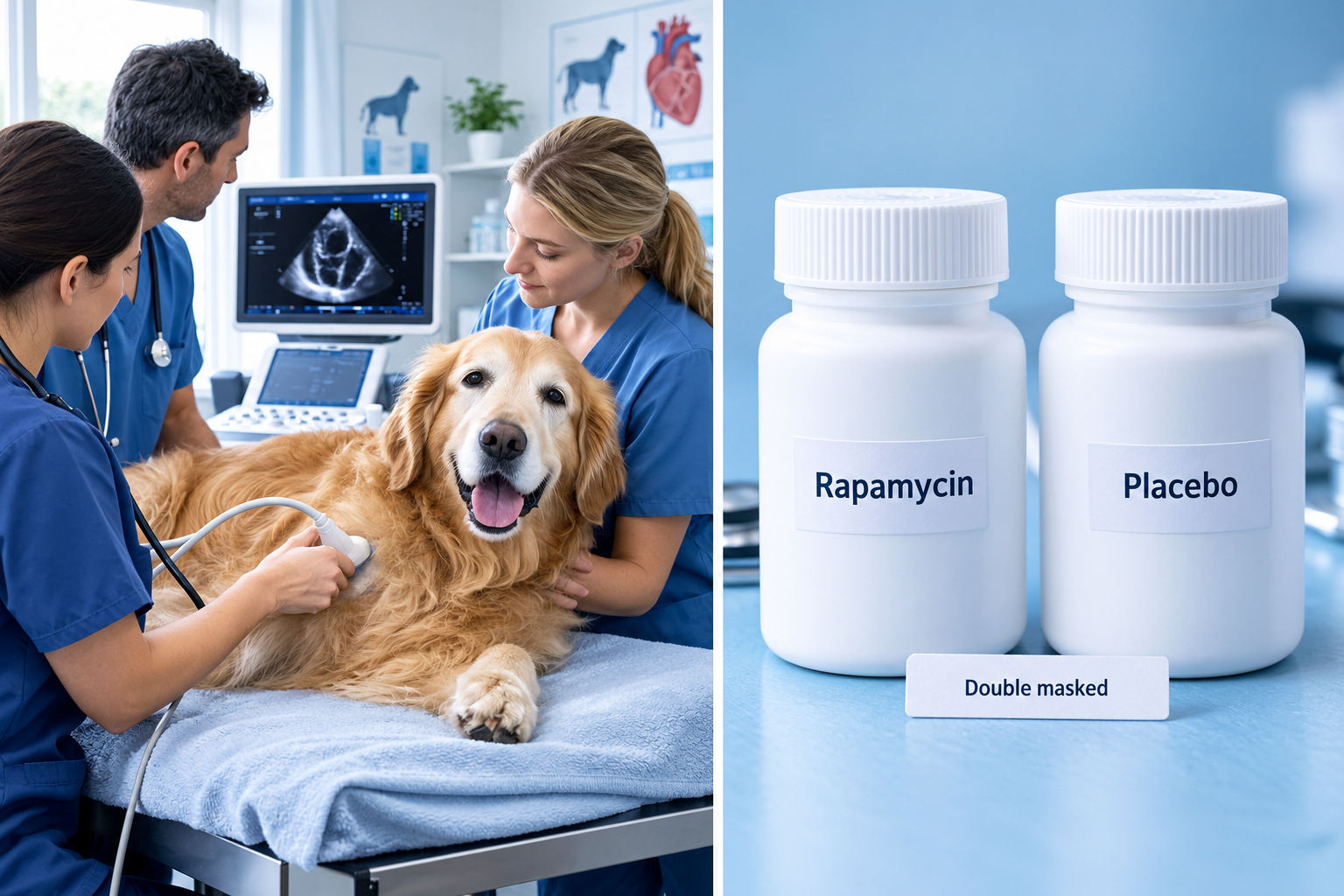
- TRIAD, the Test of Rapamycin in Aging Dogs, is a randomized, double-masked, placebo-controlled trial in dogs at least 7 years old and 44 pounds. Twelve months of dosing, 24 months of follow-up, no published efficacy result yet.
- The strongest longevity evidence in dogs still comes from the Purina Life Span Study: 48 Labradors, median lifespan 13.0 years on restricted feeding versus 11.2 years on free feeding.
- Enrollment is free for U.S. dog owners. Any age, any size, mixed breed or purebred, including dogs who have already died.
- Guidance and enrollment details checked October 2026. Always confirm current cohort status on the project’s own site.
What is the dog aging project, and how does it work?
The dog aging project is a longitudinal study of companion dogs living in U.S. homes, designed to find out which genetic, environmental, and lifestyle factors shape healthy aging. It follows the same dogs over years rather than testing one product on a small group for a month. The project describes a cohort of more than 50,000 dogs, and a 2026 preprint reported 52,705 enrolled dogs as of December 2025.
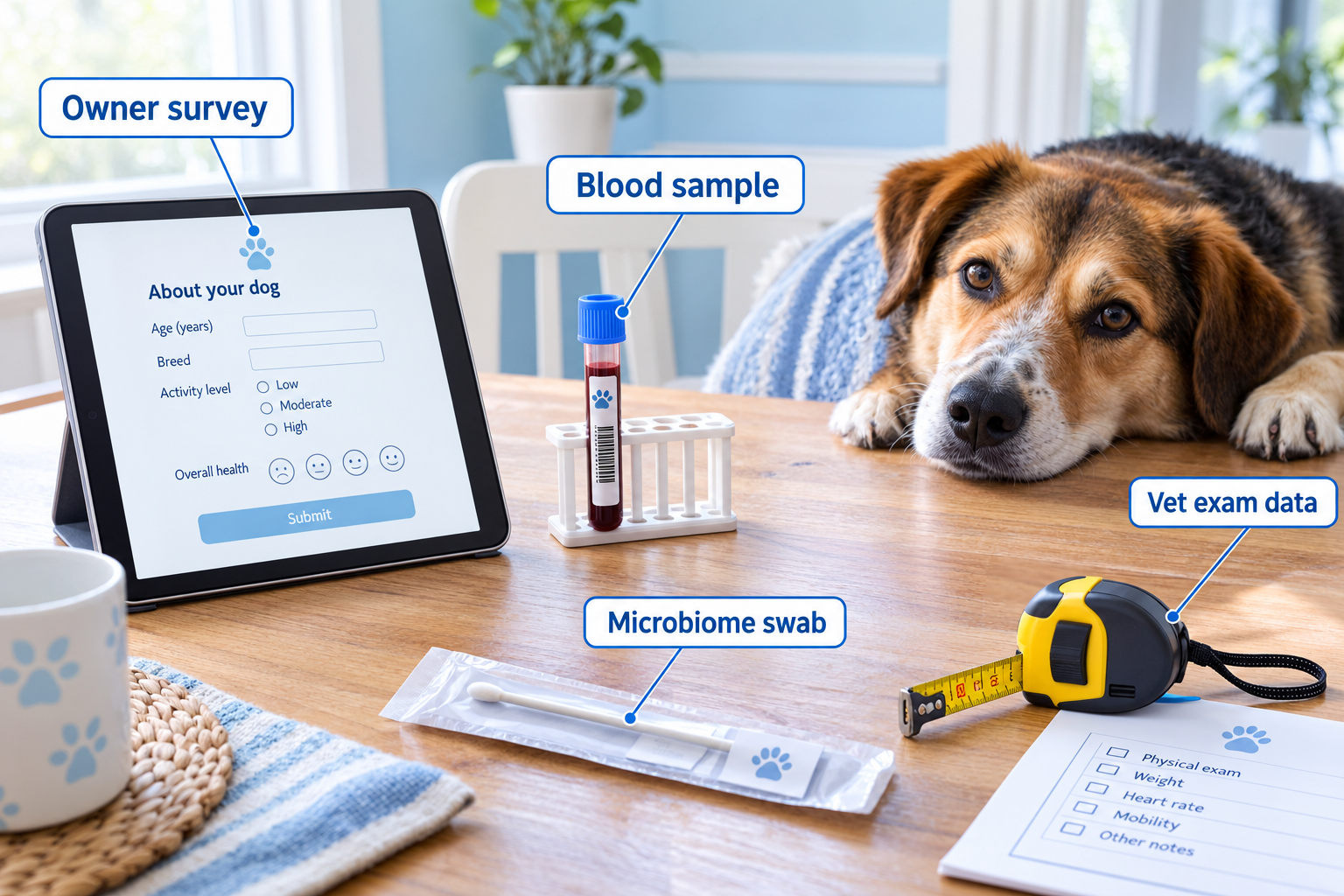
The data collection works in layers.
- Surveys. Owners complete an annual health and life experience questionnaire covering diet, activity, environment, medications, behavior, and diagnoses. Most of the cohort sits here.
- Veterinary records. Owners authorize release of clinical notes and lab results, which turns owner reporting into something checkable.
- The Precision cohort. A smaller subset visits participating veterinary practices for physical exams and sample collection: blood, urine, feces, and hair. This is where metabolite and microbiome work happens.
- Genetics and banked samples. DNA and stored samples let researchers go back and ask new questions without recruiting a new study.
- TRIAD. A separate randomized clinical trial nested inside the larger project.
Dr. Kate Creevy serves as the project’s chief veterinary officer at Texas A&M, and Dr. Daniel Promislow is its principal investigator. Texas A&M’s veterinary school publishes plain-language summaries of new papers, including the metabolite and lifespan work, which is a reasonable place to check a headline before you believe it.
Why it matters: dogs share our houses, our air, our couches, and often our snacks. They get many of the same age-related diseases we do, and they do it in a decade instead of eight. That makes them an unusually honest model for human aging and a direct beneficiary of the research at the same time.
How do dogs age compared to humans, and do size and breed change the rate?
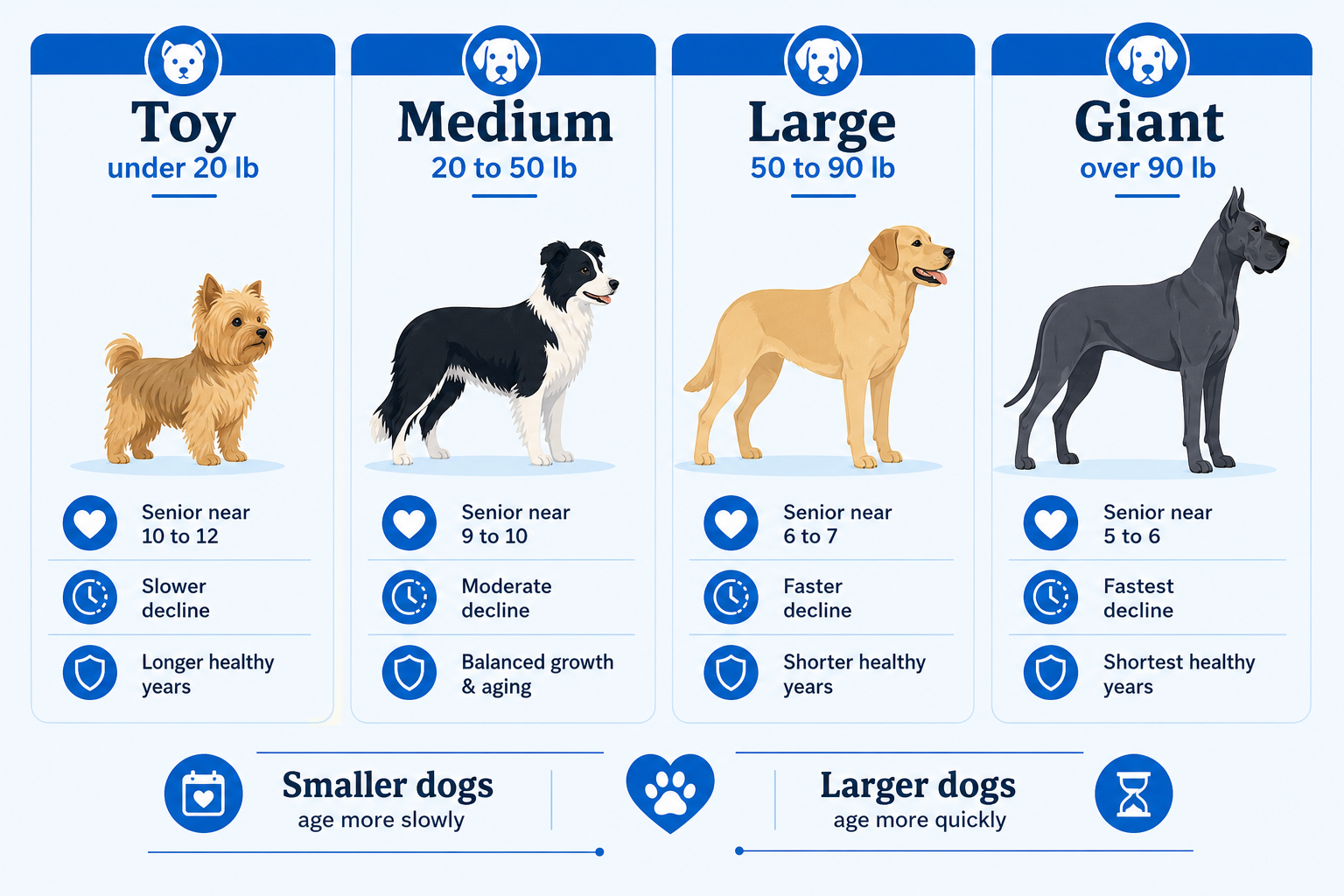
Dog aging is front-loaded and size-dependent. A dog does most of its “human equivalent” aging in the first two years, then slows down, and larger dogs run through the whole program faster than small ones. The old multiply-by-seven rule fails in both directions.
A 2020 study in Cell Systems measured DNA methylation in Labrador Retrievers and proposed a logarithmic conversion (16 times the natural log of the dog’s age, plus 31). It fit that breed reasonably well. It was built from one breed, so treat it as a useful illustration rather than a universal translator.
Do different sized dogs age at different rates?
Yes. Larger dogs tend to grow faster, show age-related change earlier, and die younger, which is backwards from the usual mammal pattern where bigger species live longer. Within dogs, bigger means shorter.
| Adult size | Commonly treated as senior around | Typical life expectancy range |
|---|---|---|
| Toy and small (under 20 lb) | 10 to 12 years | 12 to 16 years |
| Medium (20 to 50 lb) | 8 to 10 years | 11 to 14 years |
| Large (50 to 90 lb) | 7 to 8 years | 10 to 12 years |
| Giant (over 90 lb) | 6 to 7 years | 7 to 10 years |
Those ranges are planning tools, not predictions. Breed averages hide enormous individual variation, and a fit 11-year-old Border Collie can outperform a sedentary 7-year-old of the same breed. If you are still choosing a dog and want longevity in the mix, our guide on how to pick a dog breed that fits your life covers the trade-offs alongside energy, grooming, and space.
What breeds age faster or slower than others?
Smaller breeds generally age more slowly in calendar terms. Great Danes, Irish Wolfhounds, Bernese Mountain Dogs, and Mastiffs are on the fast end. Chihuahuas, Toy Poodles, and Miniature Dachshunds are on the slow end. Breed-specific disease risk matters as much as size: deep-chested giants carry higher bloat risk, and some lines carry elevated cancer risk. The dog aging project’s scale makes these breed comparisons statistically possible, but a breed average still cannot tell you what your dog will do.
How accurate is the dog aging calculator?
Online dog age calculators are rough. The better ones adjust for adult weight and use a curve rather than a flat multiplier, which puts them in the right neighborhood. None of them measure your dog.
Use a calculator to decide whether it is time to start senior screening. Do not use one to decide a dog is “only middle-aged” and skip the bloodwork. The project’s biomarker research exists precisely because calendar age and biological age come apart.
What are the 5 findings dog owners can use?
Each finding below lists what was studied, what the research found, and where the facts end. The last part is the part most summaries skip.
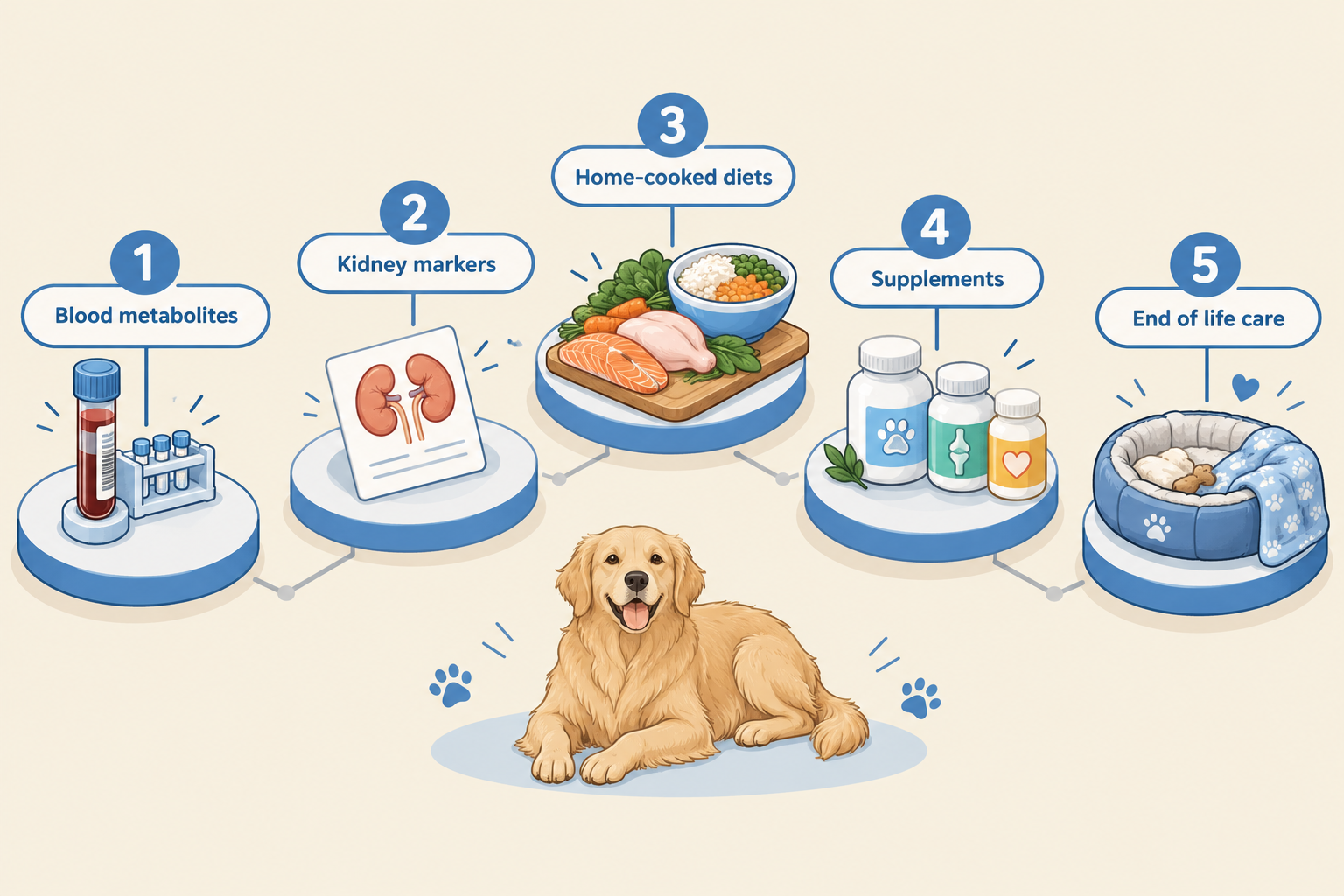
Finding 1: Blood metabolites track mortality risk, in dogs and in people
What was studied: 133 blood metabolites in 937 dogs from the Precision cohort, with survival followed over time.
What the research found: Roughly 17 percent of metabolites were associated with mortality, and 23 held up after false-discovery correction. The direction and strength of those associations correlated closely with results from human aging cohorts, as reported in The Journals of Gerontology.
What it did not prove: It did not establish cause. It did not produce a validated test that predicts an individual dog’s remaining lifespan, and no commercial lab should be selling you one on the strength of this paper.
What you can do: Ask your vet to run senior bloodwork on a schedule and keep the old results. A single panel is a snapshot. Three panels over three years is a trend, and trends are what the researchers are actually reading.
Finding 2: Kidney measures carry a large share of age-related change
What was studied: Age-related change across the measured metabolome in project dogs.
What the research found: About 36 percent of measured metabolites changed with age, and kidney-function measures mediated roughly half of the age effect for protein terminal-modified amino acids.
What it did not prove: It did not validate any of these metabolites as a screening test, and it did not show that protecting kidney function extends life.
What you can do: Make kidney assessment a standing item at senior visits, including urine testing and not only a blood panel. Chronic kidney disease is quiet early and loud late. Catching it while your dog still feels fine is the difference between management and crisis.
Finding 3: Most home-prepared diets are not nutritionally complete
What was studied: 1,726 owner-reported home-prepared diets fed to project dogs.
What the research found: Meat appeared in 90 percent of recipes and vegetables in 65 percent, and 45 percent included some commercial food or topper. Even so, only about 6 percent appeared potentially complete under adult maintenance standards, according to the study published in the American Journal of Veterinary Research and summarized on the project’s findings blog.
What it did not prove: The survey did not capture exact amounts, so even 6 percent may be generous. It also did not show that the incomplete diets harmed those specific dogs during the study.
What you can do: If you cook for your dog, get the recipe formulated by a board-certified veterinary nutritionist and follow it exactly, including the calcium source and the oil. Swapping ingredients breaks the math. Variety of ingredients is not the same thing as nutritional adequacy, which is also why reading the label and understanding AAFCO statements matters more than the picture on the bag. And before you add “just a little” of something from the fridge, check the list of foods dogs cannot eat.
Finding 4: Half of enrolled dogs get supplements, and popularity is not evidence
What was studied: Supplement use reported in enrollment surveys from 40,367 dogs, collected 2020 through 2022.
What the research found: 20,993 dogs, or 52 percent, reportedly received at least one supplement. Among users, omega-3 fatty acids led at 57 percent and joint supplements at 56 percent. Dog characteristics and health status predicted supplement use more strongly than owner characteristics, per the American Journal of Veterinary Research analysis.
What it did not prove: Nothing about effectiveness. This study counted bottles, not outcomes. It did not show that any supplement extended life, improved mobility, or slowed cognitive decline.
What you can do: Bring every bottle to the next appointment, with doses. Supplements can interact with medications, products vary in quality between brands, and senior dogs on multiple drugs are the group most likely to be getting something nobody has reviewed. The researchers specifically recommended that veterinary teams raise the topic. You can raise it first.
Finding 5: Owner experience at the end of life is now being studied too
What was studied: How owners experience the loss of a dog, including anticipatory grief and decision-making around euthanasia.
What the research found: Texas A&M reported in 2026 that project researchers published work on how owners experience pet loss, treating the human side of the human-dog bond as data worth collecting rather than a footnote.
What it did not prove: It did not establish a best way to grieve, a correct timing for euthanasia, or an intervention that reduces owner distress.
What you can do: Have the quality-of-life conversation with your vet while your dog is still well. Ask what the likely decline looks like for your dog’s specific conditions, what signs would change the plan, and what after-hours support exists. Writing that down early is kinder to the version of you who has to read it later.
Side by side: the studies behind the advice
| Study | Year | Dogs | Finding | Practical takeaway |
|---|---|---|---|---|
| Journals of Gerontology metabolite and mortality study | 2026 | 937 | 23 of 133 metabolites tied to mortality after correction | Repeat bloodwork and track the trend |
| Aging metabolome and kidney mediation analysis | 2025 | Precision cohort subset | About 36% of metabolites changed with age | Test kidney function yearly in seniors |
| Home-prepared diets analysis (AJVR) | 2025 | 1,726 diets | Only about 6% looked potentially complete | Get the recipe formulated, then follow it |
| Supplement use analysis (AJVR) | 2026 | 40,367 | 52% received supplements; no efficacy tested | Review every product with your vet |
| TRIAD rapamycin trial protocol | 2025 | 580 planned | Design published; results pending | Do not seek off-label rapamycin as an anti-aging pill |
| Purina Life Span Study (not a project study) | 2002 | 48 Labradors | Median lifespan 13.0 vs 11.2 years | Keep your dog lean for life |
What is the TRIAD rapamycin trial, and when will results come out?
TRIAD, the Test of Rapamycin in Aging Dogs, is a randomized, double-masked, placebo-controlled trial inside the dog aging project that tests whether weekly low-dose rapamycin extends lifespan and healthspan in older, larger pet dogs. It is ongoing. No peer-reviewed lifespan result has been published, and the design means results arrive years after a dog enrolls, not months.
The protocol details above come from the TRIAD trial page and the published protocol on PubMed. Endpoints include lifespan plus healthspan measures such as cardiac function, mobility, and cognition. A September 2026 Iowa State University feature described the monitoring load at participating sites: examinations and bloodwork every six months for three years, with no cost to owners at those sites.
About those "interim rapamycin results" you may have seen
Search for rapamycin for dogs and you will find commercial longevity sites quoting specific interim numbers: a 28 percent cancer reduction, better cardiac ejection fraction, more activity, a projected 15 percent lifespan increase. Those figures do not appear on the official TRIAD pages or in the peer-reviewed protocol. Treat them as marketing until a trial publication says otherwise.
Rapamycin is a real immunosuppressant with real side effects. In a double-masked trial, nobody knows which dogs got the drug until the code is broken, which is exactly why interim lifespan claims should make you suspicious. Asking a vet to prescribe it off-label as an anti-aging supplement is not a shortcut to the trial result. It is skipping the part where we find out whether it works.
Can you slow down your dog's aging process?
You cannot stop aging, and no product sold in 2026 has been shown to extend a pet dog's life. What the evidence supports is narrower and more boring: keep the dog lean, keep the muscle, treat disease early, and keep the brain busy.
The strongest intervention evidence in dogs is still the Purina Life Span Study, not a new pill. Forty-eight Labrador Retrievers were split into pairs, with one of each pair fed about 25 percent fewer calories while still receiving adequate nutrition. The restricted dogs reached a median lifespan of 13.0 years versus 11.2 years, a difference of 1.8 years, and developed chronic disease later, especially osteoarthritis. The two-decade summary appeared in the British Journal of Nutrition.
This does not mean cutting your dog's current bowl by a quarter tonight. It means working with your vet toward an ideal body condition score and staying there.
Body composition may matter more than the number on the scale. In the same research program, higher fat mass and falling lean mass predicted death most strongly about a year beforehand, and fat mass above 25 percent tracked with rising insulin resistance. Practically: run your hands along the ribs monthly, look for the waist from above, and notice whether the hind-end muscle is thinning. A dog can hold steady at 68 pounds while swapping muscle for fat, and the scale will congratulate you both.
Four things with reasonable support behind them:
- Maintain lean body condition from puppyhood on. This is the single best-supported lever.
- Keep muscle. Short, regular, low-impact activity beats one hard weekend hike. Swimming and controlled leash walks are kind to arthritic joints.
- Catch disease early. Dental disease, arthritis, kidney disease, and endocrine problems all respond better to early management.
- Protect cognition with enrichment. Sniffing walks, food puzzles, new routes, and short training sessions using humane training methods give an older brain something to do. Evidence for enrichment slowing canine cognitive dysfunction is suggestive rather than settled, and the downside risk is close to zero.
Food choice sits underneath all of this. If you are comparing formats, our rundown on dry, wet, or raw dog food and which suits your dog and the guide to judging a dog food brand before you buy will do more for your dog than any bottle labelled "longevity blend."
What are the early signs of aging in dogs, and what health problems come with senior dogs?
The early signs are usually small changes in routine, not dramatic decline: slower to rise, less interest in stairs, sleeping through noises, a new stiffness after long naps. Owners tend to call this "slowing down" and mention it a year later, which is a year of treatable arthritis going untreated.
Watch for these:
- Hesitating at stairs, jumps, or slippery floors
- Taking longer to stand up, or sitting down mid-walk
- Cloudy eyes, bumping into furniture in dim light, not responding to a familiar call
- Drinking or urinating more, including new accidents overnight
- Weight change in either direction, or a sunken look over the hips and shoulders
- Bad breath, dropping food, chewing on one side
- Night pacing, confusion in familiar rooms, staring at walls, reversed sleep patterns
- New irritability or avoidance, which is often pain rather than personality. Pain is one reason a previously gentle dog may snap, which we cover in why dogs bite their own owners and how to prevent it
Common senior conditions include osteoarthritis, dental disease, chronic kidney disease, heart disease, cancer, hypothyroidism and Cushing's disease, vision and hearing loss, and canine cognitive dysfunction. Many of them look identical from the couch. That is why "he's just old" is a hypothesis, not a diagnosis.
What age is considered very old for a dog?
There is no single number. Most veterinary guidance treats "senior" as roughly the last quarter of a dog's expected lifespan, which means a Great Dane can be senior at 6 while a Chihuahua is middle-aged at 9. Very old usually means a dog at or past the top of the expected range for its size: around 15 or 16 for a small dog, 12 or 13 for a large one, 10 for a giant breed. Reaching it is partly genetics, partly care, and partly luck.
What should I change about my dog's routine as they get older?
Change the environment and the schedule before you change the dog. Most senior adjustments cost nothing and address traction, temperature, access, and predictability.
- Vet visits twice a year instead of once, with bloodwork and urine testing, plus blood pressure checks where indicated.
- Traction. Runners on wood floors, a mat at the food bowl, a ramp into the car. A dog who slips once often starts avoiding the whole room.
- Shorter, more frequent walks. Two twenty-minute sniffing walks beat one hour-long march. Let the nose set the pace.
- Easier access. Raised bowls if the neck is stiff, a thicker orthopedic bed away from drafts, a night light near the water bowl, and one more trip outside before bed.
- Weight recheck every month and a body condition score at every vet visit.
- Food that matches the current body. Senior dogs often need the same or more protein with fewer calories, and some need prescription diets for kidney or joint issues. Switch slowly using the steps in our guide on changing dog food without upsetting their stomach.
- Dental care that actually happens. Daily brushing or a professional cleaning schedule your vet recommends.
- Keep training. Older dogs learn. Short sessions with high-value food support cognition and give a stiff dog a win.
One more note on sleep: older dogs sleep more, and that alone is not alarming. A dog who sleeps more and also drinks more, pants at rest, or cannot settle at night is telling you something different. Report the combination, not the single symptom.
Who funds the dog aging project?
The dog aging project has been supported primarily by federal research funding from the National Institute on Aging, part of the U.S. National Institutes of Health, with additional support from private philanthropy and individual donations. The project's own site is the authoritative place to check current funders and status, because grant cycles change and the project has publicly solicited donations to continue its work.
Two things worth knowing as a reader:
- Public funding means public output. The project publishes its papers and maintains a publications list and a media page, which is why you can check a claim rather than trust a headline.
- Funding is not permanent. Long-term cohort studies live grant to grant. If you see enrollment pauses or changed cohort structures, that is usually budget, not a scientific retreat.
No pet food company, supplement maker, or pharmaceutical brand gets to write the findings. If a product page cites project research as an endorsement of its product, that is the company talking, not the scientists.
How can my dog join the dog aging project? Is it free to join?
Yes, enrollment is free for U.S. dog owners, and almost any dog is eligible. Nomination happens on the project's own website, and the main cost to you is time spent on surveys.
The steps, checked October 2026:
- Nominate your dog at dogagingproject.org using your email and basic details about your dog.
- Complete the Health and Life Experience Survey. It is long. Set aside an unhurried hour and have your dog's medical history nearby.
- Authorize veterinary record release so researchers can match your answers to clinical data.
- Update annually. The value of the cohort comes from repeat measurement, so the yearly survey is the actual contribution.
- Wait for optional invitations. A subset is invited into the Precision cohort for exams and sample collection, and larger older dogs near participating sites may be contacted about TRIAD. You cannot apply your way into either; selection is by study design.
Who it suits: owners in the United States who can commit to an annual survey, including people with senior dogs, puppies, mixed breeds, and dogs with chronic illness. Owners of dogs who have already died can still contribute end-of-life data.
Who it does not suit: anyone hoping to receive a treatment, a diagnosis, or free veterinary care in general. Most participants get no clinical benefit. What you get is a line in a dataset that may outlive your dog and help somebody else's.
Enrollment windows and cohort structures do change. Check the project's blog for current status before assuming a page you read in 2023 still applies.
FAQ
Is the dog aging project still enrolling dogs in 2026?
The project reported more than 50,000 enrolled dogs and 52,705 as of December 2025, and continues to publish and recruit. Confirm current enrollment status on dogagingproject.org before you plan around it, since cohorts open and close.
Have any dog aging project rapamycin results been published?
No lifespan or healthspan results from TRIAD have been published as of October 2026. The trial design, dose (0.15 mg/kg weekly), and endpoints are published, with 12 months of dosing and 24 months of follow-up. Interim percentages circulating on commercial longevity sites are not supported by the official trial pages.
Should I ask my vet for rapamycin for my dog now?
No. Rapamycin's ability to extend a healthy pet dog's life is unproven, and it carries real immunosuppressive risks. If you want your dog in a rapamycin study, ask about TRIAD eligibility rather than off-label prescribing.
Is Texas A&M part of the dog aging project?
Yes. Texas A&M's School of Veterinary Medicine is a core institution, and Dr. Kate Creevy serves as the project's chief veterinary officer there. The university publishes plain-language summaries of new project papers.
Do supplements slow aging in dogs?
There is no good evidence that any supplement extends a dog's life. Project research shows 52 percent of 40,367 enrolled dogs received supplements, which tells you what is popular, not what works. Omega-3s and joint products have condition-specific support and should still be discussed with your vet.
Can I feed a home-cooked diet to my senior dog safely?
It can be appropriate, especially for dogs with specific medical needs, if the recipe is formulated by a board-certified veterinary nutritionist and followed exactly. Only about 6 percent of 1,726 owner-reported home-prepared diets looked potentially complete, so assume your internet recipe is not.
At what age should senior screening bloodwork start?
Discuss it at about 7 years for medium and large dogs, earlier for giant breeds, and around 8 to 10 for small dogs. Earlier if there is weight loss, increased drinking, or a known breed risk. The point is to establish a baseline while your dog is well.
Conclusion
Here is what to take from the dog aging project in 2026: the science is getting more precise, and your to-do list is getting shorter and more ordinary. Blood metabolites now track mortality risk in 937 dogs with a pattern that mirrors human aging. Kidney function explains a large slice of age-related change. Most home-cooked diets are missing something. Half of dogs get supplements nobody has evaluated. And the one drug trial everyone is waiting on is still, correctly, in progress.
Three next steps:
- Book a senior check with bloodwork and urine testing, and ask for a body condition score in writing so you have a baseline.
- Put every supplement and home-cooked recipe on the table at that appointment, with doses.
- If you live in the U.S., nominate your dog at dogagingproject.org and block out an hour for the survey.
That last one does nothing for your dog this week. In ten years, it may be the reason somebody else's dog gets an extra two.