
Eight dogs lay awake inside an MRI scanner in Vienna, unsedated, heads still, looking at photographs of strangers they had never met. Some of the faces were smiling. Some were not. The question researchers wanted to settle was not whether dogs watch us, because they obviously do, but whether different human expressions produce different patterns inside a dog’s brain. So, can dogs sense human emotions in any measurable way, or do they just read our behavior and guess well? The August 2026 brain scan study gives the clearest answer yet, and it is more specific and more limited than the headlines suggested.
Quick Answer
Dogs detect reliable signals that go with human emotional states, and brain imaging now shows those signals are processed differently inside the dog brain. In a study published in iScience in August 2026 by Raúl Hernández-Pérez, Laura V. Cuaya and colleagues at the University of Vienna, awake dogs in an MRI scanner showed distinct brain responses to human facial expressions, with smiling faces producing the strongest localized response. Dogs also discriminate human stress odor and match emotional voices to emotional faces. What no study has shown is that dogs hold a verbal thought such as “my owner is sad.” Guidance and sources here checked October 2026.
Key Takeaways: Can Dogs Sense Human Emotions?
- Yes, within limits. Dogs pick up emotion-linked cues through smell, faces, voice, posture and routine, and the 2026 fMRI work shows different expressions map to different brain activity.
- Happiness produced the cleanest result. Smiling human faces raised activity in the dogs’ temporal cortex and reached into the caudate nucleus, a reward-linked region.
- Fear was separable from anger and sadness in whole-brain analyses, which the researchers describe as a first for canine imaging.
- The sample was small. Twelve dogs in the main experiment, 14 across the whole project, and most were border collies, a breed unusually attentive to people.
- Smell carries real information. A 2022 study in PLOS ONE found trained dogs could discriminate odor samples from stressed and calm humans well above chance.
- Approach is not proof of empathy. Dogs often come to a crying person, and that behavior is consistent with emotional contagion rather than a human-style understanding of grief.
- Dogs can be wrong. A dog reading your tense shoulders and fast movements may react to the behavior, not the feeling, and sometimes misreads both.
- Individual variation beats breed. Age, socialization, training history and how long a dog has lived with you shape accuracy more than a breed label does.
How can dogs sense human emotions? Smell, faces and voices
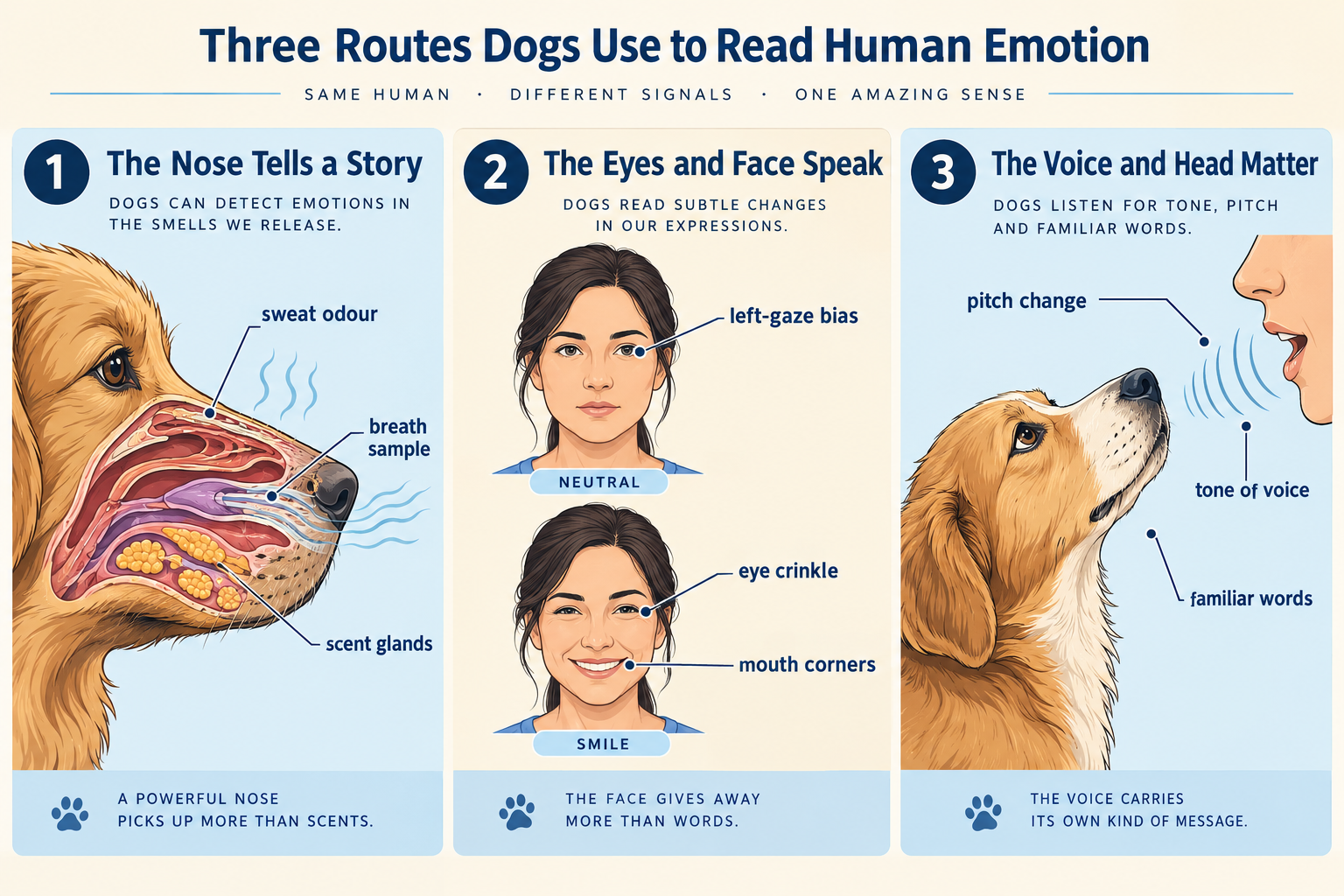
Dogs read people through at least three channels at once: odor compounds in sweat and breath, visible facial and body cues, and vocal tone. None of these work in isolation in normal life, which is exactly why controlled studies have to separate them.
How do dogs sense human emotions scientifically
The short version of the mechanism:
- Chemical signals. Emotional arousal changes the body. Heart rate, sweating and breath composition shift under stress, and those shifts alter the volatile compounds a dog can smell.
- Visual signals. Dogs attend to human faces, including the eye region, and they also read whole-body posture and movement speed.
- Acoustic signals. Pitch, volume and rhythm change when people are upset, excited or trying to sound calm while being neither.
- Learned association. A dog who has lived with you for three years has a private database: this tone precedes a walk, that silence precedes nothing good, the car keys at 7am mean something different from the car keys at 9pm.
That last point does a lot of quiet work in the real world and it is the hardest thing for a lab to control.
)
Can dogs sense emotions through smell or body language?
Both, and they appear to weight them differently depending on what is available. Smell studies isolate odor by hiding the person entirely, using sweat or breath samples in sealed containers. Visual studies show photographs with no sound. Cross-modal studies combine the two, and that combination produced one of the more interesting pre-2026 findings: in a 2016 Biology Letters study led by Natalia Albuquerque at the University of Lincoln, dogs looked longer at a facial expression that matched the emotional tone of a sound played at the same time, for both human and dog stimuli. Matching a face to a voice suggests the dog has some internal representation of the emotional category rather than a simple reflex to one cue.
Body language may be the channel owners underestimate most. Dogs are good at tracking movement and orientation, and their color vision is weaker than ours, which changes what stands out to them visually. If you are curious about that side of canine perception, what dogs can and cannot see in color explains the current evidence.
What emotions can dogs actually detect?
Based on published work, the defensible list is narrow: happiness, fear, anger, sadness and physiological stress. Those are the states researchers have tested with faces, voices or odor. Dogs have not been shown to detect guilt, jealousy, regret, grief over a specific loss, or anything requiring a story. When a dog seems to respond to something that subtle, the simpler explanation is usually a change in your voice, your movement or your smell.
What did the 2026 brain scan study show about dogs?
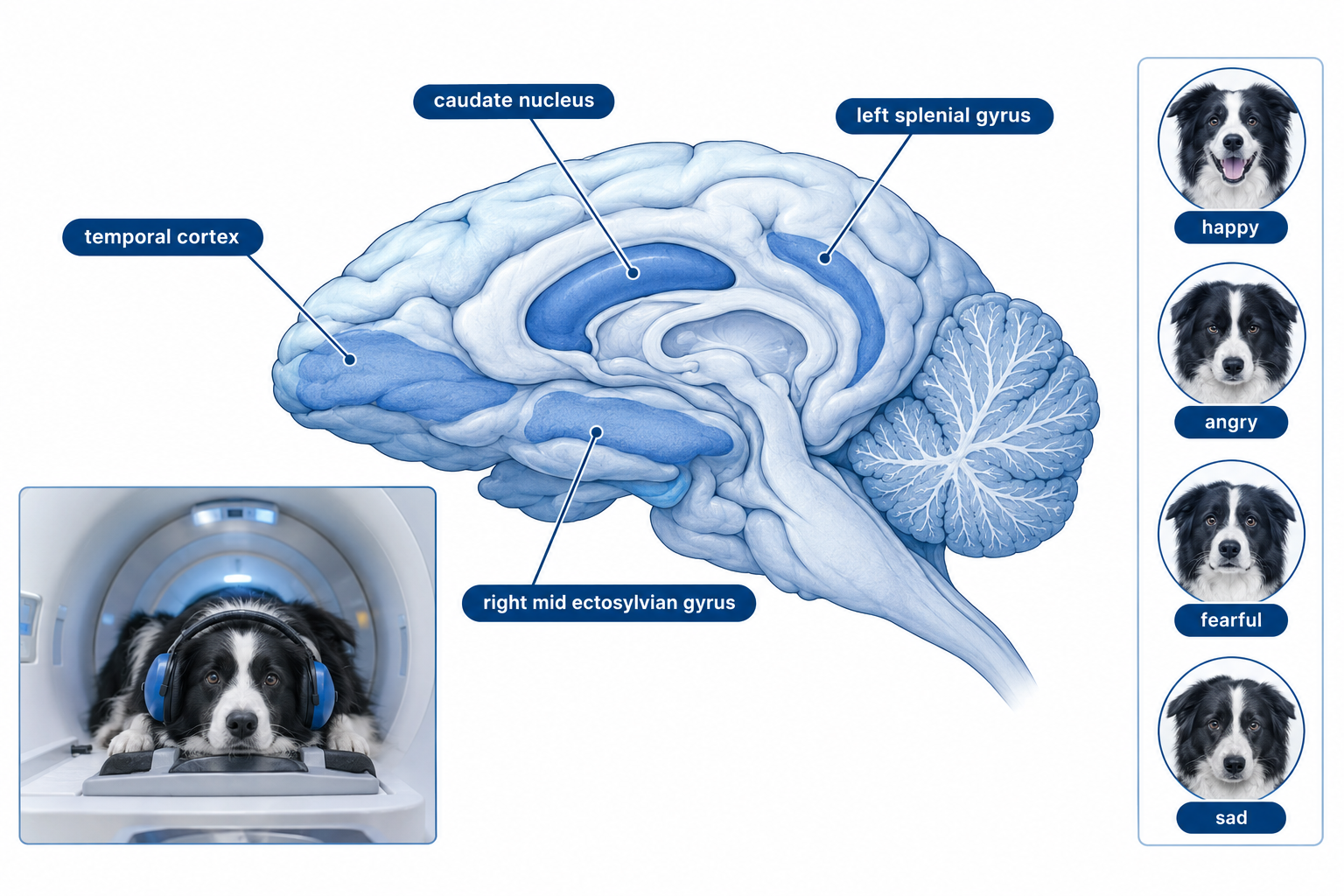
It showed that different human facial expressions produce different, measurable patterns of activity in dog brains, with happiness standing out most clearly. Published in iScience in August 2026 (DOI 10.1016/j.isci.2026.116900), the study used awake-dog fMRI and machine-learning analysis of the resulting images. Reuters, BBC, CNN and other outlets covered the finding as evidence that dogs distinguish between emotions in a human face.
)
The design, in plain terms
- Experiment one: eight trained family dogs viewed photographs of unfamiliar human faces showing happiness or a neutral expression.
- Experiment two: 12 dogs viewed faces expressing happiness, anger, fear and sadness.
- Total cohort: 14 trained family dogs, some taking part in both experiments.
- Conditions: still photographs, no sound, no scent, no familiar person, dogs holding position awake in the scanner.
What the research found
Smiling faces increased activity in the dogs’ temporal cortex and extended into the caudate nucleus. That region has shown up repeatedly in earlier canine neuroscience in connection with food rewards, social praise and the odor of a familiar person, so a happy human face appears to be processed as something socially rewarding rather than merely as a visual pattern. Cleveland.com summarized the same point in its report on the surprising response dog brains show when people smile.
Whole-brain analyses also separated fearful faces from angry faces and fearful faces from sad faces, with differences reported in regions including the right mid ectosylvian gyrus, the left splenial gyrus and the right rostral suprasylvian gyrus depending on the comparison. Researchers writing in The Conversation described this as world-first evidence that dogs can distinguish human fear from sadness.
The strongest claim the data supports is this: a smile and a fearful face are not the same thing to a dog’s brain. Everything beyond that gets thinner fast.
Where the facts end
The study did not show that every negative emotion is separable. A region-of-interest analysis could reliably pull happiness apart from the negative expressions, but it did not demonstrate equally strong discrimination between every negative pair, and whole-brain analyses did not consistently separate anger from sadness. The authors also reject human-equivalence. Hernández-Pérez has argued that dogs may be detecting subtle facial differences rather than sorting faces into “good” and “bad,” while noting that neural representations are not conscious verbal concepts. Cuaya’s interpretation is that domestication selected for social skills that support cooperation with people, so dogs arrived at these abilities on a different path from primates. CNN’s reporting on what the brain scans do and do not prove stresses that outside the scanner dogs combine faces with posture, voice, movement and scent, any of which could change the interpretation.
Follow-up coverage through September and early October 2026 from Reuters, BBC, CNN and others revisited the August paper. No independent large-scale replication of the brain-scan work has been identified in that coverage.
Comparison table: which emotions have the best evidence
| Human emotion | What dogs appear to detect | Key study | Strength of evidence |
|---|---|---|---|
| Happiness | Smiling faces, warm vocal tone | iScience fMRI, 2026 | Clearest brain result, small sample |
| Stress | Odor in sweat and breath | Wilson et al., PLOS ONE, 2022 | Strong for trained dogs in lab tests |
| Fear | Facial pattern, likely odor and posture too | iScience fMRI, 2026 | Early, separable from anger and sadness |
| Sadness | Crying sounds, face, approach-triggering behavior | Custance and Mayer, 2012 | Some, behavior only, no mental state proven |
| Anger | Face plus matching vocal tone | Albuquerque et al., 2016 | Mixed, not cleanly separated from sadness in 2026 |
Can dogs smell stress and fear on people?
Yes for stress, with solid experimental support. In a 2022 study published in PLOS ONE, Clara Wilson and colleagues at Queen’s University Belfast collected breath and sweat samples from participants before and after a stressful mental arithmetic task, then asked trained dogs to pick out the stress sample. The dogs did so well above chance, with each dog scoring above 90 percent in discrimination trials. Importantly, the people were not in the room. The only available information was odor.
)
Fear is less directly tested in odor work with pet dogs, which is why “dogs can smell fear” is one of the most confidently repeated claims with the least direct evidence behind it. Fear and stress share physiological features, so a fear-related odor shift is plausible, but plausible is not demonstrated.
Decision rule: if your dog starts hovering, pacing or pressing against you on your worst work days, treat it as information about your own state rather than a behavior problem to correct. The dog is responding to something. Changing the environment, lowering your voice and giving the dog a predictable outlet such as a sniffing walk or a chew usually settles both parties faster than reassurance alone.
Do dogs recognize when you cry, and do they feel empathy?
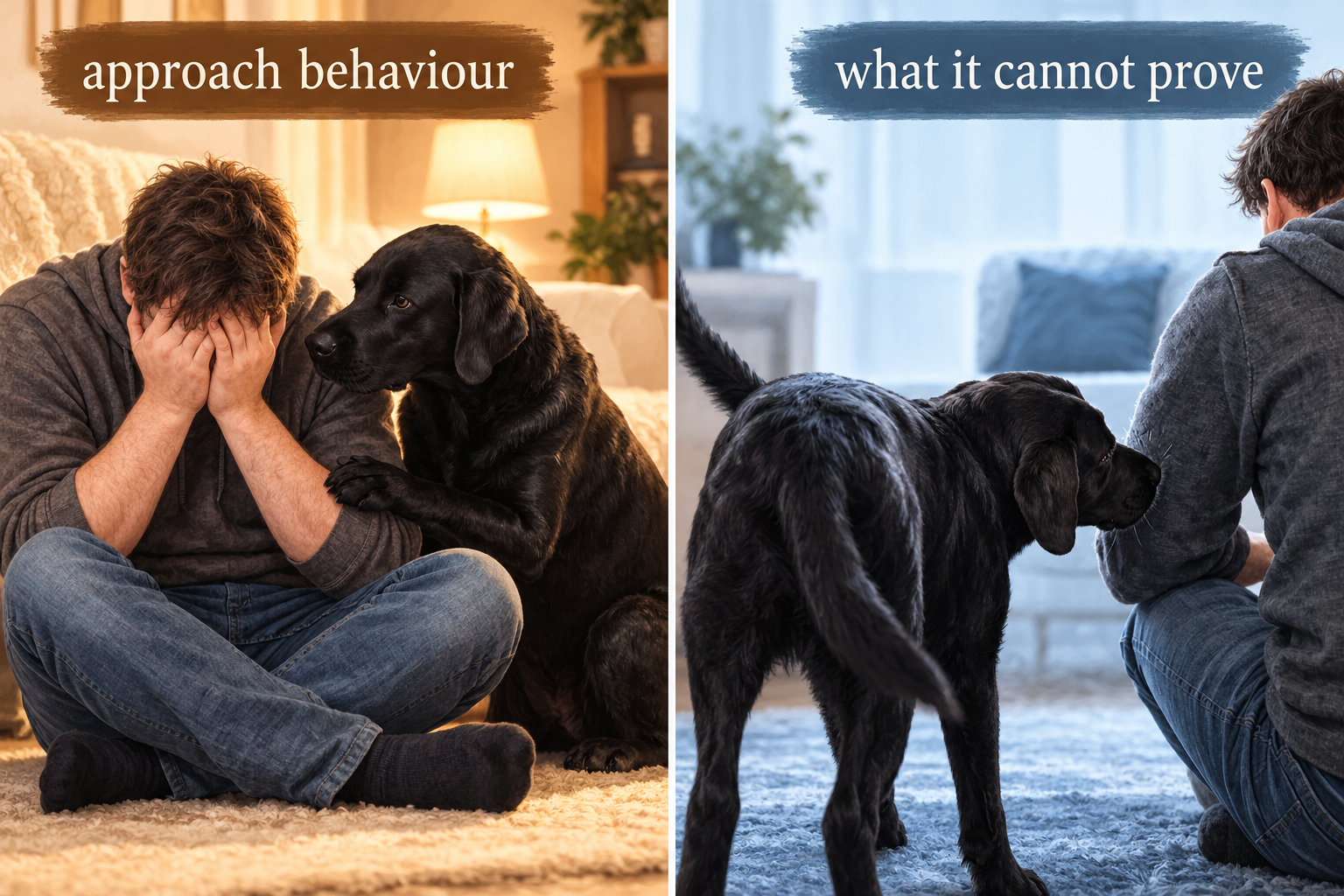
Dogs reliably approach a crying person, including a stranger, but approach is not the same as empathy. In a 2012 study published in Animal Cognition, Deborah Custance and Jennifer Mayer tested 18 dogs with an owner and an unfamiliar person who took turns crying, humming and talking. Fifteen of the 18 dogs approached the person who was crying, and several approached the stranger rather than their own owner, which rules out simple attachment-seeking as the whole story.
)
Why do dogs comfort you when you’re crying?
Three explanations fit the data, and they are not mutually exclusive:
- Emotional contagion. Distress in one animal produces arousal in another. This is a simpler process than empathy and is widespread across social species.
- Learned reinforcement. Approaching a sad person often produces petting, soft speech and contact. Behavior that pays tends to repeat.
- Genuine concern. Possible, not demonstrated. Nothing in the 2012 study separates concern from contagion, and the authors said as much.
What this does not support is the idea that your dog understands why you are crying. The human-dog bond is real and measurable in behavior and physiology. The internal narrative is where the facts end.
Do all dog breeds sense emotions the same way?
Probably not, and the 2026 study is a good example of why caution is warranted. Most dogs in that cohort were border collies, a breed bred for close visual cooperation with handlers and known to be unusually attentive to human cues. CNN’s coverage flagged this directly: results from a small group of trained, attentive family dogs may not transfer to brachycephalic breeds, livestock guardians, shelter dogs, free-ranging dogs or wolves.

Face shape alone may change the picture. A flat-faced dog with a short muzzle has different olfactory anatomy than a long-nosed scent hound, and a heavily coated guardian breed bred to work independently at distance may simply attend to people less. None of this means one breed loves you more. Breed tendencies describe group averages and tell you very little about the dog asleep on your floor. If you enjoy the breed-level comparisons, what “most intelligent dog breeds” actually measures is a useful corrective, and the same caution applies to claims about the most loyal breeds.
Do older dogs sense emotions better than puppies?
Experience helps, and age by itself does not. Adult dogs who have lived with the same household for years have far more learned associations to work from than an eight-week-old puppy who has known you for four days. Sensory ability runs the other way in old age: hearing and vision commonly decline in senior dogs, which can make an older dog seem less responsive while actually being less able to pick up the cue. A 12-year-old dog who stops reacting to a tearful voice may have a hearing problem, not an attitude problem. Worth raising with a veterinarian rather than filing under personality.
How accurate are dogs, and can dogs be wrong about your emotions?
Dogs are good at detecting change and much weaker at identifying which emotion caused it. They can absolutely be wrong, and the errors follow predictable patterns.
Sensing emotions versus reacting to behavior
This distinction is the heart of the subject. When you are anxious, you move faster, speak differently, sigh, grip the leash tighter and skip the usual sniff stops. A dog reacting to those changes does not need to detect anxiety at all. The 2026 brain imaging matters precisely because it removed behavior from the equation: still photographs, strangers, no sound, no scent. Different patterns still appeared. That supports emotion-linked processing rather than behavior-reading alone, in that narrow setting.
Common misreads:
- Nervous laughter. Loud, high-pitched sound with tense body language is a confusing combination for a dog.
- Excitement read as threat. Sudden shouting at a football match is not aimed at the dog, but the volume and arm movement arrive the same way.
- Grief read as illness. A person who stops moving and stays quiet may get a dog who paces and whines, not a dog who settles.
- Direct face-on comfort. Leaning over a dog and staring while upset can read as pressure. Many dogs look away, lick their lips or turn aside, which owners sometimes read as guilt.
When owner signals and dog signals get crossed repeatedly, tension can build in either direction. Understanding the early warning signs matters, and why some dogs bite the people they live with covers that evidence without the scare-story framing.
How long does it take a dog to sense your emotional state?
Seconds for odor and sound, since both are available on your first breath and first word through the door. The 2026 scanner trials used brief photograph presentations, so visual expression processing happens fast too. The slower part is the learning: a newly adopted dog may take weeks to work out that your particular evening silence is normal and not a warning sign. That settling-in period is one reason new adopters often report a dog who seems anxious for the first month and then stops. If you are in that stage, start with the practical side rather than the psychology, and a realistic starter guide for first time owners covers what actually helps.
Is it true dogs can sense illness or health problems in humans?
Trained medical detection dogs have performed above chance on certain disease screening tasks in published studies, including work on cancer samples, blood sugar changes and infectious disease. That is a separate skill set from pet dogs noticing a mood shift, and the evidence varies a lot by condition, training protocol and sample handling.
What to take from it:
- Trained detection work is a specific, supervised task with controlled samples, not a dog hanging around the house making diagnoses.
- Pet dogs may notice change, including altered smell during illness, but anecdotes about a dog “finding” a tumor are not evidence of reliable detection.
- Never delay a medical appointment because a dog seemed unbothered, and never treat a dog’s interest in one body part as a diagnosis.
Changes in a dog’s own routine also deserve attention rather than interpretation. A dog suddenly sleeping far more than usual is a health question, and what normal canine sleep actually looks like is a reasonable place to calibrate before worrying.
What does this mean for living with a dog?
It means your dog is gathering information constantly, mostly accurate about change and mostly guessing about cause. Three practical consequences follow.
1. Match your signals. A calm voice paired with tight shoulders and fast hands sends two messages. Dogs appear to combine face, voice, posture and scent, so consistency reads more clearly than performance does. Slow your hands first, then speak.
2. Give the dog something to do with the arousal. On a high-stress day, a predictable outlet beats reassurance. Scatter feeding in the garden, a long sniffing walk with no destination, a stuffed chew, a few minutes of easy known cues. This is ordinary enrichment and it works because it gives a stirred-up dog a job.
3. Do not over-read the head tilt. It looks like deep concern and may be about sound localization or attention. The evidence on what head tilting can really mean is more interesting than the sentimental version anyway.
And one boundary worth keeping: a dog who reads your distress is not a therapist, a mood regulator or a substitute for human support. Humane training and a steady routine help a dog cope with a tense household. They do not make the dog responsible for it.
FAQ
Can dogs sense human emotions through smell alone?
For stress, yes. A 2022 PLOS ONE study found trained dogs could pick out odor samples from stressed people at above 90 percent accuracy with the person absent from the room. Smell-only evidence for sadness and anger is much thinner.
Can dogs sense sadness in humans?
Dogs respond to crying by approaching, which 15 of 18 dogs did in a 2012 Animal Cognition study. That shows reliable approach behavior toward a distressed person. It does not show that the dog understands sadness as a concept.
Can dogs sense fear in humans?
The 2026 iScience brain scans found fearful human faces produced brain activity patterns distinct from angry and sad faces in 12 dogs. Odor-based fear detection in pet dogs is far less well tested than stress detection.
Can dogs sense depression and anxiety?
Dogs detect the behavioral and physiological changes that often accompany depression and anxiety, such as altered movement, voice, routine and odor. No study shows dogs identifying a clinical condition. Changes in your dog’s behavior are not a diagnostic tool for your mental health or a replacement for professional care.
Do dogs know when you cry?
They notice and usually approach. Crying combines a distinctive sound, a changed face and often changed smell, so there are several cues available at once. Approach is consistent with emotional contagion and with learned reinforcement.
Can my dog sense my sadness better than a stranger could?
Possibly, because your dog has years of learned associations with your particular voice, smell and habits. The 2012 crying study found dogs also approached unfamiliar criers, so familiarity is not required for a response.
Does the 2026 study prove dogs feel emotions like we do?
No. The researchers explicitly reject human equivalence. The study measured neural representations of facial expressions in 14 trained family dogs, mostly border collies, viewing still photographs. It did not measure conscious experience.
So can dogs sense human emotions reliably enough to trust?
Trust them to detect that something changed. Do not trust them to identify which emotion, and do not use a dog’s reaction as evidence about your health, your relationships or anyone’s intentions.
Conclusion
The question “can dogs sense human emotions” now has a better answer than it did in July 2026. Awake dogs in a scanner showed different brain responses to happy, angry, fearful and sad human faces, with smiling faces producing the strongest and most reward-linked response. Add the 2022 stress odor work and the 2016 cross-modal matching study, and the picture is a species that samples several emotion-linked channels at once and processes at least some of them distinctly. Twelve dogs, mostly one breed, still-image stimuli, no replication yet. That is the honest size of the claim.
Three next steps worth taking this week:
- Watch your own signals for one tense evening. Note what your dog does when your pace changes. The information flows in your direction too.
- Build one reliable outlet for high-stress days: a sniffing walk route, a chew, a scatter feed. Decide it now, not during the bad hour.
- Treat sudden changes as health questions first. A dog who stops responding to familiar voices or sleeps far more than usual gets a veterinary appointment, not an interpretation.
Your dog is reading the room. Give it something accurate to read.