
Quick Answer
Yes, dogs have feelings in the sense that they show measurable brain and behavior responses linked to basic emotional states like fear, joy and anxiety. The judgment bias test, often called the bowl test, measures this indirectly by timing how fast a dog approaches an ambiguous bowl location, with faster responses read as more optimistic. Do dogs have feelings exactly like humans do, with guilt, pride or long-term grief? The evidence does not support that, at least not yet. What the research supports is a narrower, well-documented range of emotion closer to what you’d see in a young child, a comparison The Conversation has also used when summarizing the current science.
Key Takeaways: do dogs have feelings
- Do dogs have feelings is best answered with “some, and they’re measurable,” not a flat yes or no.
- The bowl test (judgment bias test) uses approach speed to ambiguous locations as a proxy for optimism or pessimism, not a direct feelings reading.
- A large meta-analysis of 459 effect sizes across 71 studies and 22 species found real but small effects linking an animal’s condition to its judgment bias score (theconversation.com).
- Brain scans from awake dogs show reward-area activity (caudate) for praise and familiar scents, supporting the idea that dogs have feelings for their owners in a measurable way.
- Stanley Coren’s widely cited comparison places dog emotional range near a 2 to 2.5 year old child: joy, fear, anger, disgust, love, but not guilt or pride.
- Alexandra Horowitz’s 2009 study found the “guilty look” tracks owner scolding, not whether the dog actually misbehaved.
- Shelter dogs with more separation-related behavior judge the ambiguous middle bowl more pessimistically than pet dogs.
- Nosework and scent-based enrichment have been shown to shift dogs toward more optimistic judgment bias scores.
- Do dogs have feelings in their tails specifically? Tail position and speed are part of broader body language research, not a standalone emotion test.
- The test has real limits: approach latency is affected by hunger, mobility, age and fear of the room, not mood alone.
Which feeling are you wondering about?
Check the current price
Tap an option to see the answer.
The short answer: do dogs have feelings?
Dogs show consistent physiological and behavioral patterns tied to basic emotions. That is the honest, narrow version of “do dogs have feelings,” and it’s different from claiming dogs process emotion the way humans do.
The clearest supporting evidence comes from two directions: brain imaging and behavior-based testing. A 2026 University of Vienna study published in iScience scanned 12 awake, trained pet dogs while they viewed human faces showing happiness, anger, fear and sadness. A temporal-cortex and caudate network responded selectively to happy faces, and whole-brain analysis could distinguish fear from anger and sadness, though dogs didn’t reliably separate anger from sadness the way the brain data showed for happiness (nationalgeographic.com). Senior author Laura Cuaya and first author Raúl Hernández-Pérez were careful to say this shows dogs can detect differences in human facial expressions, not that dogs experience those emotions identically (discovermagazine.com).
Separately, a 2026 preprint looked at 24 awake companion dogs and 40 humans watching videos of human bodies expressing happiness, anger and neutral actions. Dogs showed emotion-related activity in the right caudal suprasylvian gyrus, humans in the right extrastriate body area. Similar representational patterns across species, but the authors explicitly do not claim dogs feel these emotions the same way humans do (petmd.com).
So: do dogs have feelings like humans? Partially, in the sense of overlapping brain architecture for detecting emotional cues. Not fully, in the sense of matching the depth, memory and self-awareness wrapped up in human emotional experience, a point echoed in National Geographic’s coverage of dog brain MRI research.
What emotions can dogs actually feel?
Dogs are generally believed to experience a basic set of emotions including joy, fear, anger, disgust, anxiety and affection, similar in range to a toddler around 2 to 2.5 years old. This comparison, popularized by psychologist Stanley Coren, excludes complex self-conscious emotions like guilt, pride or shame, which require a level of self-reflection that hasn’t been demonstrated in dogs.
What this looks like in practice:
- Joy: loose body wiggles, play bows, relaxed open mouth, tail wagging in broad sweeps.
- Fear: tucked tail, flattened ears, trembling, attempts to hide or flee.
- Anger or frustration: stiff posture, growling, fixed stare, raised hackles.
- Disgust: turning away from food or smells, lip licking, avoidance.
- Anxiety: pacing, panting without heat or exertion, lip licking, yawning out of context.
Do dogs have feelings that go beyond this short list? Some researchers suspect more nuance exists, but there isn’t strong published evidence yet for emotions like nostalgia, shame or existential worry in dogs. Discover Magazine’s review of canine cognition makes a similar point: dogs clearly have an inner emotional life, but attributing human-level complexity to it tends to outrun the data.
How do scientists know dogs have feelings?
Scientists infer that dogs have feelings by combining brain imaging, hormone measurement, and behavior-based tests like the bowl test, rather than by asking dogs directly. Each method has limits on its own, but together they build a case that’s harder to dismiss as projection.
The three main approaches:
- Awake fMRI scanning. Dogs are trained to lie still in an MRI machine without sedation. Neuroscientist Gregory Berns pioneered this approach, and it’s the basis for much of the caudate-activation research tied to reward and affection, detailed by National Geographic.
- Hormone and physiological markers. Cortisol (stress), oxytocin (bonding) and heart rate variability are measured before and after specific interactions, such as reunions with an owner or exposure to a stranger’s distress.
- Behavior-based inference tests. The judgment bias test (the bowl test) is the clearest example: researchers watch what a dog does rather than what it might be feeling internally, then treat the behavior as a proxy for mood.
Common mistake: treating a single data point from any one of these methods as proof of a specific emotion. A caudate activation spike alone doesn’t prove love. A slow bowl approach alone doesn’t prove sadness. Researchers triangulate across methods before making claims, which is why peer-reviewed studies tend to hedge their conclusions carefully, as seen in PMC’s review of canine emotion assessment methods.
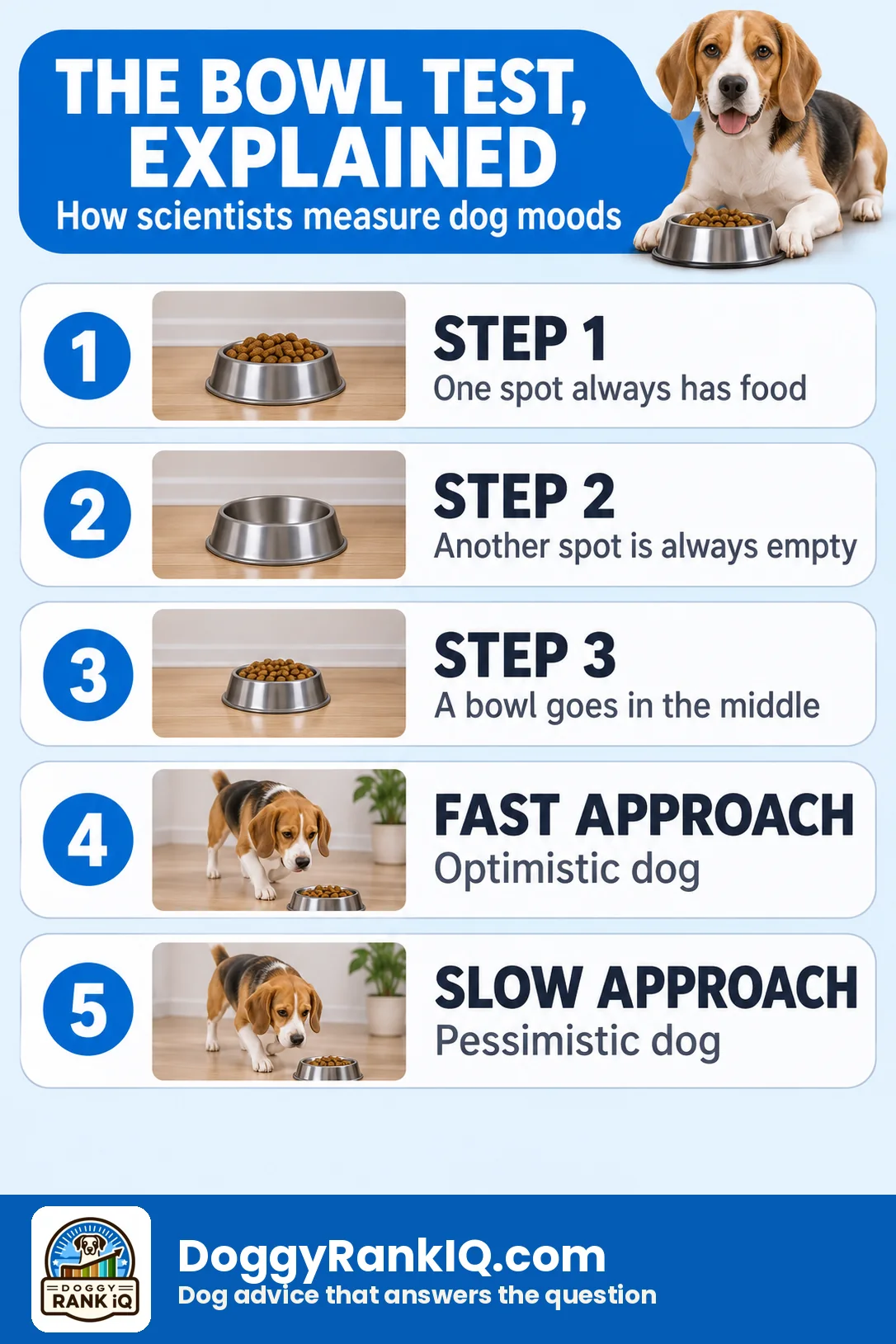
The bowl test, explained simply
The bowl test, formally called the judgment bias test, measures how fast a dog approaches an ambiguous situation to estimate whether that dog is in a relatively optimistic or pessimistic state (theconversation.com).
Here’s how it actually works, step by step:
- A dog is trained to associate one bowl location with food and a second location with an empty bowl.
- Once the dog reliably runs fast to the food spot and slow to the empty spot, researchers place a bowl somewhere in between.
- The dog doesn’t know if this middle bowl holds food or nothing.
- How fast the dog approaches that ambiguous bowl is recorded as the measurement: faster approach reads as more optimistic, slower as more pessimistic.
This is an indirect inference, not a feelings scanner. Researchers are using behavior as a proxy for internal state, similar to timing someone’s walk to a mailbox to guess whether they expect good news or a bill.
Decision rule for reading the research: if a study reports approach latency differences tied to housing conditions, enrichment or stress history, take it as evidence about group-level tendencies, not proof about one specific dog.
The strongest documented findings:
- Mendl and colleagues (2010, Current Biology) found shelter dogs with more separation-related behavior judged the ambiguous middle bowl more pessimistically than dogs with less of that behavior.
- Burani and colleagues (2020, PLOS ONE) tested 51 shelter dogs and 40 pet dogs and found shelter dogs responded more pessimistically overall, while flagging real limits in how cleanly the test isolates mood from other factors.
- Duranton and Horowitz (2019, Applied Animal Behaviour Science) found that nosework training shifted pet dogs toward more optimistic scores on the same test.
Common mistake: assuming a single bowl test session tells you anything permanent about a dog’s personality. One slow approach could mean the dog is full, tired, distracted by a smell, or simply unfamiliar with the room, not necessarily pessimistic.
A broad meta-analysis by Lagisz and colleagues pooled 459 effect sizes from 71 studies across 22 nonhuman species. Animals in better living conditions generally scored more optimistic, but the overall effect size was small and inconsistent across species, task design and sex (theconversation.com). That’s the honest ceiling on what the bowl test proves: a real but modest link between condition and judgment, not a precise feelings readout.
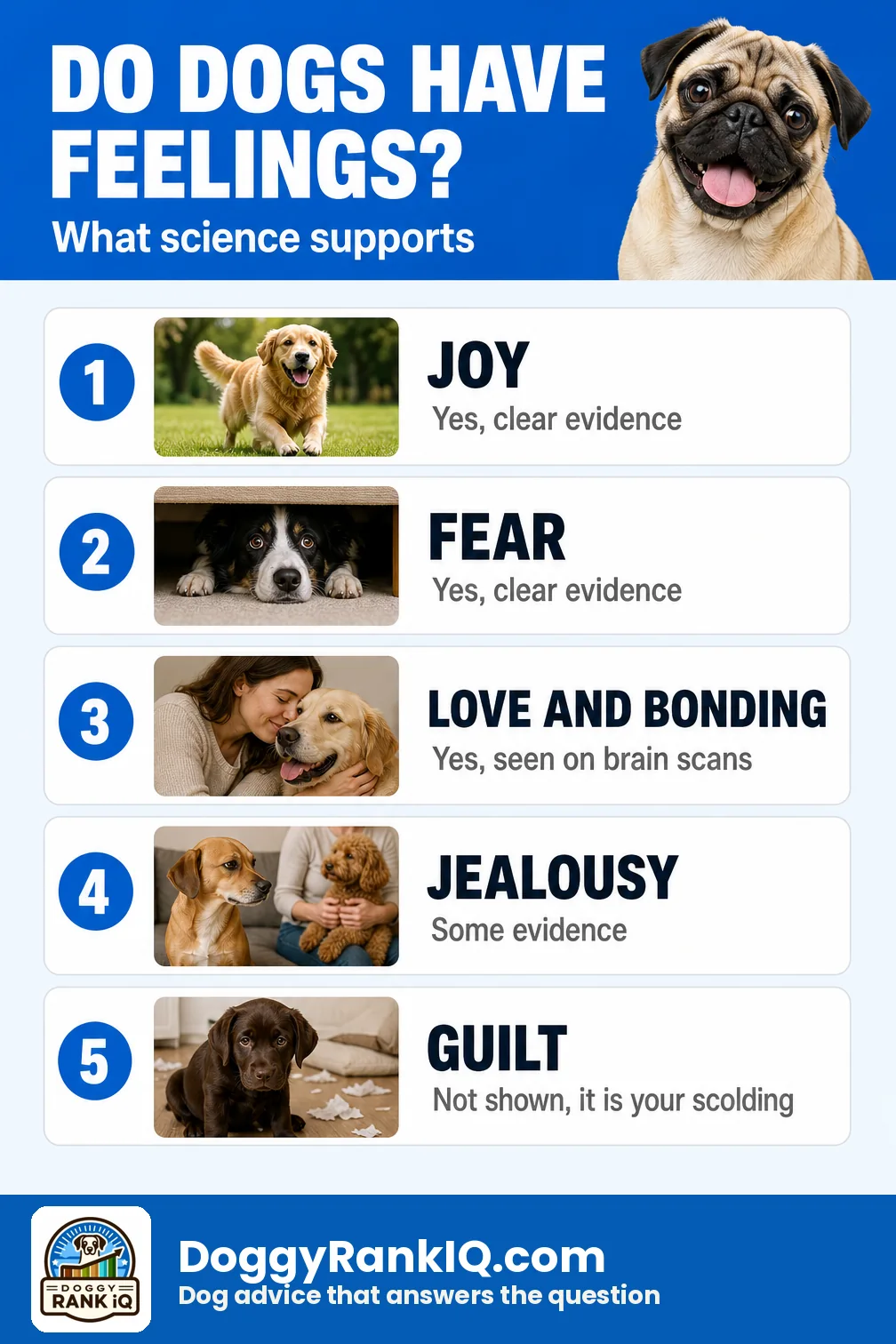
Facts table: emotions dogs show evidence for vs emotions not established
| Emotion or state | Evidence status | Key source |
|---|---|---|
| Fear | Supported, distinguishable in brain scans | Vienna fMRI study (nationalgeographic.com) |
| Joy or happiness | Supported, strongest neural signal found | Vienna fMRI study (nationalgeographic.com) |
| Optimism or pessimism (mood state) | Supported but small effect size | Lagisz meta-analysis (theconversation.com) |
| Response to human distress | Partial evidence, termed cautiously | Frontiers empathy study (petmd.com) |
| Guilt | Not established, behavior tracks scolding instead | Horowitz 2009 guilty look study |
| Pride | Not established | Coren emotional range review |
Do dogs have feelings for their owners? What brain scans show
Dogs have feelings for their owners that show up as measurable reward-related brain activity, not just trained behavior. Neuroscientist Gregory Berns’ awake-dog fMRI research found caudate activation, the brain’s reward center, in response to familiar human scents and verbal praise. That’s a biological signature overlapping with how reward circuits fire in humans experiencing affection, as summarized in National Geographic’s reporting on dog brain scans.
The 2026 empathy study adds a behavioral layer. Otzelberger, Romero and Meyers-Manor studied 35 dogs and their owners (a correction later clarified the sample as 15 males and 20 females) using owner-versus-stranger crying or laughing, person-oriented behavior, heart rate variability, contagious yawning and a cognitive-bias task completed by only 26 of the dogs (petmd.com, royalcanin.com). Dogs showed more person-oriented behavior during crying than laughing. In the stranger-crying condition, more of that behavior correlated with lower heart rate variability, r(20) = -.598, p =.003 (petmd.com).
The authors use the word “empathy” carefully. Recognizing distress and responding to it is not the same as human-style perspective-taking or moral concern (petmd.com). Incomplete HRV recordings, partly caused by fur length and poorly fitting monitoring straps, also reduced the statistical power of the findings (petmd.com).
If you want to understand this bond further, see how do dogs show affection and can dogs sense human emotions for behavior you can actually observe at home.
Do dogs feel love for their owners?
Most researchers agree dogs form attachment bonds that function like love in a measurable, biological sense, even without proof they experience the full emotional complexity humans attach to the word. Royal Canin’s guide to canine emotions describes this bond as rooted in attachment behavior similar to what’s seen between young children and caregivers.
Signs that often get read as love include:
- Seeking physical closeness without being prompted by food or play.
- Relaxed body language specifically around one person, but not strangers.
- Oxytocin increases in both dog and owner after eye contact and petting.
- Separation distress specifically tied to one person’s absence, not just any absence.
Do dogs have feelings strong enough to count as love? The biology says yes to an attachment-based version of it. Whether that matches the full emotional and cognitive complexity of human romantic or familial love is a separate, unresolved question.
How can you tell if your dog is happy?
A happy dog typically shows loose, relaxed body language: a soft wagging tail, relaxed ears, a slightly open mouth, and a willingness to approach people or other dogs without hesitation. PetMD’s overview of canine cognition notes that happiness in dogs tends to be visible rather than hidden, which makes it one of the easier emotional states to read correctly.
Quick checklist for spotting happiness:
- Tail held at a neutral or slightly raised height, wagging in wide sweeps rather than stiff, fast flicks.
- “Play bow” posture: front legs down, rear end up, inviting interaction.
- Relaxed facial muscles, soft eyes, no whale eye (whites showing).
- Eager approach toward known people, toys or feeding spots, similar to the fast bowl-test approach pattern described earlier in this guide.
Edge case: some dogs with high energy or anxiety can look “happy” (fast tail wag, panting) while actually being overstimulated or stressed. Context matters: a fast wag paired with stiff body posture and a tucked tail base often signals conflict, not joy.
Can dogs feel sad or depressed?
Yes, dogs can show behavior patterns consistent with sadness or a depressive-like state, especially after the loss of a companion, a major routine change, or prolonged isolation. PetMD’s discussion of canine emotional health notes that dogs grieving the loss of another pet or person can show reduced appetite, lower activity and more time spent sleeping.
Common signs include:
- Withdrawal from play or walks that used to get an enthusiastic response.
- Reduced appetite without an obvious medical cause.
- More time spent alone or avoiding interaction.
- A slower, more pessimistic pattern on judgment-bias-style tasks, matching the bowl test pattern seen in shelter dogs with separation-related behavior.
Common mistake: assuming any dip in energy is depression. Illness, pain, aging and seasonal changes in activity can all look similar on the surface. If low mood lasts more than two weeks or comes with appetite loss, a veterinary check is the right next step before assuming it’s purely emotional.
Are dog emotions the same as human emotions?
No. Dog emotions overlap with human emotions in basic categories like fear, joy and anger, but dogs appear to lack the self-conscious emotional layer humans have, such as guilt, pride, shame and embarrassment. The Conversation’s analysis of dog emotion research frames this as a difference in emotional complexity, not a difference in whether emotion exists at all.
Three practical differences worth knowing:
- Dogs react to the present moment and recent cues far more than they reflect on long-past events the way humans ruminate.
- Dogs can’t verbally report their internal state, so all conclusions come from behavior, physiology and brain activity, which always carries some interpretation.
- Human emotional concepts like “guilt” or “jealousy” get mapped onto dog behavior that may actually be a simpler response, such as fear of punishment or resource guarding.
Do dogs feel guilt, jealousy or empathy?
Do dogs feel guilt? The current evidence says no, not in the human sense. Alexandra Horowitz’s 2009 study found the so-called “guilty look,” ears back, avoiding eye contact, slinking away, appeared based on whether the owner scolded the dog, regardless of whether the dog had actually done anything wrong. The look is a response to a human’s tone and posture, not a confession.
Do dogs have empathy? Partial evidence exists. The 2026 Frontiers study found dogs respond differently to a crying owner than a laughing one, and show more person-oriented behavior tied to a physiological stress marker in some conditions (petmd.com). That’s recognition and response, not proven emotional sharing or concern for another’s wellbeing.
Jealousy-type behavior, like pushing between an owner and a new pet, has been studied separately and is covered in detail in do dogs get jealous, which breaks down two specific experiments.
Edge case worth noting: a fatigue-detection study from 2026 used 46 DogFACS facial landmarks across 177 videos from four working dogs, reaching F1 scores of 0.781 to 0.789 under standard testing, dropping to 0.676 to 0.740 when tested on dogs the system hadn’t seen before (shine.waltham.com). That’s a tool for spotting physical fatigue signals on video, not a device that reads emotions like guilt or jealousy. Facial movement linked to tiredness shouldn’t be relabeled as sadness without actual veterinary and behavioral confirmation.
Can dogs feel jealousy or anxiety?
Dogs can show jealousy-like behavior, such as pushing between an owner and a rival pet or object, and they can clearly experience anxiety, which is one of the better-documented canine emotional states. Anxiety shows up in both behavior and physiology, including elevated cortisol, pacing, panting and more pessimistic scores on judgment bias tasks like the bowl test.
Common anxiety triggers worth watching for:
- Separation from an owner, especially in dogs with a history of shelter stays or rehoming.
- Loud noises such as thunderstorms or fireworks.
- New environments, people or animals without a gradual introduction.
- Pain or illness that hasn’t been diagnosed yet.
Jealousy-type reactions tend to appear around resource competition, attention competition, or a new pet or baby in the home. See do dogs get jealous for a closer look at the specific experiments behind this.
What does dog body language tell you about their feelings?
Body language is the most reliable day-to-day signal of a dog’s emotional state, more useful in most households than any lab test. Ears, tail, posture and facial tension work together, and reading them in combination, not in isolation, gives the clearest picture.
Quick reference:
- Relaxed and content: soft eyes, neutral ears, loose tail, weight evenly distributed on all four legs.
- Fearful: tucked tail, lowered body, ears pinned back, possible trembling or lip licking.
- Alert or aroused: ears forward, weight shifted forward, tail held high and stiff.
- Stressed: yawning out of context, excessive lip licking, whale eye, panting without heat or exercise.
Do dogs have feelings that show up more in the face than the tail, or the other way around? Research generally treats the two as complementary signals rather than competing ones; a wagging tail combined with pinned ears usually means something very different from a wagging tail with a relaxed face.
How do different dog breeds express emotions differently?
Breed can influence how visibly a dog expresses emotion, mostly due to physical traits like tail shape, ear carriage and coat length rather than differences in the emotions themselves. A Greyhound’s tight tail carriage reads differently than a Husky’s curled tail at rest, even if both dogs are equally relaxed.
Points worth keeping in mind:
- Breeds with naturally erect ears (German Shepherds, Huskies) show ear-position changes more visibly than floppy-eared breeds (Basset Hounds, Cocker Spaniels).
- Docked tails or naturally short tails (Boxers, Corgis in some countries) remove one of the clearest emotional signals, making facial and body posture more important to read.
- High-energy working breeds may show anxiety as pacing or vocalizing, while lower-energy breeds may show it as withdrawal or stillness.
- Brachycephalic breeds (Pugs, French Bulldogs) have facial structures that can make expressions harder to read accurately, since some muscle movement is limited by their anatomy.
Do puppies feel emotions the same way adult dogs do?
Puppies experience a narrower and less stable emotional range than adult dogs, since their nervous systems and social experience are still developing. Fear responses, attachment behavior and play drive all emerge early, but regulation of those emotions, staying calm after a scare, for example, improves with age and socialization.
Key differences:
- Puppies startle more easily and recover more slowly from fear-inducing events during the critical socialization window (roughly 3 to 14 weeks).
- Attachment to a primary caregiver forms early and strongly, similar to the owner-bond research described earlier in this guide.
- Emotional regulation, the ability to settle down after excitement or stress, continues developing well into the first one to two years.
- Early negative experiences during the socialization window can have an outsized effect on adult temperament compared to similar experiences later in life.
For owners building a foundation during this stage, 5 essential commands every puppy should learn pairs well with early emotional and behavioral training.
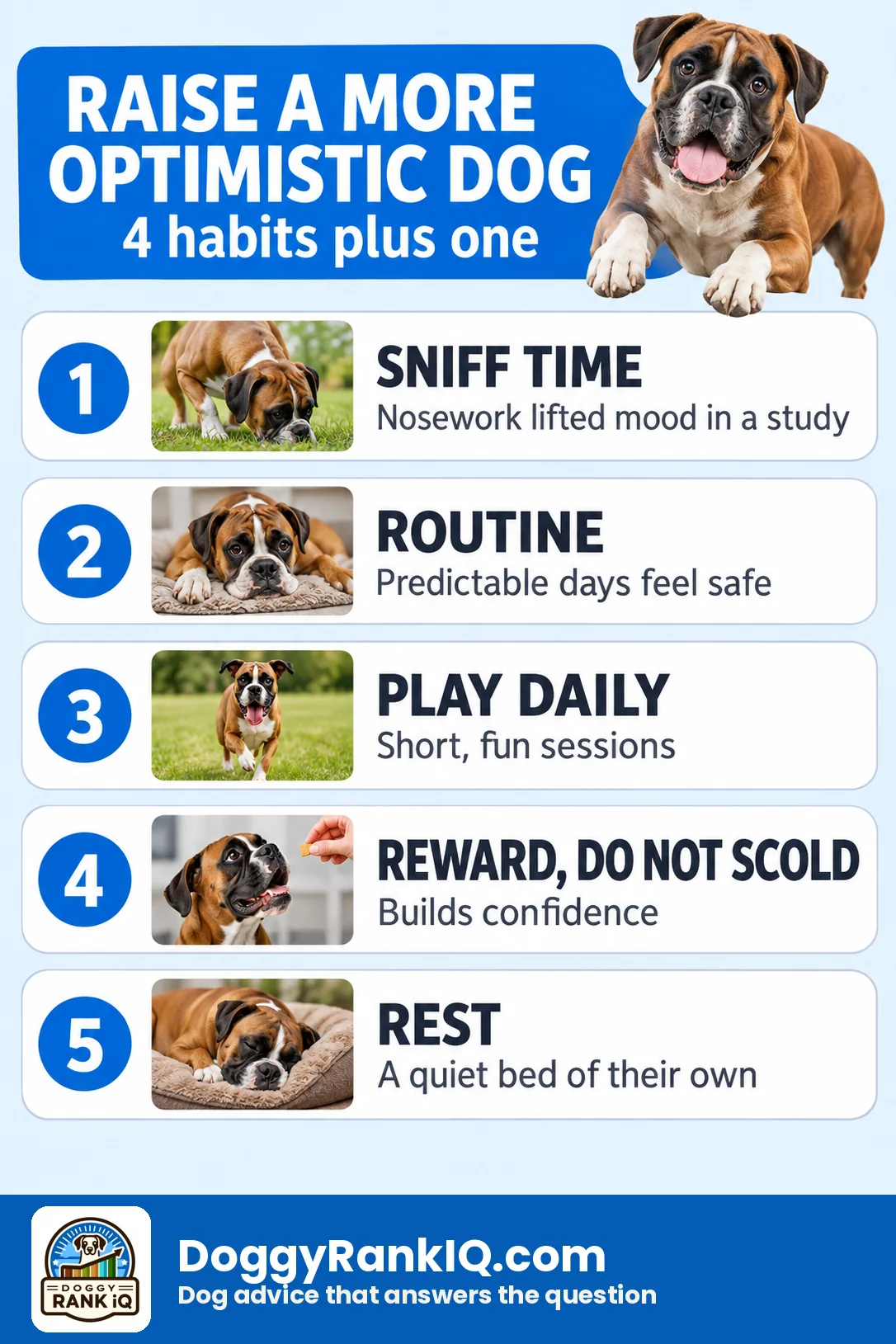
4 ways to raise a more optimistic dog
- Add scent-based enrichment. Duranton and Horowitz’s 2019 study found nosework shifted pet dogs toward more optimistic judgment bias scores. A simple way to start is scattering kibble for a snuffle search or using scent work tins, and pairing this with the best dog puzzle toys for variety.
- Build predictable routines. Dogs in more stable, better-resourced conditions scored more optimistically across the Lagisz meta-analysis’s 71 pooled studies (theconversation.com). Predictability lowers uncertainty, which is the entire mechanism the bowl test measures.
- Address separation-related behavior early. Shelter dogs showing more separation anxiety behaviors scored more pessimistically on the bowl test, which suggests catching early signs of separation distress and working on gradual alone-time training can shift that pattern before it becomes entrenched.
- Watch for signs of discomfort or pain. Chronic discomfort pulls judgment bias scores toward pessimism in several species studied by Lagisz and colleagues (theconversation.com). Keeping up with grooming, dental care, and general comfort, including tools like the best orthopedic dog bed for joint support, removes one common hidden source of a lower mood baseline.
Helpful tools for a happier dog
These aren’t a cure for anxiety and they won’t “fix” feelings on their own, but they support the enrichment and routine strategies the research points to.
- The AWOOF Snuffle Mat for Dogs (rel=”sponsored”) turns mealtime into a scent search, the same category of enrichment linked to more optimistic bowl test scores. $11.98, price checked 2026. Check the current price (rel=”sponsored”).
- The Barkwhiz Dog Puzzle Toy, 3 Levels (rel=”sponsored”) adds graduated problem-solving, useful for building confidence around uncertainty, similar in spirit to the bowl test’s ambiguous middle spot. $17.99, price checked 2026. Check the current price (rel=”sponsored”).
- The Dog Scent Work Tins Training Kit (rel=”sponsored”) lets owners replicate the nosework style used in Duranton and Horowitz’s research at home. $19.99, price checked 2026. Check the current price (rel=”sponsored”).
- The Bedsure Calming Donut Dog Bed, Medium (rel=”sponsored”) supports the predictable, comfortable resting environment tied to better outcomes in condition-based judgment bias studies. $38.24, price checked 2026. Check the current price (rel=”sponsored”).
Manufacturer claims about calming effects are not independently verified medical claims. If your dog shows ongoing anxiety, talk to your veterinarian about a full plan rather than relying on any single product.
For dogs who like to work for their food, pair enrichment tools with a slow feeder for dogs to combine mental engagement with mealtime pacing.
FAQ
The bottom line
Do dogs have feelings? The honest answer sits between “obviously” and “we can’t prove it.” Brain scans show real neural responses to joy, fear and familiar humans. The bowl test shows measurable shifts in optimism tied to living conditions and enrichment. What the evidence does not support is guilt, pride or an emotional range matching adult human complexity.
The practical move is simple: treat your dog’s behavior as a real signal worth reading, back training with positive reinforcement instead of after-the-fact scolding, and add enrichment like scent work where the data actually shows a benefit. For more on the bond itself, explore do dogs know their names and do dogs dream for two more angles on what’s going on inside your dog’s head.
Doggy Rank IQ is reader supported. As an Amazon Associate we earn from qualifying purchases, at no extra cost to you.