
Quick Answer
Puppy dog eyes are a real, physical expression powered by a muscle that lets dogs raise their inner eyebrows, making their eyes look bigger and more infant-like. Research from Kaminski and colleagues found this muscle, called the levator anguli oculi medialis, is largely absent in wolves, which suggests it developed as dogs adapted to life with people (pnas.org). The separate “guilty look,” with the lowered head and sideways glance, is a different behavior entirely. Alexandra Horowitz’s 2009 study found that look tracks whether an owner is scolding, not whether the dog actually did anything wrong (phys.org, huffpost.com).
Key Takeaways: puppy dog eyes
- Puppy dog eyes come from a specific facial muscle, the levator anguli oculi medialis, that dogs have and wolves mostly do not (pnas.org).
- The movement is called AU101 in facial coding research and makes the eyes appear larger and more infant-like (petmd.com).
- Shelter dogs that raised their inner brows more often were adopted faster, according to a study by Waller and colleagues (petmd.com, nature.com).
- Dogs make more facial movements, including puppy dog eyes, when a person is watching them, even without food involved (petmd.com).
- The “guilty face” lines up with being scolded, not with whether the dog broke a rule, based on Alexandra Horowitz’s 2009 research (phys.org, huffpost.com).
- A 2015 follow-up found owners could not reliably tell if a dog had misbehaved just by watching its greeting behavior (phys.org).
- Puppies start showing facial expressions early, though the full eyebrow-raise behavior is best documented in adult dogs responding to human attention.
- Sudden squinting, redness, cloudiness, or discharge around a dog’s eyes is a medical issue, not an expression, and needs a veterinary visit.
When do you get the look?
Tap an option to see the answer.
The short answer: what puppy dog eyes really are
Puppy dog eyes are not sadness. They are not guilt, either. They are a specific, trainable-looking facial movement that happens to work really well on humans.
The behavior has two separate parts that get lumped together in casual conversation. One is the actual eyebrow raise, the thing that makes a dog’s eyes look rounder and bigger. The other is the slumped-shoulders, avoid-eye-contact posture people call “the guilty face.” Both get called puppy dog eyes. Only one of them involves a muscle built for exactly this purpose.
Dogs aren’t performing a calculated manipulation when they do this. They’re running a behavior that happened to get rewarded, over and over, by an animal that can’t resist a round-eyed stare. That’s not an insult. It’s closer to how most learned behaviors work in any species, including the one holding the leash.
Puppy dog eyes meaning: the muscle wolves do not have
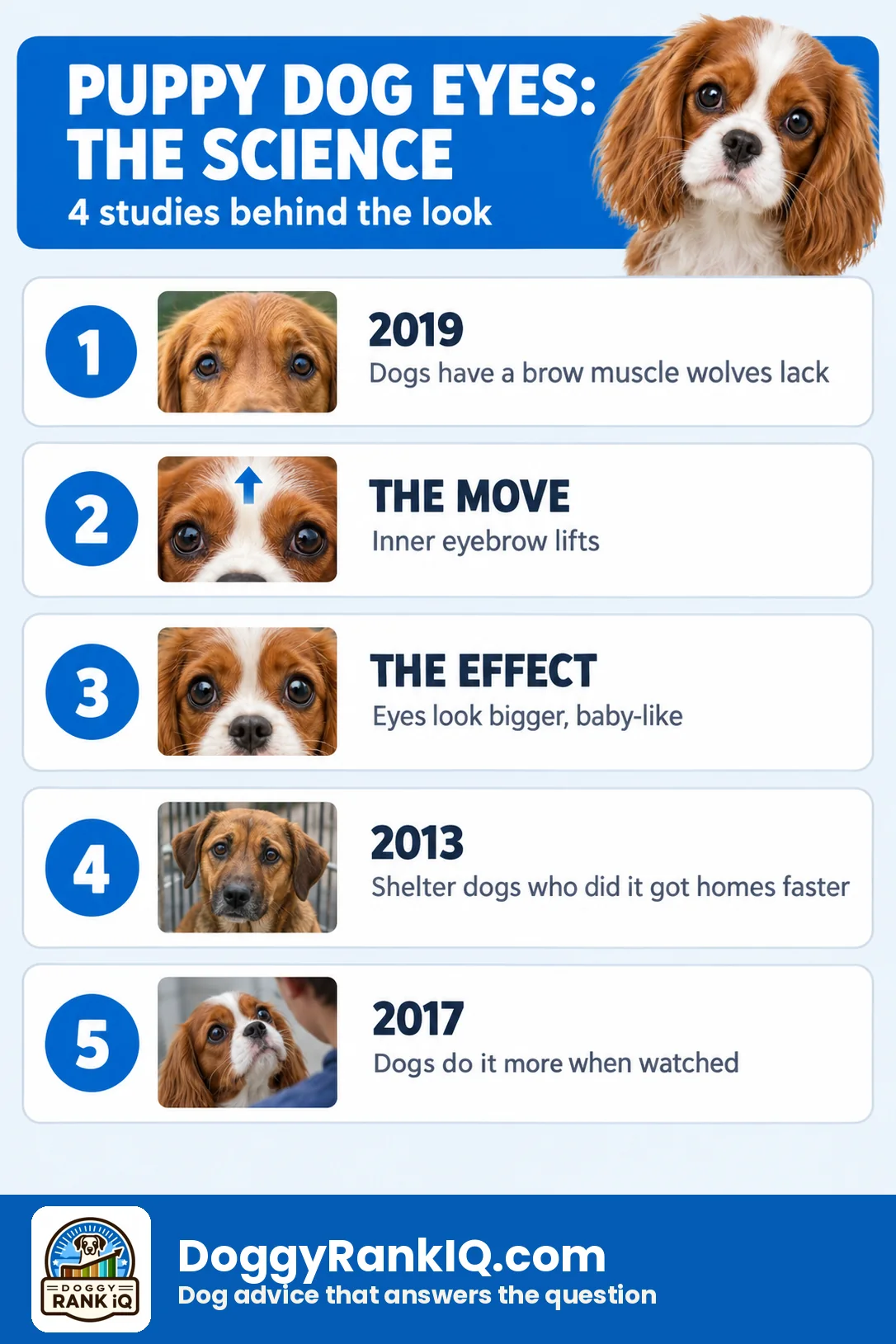
The puppy dog eyes meaning comes down to anatomy. A 2019 study published in PNAS, led by Juliane Kaminski, dissected the facial muscles of dogs and wolves and found a muscle around the eye, the levator anguli oculi medialis, that was well developed in dogs and largely missing in wolves (pnas.org).
That muscle does one job: it lifts the inner corner of the eyebrow. The result is an eye that looks wider and rounder, closer in shape to a human infant’s eyes. Researchers labeled this specific movement AU101 using the same facial coding system used to study human expressions (petmd.com).
Why does this matter for domestication? The muscle’s presence in dogs but not wolves points to it developing, or becoming more pronounced, during the thousands of years dogs lived alongside people. A face that looks more infant-like tends to pull a stronger emotional response from humans. That’s a useful trait to have if your survival depends on being kept around. Nature wasn’t planning for cuteness, but cuteness won anyway.
It’s worth being precise here: the study compared facial muscle structure, not emotional states. It showed a physical difference between dogs and wolves. It did not measure what a dog feels while making the expression. For more on how dogs communicate through posture and face together, see our guide to dog body language.
Facts table: 4 studies behind puppy dog eyes
The truth behind that guilty face
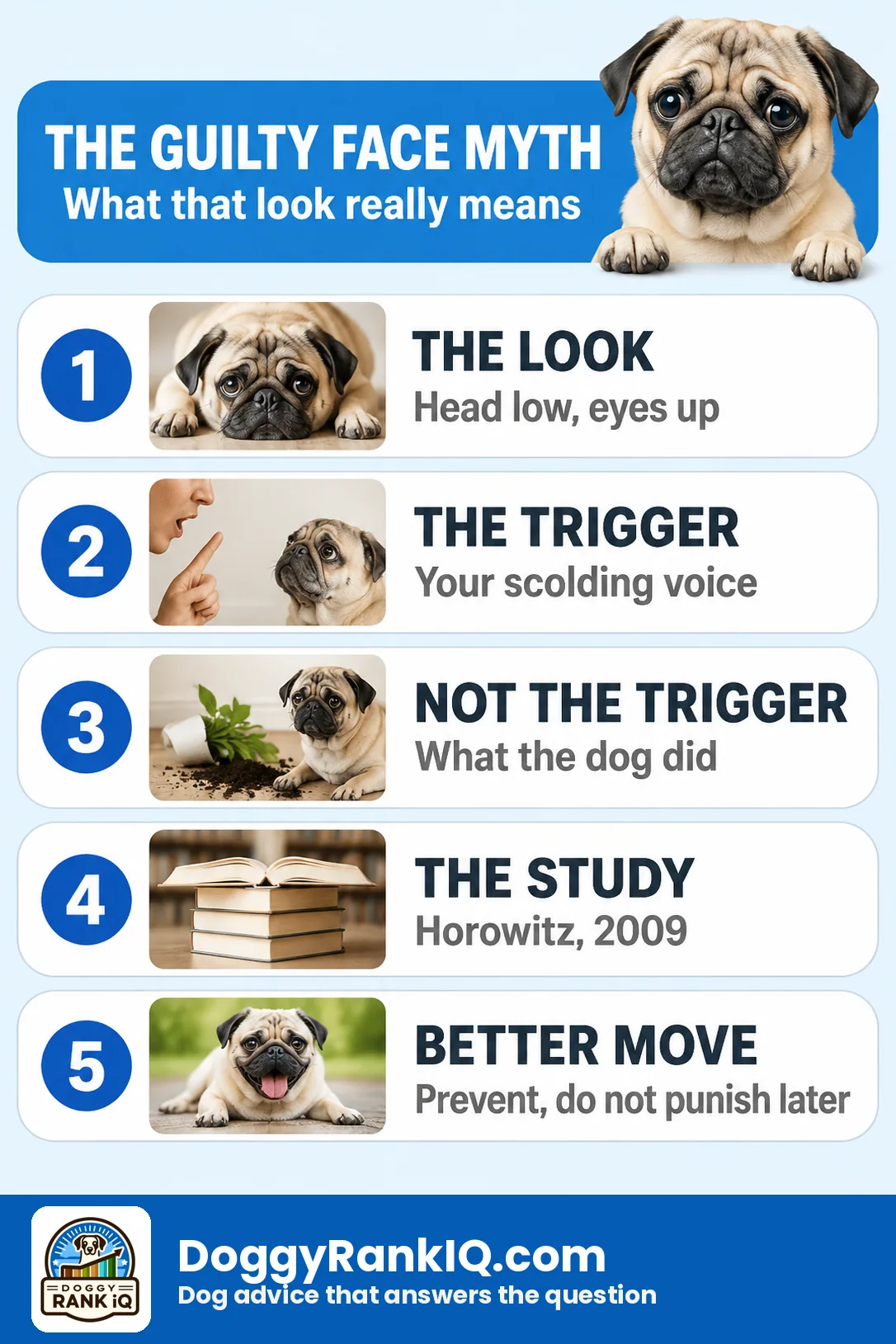
The truth behind that guilty face is that it’s a response to a human’s behavior in the moment, not a confession. Horowitz’s 2009 study tested 14 pet dogs whose owners told them not to eat a treat, then left the room (phys.org, huffpost.com). Sometimes the dog ate it. Sometimes the researcher removed it before the dog had a chance. Owners were then told, accurately or not, whether their dog had disobeyed, and asked to scold accordingly.
The dogs that got scolded looked guiltiest, even the ones who had never touched the treat. Dogs that disobeyed but weren’t scolded often showed none of the classic guilty posture at all (huffpost.com, npr.org). The expression tracked the owner’s reaction, not the dog’s actions.
A 2015 follow-up pushed further. Researchers worked with 96 owner-dog pairs and asked owners to stay neutral and judge from the dog’s greeting alone whether it had eaten forbidden food. They couldn’t reliably tell (phys.org). If owners who know their own dogs can’t read guilt accurately from behavior, the “look” isn’t the reliable signal it appears to be.
None of this proves dogs can’t feel anything resembling guilt. It shows the expression people call guilty is better explained as an appeasement response (lowered head, averted gaze, flattened ears, lip licking) to a human’s upset energy, not evidence the dog remembers breaking a rule (livescience.com, akc.org). Appeasement behavior reduces conflict. It’s a smart strategy for a social animal that depends on staying on a person’s good side, whether or not it understands why that person is annoyed.
Recent coverage in 2026, including reporting that revisits Horowitz’s work for a new audience, keeps landing on the same framing: the smarter question isn’t “is my dog ashamed,” it’s “what is my dog reacting to right now” (petmd.com, abbynews.com).
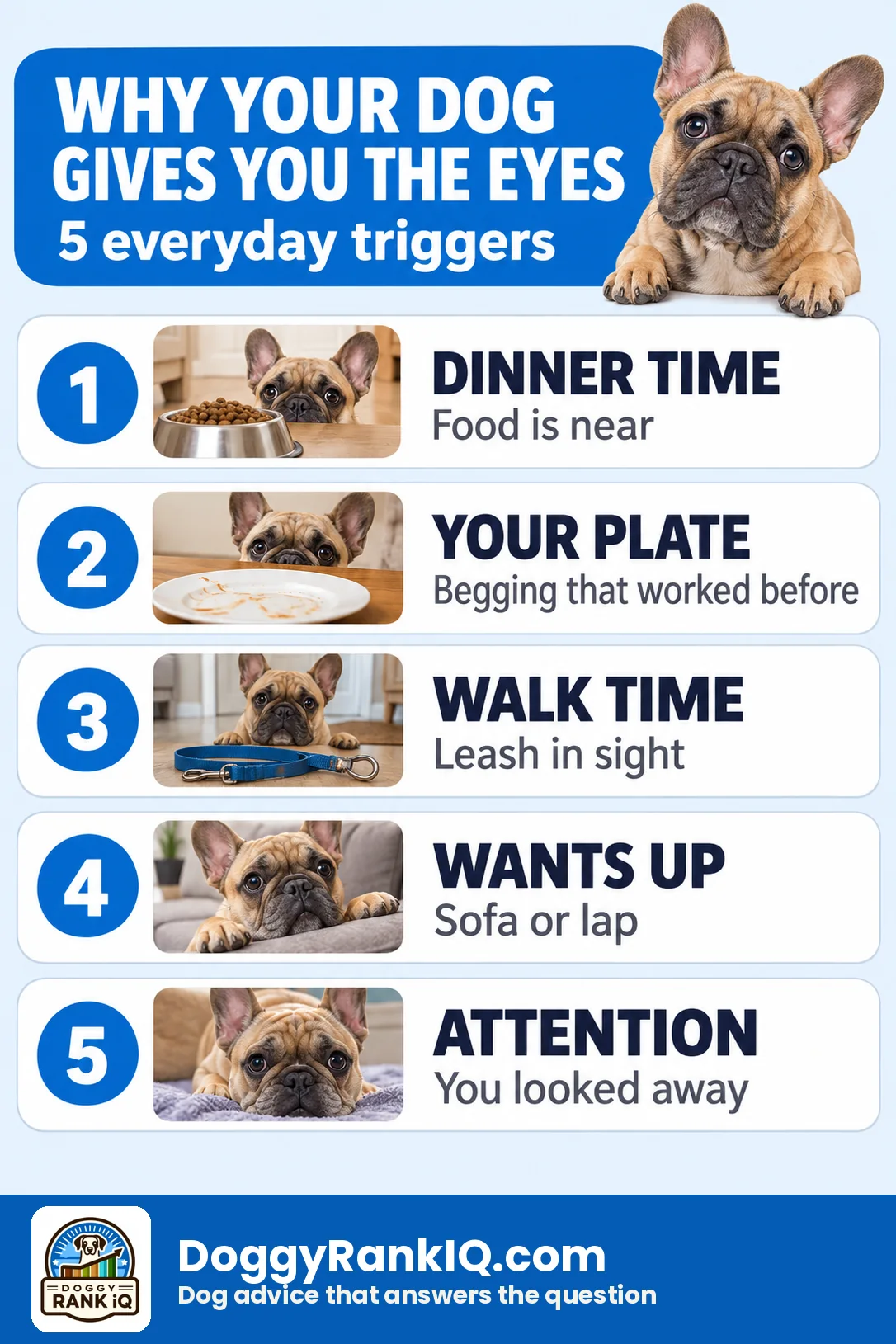
Why does he look at me with puppy dog eyes? 5 everyday triggers
1You just picked up food
Dogs are excellent readers of routine. A hand near the counter, the fridge opening, a fork clinking: these cues predict food, and the eyebrow raise often follows close behind.
2You’re giving them direct attention
Kaminski’s 2017 study found dogs produced more facial movements, including the eyebrow raise, when a person was actively looking at their face, with or without food involved (petmd.com). The expression is partly a social bid, not purely a food strategy.
3They want something specific, like a walk or a toy
Owners often report the look right before a leash grab or a game request. This fits the broader pattern: the behavior shows up most when a human is watching and attention or access to something is on the line.
4You’re upset, frustrated, or raising your voice
This is where the “guilty” posture and puppy dog eyes can blend together. A dog reading tension in a person’s voice or body may lower its head and widen its eyes as an appeasement signal, separate from any actual wrongdoing (livescience.com).
5It worked before
This one is simple. If an eyebrow raise has ever been followed by a treat, a release from a crate, or a softened tone of voice, that connection sticks. Dogs repeat what works, same as anyone.
🐺 Do all breeds make puppy dog eyes? The husky exception and faster faces
The 2019 PNAS dissections included one dog that did not fit neatly: a Siberian Husky. Huskies belong to one of the older breed groups, genetically closer to wolves than most modern breeds, and this one lacked a second small muscle, the one that pulls the outer corner of the eyelid back toward the ear. The other dogs in the study had it. The sample was tiny (six dogs and four wolves on the dissection table), so nobody should rank breeds from it. It does hint that the face changed in stages.
A second finding arrived in 2022. Anne Burrows and Kailey Omstead at Duquesne University looked at what the facial muscles are made of. Muscle fibers come in fast-twitch and slow-twitch types. Fast fibers contract quickly and tire quickly, which is why you can flash a smile in an instant and cannot hold one for a full minute. In their samples, dog facial muscles were 66 to 95 percent fast-twitch. Wolves averaged about 25 percent. The team presented the work at the Experimental Biology meeting that year.
“Dog faces run 66 to 95 percent fast-twitch fiber. Wolf faces average about 25.”
Put the two together and the eyebrow muscle is one part of a face rebuilt for speed. A dog can raise a brow, hold it for a beat and drop it before you finish reaching for the treat jar. Slow fibers suit a long howl. Fast ones suit a bark and a quick look.
💞 The stare that changes your chemistry
There is also chemistry on your side of the exchange. In 2015, Miho Nagasawa and colleagues at Azabu University in Japan reported in Science that when dogs and their owners spent time gazing at each other, oxytocin rose in both. Owners whose dogs looked at them longest showed the biggest increase. Hand-raised wolves tested the same way did not produce the effect with their handlers.
That finding explains a lot about dinner time. Puppy dog eyes work on you below the level of decision-making, and your response (a soft voice, a scratch, a crust of toast) teaches the dog to do it again.
👁️ When the look is a symptom
Wide eyes are sometimes a warning. A dog showing the whites in a half-moon shape while the head is turned away is uneasy, a look trainers call whale eye. Squinting one eye, heavy blinking, redness or new tearing points to pain in the eye itself and needs a vet the same day, since corneal scratches and pressure problems get worse fast. Droopy lower lids in Bloodhounds, Saint Bernards and Cocker Spaniels are anatomy. They give those breeds a permanent pleading face that says nothing about what the dog wants.
⭐ Top 5 Features We Love
- The round-eyed look is genuinely physical, not faked emotion. The levator anguli oculi medialis muscle makes this a real anatomical trait, not a performance (pnas.org).
- It’s tied to a plausible domestication story. A trait humans respond to warmly may have been reinforced generation after generation as dogs and people built closer lives together, a theme we cover more in when were dogs domesticated.
- Shelter dogs may benefit directly. Waller’s 2013 research found the expression was linked to faster adoption rates, a small but real practical upside for the dogs who use it most (nature.com).
- It’s a two-way conversation, not a one-way manipulation. Kaminski’s 2017 findings show dogs adjust their expressions based on whether a person is paying attention, which points to real social awareness, something explored further in how smart are dogs.
- The guilty-face research actually protects dogs from unfair blame. Knowing the “guilty look” doesn’t prove wrongdoing means owners can stop assuming a dog “knew” it did something bad hours earlier.
⚠️ Things to Look Out For
Watch for the difference between a learned attention-seeking expression and a genuine problem. A few patterns worth flagging:
- Begging that escalates during meals. If the look reliably earn table scraps, the behavior will get more frequent and more intense over time, not less.
- The look paired with whining or pawing. This combination usually signals a trained request, not distress.
- Sudden changes to the eyes themselves. Squinting, redness, cloudiness, excessive discharge, or a dog pawing at its face is not an expression. It’s a sign of a possible eye problem and needs a veterinary visit, not a treat[note: confirm with your veterinarian for any eye symptom].
- Using the “guilty look” to justify punishment after the fact. Since the expression tracks your tone, not a memory of the act, scolding a dog for something found minutes or hours earlier teaches it to fear your reaction, not to avoid the behavior.
- A dog that seems anxious rather than hopeful. Tucked tail, flattened ears, and a stiff body alongside the eyebrow raise may point toward stress rather than a simple request, something worth reviewing in our dog body language guide.
How to respond without rewarding begging
The direct answer: give attention and rewards on your schedule, not the dog’s, and keep the response calm and consistent. A few practical steps:
- Reward the behavior you want instead. If a dog sits quietly instead of staring at your plate, mark and reward that. The look fade when they stop working and a better option is available.
- Don’t scold for a mess discovered after the fact. Since the guilty look is a reaction to your tone, scolding a dog for an old mistake doesn’t connect it to the right behavior. It just teaches the dog your scolding voice is scary.
- Keep food prep and dog feeding separate in timing. If the stare only appears at the counter, moving the dog’s own routine away from that moment can reduce the trigger.
- Use consistent, humane training rather than punishment. For a step-by-step approach to building better habits generally, see the best ways to train your puppy and 5 essential commands every puppy should learn.
- Watch body language, not just the face. A relaxed body with soft eyes is different from a tense body with wide eyes. Reading the whole dog, not just the eyebrows, gives a clearer picture of what’s actually going on.
Helpful training tools
A few products make the “reward the right behavior” approach easier to put into practice, based on what the manufacturers document and what owners commonly report.
heouvo Magnetic Dog Treat Pouch with Training Clicker, priced around $9.99 (price checked 2026), keeps treats and a clicker within reach so rewards land right when the desired behavior happens, which matters more than the treat itself. Check the current price.
Buddy Biscuits Trainers Soft and Chewy Training Treats, priced around $6.99 (price checked 2026), are small and soft, which owners often find useful for quick, low-calorie rewards during repeated training reps. Check the current price.
Doggie Language: A Dog Lover’s Guide to Understanding Your Best Friend, priced around $8.99 (price checked 2026), is an illustrated guide that helps owners tell the difference between a hopeful expression and real stress signals.
The Genius of Dogs, priced around $12.75 (price checked 2026), covers the broader research on canine cognition for readers who want more detail behind studies like Kaminski’s and Horowitz’s work.
A dedicated carrying option can also help keep treats and tools organized on walks; see our dog treat pouch guide for more options.
FAQ
The bottom line
The look are a documented facial movement, not a performance of sadness or guilt. The eyebrow-raising muscle gives dogs a genuine anatomical tool that happens to work on human sympathy, and the separate “guilty look” is better explained as a reaction to a person’s tone than as proof of wrongdoing (pnas.org, phys.org). Next time the stare shows up at dinner, reward the sit instead of the stare, and save the sympathy for a change in your dog’s actual eyes, like redness or discharge, since that calls for a vet visit, not a biscuit.
Doggy Rank IQ is reader supported. As an Amazon Associate we earn from qualifying purchases, at no extra cost to you.