
When were dogs domesticated? Quick Answer
Ancient DNA currently gives the oldest confirmed genetic evidence of domestic dogs: a specimen from Pınarbaşı, Türkiye, dated to roughly 15,800 years ago, and one from Gough’s Cave in Britain, dated to about 14,300 years ago. Both dogs lived among hunter-gatherers, thousands of years before agriculture existed anywhere. So when were dogs domesticated? The genetic floor sits at nearly 16,000 years ago, and the real start of the process was likely even earlier.
Dogs were domesticated at least 15,800 years ago, and the process probably started before that, well before farming existed anywhere on Earth. That one sentence sounds tidy. The actual evidence is messier. Every few years a bone turns up in a cave in Belgium or Siberia and someone calls it “the oldest dog.” Then a geneticist runs the DNA and the bone turns out to be a very large, very old wolf. This guide sorts fossil claims from genetic claims, because those two kinds of evidence answer different questions, and mixing them up is exactly why every article on when were dogs domesticated gives you a different number.
When to call the vet (brief note): This article covers dog history, not dog health. If your own dog shows sudden behavior changes, limping, or signs of pain, that’s a conversation for your veterinarian, not an ancient DNA study. For everyday health topics, see guides on bloat symptoms in dogs and whether you need to brush your dog’s teeth linked further down.
Key Takeaways
- The oldest confirmed dog genome comes from Pınarbaşı, Türkiye, dated to approximately 15,800 years ago.
- A second early dog from Gough’s Cave, Britain, dates to roughly 14,300 years ago and shows human-like burial treatment.
- A 2026 study in Nature analyzed 216 ancient canid remains, including 181 pre-Neolithic specimens, and confirmed 14 genuine ancient dogs.
- The Bonn-Oberkassel dog from Germany, around 14,200 years old, remains one of the clearest early examples of a dog buried alongside humans.
- Several older candidates, including remains from Goyet (Belgium) and Předmostí (Czechia), dating 34,000 to 17,600 years ago, turned out on genetic testing to be extinct wolf lineages, not dogs.
- A study examining nearly two thousand canine genomes found behavioral changes tied to domestication appeared more consistently across lineages than body-shape changes.
- A study of four Neolithic dogs from Dadunzi, China, found three distinct maternal DNA lineages, pointing to multiple waves of dog movement through East and Southeast Asia.
- Answering when were dogs domesticated requires combining DNA, skeletal measurements, isotope analysis, and burial context, not any single piece of evidence alone.
Doggy Rank IQ Tool
Dog Domestication Evidence Timeline

Pick an evidence type and a confidence filter. You get the dated findings and how settled each one is.

When were dogs domesticated
The honest answer is “no later than 15,800 years ago, and probably earlier than that.” Ancient DNA gives researchers a minimum date, the oldest point at which a specimen is unambiguously dog rather than wolf. It does not reveal the exact moment wolves started hanging around human camps, because that moment left no single genetic marker. Domestication was a process stretched across generations, not a switch that flipped on one night.
Two 2026 studies published in Nature moved this question forward in a real way. One recovered usable nuclear and mitochondrial genomes from the Pınarbaşı dog in Türkiye (about 15,800 years old) and the Gough’s Cave dog in Britain (about 14,300 years old). These findings pushed the confirmed genetic record back by more than 5,000 years compared to earlier estimates, according to reporting from Nature’s coverage of the genetic record and researchers at Ludwig Maximilian University of Munich. A second study screened 216 ancient canid remains and confirmed 14 genuine early dogs, including the well-documented Kesslerloch dog from Switzerland at roughly 14,200 years old.
Every one of these dogs lived among hunter-gatherers. There was no agriculture yet, no stored grain, no livestock. That rules out the long-standing idea that dogs showed up only after farming created trash piles worth scavenging. The dogs came first, by thousands of years.
Decision rule for readers: if a source claims one precise, single date for when were dogs domesticated, treat it with caution. The field currently supports a floor of roughly 15,800 years ago, with reasonable argument that the process began earlier, somewhere in the range of 18,500 to 14,000 years ago, when the ancestral dog population expanded across western Eurasia.
When were dogs domesticated? How long ago were dogs first domesticated
The shortest honest number is “at least 15,800 years ago,” based on the Pınarbaşı dog’s genome. Older candidate specimens exist, but none have held up to genetic scrutiny as true dogs.
For decades, researchers pointed to remains from Goyet Cave in Belgium and Předmostí in Czechia, some dated as far back as 34,000 years, as possible early dogs. Once nuclear DNA testing became reliable, several of these turned out to belong to a now-extinct wolf lineage rather than the lineage that produced modern dogs. That doesn’t make those animals uninteresting. It means they don’t count as dogs under the genetic definition researchers now use.
So the usable floor sits at roughly 15,800 years, and the likely start of the actual domestication process sits somewhere before that floor, possibly by a few thousand years, based on how genetically distinct the dog population already was by the time of the earliest confirmed specimens. That gap between “confirmed dog” and “actual start of domestication” is the single biggest source of confusion whenever people ask how long ago were dogs domesticated.
When were dogs domesticated? Where did dogs first get domesticated
No single location has been confirmed as the sole origin point. The current genetic evidence points to a broad region of western Eurasia and Anatolia, with a separate, later story unfolding in East Asia.
The Pınarbaşı dog places an early population in what is now Türkiye. The Gough’s Cave dog places a closely related population in Britain at nearly the same time. Together they suggest a dog population already spread across Britain, continental Europe, Anatolia, and the eastern Mediterranean by around 14,300 years ago, according to findings reported by the Natural History Museum, London and UCL researchers. That is a wide area for a population that supposedly started in one spot, supporting the idea that dogs moved with migrating and trading human groups rather than being domesticated once in a single village.
Separately, a study of four Neolithic dogs from Dadunzi in southwestern China found three distinct maternal DNA lineages (A2a, A5, and A1a1), indicating genuine genetic diversity in that region and supporting dog movement through East and Southeast Asia on a different timeline. That doesn’t prove a second, independent domestication event in Asia. It is evidence of real complexity worth watching rather than a settled second origin story.

What animals did dogs come from before domestication
Dogs came from wolves, specifically a now-extinct wolf population, not the gray wolves alive today. Modern wolves and modern dogs are each other’s closest living relatives, but neither descended from the other.
Genetic comparisons show the wolf lineage that gave rise to dogs split off from the ancestors of today’s wolves tens of thousands of years ago, as described in Encyclopaedia Britannica’s entry on dogs. That wolf population, now extinct in its original form, gave rise to early dogs sometime before 15,800 years ago. This is part of why some ancient “dog-like” fossils, including some of the Goyet and Předmostí remains, turned out on DNA testing to be extinct wolves rather than true dogs. They looked the part skeletally. The genome said otherwise.
How did humans actually domesticate dogs
Nobody signed a contract or ran a breeding program. The leading, evidence-supported idea is that wolves which tolerated human proximity gained access to food scraps, and over generations, the friendlier, less reactive individuals survived and reproduced more successfully near human camps.
That is a process, not an event, which is exactly why ancient DNA gives researchers a floor date rather than a start date for when were dogs domesticated. Isotope evidence from Pınarbaşı suggests the dogs there may have eaten aquatic resources, likely freshwater fish, consistent with humans provisioning them directly or indirectly. Isotope data alone cannot prove full domestication versus a habituated wild animal simply eating scraps, but it fits the pattern described by Nature Asia’s coverage of early European dog genetics.
At Gough’s Cave, the evidence gets more specific. Dog remains there received burial treatment comparable to the human remains nearby, and isotope data suggests dogs and humans shared a broadly similar diet. That is not proof of companionship in the modern sense, but it is a documented, specific detail pointing to a closer relationship than “wolf that lurked near the fire.”
Which dog breed was domesticated first
There was no breed in the modern sense at the point of first domestication. Named breeds like the Labrador or German Shepherd are a product of selective human breeding over roughly the last 200 to 300 years, not a feature of the earliest dogs.
The earliest confirmed dogs, including the Pınarbaşı and Gough’s Cave specimens, were genetically similar across huge distances rather than divided into distinct breeds. Readers wondering which breed came first are really asking a question that doesn’t apply yet at 15,800 years ago. Breed-level diversity is a recent chapter layered on top of a much older domestication story. For context on how modern breed traits get selected today, see the guide on choosing the best dog breed for your lifestyle.
Why did humans want to domesticate dogs
Nobody domesticated dogs on purpose in the way a modern breeder selects for a trait. Early dogs likely proved useful for hunting assistance, camp defense through alert barking, and cleanup of food waste, while humans tolerated and sometimes fed the friendlier wolves that hung around.
Common mistake: assuming early humans “chose” to domesticate dogs the way someone picks a puppy today. The genetic and archaeological evidence points to a slower, two-way process where the wolves’ own behavior, specifically their tolerance of humans, did much of the early selecting. Humans then reinforced that tolerance over generations by not driving off the calmer individuals and occasionally feeding them.
What’s the difference between taming and domestication
Taming changes an individual animal’s behavior within its own lifetime. Domestication changes a population’s genetics across many generations, producing animals that are different from their wild ancestors even when raised without human contact.
A tamed wolf is still, genetically, a wolf. Its pups, raised in the wild, would behave like wild wolves. A domesticated dog carries inherited traits (tameness, digestive adaptations, social behavior toward humans) that show up reliably in offspring, according to Britannica’s definition of domestication. This is the exact distinction behind why “can wolves be domesticated like dogs were” gets answered no: raising one tame wolf is taming, not domestication, and it does not produce a dog.
How did domestication change dogs physically
Domesticated dogs tend to show smaller body size, shorter snouts, and more crowded teeth compared to wolves of the same era, alongside genetic markers tied to tameness, digestion, and social behavior.
- Skull shape: early dog skulls are shorter and broader relative to wolf skulls of the same period.
- Teeth: dog jaws tend to be crowded compared to the more evenly spaced wolf jaw.
- Body size: many early dogs were smaller than contemporary wolves, though not uniformly across all regions.
- Behavior: dogs show sustained tolerance of close human contact that wild wolves generally do not.
These skeletal changes show up early in the archaeological record and are part of how researchers flag a specimen as a likely dog before DNA testing confirms it. Pre-Neolithic dog remains identified in the 216-specimen Nature survey were screened partly on these physical markers, then confirmed or rejected with genetic analysis.
Did dogs get domesticated from wolves
Yes. Every line of genetic evidence currently available traces domestic dogs back to an extinct wolf population, not to any other wild canid species. There is no credible genetic support for domestic dogs descending from jackals, coyotes, or a separate “wild dog” species.
This matters because some older popular theories floated other wild canids as possible dog ancestors. Modern nuclear genome comparisons have closed that door. The wolf lineage is the only one that matches, even though the specific wolf population involved is now extinct in its original genetic form.
When were dogs domesticated in different regions
The honest answer is that it looks like domestication and spread happened on different timelines in different regions, though the full picture is still being filled in. Western Eurasian dogs show strong genetic coherence by roughly 14,300 to 15,800 years ago. East Asian dog populations, based on the Dadunzi site in China, show distinct maternal lineages by the Neolithic period, suggesting a separate and possibly later regional story rather than a simple single spread from one origin point.
This is one of the open questions researchers flag directly rather than smooth over. A single domestication event followed by worldwide spread is the simpler story to tell, but the regional genetic diversity found in places like southwestern China does not fit that story cleanly. Anyone asking when were dogs domesticated in Asia specifically should expect a different, later-resolving answer than the western Eurasian timeline.
What evidence shows when dogs were domesticated
No single piece of evidence proves an exact date for when were dogs domesticated. The field relies on a combination of ancient DNA (which confirms genetic dog status), skeletal measurements (which flag likely candidates), isotope analysis (which hints at diet and provisioning), and burial context (which hints at social relationship).
| Evidence type | What it shows | Limitation |
|---|---|---|
| Nuclear DNA | Confirms true dog vs. wolf lineage | Requires well-preserved ancient samples |
| Skeletal shape | Flags likely candidates for testing | Can be misleading on its own |
| Isotope analysis | Hints at diet and possible provisioning | Can’t confirm full domestication alone |
| Burial context | Suggests social relationship with humans | Rare and site-specific |
Table caption: combining these four evidence types is how researchers currently answer when were dogs domesticated with any confidence.
The strongest current proof points are the confirmed nuclear genomes from Pınarbaşı and Gough’s Cave, because nuclear DNA, unlike skeletal shape alone, can distinguish a true dog from a wolf that merely resembles one. That is exactly the test that eliminated several older “oldest dog” claims from Belgium and Czechia.
Could early humans have domesticated dogs by accident
Yes, and this is the explanation most supported by current evidence. Rather than a deliberate plan, domestication likely began with wolves that scavenged near human camps without being chased off, and the calmer individuals among them gained a survival advantage simply by tolerating people.
Over enough generations, that unplanned tolerance compounded into genetic change. Humans did not need a goal of “let’s make a dog” for the process to start. They only needed to not kill every wolf that came near, and to occasionally benefit from having one around for warning barks or scrap cleanup. The Smithsonian Magazine’s reporting on the world’s first known dog frames this as a slow, mutual arrangement rather than an invention.
What did the first domesticated dogs look like
The first confirmed dogs were smaller and shorter snouted than wolves of the same period, but they did not yet show the extreme variation seen in modern breeds. A Pınarbaşı or Gough’s Cave dog would likely have resembled a medium-sized, wolf-like animal rather than anything resembling a modern Chihuahua or Mastiff.
The genetic similarity between dogs found more than 4,000 km apart (Türkiye and Britain) suggests a fairly uniform early dog population rather than regionally distinct “types.” Visible breed diversity came much later, driven by human selective breeding rather than the original domestication process itself.
Are dogs still being domesticated today
In a narrow genetic sense, dogs are already fully domesticated and have been for thousands of years. What continues today is selective breeding for specific traits (coat type, size, temperament), which is a different process layered on top of domestication rather than domestication itself happening again.
Behavioral research comparing nearly two thousand canine genomes has found that behavioral traits tied to domestication, such as tolerance of humans and reduced reactivity, appear more consistently across dog lineages worldwide than physical traits like body shape. That suggests the behavioral core of domestication was locked in early and broadly, while physical variety (today’s breed diversity) came later and more unevenly. Anyone training a new puppy today is working with that inherited behavioral foundation, not starting the domestication process over. For practical next steps with a puppy, see the guide on essential commands every puppy should learn.
Can wolves be domesticated like dogs were
Not in a human lifetime, and not casually. The original domestication of dogs took place over many generations under specific conditions: close, repeated contact with humans, access to human food sources, and a selective survival advantage for tamer individuals.
A modern wolf raised by a person does not become a dog. It remains a wild animal with wild-animal instincts, regardless of how it is raised. This matters for anyone who has encountered wolfdog marketing. A wolf hybrid is not a shortcut back to the Paleolithic domestication process, and most veterinary and animal behavior organizations caution against treating wolf content in a pet as a minor detail. Readers comparing dog breeds for a family home can check the guide on the best dogs for first-time owners for a far more practical starting point than a wolf hybrid.
How do scientists use DNA to figure out dog domestication timelines
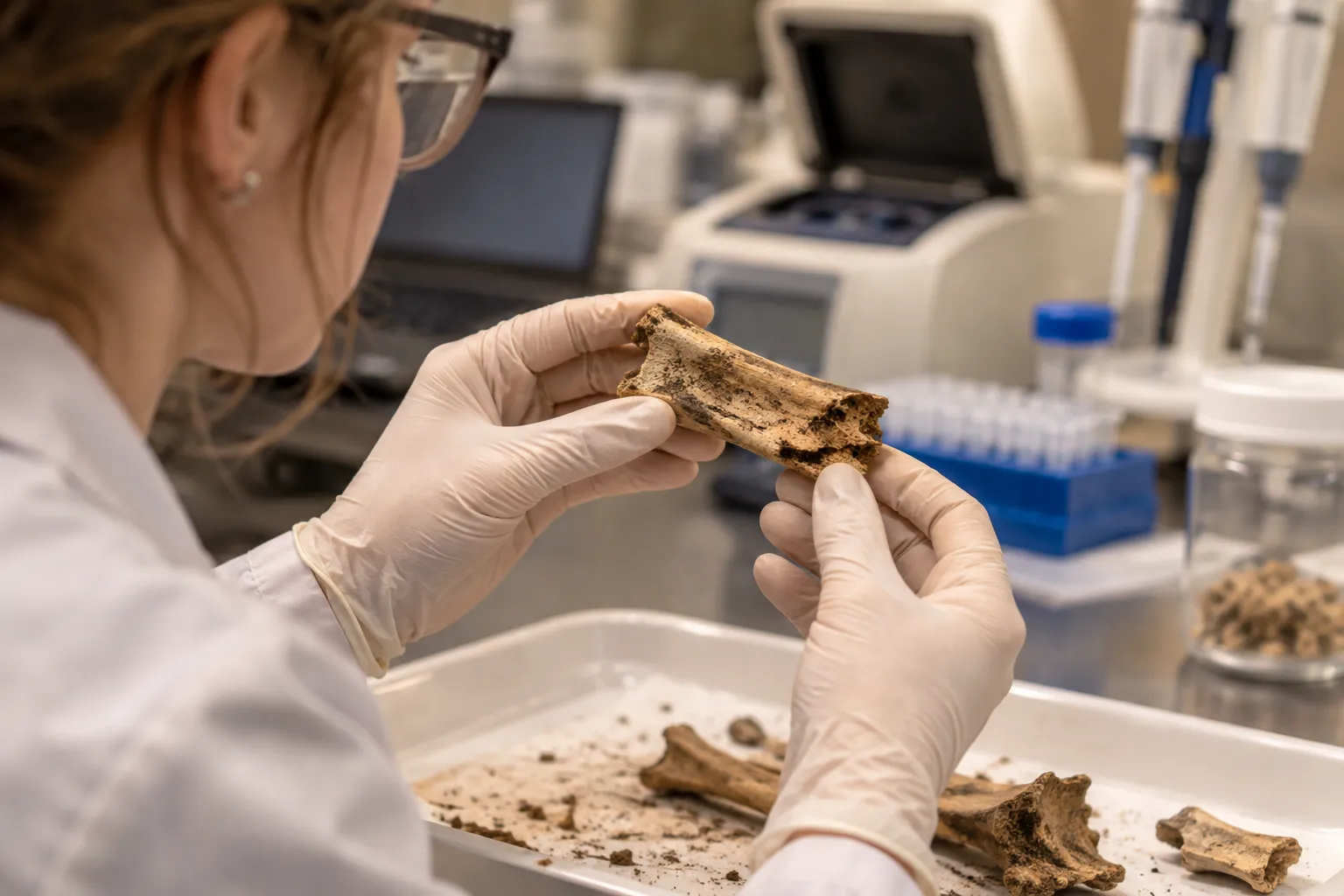
Researchers extract nuclear and mitochondrial DNA from ancient bone or tooth material, compare it against known wolf and dog reference genomes, and estimate how long ago the sample’s lineage diverged from wild wolf populations. Radiocarbon dating of the same specimen then anchors that genetic information to an actual calendar date.
This combination is what let the 2026 research team confirm the Pınarbaşı and Gough’s Cave specimens as genuine dogs rather than large wolves, and it is the same method that disqualified several older fossil candidates once their DNA came back wolf, not dog.
Why do we have so many dog breeds if they all came from wolves
Breed diversity is a very recent development relative to domestication itself. Most named dog breeds recognized today, from a Beagle to a Great Dane, were shaped through selective human breeding over the last few hundred years, not over the 15,000-plus years since domestication began.
The earliest dogs did not look dramatically different from each other across the vast distances researchers have sampled, which is part of why the Pınarbaşı and Gough’s Cave genomes look so closely related despite the geographic gap. Breed-level variation came much later, once humans started deliberately selecting for size, coat, and temperament rather than simply tolerating friendlier wolves. Anyone shopping for a puppy today based on breed traits can start with the guide on America’s top dog breed or the roundup of family-friendly breeds for kids.
FAQ
When were dogs domesticated, in simple terms? At least 15,800 years ago, based on the Pınarbaşı dog genome from Türkiye, with the actual process likely starting somewhat earlier.
Were dogs domesticated before or after farming? Before. All confirmed early dog specimens, including Pınarbaşı and Gough’s Cave, lived among hunter-gatherers thousands of years before agriculture existed.
What is the oldest confirmed dog fossil? The Pınarbaşı dog from Türkiye, dated to roughly 15,800 years ago, currently holds that title based on nuclear genome testing.
Did dogs come from wolves or a separate wild dog species? From wolves, specifically a now-extinct wolf population, not from any other wild canid species.
Why were some famous “oldest dog” fossils reclassified as wolves? Because nuclear DNA testing, unlike skeletal shape alone, can tell true dogs apart from wolves that merely resemble them, and several Belgian and Czech specimens failed that test.
Is there one single place where dogs were first domesticated? No single confirmed location exists. Evidence currently points to a broad western Eurasian and Anatolian population, with a separate regional story in East Asia.
Can a modern wolf become a dog if raised by humans? No. A tamed individual wolf is not genetically a dog, and its offspring raised in the wild would behave like wild wolves.
Are today’s dog breeds as old as domestication itself? No. Most named breeds formed over the last few hundred years through selective breeding, long after domestication began over 15,000 years ago.