
Do dogs know their names? Quick Answer
Dogs can pick their name out of surrounding speech and turn toward it reliably, and recent word studies using brain scans and behavior tests back this up. Whether that counts as “knowing” a name the way a person knows their own identity is a separate question, and no study has proven dogs link a name to a sense of self. For most dogs, a name works as a strong, well-practiced sound cue tied to attention, food, or a walk, and that is enough to make it useful every day.
Dogs do not know their names the way a toddler knows hers. They know a sound pattern that reliably predicts something good, and for most pet dogs, that is close enough to matter.
Key Takeaways
- A September 24, 2026 study from Eötvös Loránd University tested 20 dogs and 20 human adults and found dogs track consonant patterns in speech, a strategy linked to word-boundary detection.
- In a January 8, 2026 Scientific Reports study on label learning, 7 of 10 “Gifted Word Learner” dogs learned new toy names just by overhearing their owners talk, with 6 of 7 also succeeding in direct teaching.
- A control group of 10 Border Collies without prior vocabularies showed no comparable overhearing ability, meaning this finding does not apply to typical pet dogs.
- A March 2024 EEG study recorded brain activity in 18 of 27 dogs tested, with 14 of 18 showing a distinct neural pattern between matching and mismatched objects.
- Gregory Berns’ 2018 Emory fMRI work used 12 trained dogs and found different auditory brain responses to known words versus made-up pseudowords, as described by the American Kennel Club.
- No peer-reviewed study has shown a dog understands its name as a symbolic marker of self, only that the sound reliably predicts attention or reward.
- Do dogs know their names at the level most owners mean the question? Yes, functionally, through repeated pairing of sound and consequence, not through conceptual self-recognition.
When to call the vet or a trainer: A dog who suddenly stops responding to a name it previously knew, especially alongside confusion, bumping into furniture, or changed sleep patterns, may be showing signs of hearing loss or canine cognitive decline rather than a training lapse. An older dog that loses name response over weeks, not days, deserves a veterinary hearing and cognition check before more name training. The Dog Aging Project has useful background on how cognitive decline shows up in senior dogs.
Do dogs know their names
Dogs know their names in the sense that they can reliably pick the sound out of a stream of speech and turn toward it, and research supports that this skill develops through the same pattern-detection abilities infants use to find word boundaries. What the evidence does not support is that dogs attach a name to a concept of self the way people do.
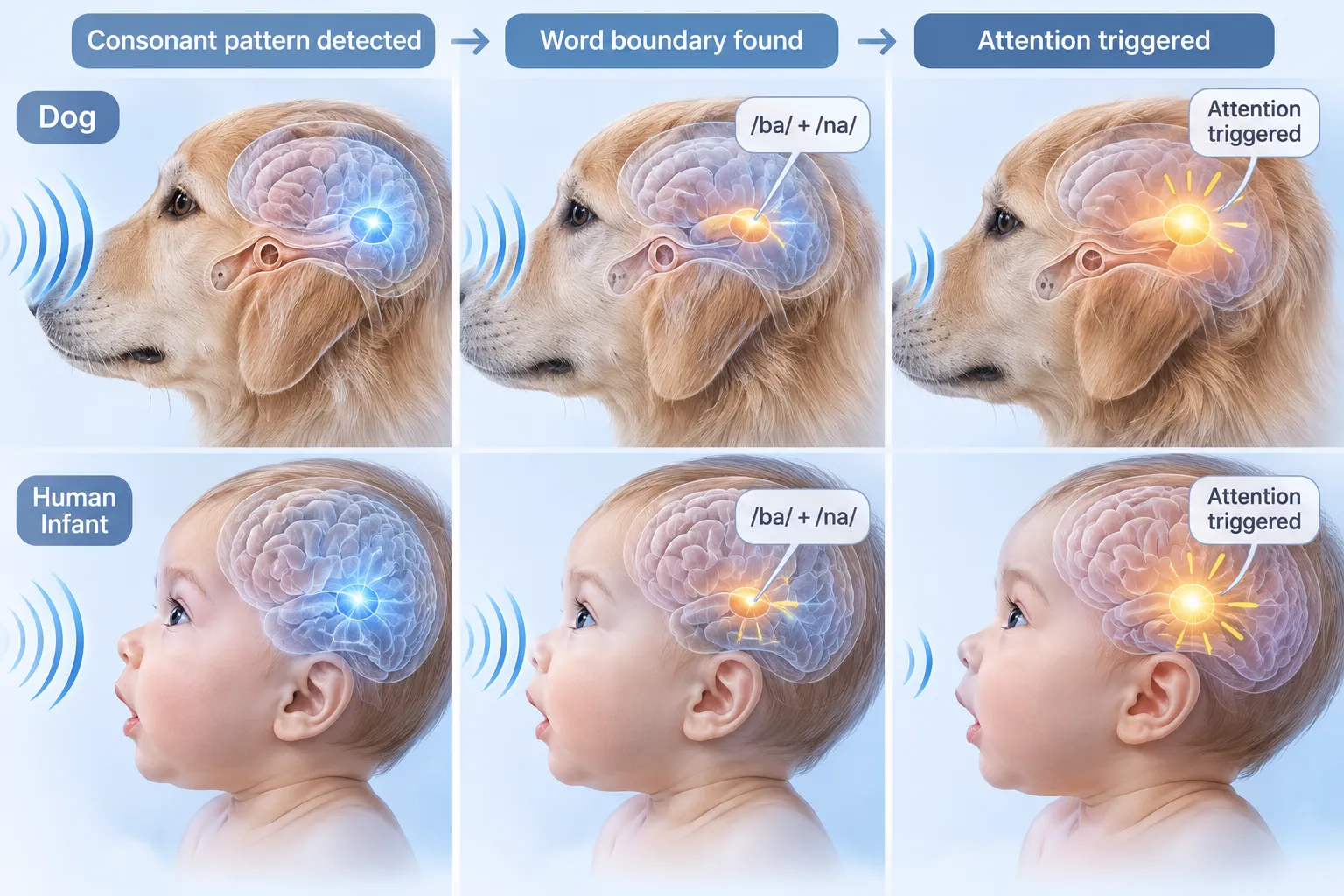
Research on do dogs know their names generally splits into two separate questions. The first: can a dog’s brain or behavior tell its name apart from other sounds? The answer is yes, demonstrated by EEG and fMRI work showing distinct neural responses to familiar versus unfamiliar words. The second: does the dog understand the name refers to itself, as an identity? That question has not been answered by any study on this list.
Trainer Sian Lawley-Rudd, quoted by Ask A Vet, draws this same line between reliable recognition and human-style self-identification. A dog responding to its name is closer to a well-rehearsed cue response than a moment of self-reflection.
For the average owner, the practical version of do dogs know their names comes down to consistency and reinforcement. A name becomes a cue the same way “sit” becomes a cue: repeated pairing with something meaningful, usually attention or food, until the sound alone produces a response. If you’re still working on foundational cues, the guide to essential commands for puppies covers how that pairing process works beyond just names.
Doggy Rank IQ Tool
Dog Name Recognition Test and Reteach Planner

A three step home test, scored, plus a 7 day plan to teach or rename.
Do dogs know their names? Can a dog pick out its name from other speech?
Yes, dogs can distinguish their name from surrounding speech, and the clearest recent evidence comes from how their brains process sound patterns rather than meaning. A September 24, 2026 study published in Science by researchers at Eötvös Loránd University tested 20 dogs and 20 human adults with streams of meaningless syllables and found dogs’ brain activity tracked repeating consonant-based patterns more strongly than vowel patterns.
That matters for names specifically because consonant structure is one of the main things that makes “Biscuit” sound different from “Sit down” in a run of ordinary household speech. Researchers compared this to a strategy human infants use before they understand any words, finding boundaries in continuous speech.
What the study did not test is meaning. The syllables were invented and carried no definition, so the dogs were not proving they understood anything was being asked of them, only that they could track a repeating sound structure. This is consistent with other recent work on how dogs process human sound, including a Scientific Reports paper on sound symbolism in human-dog communication, which found dogs respond differently to certain sound shapes even without prior training on those specific words.
Decision rule: if your dog turns its head reliably to its real name but not to random words of similar length, that is evidence of pattern detection working in your favor, not proof the dog understands “that word refers to me.”
Do dogs know their names? What does an object-word experiment tell us about name recognition?
Object-word experiments show some dogs can map a spoken label to a specific item, which is a step closer to word meaning than simple orientation, but this ability has only been confirmed in a small, unusual group of dogs. In a January 8, 2026 study covered by NPR, researchers tested 10 dogs already known to have large vocabularies of object labels, so-called “Gifted Word Learners,” and found 7 of 10 learned names for new toys just from overhearing their owners discuss the toys with another person, without the dog being directly addressed.
Six of those seven successful dogs also succeeded when taught directly, and Nature’s briefing on the study described the word-learning speed of these dogs as comparable in some respects to early toddler vocabulary growth, though the researchers were careful to note the comparison is limited to counting rate, not comprehension depth.
A control group of 10 Border Collies without a demonstrated object vocabulary showed no comparable overhearing ability. That split is the most important finding for ordinary owners: it means the skill is real, but it is not evidence that a typical family dog, including a well-loved mixed breed with a decent toy collection, will pick up new words by eavesdropping on dinner conversation. The AKC’s explainer on gifted word learner dogs is a good next read if you suspect your dog might be one of these rare cases.
Edge case: if your dog already knows the names of several toys by sight and sound, it may belong to this rare group. For the majority of pet dogs, this research does not apply, and name learning still runs through direct, repeated pairing.
Do dogs know their names? Two-study methods and limits table
The table below compares the sample sizes, what each do dogs know their names study actually measured, and what it stopped short of proving.
| Study | Sample | What it measured | What it did not show |
|---|---|---|---|
| ELTE speech-pattern study (2026) | 20 dogs, 20 humans | Brain tracking of consonant patterns in nonsense syllables | Word meaning or comprehension |
| Overhearing vocabulary study (2026) | 10 Gifted Word Learner dogs, 10 Border Collie controls | New toy-label learning via direct teaching and overhearing | Generalization to ordinary pet dogs |
| EEG word-object study (2024) | 18 of 27 dogs with usable data | Neural response difference between matching and mismatched objects | Universal effect across all dogs tested |
Do dogs know their names? Sourced stat cards
20 dogstested for consonant-pattern tracking, September 2026 7 of 10
Gifted Word Learner dogs learned toy names by overhearing 14 of 18
dogs showed distinct EEG patterns for matching objects, 2024 12 dogs
in Berns’ 2018 fMRI word-response study
Do dogs know their names? How do dogs learn their names
Dogs learn their names through classical and operant conditioning, not through being told what a name means. A sound is repeated right before or during something the dog already finds rewarding, such as eye contact, a treat, or being let outside, and over dozens or hundreds of repetitions the sound alone starts to trigger the same attention response.

This process does not require the dog to understand grammar or reference. It works the same way “sit” or the sound of a leash clip works: association built through timing and consistency. The AKC’s guide to teaching a dog its name recommends marking the moment a dog looks toward you after hearing its name, then rewarding within one to two seconds, since dogs link cause and effect most strongly inside that short window.
Common mistake: repeating a dog’s name over and over while it is already distracted and not responding. This teaches the dog that the name can be safely ignored, since nothing meaningful follows repeated, unanswered calls.
Do dogs know their names? At what age do puppies understand their name
Puppies can begin associating a sound with attention and reward as early as 8 weeks old, though reliable, consistent response usually takes several weeks of repetition rather than a single session. There is no published study pinpointing an exact age at which name learning clicks on, since the skill builds gradually through reinforcement rather than switching on at a developmental milestone.
Most trainers, including those cited in the AKC’s puppy name training guide, suggest starting the moment a puppy comes home, since early, low-distraction environments make the first repetitions easier to land successfully.
Common mistake: expecting a puppy to respond to its name within a day or two of adoption. Early inconsistency is normal, not a sign the puppy is ignoring you or that the name is wrong.
Why won’t my dog respond to their name
A dog that ignores its name is usually responding to competing stimuli, a weak reinforcement history, or a name that has become associated with something unpleasant, such as being scolded. Dogs do not selectively “forget” an identity; they simply weigh the name against whatever else is grabbing their attention at that moment, whether that is a squirrel, another dog, or background noise.
Check these common causes before assuming a training failure:
- Name fatigue: the name has been said so often without consequence that it has lost meaning as a cue.
- Negative association: the name was used right before something the dog disliked, such as nail trims or being put in a crate.
- Hearing changes: older dogs can develop partial hearing loss gradually, which looks like disobedience but is physical.
- Competing stimulus strength: a squirrel, another dog, or a doorbell is simply a stronger pull than the reward history attached to the name.
- Inconsistent tone or volume: using the name in a frustrated or sharp tone teaches the dog to associate it with discomfort rather than attention.
Edge case: if a dog responds at home but not outdoors, that is not a sign the dog “doesn’t know” its name, it is a sign the reinforcement history outdoors is weaker than the pull of outdoor distractions, and needs separate practice.
How long does it take to teach a dog their name
Most dogs start responding reliably to a new or reinforced name within 3 to 7 days of short, focused training sessions, though full reliability around distractions can take several weeks. The 7-day planner above follows this general timeline: building a simple association in the first two days, then layering in distraction and distance.
Factors that speed up or slow down the process include the dog’s age, how many other cues it already knows, how rewarding the training reinforcer is to that specific dog, and how much competing stimulation exists in the training environment. A food-motivated adult dog in a quiet home can often hit reliable indoor recognition in under a week. A shy rescue dog recovering from a stressful transition may need several weeks of calm, low-pressure repetition before the name consistently produces a response.
Decision rule: if a dog is not responding after two full weeks of consistent, rewarded practice, the issue is more likely a reinforcement or environment problem than a comprehension problem, and it is worth reviewing reward timing before adding more repetitions.
Can dogs learn multiple names
Yes, dogs can respond to more than one name or nickname, since each sound simply becomes its own cue through repetition, similar to how a dog can learn both “sit” and “down” without confusion. Owners who use a formal name, a nickname, and a shortened version all consistently paired with the same rewarded response can see a dog respond to all three.
Problems appear when the names are used inconsistently, with some names rewarded and others not, since the dog has no way to know which sound matters unless the pattern of reward stays consistent across all of them. Households with multiple family members calling a dog by different names should agree on which version gets reinforced during initial training, then introduce variations once the core response is solid.
Example: a dog named “Theodore” who is also called “Theo” and “Teddy bear” by different family members can learn to respond to all three, provided each name is at some point paired with attention or reward rather than only one version being reinforced.
Do different dog breeds learn their names differently
Breed can influence how quickly a dog builds reliable name response, mainly through differences in food motivation, attention span, and sensitivity to distraction, though no large study has ranked breeds specifically on name-learning speed. Breeds developed for close handler cooperation, such as Border Collies and retrievers, often show faster cue acquisition in general training contexts, including name response, simply because they were selected over generations for attentiveness to human cues.
That said, individual temperament inside a breed matters more than breed averages for most pet owners. A low-drive Labrador may take longer than a food-motivated terrier mix, regardless of what breed stereotypes suggest. The guide to America’s top dog breed and the breed matchmaker category cover trainability differences in more depth if breed choice is still a factor in your decision.
Common mistake: assuming a “stubborn breed” cannot learn its name quickly. Slower name response is more often a reinforcement issue than a hardwired breed trait.
Can you teach an older dog a new name
Yes, adult and senior dogs can learn a new name, and the process uses the same conditioning method as puppy training, just often with a shorter timeline since older dogs already understand that sounds can predict rewards. Rescue dogs renamed by new owners typically adjust within the same 1 to 2 week window as the standard reteach schedule, provided the new name is used consistently and paired immediately with something positive.

The main risk with renaming an older dog is inconsistency: if the old name is still used occasionally by family members or in old routines, the dog receives mixed signals about which sound matters. Fully retiring the old name and committing to the new one speeds up the transition considerably.
Edge case: dogs with hearing loss or advancing cognitive decline may struggle with a new name regardless of training quality, since the issue is sensory or neurological rather than associative. This is one of the clearer cases where a veterinary check, not more repetition, is the right next step.
What’s the difference between knowing their name and just responding to sound
Knowing a name in the human sense would require a dog to connect the sound to a concept of self, while responding to sound only requires the dog to recognize a pattern that reliably predicts attention or reward. Every peer-reviewed study referenced in this article, including the EEG and fMRI work, demonstrates the second kind of recognition, not the first.
Here is a practical way to separate the two in daily life: a dog that reliably turns toward its name from another room, ignoring similar-sounding words, is showing strong pattern-based sound recognition. No current test, behavioral or neurological, can show whether that same dog understands the sound is “who they are” in any reflective sense. The AKC’s own breakdown of how much language dogs really understand draws a similar line, noting that vocabulary recognition and self-concept are separate questions that current research tools cannot fully bridge.
How to train your dog to come when you call their name
Training reliable recall starts with building strong name recognition in a low-distraction setting, then gradually adding distance, distractions, and real-world stakes before expecting it to work everywhere. The process typically unfolds in four stages:
- Indoors, no distractions: say the name, reward the instant the dog looks or moves toward you, repeat 10 to 15 times per session.
- Indoors with mild distractions: add background noise or another person in the room, keep the reward rate high.
- Fenced outdoor space: call the name from a short distance, reward generously on arrival, and resist repeating the name multiple times if the dog hesitates.
- Open or higher-distraction settings: only move here once the first three stages are consistently successful, and keep a long training leash in play until recall is solid.
Dogs that already know basic commands tend to pick up recall faster, since they are used to a sound producing a predictable reward. The guide to essential commands every puppy should learn is a useful companion resource if recall training is stalling because foundational cues are shaky.
Common mistake: calling a dog’s name to end something enjoyable, like calling a dog over at the dog park only to immediately leash up and go home. This teaches the dog that responding to its name sometimes ends the fun, which weakens recall over time.
Do cats know their names like dogs do
Cats can also distinguish their own name from other words, and a well-known 2019 study by Saito and colleagues found cats orient differently to their name compared to similar-sounding words, in a pattern that looks structurally similar to what dog studies have found. The mechanism appears comparable: pattern recognition tied to reward or attention, not evidence of self-concept.
The main behavioral difference most owners notice is not comprehension but motivation to respond. Cats are frequently less motivated than dogs to orient or approach after recognizing a sound, which can look like “not knowing” the name when the cat is actually just choosing not to act on it. This is a motivational difference, not necessarily a difference in the underlying recognition ability.
What happens if you change your dog’s name
Changing a dog’s name does not confuse or distress a dog in any lasting way, since the old name was never a fixed identity marker to begin with, only a learned sound cue. Rescue organizations rename dogs routinely, and most adjust to a new name within one to two weeks of consistent use paired with rewards, following the same timeline as the standard reteach schedule described earlier.
The practical keys to a smooth transition are consistency and a clean break from the old name: everyone in the household uses only the new name starting immediately, and the new name gets paired generously with treats, play, and attention during the first several days. Dogs adopted later in life, including seniors, generally handle renaming well as long as hearing and cognition are intact.
Can dogs forget their names
Dogs do not typically “forget” a well-established name the way people forget information, since the association is behavioral rather than stored as a fact. What looks like forgetting is usually one of three things: a drop in reinforcement that weakens the cue over time, a competing stronger stimulus in the moment, or an underlying medical issue such as hearing loss or cognitive decline in senior dogs.
A sudden, sharp decline in name response, especially paired with disorientation, pacing at night, or reduced interest in previously exciting cues, is a signal worth taking to a veterinarian rather than retraining through repetition alone. This lines up with the when-to-call-the-vet guidance noted earlier in this article: gradual decline over weeks in an older dog points toward a health check first, training second.
How do you know if your dog actually knows their name
The clearest home test is the three-step comparison used in the planner above: a neutral-tone call, a similar-sounding decoy word, and a call from out of sight. A dog that responds strongly to the real name but weakly or not at all to the decoy, even without visual or tonal cues, is showing solid, sound-based name recognition rather than simply reacting to excitement in your voice or body language.
Owners often mistake tone-reading for name recognition. A dog that only responds to an enthusiastic, high-pitched voice saying its name, but ignores the same name said flatly, may be reading vocal excitement rather than the specific word. Testing with a flat, neutral tone, as the planner above does in Step 1, removes that variable and gives a cleaner read on actual sound recognition.
Are some names easier for dogs to learn
Yes, certain name qualities make learning faster and response more reliable, mainly short length, clear consonant sounds, and distinctiveness from common household words and other cues. The AKC’s guide to choosing a dog’s name recommends one or two syllables with a strong consonant sound, since names like “Max,” “Buddy,” or “Zara” stand out more clearly in a stream of speech than longer, softer-sounding names.
Names that closely resemble common commands cause the most trouble. A dog named “Beau” may struggle more with recall clarity than a dog named “Max,” since “Beau” sounds close to “no” in casual speech. This lines up directly with the September 2026 Eötvös Loránd University findings on consonant-pattern tracking: distinct, consonant-heavy sounds are easier for a dog’s brain to isolate from background speech.
Decision rule: choose a name with at least one hard consonant sound and avoid names that rhyme with frequently used commands like “sit,” “no,” or “stay.”
FAQ
Do dogs know their names the same way humans do? No. Dogs recognize their name as a sound pattern linked to attention or reward, not as a marker of personal identity. No study has shown dogs connect a name to a concept of self.
How do dogs learn their names? Dogs learn names through repeated pairing of a sound with a reward, such as food, play, or attention, the same conditioning process used for commands like “sit” or “stay.”
At what age do puppies understand their name? Puppies can start forming the association as early as 8 weeks old, though consistent, reliable response usually takes several weeks of regular, rewarded practice.
Why won’t my dog respond to their name? Common reasons include competing distractions, a weak reward history, negative associations with the name, or in older dogs, hearing loss or cognitive decline that needs a veterinary check.
How long does it take to teach a dog their name? Most dogs build a basic response within 3 to 7 days of focused practice, with full reliability around distractions taking a few additional weeks.
Can dogs learn multiple names or nicknames? Yes, as long as each version is consistently paired with reward at some point. Inconsistent use across different names slows down learning for all of them.
Can you rename an older dog successfully? Yes. Older dogs typically adjust to a new name within one to two weeks of consistent use, following the same process as puppy name training.
Do cats know their names like dogs do? Research suggests cats can distinguish their name from similar sounds in a way structurally similar to dogs, but cats are often less motivated to respond, which can look like lower recognition.
What’s the difference between knowing a name and just responding to sound? Responding to sound means recognizing a pattern tied to reward. Knowing a name in the human sense would require linking that sound to self-identity, something no current study has demonstrated in dogs.
Can dogs forget their names? Not typically through simple time passing. Apparent forgetting is usually weak reinforcement, a stronger competing distraction, or an underlying medical issue like hearing loss.
Are some dog names easier to learn than others? Yes. Short names with a clear consonant sound, distinct from common commands, are generally easier for dogs to isolate from background speech and learn quickly.
Does do dogs know their names research apply to all breeds equally? Most studies, including the Gifted Word Learner research, used small, specific samples and do not claim to generalize across all breeds. Individual temperament and training history matter more than breed alone.