
This post contains affiliate links. If you buy through one we may earn a commission at no extra cost to you. As an Amazon Associate I earn from qualifying purchases.
Quick answer: A dog treat pouch with a magnetic or split-top closure opens reliably with one hand while you hold a leash, while drawstring and zippered pouches generally need both hands. Silicone-lined pouches handle soft or oily treats and clean up faster than fabric, which hand washes and air dries. Expect to pay between 15 and 60 dollars depending on capacity, closure type, and wearing options.
Key Takeaways
- Magnetic closures open and reseal with one hand, according to comparisons from Honest Hound and The Spruce Pets, while drawstrings and zippers typically need both hands.
- Ruffwear’s Treat Trader holds up to 2 cups of treats and uses a food-grade waterproof lining with a belt clip and adjustable belt.
- Orvis sells a 35 dollar split-neoprene pouch rated hand wash only, with wearing options including clip, belt loops, and a stand-alone belt.
- Silicone liners resist odor and oil absorption better than fabric, per Honest Hound and Spruce Pets reviews, and some tolerate rinsing or dishwasher cleaning.
- A 2026 buying guide from Chewy found the category now includes crossbody designs and multi-pocket training bags, not just basic pouches.
- No major 2026 testing has measured opening speed, spill rate, or wash durability in a standardized way, so claims about “fastest” closures rely on reviewer judgment, not lab data, as Wirecutter notes in its own walking gear testing limits.
- Training guidance from trainers interviewed by Whole Dog Journal says fast, consistent reward timing helps reinforce behavior while keeping a hand free for the leash or clicker.
What’s a dog treat pouch and why do I need one
A dog treat pouch is a small bag worn at the waist or across the body, built to hold dry or soft rewards during training, walks, or recall work. The point is speed: get a treat out with one hand, fast, without dropping the leash or digging through a jacket pocket full of crumbs while your dog is mid-behavior.
Timing is the actual reason trainers push people toward a dedicated pouch instead of loose pockets. If a reward shows up even two seconds late, a dog can connect the treat to the wrong action, which undoes the point of the training rep. Whole Dog Journal and the AKC both frame reward timing as one of the biggest variables in how fast a dog picks up a new cue.
The category has grown past the basic drawstring bag. Current designs, per Chewy’s 2026 roundup, include magnetic flaps, silicone shells, crossbody straps, and pouches with a separate pocket for poop bags or a phone. Some pouches are built around one closure type and do that one thing well. Others try to handle five jobs at once, which sometimes means none of them particularly well.
Who needs one: anyone doing regular reward-based training, recall practice, or long walks with a dog that gets frequent treats. Who can skip it: see the dedicated section below.
Pouch Picker
Select your training type, treat type, and extras below.
body{font-family:system-ui,-apple-system,”Segoe UI”,Roboto,sans-serif;margin:0;background:#fff} .cg-wrap{max-width:560px;margin:0 auto;padding:16px;border:1px solid #D1D5DB;border-radius:10px} .cg-wrap h3{color:#1E293B;font-size:16px;margin:0 0 10px} .cg-row{margin-bottom:10px} .cg-row label{display:block;font-size:13px;color:#334155;margin-bottom:4px;font-weight:600} .cg-row select{width:100%;padding:8px;border:1px solid #D1D5DB;border-radius:6px;font-size:14px;color:#1E293B} .cg-btn{background:#046BD2;color:#fff;border:none;padding:10px 16px;border-radius:6px;font-size:14px;cursor:pointer;width:100%;margin-top:6px} .cg-btn:hover{background:#045CB4} .cg-result{margin-top:14px;padding:12px;background:#F0F5FA;border-radius:6px;font-size:14px;color:#1E293B;display:none}Find your closure and liner
Liner: “+liner+”
Storage: “+extra+”
From this article: “+pick; }
Doggy Rank IQ Tool
Dog Treat Pouch Picker

Timing is everything in training. Pick the pouch that opens with one hand for your treats and setting.
One-Hand Access and Wash Care
With a magnetic closure, you can open a dog treat pouch with one hand while a leash is wrapped around the other, and it works consistently session after session. The magnet releases under light thumb pressure and most designs reseal on their own once you let go, which also keeps the bag from gaping open on a hike.
A split neoprene top, like the one on the Orvis pouch, works almost as fast. You push through the stretch fabric rather than flipping a magnet, and it still leaves your other hand free for the leash or a clicker. Drawstrings are the slow option here. You need a second hand to loosen the cord, which defeats the entire point of a dedicated pouch during a leash walk or a recall drill in an open field. Zippers are worse still, since most require two hands to line up the pull and slide it.
Decision rule: choose a magnetic closure if you train off-leash recall or walk reactive dogs where both hands get busy fast. Choose a split-top if you want something slightly more weatherproof and don’t mind a bit more resistance on the draw. Choose a drawstring or zip pouch only for slow-paced class settings where speed is not the priority.
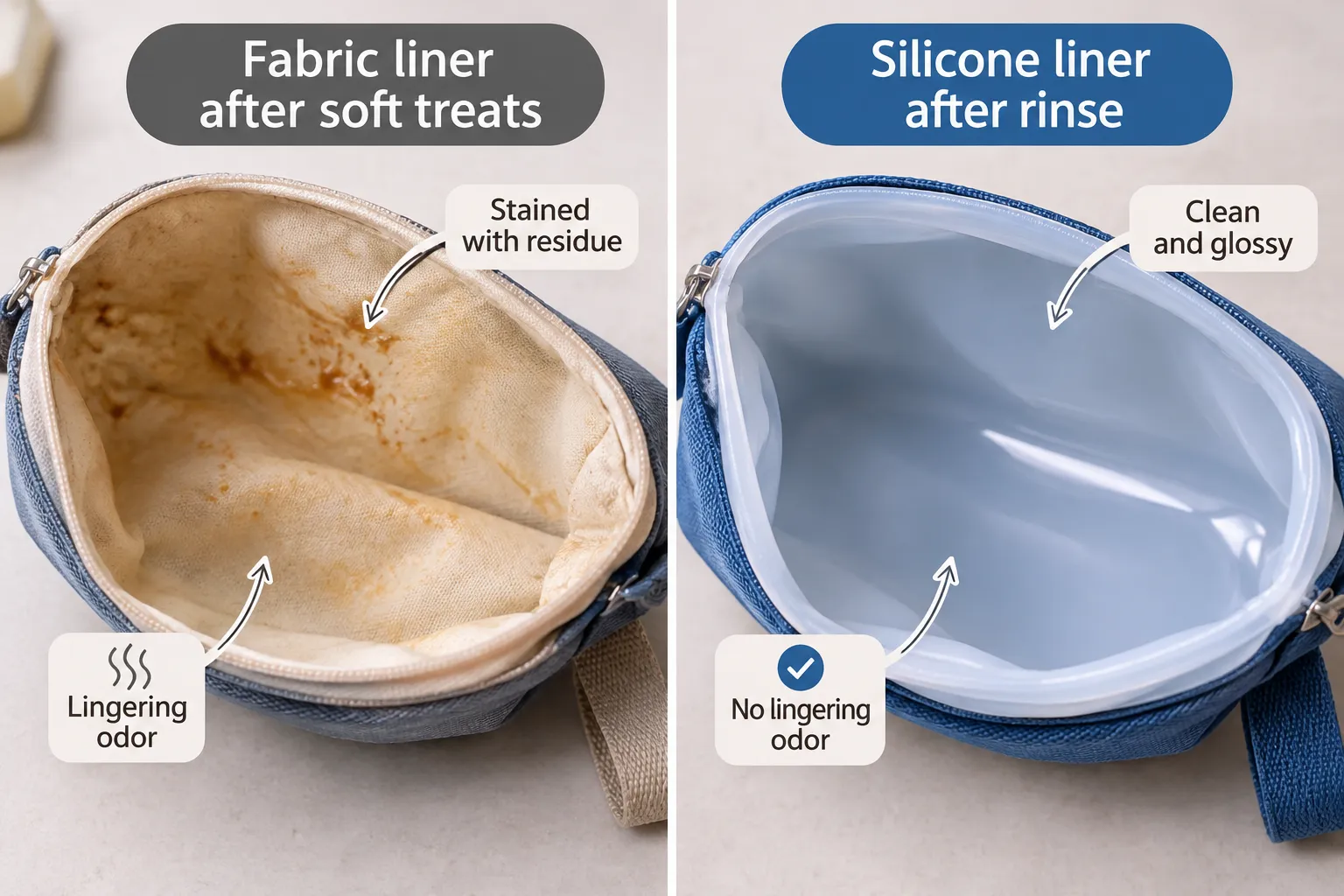
Wash care is the part owners discover too late. Soft treats, the sticky, fishy, liver-based kind, turn a fabric lining into a problem within a few training sessions. A lined fabric pouch without a removable insert often ends up hand washed in the sink, air dried overnight, and used again smelling faintly of whatever was inside last week.
Silicone changes that equation. Because it is non-porous, it does not absorb oils and odors the way fabric does, and several models tolerate rinsing under a faucet or a dishwasher cycle, depending on the manufacturer’s instructions, as noted in reviews from Honest Hound and The Spruce Pets.
Waterproof lining is not the same claim as machine washable. A liner can resist spills without ever being rated safe for a washing machine, so check the actual care tag on your dog treat pouch rather than relying on the word “waterproof” printed on the box or listing.
For owners also setting up a consistent feeding routine at home, the same logic about washable parts applies. If you are building a full feeding or water station, the guide on choosing the best healthiest dog food covers the same “parts that come apart and clean easily” priority that applies to treat storage too.
Best dog treat pouches for obedience training
For obedience class work, the best dog treat pouch is one that balances fast access with enough capacity to last a 45 to 60 minute session without refilling. Magnetic closures again come out ahead for speed, but capacity and a secure clip matter more here than in casual walks, since class settings involve a lot of standing, bending, and repetition.
Dogster’s trainer-focused reviews and Whole Dog Journal’s testing both point to a few consistent traits in pouches that hold up in class: a secure belt clip that doesn’t slide around during movement, a liner that doesn’t get slick with treat crumbs, and enough room (1.5 to 2 cups) that an hour-long class doesn’t require a mid-session refill.
- The heouvo Magnetic The pouch with Clicker fits this niche well for group classes where you also need a hand-held clicker loop.
- The Goodie Treat Bag works for class settings where carrying capacity (extra pockets for handouts, poop bags, treats) outweighs raw speed.
- Larger-capacity options like the Ruffwear Treat Trader suit longer sessions or multi-dog households where refills during class are inconvenient.
Common mistake: picking a pouch based on looks rather than clip security. A pouch that slides down your hip mid-class forces you to readjust constantly, which slows your reward timing more than a slower closure ever would.
Dog treat pouch vs training vest, which is better
A the pouch is better for most owners doing standard leash walks, recall drills, or weekly classes, while a training vest makes more sense for professional trainers running back-to-back sessions with multiple dogs or handling gear-heavy work like scent detection.
A standalone pouch is lighter, cheaper (15 to 60 dollars versus 40 to 100+ for a vest), and easier to put on and take off between sessions. A training vest spreads pocket space across the torso instead of the hip, which helps if you are carrying treats, a clicker, poop bags, and a water bottle all at once, but it is overkill for someone who just wants quick access to kibble on a daily walk.
Choose a pouch if: you walk or train one dog at a time and want something fast to clip on and off. Choose a vest if: you train professionally, work multiple dogs per day, or need more storage than a single waist pouch can hold.
Can I put wet treats in a dog treat pouch
Yes, but only in pouches with a non-porous liner or a removable, washable insert. Wet or soft treats such as cooked chicken, liver bits, or canned food cut into cubes will soak into fabric linings quickly and leave both residue and smell behind.
Silicone-shelled pouches like the RoyalCare Silicone The pouch{rel=”sponsored nofollow”} handle wet treats far better than fabric, since the material wipes clean or rinses under a faucet. Fabric pouches with a plastic or silicone liner insert are the next best option, since you can pull the liner out and wash it separately from the outer shell.
Edge case: if you use very wet, high-moisture treats (think raw meat cubes), even silicone pouches benefit from a quick rinse after every session rather than waiting until odor builds up. Letting wet treats sit in any pouch for more than a few hours, even a washable one, invites bacterial growth, especially in warm weather.
How to stop my treat pouch from smelling bad
The fastest fix is switching to a silicone liner or a removable fabric insert that you can wash after every few uses instead of letting residue build up over weeks. Odor comes from oil and protein residue sitting in porous fabric, not from the treats themselves, so the fix is almost always about the liner material, not the treat choice.
Practical steps that work:
- Empty the pouch completely after each session rather than leaving leftover treats inside overnight.
- Wipe silicone liners with a damp cloth or rinse under warm water; check if the model is dishwasher-safe per the manufacturer’s care instructions.
- Hand wash fabric liners with mild dish soap and let them air dry fully before the next use; a damp liner left sealed shut grows odor fast.
- Rotate between two pouches (or a two-pack like RoyalCare’s) so one is always drying while the other is in use.
- Avoid storing a the pouch sealed in a bag or drawer while still slightly damp, which traps moisture and accelerates smell.
Are dog treat pouches worth it
For anyone doing regular reward-based training, yes. A the pouch solves a real timing problem (getting a reward into a dog’s mouth within one to two seconds of the correct behavior) that pockets and loose baggies handle poorly. The cost, typically 15 to 60 dollars, is low relative to the number of sessions most owners get out of one.
They are less worth it for owners who train rarely, rely mostly on toy or praise rewards, or already carry a multi-pocket gear bag that has room for treats. In that case, a pouch becomes one more item clipped to an already busy belt without adding real function.
Decision rule: if you train more than once a week with food rewards, a dedicated pouch pays for itself quickly in faster reward timing and less fumbling. If training is occasional and low-stakes, skip it and use a pocket.
What size dog treat pouch should I get
Match the pouch size to session length, not the longest session you occasionally run. A pouch in the 1 to 1.5 cup range covers most 15 to 30 minute walks or short training reps, while anything over 2 cups, like the Ruffwear Treat Trader, suits longer hikes or back-to-back classes where refilling mid-session is inconvenient.
- Small dogs or short daily walks: 1 cup or less is usually enough.
- Standard obedience classes (45 to 60 minutes): 1.5 to 2 cups.
- Long hikes, field recall work, or multi-dog households: 2+ cups.
Oversized pouches add bulk to the hip without adding speed, and in fact can slow down one-hand access since your thumb has to search a wider opening for the treat.
Cheapest good quality dog treat pouch
The Goodie Treat Bag{rel=”sponsored nofollow”} is the budget pick in this lineup, typically priced around 20 to 30 dollars, and it includes a zip pocket for poop bags or a phone. It uses a drawstring top rather than a magnet, so it is not the fastest one-hand option, but for class settings where speed matters less than carrying capacity, that tradeoff works fine.
For an even lower price point, the heouvo Magnetic The pouch with Clicker runs around 15 to 25 dollars and adds a magnetic closure, which makes it a better value pick if speed matters more to you than extra storage.
Budget tip: two-packs, like the RoyalCare Silicone The pouch, often work out cheaper per unit than buying two separate single pouches, and having a spare means one is always clean and ready while the other dries.
Dog treat pouch alternatives for hiking
For hiking, a crossbody treat pouch or a multi-pocket hip pack with a dedicated treat compartment often beats a basic waist pouch, since hiking involves more movement, elevation changes, and the need for extra storage (water, a map, a phone).
Alternatives worth considering:
- A crossbody the pouch, which distributes weight across the body instead of one hip, reducing bounce on uneven trail.
- A multi-pocket hiking belt with a treat pouch attachment, useful if you already carry water and a first aid kit.
- A fanny pack retrofitted with a washable liner bag inside, covered in the next section.
Wirecutter’s dog walking accessories guide notes that for longer outdoor sessions, a secure closure matters more than it does on short walks, since vigorous movement on trail can shake loose treats out of an open-top bag.
Can you use a fanny pack as a dog treat pouch
Yes, a standard fanny pack can work as a the pouch if you add a washable liner, such as a silicone food storage bag or a small zip pouch insert, to keep treat residue off the fabric interior. This is a reasonable low-cost option if you already own a fanny pack and don’t want to buy a dedicated product.
The tradeoff is access speed. Most fanny packs use zippers, which are the slowest closure type for one-hand access while holding a leash. If you go this route, look for a fanny pack with a front zipper pull large enough to grab with one hand, or consider swapping the zipper pull for a bigger loop.
Edge case: fanny packs with a front flap and magnetic snap (increasingly common in 2026 gear lines per Chewy’s category roundup) close the speed gap almost entirely and make a reasonable dual-purpose option for walks and errands.
Best waterproof treat pouch for beach training
For beach or wet-weather training, prioritize a pouch with a sealed, waterproof liner and a secure closure that won’t let sand or water seep in during a session near waves or puddles. Ruffwear’s Treat Trader uses a food-grade waterproof lining and is a common pick for owners training near water, per Ruffwear’s product listing.
Silicone-shelled pouches also perform well at the beach since sand rinses off easily and the material does not absorb saltwater or moisture the way fabric does. Avoid fabric pouches without a sealed liner for beach use, since damp fabric combined with treat residue creates odor and mildew risk faster than at home.
Quick example: an owner training recall on an off-leash beach with a Labrador that loves water would do better with a magnetic, silicone or waterproof-lined pouch than a drawstring fabric bag, both for speed and for keeping treats dry if the dog or pouch gets splashed.
Do professional dog trainers use treat pouches
Yes, most professional trainers use a dedicated treat pouch or training vest rather than pockets, specifically because consistent, fast reward delivery is central to reinforcement-based training methods. Whole Dog Journal’s trainer interviews and the AKC’s training guidance both note that delayed rewards can reinforce the wrong behavior, which makes a pouch a practical tool rather than a convenience item for working trainers.
Many professional trainers running multiple dogs per day lean toward a training vest instead of a single pouch, since a vest spreads capacity across more pockets (treats, clicker, poop bags, leash clips) without concentrating all the weight on one hip.
How to attach a treat pouch to my belt
Most the pouches attach to a belt using a clip, a dedicated belt loop, or a standalone adjustable strap, and the right method depends on what you are already wearing. Clip attachments are fastest to put on and take off, belt loops are more secure during vigorous movement, and standalone straps work when you are not wearing a belt with loops at all.
- Check whether your pouch includes a clip, loop, or standalone strap (the Orvis pouch offers all three on one product).
- For a clip, snap it directly onto your existing belt or waistband.
- For belt loops, thread your own belt through the loop before buckling.
- For a standalone strap, adjust it to sit at hip height where your dominant hand can reach without looking down.
- Test one-hand access before a real session: reach for a treat with your eyes on an imaginary dog, not the pouch.
Dog treat pouch for small dogs vs large dogs
The pouch itself does not need to change based on dog size, but treat type and capacity often do. Small dogs usually take smaller treats in higher volume per session, while large dogs may take fewer, larger treats, which changes how quickly a pouch empties.
- Small dog owners (training a Chihuahua or terrier mix) often do fine with a 1 cup pouch, since treats are tiny and sessions are shorter due to the dog’s smaller size and energy limits.
- Large dog owners (Labradors, German Shepherds) training longer recall drills or agility work often prefer 1.5 to 2 cup capacity, since larger treats take up more room per piece.
- For breed-specific training context, the roundup of 5 essential commands every puppy should learn covers how session length and treat frequency change by age and size.
 )
Top 5 Features That Decide the Purchase
1. Closure speed. The heouvo 1.67 Cup Magnetic The pouch with Training Clicker uses a magnetic flap built for one-hand release, which matters most during recall work where both hands are often busy with a leash and a clicker.
2. Liner material. The RoyalCare Silicone The pouch-Small Training Bag-Portable Dog Treat Bag for Leash with Magnetic Closure and Waist Clip airtight sealed – 2pieces [US Design Patent]{rel=”sponsored nofollow”} is built around a silicone shell, which resists the oil residue soft treats leave behind in fabric linings.
3. Attachment method. Belt clip, waist strap, or crossbody. The Orvis pouch offers all three wearing methods on one product, which matters if you walk one dog on a belt and bring a second to class on a crossbody strap.
4. Capacity versus bulk. Ruffwear’s Treat Trader holds up to 2 cups, generous for a long hike, but a bigger pouch also sits heavier on the hip during a short neighborhood walk. Match capacity to the actual session length, not the longest one you occasionally do.
5. Extra storage. The Goodie Treat Bag, Dog Treat Training Pouch{rel=”sponsored nofollow”} includes a separate compartment, useful for owners who want poop bags and a phone in the same unit instead of stuffing a jacket pocket.
Closure Type and Attachment Options
This comparison table lines up each the pouch by closure type, attachment method, and wash care so you can match a model to your training style before buying.
| Model | Price Band | Closure | Attachment | Wash Care |
|---|---|---|---|---|
| heouvo Magnetic The pouch with Clicker | around $15 to $25 | Magnetic, 1.67 cup | Belt, clip | Fabric, hand wash |
| RoyalCare Silicone The pouch (2-pack) | around $15 to $25 | Magnetic, airtight seal | Waist clip | Silicone, rinse or wipe |
| Goodie Treat Bag, Dog Treat Training Pouch | around $20 to $30 | Drawstring top, zip pocket | Belt, crossbody | Fabric, hand wash |
| Orvis The pouch (reference) | around $35 | Split neoprene top | Clip, belt loop, adjustable belt | Hand wash only |
| Ruffwear Treat Trader (reference) | around $40 to $60 | Magnetic, audible cue | Belt clip, adjustable belt | Waterproof lining, wipe clean |

Which Pick Fits Which Dog and Owner?
An owner doing short leash walks around the block with a small dog and dry kibble treats does not need the biggest pouch on the shelf. The heouvo Magnetic The pouch covers that case well: small capacity, magnetic flap, clicker loop built in for anyone layering in clicker work.
An owner feeding mostly soft, high-value treats (cooked chicken or liver bits) for a reactive dog or a new puppy should prioritize the liner over closure speed. The RoyalCare Silicone pouch solves the odor problem directly, since silicone does not hold onto grease the way fabric does, and the two-pack means a spare is already on hand while one dries.
The budget pick is the Goodie Treat Bag. It costs less than the premium options, includes a zip pocket for poop bags or a phone, and works fine for class settings where speed matters less than carrying capacity. It uses a drawstring top rather than a magnet, so it is not the fastest one-hand option, but for an owner mainly training in a controlled class environment rather than chasing recall across a field, that tradeoff is reasonable.
An owner doing field recall work, longer hikes, or anything with unpredictable movement should lean toward the magnetic designs with a locking seal, since open-top designs can release treats during vigorous movement, per field-use notes from BestReviews.
For readers building training routines around this gear, the step-by-step recall training guide explains how to pair pouch access with hand targeting, and a beginner’s guide to dog grooming covers other gear habits worth building early.
Things to Watch Out For
Waterproof is not the same claim as washable. A liner can shrug off rain and still require hand washing only, as is the case with the Orvis pouch. Check the actual care label before assuming a the pouch goes in the machine.
Magnetic closures are fast, but the magnet itself is a wear part. A weak or worn magnet eventually stops resealing tightly, which matters if you are walking near water or brush where a loose seal lets treats fall out.
Multi-pocket designs sound efficient until the pouch doubles in bulk. A pouch built to hold poop bags, a phone, a clicker, and treats is heavier on the hip and slower to dig through than a single-compartment pouch, which can undercut the whole one-hand-access argument.
No standardized testing currently measures opening speed, spill rate under movement, or wash-cycle durability across models, so comparisons in current buying guides rely on reviewer judgment rather than lab numbers. Treat any claim of “fastest” or “most durable” as an opinion, not a measured result.
Who Should Skip This
An owner running only brief sessions with a handful of dry treats, or relying mainly on praise, play, and toys instead of food rewards, may not need a dedicated the pouch at all. A jacket pocket works fine for a five-minute sit-stay in the backyard.
Owners who already carry a fanny pack or a multi-pocket gear vest for hiking may find a standalone pouch redundant, since clipping one more item to an already loaded belt just adds bulk without adding function. In that case, retrofitting an existing bag with a washable liner (covered above) is more practical than buying a second product.
For readers working on the underlying behavior rather than the gear, the guide to teaching a dog recall with a hand target and the roundup of 5 essential commands every puppy should learn cover the training side a the pouch is meant to support.
FAQ
Can you open the treat pouch with one hand while holding a leash? With a magnetic or split-top closure, yes, and most magnetic designs also reseal on their own once released. Drawstrings generally require a second hand to loosen the cord, and zippers are slower still.
Which liner can be cleaned after using soft treats? Silicone liners handle soft, oily treats best because the material does not absorb grease or smell the way fabric does, and several models tolerate rinsing under a faucet or a dishwasher cycle depending on the manufacturer’s instructions.
What is the best the pouch for training? It depends on treat type and session length. For dry treats and short walks, a small magnetic pouch like the heouvo model works well. For soft or wet treats, a silicone-shelled pouch like RoyalCare handles odor and residue better over repeated use.
Is a the pouch worth buying if I only train occasionally? Probably not. A the pouch earns its cost through repeated use with fast reward timing, so owners training less than once a week may do fine with a jacket pocket or a small plastic bag instead.
What size the pouch should I buy? Match capacity to session length rather than the longest session you occasionally run. A 1 to 1.5 cup pouch covers most short walks, while 2+ cup options suit hikes, classes, or multi-dog households.
Can I wash a the pouch in the washing machine? Check the care label first. Many fabric pouches, including the Orvis model, are rated hand wash only even when the lining is described as waterproof. Silicone pouches typically rinse or wipe clean instead of going through a washing machine.
Do professional trainers actually use treat pouches? Yes. Most professional trainers use a pouch or training vest because fast, consistent reward delivery supports reinforcement-based methods, according to trainer interviews published by Whole Dog Journal.
Can I use a regular fanny pack instead of a dedicated treat pouch? Yes, if you add a washable liner bag inside to protect the fabric from treat residue. The main downside is that most fanny packs use zippers, which are slower for one-hand access than magnetic or split-top pouches.