
This post contains affiliate links. If you buy through one we may earn a commission at no extra cost to you. As an Amazon Associate I earn from qualifying purchases.
Quick answer: A no spill dog water bowl uses a floating disk that sits on top of the water and closes off most of the open surface, cutting down on splashing and tipped-over messes. It only works well if the disk’s opening actually fits your dog’s muzzle, which means checking opening width in inches, not just bowl capacity in ounces. Stainless steel models with a disk that lifts out by hand are easier to keep clean than molded plastic units where the disk never fully separates from the base.
A no spill dog water bowl stops the puddle under the bowl, but only if your dog’s muzzle can get past the disk to the water underneath it. That is the entire decision in one sentence, and most product listings never mention it. The rest of this guide walks through disk fit, cleanup, pricing, and which model fits which dog, using actual listing data and current veterinary guidance instead of marketing copy.
Key Takeaways
- The floating disk in a no spill dog water bowl only works if the opening fits your dog’s muzzle width, not just the bowl’s listed capacity. A 101-ounce bowl is useless to a dog that cannot get its nose past the disk AKC.
- Veterinary guidance published by the American Kennel Club recommends washing water bowls daily with soap and water, which is stricter than the twice-weekly rinsing some disk-bowl manufacturers suggest AKC.
- Stainless steel disks and bowls scrub cleaner than plastic because nonporous surfaces resist biofilm buildup, a point repeated across veterinary bowl guides.
- Feedoo’s double-wall 18/8 stainless bowl claims up to 90 percent splash reduction through its floating disk and lid design, based on the manufacturer’s own listing.
- The 3.17-gallon AEUSDOG model recommends replacing its filter every 2 to 3 weeks and rinsing the float basket twice weekly.
- Dr. Jamie Whittenburg, DVM, recommends daily bowl washing regardless of design, favoring stainless steel for durability and dishwasher compatibility, according to AKC’s bowl-washing guide AKC.
- Price for genuinely tool-free, dishwasher-safe disk bowls runs roughly 20 to 95 dollars depending on capacity and filtration, based on current Amazon and Chewy listings.
- Newer 2026 roundups, including The Spruce Pets’ annual bowl guide, now treat spill control as a standard feature category alongside slow-feed and elevated designs The Spruce Pets.
How does a no spill dog water bowl work
A no spill dog water bowl works by floating a perforated or slotted disk on top of the water inside a sealed or semi-sealed basin. The disk rises and falls with the water level, so the open surface area stays small no matter how much the dog paws, bumps, or tilts the bowl.
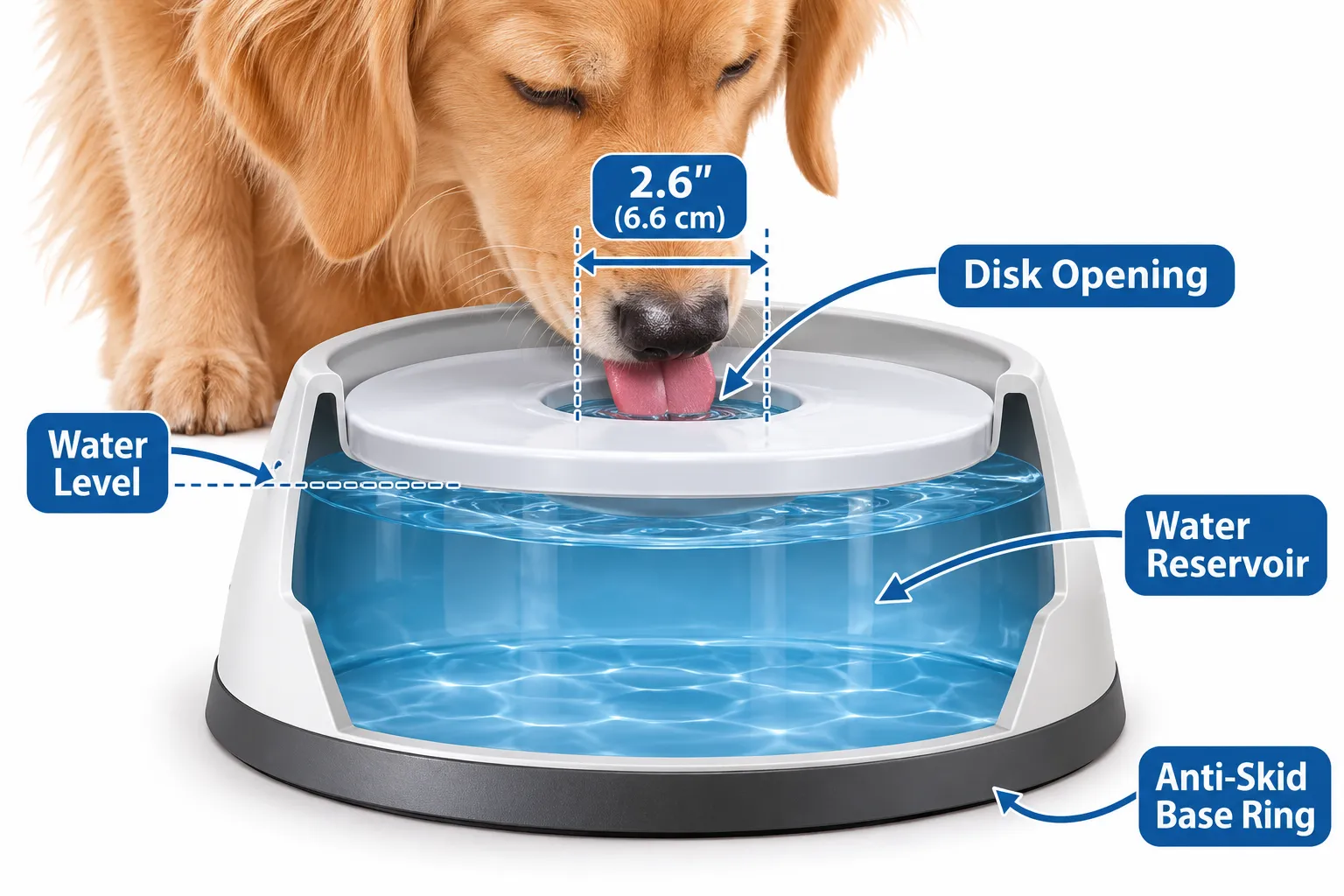
Your dog pushes its muzzle through the disk’s center opening or around its slotted edges to reach the water pooled underneath. That mechanism solves the puddle problem on your floor, but it does not automatically solve the drinking problem for every dog. A disk built with a narrow center opening, sized for a small or medium muzzle, can genuinely block a dog with a wide snout or long jowls from getting enough surface area to drink comfortably.
Some designs, like the Road Refresher bowl, use a slightly different mechanism: a raised internal reservoir plate that keeps most of the water below splash height even while the dog drinks from an open top, rather than a disk that the dog pushes through Road Refresher. Slopper Stopper uses a similar reservoir-style approach aimed specifically at dogs with loose jowls that normally drag water everywhere Slopper Stopper.
Decision rule: choose a true floating-disk bowl if your dog has a tight, narrow muzzle and drinks fairly cleanly already. Choose a reservoir-style bowl (Road Refresher or Slopper Stopper type) if your dog has loose jowls that drip water well beyond the bowl’s edge, since a disk opening will not stop drip-based mess the way a reservoir plate does.
Doggy Rank IQ Tool
No Spill Dog Water Bowl Muzzle Fit Checker

Wide muzzles and big drinkers struggle with narrow openings. Check fit and refills before buying.
Are no spill dog water bowls worth it
Yes, for most households with hard flooring, a no spill dog water bowl is worth the 20 to 60 dollar price difference over a plain stainless bowl, provided the disk opening actually matches your dog’s muzzle. The value comes from less mopping and fewer slip hazards near the bowl, not from eliminating all water mess on the floor.
A no spill dog water bowl will not stop water that clings to a dog’s muzzle fur and drips off after drinking. It also will not stop a determined dog from flipping the whole bowl if the base isn’t weighted or rubber-gripped. What it reliably stops is the open-surface sloshing that happens when a dog drinks fast, paws at the water, or walks past the bowl and bumps it.
Common mistake: buying based on bowl capacity alone. A 101-ounce bowl sounds generous, but if the disk opening is sized for a 20-pound dog, a 70-pound dog will either struggle to drink or will pry the disk out within a week. Match opening width to muzzle width first, capacity second.
Best no spill water bowls for dogs
The best no spill dog water bowl for most owners is the one with a lift-out disk in stainless steel, sized correctly for the dog’s muzzle, with a rubber or weighted base. Below are five models that currently meet that bar at different price points and capacities.
1. 3L/101oz Dog Water Bowl Stainless Steel Slow Water Bowl. A wide-opening disk design meant for medium to large dogs, priced around 25 to 35 dollars, with a disk that lifts straight out for washing.
2. 3L No Spill Dog Water Bowl with Slow Drinking Disk (Gray). A mid-size opening suited to small and medium dogs, priced around 20 to 30 dollars, with a lift-out disk that needs no tools.
3. Heouvo 1 Gallon No Spill Dog Water Bowl with Slow Drink Floating Disk (Gray). Separates by hand into base, disk, and anti-skid ring, priced around 25 to 40 dollars, good for multi-dog homes that need more capacity without a built-in filter.
4. Feedoo Double-Wall 18/8 No Spill. Comes in 2 liter or 3.8 liter sizes, priced around 30 to 37 dollars, with a manufacturer claim of up to 90 percent splash reduction.
5. AEUSDOG 3.17 Gallon Stainless with Dual Filtration. Priced around 45 to 60 dollars, built for large dogs or multi-dog households, with a float basket that needs rinsing twice weekly and a filter swap every 2 to 3 weeks.
For owners comparing beyond disks entirely, The Spruce Pets’ 2026 bowl roundup also tests elevated and slow-feed designs that pair well with spill control for dogs that eat and drink too fast The Spruce Pets.
No spill vs regular dog water bowl
A regular open bowl lets a dog drink from the full surface with zero restriction, but every splash, paw-dip, or bump sends water onto the floor. A this no spill water bowl trades a small amount of drinking ease for a large reduction in floor mess, which matters most on hardwood, tile, or carpet near the bowl.
Regular bowls are also cheaper (often 5 to 15 dollars for a basic stainless bowl) and need zero disassembly for cleaning: wipe and rinse, done. No spill designs add a part (the disk) that must be removed, scrubbed, and reseated correctly, and that part can wear out, crack, or get chewed.
Choose a regular bowl if: your dog drinks calmly, your floor is tile or a space where mopping isn’t a hassle, or your dog is a puppy still learning normal eating and drinking behavior.
Choose a this no spill water bowl if: you have carpet or hardwood near the water station, multiple dogs that play near the bowl, or a dog that paws or splashes while drinking.
Why does my dog’s water bowl keep leaking
A water bowl that leaks or drips usually has one of three causes: the base seal has degraded, the bowl is overfilled past the disk’s rated water line, or the surface underneath isn’t level. None of these are fixed by switching disk styles; they’re fixed by checking fit and placement first.
Overfilling is the most common issue. Most disk bowls have a maximum fill line printed or molded near the top edge. Filling past that line pushes water up around the disk’s edge seam even on a well-designed unit, since the disk is rated to float within a specific range, not to seal against unlimited pressure from above.
An uneven floor is the second most common cause. A bowl that rocks even slightly on an uneven tile or vinyl seam will pump small amounts of water out through the disk seal with every rock. A rubber mat under the bowl solves both the rocking and the resulting leak in most cases.
Edge case: some molded plastic bowls develop micro-cracks at the seam between the base and the rim after repeated dishwasher cycles. If a bowl that used to hold water dry now beads consistently along one edge, check that seam for hairline cracks before assuming the disk itself has failed.
Dog won’t drink from no spill bowl
If your dog refuses to drink from a this no spill water bowl, the opening is very likely too narrow or too stiff for comfortable use, not that the dog dislikes the concept. Dogs generally adapt to a disk within a day or two if the opening fits; refusal lasting longer than that is a fit problem.

Try these steps in order:
- Measure your dog’s muzzle width at the widest point (just below the eyes) and compare it against the disk opening. A mismatch of even half an inch can be enough to put off a nervous drinker.
- Fill the bowl slightly higher than minimum so more water sits visibly near the disk’s surface, since some dogs hesitate when they can’t see water right away.
- Leave a regular open bowl next to the disk bowl for three to five days so the dog can choose, then slowly phase out the open bowl once the dog is using the disk comfortably.
- Check for a chemical smell from new plastic. Wash a brand-new bowl with soap and water before first use; some dogs refuse bowls that still carry a manufacturing smell.
Common mistake: assuming the dog “doesn’t like” spill-proof bowls in general after one bad experience with a too-narrow disk. Trying a second model with a wider or slotted opening, like the large-opening stainless models aimed at medium and large dogs, often resolves it completely.
Cheapest no spill dog water bowl
The cheapest genuinely functional this no spill water bowl currently runs around 20 dollars, typically a 1 to 3 liter stainless or plastic model with a basic lift-out disk and no filtration. Prices below that range tend to use molded, non-removable disks that are much harder to clean properly.
Based on current Amazon and Chewy listings, budget options in the 20 to 30 dollar range include the 3L This no spill water bowl with Slow Drinking Disk and similar stainless models from UPSKY and Casfuy, both of which show up in Chewy’s slow-feed water bowl category Chewy and Chewy. These are reasonable starting points for a single small or medium dog with no special filtration needs.
Decision rule: if you’re testing whether your dog will even accept a disk bowl, start with the cheapest reputable stainless option rather than a premium filtered model. There’s no point paying 50 dollars for filtration before confirming your dog will drink from a disk at all.
No spill bowl or water fountain which is better
A this no spill water bowl is better for simplicity, low cost, and zero electricity; a water fountain is better for encouraging dogs who drink too little, since moving water tends to attract more interest from cats and some dogs. Choose based on what problem you’re actually solving.
Fountains filter and circulate water continuously, which helps with taste and freshness but adds a pump that needs regular cleaning and occasional replacement, plus an outlet nearby. A this no spill water bowl has no moving parts beyond the disk itself, nothing to plug in, and nothing to replace except the disk or base ring if damaged.
Choose a no spill bowl if: your main problem is floor mess from splashing or tipping, and your dog already drinks a normal amount of water daily.
Choose a fountain if: your main problem is a dog that drinks too little, especially cats in a mixed household, since movement and aeration genuinely increase interest in drinking for many pets.
Do puppies need no spill water bowls
Puppies don’t strictly need a this no spill water bowl, but a shallow, properly sized one can help reduce mess during the clumsy stage when puppies step in bowls, chew on bowl edges, and splash more than adult dogs. Skip anything with a narrow or stiff disk until the puppy is past the teething and exploring phase.
A puppy’s muzzle changes shape and size quickly during the first year, so a disk opening that fits at 10 weeks may be far too small by 6 months. For growing puppies, a wide, shallow, open bowl is often more practical than committing to a disk model, then switching to a properly fitted this no spill water bowl once muzzle growth has mostly leveled off, usually around 8 to 10 months for most breeds. For training basics that go alongside this stage, see the guide on essential commands every puppy should learn.
Edge case: teething puppies often chew disk edges out of curiosity, which can crack cheaper plastic units within weeks. If your puppy chews everything in reach, stainless steel disk models hold up far better than plastic ones during this phase.
How to clean a no spill dog water bowl
Clean a this no spill water bowl daily with warm soapy water, lifting the disk out fully rather than rinsing around it, since biofilm builds up on the underside of the disk and the base seam where water sits stagnant. The American Kennel Club’s guidance on bowl washing recommends daily cleaning for all bowl types, disk or not AKC.
Steps for a thorough clean:
- Remove the disk and any anti-skid ring completely from the base.
- Wash each piece separately with dish soap and warm water, using a bottle brush or sponge to reach the underside of the disk where algae and biofilm collect fastest.
- Rinse thoroughly to remove all soap residue, since leftover soap can upset some dogs’ stomachs.
- Check the disk’s dishwasher-safe status separately from the bowl base; not every disk is top-rack safe even when the base is.
- Reassemble and refill with fresh water, checking the fill line before adding water.
Models with filtration, like the AEUSDOG 3.17 gallon unit, add a separate task: rinse the float basket twice weekly and replace the carbon filter every 2 to 3 weeks regardless of how clean the water looks. Skipping filter changes defeats the purpose of paying for filtration in the first place.
Common mistake: assuming a weekly rinse is enough because the water “looks clean.” Biofilm forms a slick film that isn’t always visible but shows up as a slightly slippery feel on the disk underside; that’s the sign a bowl has gone too long between washes.
No spill water bowl for large dogs
Large dogs need a this no spill water bowl with a disk opening of at least 3 to 4 inches, or a slotted-edge design instead of a single center hole, since narrow openings restrict airflow and surface access for wide muzzles. Capacity should run at least 3 liters to avoid refilling multiple times a day.

The 3L/101oz Dog Water Bowl Stainless Steel Slow Water Bowl and the AEUSDOG 3.17 gallon model both target this size range, with wider openings and sturdier bases that resist tipping from a 60 to 100 pound dog leaning into the bowl. A looser-fitting disk is actually the better choice for large dogs even though it controls splashing slightly less than a tight seal, because a disk a large dog can’t comfortably use ends up pried out and discarded within days anyway.
Decision rule: if your dog weighs more than 50 pounds or has a long snout (Collies, Dobermans, Greyhounds), prioritize opening width and base weight over splash-reduction percentage claims. A bowl that controls 90 percent of splash but that your dog refuses to drink from controls 0 percent of anything.
Portable no spill dog water bowl for travel
A portable this no spill water bowl for travel should be collapsible or low-profile, hold at least 12 to 16 ounces, and seal tightly enough to survive being tossed in a car seat pocket or backpack without leaking. The Road Refresher and Spruce Pets’ travel bowl testing both cover this category specifically, since travel bowls face different stress (motion, tilting, car rides) than stationary home bowls The Spruce Pets.
Look for:
- A screw-top or snap-seal lid rated for zero leakage when tipped sideways, not just upright.
- Silicone or collapsible fabric construction for pack weight, versus rigid stainless for durability on rougher trips.
- A built-in loop or clip if the bowl needs to attach to a leash, harness, or bag during hikes.
Edge case: a disk-style travel bowl that works fine at home can fail in a moving car because road vibration constantly pushes water past the disk edge, something a stationary floor bowl never experiences. For car travel specifically, a sealed no-spill travel bottle-bowl combo tends to outperform a disk design.
Most durable no spill dog water bowl
The most durable this no spill water bowl construction is 18/8 or 304-grade stainless steel for both the base and the disk, since stainless resists dents, scratches, and the bacterial buildup that forms in scratched plastic over time. Humane organizations and veterinary sources consistently recommend stainless and glass over plastic for exactly this reason.
Double-wall stainless designs, like the Feedoo model, add an insulation layer that also resists dents from being knocked around on hard floors. Anti-skid rubber bases extend durability indirectly by preventing the bowl from sliding into walls, furniture, or door frames repeatedly.
Common mistake: choosing a bowl based on disk material alone while ignoring the base. A stainless disk sitting in a thin plastic base will still crack at the base seam eventually, especially in households with multiple large dogs bumping the bowl daily.
No spill water bowl for multiple dogs
For multiple dogs, choose a this no spill water bowl with at least 1 gallon of capacity per 2 dogs and a wide base footprint that resists tipping when more than one dog noses it at once. Smaller 1 to 2 liter bowls designed for single dogs empty too fast and need refilling multiple times a day in multi-dog homes.
The Heouvo 1 Gallon model and the AEUSDOG 3.17 gallon model both work well here, with the AEUSDOG unit better suited to 3 or more dogs or a mixed household of large and small breeds, since its opening accommodates a wider range of muzzle sizes than most single-dog bowls.
Decision rule: if dogs in the household compete for water access (common with food-motivated or resource-guarding dogs), use two separate stations rather than one large bowl, even if total capacity is the same. A single large this no spill water bowl doesn’t resolve guarding behavior around water, and may make it worse.
Disk Fit and Cleanup
The honest answer most listings avoid: a disk that fits your dog’s muzzle still has to come apart for washing, and some do not come apart easily at all. Several budget models mold the disk and base as a near-permanent unit, which means reaching a sponge into a narrow gap instead of lifting out a flat piece and scrubbing it properly.
The 3L This no spill water bowl with Slow Drinking Disk (Gray) uses a lift-out disk design, which matters more than its capacity number. A disk that pulls straight up means the underside, where biofilm actually collects, gets scrubbed rather than swirled with water and hoped clean. The AKC’s bowl-washing guidance is blunt about this: wash water bowls daily with soap and water, and a disk that resists disassembly turns that daily habit into a chore most owners eventually skip AKC.
Here’s where fit and cleanup collide. A disk that fits snugly enough to seal against splashing often has a tighter edge seam, and tighter seams trap more residue. A looser-fitting disk, the kind that lets a bigger dog drink comfortably, usually lifts out with less resistance because it was never designed to seal tightly in the first place. Owners buying for a large or giant breed should lean toward the looser, easier-to-remove disk even if it controls splashing slightly less. The alternative, a snug disk a dog struggles to drink from, usually ends with the dog removing the disk itself and leaving it on the kitchen floor.
Dishwasher compatibility is the other half of cleanup. Not every disk is top-rack safe even when the bowl base is. Check the specific listing for the disk, not just the bowl, before assuming the whole unit goes in together.
Top 5 Features That Decide the Purchase
1. Disk opening width relative to muzzle size. This decides whether a dog can actually drink, and it’s the feature most buyers skip checking before ordering a this no spill water bowl. A bowl with great reviews from small-dog owners can be a poor fit for a Labrador.

2. Disassembly without tools. The Heouvo 1 Gallon This no spill water bowl with Slow Drink Floating Disk (Gray) separates into a base, disk, and anti-skid ring by hand, no screwdriver or twist-lock mechanism required. That matters every single wash, not just the first one.
3. Material: stainless steel versus plastic. Veterinary and welfare sources consistently favor stainless steel and glass over plastic, since plastic scratches and holds bacteria in those scratches over time. Nearly every model worth considering in this category now ships in stainless steel.
4. Base stability on hard floors. A this no spill water bowl that slides across tile every time a dog noses it defeats its own purpose. Rubber rims and weighted bases matter as much as the disk itself.
5. Filtration, if included. Newer 2026 listings, like the AEUSDOG 3.17-gallon model, bundle activated carbon or ion-exchange filtration alongside the floating disk. That’s a genuine water-quality upgrade, but it’s also a recurring cost and one more part to clean or replace on schedule.
Opening Width, Disk Removal and Usable Capacity
The table below compares opening width, price band, and disk removal method across five current this no spill water bowl options, since those three factors decide practical day-to-day usability more than any single spec on its own.
| Model | Price Band | Capacity | Disk Removal |
|---|---|---|---|
| 3L/101oz Dog Water Bowl Stainless Steel Slow Water Bowl | around $25 to $35 | 101 oz / wide-opening disk | Lift-out, no tools |
| 3L This no spill water bowl with Slow Drinking Disk (Gray) | around $20 to $30 | 3 liters / medium opening | Lift-out, no tools |
| Heouvo 1 Gallon This no spill water bowl with Slow Drink Floating Disk (Gray) | around $25 to $40 | 1 gallon / anti-skid ring | Hand-separable base, disk, ring |
| Feedoo Double-Wall 18/8 No Spill | around $30 to $37 | 2L or 3.8L / claims 90% splash reduction | Integrated disk, simple lift |
| AEUSDOG 3.17 Gal Stainless with Dual Filtration | around $45 to $60 | 3.17 gallons / large-dog opening | Float basket rinsed twice weekly, filter swap every 2 to 3 weeks |
Which Pick Fits Which Dog and Owner?
If you own a small or medium dog and want the simplest daily routine, the 3L This no spill water bowl with Slow Drinking Disk (Gray) is the budget pick. It’s priced in the 20 to 30 dollar band, the disk lifts out by hand, and its opening suits muzzles up to roughly medium width without forcing the dog to work for water.
If you own a large breed, or a dog with a longer snout that struggles against narrower disks, the 3L/101oz Dog Water Bowl Stainless Steel Slow Water Bowl gives more surface area and an opening built for bigger muzzles while still controlling splash better than an open bowl.
If your household runs multiple dogs or a single big drinker and you don’t want to refill constantly, the Heouvo 1 Gallon This no spill water bowl with Slow Drink Floating Disk (Gray) balances capacity with a base, disk, and ring that separate by hand for actual daily washing, which matters more than most buyers expect until week two.
Owners setting up a full feeding and water station alongside a slow feeder for food should keep the two separate by design. This guide covers water spill control specifically; see the guide on bloat symptoms in dogs if eating pace or bloat risk is the actual concern rather than drinking mess. For broader feeding setup decisions, the beginner’s guide to choosing food is a useful companion read.
Check current availability for the best-fit model before assuming capacity alone settles the decision.
Things to Watch Out For
A this no spill water bowl does not mean a spill-proof floor. Even the tightest disk design allows some water to cling to fur and drip off a dog’s muzzle after drinking. A bowl mat underneath remains worth using regardless of which disk you buy.
Replacement parts are a real cost people forget to budget. A cracked disk or a torn rubber base ring usually isn’t sold separately, so a 25 dollar bowl with a damaged disk becomes a 25 dollar bowl thrown out. Check whether the manufacturer sells spare disks before committing to a model for the long term.
Filtration add-ons create their own maintenance schedule. The AEUSDOG model’s 2-to-3-week filter replacement window is a recurring cost and task that a simple disk-only bowl doesn’t have. Decide whether filtered water or just spill control is the actual goal before paying for both.
No current regulatory standard specifically governs no-spill bowl design, so splash-reduction percentages, like Feedoo’s stated 90 percent figure, come from the manufacturer’s own listing, not an independent test. Treat those numbers as a general indicator, not a guarantee for your particular floor and dog.
Who Should Skip This
Dogs who already drink calmly from an open bowl, without splashing, pawing, or spilling, don’t need to switch to a this no spill water bowl at all. The upgrade solves a specific problem (mess from drinking behavior), and if that problem doesn’t exist in your household, a plain stainless bowl remains the simpler, cheaper, easier-to-clean choice.
Households with very young puppies still growing into their adult muzzle size should also hold off, since a disk fitted today may be the wrong size in a few months. Dogs recovering from dental surgery or jaw injuries may find any disk uncomfortable against a sensitive mouth; a vet should weigh in before introducing a restrictive opening during recovery. And multi-pet homes where a cat also shares the water station should check that the disk opening isn’t so narrow it blocks the cat entirely, since most disk bowls are sized around dog muzzles, not feline ones.
For general grooming and care routines that pair with a clean water station, the beginner’s guide to dog grooming covers related hygiene habits worth building alongside bowl maintenance.
FAQ
Does a this no spill water bowl actually stop all spills? No. It reduces splashing and sloshing significantly but doesn’t stop water that drips off a dog’s wet muzzle after drinking. A mat under the bowl handles that remaining mess.
How often should I wash a this no spill water bowl? Daily, according to AKC guidance on bowl hygiene, with the disk fully removed and scrubbed rather than just rinsed in place.
What size disk opening does my dog need? Measure your dog’s muzzle width at its widest point. Small dogs typically need a 1.5 to 2 inch opening, medium dogs 2 to 3 inches, and large or long-snouted dogs 3 to 4 inches or a slotted design instead of a single hole.
Can I put the disk in the dishwasher? Sometimes, but not always, even when the bowl base is dishwasher safe. Check the specific product listing for the disk’s care instructions before assuming the whole unit can go in together.
Why is my dog avoiding the disk bowl? The most common reason is an opening too narrow for the dog’s muzzle. Measure and compare against the disk dimensions, and consider leaving an open bowl alongside it for a few days during the transition.
Are stainless steel no spill bowls really better than plastic? Yes, for hygiene and durability. Stainless resists scratches that trap bacteria, and it doesn’t degrade from repeated dishwasher cycles the way some plastics do over time.
Do no spill water bowls work for cats too? Some do, especially smaller-capacity models, but check the opening width carefully since most are designed around dog muzzle sizes and may be too narrow or too wide for a cat’s comfort.
Is a filtered no spill bowl worth the extra cost? Only if you specifically want improved water taste or quality on top of spill control. Filtration adds a recurring cost (filter changes every 2 to 3 weeks) and an extra cleaning step that a basic disk bowl doesn’t require.
What’s the cheapest this no spill water bowl that still works well? Models in the 20 to 30 dollar range with a stainless lift-out disk, such as the 3L This no spill water bowl with Slow Drinking Disk, offer solid function without the cost of filtration or double-wall insulation.
Can a this no spill water bowl be used for travel? Standard disk models generally aren’t built for travel since road vibration can push water past the disk seal. A dedicated sealed travel bowl handles car trips and hikes better than a stationary disk design.