
This post contains affiliate links. If you buy through one we may earn a commission at no extra cost to you. As an Amazon Associate I earn from qualifying purchases.
Quick Answer
The best dog blow dryer has stepless, continuously adjustable airflow rather than two or three fixed speeds, a heat option you can turn off entirely, a hose long enough to reach from the floor outlet to the tub rim, and a noise level your specific dog can tolerate at the lowest setting. Horsepower matters less than how finely you can control speed and heat once the machine is actually running in your bathroom. For most home groomers, that means a mid-priced high-velocity model in the $75 to $200 range rather than the most powerful unit on the shelf.
Key Takeaways
- The SHELANDY 1902 offers stepless airflow from 65 to 135 mph with two temperature settings and automatic overheat cut-off.
- Chewy’s November 5, 2026 pricing showed the SHELANDY at $75.99, the Flying Pig High Velocity at $187, and the MetroVac Air Force Commander at $289.99, according to Chewy’s dog dryer listings.
- The American Kennel Club notes that airflow, not heat, does most of the actual drying work on a dog’s coat.
- The K-9 Fluffer runs no heating element at all, capping air temperature near 95°F for heat-sensitive dogs.
- High-velocity force dryers can cut drying time significantly compared with towel-and-air drying by physically blowing water off the coat instead of waiting on evaporation, per BestReviews testing notes.
- The MetroVac Air Force Commander is built with an all-steel housing, a 4.0 peak-HP motor, and a 12-foot cord for reach in larger bathrooms.
- A human hair dryer and a dedicated dog dryer are not interchangeable tools because the difference is airflow volume, not just heat, as explained by The Spruce Pets.
- Not every dog needs the best dog blow dryer on the market; short-coated breeds bathed occasionally in warm climates can often get by with a towel.
What Is the Best Dog Blow Dryer
The best dog blow dryer for most home groomers is a high-velocity model with stepless speed control, a selectable or optional heat setting, and a hose that reaches your tub without forcing you into an awkward crouch for twenty minutes. It is not necessarily the dryer with the highest horsepower number printed on the box.

Three things separate a good purchase from a regretted one: airflow that can be dialed down low enough for a dog’s face and ears, heat that can be switched off entirely for puppies or skin-sensitive breeds, and a hose and cord combination that actually fits your bathroom. A $300 dryer with a short hose in a tiny half-bath is a worse purchase than a $75 model with a long hose and good control range. Measure your bathroom and your tub before you check the spec sheet.
A quick example: an apartment owner with a 30-pound mixed breed and a cramped half-bath will usually get more real-world use from a compact stepless dryer with a 6-foot hose than from a 4.0 peak-HP steel unit that barely fits on the counter. The best dog blow dryer for that household is the one that actually gets used every bath, not the one with the biggest number on the box. If you are still building out your grooming routine from scratch, a beginner’s guide to dog grooming is a reasonable starting point before you buy equipment.
Speed and Heat Controls: Why Do They Matter More Than Horsepower?
Speed and heat controls decide whether a dog tolerates the dryer at all, and whether the coat dries evenly instead of in patches. A dryer stuck at one blasting speed with no heat option gives you no way to adjust for a scared dog, a thin-coated breed, or a small bathroom that traps noise and makes everything sound louder than it is.
Stepless speed, meaning a dial rather than a 2-speed switch, lets you start slow near the face and ears, then ramp up over the body and undercoat, where most of the water actually lives. Separate heat controls matter for a different reason: heat speeds evaporation but also raises the risk of hot spots on skin that has already been scrubbed and rinsed clean of its natural oils.
- Low speed, no heat: good for the face, ears, paws, belly, and any dog meeting the dryer for the first time.
- High speed, no heat: the combination most groomers use for the bulk of the body on a healthy adult dog, since airflow does the real work.
- High speed, warm heat: useful for finishing a thick double coat fast in a cold room, but it should never run unattended against one spot.
Decision rule: choose a model with stepless or at least 4-step speed and a heat on/off switch, not a heat-only unit, if your dog has any skin sensitivity, anxiety around noise, or a thin coat. A common mistake is buying based on wattage alone and discovering after the first bath that there is no way to turn the heat off for a puppy’s first grooming session.
Doggy Rank IQ Tool
Dog Blow Dryer Fit Picker

Horsepower sells dryers. Noise, heat and hose reach are what decide whether you use it.
What’s the Difference Between a Dog Blow Dryer and a Regular Hair Dryer
A best dog blow dryer moves far more air at lower heat than a regular human hair dryer, which is built to concentrate heat for styling rather than to push water out of a dense undercoat. That difference in airflow volume, not just temperature, is why a human dryer struggles on a thick coat, according to The Spruce Pets and BestReviews.
Human hair dryers top out around 1,800 watts and rely on concentrated heat to dry small amounts of hair fast. Dog dryers, especially high-velocity models, use motor force, measured in CFM or mph, to physically blow water droplets off the skin and off each hair shaft before heat ever becomes necessary. A high-velocity dryer run at room temperature can out-dry a hot human dryer on a Labrador’s undercoat in a fraction of the time, because the water is being pushed off mechanically instead of evaporated with heat alone.
Edge case: a small single-coated dog like a Chihuahua or a Boston Terrier has so little undercoat that a human dryer on cool shot can sometimes get the job done in a pinch, but it will still take longer than a purpose-built unit and offers no automatic overheat protection.
How Hot Should a Dog Blow Dryer Get
A best dog blow dryer should not exceed warm, comfortable-to-the-hand temperatures, generally in the 85°F to 140°F range depending on model and setting, and many professional groomers prefer airflow with little or no added heat. The AKC notes that airflow does most of the drying, with heat acting as a secondary comfort factor rather than the main drying mechanism.
- PetNF’s handheld model lists temperature settings around 85°F and 140°F with automatic overheat protection.
- The K-9 Fluffer runs no heating element, with motor-warmed air capping near 95°F.
- The K-9 II Variable produces motor-warmed air around 126°F, intended for faster professional-level drying, not entry-level home use.
Common mistake: holding a heated nozzle in one spot for too long. Keep the nozzle moving, test the air temperature against your own wrist every few minutes, and drop to no-heat mode on ears, groin, and paw pads where skin is thinner and more reactive.
Best Dog Blow Dryer for Thick Coats
For thick double coats, the best dog blow dryer is a high-velocity, high-CFM model, since airflow volume rather than heat is what physically separates and dries dense undercoat fibers down to the skin. The Flying Pig High Velocity dryer, rated around 240 CFM with a steel shell and 10-foot hose, is built for exactly this kind of job.
Owners of Huskies, German Shepherds, Golden Retrievers, and other double-coated breeds consistently report that a high-velocity dryer also blows out loose undercoat during the drying process, which cuts down on future shedding on the floor. Chewy’s November 5, 2026 listing showed the Flying Pig priced at $187. For breed-specific coat and care context, America’s favorite dog breeds often fall into this double-coated category, which is worth knowing before you buy a dryer sized for a short-coated breed instead.
Decision rule: if your dog’s coat holds water against the skin for more than a few minutes after a towel pass, you likely have enough undercoat to justify a high-velocity purchase over a smaller handheld unit.
Best Quiet Dog Blow Dryer So It Doesn’t Scare Them
The best quiet best dog blow dryer for a sound-sensitive dog is a single-motor model with a stepless low setting and a sound rating under roughly 85 decibels at its lowest speed, since the startle response in most dogs comes from sudden loud bursts rather than steady background noise. Compact handheld units, like entry-level SHELANDY or PetNF models, tend to run quieter at their lowest setting than large dual-motor professional units.

- Start any new dryer at its lowest speed with the nozzle pointed away from the dog’s body.
- Avoid dual-motor professional units like the K-9 II Variable for a dog with known noise anxiety, since their higher CFM ceiling also means a louder low end.
- Run the dryer in an adjoining room first so the dog can hear it at a distance before it touches their coat.
Edge case: some dogs are more bothered by the vibration through the floor or tub than by the sound itself. If a dog reacts badly even to a quiet model, check whether the unit is resting on a hard surface that amplifies vibration, and try placing a rubber mat underneath.
High Velocity Dog Blow Dryer vs Regular Which Is Better
A high-velocity dog blow dryer is better for most dogs with any meaningful coat volume, because it dries through airflow force rather than heat, cutting total drying time and reducing the skin risk that comes with prolonged heat exposure. A regular lower-powered handheld dryer still has a place for small, thin-coated dogs or for spot-drying after a quick paw rinse.
- Choose high-velocity if: the dog weighs over 25 pounds, has a double coat, or gets bathed weekly or more often.
- Choose a regular handheld dryer if: the dog is under 15 pounds with a thin single coat and gets bathed only occasionally.
- Common mistake: buying a high-velocity dryer for a toy breed and running it at full power close to the skin, which can be uncomfortable and unnecessary for a coat that has little water retention to begin with.
How to Get Your Dog Used to a Blow Dryer
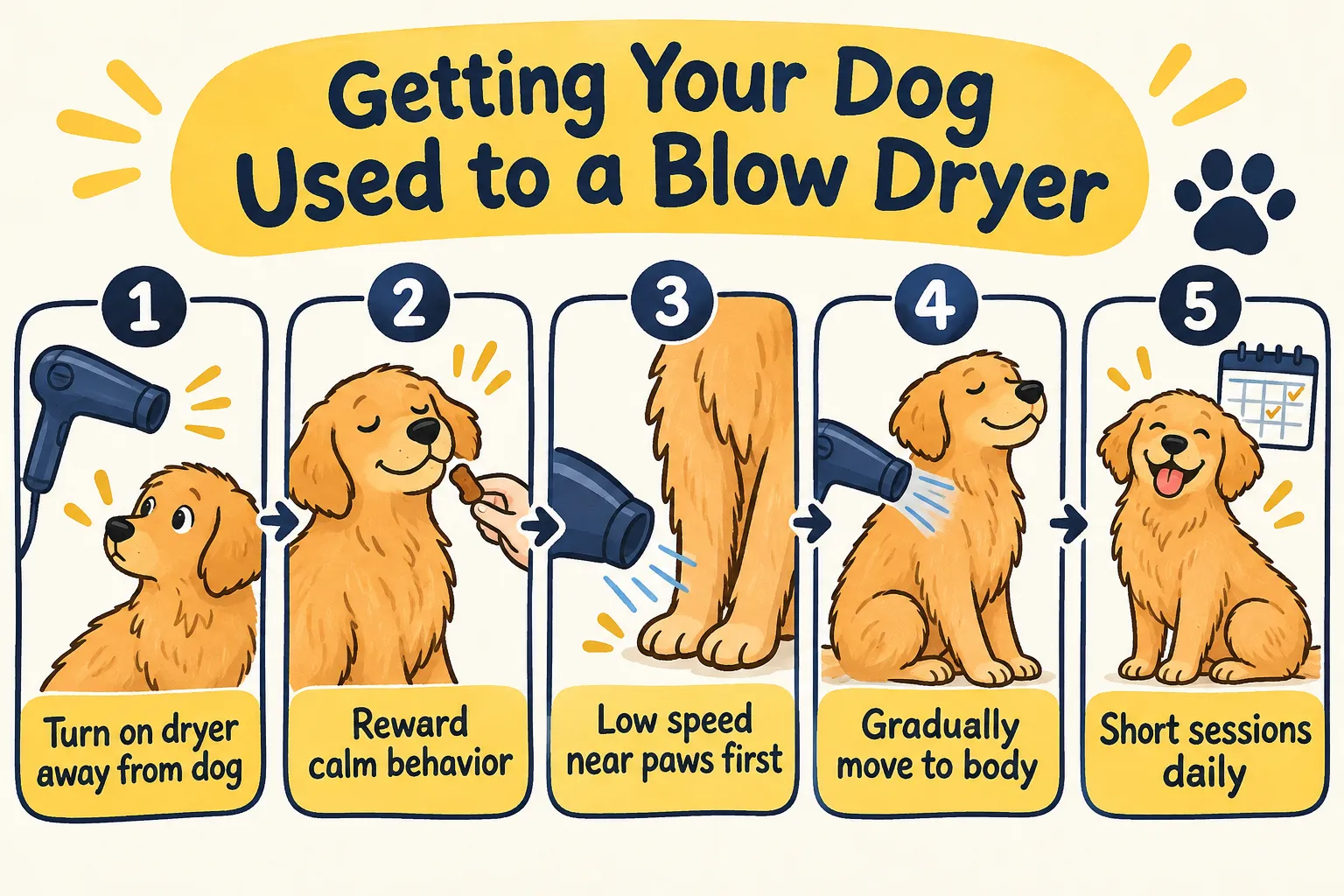
Getting a dog used to a blow dryer takes gradual, reward-based exposure over several sessions rather than a single bath-day introduction, and most dogs adjust within two to four grooming sessions if the process starts slow. Rushing the first exposure is the single most common reason dogs develop lasting fear of the dryer.
- Turn the dryer on in another room first so the dog hears it at a distance without any pressure to stay nearby.
- Let the dog sniff the unglued nozzle while it is off, then reward calm behavior with a treat.
- Turn it on at the lowest speed, pointed away from the dog, for just a few seconds at a time.
- Gradually move the airflow toward the paws and legs first, since these areas are generally less sensitive than the face.
- Build up to full-body drying over several short sessions rather than one long one.
- Always pair the dryer with something the dog already likes, such as treats or a favorite chew, so the sound becomes associated with something positive.
If you’re also working through basic obedience alongside grooming routines, reinforcing a solid “stay” command can make dryer sessions considerably easier; see 5 essential commands every puppy should learn for a starting framework.
Dog Blow Dryer vs Towel Drying Which Is Better
A dog blow dryer is better than towel drying for dogs with double or thick coats, because towels leave damp undercoat behind that can mat, trap moisture against skin, and dry unevenly, while a dryer can push water out from the base of the coat. Towel drying remains reasonable for small, thin-coated dogs bathed infrequently in warm climates.
- Blow dryer advantages: faster, more even drying, reduces matting risk, helps prevent moisture-related skin issues in humid climates.
- Towel drying advantages: free, no equipment needed, lower noise stress for extremely sound-sensitive dogs.
- Decision rule: if a dog’s coat still feels damp to the touch more than 30 minutes after a towel-only dry, a blow dryer is worth the investment.
Does Every Dog Breed Need Blow Drying
Not every dog breed needs blow drying, and the need depends more on coat type and bathing frequency than on breed alone. Double-coated and long-haired breeds generally benefit the most, while short, thin-coated breeds bathed occasionally often do fine with a towel and warm room air.
- Breeds that usually benefit: Huskies, Golden Retrievers, German Shepherds, Bernese Mountain Dogs, Poodles, and other curly or wool-coated breeds prone to matting if left damp.
- Breeds that often don’t need it: Chihuahuas, Boston Terriers, and other short single-coated small dogs bathed infrequently.
- Climate matters too: even a short-coated dog in a cold, damp region may benefit from faster drying to avoid sitting around wet and chilled.
Do You Really Need a Dog Blow Dryer or Is It Optional
A dog blow dryer is optional for many owners, but it becomes a practical necessity for anyone bathing a double-coated or thick-coated dog more than once or twice a month. A single-coated dog bathed occasionally in a warm climate may genuinely get by with a towel and air drying.
This is the honest answer most product pages skip: not every dog needs one. A short-haired Chihuahua bathed once a month in a warm apartment is in a very different situation than a Bernese Mountain Dog bathed weekly through a Minnesota winter, where damp undercoat sitting against skin for hours is a real discomfort and skin-health concern.
Dog Blow Dryer Brands Compared
SHELANDY, MetroVac, K-9 Dryers, Flying Pig, and PetNF each take a different approach to speed and heat, from budget stepless models to professional dual-motor units. The table below compares the best dog blow dryer options across price bands so you can match a model to your coat type and bathroom size rather than chasing the biggest horsepower number.
| Brand/Model | Approx. Price Band | Airflow | Heat Control |
|---|---|---|---|
| SHELANDY 1902 | $70-$80 | 65-135 mph stepless | 2 settings, overheat cut-off |
| MetroVac Air Force Commander | $280-$360 | 126 CFM, 4.0 peak HP | Variable, steel body |
| K-9 Fluffer | $380-$400 | Single-motor variable | No heating element (~95°F) |
| K-9 II Variable | $600-$650 | 20-218 CFM, dual motor | Motor-warmed air (~126°F) |
| Flying Pig High Velocity | $180-$190 | ~240 CFM | Multiple speeds, minimal heat |
| PetNF 3.2HP | $85-$95 | 25-65 m/s adjustable | 85°F / 140°F settings |
How Much Does a Good Dog Blow Dryer Cost
A capable dog blow dryer with real speed and heat control generally costs between $75 and $300, with entry-level plastic models under $100 and professional steel-body units running $280 and up. Specialty drying boxes and dual-motor units can exceed $500, according to pricing tracked on Chewy.
- Entry level ($40-$90): SHELANDY and PetNF-style models, single motor, decent stepless or multi-speed range, suitable for most home users with small to medium dogs.
- Mid-range ($150-$290): Flying Pig and MetroVac, steel or reinforced bodies, longer hoses, better noise control, suited to larger or double-coated dogs.
- Professional ($380-$650+): K-9 Dryers models and drying boxes built for daily grooming volume, generally overkill for an owner bathing one or two dogs at home.
Best Budget Dog Blow Dryer Under $50
Genuinely capable dedicated dog dryers under $50 are rare, and most options in that price range are repurposed human hair dryers rebranded for pets, which still lack the airflow volume a true force dryer provides. Shoppers on a strict $50 budget are usually better served by a basic plug-in handheld unit with at least two speeds and a cool-shot option, understanding that drying time on a double coat will be noticeably longer than with a $75 to $100 stepless model.
- If budget is the hard constraint, prioritize a cool-shot button over wattage.
- Expect drying sessions on a medium or large dog to take considerably longer than with a dedicated high-velocity unit.
- Consider this tier a bridge purchase rather than a long-term solution if your dog has a double coat.
How Long Does It Take to Blow Dry a Dog
Blow drying a dog typically takes 15 to 45 minutes with a high-velocity force dryer and 45 minutes to over an hour with a standard handheld or human-style dryer, depending on coat thickness, dog size, and the airflow volume of the unit. A small single-coated dog like a Beagle might dry in under 15 minutes on a high-velocity unit, while a large double-coated breed like a Bernese Mountain Dog can take 30 to 45 minutes even with a strong force dryer.
- Small, thin coat: roughly 10 to 20 minutes with a handheld or mid-velocity dryer.
- Medium, moderate coat: roughly 20 to 35 minutes with a stepless mid-range unit.
- Large, double coat: roughly 30 to 45 minutes with a high-velocity dryer, longer with a lower-powered handheld model.
Decision rule: if your current drying sessions regularly run past 45 minutes, your dryer’s CFM is probably the bottleneck, not your technique.
Dog Blow Dryer Alternatives What Can I Use Instead
Towel drying, air drying in a warm room, and professional grooming salon dryers are the main alternatives to buying a home dog dryer. Each trades speed for cost or convenience, and the right choice depends on how often the dog is bathed and how much the owner is willing to spend per visit.
- Towel drying: free, slow, leaves damp undercoat that can mat or trap moisture against skin.
- Air drying indoors: no equipment cost, but risky for double coats in humid climates since trapped moisture can contribute to skin issues.
- Professional grooming drying box or force dryer: fast and thorough, but a recurring cost per visit versus a one-time home purchase. For owners who groom at home regularly, a beginner’s guide to dog grooming covers how a dryer fits into a full at-home routine alongside brushing and bathing.
Decision rule: if a dog is bathed more than twice a month, a home dryer usually pays for itself within a few salon visits.
Common Mistakes When Blow Drying a Dog
The most common mistakes when blow drying a dog are running heat too close to one spot, starting at full speed instead of easing in, and skipping the brushing step that lets airflow actually reach the undercoat. Each of these mistakes increases drying time, discomfort, or both.
- Holding heat in one spot: keep the nozzle moving constantly, especially over ears, belly, and groin.
- Starting at full speed: a sudden blast of air can startle a dog and set back any progress made getting them comfortable with the dryer.
- Not brushing first: matted or tangled fur blocks airflow from reaching the skin, so brushing before and during drying is part of the process, not an optional extra.
- Drying too close to the skin: most force dryer nozzles should stay several inches away from the coat, not pressed directly against it.
- Ignoring the ears: water trapped in ear canals after a bath is a common cause of ear infections if not addressed separately from coat drying.
Can You Use a Human Hair Dryer on a Dog
A human hair dryer can be used occasionally on small dogs if it is kept on the coolest, lowest setting and held well away from the skin, but it is not a substitute for a dedicated dog dryer on a dense or double coat. The heat concentration in most human dryers is built for human hair diameter, not canine undercoat volume, according to The Spruce Pets.

If a human dryer is all you have, use the cool shot setting only, keep it moving constantly, and expect a drying session that takes far longer than a purpose-built pet dryer would. This is a reasonable stopgap for an owner with a small, thin-coated dog, but not a long-term plan for anyone with a double-coated or frequently bathed dog.
Fastest Dog Blow Dryer for Drying
The fastest drying typically comes from high-CFM, high-velocity force dryers rather than heated handheld units, because moving a large volume of air physically pushes water off the coat instead of waiting for evaporation. The Flying Pig High Velocity, rated around 240 CFM, is one of the faster consumer options on the market for this reason.
Decision rule: if speed is the top priority because you have a large dog, a frequent bathing schedule, or limited time, choose CFM over wattage. A 240 CFM dryer will usually outperform a 2,400-watt dryer with lower airflow, even though the wattage number looks more impressive on the box.
Dog Blow Dryer for Sensitive or Itchy Skin
For dogs with sensitive, itchy, or recently treated skin, the safest choice is a dryer with a true no-heat option and a low, adjustable speed setting rather than a fixed-heat handheld unit. The K-9 Fluffer’s lack of a heating element makes it a reasonable option here.
Heat can aggravate skin that is already irritated from allergies, hot spots, or recent medicated baths. Running cool, moderate airflow over these areas, and reserving any warmth for the healthy parts of the coat, reduces that risk without sacrificing drying speed.
Top 5 Features That Decide the Purchase
These five features, more than peak horsepower, determine whether a dog blow dryer purchase works out at home, and together they are what separate the best dog blow dryer options from ones that end up back in a closet after one bad bath.
- Stepless or multi-step speed control: the SHELANDY 1902’s 65-135 mph stepless range lets owners start low near sensitive areas.
- Separate heat on/off switch: the K-9 Fluffer’s heat-free design removes the overheating worry entirely for sensitive-skin dogs.
- Hose length and cord length: a 6 to 10 foot hose matters more in larger bathrooms, while compact units with shorter hoses work fine in small spaces.
- Noise level at the lowest setting: single-motor handheld units tend to run quieter than dual-motor professional models.
- Build quality and motor housing: steel-body units like the MetroVac Air Force Commander tend to hold up better under frequent use than lighter plastic models.
Things to Watch Out For
A few recurring issues show up across dog blow dryer reviews, and knowing them ahead of time avoids a return trip to the retailer.
- Hose connections on budget models can loosen over repeated use, so check the fitting before every session.
- Some stepless dials have a very narrow usable range at the low end, making it hard to find a truly gentle setting even when the spec sheet advertises a wide mph range.
- Overheat cut-off switches on cheaper units sometimes trip during normal use on thick coats, interrupting a session unexpectedly.
- Loud startup noise, even on otherwise quiet units, can undo weeks of desensitization training if the dog is standing right next to the dryer when it powers on.
Who Should Skip This Purchase
Owners of single-coated small breeds bathed only occasionally, people without a bathroom setup that can accommodate a hose and cord, and anyone whose dog has a severe, unmanageable fear of loud appliances may be better served skipping a home dryer purchase. In these cases, towel drying, air drying in a warm room, or an occasional professional groomer visit covers the need without the expense or the storage space a dryer requires.
Best Budget Pick
For most home owners who want real speed and heat control without professional pricing, the SHELANDY 1902 at roughly $75 represents the strongest value in the category: stepless airflow from 65 to 135 mph, two heat settings, and an automatic overheat cut-off, all for less than a third of what a steel-body professional unit costs.
FAQ
What is the best dog blow dryer for a nervous dog? The best dog blow dryer for a nervous dog is a single-motor, stepless model with a genuinely quiet low setting and a heat on/off switch, since gradual exposure at low speed works far better than a loud, fixed-speed unit.
Is a higher CFM always better? No. Higher CFM dries faster, but it is also usually louder and more intense against the skin. Match CFM to coat thickness and dog size rather than choosing the highest number available.
Can a dog blow dryer burn a dog’s skin? Yes, if heat is left on one spot too long or if a unit lacks overheat protection. Keeping the nozzle moving and testing air temperature against your own wrist reduces this risk substantially.
Do puppies need a different dryer than adult dogs? Puppies generally need a model with a true no-heat setting and a low, stepless speed, since their skin is thinner and their tolerance for noise and sensation is still developing.
How often should a dog be blow dried? This depends on bathing frequency rather than a fixed schedule. Dogs bathed weekly or more, especially double-coated breeds, benefit most from drying every time; dogs bathed monthly in a warm climate may not need it every bath.
Is it worth buying a professional-grade dog dryer for home use? Only for owners bathing dogs very frequently, such as multi-dog households or frequent show preparation. For occasional home grooming, a mid-range model in the $75 to $200 range usually covers the need.
What’s the difference between CFM and mph in dog dryer specs? CFM measures the volume of air moved per minute, while mph measures the speed of that air. A dryer with high mph but low CFM can feel powerful up close but may not move enough total air to dry a thick coat quickly.
Does a dog blow dryer help with shedding? High-velocity dryers can blow out loose undercoat during drying, which some owners find reduces loose hair around the house afterward, though this is a secondary benefit rather than the dryer’s main function.
Related Reading
For more on building out a full at-home grooming routine, see a beginner’s guide to dog grooming. If you’re working on obedience basics alongside bath time training, 5 essential commands every puppy should learn is a useful companion resource. Coat and breed-specific care often ties back to broader breed research, covered in America’s favorite dog breeds.