
Do dogs have a sense of time? Quick Answer
Dogs do not read clocks, but research shows they register duration in a physical, felt way. In a study of 12 pet dogs, owners saw noticeably more activity, attention, and tail wagging at the door after two and four hours alone compared with 30 minutes On the clock: Interval timing and overshadowing in domestic dogs. So do dogs have a sense of time? Yes, but it is built from routine, light, scent, and arousal rather than minutes and hours on a dial.
Key Takeaways
- A study of 12 privately owned dogs found reunion behavior changed with absence length: 30 minutes versus 2 hours versus 4 hours.
- Dog-initiated interaction after reunion rose from about 0.14 instances per 15 seconds at 30 minutes to 0.47 at 2 hours and 0.42 at 4 hours.
- Heart rate in the first minute after reunion averaged roughly 127.6 bpm after 2 hours, versus about 106.2 bpm after 30 minutes.
- VCA Animal Hospitals notes that dogs likely rely on scent strength and routine cues rather than true time awareness VCA Animal Hospitals.
- Most healthy adult dogs can generally manage up to about 4 hours alone, though the right limit depends on the individual dog.
- Anxious behavior in distressed dogs often appears early in an absence, which is different from ordinary time-apart behavior.
- The American Kennel Club reports that daylight saving time shifts can disrupt a dog’s feeding and walk schedule even though dogs are not consciously aware of the clock change AKC on daylight saving time.
- National Geographic covered research suggesting dogs react behaviorally to schedule shifts around daylight saving time, even without understanding why National Geographic.
When to call the vet: If a dog destroys doors or crates, injures itself trying to escape, urinates or defecates indoors despite being house-trained, or shows constant drooling, pacing, or panic before departures, this points toward separation-related distress rather than ordinary time-alone behavior. A veterinarian or veterinary behaviorist can rule out medical causes and build a treatment plan.
Doggy Rank IQ Tool
Time Apart Planner for Dogs

Enter your day. You get an evidence based read on what the wait likely feels like and a departure checklist.
Do dogs have a sense of time
Dogs have a sense of time, but not the kind built on a calendar or a clock face. The clearest evidence comes from a peer-reviewed study of 12 pet dogs with no known separation problems, left alone for 30 minutes, 2 hours, and 4 hours in randomized order Rehn and Keeling, PubMed. The dogs did not act dramatically different during the absences themselves. The difference showed up at the door.

After longer absences, dogs moved more, paid closer attention to their owners, wagged their tails more, and initiated more contact. Physical activity rose from a mean of 0.20 instances per 15 seconds after 30 minutes to 0.37 after 2 hours and 0.48 after 4 hours. Attentive behavior climbed from 0.21 to 0.52 and then 0.48 across the same conditions. None of this proves a dog can tell 3 hours apart from 3 hours and 40 minutes. It shows a dog’s body and behavior track something that scales with duration, which answers the question of whether dogs have a sense of time in a functional way: yes, through arousal, routine, and physiology, not arithmetic.
Petplan’s veterinary advice page makes a similar point, noting that dogs seem to notice longer absences through changes in mood and energy at reunion rather than any conscious tracking of hours Petplan on dogs and time.
Do dogs have a sense of time? How do dogs perceive time differently than humans
Dogs perceive time through smell, light, hunger, and routine rather than through numbers on a clock. A human checks a phone and says “I was gone three hours.” A dog has no equivalent mental tool for counting hours, but the body still registers that something changed.
The differences break down a few ways:
- Humans use symbolic time (clocks, calendars, appointments). Dogs use sensory and physiological time (scent strength, light angle, hunger, energy level).
- Humans can plan for a future date weeks away. Dogs respond mostly to cues that are close in time, like the sound of keys or a leash coming off a hook.
- Humans experience boredom tied to clock-watching. Dogs experience restlessness tied to arousal building up, which increases the longer a routine is interrupted.
A dog’s sense of time is less like a stopwatch and more like a slowly fading signal (scent, light, and household quiet) combined with a learned expectation of what usually happens next.
Do dogs have a sense of time? Can dogs tell how long you’ve been gone
Dogs appear to register whether an absence was short or long, based on measurable changes in behavior at reunion, though they almost certainly cannot count hours the way people do. The Rehn and Keeling study found dog-initiated interaction nearly tripled between the 30-minute and 2-hour conditions, which is a strong signal that something scales with duration PubMed study on interval timing in dogs.
Choose to trust this signal if your dog consistently greets you more intensely after a full workday than after a 20-minute grocery run. That pattern lines up with the research. A common mistake is reading a big greeting as guilt or anger about being left. The data points toward arousal and relief, not resentment.
Do dogs have a sense of time? Do dogs understand the passage of time
Dogs do not understand the passage of time the way humans consciously do, but their bodies and behavior respond to elapsed time through physiological and environmental signals. There is no evidence of a dog mentally narrating “two hours have gone by.” Instead, hunger builds, bladder pressure builds, scent in the home fades, and light shifts, and all of these combine into something that functions like time awareness without being a cognitive clock.
VCA Animal Hospitals frames this as dogs likely using a mix of internal cues (hunger, energy, body rhythm) and external cues (light, sound, scent) to approximate time passing, rather than any internal numeric tracking VCA Animal Hospitals on how dogs tell time.
Do dogs have a sense of time? Why does my dog act like I’ve been gone forever
A dog acting like an absence lasted far longer than it did is usually a mix of genuine duration tracking and ordinary social excitement, not proof the dog thinks in hours. The reunion study found dogs scaled physical activity and attention to the real length of the absence, so a bigger greeting after a workday than after a quick errand fits what the research shows.
Separate from that tracking effect, dogs are social animals that find reunions rewarding no matter how long the gap was. That adds enthusiasm on top of any time-tracking signal. A quick example: a dog that naps calmly through a 45-minute absence but spins, barks, and brings a toy to the door after 6 hours is likely showing both effects at once, mild duration awareness plus simple joy at a person coming home.
Do dogs have a sense of time? Can dogs tell the difference between 5 minutes and 5 hours?
Dogs can likely tell the difference between a short absence and a long one through behavioral and physiological change, but there is no evidence they track specific minute or hour counts. The 2011 study used 30-minute, 2-hour, and 4-hour conditions, not a fine-grained scale, so the research supports “longer versus shorter” rather than precise counting.
A dog’s read on 5 minutes versus 5 hours is closer to a felt difference in arousal and routine disruption than a mental stopwatch. In practice, most owners notice this difference too: a dog barely stirs for a 5-minute trip to the mailbox, but may pace, whine, or chew something during a 5-hour gap, especially without enrichment.
Do dogs have a sense of time? How long do dogs keep in mind things
Dogs can hold onto short-term memory for roughly a few minutes for simple tasks, but long-term associative memory, like recognizing a person, place, or routine, can last months or years. This matters for the time question because memory and time sense work together: a dog does not need to count hours if it strongly remembers that a certain sound (garage door, school bus) reliably means a person is near.
- Working memory (where a treat was just hidden): generally short, often measured in seconds to a couple of minutes in dog cognition research.
- Associative memory (a specific person’s scent, a specific command, a fear trigger): can persist for years, which is why dogs can recognize an owner after a long trip or react to a location tied to a past vet visit.
- Routine memory (meal timing, walk timing): builds over days and weeks of repetition and becomes a strong predictor of behavior.
This layered memory system is part of why dogs seem to “know” things about timing without ever having a human-style clock in their heads.
Do dogs have a sense of time? Do dogs have a sense of days and weeks
There is no strong evidence that dogs track days of the week or count calendar days, though dogs do seem sensitive to disruptions in weekly routines. A dog cannot distinguish “Tuesday” from “Saturday” by name, but many dogs notice when a weekday routine (early departure, quiet house) differs from a weekend pattern (more people home, later mornings).
This sensitivity comes from pattern recognition built over weeks, not a built-in weekly calendar. A dog that seems excited every Friday evening is far more likely responding to a specific recurring cue (a family member arriving, a particular dinner smell, a weekly walk) than to any awareness that a week has passed.
Do dogs have a sense of time? Can dogs tell what time of day it is
Dogs can often predict daily events like mealtime or walk time with good accuracy, but this comes from light cues and routine, not clock reading. Morning light differs from evening light, household noise differs by hour, and hunger builds on a fairly predictable cycle, and dogs use all three together.
The American Kennel Club notes that shifts like daylight saving time can throw off a dog’s usual feeding and walking schedule for a few days, since the dog’s routine cues suddenly do not match the clock anymore, even though the dog has no awareness of the clock change itself AKC on daylight saving and dogs. The Farmer’s Dog makes a similar point, noting dogs are unlikely to understand clocks or daylight-saving changes the way people do, and instead simply respond to whatever light and routine cues are present that day The Farmer’s Dog on daylight saving time.
Do dogs have a sense of time? How does routine affect a dog’s sense of time
Routine is the single biggest factor shaping how a dog appears to track time, since consistent daily patterns let a dog anticipate events without needing to count hours. A dog fed at roughly the same time each day will often show signs of anticipation (pacing near the food area, increased alertness) shortly before that time, purely from learned association.
- Dogs on a tight, consistent schedule tend to show more obvious anticipatory behavior (waiting by the door, perking up at certain sounds).
- Dogs on an irregular schedule often show less predictable anticipation, since there is no stable pattern to learn from.
- Multi-pet households sometimes develop shared routine cues, where one dog’s reaction to a sound cues the other dogs as well.
Choose consistent daily timing for feeding, walks, and departures if a goal is calmer alone-time behavior. Dogs that know roughly what to expect tend to settle faster than dogs facing unpredictable schedules.
Do dogs have a sense of time? Do dogs have an internal clock like humans do
Dogs do not have a clock-reading sense like humans, but they do have a circadian rhythm, the same biological clock mechanism found across mammals that governs sleep, hunger, and alertness cycles. This is a different system from consciously tracking hours.
A dog’s circadian rhythm, paired with environmental cues such as light and household routine, lets a dog anticipate events like mealtime or a walk without any concept of “6 p.m.” The Farmer’s Dog makes the same distinction, noting dogs are unlikely to read clocks or notice daylight-saving shifts the way people consciously do The Farmer’s Dog. This circadian system is biological and largely fixed, while routine learning on top of it is flexible and can shift over days to weeks when a schedule changes.
How does a dog’s internal clock work
A dog’s internal clock works through a combination of circadian biology and learned environmental associations, not through any awareness of numbers or hours. The biological piece runs on light exposure, melatonin cycles, and regular feeding, similar to the mechanism that governs human sleep and wake cycles. The learned piece comes from repeated pairing of specific cues (a certain sound, a certain light level, a certain scent) with specific outcomes (a walk, a meal, an owner’s return).
Together these two systems let a dog function smoothly within a day without ever consciously measuring time the way a person checking a smartwatch would. This is also why sudden schedule changes, like a new work shift or travel across time zones, can temporarily unsettle a dog until the two systems resync with the new pattern.
What’s the difference between dog time and human time
Human time is symbolic and precise (minutes, hours, dates), while dog time is sensory and relative (light level, scent strength, hunger, routine position). The core difference is that a person can look at a clock and know an exact number, while a dog can only estimate based on how things feel and what patterns have repeated before.
This distinction matters for everyday decisions. A person scheduling a workday thinks in exact hours. A dog experiences that same stretch as a gradual build in hunger, restlessness, and scent fading, with no exact number attached. Understanding this gap helps explain why two dogs left alone for the identical clock-measured time can behave differently: their “felt” duration depends on individual temperament, training, and what enrichment or distraction was available.
Why do dogs seem to know when I’m coming home
Dogs often appear to anticipate an owner’s return because they have learned to associate specific routine cues, not clock times, with that event. A dog does not know “5:30 p.m.” means an owner is due home. A dog does learn that certain sounds, smells, and light levels tend to precede a return, and reacts to those patterns.
This falls under routine conditioning, not a sense of clock time, which is the key distinction running through the entire question of whether dogs have a sense of time. Adopt a Pet’s coverage of this topic notes that owners often misread this anticipation as proof of clock awareness, when it is more accurately explained by consistent scheduling and strong scent or sound associations Adopt a Pet on how dogs tell time.
Do older dogs have a different sense of time than puppies
Older dogs and puppies can both show time-related behaviors, but for different reasons: puppies lack the bladder control and training to handle long gaps, while senior dogs may show slower routine adjustment or signs of cognitive change. A young puppy under 6 months typically needs a bathroom break every 1 to 3 hours and has not yet built strong routine associations, so anticipation behavior tends to be weaker and less consistent.

Senior dogs often have well-established routines built over years, so their anticipatory behavior can be very precise (waiting at a specific spot at a specific point in the day). However, cognitive decline in aging dogs can disrupt this, leading to confusion about routine or disrupted sleep-wake cycles, a topic covered in more depth in the dog dementia guide. Choose shorter, more frequent outings for both puppies and seniors rather than assuming either group can match an adult dog’s typical 4-hour comfort window.
Is my dog’s separation anxiety related to time perception
Separation anxiety is not primarily about a dog’s sense of time, it is a distress response triggered by being left at all, regardless of duration. A dog with true separation anxiety may show panic within minutes of a departure, not hours, which separates this condition from ordinary time-alone behavior.
Research on separation-related behavior, including a longitudinal study tracking dogs at six months of age, has identified early-life and owner-related risk factors that predict which dogs are more likely to struggle with being left alone, independent of how long the absence lasts Cambridge Core study on separation-related behavior. If a dog shows panic almost immediately after a door closes, the issue is very unlikely to be about tracking elapsed time and much more likely to be a distress response that needs behavioral treatment. The separation anxiety guide covers diagnosis and treatment steps in more depth.
Can you train a dog better by understanding their time sense
Yes, understanding how dogs experience time can directly improve training outcomes, especially for alone-time tolerance and basic obedience work. Since dogs respond to routine, repetition, and immediate consequences rather than clock-based planning, training sessions work best when rewards and corrections happen within a second or two of the behavior.
- Keep training sessions short and frequent rather than long and rare, since dogs do not benefit from “banking” learning across a big gap the way humans can study for an exam.
- Build alone-time tolerance gradually, starting with very short gaps (seconds, not minutes) and extending slowly, since dogs learn comfort with absence through repeated, low-stress exposure rather than willpower.
- Use consistent daily timing for key commands and routines, since dogs latch onto pattern repetition far more easily than onto verbal explanation.
This approach pairs well with foundational training resources like the guide to essential puppy commands, which rely on the same repetition-based learning style.
What changes when a dog is left alone for different amounts of time?
What changes most is not the dog’s behavior during the absence but the dog’s behavior at reunion. In the Rehn and Keeling study, physical activity, attentiveness, tail wagging, and owner-directed contact all increased step by step from 30 minutes to 2 hours to 4 hours. Heart rate followed a similar pattern, averaging around 127.6 bpm in the first minute after a 2-hour absence compared with about 106.2 bpm after 30 minutes, though the researchers described this as a trend rather than a firm result.
Lip licking and body shaking also increased after longer absences. Those behaviors can reflect stress or simple arousal, and reunion excitement alone does not separate the two. The honest summary, consistent with the broader question of whether dogs have a sense of time, is that something in the dog tracks elapsed time closely enough to produce a measurably bigger greeting after 4 hours than after 30 minutes, without resembling human clock reading in any way.
Which daily cues might help explain anticipation?
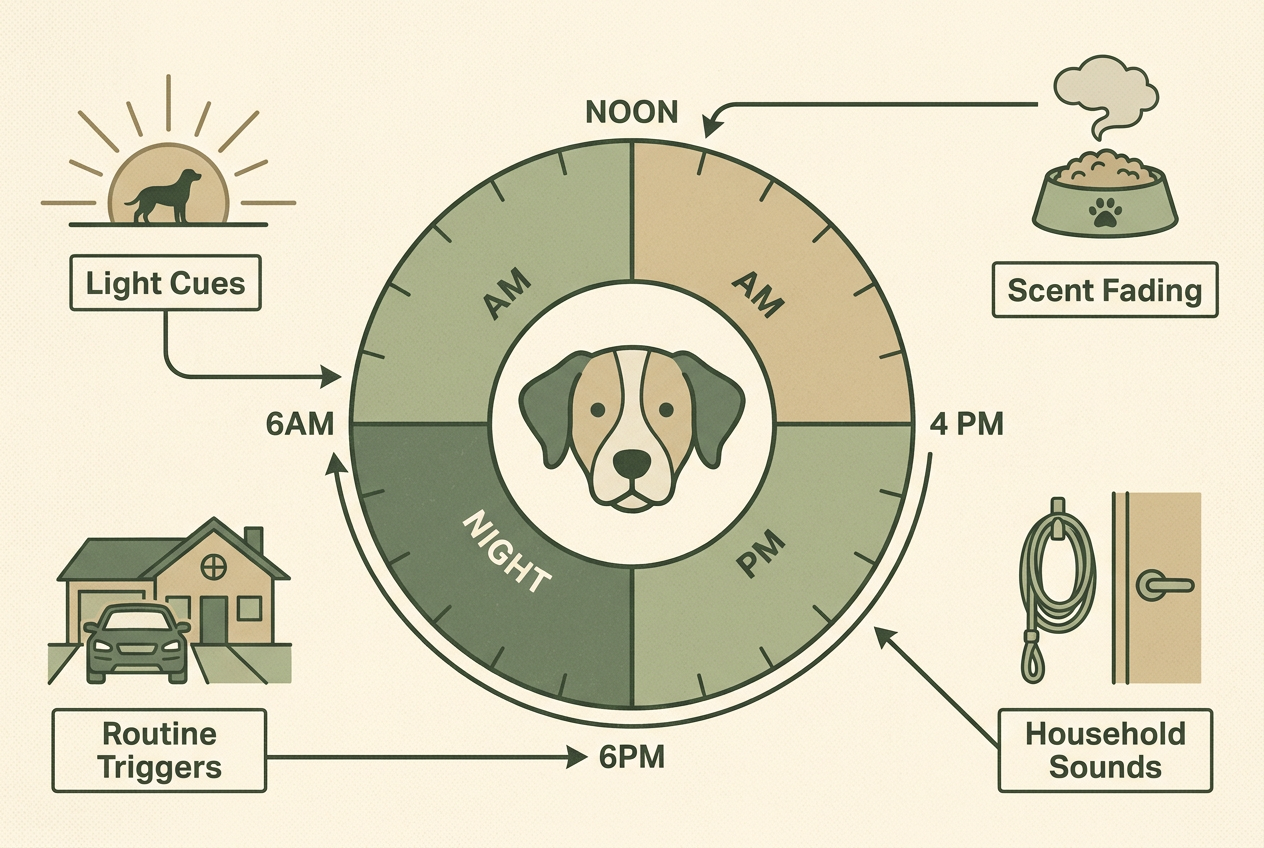
The cues most likely to explain a dog’s apparent anticipation are learned associations with routine, light, and scent, not time measurement. Dogs are strong pattern learners, and several daily signals repeat on a near-fixed schedule in most households.
- Light and shadow changes, which shift gradually and predictably across a day.
- Household sounds, like a neighbor’s car, a school bus, or a garage door at a consistent hour.
- Scent fading, a commonly discussed idea that an owner’s scent weakens over hours, giving a dog an indirect read on elapsed time.
- Routine triggers, such as a dog walker’s regular arrival time or a housemate coming home from school.
None of these require a dog to understand time the way a person checking a phone does. They require consistent repetition, which dogs are very good at learning.
Time-alone comparison: scenarios owners actually face
| Scenario | Typical duration | General guidance | Watch for |
|---|---|---|---|
| Quick errand | Under 1 hour | Low concern for most adult dogs | Nothing unusual expected |
| Standard workday | 6 to 9 hours | Above the roughly 4 hour comfort range commonly cited by veterinary sources | Midday walker or doggy daycare worth considering |
| Overnight trip without the dog | 12+ hours | Needs a sitter, boarding, or trusted caregiver, not a solo stretch | Food, water, bathroom access must be arranged |
| Gradual alone-time training | Seconds to minutes, increasing weekly | Start very short and lengthen slowly over weeks | Signs of panic mean slow the pace down |
For dogs who already show distress when left, the separation anxiety guide covers diagnosis and a step-by-step treatment plan in more depth than this article’s scope. If the concern is a senior dog’s changing behavior around routines, the dog dementia guide is also a useful next read.
How long can you safely leave a dog alone?
Most healthy adult dogs can generally handle up to about 4 hours alone, though the right number depends on the individual dog’s age, health, training, and bladder control. Puppies need far more frequent breaks, often every 1 to 3 hours depending on age, since they cannot hold their bladder as long as an adult dog. Senior dogs may also need shorter stretches due to joint stiffness, bathroom needs, or cognitive changes.
A dog with no history of distress and a comfortable setup (water, a safe chew, a familiar resting spot) typically handles a standard 8-hour workday acceptably, though a midday break is still a better welfare choice than a single long stretch. This is also where the earlier question of whether dogs have a sense of time becomes practical: a dog that seems fine after 4 hours but visibly distressed after 8 may simply be showing a felt difference in duration rather than any clock awareness, and that difference is worth planning around.
A good baseline checklist before leaving a dog alone for several hours:
- Exercise or play beforehand to reduce restlessness.
- Fresh water available at all times.
- A safe chew or puzzle toy left out for enrichment.
- Predictable background noise, like a radio or TV, to soften silence.
- A calm, low-key goodbye rather than a long, emotional one.
Frequently asked questions
Do dogs have a sense of time at all, or is it just instinct? Dogs have a sense of time in a practical, body-based sense, built from circadian rhythm, routine learning, and sensory cues like light and scent, rather than a conscious awareness of hours or minutes.
Can a dog tell if I’ve been gone 2 hours versus 4 hours? Research suggests dogs show measurably different reunion behavior after 2 hours compared with 4 hours, including more activity and owner-directed contact, though this reflects a general sense of “longer” rather than an exact hour count.
Why does my dog sleep through a short absence but get anxious during a long one? Shorter absences often fall within a dog’s comfort window and produce little reaction, while longer absences can allow restlessness, hunger, or boredom to build, which shows up as pacing, barking, or destructive behavior once a threshold is crossed.
Does a dog’s sense of time change with age? Yes. Puppies have weaker routine associations and more frequent physical needs, while senior dogs often have strong, well-established routines but may show disruption from cognitive decline.
Can training improve how well a dog handles being left alone? Yes. Gradual alone-time training, starting with very short absences and slowly lengthening them, is a widely recommended approach for building tolerance without triggering panic.
Is scent really part of how dogs judge time? Many veterinary sources discuss scent fading as a likely contributing cue, though it has not been proven as a precise time-measuring mechanism. It is best understood as one of several supporting cues alongside light and routine.
Do dogs get confused by daylight saving time changes? Dogs do not understand the concept of clocks changing, but their routine cues (feeding time, walk time) can be thrown off for a few days until the household resettles into a new pattern.
What is the biggest mistake owners make about their dog’s sense of time? Assuming a big greeting after a long absence means the dog “missed” the owner in a humanlike, hour-counting way, when the behavior is better explained by routine disruption, built-up arousal, and simple social reward at reunion.