
How to clean dog ears? Quick Answer
How to clean dog ears comes down to one rule: clean only when the ear needs it, not on a fixed weekly schedule, and stop immediately if you see pain, swelling, odor, or a head tilt. A healthy ear is pink, dry, and odor-free, and routine cleaning with a vet-approved solution is appropriate for maintenance, not for treating a problem that’s already there, according to PetMD and the American Kennel Club.
Key Takeaways
- A healthy dog ear is pink, odor-free, and comfortable to the touch, per AKC guidance.
- VCA Animal Hospitals notes some dogs may never need routine ear cleaning at all.
- The standard massage step takes about 30 seconds, according to VCA and AKC.
- Dogs treated for an active infection may need daily cleaning at first, dropping to every one to two weeks for maintenance, per Cornell University.
- Never let the applicator tip touch the ear canal. VCA warns this can contaminate the whole bottle with bacteria or yeast.
- Otitis externa can come from bacteria, yeast, parasites, allergies, or foreign objects, says the Merck Veterinary Manual, and cleaning alone won’t fix any of those causes.
- PDSA says many dogs don’t need regular cleaning unless ears look dirty, waxy, or a vet has prescribed a routine.
- A vet ear cleaning visit typically falls in the same price range as a basic exam, often bundled into a wellness visit rather than billed as a standalone service.
When to call the vet first
If your dog’s ear is red, swollen, painful, smells bad, has dark discharge, or your dog is tilting their head, stop cleaning and call your vet before doing anything else. These signs can point to an infection, a foreign body, or even a ruptured eardrum, and cleaning first can make diagnosis harder or push debris deeper into the canal, according to VCA and the Merck Veterinary Manual.
A dog with a painful ear often flinches, pulls its head away, or won’t let you lift the flap at all. That reaction alone is a reason to pick up the phone rather than the cotton ball.
How to clean dog ears
Cleaning a dog’s ear means filling the canal with a vet-labeled cleanser, massaging the base for about 30 seconds, letting your dog shake, then wiping away loosened debris with gauze or cotton, never a cotton swab. The goal is to loosen material so it can work its way out on its own, not to scrub the canal clean by hand.

The dog ear canal is not straight. It bends into an L shape, with a vertical section leading into a horizontal section near the eardrum, according to Cornell University’s veterinary college. That bend is exactly why debris gets trapped and why squirting cleanser in fast, or digging with a swab, pushes material toward the eardrum instead of out. Massage works because it coaxes trapped liquid and wax back up the vertical section, where gravity and a good head shake finish the job.
A few specifics worth knowing before starting:
- Fill, don’t drip. The canal should be visibly full of solution before massaging.
- Keep the bottle tip at the opening of the ear, never inside it.
- Let the dog shake. That shake flings loosened debris up and out of the canal.
- Wipe only what’s visible. Cotton or gauze over a finger works. A swab pushed into the canal does not.
For owners who are also working through basic handling and training with a new dog, it helps to build calm ear tolerance the same way you’d teach any other skill, something covered in general puppy training guides.
How to clean dog ears? Why do dogs need their ears cleaned anyway?
Dogs need occasional ear cleaning because wax, dirt, and moisture build up in a canal shape that doesn’t drain well on its own, and left alone that buildup can turn into an environment where yeast and bacteria grow. The L shaped canal traps debris at the bend, and dogs can’t clear it the way humans clear their own ears.
Left unchecked, trapped wax and moisture raise the risk of otitis externa, the general term for outer ear inflammation, which the Merck Veterinary Manual links to bacteria, yeast, mites, allergies, and foreign material. Cleaning is preventive maintenance for dogs prone to buildup, not a universal requirement. A dog with naturally dry, low-wax ears and no allergies may genuinely need little to no cleaning across its whole life.
How to clean dog ears? When is routine dog ear cleaning appropriate?
Routine ear cleaning is appropriate when the ear is healthy but shows ordinary buildup: light wax, a faint earthy smell, or visible debris after a swim or a muddy walk, without redness, pain, or discharge. This is maintenance, not treatment.
AKC’s updated guidance is specific that cleaning should happen when needed, not on a fixed calendar. PDSA goes further, saying many dogs simply don’t need regular cleaning at all unless their ears are visibly dirty or a vet has prescribed a routine. That’s a shift from the old advice to clean weekly regardless of condition.
Decision rule: if the ear looks pink, smells faintly earthy (not sour or yeasty), and the dog doesn’t flinch when you touch the base of the ear, go ahead and clean. If any of those three things are off, stop and read the next section before touching anything.
How to clean dog ears? How often should I clean my dog’s ears?
Most dogs with healthy ears need cleaning only when visible buildup, moisture, or odor shows up, not on a fixed weekly schedule. A vet-prescribed schedule is the exception, not the rule.
Cornell notes dogs being actively treated for infection may need daily cleaning early in treatment, dropping to maintenance cleaning every one to two weeks once things settle. Merck describes a similar taper: start frequent, reduce to once or twice weekly under veterinary direction. For a healthy dog with no history of infection, that frequency is overkill and can irritate the canal lining over time.
- Healthy, low-risk dog (short coat, floppy or upright ears, no allergies, rarely swims): check monthly, clean only if buildup is visible.
- Moderate-risk dog (swims regularly, floppy ears, mild seasonal allergies): check weekly, clean every one to two weeks as needed.
- Dog under active vet treatment: follow the prescribed schedule exactly, usually daily tapering to weekly or biweekly.
How to clean dog ears? What’s the best product to use for cleaning dog ears?
The best product is one labeled specifically for dog ears, matched to the dog’s actual problem: drying agents for moisture-prone ears, or antimicrobial ingredients for dogs prone to yeast. This article covers the cleaning routine itself rather than specific product picks, since formula choice depends on an individual dog’s skin and allergy history.
What matters at the routine level: the solution should be formulated for ears, not a general skin cleaner, and it should avoid alcohol if the ear has any irritation, since alcohol stings on broken or inflamed skin, per guidance from Banfield Pet Hospital and PDSA. If you’re unsure which formula fits your dog, ask your vet at a routine visit rather than guessing off a label in a store aisle.
How to clean dog ears? Can I just use vinegar or peroxide to clean dog ears?
Vinegar and peroxide are not recommended as go-to dog ear cleaners because both can sting on irritated skin and peroxide in particular can damage healthy tissue in the canal with repeated use. Neither is formulated with the drying agents or pH balance that labeled ear cleansers use.
Some diluted vinegar solutions are sometimes mentioned anecdotally online, but without veterinary guidance on dilution and frequency, the risk of irritating a canal that’s already sensitive isn’t worth it. If cost is the concern, a basic labeled cleanser is inexpensive compared to a vet visit for an irritated ear caused by the wrong product. When in doubt, stick with a product made for the job, the same logic covered in general dog grooming basics.
How to clean dog ears? Which symptoms mean you should stop and call a vet?
Stop cleaning and call a vet if you see redness, swelling, dark or bloody discharge, a strong odor, pain on touch, head tilting, or loss of balance. These can point to otitis externa, a foreign body lodged in the canal, or in rare cases a ruptured eardrum, and a vet needs to look with an otoscope before anything is poured in.
The Merck Veterinary Manual lists bacteria, yeast, ear mites, allergies, and foreign bodies as common causes of otitis externa, and notes the same visible symptoms (head shaking, redness, itching, discharge) can come from very different underlying problems. That’s the trap: a sour smell from yeast and a sour smell from a grass seed lodged deep in the canal look almost identical to an owner at home. Only an exam tells them apart.
Common mistake: owners smell something off, assume “ear infection,” and grab the cleaner bottle. If there’s pain or visible inflammation, cleaning first can mask symptoms your vet needs to see and can push fluid against an already irritated or ruptured eardrum.
Ear check before you cleanSmell: faint and earthy = clean it. Sour, yeasty, or foul = stop.
Discharge: light tan wax = clean it. Dark brown, black, or bloody = stop.
Touch: no reaction at the base = clean it. Flinching or pulling away = stop.
Head: steady = clean it. Tilting or repeated shaking = stop.
Color: pink = clean it. Red, swollen, or crusted = stop.
How to clean dog ears? What are the signs my dog’s ears actually need cleaning?
Visible wax buildup, a faint earthy smell, dust or debris you can see at the ear opening, or your dog shaking its head after a swim are the clearest signs ears need cleaning. None of these alone signal infection if the ear is otherwise pink and pain-free.
- Visible tan or light brown wax at the opening
- A faint, non-sour smell that wasn’t there a week ago
- Dirt or grass debris after an outdoor walk
- Mild head shaking right after swimming or bathing, which usually resolves once water drains naturally
If any of those signs come with redness, heat, or pain, treat it as a vet issue rather than a cleaning task.
Ear handling steps and symptom stop box
Handling the ear correctly matters as much as the cleaner chosen. Hold the ear flap up gently, keep the dog’s head level, and never force liquid in if the dog is actively resisting with signs of pain. This table on how to clean dog ears step by step also flags when to stop at each stage.
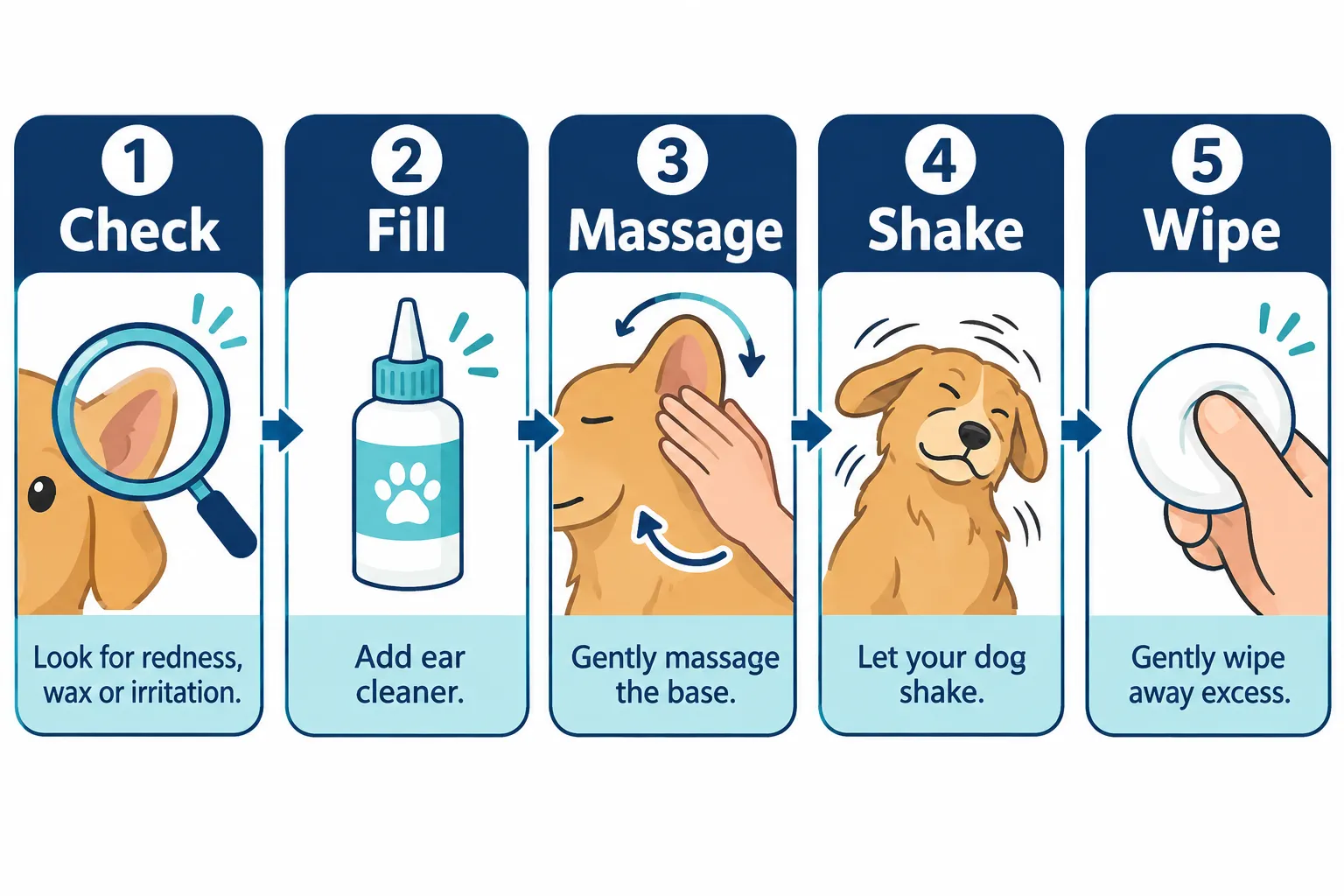
| Step | What to do | Stop and call a vet if… |
|---|---|---|
| 1. Check | Look at color, smell, discharge | Redness, odor, dark discharge present |
| 2. Fill | Fill canal with cleanser at the opening | Dog yelps or pulls away when touched |
| 3. Massage | Rub gently at the base for 30 seconds | Swelling or heat felt under your fingers |
| 4. Shake | Let the dog shake it out on their own | Head tilt or loss of balance appears |
| 5. Wipe | Wipe visible debris with cotton or gauze | Blood or thick pus on the cotton |
What does a healthy dog ear look like?
A healthy ear is light pink inside, free of strong odor, and has little to no visible discharge beyond a small amount of tan wax. There’s no heat, no swelling, and the dog shouldn’t react with pain when the flap is lifted or the base is touched.
Think of this as a baseline. Check a healthy ear occasionally when the dog is calm so you know what’s normal for that specific dog. Individual variation is real: some dogs run a little waxier than others, and that alone isn’t a problem.
What breeds need regular ear cleaning the most?
Breeds with floppy ears, heavy ear hair, or a history of allergies tend to need more frequent checks, including Cocker Spaniels, Basset Hounds, Poodles, and Labrador Retrievers that swim often. Breed alone doesn’t guarantee a problem, but it does raise the odds of buildup and reduced airflow in the canal.
- Floppy-eared breeds (Cocker Spaniel, Basset Hound, Beagle): limited airflow traps moisture
- Water-loving breeds (Labrador, Golden Retriever): wet canals after swimming
- Allergy-prone breeds (many terriers, Bulldogs): more wax and yeast activity
- Heavily-coated ear canals (Poodles, Schnauzers): hair can trap debris, sometimes requiring a groomer to pluck excess hair
For a broader look at how breed traits shape care needs beyond ears, see this guide on choosing the best dog breed for your household.
Why do some dogs need their ears cleaned more than others?
Ear canal shape, coat around the ear, allergies, and swimming habits all change how much wax and moisture a dog’s ears collect, which is why two dogs in the same house can need very different routines. Dogs with narrow or hairy canals trap more debris, and dogs with environmental allergies often produce more wax and are more prone to yeast overgrowth.
This is where individual variation matters more than breed generalizations. A Labrador that swims daily needs a different routine than one that never gets near water, even though they’re the same breed.
Can you use just water to clean dog ears?
Water alone isn’t ideal because it doesn’t dissolve wax or evaporate from the canal the way a proper cleanser does, and leftover moisture can actually encourage yeast growth. A labeled dog ear cleanser is designed to break down debris and help dry the canal afterward, which plain water can’t do.
If you’re in a pinch with nothing else available, a small amount of lukewarm water with thorough drying afterward is better than nothing for light surface dirt, but it’s not a substitute for a real routine using a proper cleanser.
My dog won’t let me near their ears, what do I do?
If a dog resists, try saturating a cotton pad with cleanser and wiping the visible part of the ear rather than pouring liquid directly into the canal, a lower-stress alternative recommended by Cornell for dogs who won’t tolerate the standard method. Go slow, use treats, and stop if the dog shows real distress rather than ordinary fussiness.
Repeated, strong resistance to a specific ear, especially if it’s new, can itself be a symptom. A dog who suddenly hates having one ear touched when they used to tolerate it may be telling you something hurts. That’s worth a vet visit before more attempts at home. Building general comfort with handling early, the same way you would with basic obedience training, makes ear cleaning far less of a fight later.
Signs your dog has an ear infection and needs to stop cleaning
Stop cleaning if you see persistent head shaking, a strong odor that returns within a day of cleaning, dark or waxy discharge that keeps coming back, or visible pain. These are signs of otitis externa, and cleaning alone won’t resolve the underlying cause.
An infection needs a diagnosis, usually an otoscope exam and a look at the discharge under a microscope, because bacteria, yeast, and mites are treated with different medications. Guessing and cleaning more often just delays getting on the right treatment.
Can you clean a dog’s ears if they have an infection?
Generally, no, not without veterinary direction first, because cleaning an already inflamed or ruptured eardrum can push bacteria deeper or cause pain without fixing the underlying cause. Once a vet diagnoses the issue, they may actually prescribe cleaning as part of treatment, but with specific products and a specific schedule.
A vet-prescribed cleaning plan during an active infection often starts daily and tapers down as symptoms improve, per Cornell’s guidance. Cleaning on your own schedule, without that diagnosis, is the mistake to avoid.
How much does it cost to get dog ears cleaned at the vet?
A vet ear cleaning is often included as part of a standard wellness exam rather than billed separately, though clinics that treat an active ear infection typically charge for the exam, any diagnostic testing (such as a cytology swab), and medication on top of the cleaning itself. Costs vary widely by clinic and region, so it’s worth asking for a price estimate before the appointment if cost is a concern.

For routine, uncomplicated maintenance cleaning with no infection present, most owners can handle it at home with a labeled cleanser for a fraction of the cost of repeated vet visits, which is part of why understanding how to clean dog ears properly at home matters for both the dog’s comfort and the household budget.
Do you need to take your dog to the vet for ear cleaning?
Most routine ear cleaning can be done at home with a labeled cleanser once the dog’s normal baseline is known. A vet visit is needed when the ear is painful, inflamed, has abnormal discharge, or when a dog has recurring infections that need a prescribed cleaning and medication plan.
If reading what’s normal versus abnormal for a specific dog feels uncertain, ask the vet to show the process during a regular visit. That five-minute demonstration is worth more than any amount of reading, and it’s a good way to confirm you’re doing each step of how to clean dog ears correctly before doing it alone at home.
Is it better to have a groomer do it or do it myself?
For routine maintenance on a healthy ear, doing it yourself at home is usually fine and saves money, while a groomer or vet is the better choice for breeds with heavy ear hair that needs plucking, or for owners who feel genuinely unsure about the process. Groomers are not a substitute for a vet when infection is suspected.
A groomer can safely pluck excess ear hair in breeds like Poodles and Schnauzers, which can reduce airflow problems, but groomers are not trained to diagnose infections and shouldn’t be relied on to judge whether an ear looks abnormal.
Is it safe to clean a puppy’s ears?
Puppies with healthy, calm ears can be introduced to gentle ear handling early, using the same signs: check for redness, odor, and pain before cleaning, and use a dog-specific solution. Puppy ear tissue is just as sensitive as an adult dog’s, so the same stop signs apply.
Early positive handling also makes future vet exams and cleanings easier, since a puppy used to having ears touched calmly tends to tolerate it better as an adult. This pairs naturally with other early-socialization habits covered in guides on essential commands for puppies.
Doggy Rank IQ Tool
Dog Ear Check Before You Clean

Answer what you see and smell. Cleaning an infected ear delays treatment.
Dog shaking head after cleaning ears, is that normal?
A moderate head shake right after cleaning is normal and expected, since that shake is how a dog flings out loosened debris and leftover solution from the canal. It usually settles within a minute or two.
Shaking that continues for many minutes, returns repeatedly over the following hours, or comes with visible discomfort or tilting is not normal and should prompt a call to the vet, since it can signal that cleanser was left too deep, that the ear was already irritated before cleaning, or that something else is going on in the canal.
How deep should you go when cleaning a dog’s ear canal?
The correct depth is: not deep at all. The cleanser bottle tip should stay at the opening of the ear, and fingers should only massage the outside base of the ear, never probe inside the canal itself.
This is the single most misunderstood part of how to clean dog ears. Owners sometimes assume more thorough means deeper, but the canal’s L shape means anything pushed in by hand or swab tends to pack debris against the eardrum rather than remove it. Let the cleanser, massage, and the dog’s own head shake do the actual work.
What are the most common mistakes when cleaning dog ears?
The most common mistakes are using cotton swabs inside the canal, cleaning a painful or inflamed ear instead of calling a vet, and sticking to a rigid weekly schedule regardless of what the ear actually looks like. Each of these either pushes debris deeper or masks a problem that needs treatment.
Other frequent errors: letting the bottle tip touch the ear (risking contamination of the whole bottle), skipping the massage step so the cleanser never actually loosens anything, and not giving the dog time to shake before wiping. A less obvious mistake is over-cleaning a dog that never had a problem to begin with, which brings its own risks.
How to tell if you’re cleaning your dog’s ears too much
Over-cleaning shows up as redness, dryness, flaking, or a dog who suddenly becomes head-shy about ear handling they used to tolerate. Cleaning strips natural wax and oils that help protect the canal, and doing it too often can irritate the lining.
If cleaning has been happening weekly without a specific reason (no swimming, no allergies, no prior infection), that’s a cue to scale back to an as-needed schedule and let the ear’s natural balance reset.
What does it mean if your dog’s ears smell bad?
A bad smell, especially sour, yeasty, or rotten, usually points to bacterial or yeast overgrowth and is one of the clearest signs that cleaning alone won’t fix the problem. Odor paired with redness or discharge is a vet-visit situation, not a cleaning situation.
A faint, slightly musty smell after a swim or a long walk is normal. A smell that’s strong, persistent, or that returns within hours of cleaning is not, and it belongs in the “stop and call the vet” category rather than the “clean it at home” category.
FAQ
Is it okay to clean my dog’s ears every day? No, daily cleaning is only appropriate during active vet-directed treatment for an infection. For a healthy dog, daily cleaning can strip protective oils and irritate the canal.
What color should healthy dog ear wax be? Light tan to light brown is normal. Dark brown, black, or bloody discharge is not and warrants a vet check.
Can I use baby wipes on my dog’s ears? No, baby wipes are formulated for human skin and often contain fragrances or alcohol that can irritate a dog’s ear canal. Use a labeled dog ear cleanser instead.
How long does a full ear cleaning take per ear? A single ear typically takes two to three minutes including the 30 second massage, shake time, and wiping.
Should I clean both ears even if only one looks dirty? Check both, but only clean the ear that actually needs it. Over-cleaning a healthy ear just because its pair needed attention isn’t necessary.
Can allergies cause ear problems even without food changes? Yes, environmental allergies (pollen, dust, mold) can trigger excess wax and yeast overgrowth in the ears just as much as food allergies can, according to the Merck Veterinary Manual.
Is it normal for puppies to have more ear wax than adult dogs? Not necessarily more, but puppies are still building tolerance to handling, so checks should be gentle and brief at first.
Do indoor-only dogs still need ear checks? Yes, indoor dogs can still develop wax buildup, allergies, or yeast issues. Indoor living lowers exposure to dirt and water but doesn’t eliminate ear care needs entirely.