
Resource guarding in dogs: Quick Answer
Resource guarding in dogs is when a dog uses body language, sound, or physical movement to keep people or other animals away from something it values, such as food, a toy, a bed, or even a favorite person. Most dogs show quiet warning signs like freezing or stiffening long before a growl or a bite, and the safest fix starts with reading those signs and managing the environment, not punishing the dog for communicating.
Key Takeaways
- In a referral-based study of 103 dogs that had bitten 111 children, resource guarding showed up in 61% of cases during behavioral screening VETzInsight.
- Among bites to children under six, 44% were linked to resource guarding, and food guarding accounted for 42% of bites to children familiar to the dog VETzInsight.
- A 2026 survey of 293 Canadian and American dog breeders found that 24.6% removed the food bowl while the puppy was still eating, a practice the researchers flagged as likely increasing competition rather than preventing it PubMed Central.
- The same survey found 70.6% of breeders petted or handled puppies while they ate, and 65.5% touched the food or bowl directly during meals Cambridge Core.
- The American Kennel Club notes that most dogs give clear warning signals, such as freezing or stiffening, well before escalating to a growl or snap American Kennel Club.
- Humane World for Animals recommends management and gradual desensitization over confrontation, since taking items away by force tends to make guarding worse Humane World for Animals.
- Resource guarding is common in shelter and rescue dogs and does not automatically mean a dog is unsafe or unadoptable; many cases respond well to structured management Maddie’s Fund.
- A growl is information, not disobedience. Removing the growl through punishment does not remove the discomfort behind it.
Resource guarding in dogs: When to call the vet
Book a veterinary visit if resource guarding in dogs appears suddenly in an adult dog, worsens quickly, or shows up alongside other new behavior such as irritability, pain signals, or changes in appetite. Pain, dental disease, vision or hearing loss, and endocrine conditions can all lower a dog’s tolerance for being approached near something it values. A sudden change in guarding behavior is a medical question first and a training question second.

What does resource guarding mean in dogs?
Resource guarding in dogs means a dog is using body language, sound, or physical action to keep a person or another animal away from something it considers valuable, such as food, a bone, a toy, a bed, a doorway, or a specific person. It ranges from a stiff pause over a bowl to a lunge or bite, and the behavior exists on a spectrum rather than as a single fixed trait.
The American Kennel Club describes resource guarding as a natural behavior rooted in survival instinct that becomes a problem when it puts people or other animals at risk in a home setting American Kennel Club. A dog that resource guards is not necessarily aggressive by temperament. It is a dog that has learned, through instinct or experience, that a valued item might be taken away, and it is responding to that perceived threat.
Resource guarding in dogs can target:
- Food bowls, bones, and chews
- Toys, balls, and stolen household objects
- Beds, crates, couches, and other resting spots
- Doorways or narrow spaces
- A specific person, especially around other dogs or strangers
The intensity varies by dog, by resource, and by who is approaching. A dog might freeze over a rawhide but show nothing over a bowl of kibble. A dog might guard a favorite person from another dog in the house but never guard that same person from a stranger.
Why do dogs resource guard?
Dogs resource guard because the behavior is partly instinctive and partly learned, shaped by genetics, early experience, competition in the litter, and sometimes pain or insecurity. It is not automatically a sign of dominance or a flawed temperament.
Several factors raise the likelihood of resource guarding in dogs:
- Litter competition: puppies raised in large litters with limited food access often learn to eat fast and defend space around the bowl.
- Scarcity history: dogs that spent time as strays or in shelters with inconsistent food access may guard more intensely once they have reliable resources.
- Early handling practices: the 2026 breeder survey found that common practices like removing the bowl mid-meal or reaching in to touch food were widespread, yet researchers noted these actions may increase competitive behavior rather than build tolerance Cambridge Core.
- Pain or discomfort: a dog with dental pain, arthritis, or an underlying illness may guard more because being approached feels riskier when the body already hurts.
- Individual temperament: two puppies from the same litter can land at opposite ends of the guarding spectrum depending on personality and what each one learned about hands near food.
The practical point: guarding is rarely about a dog trying to run the household. It is usually a dog trying to protect something it fears losing, based on real or perceived past experience.
How can I stop my dog from resource guarding?
The most reliable way to reduce resource guarding in dogs combines environmental management with gradual desensitization and counterconditioning, building a new association between a person approaching and something good happening, rather than something being taken away.
A basic working plan looks like this:
- Remove the competition first. Feed dogs separately, in different rooms or crates, so no one has to guard anything from anyone.
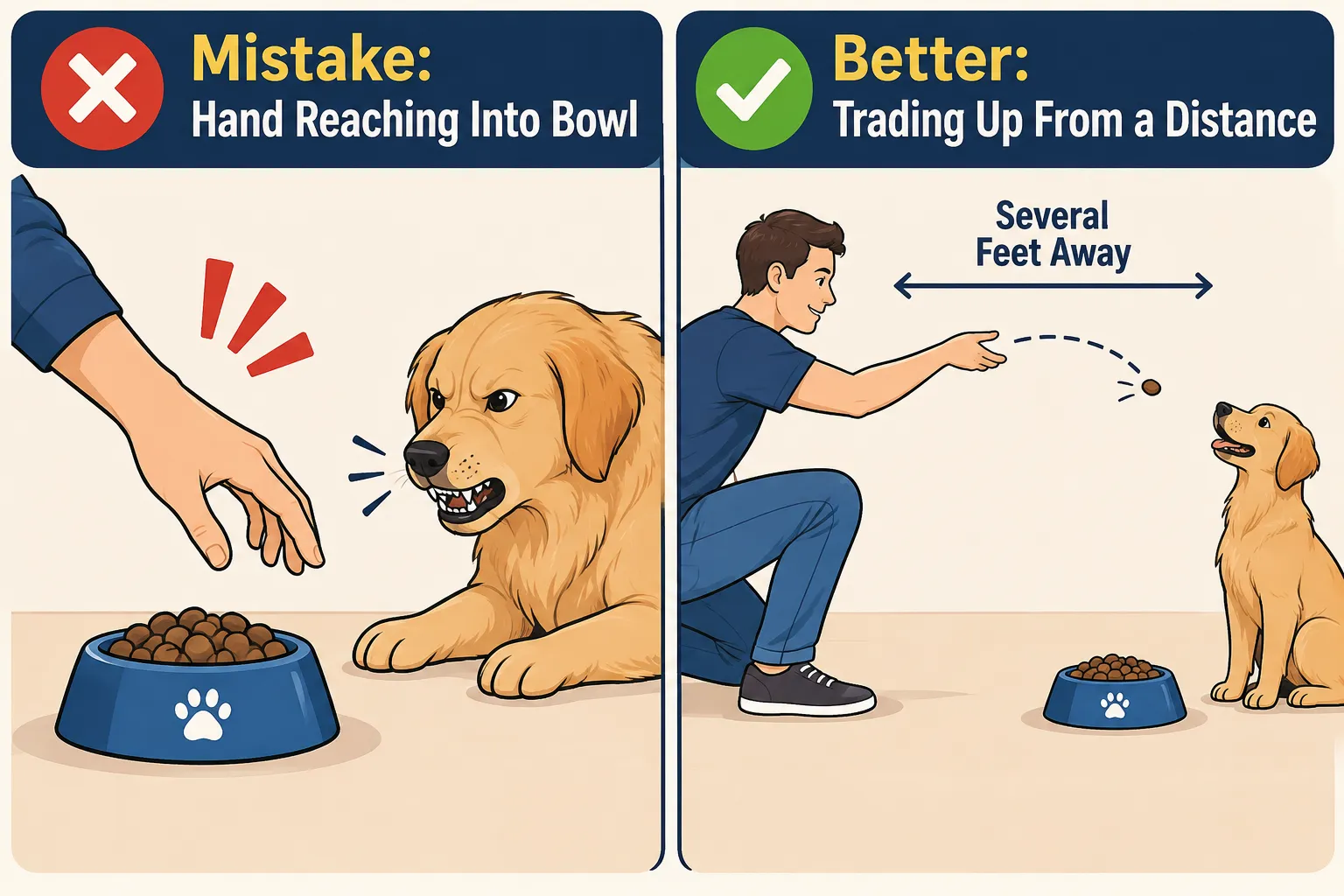
- Stop testing the dog. Do not reach into the bowl, grab the toy, or pull on a chew to “check” the dog’s reaction. This creates exactly the pressure that builds guarding.
- Start a trade-up routine. Approach from a distance where the dog stays relaxed, toss a higher-value treat near (not into) the bowl or toy, and walk away. Repeat often, short sessions, several times a day.
- Gradually close distance. Once the dog stays loose and relaxed at one distance, shrink the gap by small amounts over days or weeks, not in a single session.
- Add duration and movement. Once close approaches are calm, start walking past instead of stopping, then eventually practice brief, calm handling near the resource.
- Call a professional for anything beyond mild signs. Growling, snapping, or biting means it is time for a certified trainer or veterinary behaviorist, not a solo project.
Decision rule: if the dog’s body stays loose and the tail stays neutral or relaxed as you approach, continue at that distance for a few more repetitions before closing the gap. If the dog stiffens, freezes, or hard-stares, back up to the last distance where it was comfortable.
What should I do if my dog guards their food bowl?
If a dog guards its food bowl, the first and most effective step is to stop approaching during meals and instead feed in a separate space where no one needs to walk past or reach toward the bowl. This single change removes most of the pressure that triggers guarding at mealtime.
From there:
- Feed in a closed room, crate, or behind a baby gate so the dog can eat without feeling watched or crowded.
- Avoid hovering, reaching in, or touching the bowl, even briefly, during meals.
- If other pets are in the house, feed at the same time in separate locations rather than staggering meals in the same room.
- Once the dog is consistently relaxed eating alone, begin the trade-up approach described above from a distance, before gradually closing in.
Common mistake: many owners try to “fix” bowl guarding by repeatedly taking the bowl away mid-meal to prove the dog can handle it. The 2026 breeder survey found that 24.6% of breeders did exactly this with puppies, and researchers noted it was associated with more competitive behavior around food, not less PubMed Central. The safer approach builds trust at a distance instead of testing tolerance up close.
Is resource guarding normal dog behavior?
Mild resource guarding is common and considered a normal part of canine behavior, not a sign of a damaged or dangerous dog. It becomes a safety concern only when the intensity escalates toward growling, snapping, or biting, or when it involves children.
Humane World for Animals notes that many dogs show some degree of guarding at some point, and that the behavior sits on a spectrum from mild (a slight freeze or stiffening) to severe (a bite) Humane World for Animals. A dog that stiffens slightly when someone walks by its bowl is showing normal caution. A dog that lunges or bites when anyone comes within ten feet of its food needs a structured management and training plan, ideally with professional support.
Edge case: puppies sometimes show brief, mild guarding around eight to sixteen weeks as part of normal development. This is different from guarding that is intensifying over weeks or months in an adult dog, which warrants earlier intervention.
Resource guarding vs dog aggression: what’s the difference?
Resource guarding is a specific, situational behavior tied to protecting an item or person, while general aggression can appear across many contexts without a clear resource trigger. A dog can resource guard without being aggressive in any other setting, and a dog can be reactive or fearful in other contexts without ever guarding an item.
The distinction matters for a safety plan:
- Resource guarding: triggered specifically by proximity to food, toys, beds, or a person; often predictable and tied to a clear object or location.
- General aggression: can appear in multiple, less predictable contexts such as fear of strangers, territorial behavior at the door, or pain-related irritability unrelated to any resource.
Dogs can show both. A dog that resource guards and also reacts fearfully to strangers needs a plan that addresses each trigger separately, since the training approach for guarding (distance and trade-ups) is different from the approach for general fear-based reactivity (systematic desensitization to the broader trigger).
Which dog breeds are most prone to resource guarding?
No breed is immune to resource guarding, and no single breed is guaranteed to develop it, since the behavior is shaped more by individual history, early experience, and temperament than by breed alone. That said, some working and guarding-lineage breeds (including certain terriers, herding breeds, and breeds historically used for protection) are anecdotally reported more often in trainer and shelter caseloads, though this reflects observation rather than controlled breed-specific data.

What matters more than breed:
- Whether the dog came from a large, competitive litter
- Whether the dog experienced food scarcity as a puppy or stray
- How mealtimes and toy time were handled in the first several months of life
- The individual dog’s baseline temperament, which varies within every breed
Families choosing a puppy who want to reduce the odds of guarding later on may find it useful to review guidance on choosing the best food for your dog and general training basics in essential commands every puppy should learn, since calm, low-pressure routines around food and objects early on tend to lower guarding risk regardless of breed.
Common mistakes people make with resource guarding dogs
The most frequent mistakes turn a manageable, quiet signal into a dog that stops warning at all before it reacts. Three patterns show up again and again in both breeder surveys and shelter casework.
- Testing instead of managing: reaching into the bowl or pulling the toy away “to see what happens” adds pressure rather than reducing it.
- Punishing the growl: scolding or correcting a growl removes the warning signal without touching the underlying worry, which research and veterinary guidance both caution against Humane World for Animals.
- Leaving children unsupervised: given how often resource guarding shows up in documented child bite cases, with 44% of bites to children under six linked to guarding, supervision during meals, chews, and bones is non-negotiable VETzInsight.
- Assuming a rescue dog’s guarding is a character flaw: a dog with a history of scarcity may guard out of learned necessity rather than temperament, and that history should shape a gentler, more patient plan rather than a punitive one.
- Skipping professional help after a bite or snap: home management can work for freezing, stiffening, or mild growling, but any bite history calls for a certified trainer or veterinary behaviorist.
Can you train a resource guarding dog yourself, or do you need a trainer?
Mild resource guarding, limited to freezing, stiffening, or occasional hovering, can often be managed at home with consistent distance-based trade-up exercises. Anything involving a growl directed at a child, a snap, or a bite needs a certified trainer or veterinary behaviorist before continuing any hands-on work.
A simple decision rule:
- Choose home management if the dog shows freezing, hard eye, or hovering only, and no household member has been bitten or snapped at.
- Choose a certified trainer if growling has occurred, especially around other dogs, or if progress has stalled after a few weeks of consistent management.
- Choose a veterinary behaviorist if there has been a bite, a snap near a child, or guarding that has escalated quickly in an adult dog, since this level often needs a structured plan alongside a medical evaluation. See the comparison in veterinary behaviorist vs dog trainer for how to choose between the two.
How long does it take to fix resource guarding?
Timelines vary widely, but many mild cases show meaningful improvement within four to eight weeks of consistent daily management and trade-up practice, while moderate to severe cases involving growling or snapping often take several months of structured work with a professional. There is no fixed schedule, because progress depends on the dog’s history, the intensity of the guarding, and how consistently the household follows the plan.
Realistic expectations:
- Mild guarding (freezing, stiffening): often improves in a few weeks with consistent distance work.
- Moderate guarding (hovering, lip lift, occasional growl): typically takes two to four months with a trainer involved.
- Severe guarding (snapping or biting): often requires ongoing management for the dog’s lifetime rather than a single fix, especially in multi-dog or multi-child households.
A quick example: a two-year-old rescue mix that freezes over a bone but has never growled or snapped might show relaxed body language at six feet within two weeks of daily trade-ups, and comfortable handling within six to eight weeks. A dog with a documented snap at a visiting child will likely need a longer, professionally guided plan with strict separation in place the entire time.
How do I introduce a new dog to one that resource guards?
Introduce a new dog to a resource guarding dog gradually, in neutral territory, and only after the resident dog’s triggers are clearly identified and physically separated from the introduction process. Skipping this step is one of the most common causes of dog-to-dog bite incidents in homes with a known guarder.
A safer introduction sequence:
- Meet on neutral ground (a yard or park, not the home) with no food, toys, or beds present.
- Keep both dogs on loose leashes and watch body language rather than forcing interaction.
- Once calm in neutral space, bring the new dog into the home with all resources (bowls, beds, toys) picked up or in separate rooms.
- Feed the dogs in separate rooms indefinitely if the resident dog has any history of guarding food.
- Reintroduce toys and chews only under direct supervision, one item at a time, with both dogs at a distance from each other.
Edge case: if the resident dog guards the owner specifically (rather than food or toys), affection time with the new dog should happen separately at first, since guarding a person around another dog carries real injury risk and often needs a trainer’s input before the dogs share space freely.
Can resource guarding in dogs be completely cured?
Many cases of resource guarding in dogs improve substantially with consistent management and counterconditioning, but a full, permanent “cure” is not guaranteed for every dog, and some dogs need ongoing management rather than a one-time fix. This is a realistic expectation to set from the start rather than a discouraging one.
What tends to happen in practice:
- Mild cases often resolve to the point where the behavior rarely if ever reappears.
- Moderate cases often improve significantly but may show occasional stiffening under stress, illness, or high-value items like a fresh bone.
- Severe cases (bite history) usually require permanent management strategies, such as separate feeding and no unsupervised access to high-value items, even after training progress.
The goal for most households is not a dog that never shows any guarding signal again. It is a dog whose signals are mild, predictable, and managed well enough that no one gets hurt.
What to do when multiple dogs in the house resource guard
When more than one dog in a household resource guards, the safest approach is full physical separation during all meals and high-value chew time, since allowing two guarders to share space around food or toys significantly raises the risk of a dog-to-dog fight. Management comes first, training comes second.
Practical steps for multi-dog households:
- Feed every dog in a separate room, crate, or behind a barrier, with no exceptions during a training period.
- Pick up all chews, bones, and high-value toys when dogs are loose together; only offer them during supervised, separated sessions.
- Rotate one-on-one time with people so no dog needs to guard a lap or attention from a housemate.
- Work with a trainer who specializes in dog-to-dog dynamics rather than attempting group training sessions, since correcting one dog in front of another can escalate tension.
A household with two or more guarding dogs is a higher-risk environment than a single-dog home, and it usually benefits from professional guidance earlier rather than later, particularly if there is any bite history between the dogs.
Is my dog resource guarding or just protective?
A dog that resource guards is responding to a specific item or person it fears losing, while a dog that is “just protective” in the broader sense (such as alert barking at the door) is usually reacting to a perceived outside threat rather than defending a possession. The two behaviors can look similar from a distance but have different triggers and different fixes.
Quick way to tell the difference:
- Resource guarding: the trigger is proximity to a specific object, location, or person combined with another dog or person approaching it. The dog relaxes once the item is out of play.
- General protectiveness: the trigger is an outside presence (a stranger, a knock at the door, another animal outside) regardless of whether the dog is holding anything.
Example: a dog that growls only when someone reaches toward its bone, but is friendly and relaxed with no bone present, is resource guarding. A dog that barks and postures at every visitor regardless of what it is holding is showing general protective or territorial behavior, which calls for a different training approach focused on visitor routines rather than trade-ups around objects.
Early warning signs around toys, beds, or bowls
Early signs of resource guarding in dogs are usually quiet: freezing mid-chew, stiffening when someone walks near the bowl, eating faster, or hovering over a toy with a lowered head. These signals come before any growl or snap, and catching them early is the best chance to change course before the behavior escalates.
Watch for these specific signals:
- Freezing: the dog stops moving entirely when approached.
- Hard stare or whale eye: the whites of the eyes show while the head stays down.
- Hovering: the body curls around the item, blocking access.
- Lip lift: a small curl of the lip without full teeth showing.
- Faster eating: a sudden change in pace when a person enters the room.
- Moving the object away: picking up the toy and retreating with it.
Decision rule: if a dog shows any two of these signs around the same object or location more than once, start management that same day rather than waiting for a growl to confirm the behavior.
Doggy Rank IQ Tool
Resource Guarding Escalation Ladder

Tick what you have seen. You get a risk level, a do not do list, and when to bring in qualified help.
Comparison table: common resource guarding scenarios
Different resource guarding scenarios need different first moves, and matching the response to the risk level is more useful than applying one generic rule to every dog.
| Scenario | Primary risk | First safe step | Who should help |
|---|---|---|---|
| Food bowl guarding, single dog household | Low to moderate, mainly to adults who crowd the bowl | Feed in a closed room, no approach during meals | Certified trainer if growling appears |
| Guarding owner from other dogs | Moderate, dog-to-dog injury possible | Separate dogs physically during affection time, rotate attention | Certified trainer, dog-dog specialist |
| Guarding around young children | High, documented link to child bite cases | Full physical separation, no shared space during eating or chewing | Veterinary behaviorist, non-negotiable |
Sourced stat snapshot
- 61% of 103 dogs that bit children showed resource guarding on behavioral screening VETzInsight.
- 44% of bites to children under six were linked to resource guarding VETzInsight.
- 24.6% of 293 surveyed breeders removed the bowl mid-meal, a practice linked to more competitive feeding behavior in puppies PubMed Central.
- 42% of bites to familiar children were tied specifically to food guarding VETzInsight.
Things to watch out for
Owners most often go wrong by testing the dog instead of managing it. Reaching into the bowl to “prove” the dog is fine, taking a bone away repeatedly as practice, or scolding a growl are three habits that can turn a quiet warning signal into a dog that reacts without warning at all.
- Do not punish a growl. It is the dog’s clearest warning, and removing it does not remove the discomfort underneath it.
- Do not use hand-feeding games that involve grabbing the bowl as a test. The breeder survey found that handling food and removing bowls mid-meal was associated with more competitive behavior in puppies, not less Cambridge Core.
- Do not assume a rescue dog’s sudden guarding is a character flaw. It may reflect a history of scarcity, as shelter behavior research frequently documents Maddie’s Fund.
- Do not leave young children unsupervised with a dog and a chew, a bowl, or a bone, given how often guarding appears in documented child bite cases.
Editor’s take
Resource guarding in dogs gets treated like a discipline problem when it is closer to a communication problem. A freeze, a hard stare, a lip lift: these are a dog’s way of asking for space, offered well before a growl or a bite. Punish the growl and the dog does not become less worried. It just stops telling anyone before it reacts.
The breeder data is worth sitting with. Nearly a quarter of surveyed breeders were pulling the bowl away mid-meal, likely trying to build tolerance, and the research suggests that approach may backfire instead. The instinct to test a dog’s reaction around food is common and understandable. The evidence points the other way: separate the resource, lower the pressure, and build trust at a distance the dog can actually handle. For related reading, see veterinary behaviorist vs dog trainer and dogs that bite owners for next-step detail, and general obedience groundwork in essential commands every puppy should learn.
| Scenario | Primary risk | First safe step | Who should help |
|---|---|---|---|
| Food bowl guarding, single dog household | Low to moderate, mainly to adults who crowd the bowl | Feed in a closed room, no approach during meals | Certified trainer if growling appears |
| Guarding owner from other dogs | Moderate, dog-to-dog injury possible | Separate dogs physically during affection time, rotate attention | Certified trainer, dog-dog specialist |
| Guarding around young children | High, documented link to child bite cases | Full physical separation, no shared space during eating or chewing | Veterinary behaviorist, non-negotiable |
FAQ
Q: What are the early signs of resource guarding in dogs? Freezing, stiffening, hovering over an item, eating faster, hard staring (whale eye), and a lip lift typically come before any growl. Catching these early is the best chance to manage the situation before it escalates into a snap or bite.
Q: Why does my dog growl when I come near his food? The growl is a warning that the dog feels the food is at risk of being taken, often due to past experience, instinct, or current discomfort. It is a request for distance, not an act of defiance, and punishing it removes the warning without removing the worry underneath it.
Q: Should you punish a dog for resource guarding? No. Current veterinary behavior guidance recommends against punishing growling or forcibly removing items, since punishment can increase fear and worsen defensive behavior. Management and gradual counterconditioning are the supported approach instead.
Q: How do you stop resource guarding in dogs? Start with environmental management, meaning separate feeding and no approach during meals, then build desensitization and counterconditioning at a distance where the dog stays relaxed, pairing your approach with something better than what the dog already has. Involve a certified trainer or veterinary behaviorist if any growl, snap, or bite has occurred.
Q: Can resource guarding be trained out? Many cases improve meaningfully with consistent management and counterconditioning, though individual variation means some dogs need ongoing management rather than a full cure. Dogs with a bite history or guarding around children need a qualified professional rather than a solo project.
Q: Why does my rescue dog guard me from other dogs? A newly adopted dog may guard a person because it has learned that attention and safety felt scarce in the past, or because it has not yet built trust with the other animals in the home. This is common in shelter and rescue populations and often improves with separated affection time and gradual, supervised introductions rather than forced closeness.
Q: Is resource guarding more common in certain breeds? No breed is immune and none is guaranteed to develop it, since individual history and early experience matter more than breed alone. Puppies from competitive litters or households with inconsistent food access tend to show more guarding regardless of breed.
Q: Can two resource guarding dogs live together safely? Yes, with consistent separation during meals and high-value chew time, plus supervised, gradual reintroduction of shared space. Multi-dog households with more than one guarder carry higher risk and usually benefit from a trainer experienced in dog-to-dog dynamics.