
How to stop a dog from jumping? Quick Answer
The fastest way to learn how to stop a dog from jumping on guests is to set up a barrier tool (leash, gate, or mat) before anyone knocks, then reward the dog only once all four paws are on the floor. Every person in the household, plus the guest, needs to follow the same script, because mixed reactions are the number one reason jumping sticks around for months instead of days.
Key Takeaways
- The Humane World for Animals recommends teaching an incompatible behavior, such as sitting, rather than punishing a dog after it jumps.
- The SPCA of Wake County notes that management tools like gates and leashes reduce how often a dog gets to rehearse jumping while training is still in progress.
- VCA Animal Hospitals advises ignoring jumping completely, including no eye contact, no pushing, and no scolding, since all three can act as attention.
- The Wisconsin Humane Society points out that jumping usually started because it worked, meaning it got the dog attention, touch, or eye contact in the past.
- Short daily sessions, often five to fifteen minutes, tend to change greeting behavior faster than occasional long sessions, according to VCA Animal Hospitals.
- A printed or texted guest script removes the “it’s fine” problem that undoes weeks of consistent practice.
- Older dogs with long-practiced jumping habits can still learn a new greeting routine, though it usually takes longer than it would with a puppy.
How to stop a dog from jumping? When to call the vet box
Jumping that includes growling, snapping, mouthing that leaves marks, or a dog that cannot settle down even after guests leave is not a simple manners problem. If a dog shows fear, trembling, or tries to escape the room rather than jumping out of excitement, a veterinary behavior consult should happen before any arrival drills. Connecticut Humane Society and VCA Animal Hospitals both separate normal greeting jumping from behavior that signals fear or conflict, and the two call for very different responses. A dog that is overly aroused but friendly needs management and training. A dog that is frightened or guarding space needs a professional evaluation first, because practicing arrivals with a scared dog can make the fear worse, not better.
How to stop a dog from jumping
The direct answer: manage the environment so jumping cannot physically happen, then reward a specific alternative behavior every time a person walks through the door. That is the core idea behind how to stop a dog from jumping, according to guidance from the Humane World for Animals and the SPCA of Wake County. Punishing the jump after it already happened does far less than preventing the rehearsal in the first place and reinforcing something better instead.
Here is the part most households get wrong. One person says “down!” The teenager laughs and lets the dog climb on them anyway. The guest insists “it’s fine” while absorbing eighty pounds of golden retriever to the chest. The dog, in that moment, has just been rewarded by three different reactions for the exact same jump. Dogs jump because jumping has historically produced attention, touch, or eye contact, not because they are trying to outrank anyone standing in the entryway.
So the fix is not one trick. It is a household rule applied the same way by every person, every single time. That means:
- A single tool at the door (leash, gate, or mat) that every family member uses, not just whoever remembers.
- One cue that everyone says the same way, or better yet, nobody says anything and the household simply waits for calm.
- A guest script, printed or texted ahead of time, so “it’s fine” does not undo weeks of repetition.
If training feels overwhelming at first, start with a few basic cues the dog already knows well, like the groundwork in 5 essential commands every puppy should learn, before layering on guest-specific drills.
How to stop a dog from jumping? What do you set up before guests arrive?
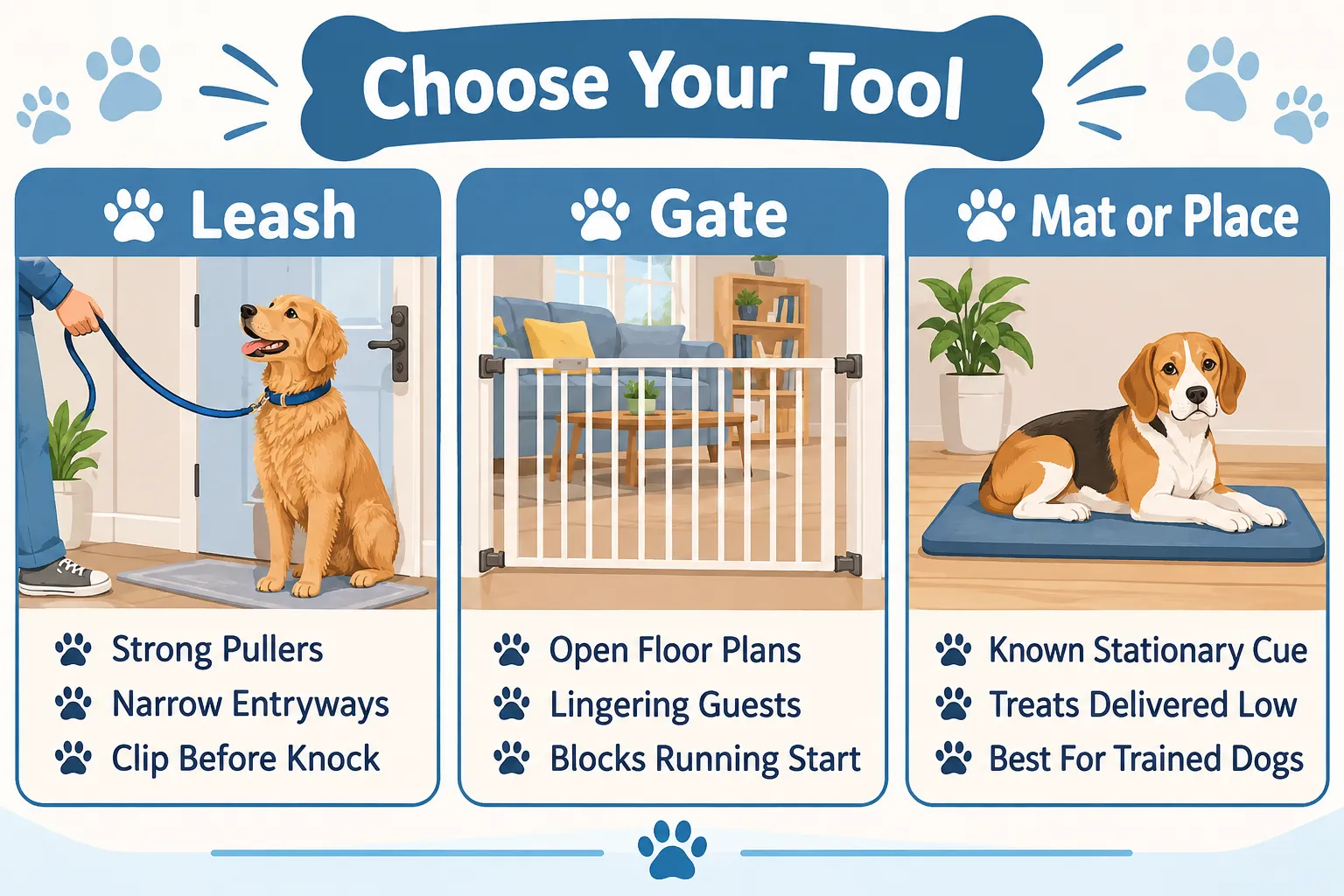
Set up one barrier tool and one designated spot before anyone rings the bell, not after the dog is already in the air. A leash clipped on before opening the door, a baby gate across the entry, or a mat a few feet back from the threshold all work, and the right pick depends on the dog’s size, the door layout, and how fast the dog accelerates toward new people.
- Leash: Best for large or strong dogs and narrow entries. Clip it on before the knock, not during the scramble once the doorbell has already rung.
- Gate: Useful for open floor plans where a dog has room to build up speed before reaching the door.
- Mat or “place”: Works once a dog already knows a stationary cue. Pair it with a high-value treat delivered low, near the floor, so the dog’s head and front end stay down.
Choose a gate if guests tend to linger and chat in the doorway, since it keeps the dog back without anyone holding a leash the whole time. Choose a leash if the dog bolts the second the door cracks open, because a gate alone will not stop a determined dog from squeezing through or jumping over it.
How to stop a dog from jumping? Which behavior can you reward instead of jumping?
Reward “four on the floor,” a sit, or a settled down on a mat, since all three physically prevent jumping while giving the dog a clear job to do. The Humane World for Animals specifically names sit and go-to-mat as incompatible behaviors worth building up before guests ever arrive.
Pick whichever cue the dog already performs reliably under low distraction, then add mild distractions, like a knock on a wall or a doorbell sound played from a phone, before testing it on an actual guest. Reward-based methods include food, toys, play, and calm attention delivered the instant all four paws touch the ground. Skip the knee-in-the-chest correction. It does not teach the dog what to do instead, and it can startle a dog that is overstimulated rather than defiant or pushy.
How to stop a dog from jumping? Guest arrival steps and reward plan
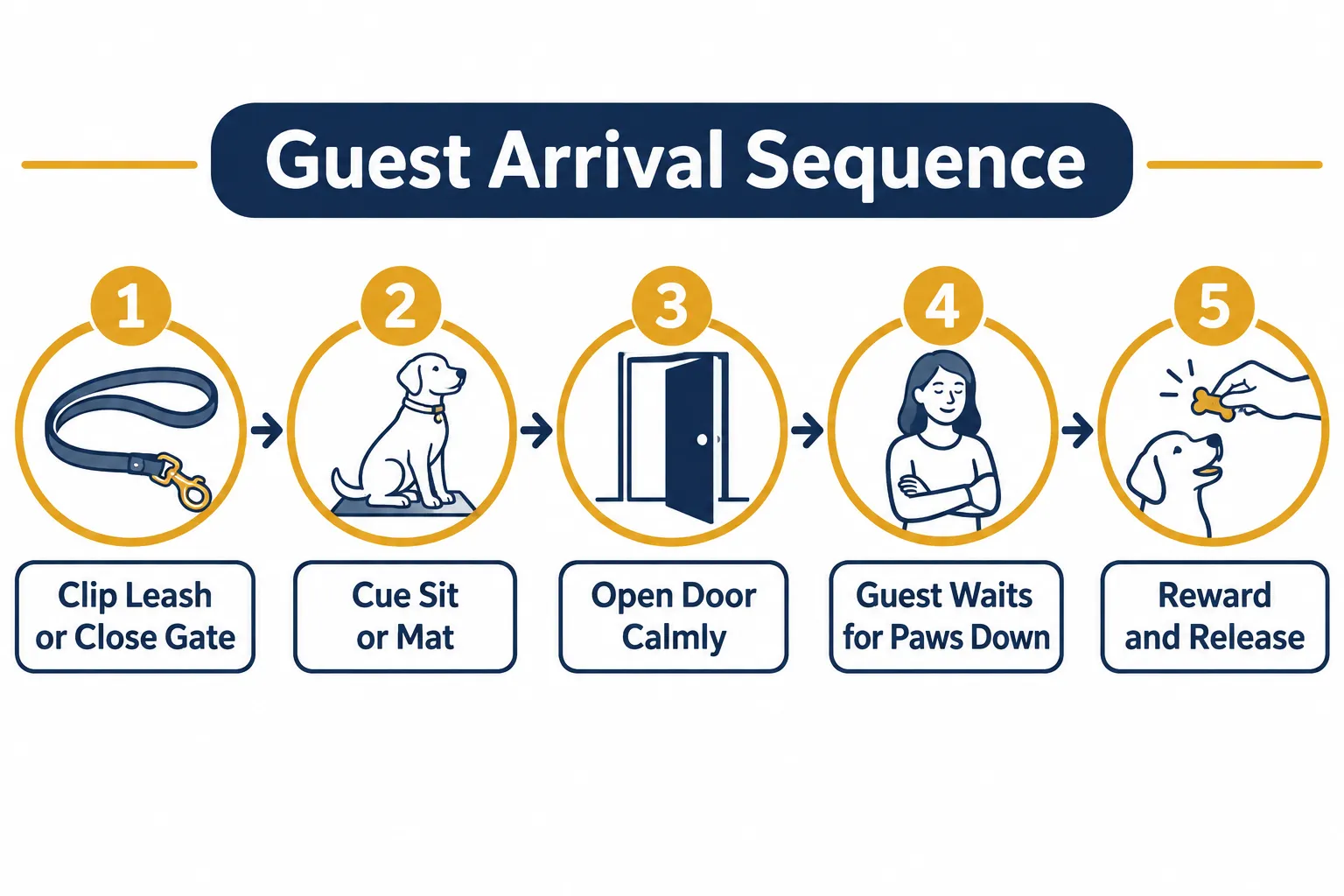
The sequence below answers the core question directly: when everyone in the house, plus the guest, follows the same five steps, jumping stops getting reinforced from any direction.
- Clip the leash or close the gate before opening the door.
- Cue the dog to the mat or ask for a sit, a couple of steps back from the threshold.
- Open the door. If the dog breaks position, reset calmly, no scolding involved.
- Have the guest wait silently until paws are on the floor, then reward with a treat delivered low.
- Release the dog for a calm greeting only after a few seconds of settled behavior.
Animalso and the SPCA of Wake County both describe this ignore-then-reward sequence as one of the more reliable routes to lasting change, though “reliable” still usually means days to weeks of short, repeated sessions rather than a single breakthrough visit.
How to stop a dog from jumping? Why does my dog jump on me?
Dogs jump to reach a person’s face and hands, which is where attention, eye contact, and greeting behavior usually happen between humans. A dog that jumps on its owner at the end of the workday has almost always learned, through repetition, that jumping gets picked up on, whether that reaction is a pet, a laugh, or even a scolding.
Puppies in particular jump because they greet their mother and littermates face to face, and that instinct carries into how they try to greet people. Without a replacement behavior, the habit simply continues into adulthood. The fix is the same whether the jumping target is a family member or a stranger at the door: ignore the jump, reward the calm alternative.
How to stop a dog from jumping? How long does it take to train a dog not to jump?
Most dogs show noticeable improvement within one to three weeks of short, consistent daily sessions, though a dog with years of practice jumping on everyone who enters a room can take longer. Five to fifteen minutes a day of focused practice, paired with strict household consistency, tends to produce faster results than occasional long sessions on weekends only.
Three variables affect the timeline the most:
- Consistency: A household where even one person allows jumping slows progress for everyone else.
- History: A dog that has jumped successfully for years has a longer habit to unlearn than an eight-week-old puppy.
- Arousal level: Dogs that get extremely worked up at the door need more reps at a lower distraction level before testing a real guest.
How to stop a dog from jumping? Best methods to stop a dog from jumping
The most effective approach combines environmental management with reward-based training, rather than relying on verbal corrections alone. Management (a leash, gate, or mat) prevents the dog from practicing the jump, while rewarding an incompatible behavior, like sitting or settling on a mat, teaches the dog what to do instead.
VCA Animal Hospitals and the Wisconsin Humane Society both describe turning away and withholding attention as useful additions, since a dog that gets no reaction from a jump has less reason to repeat it. Combining these three pieces (management, incompatible behavior, and ignoring the jump) tends to outperform any single method used alone.
How to stop a dog from jumping? Dog still jumping after training, what should I do?
If a dog is still jumping after a few weeks of practice, go back one step in the training progression rather than pushing forward. Common culprits include practicing only with low-energy family members instead of actual guests, skipping the leash or gate step too early, or allowing one household member to break the rule.
Check these specific things:
- Is the dog practicing with real doorbell sounds and knocks, not just quiet walk-ins?
- Is everyone in the house, including kids, following the same script?
- Is the dog too aroused to take a treat during practice? If so, add more distance or a quieter environment first.
- Has a guest been coached ahead of time, or is “it’s fine” creeping back in?
If jumping continues to involve mouthing, growling, or an inability to calm down, that moves back into the vet or behaviorist territory covered earlier in this guide.
Do certain dog breeds jump more than others?
Yes, breeds bred for high energy, close human contact, or working closely alongside people, such as retrievers, herding breeds, and many terriers, tend to jump more often than breeds bred for independent work. That said, jumping is a learned behavior reinforced by attention, so any breed can develop the habit if jumping has worked for them in the past.
Size also matters for how the problem gets handled. A fifteen-pound terrier jumping on a toddler is a different safety concern than an eighty-pound Labrador doing the same thing, even though the training approach is nearly identical for both.
Can you train an older dog not to jump?
Yes, older dogs can absolutely learn a new greeting routine, though habits practiced for years usually take more repetitions to change than a puppy’s brand-new behavior. The training mechanics stay the same: management tool, incompatible behavior, consistent rewards, no inconsistent reactions from the household.
The main difference with older dogs is patience. A six-year-old dog that has jumped on every visitor since puppyhood has thousands of successful reps behind that behavior. It is not stuck, but it will likely need more sessions and more consistency before the new habit sticks as firmly as the old one did.
How to stop my dog from jumping on guests
This is really the central question of the whole plan: set the barrier tool before the knock, cue the alternative behavior, and have the guest wait for calm before any attention happens. This exact sequence, repeated the same way every time, is how to stop a dog from jumping on people walking through the front door specifically, as opposed to jumping in other contexts like walks or the backyard.
A written or texted guest card helps enormously here. Something as simple as “please ignore the dog until paws are on the floor, no eye contact or talking until then” prevents well-meaning visitors from undoing the plan in the first thirty seconds.
Should I push my dog down when they jump?
No. Pushing a dog down, kneeing it in the chest, or grabbing its paws are all forms of physical contact, and physical contact can function as a reward even when it is meant as a correction. VCA Animal Hospitals specifically advises against physical pushing because it keeps the interaction focused on the dog at the exact moment jumping needs to stop producing any reaction at all.
Physical corrections can also startle a dog that is overstimulated rather than being deliberately disobedient, which sometimes escalates excitement instead of calming it down. The better move is to turn away, fold arms, and wait silently for four paws on the floor before giving any attention.
Doggy Rank IQ Tool
Stop Jumping House Rule Builder

Jumping survives because everyone handles it differently. Build the one script and the guest card.
Does exercise help a jumping dog?
Yes, a dog that has had adequate physical and mental exercise before guests arrive is generally easier to settle, since excess energy often shows up as jumping, spinning, or mouthing at the door. A brisk walk, a game of fetch, or a food puzzle an hour or two before expected guests can take the edge off a dog’s arousal level.

Exercise alone will not teach a dog what to do instead of jumping, though. It works best as a supplement to the management and reward-based training described above, not a replacement for it.
Is there a difference training puppies vs adult dogs not to jump?
Puppies typically learn faster because they have fewer competing habits, but they also have shorter attention spans and need more frequent, shorter sessions. Adult dogs may need more repetitions to override an established pattern, but they often have longer attention spans and can handle slightly longer training sessions per sitting.
For puppies, this is also the ideal window to build calm greeting habits from the start, rather than correcting an existing one. Pairing jumping prevention with other foundational cues early on tends to produce a more consistently well-mannered adult dog.
Jumping on people, is it a sign of aggression?
Not usually. Jumping driven by excitement typically comes with a loose, wiggly body, a wagging tail, and an attempt to reach the face, which is very different from aggressive body language like stiffness, growling, or bared teeth. The Connecticut Humane Society draws this same line between an overly friendly greeting and a genuine warning signal.
If jumping is paired with growling, snapping, or an inability to calm down, that falls under the vet or behaviorist guidance near the top of this guide rather than a standard manners fix.
What’s the fastest way to stop jumping behavior?
The fastest realistic path combines strict management (so the dog cannot rehearse the jump at all) with immediate, consistent rewards for an alternative behavior the very first time it happens. Dogs that get zero opportunity to jump, because a leash or gate prevents it, tend to pick up the new pattern faster than dogs who still occasionally get to jump and get rewarded for it.
There is no realistic one-session fix for a well-practiced habit. Households expecting an overnight change are usually the ones who give up on day three, right before consistent practice would have started paying off.
Dog trainer for jumping problems near me
A local, certified dog trainer who uses reward-based methods is worth contacting if jumping persists after several weeks of consistent household practice, or if the dog shows signs of fear, aggression, or an inability to calm down around guests. Look for a trainer who explains their methods clearly and avoids heavy reliance on physical corrections, since current behavioral guidance from organizations like the Humane World for Animals favors reward-based approaches over punishment-based ones.
For households that want to start before booking a trainer, resources like the Woods Humane Society training methods page outline the same reward-based principles used by most professional trainers today.
Comparison table
| Scenario | Tool | Reward Timing | Best for |
|---|---|---|---|
| Familiar guest, small dog | Mat cue | Immediate, low treat | Dogs who already know “place” |
| Stranger or delivery, large dog | Leash before door opens | After 3 seconds calm | High-energy or strong dogs |
| Kids visiting | Gate plus leash | After sit, before release | Dogs that mouth or nip when excited |
| Overstimulated dog, repeat visitors | Separate room, then gradual intro | Only once dog can respond to name | Dogs too aroused to take treats |
Things to watch out for
Mixed signals from family members are the single most common reason jumping does not go away. If one person cuddles the dog after a jump and another pushes it down, the dog gets rewarded on a schedule that no amount of occasional consistency can beat. Pick the household rule, write it down, and tape it near the door if that helps everyone keep in mind.
Watch arousal level too. A dog too excited to take a treat or respond to its name is not ready for a greeting cue. It needs distance, a quiet room, or a sniffing task first, then a graded reintroduction once it can think clearly again. Dogs with separation-related stress sometimes show jumping as part of a bigger pattern; the separation anxiety guide covers signs that go beyond simple excitement.
Guests who say “it’s fine” are not being difficult, they just do not know the plan. A printed or texted guest card removes that guesswork entirely.
Editor’s take
Jumping on guests is rarely about rudeness. It is a dog that learned, through months of accidental reinforcement, that leaping gets a reaction, any reaction at all. The households that fix it fastest are not the ones with the strictest-sounding commands; they are the ones where everyone, kids included, follows the identical five-step script above. Individual variation matters here. A twelve-week-old puppy and a six-year-old rescue with a bite history need different starting points, different distances, and in the second case, probably a professional trainer before a single guest walks through the door.
FAQ
Q: How do you stop a dog from jumping on guests?
Use a barrier (leash, gate, or mat) before guests arrive, then reward the dog only after all four paws are on the floor, with every household member and guest following the same script.
Q: Why do dogs jump on people when excited?
Jumping usually developed because it reliably produced attention, touch, or eye contact in the past, not because the dog is trying to assert dominance over the person.
Q: Does ignoring a dog stop jumping?
Ignoring jumping, meaning no eye contact, no talking, and no pushing away, removes the reward that maintains the behavior, and it works best alongside rewarding a calmer alternative like sitting or going to a mat.
Q: How do you stop a dog from jumping on you when you get home?
Keep arrivals boring: avoid high-pitched greetings, wait for four paws on the floor before petting, and consider tossing a treat to a mat as you walk in so the dog has something else to do besides jump.
Q: How do you stop a dog jumping on strangers on walks?
Increase distance from the stranger, ask for a sit or watch-me cue before the person gets close, and reward attention on you. This uses the same incompatible-behavior principle as guest training, just applied at a longer distance.
Q: Should you knee a dog that jumps?
No. Physical corrections like kneeing can startle or hurt the dog and do not teach a replacement behavior. Current behavioral guidance favors reward-based alternatives over physical corrections for learning how to stop a dog from jumping safely and effectively.
Q: How long does it take to train a dog not to jump?
Short daily sessions over one to several weeks are typical, though timelines vary by dog, consistency across the household, and how reinforced the jumping behavior has already become. Older, long-practiced jumping can take longer but is not untrainable.
Q: What should guests do when the dog jumps?
Turn away, fold arms, avoid eye contact and conversation with the dog, and wait silently until all four paws are back on the floor before offering any attention or a treat.
Q: Is jumping a sign my dog is dominant?
No. Modern behavioral science views jumping as a learned attention-seeking behavior rather than a dominance display, which is why reward-based correction works better than forceful physical responses.
Q: Can a dog ever fully stop jumping on everyone?
Most dogs can reach a point where jumping is rare and brief, especially with consistent household rules, though very high-energy dogs may need occasional refresher sessions, particularly after long gaps between visitors.