
Quick Answer
Among calming products for dogs, the better supported options are dog-appeasing pheromone, alpha-casozepine, and L-theanine, and even those come from small studies showing mild effects. Pressure wraps, ear covers, calming music, CBD chews, and melatonin sit on thinner or mixed evidence. No over-the-counter calming supplement for dogs has FDA approval for treating anxiety, and the FDA has not approved CBD for any use in animals. For a dog who truly panics, a product is a support act. Behavior work, and prescription medication for severe cases, do the real work. Guidance checked October 2026.
Key Takeaways: Calming Products for Dogs
- The published research on calming products for dogs is mostly small, short, and measured in artificial settings such as simulated thunderstorms or car rides.
- Pheromone products have the widest research base, and even there, reviews rate the evidence as moderate for some storm-related behaviors and weak for other situations.
- Alpha-casozepine and L-theanine have plausible small-study support for mild stress and veterinary visits, not for full-blown phobia.
- “Natural” is a marketing word, not a safety claim. Supplements can upset the gut and interact with medication.
- A calming chew that does nothing on fireworks night is often a dosing or timing problem, not proof the ingredient is useless.
- Severe noise phobia, separation distress, and aggression need a veterinary assessment. Over-the-counter products are not a substitute for diagnosis.
- Start products three to seven days before a known event where the label allows it. Fireworks night is the wrong time for a first trial.
What are calming products for dogs, and how do they work?
Calming products for dogs are non-prescription aids meant to lower stress arousal, and they work through four different routes: scent (pheromone analogues), ingested compounds (supplements and chews), physical contact (pressure wraps), and sensory reduction (ear covers, sound masking, covered crates). Each route has its own evidence base, so lumping them together is how shoppers end up disappointed.
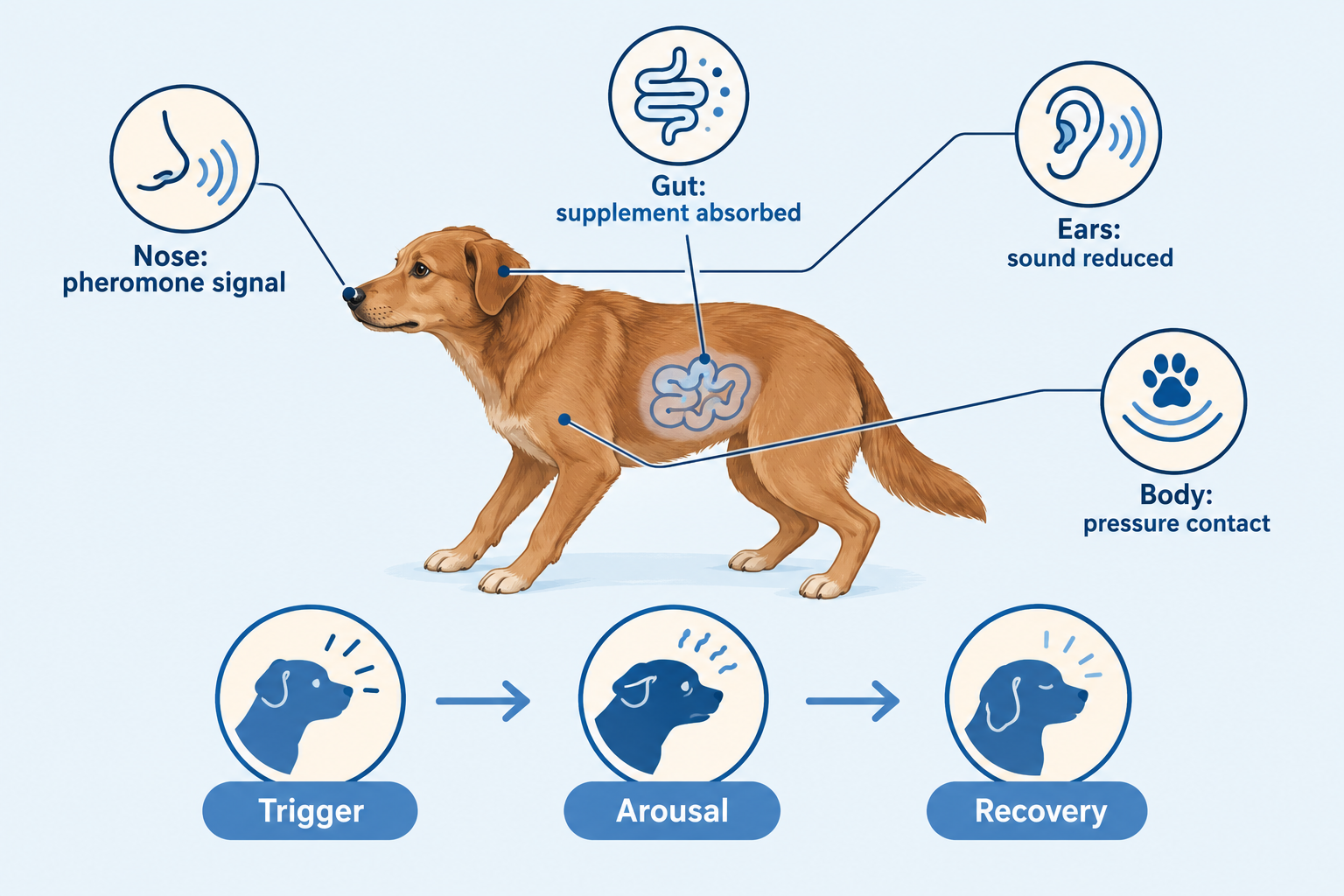
The intended mechanisms are easy to describe and much harder to prove:
- Pheromone analogues copy the chemical signal a nursing mother produces, delivered by collar, spray, or plug-in diffuser.
- Milk-protein derivatives such as alpha-casozepine act on receptors linked to relaxation.
- Amino acids such as L-theanine and L-tryptophan feed into neurotransmitter pathways tied to mood regulation.
- Pressure wraps apply steady torso contact, with the theory borrowed loosely from human sensory work.
- Sound control reduces the actual trigger, which is the one mechanism nobody argues about.
One thing to keep straight while reading labels: every veterinary source worth trusting treats these products as adjuncts. The Merck Veterinary Manual’s position is that medication or supporting products may stabilize an anxious dog enough to make learning possible, and lasting improvement still depends on behavior modification. VCA makes a similar point, noting that supplements may be reasonable for mild problems and are rarely sufficient on their own, with management, desensitization, and counterconditioning doing the durable part.
Do calming treats for dogs actually work?
Some do something, mildly, in some dogs. The honest summary is that a few ingredients have measurable effects in small trials, effect sizes are modest, and most of the specific chews on shelves have never been tested as sold. A tub containing chamomile, passionflower, ginger, and 4 mg of something interesting is not the same product that was studied.
The clearest demonstration of “mild” comes from a 2025 crossover study in Frontiers in Veterinary Science by Hannah Flint, Jennifer Weller, Alysia Hunt, and Tammie King. Fifty-four dogs went through a standardized car-travel stress test. A product combining CBD with L-tryptophan and alpha-casozepine produced a statistically smaller cortisol rise than placebo. No other treatment effect reached significance, and the authors described the effect as mild. That is what a real positive result looks like in this category: one hormone marker moved, and the dogs did not become different animals.
What is the difference between calming chews and anxiety medication for dogs?
Calming chews are food supplements with no premarket efficacy review, variable active ingredient amounts, and mild expected effects. Prescription anxiety medication is a regulated drug with required efficacy and safety data, a diagnosis behind it, and a veterinarian monitoring the dose.
| Feature | Calming chews and supplements | Prescription anxiety medication |
|---|---|---|
| Regulation | Sold as supplements, no efficacy review before sale | Approved drugs with required trial data, or legally prescribed off label |
| Who decides the dose | You, from a label based on body weight | Your veterinarian, adjusted by response |
| Realistic effect | Mild, better suited to low-level stress | Can meaningfully reduce panic in diagnosed cases |
| Best use | Mild situational stress, vet visits, car trips, support alongside training | Noise phobia, separation distress, generalized anxiety disorders |
A dog who destroys a door frame when left alone is not an under-supplemented dog. That is a case for a veterinary behavior assessment, prescription support if indicated, and a structured plan. Supplements can ride along. They should not be the plan.
Are natural calming products safe for dogs?
Not automatically. VCA warns that supplements can cause gastrointestinal effects, interact with medications, and be a poor choice for dogs with severe phobias, aggression, existing medical disease, or pregnancy. Dose stacking is the quiet risk: owners often give a chew, a diffuser, and a herbal tincture at once, then wonder why the dog is drooling.
Three safety habits worth adopting before fireworks week:
- Tell your veterinarian every product you plan to use, especially if the dog takes any prescription medication.
- Trial one new product at a time, on a normal day, so you can tell what caused what.
- Read the full ingredient list for xylitol, which is toxic to dogs and appears in some human-marketed soft chews.
Which calming products for dogs have real evidence? The 8 options ranked
Ranked by published evidence quality rather than popularity or shelf space. Nothing here earns a “strong” label, because the studies are small and short. Affiliate disclosure: Doggy Rank IQ earns commission on some product links. Commission plays no part in this order. Review method for this piece is evidence review of peer-reviewed studies and veterinary references, not hands-on product testing.
1. Dog-appeasing pheromone (collar, diffuser, spray)
Evidence: some, mixed by situation. In a randomized thunderstorm-simulation study of 24 Beagles, a dog-appeasing pheromone collar significantly improved global fear scores and active fear scores compared with placebo. Broader reviews of pheromone research in dogs have been less uniform, rating evidence moderate for some thunderstorm behaviors, weak for stress in hospitalized dogs, and insufficient to show that collars, sprays, or diffusers beat each other.
Who it suits: noise-sensitive dogs, new arrivals settling in, crate work. Drawback: collars need skin contact and several days to build, and a diffuser only treats the room it is plugged into. A 2026 controlled study of 12 laboratory dogs found that a maternal bovine appeasing substance did not significantly reduce barking across 22,502 decibel readings. That product is a different species-derived substance, and the lesson still travels: “pheromone” on a box is not one product category.
2. Alpha-casozepine (milk protein hydrolysate, sold as Zylkene and in combination chews)
Evidence: some, for mild stress and clinic visits. A 2025 randomized, blinded, placebo-controlled crossover study gave 20 privately owned dogs 15 mg/kg daily for six days before veterinary examinations. Stress-related postures and veterinarian-assessed stress scores were lower on treatment, while autonomic measures did not change. Twenty dogs is a small sample, and the setting was a clinic, not a street full of rockets.
Who it suits: dogs who tense up at the vet, groomer, or in new places. Give it days ahead, not minutes.
3. L-theanine (sold as Anxitane and in many blends)
Evidence: some, limited quality. VCA identifies Anxitane, a branded L-theanine product, as potentially useful for fear and anxiety, while stressing that studies are small and supplements skip the premarket efficacy review that approved drugs face. L-theanine is one of the more defensible ingredients on a label, which is not the same as a reliable result.
Who it suits: mild to moderate situational anxiety, often alongside training. Watch out for blends where theanine appears last on the list in a token amount.
4. CBD in a combination formula
Evidence: emerging, effect mild, legal status unsettled. The 54-dog car-travel study above is the most relevant recent canine work, and it tested CBD with L-tryptophan and alpha-casozepine, so the CBD contribution alone is unknown. The FDA states plainly that it cannot assure the safety, quality, or effectiveness of animal CBD products. Product-to-product variation in actual cannabinoid content is a real purchasing risk.
Who it suits: owners willing to discuss it with their veterinarian first, for mild travel or handling stress. Not a fireworks solution for a dog who panics.
5. Pressure wraps (Thundershirt and similar vests)
Evidence: weak. A 2025 systematic review of compression wraps for canine anxiety found only three experimental studies, covering firecracker sounds, thunderstorm sounds, and separation. Three studies is a much thinner base than the marketing suggests. Wraps are cheap, reusable, and low risk, which is why they stay popular, and popularity is not data.
Who it suits: dogs who already tolerate clothing, as one layer in a bigger plan. Fit matters more than brand, so check the measurement chart against your dog’s chest girth rather than guessing from weight.
6. Ear covers and noise reduction gear
Evidence: weak as published research, sound mechanics are not in doubt. Reducing the volume of the trigger is the most direct intervention available on a fireworks night, and formal canine trials for consumer ear muffs are scarce. Many dogs refuse them outright without gradual, reward-based conditioning over weeks.
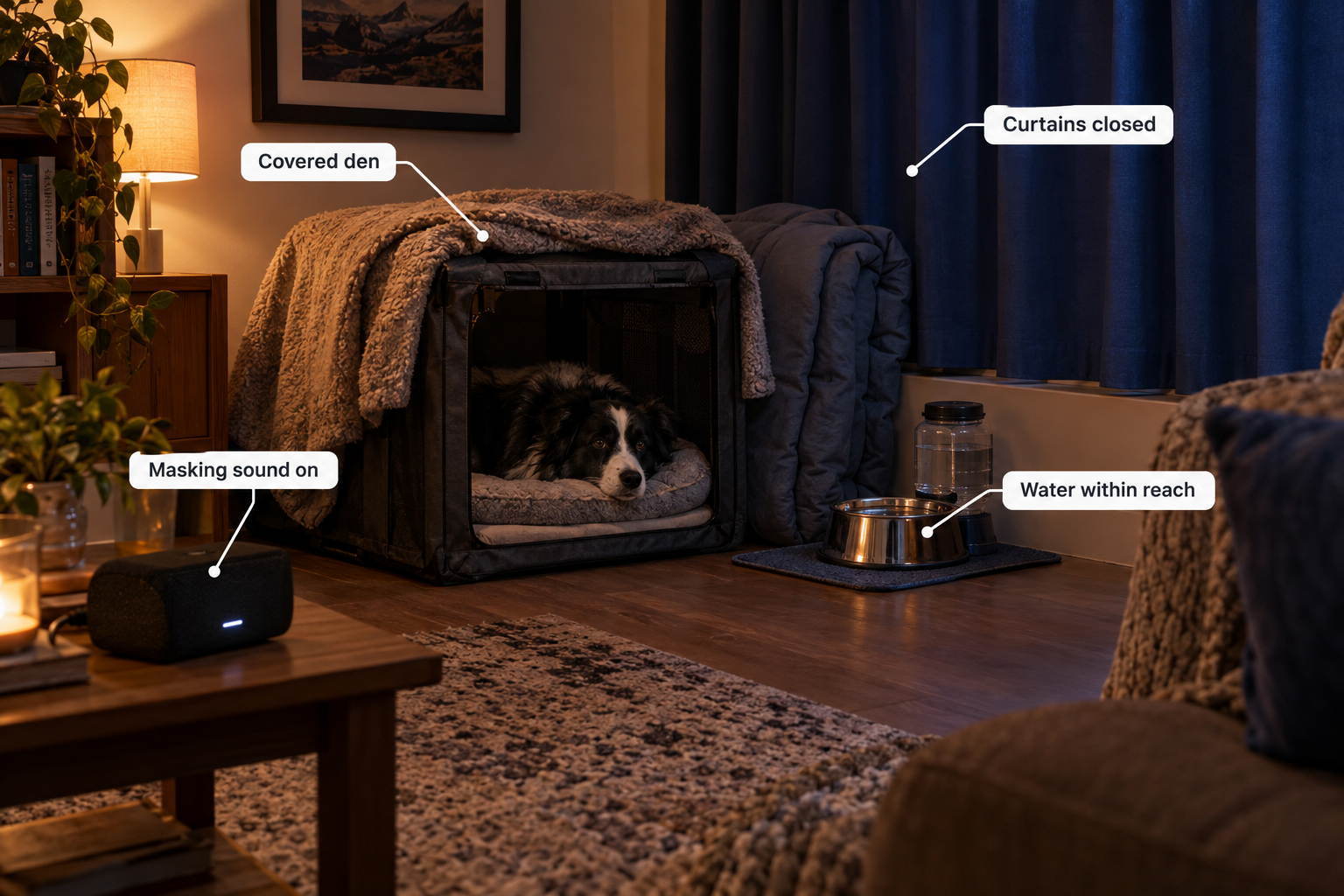
Who it suits: dogs with existing muzzle and gear tolerance, owners who start conditioning in October rather than on November 5. A covered crate against an interior wall with the curtains closed achieves part of the same goal for free.
7. Calming music and sound masking
Evidence: weak and setting-limited. Most of the published work on music for dogs comes from kennel and shelter environments and measures behavior there, which is a long way from a terrier under a sofa during a fireworks display. Masking sound does have an obvious use: it blurs the gap between a bang and silence, which is often when a startled dog re-alerts.
Who it suits: everyone, because it costs nothing and carries no risk. Expect masking, not magic. If your dog’s resting behavior looks unusual on quiet nights too, what research tells us about how much dogs sleep is a useful baseline read.
8. Melatonin
Evidence: weak for canine anxiety. Melatonin is widely used in practice for noise aversion and is often recommended informally, and controlled canine data for anxiety outcomes is limited. Dose, product purity, and the xylitol risk in human gummy formulations all make this one to clear with a veterinarian first rather than buying from a supermarket shelf.
Who it suits: discuss with your veterinarian. Do not improvise from a human bottle.
Honorable mention, strain specific: a 2025 study of Lactiplantibacillus plantarum LP815 reported significant improvements in anxiety (p=0.0005) and aggression (p=0.0047) versus placebo. That result belongs to that strain, not to probiotics in general, so a random gut supplement does not inherit the finding.
Comparison table: calming products for dogs at a glance
| Product type | Active element | Evidence | Best for | Onset |
|---|---|---|---|---|
| Pheromone collar (Adaptil) | Dog-appeasing pheromone | Some, mixed | Storms, fireworks, settling in | Days |
| Milk protein capsule (Zylkene) | Alpha-casozepine | Some | Vet visits, travel, mild stress | Several days |
| L-theanine tablet (Anxitane) | L-theanine | Some, small studies | Mild to moderate fear | Hours to days |
| CBD combination chew | CBD, L-tryptophan, casozepine | Emerging, mild | Car travel, handling | 1 to 2 hours |
| Pressure wrap (Thundershirt) | Torso compression | Weak | Dogs used to wearing gear | Minutes |
| Canine ear covers | Noise attenuation | Weak | Pre-conditioned dogs | Immediate |
| Calming music or masking audio | Sound masking | Weak, kennel settings | Any noise event | Immediate |
| Melatonin | Melatonin | Weak for anxiety | Vet-directed use only | 30 to 60 minutes |
How much do dog calming products cost, and which dogs benefit most?
Expect roughly 15 to 40 US dollars for a month of a mainstream supplement, 20 to 35 for a pheromone collar, 25 to 40 for a diffuser kit with refills, 35 to 50 for a pressure wrap, and 40 to 60 for canine ear covers. Those are estimates based on typical mainstream retail listings rather than a price checked on a single date, so verify current prices before buying.
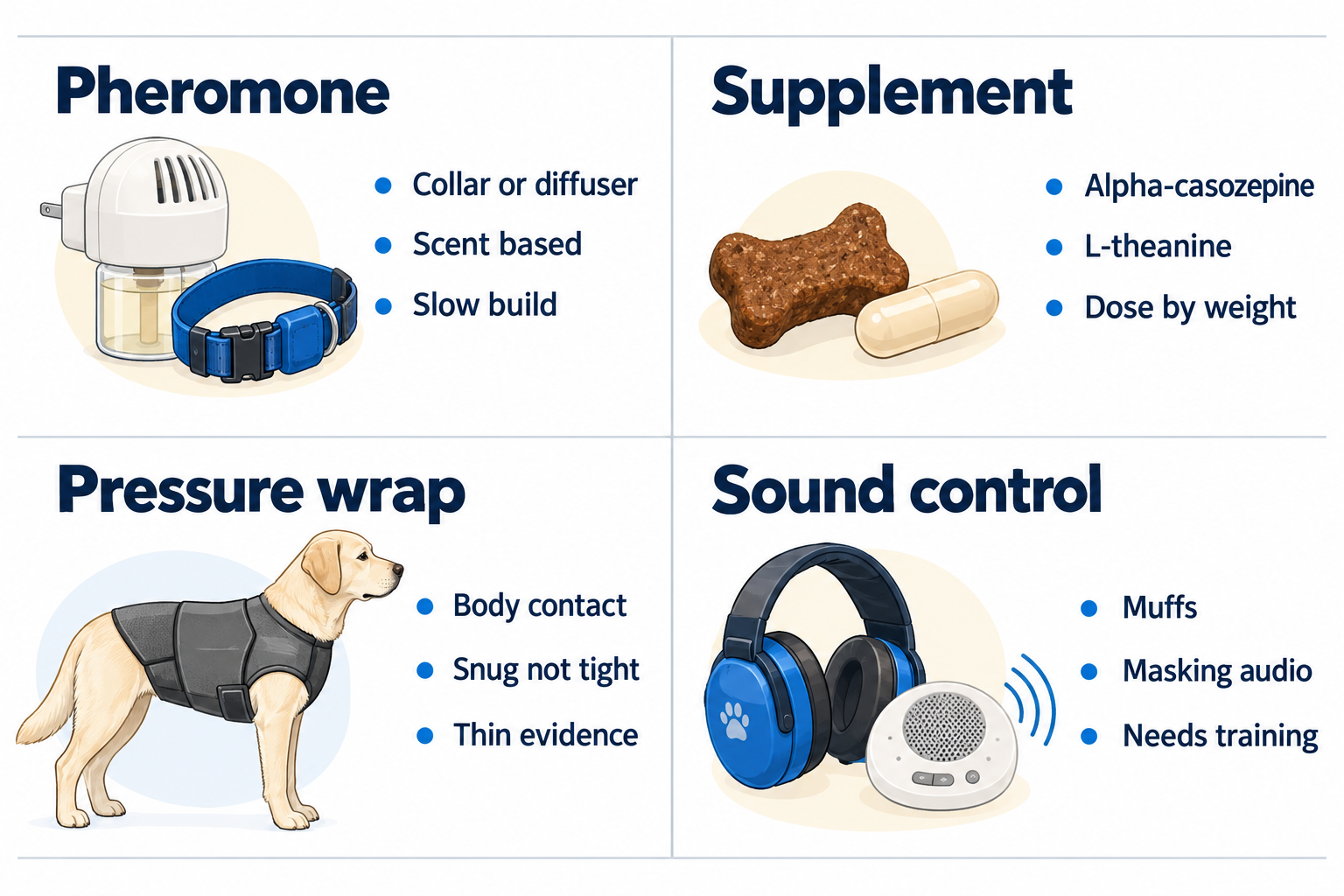
The dogs who benefit most from calming supplements are the mildly stressed ones: a dog who gets fidgety in the car, stiff in the waiting room, or unsettled by a thunderclap but recovers within minutes. Those are the conditions the studies tested, and those are the dogs most likely to show a difference you can see.
The dogs least likely to benefit are the ones most owners are shopping for. Severe noise phobia, panic when left alone, and fear-based aggression all sit outside what a chew can reach. For context on where fear and bite risk overlap, why dogs bite their own owners and how to prevent it covers the warning signs worth taking seriously.
Decision rule: if your dog’s worst reaction resolves on its own within about ten minutes and never involves injury, escape attempts, or self-harm, a supported product plus environment changes is a reasonable first step. If any of those three appear, book the vet appointment first and treat products as support.
What do vets recommend to calm dogs before fireworks?
Veterinary guidance for fireworks season centers on three things: prepare early, control the dog’s environment, and arrange prescription support in advance if the dog has a history of panic. Products come last in that order, not first. Clinics get calls on November 5 asking for something that works tonight, and the honest answer is that most calming products need days of lead time.
A practical setup most veterinary behavior sources support:
- Build a covered den in an interior room, available for weeks before the event, never forced.
- Close curtains, leave lights on, and run masking sound from early evening.
- Walk and feed before dusk, and keep the dog on a secure lead in the yard.
- Start a pheromone collar or alpha-casozepine course several days ahead where the label allows.
- Stay normal and available. Comforting a frightened dog does not reinforce fear.
Which calming products for dogs suit separation anxiety, fear, or aggression?
Separation distress, noise fear, and aggression are different problems, and the product that helps one may be irrelevant to another. The sorting question is simple: can the dog escape the trigger, and does it recover?
- Separation anxiety: the trigger is your absence, so no product removes it. Veterinary references put graduated absence training at the center, with supplements or prescription medication as support. Expect weeks, not a weekend.
- Fearful dogs (noise, strangers, handling): these dogs do best with trigger reduction plus counterconditioning. Pheromone and the better supplements belong here, because the studies that exist were run on fear responses.
- Aggressive dogs: aggression is usually fear or resource defense with teeth attached. VCA specifically cautions against treating aggression with supplements alone. Diagnosis comes first, and safety management comes with it. Reading on dog behavior and what it signals helps, and a professional assessment does more.
Edge case worth naming: an older dog who suddenly develops noise sensitivity or night pacing may be in pain or dealing with cognitive change. New anxiety in a senior dog is a medical question before it is a shopping question. Our health and care section is a starting point, and the exam room is the next stop.
Why isn’t my dog’s calming supplement working? Common mistakes
Most failures come down to five fixable things: the wrong dose for the dog’s weight, no loading period before the event, a trigger too intense for a mild product, an unrealistic expectation of sedation, and no training plan running alongside. Individual variation also matters. Two Labradors of the same weight can respond differently to the same chew.
Common mistakes with calming products for dogs:
- Giving one chew ten minutes before the first rocket. Several of the better supported ingredients need days.
- Under-dosing a large dog. Labels dose by body weight for a reason.
- Expecting drowsiness. Reduced arousal looks like a dog who settles sooner, not a dog who sleeps through bangs.
- Stacking four products at once. You learn nothing, and you raise the risk of gut upset.
- Skipping the training. Behavior change is where lasting improvement comes from, and humane, reward-based training is the part no supplement replaces.
- Judging after one night. A single fireworks display is a terrible test condition.
Can you give dogs too many calming treats?
Yes. Exceeding the label dose does not increase the calming effect reliably, and it does raise the chance of vomiting, diarrhea, or excess sedation, particularly with melatonin or formulas containing multiple actives. Calming chews also carry calories, and a few extra per day adds up in a small dog. If you have doubled a dose and seen no change, stop and call your veterinarian rather than tripling it.
When is a calming product not enough?
A calming product is not enough when your dog’s fear response causes harm, lasts hours, or gets worse year on year. Those are signs of a clinical anxiety disorder, and veterinary references distinguish that clearly from mild situational stress.
Book a veterinary appointment, and ask for a referral to a veterinary behaviorist, if your dog:
- injures itself, breaks teeth, or bloodies paws trying to escape
- cannot be interrupted or redirected with food during an episode
- shows trembling, panting, or hiding for hours after the noise stops
- loses house training, refuses food, or stops drinking around trigger events
- has started showing aggression toward people or other dogs
- is getting measurably worse each fireworks season
Pain, thyroid disease, and age-related cognitive change can all present as anxiety. A physical exam is part of the answer, not a detour around it.
How do you pick a safe calming chew?
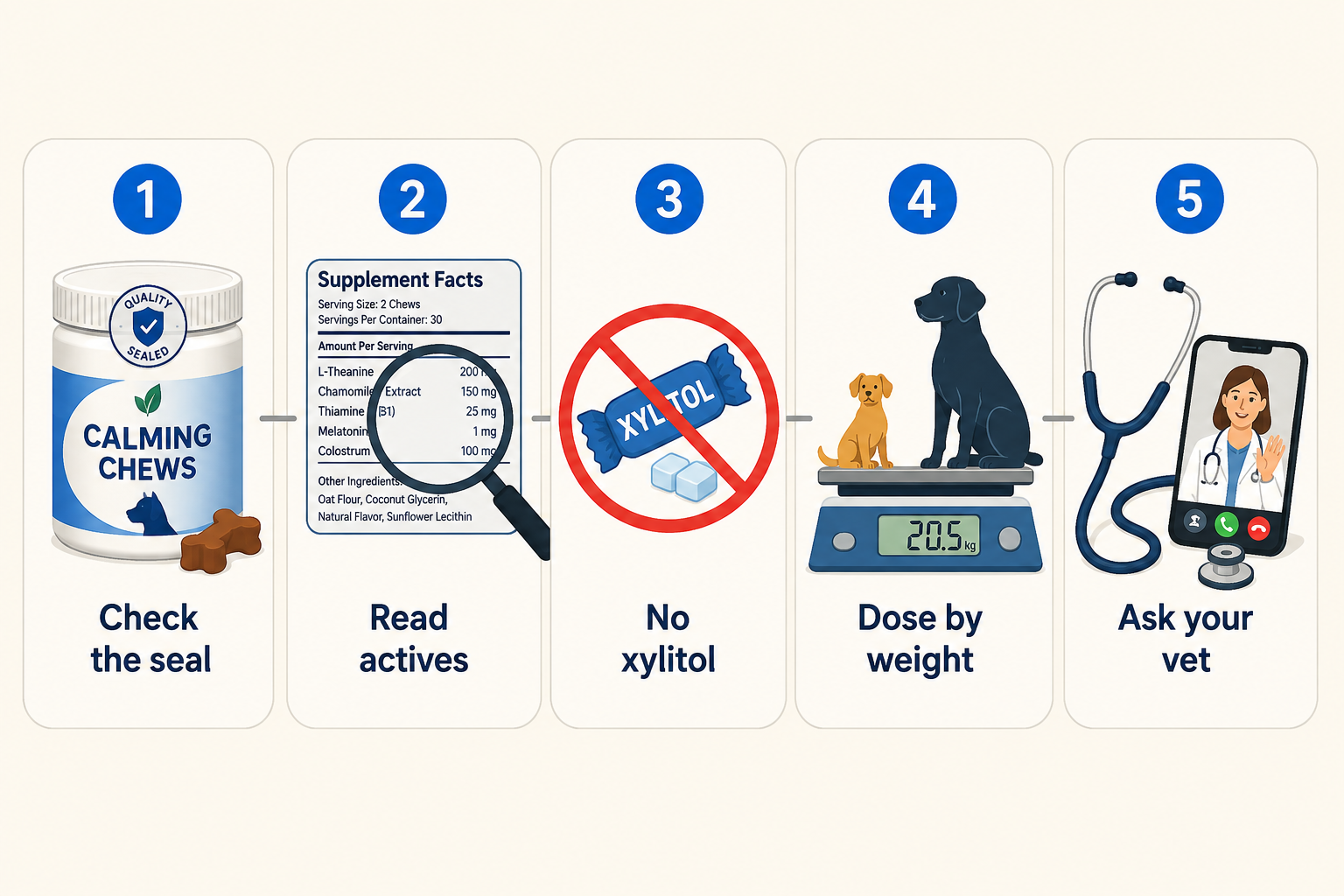
Choose a chew that names its active ingredients with amounts per chew, doses by body weight, carries a recognized quality seal such as the NASC Quality Seal, and contains no xylitol. Then check the amount of the active you actually care about rather than the length of the ingredient list.
A short label audit before you buy:
- Named actives with quantities. “Proprietary calming blend” tells you nothing. L-theanine, alpha-casozepine, or L-tryptophan with milligrams per chew tells you something.
- A quality seal. NASC membership signals audited manufacturing practices, not proven efficacy. Those are separate claims.
- No xylitol, no added caffeine, no unexplained “hemp” vagueness. If the label cannot say what cannabinoid content it contains, treat that as a gap.
- Weight-banded dosing. Clear instructions by weight, with a stated loading period if one applies.
- A lot number and expiry date. Basic, and some tubs still fail it.
- A conversation with your veterinarian if your dog takes any medication, is pregnant, or has liver, kidney, or heart disease.
Nobody should call a calming chew vet-approved without naming the basis, and no product in this category is safe for all dogs. If you are buying for a puppy, note that most labels set a minimum age, and a young dog’s unsettled behavior is often normal development plus incomplete training. Teaching the basics first often helps more, which is why the five commands every puppy should learn is the cheaper starting point.
FAQ
What is the most effective calming aid for dogs?
There is no single most effective option. For mild to moderate situational fear, dog-appeasing pheromone and alpha-casozepine have the most supportive published studies, with mild effects. For severe anxiety, veterinarian-prescribed medication combined with behavior modification outperforms over-the-counter calming products for dogs.
How can I calm my dog down instantly?
Reduce the trigger and remove the pressure. Move the dog to an interior room, close curtains, turn on masking sound, offer a covered den, and stop asking anything of the dog. No supplement works instantly, and forcing a frightened dog into the open makes things worse.
Do vets recommend calming products for dogs?
Many veterinarians recommend them for mild stress, usually alongside behavior work. Veterinary references including VCA and the Merck Veterinary Manual treat supplements and pheromones as adjuncts rather than treatments, and they consistently place behavior modification and veterinary assessment at the center of care.
What is the 3-3-3 rule for dog anxiety?
The 3-3-3 rule is a rescue adjustment guideline, not a treatment for anxiety: roughly three days of decompression, three weeks to learn the routine, three months to settle in. It is a useful expectation setter for new adopters and has no published research behind the exact timeframes.
Are calming treats safe for puppies?
Only if the label states a minimum age and your veterinarian agrees. Most unsettled puppy behavior is normal arousal and incomplete training, not clinical anxiety, so routine, enrichment, and reward-based teaching usually help more than a chew.
Do home remedies for dog anxiety work?
Environmental changes work best among home options: a covered den, closed curtains, masking sound, exercise earlier in the day, and calm company. Herbal remedies have little canine evidence, and some human products contain ingredients toxic to dogs, so check with a veterinarian first.
How long before fireworks should I start a calming product?
Three to seven days for pheromone collars and alpha-casozepine courses, and the night before at the latest for anything label-dosed daily. For prescription options, contact your veterinarian two to four weeks ahead so there is time for a trial dose on a quiet evening.
Conclusion: a fireworks-week plan
Work backwards from the date. Three to four weeks out, book the vet if your dog has a history of panic, and begin conditioning ear covers or a wrap if you plan to use them. One week out, start the pheromone collar or diffuser and begin a supplement course with named actives and weight-based dosing. Three days out, trial everything on a normal evening so there are no surprises. On the night, set up the den, close the curtains, run masking sound, feed and walk before dusk, keep the yard secure, and stay with your dog.
Then write down what happened. Which products you used, what dose, what time, and how long the dog took to settle. That record is what turns next year from a guess into a decision, and it is the single most useful thing an owner can do with calming products for dogs.