
Quick Answer
Why are dog noses wet? A dog’s nose stays moist because nasal glands produce mucus and watery fluid that helps trap scent particles, and because dogs lick their noses to clean them and move odor molecules toward the roof of the mouth (vcahospitals.com). The wetness also humidifies incoming air and supports a small amount of evaporative cooling (vcahospitals.com). A dry nose is not automatically a sign of illness. It can simply mean your dog just woke up, sat in the sun, or has a naturally drier nose on any given day (vetmed.tamu.edu).
Key Takeaways: why are dog noses wet
- Why are dog noses wet comes down to mucus production, licking, and moisture from the environment, not one single cause (vcahospitals.com).
- A cold, wet nose does not prove a dog is healthy, and a warm, dry nose does not prove a dog is sick (pursuit.unimelb.edu.au).
- Moisture helps odor molecules stick to the nose so scent receptors can detect them (pmc.ncbi.nlm.nih.gov).
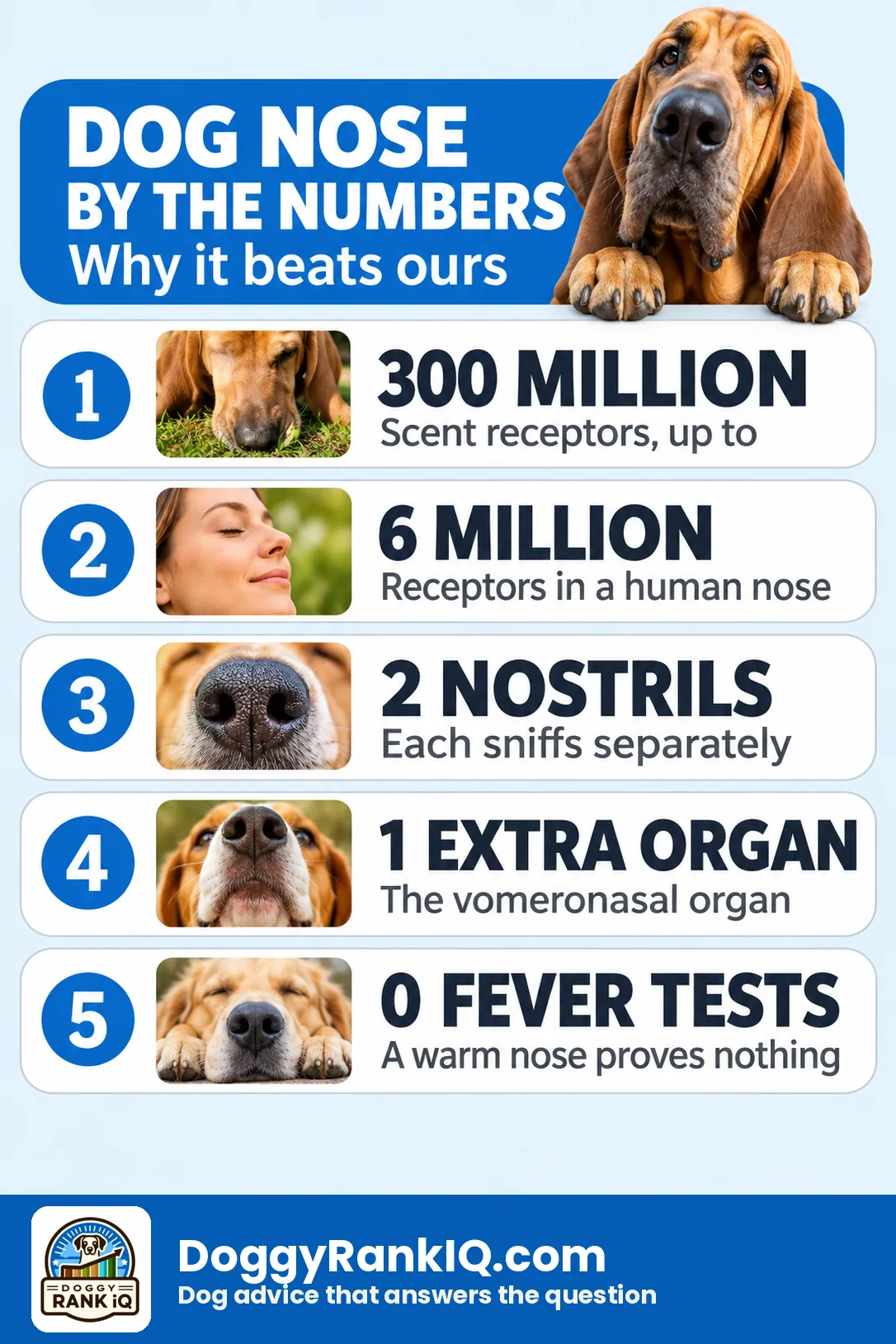
- Dogs have roughly 220 million olfactory receptors, compared to about 5 to 6 million in humans, and nose moisture is one small piece of that system (pmc.ncbi.nlm.nih.gov).
- Nasal evaporation adds a little cooling, but panting and paw pad sweat do the real work (vcahospitals.com, webmd.com).
- Dry noses are common after sleep, sun exposure, wind, aging, or exercise (vetmed.tamu.edu).
- See a vet for cracking, bleeding, color loss, sores, or thick discharge, not for a warm nose alone (vcahospitals.com).
- Each dog’s nose print is unique, similar to a human fingerprint.

What does the nose look like?
Tap an option to see the answer.
The short answer: why are dog noses wet?
Why are dog noses wet most of the time? Nasal glands inside the nose produce mucus and watery secretions, and dogs add to that moisture by licking and by investigating damp grass, puddles, and bowls (vcahospitals.com). The result is a nose that functions less like decoration and more like a tool.
Texas A&M veterinary lecturer Dr. Erin Ray has pointed out that wetness varies with hydration, licking habits, climate, and even underlying nasal conditions, so one dog’s “normal” can look different from another’s (vetmed.tamu.edu). That variation is part of why so much confusion exists around this topic.
A University of Melbourne explainer published in October 2025 goes further. Associate Professor Leonie Richards calls the healthy-equals-wet-nose idea an “old wives’ tale,” noting that nose moisture “doesn’t really tell us much at all” about a dog’s overall health (pursuit.unimelb.edu.au). The nose is doing real work. It is just not the health gauge people were told it was.
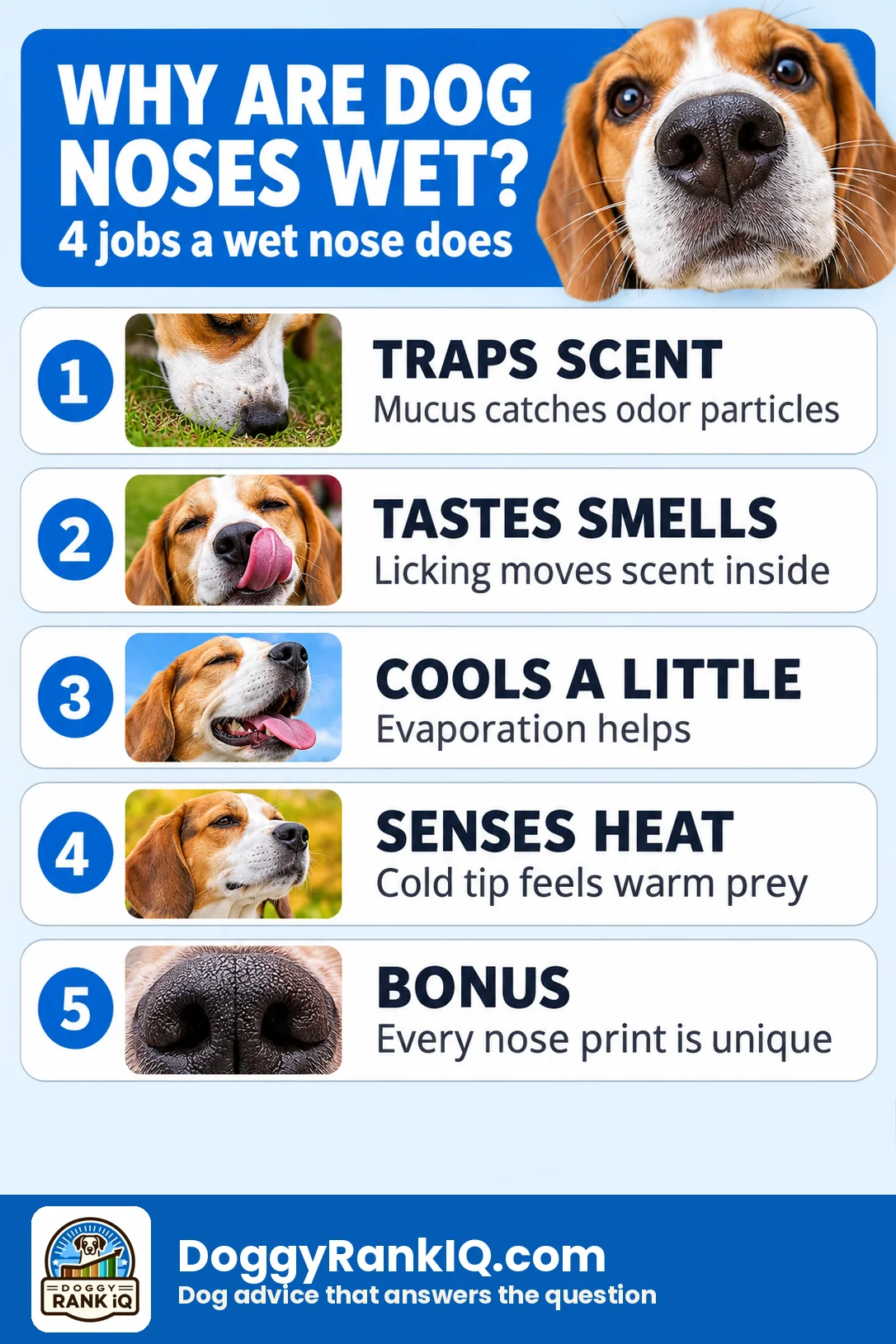
4 surprising jobs a wet nose does
1Trapping scent particles for better detection
A wet nose helps odor molecules dissolve into the mucus layer, which brings those molecules into closer contact with scent receptors inside the nose (pmc.ncbi.nlm.nih.gov). Dry receptor surfaces interfere with normal smell processing, according to the veterinary research review published in Frontiers in Veterinary Science (pmc.ncbi.nlm.nih.gov).
This is the job most vet sites mention, and for good reason. It is the clearest, best-supported function on this list.
2Humidifying the air a dog breathes in
Moisture inside the nasal passages keeps the respiratory tract and the olfactory epithelium (the scent-detecting tissue) from drying out during normal breathing (pmc.ncbi.nlm.nih.gov). A dry mucosal surface can reduce how well odorants interact with receptor cells, which matters most for working dogs doing scent detection for long stretches (pmc.ncbi.nlm.nih.gov).
3Supporting a small amount of cooling
Nasal glands produce watery fluid that evaporates off the nose surface, adding a modest cooling effect (vcahospitals.com, webmd.com). This should not be mistaken for the dog’s main cooling system. Panting remains the primary way dogs lose heat, with additional heat loss through the paw pads (webmd.com). In fact, heat stress and heavy panting can reduce airflow over the olfactory epithelium and temporarily dull a dog’s sense of smell (pmc.ncbi.nlm.nih.gov).
4Helping dogs transfer scent to the vomeronasal organ
Licking the nose does more than tidy it up. It can carry scent compounds toward the roof of the mouth, where the vomeronasal (Jacobson’s) organ helps process chemical information, including social and reproductive cues (vcahospitals.com). This connects to one of the reasons why dogs lick you and surfaces so often in everyday behavior.
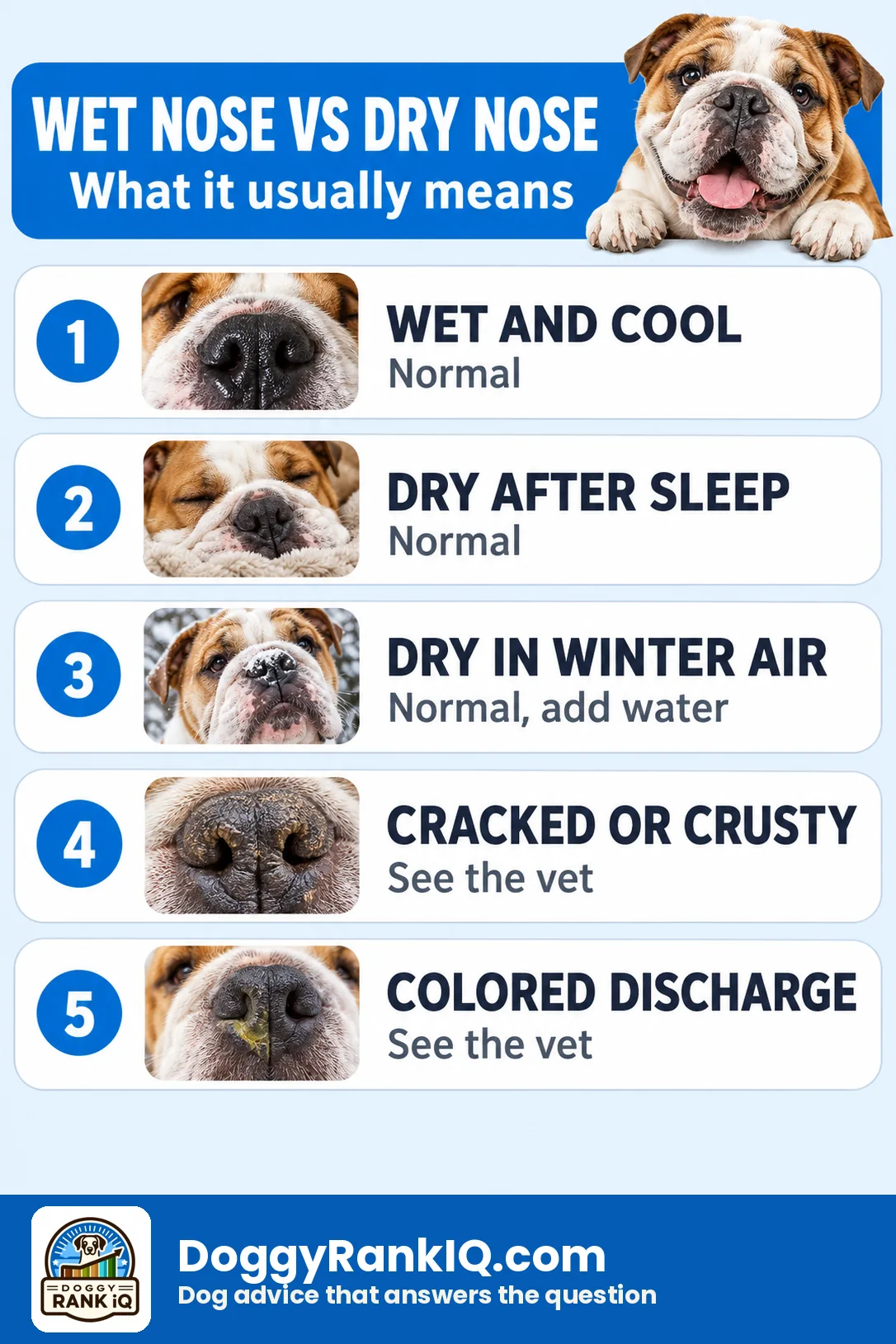
Facts table: dog wet nose vs dry nose
This table answers “why are dog noses wet” at a glance.
Decision rule: if the nose change comes with normal eating, energy, and behavior, it is probably not urgent. If it comes with lethargy, appetite loss, or visible sores, book a vet visit.
What does it mean when a dog’s nose is wet and cold?
A wet, cold nose usually just means the dog has been licking it, drinking water, sniffing damp ground, or sitting in a cool room (vcahospitals.com). It is a snapshot of recent activity and environment, not a built-in health meter.
This is the piece most owners get wrong. The cold, wet nose became shorthand for “healthy dog” decades ago, but veterinary sources now push back on that directly (pursuit.unimelb.edu.au, webmd.com). A dog recovering from illness can still have a perfectly cool, moist nose, and a completely healthy dog can have a warm one after a nap in a sunbeam. The nose temperature test simply was not built to catch illness the way a thermometer is.
Why are dogs’ noses wet and sometimes dry?
Noses fluctuate through the day because the moisture comes from several shifting sources at once: internal gland secretions, licking frequency, humidity, and recent activity (vcahospitals.com). None of those stay constant for 24 hours.
A dog that just finished playing fetch, panting hard in dry air, will likely have a drier nose than that same dog ten minutes later after a drink of water. Add individual variation between dogs, and “sometimes dry” becomes the expected pattern rather than the exception (vetmed.tamu.edu). Breeds with shorter muzzles, for instance, often show more visible nose licking simply due to facial structure, though this varies dog to dog.
Can some dogs have naturally drier noses than others? Yes. Age, breed structure, and even a dog’s individual gland activity play a role, and a vet who knows the dog’s baseline is in the best position to say what’s typical for that particular animal.
💧 Where the wet comes from: glands, tears and a lot of licking
Ask why are dog noses wet and most answers skip the plumbing. There are three sources, and only one of them is the tongue.
The first is a pair of lateral nasal glands inside the nose. They release a thin, watery fluid toward the front of the nasal passage, and the output climbs as a dog warms up. Physiologists described this in 1972 in the journal Science, in a paper on panting that treated the glands as a built-in water supply for evaporative cooling. The second source is tears. A small duct runs from the inner corner of each eye down into the nose, so some of what the eye makes ends up at the nostril. (It is the same reason your own nose runs when you cry.) The third is ordinary mucus from the lining of the nasal passages.
Licking spreads all of it across the leathery surface and tops it up. A dog who is asleep stops licking, the surface dries in the air, and you get the warm, dry nose that worries people at 6 a.m. Ten minutes after waking it is usually damp again.
“A dry nose at 6 a.m. usually means the dog was asleep and the tongue was off duty.”
👃 How a dog sniffs: the reason for the slits
Look at the side of a dog’s nostril and you will see a slit curving back from the round opening. It has a job.
Brent Craven and colleagues at Penn State modeled the airflow through a dog’s nose and published the work in 2010. Air comes in through the round front of the nostril. On the exhale, it leaves through the side slits and is pushed back and to the sides, away from whatever the dog is investigating. The outgoing breath does not blow the scent off the ground. A dog working a trail repeats this about five times a second.
The same research showed that each nostril pulls air from its own small region of space. Two samples, slightly apart, give the brain a left and right comparison, which helps a dog work out which direction a smell is coming from. Moisture is part of that system, because odor molecules dissolve into the wet layer before they reach the receptors.
🐶 Flat faces, old noses and the dogs who run dry
Some dogs have a harder time keeping the surface wet, and illness has nothing to do with it.
Pugs, Bulldogs, Boxers and other short-muzzled breeds often cannot reach the top of the nose with the tongue. The upper half stays dry and can turn crusty. Older dogs of any shape may build up extra keratin on the nose, a rough, horny layer vets call nasal hyperkeratosis. It is usually a comfort problem. A vet can confirm what it is and show you how to soften it safely.
Dogs with blocked tear ducts lose one of the three water sources, and dogs who sleep beside a heating vent lose moisture faster than they replace it. In both cases the nose is telling you about the plumbing or the room. It says little about whether the dog has a fever. For that, the only reliable tool is a thermometer.
🚩 When a wet nose is too wet
A clear, watery drip on a hot day or after a hard run is the cooling system doing its work. The things worth a call to the vet look different:
- Discharge from one nostril only
- Thick yellow, green or bloody discharge
- Sneezing fits that start suddenly after a walk in tall grass
- Noisy breathing or pawing at the face
One-sided discharge deserves a prompt exam, because a grass seed, a tooth root problem or a growth can sit behind it.
☀️ Sun, snow and the pale nose
Dark noses come with built-in sun protection. Pink and partly pink noses do not, and they burn. White Bull Terriers, Dalmatians, Australian Shepherds with pink patches and any dog whose nose fades in winter are the usual patients. A burned nose looks red, then dry and flaky, and repeated burns raise the risk of skin cancer on that spot.
Shade and timing do most of the work: walk early or late in high summer. For beach and snow days, use a sunscreen made for dogs. Human products are a problem because dogs lick their noses, and zinc oxide, a common ingredient, is harmful when swallowed. Dab on a thin layer, then distract the dog with a short game for a few minutes while it soaks in.
👅 Nose licking as a message
Licking keeps the nose wet, and it also says something. A quick tongue flick over the nose with no food around is one of the small signals dogs give when they are uneasy. Natalia Albuquerque and colleagues reported in 2018 that dogs licked their mouths more often when shown angry human faces than happy ones. You will see the same flick at the vet, during a hug from a stranger or when a camera is pushed close.
One flick is conversation. Constant licking with drooling, gulping or lip smacking is different and often points to nausea or something stuck in the mouth, which is a reason to call your vet.
⭐ Top 5 Features We Love
- Built-in scent trap. The mucus layer helps catch odor molecules before they drift away, aiding the detection work behind how dogs’ sense of smell outperforms ours so dramatically.
- Self-cleaning design. Licking clears dust and food debris without any product or effort from the owner.
- A built-in ID tag. Each dog’s nose print is as individual as a fingerprint, a detail explored further in our dog nose print guide.
- A backup cooling assist. Nasal evaporation adds a small cooling boost alongside panting on hot days (vcahospitals.com, webmd.com).
- A social signal reader. The vomeronasal connection means the nose participates in reading other dogs, not just the environment.
⚠️ Things to Look Out For
A few cautions for anyone asking “why are dog noses wet”:
- Cracking or crusting that doesn’t resolve with basic moisturizing.
- Sudden color loss on a previously pigmented nose.
- Thick, colored, or foul-smelling discharge instead of clear moisture.
- Nosebleeds, which are never a normal variation (vcahospitals.com).
- Persistent dryness paired with lethargy or appetite loss, which points to something beyond simple dehydration or sun exposure.
If your dog is doing something that worries you beyond nose texture, our guide to dog body language warning signals can help you figure out what else to watch.
How to care for a dry, cracked nose
Mild dryness from sun, wind, or indoor heating often responds to a dog-safe nose balm applied in a thin layer. Avoid human lotions, which can contain ingredients unsafe for dogs to lick off.
Keep fresh water available, since dehydration can contribute to a drier nose surface; a dog water fountain can encourage dogs who drink less than they should. If cracking persists beyond a week, worsens, or comes with bleeding or swelling, stop the home care and check with a veterinarian, since some nasal issues need a prescription treatment rather than balm.
Helpful nose care products
These products address dryness and cracking specifically. They are not treatments for infections, growths, or anything beyond ordinary surface dryness, and persistent problems still need a vet’s opinion.
- Natural Dog Company Snout Soother Nose Balm, 1 oz Tin is a plant-based balm marketed for dry, cracked noses. Price checked 2026: $15.49. Check the current price.
- Natural Dog Company Snout Soother Travel Stick is a smaller stick format for bags and travel kits. Price checked 2026: $6.49. Check the current price.
- Large Stainless Steel Dog Water Fountain, 4 gallon supports hydration, which can indirectly affect nose moisture. Price checked 2026: $60.99. Check the current price.
- Inside of a Dog by Alexandra Horowitz explains canine sensory perception for readers who want the fuller science. Price checked 2026: $11.21. Check the current price.
Owners managing broader care routines might also want our lick mat recipes and reviews, since lick mats keep dogs occupied during grooming or balm application.
FAQ: why are dog noses wet
The bottom line: why are dog noses wet?
Why are dog noses wet? Mostly because mucus, licking, and environment moisture work together to support scent detection, humidify incoming air, and add a touch of cooling (vcahospitals.com, pmc.ncbi.nlm.nih.gov). A dry nose on its own rarely means trouble. Watch instead for cracking, bleeding, color changes, or discharge, and bring those to a veterinarian rather than relying on nose temperature as a stand-in diagnosis (vcahospitals.com, pursuit.unimelb.edu.au). For now, a quick balm application and a full water bowl cover most ordinary dryness, and anything beyond that is worth a professional look.
Doggy Rank IQ is reader supported. As an Amazon Associate we earn from qualifying purchases, at no extra cost to you.