
A dog’s dog dog sense of smell depends less on raw power and more on how air actually moves around a sniff, which explains why your dog can find a crumb under the couch but miss a hot dog hidden ten feet upwind. The nose is remarkable. The wind decides what reaches it.
Dog sense of smell: Quick Answer
Dog dog dog sense of smell works through a split airflow system: most inhaled air goes to the lungs, but a smaller stream gets funneled into a maze of scroll-shaped turbinate bones dedicated purely to smelling. Wind and air currents carry odor molecules in broken, drifting pockets called a scent cone, not a straight line, so distance, wind direction, humidity, and obstacles all change what a dog can actually detect, even when the dog’s biological equipment stays the same.
Key Takeaways
- About 10 to 15% of a dog’s inhaled air goes to the dedicated olfactory region during sniffing, while 80 to 85% goes to the respiratory pathway, according to a 2026 review in Animals.
- Dogs sniff at roughly 5 cycles per second, a rate described in computational modeling work on canine nasal airflow.
- Exhaled air exits mostly through side nostril slits instead of retracing the inhaled path, which keeps fresh odor molecules in contact with olfactory tissue longer.
- A 2026 CU Boulder study found turbulence reshapes odor plumes into intermittent whiffs rather than a smooth gradient, a pattern that may carry directional information for the animal reading it.
- Breed differences in scenting performance are measurable and real, not just folklore, as shown in a 2025 Scientific Reports study on breed differences in olfactory performance.
- Aging changes a dog’s smell function in ways that go beyond general decline, per GeroScience research on aging and dog olfactory performance.
- Dogs sample air through two nostrils independently, a form of stereo smelling that can help them judge timing or concentration differences side to side.
- Brain connectivity tied to smell processing shifts with age and skull shape, according to Scientific Reports research on olfactory brain connectivity.
Doggy Rank IQ Tool
Scent Game Planner

Dogs smell in a cone that moves with the air. Enter the conditions and get where to hide the item and what to watch.
Dog sense of smell: When to Call the Vet
A sudden loss of smell, especially paired with loss of appetite, nasal discharge, sneezing fits, facial swelling, or a head injury, is worth a same-week veterinary visit. Dogs that stop responding to food cues or familiar people by scent, particularly older dogs showing other new behavior changes, should get checked for nasal disease, dental infection, or cognitive decline rather than written off as “just getting old.”

Watch for these combinations specifically: one-sided nasal discharge (often a sign of a tumor or foreign object rather than a simple cold), sudden disinterest in food the dog used to inhale within seconds, or a dog that bumps into furniture while also seeming to miss smells it used to react to instantly. Any of these deserve a vet visit rather than a wait-and-see approach.
Dog Sense of Smell: What It Actually Means
Dog dog dog sense of smell refers to a dog’s capacity to detect, discriminate, and locate airborne and surface-bound odor molecules using a nose built almost entirely around that one job. It is not a single number you can multiply against human smell and call it done.
The commonly repeated claim that dogs smell “10,000 to 100,000 times better” than humans comes from estimates of olfactory receptor counts and scent-detection thresholds for specific chemicals, not a blanket multiplier that applies to every scent in every condition. A dog’s advantage depends on which odor, how concentrated it is, how it is moving through the air, and whether the dog has been trained to notice it.
Three things combine to produce what a dog actually detects:
- Anatomy: the turbinate structure, nostril shape, and receptor density.
- Behavior: sniffing rate, head movement, and nostril-by-nostril sampling.
- Physics: how wind, humidity, and obstacles move odor molecules through the space between the source and the dog’s nose.
Owners usually only hear about the first one. The other two decide whether the hidden treat actually gets found. If you are working on basic obedience alongside scent games, a guide to essential puppy commands can help build the groundwork before adding nose work.
Dog sense of smell: How Does Air Move Through a Dog’s Nose During a Sniff?
Inhaled air entering a dog’s nostrils splits into two separate streams almost immediately: a larger respiratory stream headed for the lungs and a smaller olfactory stream diverted up into a scroll-shaped maze of bone called the turbinates. The 2026 Animals review reports that roughly 80 to 85% of inhaled air goes toward respiration, while about 10 to 15% is redirected into the dorsal and ethmoidal region built for smelling. These figures come from modeling work and are not a fixed rule for every breed or every sniff intensity.
Inside the turbinate maze, airflow does not move in a smooth straight line. The review describes local flow separation and small vortices that increase how long odorant molecules sit near the olfactory epithelium, the tissue packed with scent receptors. More contact time means more chances for a faint molecule to get registered.
Exhaling works differently than most owners assume. Air breathed out does not simply reverse course back through the same channel. Instead, it exits mainly through the lateral slits on the sides of the nostrils. That one-way loop keeps incoming scent from being disturbed by the dog’s own exhaled breath, letting the dog take rapid, repeated sniffs, about five per second, without constantly clearing the sample.
Decision rule: if a dog seems to be “double checking” an area with quick, repeated sniffs instead of one long inhale, that is normal sampling behavior, not confusion or a weak nose.
Dog sense of smell: What Changes How Far a Dog Can Detect a Scent?
Detection distance depends on wind speed and direction, source strength, humidity, temperature, ground cover, and obstacles far more than it depends on the dog’s breed alone. A dog that can detect a scent at 20 feet in calm conditions might miss the same object entirely at 10 feet if the wind is blowing the wrong way.
Odor does not travel outward in a neat, even bubble. It moves downwind in a shape researchers and trainers call a scent cone: narrow and concentrated near the source, widening and thinning out farther away. A dog standing upwind of a hidden item may get almost nothing. A dog working the edges of the cone, zigzagging, will often find the plume faster than one walking a straight line toward where the item “should” be.
A 2026 study out of CU Boulder, led by postdoctoral researcher Elle Stark with John Crimaldi and collaborators in the Odor2Action research network, modeled how turbulent wind reshapes odor signals in three specific ways: filtering out some frequency patterns, spreading others across a wider range, and generating entirely new frequency components in the plume. The study was not conducted on dogs directly, but it describes the physical signal any sniffing animal would receive before its brain does anything with it.
That matters practically because a dog in turbulent, gusty air is not receiving a weaker version of the same smell. It is receiving a different pattern entirely, made of short bursts and gaps rather than one continuous whiff. Researchers suggest these timing patterns, not just strength, may carry information about distance and direction.
Common mistake: hiding a treat close to a wall or furniture indoors and assuming a short distance guarantees an easy find. Dead air pockets near walls and corners can trap or stall a scent cone, making a close hide harder than a farther one in open airflow.
Edge case: in still indoor air, especially with central heating or air conditioning pushing currents in unpredictable directions, a scent cone can behave more like a slow-drifting cloud than a straight line, which is why indoor scent games often need shorter distances and more patience than outdoor ones.
Dog sense of smell: Labeled Canine Airflow and Detection Study Summary
The table below summarizes the physical stages behind dog dog dog sense of smell and what research says changes the outcome at each stage.
| Stage | What happens | Key factor that changes it | Supporting source |
|---|---|---|---|
| Inhale split | ~85% air to lungs, ~15% to olfactory region | Sniff intensity, nostril shape | Animals, 2026 |
| Turbinate maze | Vortices increase odorant contact time | Turbinate structure, breed anatomy | Animals, 2026 |
| Sniff rate | Rapid repeated sampling, around 5 Hz | Dog’s arousal, task, breed size | Canine nasal modeling research |
| Exhale | Air exits via side slits, not reverse path | Preserves fresh scent for next sniff | Animals, 2026 |
| Plume transport | Odor moves in a scent cone, not a straight line | Wind speed, direction, turbulence | CU Boulder, 2026 |
| Detection decision | Dog recognizes a trained target pattern | Training history, scent concentration threshold | Frontiers in Veterinary Science, 2025 |
Dog sense of smell: How much better is a dog’s sense of smell than humans?
Dogs generally detect specific trained odors at far lower concentrations than humans can, but there is no single multiplier that applies across every scent and condition. New behavioral testing methods, including canine versions of the human “Sniffin’ Sticks” olfactometry test described in a 2026 Scientific Reports study, are starting to measure actual detection thresholds in dogs rather than relying on receptor-count estimates alone.
Receptor count is part of the story. Dogs have hundreds of millions of olfactory receptors compared to roughly six million in humans, and the genetic basis for this difference is documented in a 2025 Molecular Biology and Evolution study on olfaction genetics in dogs and wild canids. But receptor count alone does not explain performance. A dog’s advantage shows up most clearly on trained detection tasks with specific target chemicals, not as a flat improvement on every smell a dog encounters.
How do dogs smell things so well explained?
Dogs smell well because their noses separate breathing and smelling into two distinct airflow paths, letting them sample scent constantly without interrupting normal breathing. A dedicated olfactory recess, tucked away from the main breathing passage, keeps that tissue undisturbed by every inhale and exhale cycle, which is the real engineering advantage over a human nose that shares one passage for both jobs.
Humans breathe and smell through the same shared passage, with comparatively few receptors and no dedicated airflow detour. Dogs separate the two jobs physically. The result is less about raw receptor count alone and more about a nose built to keep sampling scent constantly.
Which dog breeds have the best sense of smell?
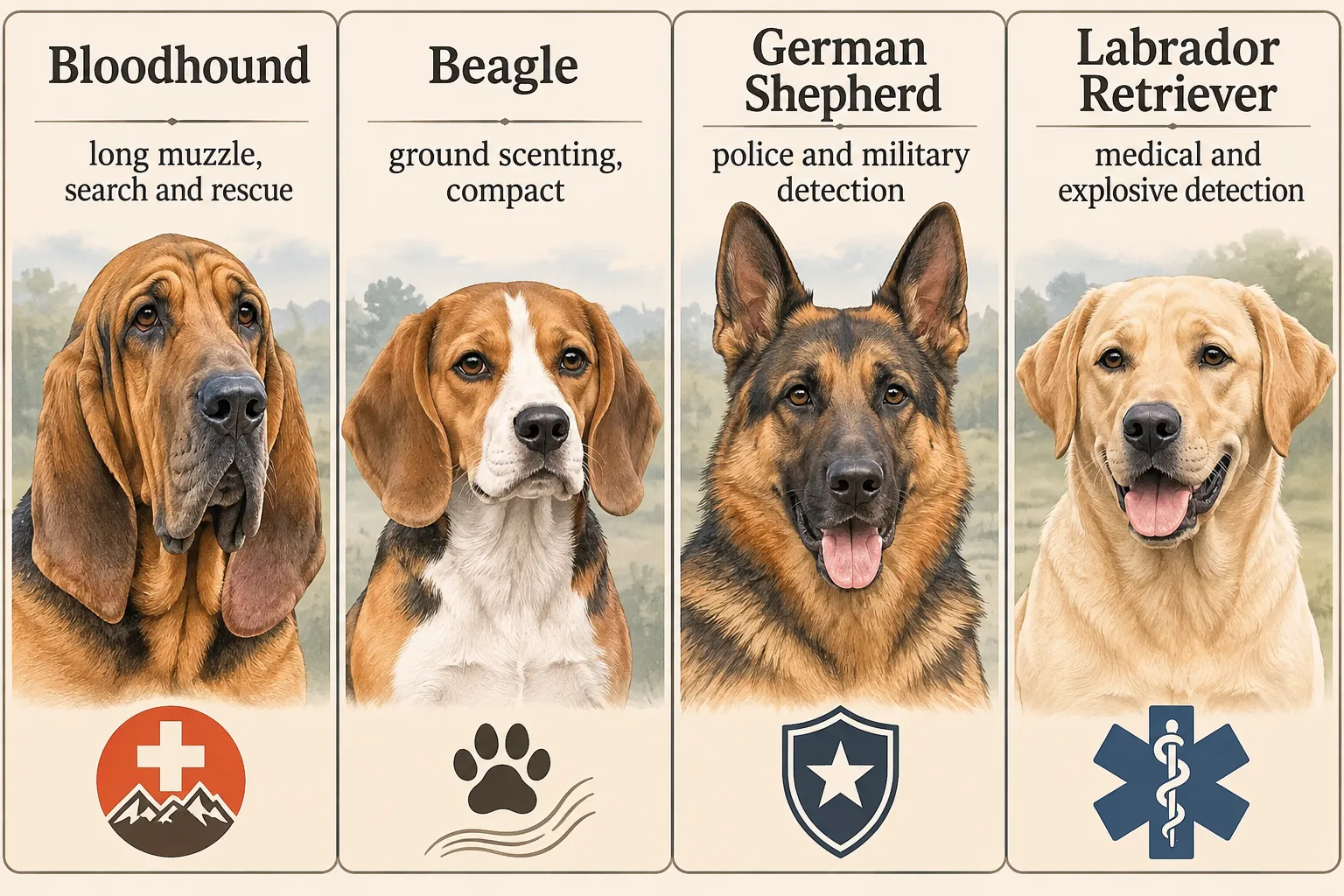
Breeds with long muzzles and large nasal surface areas, such as Bloodhounds, Beagles, German Shepherds, and Belgian Malinois, generally perform best on tracking and detection tasks, though individual variation within any breed is significant. A 2025 Scientific Reports study on breed differences in olfactory performance found measurable gaps between breeds on standardized scent tasks, supporting what working-dog trainers have long observed.

- Bloodhounds: used historically and currently in search-and-rescue and law enforcement tracking work.
- Beagles: compact size and strong ground-scenting ability, widely used in agricultural detection roles.
- German Shepherds and Belgian Malinois: common in police and military detection programs.
- Labrador Retrievers: frequently chosen for medical and explosive detection due to trainability combined with solid scenting ability.
Choose a working-line scenting breed if the goal is competitive nose work or formal detection training. Choose based on temperament and household fit if the goal is an enriching home scent game, since most healthy dogs of any breed can learn basic scent games. For help matching a breed to a household, see this guide on choosing the best dog breed for your lifestyle.
How far can a dog smell something away?
There is no single fixed distance, because detection range depends on the scent’s concentration, wind conditions, and what the dog has been trained to recognize, not a universal number that applies across scents and settings. Reports of dogs detecting scents from a few feet to over a mile tend to describe specific trained targets under favorable wind conditions, not an average household sniff.
A trained detection dog searching for a strong, well-known target odor downwind in open air will outperform a pet dog searching for an unfamiliar faint scent indoors with poor air movement, even if both dogs have identical biological equipment. Source strength and wind do more work than most owners expect. Working dog performance under real field conditions is a major focus of the Penn Vet Working Dog Center’s ongoing research.
Can dogs smell emotions or feelings?
Dogs cannot smell an emotion directly, but they can detect chemical changes in human sweat, breath, and skin oils that shift with stress, fear, or anxiety, which lets them respond to a person’s emotional state through scent along with body language and tone of voice. This is one reason a dog may act differently around a person having a panic attack or a stressful phone call, even before any visible change happens.
Stress-related compounds released through sweat glands change in composition under anxiety, and a dog’s constant sampling behavior means it is well positioned to pick up on those shifts. For more detail on this topic, see this piece on whether dogs sense human emotions.
Why does my dog keep sniffing everything?
Constant sniffing is normal information-gathering behavior, not a sign of anxiety or confusion in most dogs, since a dog’s environment is read through scent the way a person reads a room visually. Walks in particular function as scent reports: other dogs, people, food residue, and wildlife leave traces that update constantly.
Decision rule: if sniffing is paired with normal eating, play, and energy, it is simply exploration. If sniffing becomes obsessive, paired with pacing or an inability to settle, it can signal anxiety and is worth mentioning to a vet or trainer.
Can dogs smell diseases like cancer or diabetes?
Yes, dogs can be trained to detect certain disease-related volatile organic compounds in breath, sweat, or urine, including some cancers and blood sugar changes linked to diabetes, through standard scent-detection training methods. This is an active area of applied research rather than a party trick, and training protocols matter: a 2025 Frontiers in Veterinary Science study on marker training found that how a target odor is introduced and reinforced significantly affects a dog’s long-term reliability on detection tasks.
Medical alert dogs trained for diabetes typically detect a specific compound tied to blood sugar swings and are trained to alert their handler with a nudge, paw, or sit before symptoms become visible. These programs take months of consistent training and are not something achieved through casual home practice.
What smells do dogs hate or dislike the most?
Dogs commonly react negatively to citrus, vinegar, strong cleaning chemicals, and certain essential oils, often pulling away, sneezing, or avoiding the area entirely. This reaction is partly due to receptor sensitivity and partly due to the sharpness of these compounds at concentrations humans barely notice.
Strong synthetic fragrances, including some perfumes and scented candles, can also cause a dog to leave a room rather than settle nearby, which is worth considering when choosing cleaning products or air fresheners for a multi-dog household.
Do puppies smell as well as adult dogs?
Puppies are born with a functional dog sense of smell before their eyes and ears fully develop, but detection performance and reliability on trained tasks typically improve with age and experience rather than peaking immediately. Young puppies can locate a nursing mother by scent within days of birth, showing that the anatomy works early, even though focused detection work takes months of training and maturity to perform reliably.
Formal scent training is usually introduced gradually, starting with simple find-it games before moving to structured detection work as the puppy matures physically and mentally. Building foundational commands first, covered in this guide to essential commands for puppies, makes later scent training easier to layer on.
Is a dog’s sense of smell better in certain weather?
Yes. Moderate humidity tends to help scent molecules stick to surfaces and linger, while very dry, hot, or extremely windy conditions can disperse or degrade a scent trail faster than a dog can follow it. Search-and-rescue and tracking trainers commonly adjust search timing and strategy around weather for exactly this reason.
Decision rule: schedule outdoor scent games for calm, mild conditions when possible. Skip high-wind days for a dog still learning the basics, since gusty air scatters the scent cone unpredictably.
Why do some dogs have worse sense of smell?
Age, skull shape, nasal disease, and genetics all affect scenting ability, and the differences can be measurable rather than anecdotal. A 2026 Scientific Reports study on brain connectivity found that resting-state connectivity in olfactory brain regions shifts with both age and brain shape, meaning flat-faced (brachycephalic) breeds may process scent differently than long-muzzled breeds even with similar receptor counts.
Aging itself brings measurable decline in some dogs, documented in a 2025 GeroScience study evaluating aging effects on dog olfactory performance. Nasal tumors, chronic infections, and dental disease are also common and treatable causes of reduced scenting ability, which is part of why sudden smell loss belongs in the vet-visit category rather than the “just aging” category.
How to train a dog using their sense of smell
Training a dog’s nose starts with pairing a specific target odor with a reward until the dog reliably signals when it finds that odor, a process used in everything from explosives detection to medical alert work. Marker-based training, where a clear signal marks the exact moment the dog detects the right scent, has been shown to improve reliability more than less structured approaches, according to Frontiers in Veterinary Science research on marker training for detection dogs.
A simple home progression:
- Start with a strong, easy scent (a treat in a box) in a quiet room.
- Reward the dog immediately upon showing interest near the scent source.
- Gradually increase hiding distance and add light obstacles.
- Introduce outdoor searches only after indoor reliability is consistent.
- Add wind awareness by practicing in varied outdoor conditions once basics are solid.
Can you improve or improve your dog’s sense of smell?
A dog’s basic scenting anatomy cannot be upgraded, but detection performance on specific tasks can improve significantly through consistent, structured training and good health maintenance. Dental health, nasal health, and body condition all affect how well a dog’s nose functions, so routine care (including regular teeth brushing or professional cleaning) supports smell function indirectly by preventing infections that can block or damage nasal tissue.
Scent games played a few times a week, combined with varied environments and gradually increasing difficulty, build a dog’s confidence and efficiency at using the nose it already has, even if raw sensitivity stays roughly the same.
Do dogs rely on smell more than sight or hearing?
For most tasks involving identification, tracking, and environmental information gathering, dogs rely on smell more heavily than sight, since scent provides detail that vision cannot, such as who passed through an area and roughly how long ago. Vision and hearing remain important for movement detection, social cues, and immediate threat assessment, but smell is generally considered the primary information channel for dogs handle an environment.
This is part of why dogs investigate new environments nose-first rather than looking around first, and why a dog meeting a new person or animal will typically sniff before making eye contact or reacting visually.
Can Dogs Smell Through Walls or Closed Doors?
Dogs can often detect scent that leaks through gaps around doors, vents, and imperfect seals, rather than smelling directly through solid material. A dog alerting at a closed door is usually responding to odor molecules that have already escaped into the hallway air, carried by small air currents most people never notice.
This is why detection dogs are trained to work door gaps, vents, and seams specifically, rather than standing in the center of a hallway waiting for a strong signal.
FAQ
Does dog sense of smell decline with age? Yes, in many dogs. Research on aging dogs shows measurable declines in scent detection performance over time, though the rate varies by individual dog, breed, and overall health.
Can a dog’s sense of smell be damaged permanently? Yes. Chronic nasal infections, untreated dental disease, tumors, or significant head trauma can cause lasting damage to the tissue responsible for dog sense of smell, which is why early veterinary attention matters.
Do flat-faced breeds have a weaker sense of smell? Not necessarily weaker, but structurally different. Shorter muzzles mean less turbinate surface area, which can affect how scent is processed compared to long-muzzled breeds, though individual performance still varies.
Is a dog’s sense of smell stronger at certain times of day? Cooler, calmer conditions typically found in early morning or evening often support scent tracking better than hot midday air, which can cause faster evaporation and dispersal of ground scent.
Can indoor air conditioning affect how well a dog smells things? Yes. Air currents from HVAC systems can scatter or redirect a scent cone indoors, which is why indoor scent games sometimes need shorter distances than outdoor ones.
Do all dogs have the same number of scent receptors? No. Receptor counts and nasal structure vary by breed and individual, with long-muzzled working breeds generally having more surface area dedicated to smell than short-muzzled companion breeds.
Can diet affect a dog’s sense of smell? Indirectly. General health, including proper nutrition, supports immune function and tissue health, which affects how well a dog’s nasal tissue functions over time. For general feeding guidance, see this beginner’s guide to choosing dog food.
Is it safe to use strong-scented grooming products on a dog? Heavily fragranced shampoos and sprays can overwhelm a dog’s sensitive nose temporarily. Milder, dog-specific products are generally a better choice, and a beginner’s guide to dog grooming covers safer options.