

Quick Answer
Do dogs understand words? New EEG research from 2026 says dogs can split continuous human speech into word-like chunks, tracking consonant patterns the same way human infants do. That does not mean dogs read dictionaries in their heads. The evidence shows dogs process speech structure and, for some learned words, recall a mental picture of the object, but comprehension stays tied to repetition, tone, and context rather than grammar.
Key Takeaways: do dogs understand words
- A 2026 study in Science found dogs’ brains track consonant patterns in speech, a sign they segment words from a sound stream.
- Dogs do not need to be raised in a human home from birth. Shelter dogs and street dogs in the study showed the same consonant bias.
- A 2024 study covered by the Los Angeles Times found dog brains respond differently when a spoken object name matches or mismatches the object shown, suggesting a mental image forms.
- Chaser the Border Collie learned over 1,000 object names; most family dogs likely learn far fewer, closer to a working set of 100 to 200, per PetMD.
- Tone carries real instructions on its own. Dogs responded to pitch and rhythm changes in a made-up syllable without any training.
- Do dogs understand words and phrases the way people do? Not with syntax. They lean on sound patterns, repetition, and context clues.
- Consistency (one word, one meaning, every time) is the single biggest lever an owner has for teaching new words.

What do you want to know?
Tap an option to see the answer.
The short answer: do dogs understand words or just tone?
Both, and the split depends on the word. Dogs process tone in the right hemisphere and recognize certain learned words in the left hemisphere, according to a 2016 fMRI study covered by the AAAS.
The 2016 scan work found dogs’ reward centers lit up most when a praise word was said in a praising tone. Flat-voice praise or enthusiastic neutral words did not get the same response. So a dog can evaluate what is said and how, but the emotional payoff depends on the two lining up. This is one of the clearest answers to do dogs understand words or just tone: the brain treats them as separate channels that combine for the strongest reaction.
Decision rule: if your dog ignores a word spoken flatly but reacts instantly to the same word said warmly, tone is still doing most of the work. If your dog reacts the same regardless of your tone of voice, word recognition has taken over.
Common mistake: assuming a dog “knows” a word because it reacts to a sentence. Dogs often respond to the whole bundle, your posture, the leash sound, your tone, not the word alone. That is context learning, not vocabulary. Owners asking do dogs understand words should watch for this trap before assuming a cue has been learned.
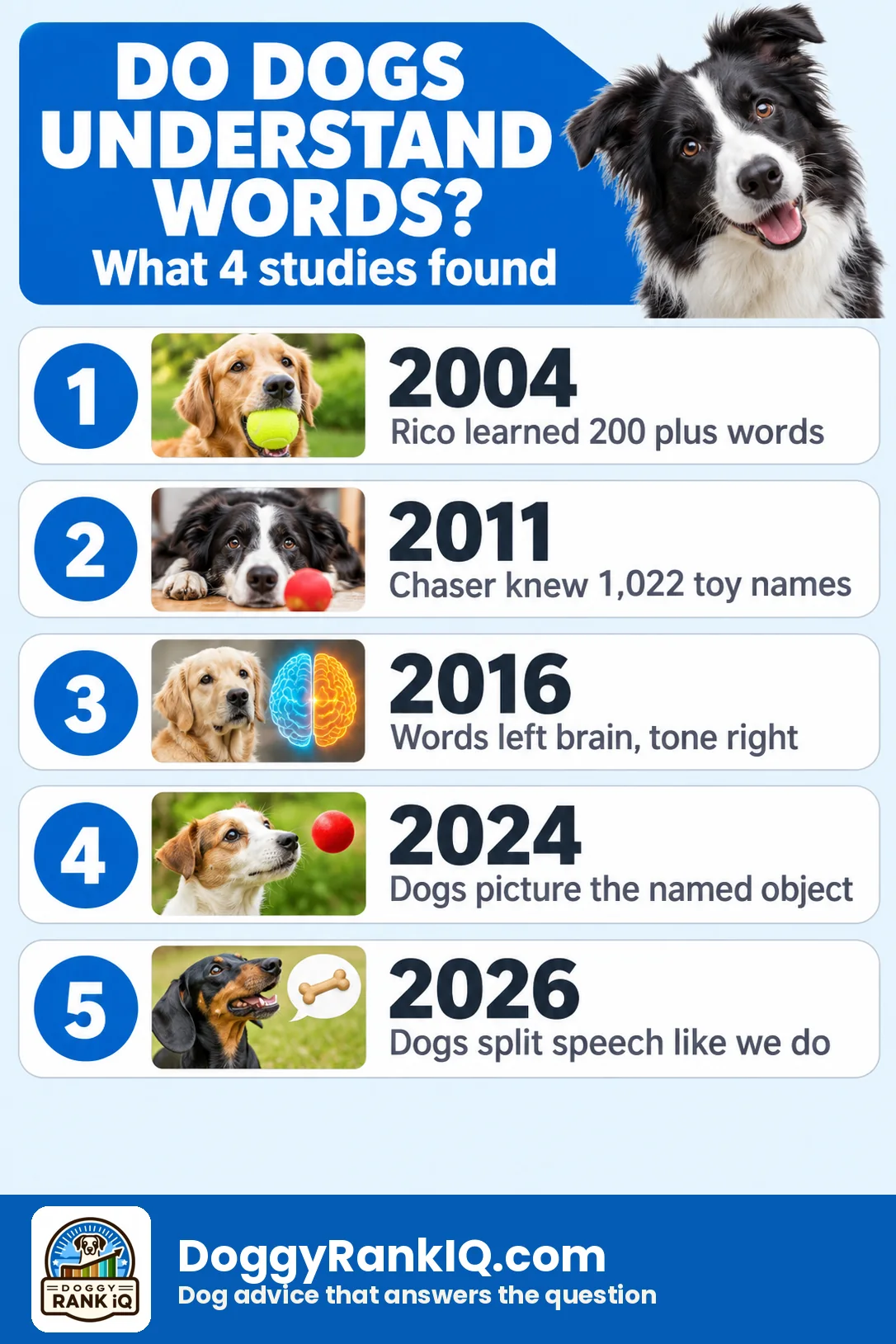
What the 2026 brain study found
On 2026, Science published EEG research from Boglárka Morvai, Attila Andics, and colleagues at Eötvös Loránd University comparing brain responses in 20 dogs and 20 humans listening to continuous artificial speech streams, as described in the original Science paper. Dogs’ brains tracked recurring consonant patterns more strongly than vowel-based or random ones, which means dogs can carve an unbroken stream of sound into word-like pieces.
The key neural signal appeared roughly 400 milliseconds after a word began, a timing window linked to speech segmentation. That is evidence of detection, not proof of meaning. A dog can notice that “sit” is a repeating chunk of sound without knowing what sitting is. This distinction matters anytime someone asks do dogs understand words in a strict, human-language sense: detecting structure and assigning meaning are two separate skills, and the 2026 study only confirms the first.
One detail stands out: the effect was not limited to dogs raised in human homes from puppyhood. Dogs that spent their first three months on the street or in a shelter showed the same consonant bias. The researchers suggest this points to ongoing exposure and pattern learning rather than a narrow early-life window.
A limit worth naming directly: humans could track vowel-structured patterns too, just less well than consonant ones. Dogs showed no such vowel tracking. Humans also synchronized to individual speech sounds, while dogs appeared to process whole syllables as their basic unit. The study’s own authors describe this as a speech-processing bias in a nonspeaking species, not proof that dogs understand language with human grammar.
Related read: how smart are dogs really and more on 5 essential commands every puppy should learn.
Facts table: 5 studies on how dogs process words
| Year | Method | Dogs tested | Finding |
|---|---|---|---|
| 2016 | fMRI, trained to lie still | 13 | Meaningful words processed left hemisphere, tone right hemisphere |
| 2024 | EEG, object match/mismatch | 18 | Brain response differs when named object does not match what is shown |
| 2026 (June) | Tone-only vocal experiment | Multiple, study sample | Dogs follow pitch and rhythm cues on a made-up syllable |
| 2026 (September) | EEG, continuous speech stream | 20 | Dogs track consonant patterns, segmenting speech into word-like units |
| 2004 | Owner training and testing | 2 (Chaser, Rico) | Chaser learned 1,022 object names; Rico learned 200+ |
How many words can a dog learn?
Most family dogs learn somewhere between 100 and 200 words with consistent training, according to estimates reported by PetMD, while a handful of exceptional dogs have learned far more under intensive, formal training programs. Chaser, a Border Collie trained by retired psychology professor John Pilley, learned the names of 1,022 distinct objects, a result that was documented and tested formally. Rico, another Border Collie studied earlier, learned over 200 object names.
Those two dogs are outliers, not a baseline. Border Collies were the test subjects partly because they train well and hold handler focus for long sessions, not because every dog of that breed will match Chaser’s output. Individual variation matters here: drive, training hours, and the handler’s consistency all shape the ceiling on how many words a dog ends up learning.
For an average family dog, trainers commonly cite a working vocabulary closer to 100 words dogs understand, covering commands, names of people, favorite toys, and routine cues like “walk” or “dinner.” That number is a practical estimate based on common training outcomes, not a hard biological limit, and answers to do dogs understand words questions should always be read with that caveat.
Example: a dog that reliably responds to “sit,” “down,” “stay,” “come,” “off,” five or six toy names, and two or three family member names already has a working vocabulary in the 15 to 20 word range within a few months of consistent training, which is a normal and healthy pace.
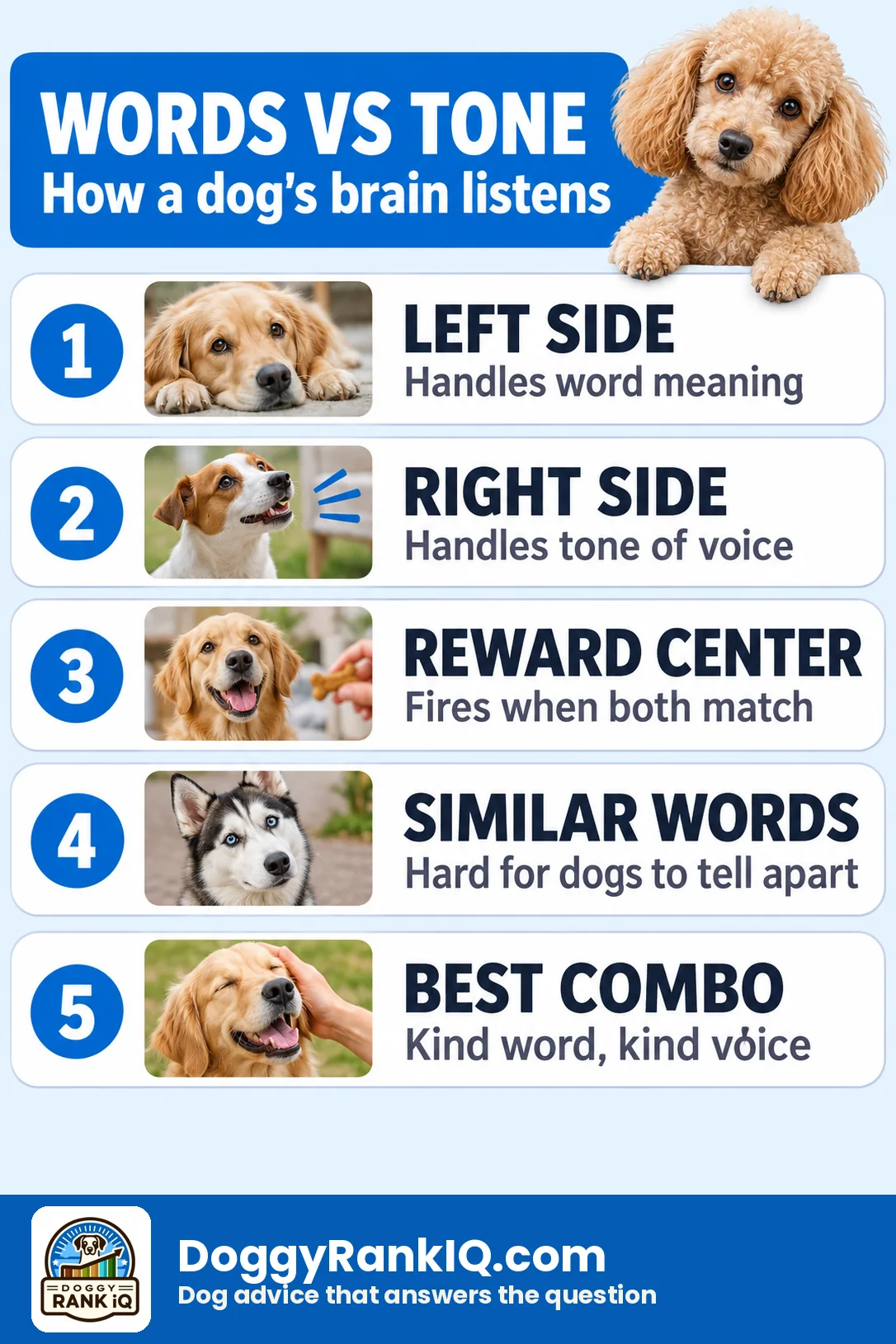
Do dogs understand words or just tone of voice?
Dogs rely on both systems, but tone tends to dominate early in training and word recognition grows stronger with repetition over time. A dog hearing a brand-new word almost always leans on your tone, posture, and timing first, then gradually shifts toward the sound of the word itself as it gets reinforced.
- If a command only works in an upbeat, singsong voice, the dog is likely still tone-dependent.
- If the command works even said flatly or by a stranger, the word itself has become the trigger.
- Mixing an angry tone with a happy word (like saying “good dog” in a frustrated voice) confuses the signal and can slow learning.
This split is part of why the question do dogs understand words or just tone of voice does not have a single universal answer: it depends on how long a specific word has been trained and how consistently it has been paired with the same tone.
Can dogs understand their own name?
Yes. Dogs typically learn their own name as one of the earliest and most reliable sound patterns they respond to, often within the first few weeks of consistent use. A name functions like any other learned word: repetition, a consistent sound, and a predictable outcome (attention, a treat, eye contact) build the association.
- Use the name to get attention, not as a scolding word. Pairing a name with punishment teaches a dog to avoid responding to it.
- Short, distinct-sounding names work better than names that resemble common commands (“Beau” can blur with “no”).
- A dog that turns its head or makes eye contact on hearing its name, even amid distractions, has a solid name response.
For a deeper breakdown of this specific skill, see best dog breeds for apartment living for related training context, and consider pairing name training with 5 essential commands every puppy should learn.
How do I teach my dog to understand more words?
Teach one new word at a time, pair it immediately with the object or action, and repeat it across different rooms and situations until the response holds without extra cues. This mirrors how trainers build on the foundational 100-word vocabulary most family dogs reach.
- Choose a single, short word. One syllable or two is easier for a dog to isolate from a sentence.
- Say it right before or during the action, never several seconds apart.
- Reward immediately the first dozen times, then taper to intermittent rewards.
- Practice in a new location once the dog responds reliably at home; generalization is a separate skill from first learning.
- Add one distraction at a time, such as another person in the room, before testing in a busy outdoor setting.
- Avoid changing the word. If “couch” becomes “sofa” halfway through, the dog is effectively starting over on that word.
Why isn’t my dog responding to commands?
A dog that stops responding to a known word usually has a tone mismatch, a context gap, a distraction problem, or has simply never generalized the word beyond one room. This is one of the most common frustrations owners bring up, and it rarely means the dog “forgot” the word.
- Context gap: a command trained only in the kitchen at dinnertime may not transfer to the backyard. Retrain in the new setting with the same reward structure.
- Competing stimulus: squirrels, other dogs, and food smells can outcompete a moderately trained word. Build up distraction tolerance gradually rather than assuming defiance.
- Inconsistent tone or wording: if different family members use different words or tones for the same cue, the dog may be responding to a blended, weaker signal.
- Overuse without reinforcement: repeating a command five times in a row without consequence teaches a dog that the first four repetitions can be ignored.
Common mistake: repeating a command louder when a dog does not respond. Volume rarely fixes a tone or context problem and can make a dog more hesitant rather than more responsive.
Can puppies understand words like adult dogs do?
Puppies can begin recognizing simple words within weeks, but their attention spans and memory consolidation are still developing, so comprehension builds more slowly than in adult dogs. A puppy at eight to ten weeks can start learning its name and one or two basic cues, but expecting a long working vocabulary this early is unrealistic.
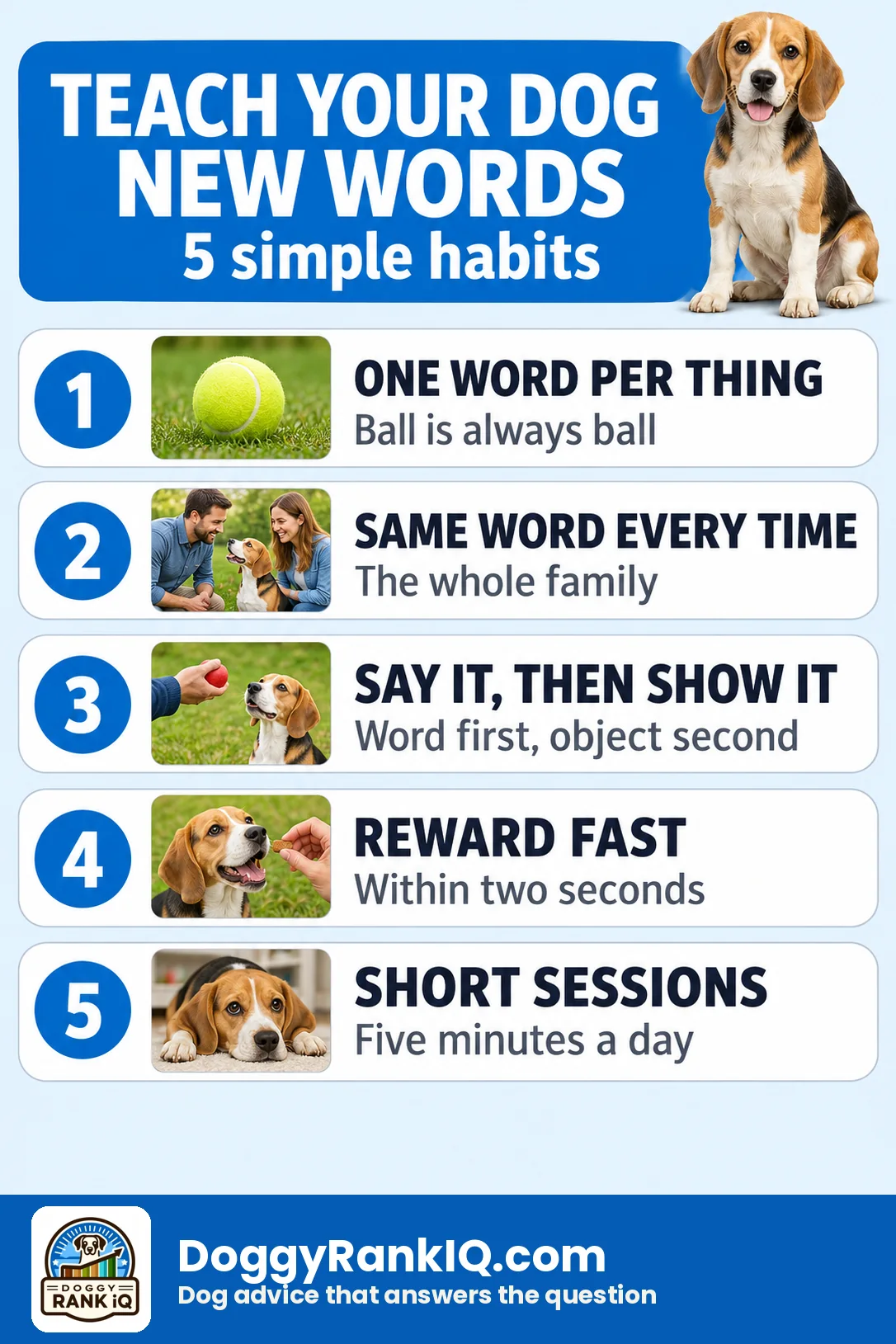
- Puppies under four months generally need shorter, more frequent training sessions (five minutes, several times a day) rather than long drills.
- Early exposure to a wide range of words and sounds appears to support later learning, based on the pattern-tracking abilities documented in the 2026 Science study, though puppies were not the specific subjects of that research.
- Basic cues like sit, come, and the puppy’s name are realistic first targets; complex multi-step commands typically come later.
See 5 essential commands every puppy should learn for a practical starting sequence.
Do different dog breeds understand words better or worse?
Breed can influence trainability and focus, but individual temperament, motivation, and owner consistency matter just as much or more than breed alone. Herding and working breeds such as Border Collies, German Shepherds, and Poodles often top trainability rankings, yet a food-motivated Labrador with a highly consistent owner can out-learn a distracted herding dog.
- Which dog breeds understand the most words is a fair question with a fuzzy answer, since formal word-count studies have only been done on a tiny number of individual dogs, not large breed samples.
- Scent-driven breeds (Beagles, Bloodhounds) may need extra effort to hold focus during word training sessions, not because they lack capacity, but because competing instincts pull attention elsewhere.
- Toy and companion breeds often learn household vocabulary quickly simply because they spend more waking hours in close proximity to their owners.
Can older dogs learn new words?
Yes, older dogs can learn new words throughout life, though it may take more repetition than it did when they were younger. There is no large study directly comparing comprehension by age, but cognitive decline in senior dogs can slow new learning without stopping it.
- Keep training sessions shorter for senior dogs and increase repetition frequency instead of session length.
- Watch for hearing loss in older dogs, which can look like forgetting a word when the actual issue is reduced volume perception; raising pitch slightly sometimes helps more than raising volume.
- A senior dog learning a brand-new word for the first time, such as the name of a new family member, is common and not a sign of a learning problem.
What’s the difference between dogs understanding words vs sounds?
A word, in this context, is a consistent sound pattern tied to a specific meaning or outcome through repetition, while a sound is anything a dog’s ears register, including background noise it never attaches meaning to. Dogs understanding words vs sounds is really a question of which chunks of audio have been reinforced enough to carry information.
- The 2026 Science study found dogs segment speech into word-like chunks based on consonant patterns, which is a first step toward treating a sound as a word.
- Not every sound a dog hears becomes a word; most environmental noise stays just noise unless it predicts something relevant.
- A clicker, as noted in the tools section below, works because it is a single, unchanging sound dedicated to one meaning, which is easier for a dog to lock onto than a variable human voice.
How long does it take to teach a dog a new word?
Most dogs can learn a simple, concrete word (a command or an object name) within one to two weeks of short daily sessions, though full generalization across locations and distractions can take four to six weeks. These are practical training estimates based on common trainer-reported outcomes, not fixed timelines, and individual dogs vary.
- Simple commands tied to a physical action (sit, down) tend to be faster than abstract words (wait, leave it).
- A word trained only in one context will need additional practice sessions in new settings before it holds reliably everywhere.
- Consistency across the full household, not just the primary trainer, speeds up the timeline noticeably.
Can deaf dogs understand spoken words or only hand signals?
Deaf dogs cannot process spoken words through hearing, but they can learn hand signals through the same repetition and consistency principles used for spoken-word training. This is well established in deaf-dog training communities and supports the broader point that dogs attach meaning to any consistent signal, sound or visual.
- Hand signals should be distinct from each other in shape and motion, the same way distinct-sounding words are easier for hearing dogs to tell apart.
- Vibration collars or physical taps are commonly used to get a deaf dog’s attention before giving a hand signal, functioning like a name call.
- Consistency between people using the signals matters just as much as it does with spoken words; a signal that changes slightly between family members slows learning.
Do dogs understand if you talk to them like a baby?
Dogs respond to the tone and rhythm of baby talk (higher pitch, slower pace, more melodic patterns) more than to the specific words used in it. This connects directly to the 2016 fMRI findings on tone processing and the 2026 tone-only vocal study, both of which show dogs track pitch and rhythm independent of word meaning.
- Puppies and adult dogs alike often show more attentive body language toward exaggerated, higher-pitched speech, similar to patterns seen in infant-directed speech research.
- Baby talk is not harmful to a dog’s ability to learn words; it is simply a tone layer added on top of whatever words are being used.
- If a dog only responds to commands said in a baby-talk tone and ignores the same word said normally, tone is still doing most of the work for that particular cue.
Do dogs understand words and phrases, kisses, and voices over the phone?
Dogs understand words and phrases mainly as learned sound patterns tied to outcomes, not as grammar. A phrase like “want to go for a walk” works because the whole string has been repeated with the same result every time, not because the dog parses “want,” “go,” and “walk” separately.
Do dogs understand kisses? Not as a human gesture with the same meaning. Dogs read the approach, the tone of your voice, and the physical closeness. Many dogs learn that a kiss predicts affection and relax into it, which is a learned association, not an understanding of the kiss itself.
Do dogs recognize voices over the phone? Anecdotal reports and owner video, including viral clips covered by outlets like NPR, are common, and a dog’s hearing range and memory for vocal pitch make this plausible, but there is no large controlled study confirming dogs reliably identify a specific owner’s voice through a speaker versus simply reacting to any human voice saying a familiar word. Treat this one as unconfirmed.
Can dogs understand sign language? Dogs can learn hand signals as cues the same way they learn spoken words, through repetition and consistent pairing. This is common in deaf-dog training and in gun dog work, and it supports the idea that dogs attach meaning to a consistent signal regardless of whether that signal is a sound or a gesture.
Can dogs understand humans more broadly, including our emotional states? Related research, including work summarized by Elsevier Connect, suggests dogs pick up on mood signals well before they grasp specific words.
Top 5 features we love
- Consonant sensitivity. The 2026 Science study found dogs track consonant patterns over vowels, a feature shared with human infants learning language.
- Tone-reading without training. Dogs responded to pitch, smoothness, and repetition in a nonsense syllable, meaning your voice alone carries information.
- Object recall signals. The 2024 EEG study, reported by the Los Angeles Times, showed a measurable brain difference when a named toy did not match what was shown, hinting at a stored mental picture.
- Reward tied to combination. Dogs’ reward centers respond strongest when a praise word and praising tone match, per the 2016 fMRI study.
- Learning without a nursery. Shelter and street dogs in the 2026 study showed the same consonant tracking as home-raised dogs, suggesting the skill develops through ongoing exposure.
How to teach your dog new words at home
Dogs learn words through repetition, consistency, and a tight link between sound and outcome, not through explanation. The research above backs a simple formula that trainers have used for years and that brain studies now partly explain.
- Pick one word per thing. If you say “down” sometimes and “lie down” other times, you are teaching two different sound patterns.
- Use the same word every time. Family members should agree on the vocabulary list before training starts.
- Pair the word with the object or action immediately. Say “ball” while handing over the ball, not five seconds before or after.
- Keep your tone consistent for the same command. Since dogs process tone and words together, a shifting tone muddies the signal.
- Build in repetition across contexts. A word learned only in the kitchen may not transfer to the yard without extra practice.
Helpful tools for teaching words
A few simple products support the one-word, one-meaning approach without turning training into a chore. A soundboard-based approach has also gained attention, including findings summarized by the University of California on dogs pressing recorded word buttons.
The Dog Talking Buttons Starter Set, 10 recordable buttons with mat (rel=”sponsored”) lets owners record a single word per button and place it in a consistent spot, which matches the repetition model the research supports. Price checked 2026: $35.99. Check the current price (rel=”sponsored”).
A Dog Training Clicker with Wrist Strap (rel=”sponsored”) gives a consistent, tone-free sound to mark behavior, useful for separating the “what happened” signal from your voice. Price checked 2026: $4.99. Check the current price (rel=”sponsored”).
For background reading, The Genius of Dogs (rel=”sponsored”) by Brian Hare covers canine cognition research in plain language. Price checked 2026: $12.75. Check the current price (rel=”sponsored”). Inside of a Dog (rel=”sponsored”) by Alexandra Horowitz covers how dogs perceive the world more broadly. Price checked 2026: $11.21. Check the current price (rel=”sponsored”).
None of these tools were lab-tested by Doggy Rank IQ. Details above reflect manufacturer listings and commonly reported owner use, current as of 2026.
FAQ
The bottom line
Do dogs understand words? The honest answer sits between skeptics and wishful owners: dogs’ brains are built to detect the structure of speech, track consonant patterns, and in some cases recall a mental image tied to a learned word, based on EEG and fMRI research published between 2016 and 2026. What the evidence does not support is human-style comprehension, grammar, or guaranteed vocabulary size for every dog.
The practical path forward does not require a lab. Pick a word, use it the same way every time, pair it immediately with the object or action, and keep your tone consistent. That approach lines up with what the brain studies actually found, and it is the same advice trainers have given for decades, now with EEG data behind it.
For related reading, see Why Do Dogs Tilt Their Heads? What It Can Really Mean and How Do Dogs Show Affection? Signs You Can Observe.
Doggy Rank IQ is reader supported. As an Amazon Associate we earn from qualifying purchases, at no extra cost to you.