
Quick Answer
Dog joint supplements range from about $0.03 to $1.00 per day depending on the ingredient, the dog’s weight, and the dosing on the label. The best dog joint supplements for most owners combine a verified daily cost with ingredients that actually have research behind them: the evidence is strongest for omega-3 fish oil, weaker for glucosamine and chondroitin, and mixed for green-lipped mussel. Cosequin, Dasuquin, and several budget chews all show up in this guide with real per-day math using the dosing printed on each label. None of this replaces a veterinarian’s exam, weight management, or prescribed pain control for a dog with diagnosed arthritis.
Key Takeaways: dog joint supplements
- Omega-3 fatty acids (EPA and DHA) have the strongest evidence among dog joint supplements, according to Cornell veterinarians and multiple 2026 reviews.
- Glucosamine and chondroitin, the most common combination on pet store shelves, showed essentially no meaningful pain relief in a 2022 meta-analysis cited across current veterinary literature.
- Cost per day depends on three numbers: bottle price, chew count, and how many chews the label says to give for your dog’s weight. Skipping that third number is the most common math mistake.
- Green-lipped mussel and UC-II collagen sit in the middle of the evidence spectrum, better supported than glucosamine alone but with less data than fish oil.
- The NASC Quality Seal signals that a supplement maker has passed an independent audit, though it does not certify that the product reduces pain.
- Dog joint supplements are not regulated or approved the same way as drugs, and no new FDA approval for a canine joint supplement exists as of 2026.
- A supplement supports comfort. It does not replace weight control, exercise, or prescribed pain relief for a dog already showing signs of arthritis.
- Weight management alone can reduce joint strain as much as a supplement does in some overweight dogs, according to VCA Hospitals.

What are you shopping for?
Check the current price
Tap an option to see the answer.
What are dog joint supplements and how do they work?
Dog joint supplements are oral products, usually chews, tablets, or liquids, meant to support cartilage health, reduce inflammation, or ease stiffness in dogs with aging joints or diagnosed osteoarthritis. They work through a few different mechanisms depending on the ingredient, and no single mechanism applies to every product on the shelf.
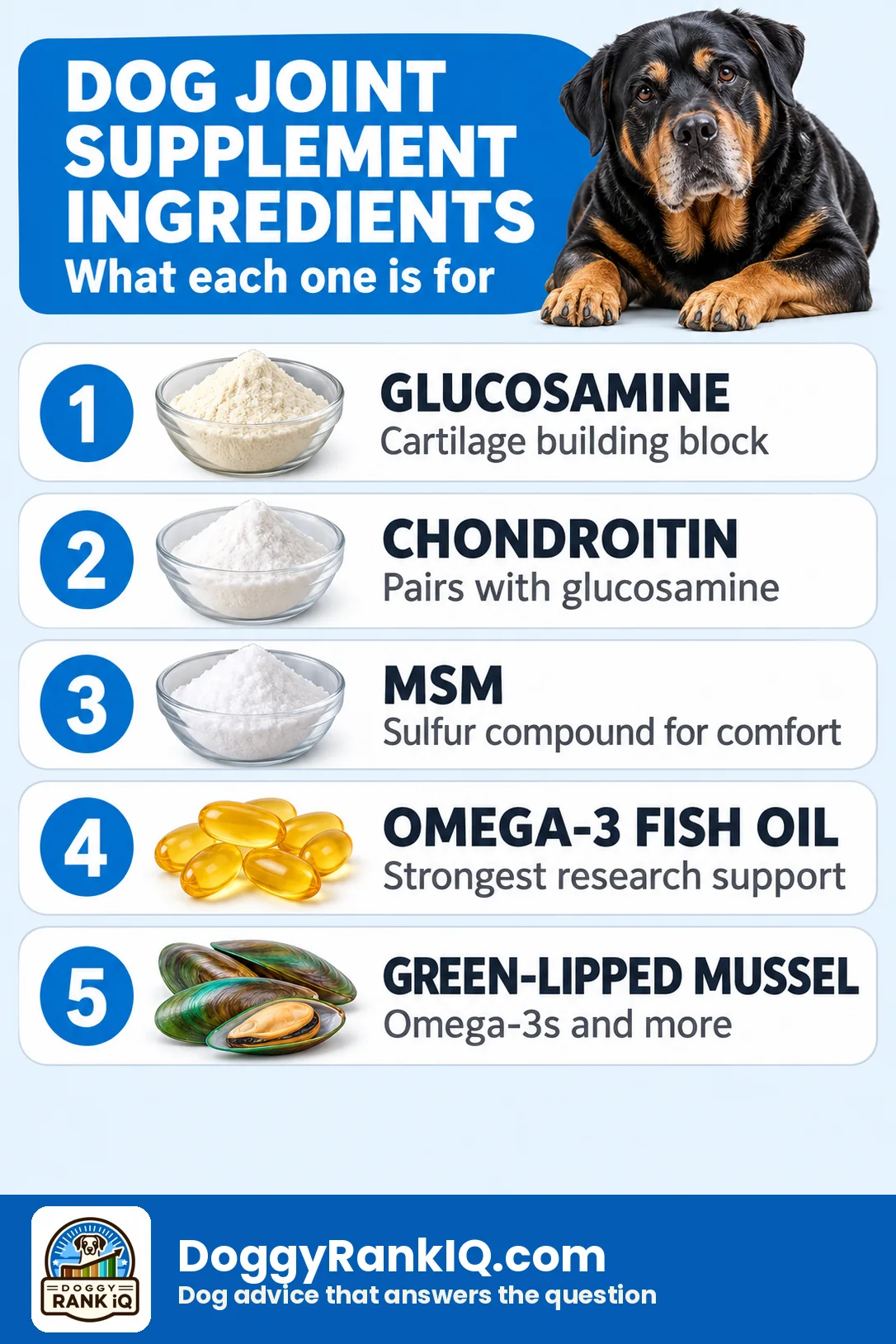
Glucosamine and chondroitin are building blocks of cartilage, and the theory behind adding them to the diet is that extra raw material could support cartilage repair. In practice, as Cornell’s Riney Canine Health Center and other recent reviews have pointed out, the pain-relief data for this pairing is thin despite its popularity.
Omega-3 fatty acids, specifically EPA and DHA from fish oil, work differently. They influence the body’s inflammatory pathways directly, which is part of why VCA Hospitals lists omega-3s among the more consistently supported options for joint comfort in dogs with osteoarthritis.
Green-lipped mussel contains a natural blend of omega-3s, glycosaminoglycans, and other compounds, giving it a broader nutrient profile than a single isolated ingredient. UC-II collagen is processed differently from standard collagen and is thought to work partly through an immune-tolerance effect in the gut rather than by direct cartilage building.
A quick example: a 9-year-old mixed-breed dog with mild hip stiffness might see more day-to-day benefit from a fish oil supplement dosed correctly for body weight than from switching between three different glucosamine chews over a year. The ingredient and the dose matter more than the brand name on the label.
Do dog joint supplements work? What the evidence says per ingredient
The honest answer is: it depends entirely on which ingredient is in the bottle. Omega-3 fish oil has the broadest and most consistent support of any ingredient commonly marketed for dog joints, while glucosamine and chondroitin, despite dominating the market, have a surprisingly thin pain-relief record.
Veterinary nutritionist Laura Gaylord, DVM, DACVIM, summarized the current literature in 2026 and reported that a 2022 meta-analysis found glucosamine-chondroitin combinations produced no meaningful analgesic benefit compared with placebo. That is not a small detail. It is the most common active ingredient pair in dog joint supplements, including Cosequin and most store-brand chews.
A 2026 veterinary textbook chapter on canine osteoarthritis backs this up, ranking evidence as strongest for omega-3 fatty acids and green-lipped mussel, weaker for collagen and cannabinoid products, and poor for glucosamine-chondroitin. PetMD’s review of joint supplements echoes this hierarchy, noting that owners often overestimate what glucosamine alone can accomplish.
Not every Cornell veterinarian agrees completely. Dr. Joseph Wakshlag takes a more permissive view, suggesting glucosamine, chondroitin, and combination products like Dasuquin may still help slow joint changes over time, even while agreeing fish oil has the clearer pain-relief data and can sometimes reduce the NSAID dose a dog needs. That is a meaningful nuance: “no proven pain relief” is not the same statement as “does nothing,” and reasonable vets land in different places on long-term glucosamine use.
Dr. Duncan Lascelles of NC State’s Comparative Pain Research and Education Center points to marine-derived EPA and DHA specifically, not plant sources like flaxseed, as the omega-3 form most consistently tied to real relief in dogs. Dr. Christopher Frye at Cornell suggests a starting point around 1 teaspoon of fish oil per 20 pounds of ideal body weight, while cautioning that concentration varies a lot by brand, so the label always governs the actual dose.
Choose fish oil as your anchor ingredient if your dog has diagnosed or suspected arthritis and you want the ingredient with the most research behind it. Add glucosamine-chondroitin or Dasuquin as a secondary layer if your vet is comfortable with it, understanding the evidence for pain relief specifically is weak.
Common mistake: owners assume all dog joint supplements with “glucosamine” on the label work the same way and at the same strength. Concentration, source material, and the presence of companion ingredients like MSM or ASU all change how much active compound actually reaches the dog.
How do I know if my dog needs a joint supplement?
Dogs that benefit most from dog joint supplements are typically large-breed, senior, overweight, or previously injured animals showing early stiffness, slow rising, or reduced activity after rest. A young, lean, healthy dog with no mobility complaints generally does not need one, though some owners start preventively in breeds prone to hip dysplasia.
Signs worth watching for, according to the American Kennel Club, include:
- Stiffness after naps or overnight rest that improves once the dog warms up
- Reluctance to jump into the car, onto furniture, or up stairs
- Slower pace on walks or shorter walks tolerated before tiring
- Licking or chewing at a joint
- Muscle loss around the hips or thighs on one or both sides
If a dog shows several of these signs, a veterinary exam should come first, not a supplement purchase. A vet can confirm whether the issue is arthritis, an injury, or something unrelated to joints entirely, such as a neurological problem. For a fuller rundown of what to watch for at home, see this guide to signs of arthritis in dogs.
Decision rule: start with a vet visit if your dog is limping, yelping, or suddenly less mobile. Consider a preventive supplement conversation if your dog is a large breed over age 7 with no current symptoms but a family history of joint issues.
How to work out cost per day
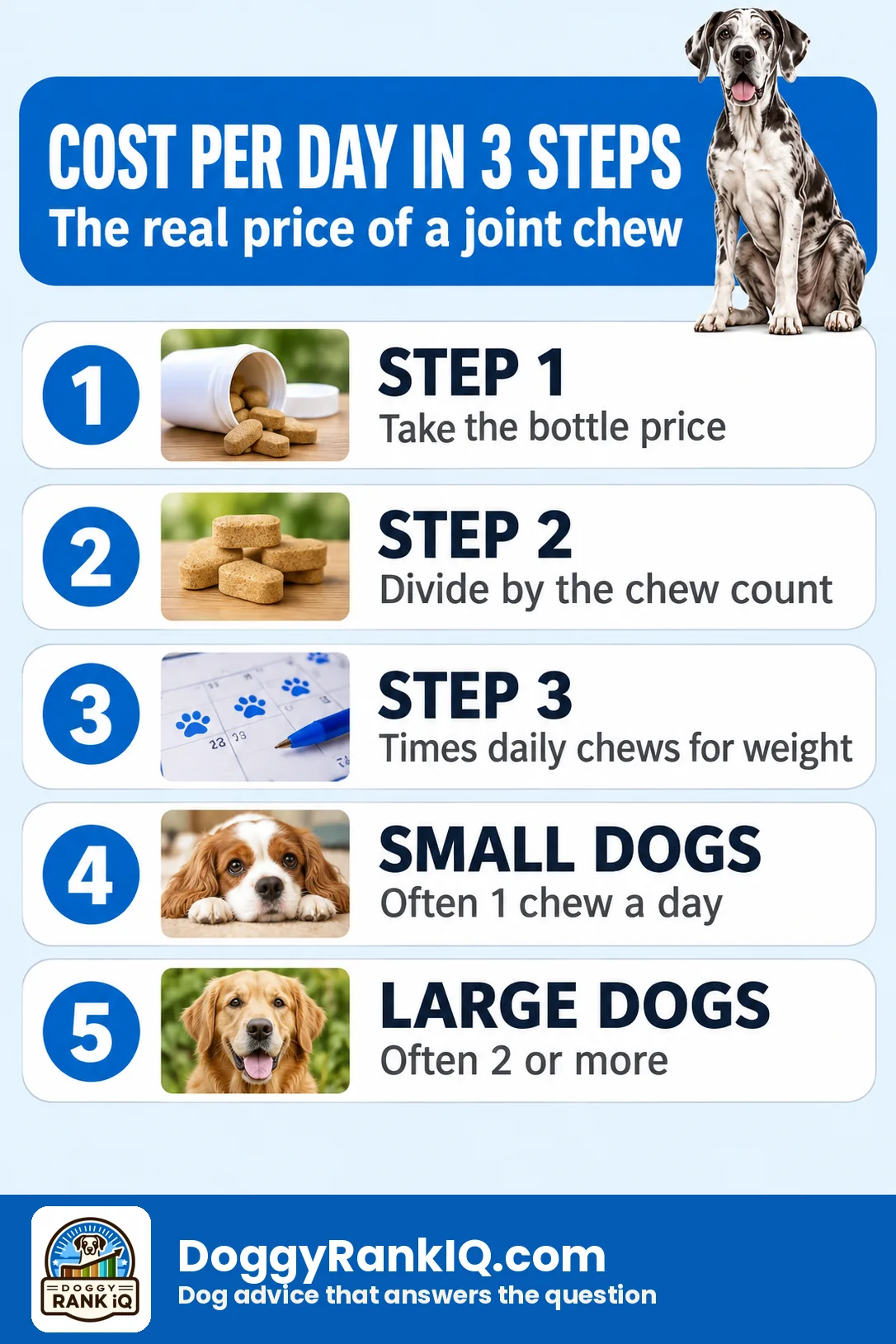
Cost per day for dog joint supplements comes from one simple formula: bottle price divided by chew count, multiplied by the number of daily chews the label lists for your dog’s weight. The tricky part is that daily dosing almost always scales up with weight, so a 70-pound Labrador and a 12-pound terrier are never paying the same rate out of the same bottle.
The formula:
Cost per day = (Price ÷ Total chews) × Chews per day for your dog’s weight
A few examples make this concrete:
- A 132-count bottle priced at $34.91 works out to about $0.26 per chew. If the label calls for 2 chews daily for a 60-pound dog, that’s about $0.53 per day.
- A 60-count bottle priced at $89.95 is about $1.50 per chew. Even at 1 chew daily, that’s $1.50 per day, among the pricier options in this guide.
- A 90-count bottle priced at $8.49 is roughly $0.09 per chew, making it one of the cheapest options even before adjusting for dosing.
Common mistake: owners calculate cost per day using the smallest printed dose, then discover their dog’s weight bracket actually requires double chews. Always check the dosing chart on the actual label, not the price tag, before comparing products. Omega-3 liquids complicate this further, since dosing is measured in milliliters of EPA and DHA rather than chew count, and concentration varies by brand as Dr. Frye noted.
Quick example: a 45-pound dog on a label that requires 1.5 chews per day from a 100-count, $25 bottle pays $0.25 per chew, so $0.375 per day, not the $0.25 per day an owner might assume from a quick glance at the price tag.
Dog joint supplements comparison table
| Product | Key ingredients | Count | Cost per chew | Price |
|---|---|---|---|---|
| Cosequin Chewable Tablets | Glucosamine, chondroitin | 132 ct | ~$0.26 | $34.91 |
| Cosequin MSM plus HA | Glucosamine, chondroitin, MSM, HA | 250 ct | ~$0.24 | $59.99 |
| Dasuquin MSM (Large Dogs) | Glucosamine, chondroitin, ASU, MSM | 150 ct | ~$0.57 | $84.99 |
| Dasuquin MSM (Small/Medium) | Glucosamine, chondroitin, ASU, MSM | 84 ct | ~$0.60 | $49.99 |
| VetIQ Hip and Joint Chews | Glucosamine, MSM, krill | 180 ct | ~$0.14 | $24.94 |
| PetNC Hip and Joint Soft Chews | Glucosamine, chondroitin, MSM | 90 ct | ~$0.09 | $8.49 |
| Advanced Hip and Joint (Large Breed) | Green-lipped mussel, glucosamine | 60 ct | ~$1.50 | $89.95 |
| Joint Supplement with Glucosamine, Chondroitin, MSM | Glucosamine, chondroitin, MSM | 200 ct | ~$0.13 | $25.99 |
Price checked 2026. Per-chew cost does not equal per-day cost; multiply by your dog’s label dose.
The 8 best dog joint supplements picks by cost per day
1 Nutramax Cosequin Chewable Tablets, 132 ct
 Nutramax Cosequin Chewable Tablets, 132 ct
 is the chew most owners already recognize from the vet’s office shelf. It contains glucosamine and chondroitin, the classic pairing, and runs about $0.26 per chew, or roughly $0.26 to $0.52 per day depending on whether your dog’s weight bracket calls for one or two chews. Check the current price.
Who it suits: owners who want the most widely available option and are comfortable with the weaker pain-relief evidence for this ingredient pair. Skip it if you’re prioritizing the strongest available evidence; fish oil will do more for that goal.
2Nutramax Cosequin MSM plus HA Chew Tablets, 250 ct
Cosequin MSM plus HA Chew Tablets, 250 ct adds MSM and hyaluronic acid to the base formula, at about $59.99 for 250 chews, roughly $0.24 per chew. The bigger count brings the per-chew cost down slightly compared to the 132-count bottle. Check the current price.
Who it suits: larger households with multiple dogs, since the per-chew math improves with volume. Skip it if your dog is small and the bottle will expire before it’s finished.
3Nutramax Dasuquin MSM Soft Chews for Large Dogs, 150 ct
Dasuquin MSM Soft Chews for Large Dogs, 150 ct adds ASU (avocado and soybean unsaponifiables) to glucosamine, chondroitin, and MSM. At $84.99 for 150 chews, it runs about $0.57 per chew. Dr. Wakshlag’s more favorable view of Dasuquin for slowing joint changes applies here, though it is still not the strongest evidence category overall. Check the current price.
Who it suits: owners of large or giant breed dogs whose vet recommends a multi-ingredient option. Skip it if budget is the deciding factor; it’s among the pricier chews here.
4Nutramax Dasuquin MSM Soft Chews for Small and Medium Dogs, 84 ct
Dasuquin MSM Soft Chews for Small and Medium Dogs, 84 ct is the sized-down version for dogs under roughly 60 pounds, priced at $49.99 for 84 chews, about $0.60 per chew. Check the current price.
Who it suits: small and medium dogs whose owners already use or trust the Dasuquin line. For a direct side-by-side of this brand family, see our Cosequin vs Dasuquin cost comparison.
5VetIQ Glucosamine Hip and Joint Chews with MSM and Krill, 180 ct
 VetIQ Glucosamine Hip and Joint Chews with MSM and Krill, 180 ct
VetIQ Hip and Joint Chews, 180 ct runs $24.94 for 180 chews, about $0.14 per chew, and includes krill, which contributes a small amount of marine omega-3. Check the current price.
Who it suits: budget-minded owners who still want a touch of marine-derived omega-3 alongside glucosamine. Skip it if you want fish oil as the main event; the krill dose here is a minor addition, not a replacement.
6PetNC Natural Care Hip and Joint Soft Chews, 90 ct
 PetNC Natural Care Hip and Joint Soft Chews, 90 ct
PetNC Hip and Joint Soft Chews, 90 ct is the cheapest pick in this roundup at $8.49 for 90 chews, about $0.09 per chew. It’s a basic glucosamine-chondroitin-MSM formula. Check the current price.
Who it suits: owners testing whether a supplement routine fits their dog’s daily life before spending more. Skip it if your dog has diagnosed arthritis and needs an ingredient with stronger pain-relief data.
7Advanced Hip and Joint Chews for Large Breed Dogs with Green-Lipped Mussel, 60 ct
Advanced Hip and Joint Chews with Green-Lipped Mussel, 60 ct is the priciest pick at $89.95 for 60 chews, roughly $1.50 per chew. Green-lipped mussel sits in the middle of the evidence spectrum, better supported than glucosamine alone but behind fish oil. Check the current price.
Who it suits: owners of large breed dogs who want a mussel-based formula and have already ruled out budget options. Skip it if cost per day matters more than the specific ingredient source.
8Joint Supplement for Dogs with Glucosamine, Chondroitin and MSM, 200 ct
Joint Supplement with Glucosamine, Chondroitin and MSM, 200 ct costs $25.99 for 200 chews, about $0.13 per chew, making it one of the better value picks for a standard glucosamine-chondroitin formula. Check the current price.
Who it suits: owners who want a large-count bottle without the brand-name price tag, understanding the ingredient evidence is the same as every other glucosamine chew on this list.
Vet recommended joint supplement for dogs: what vets look for
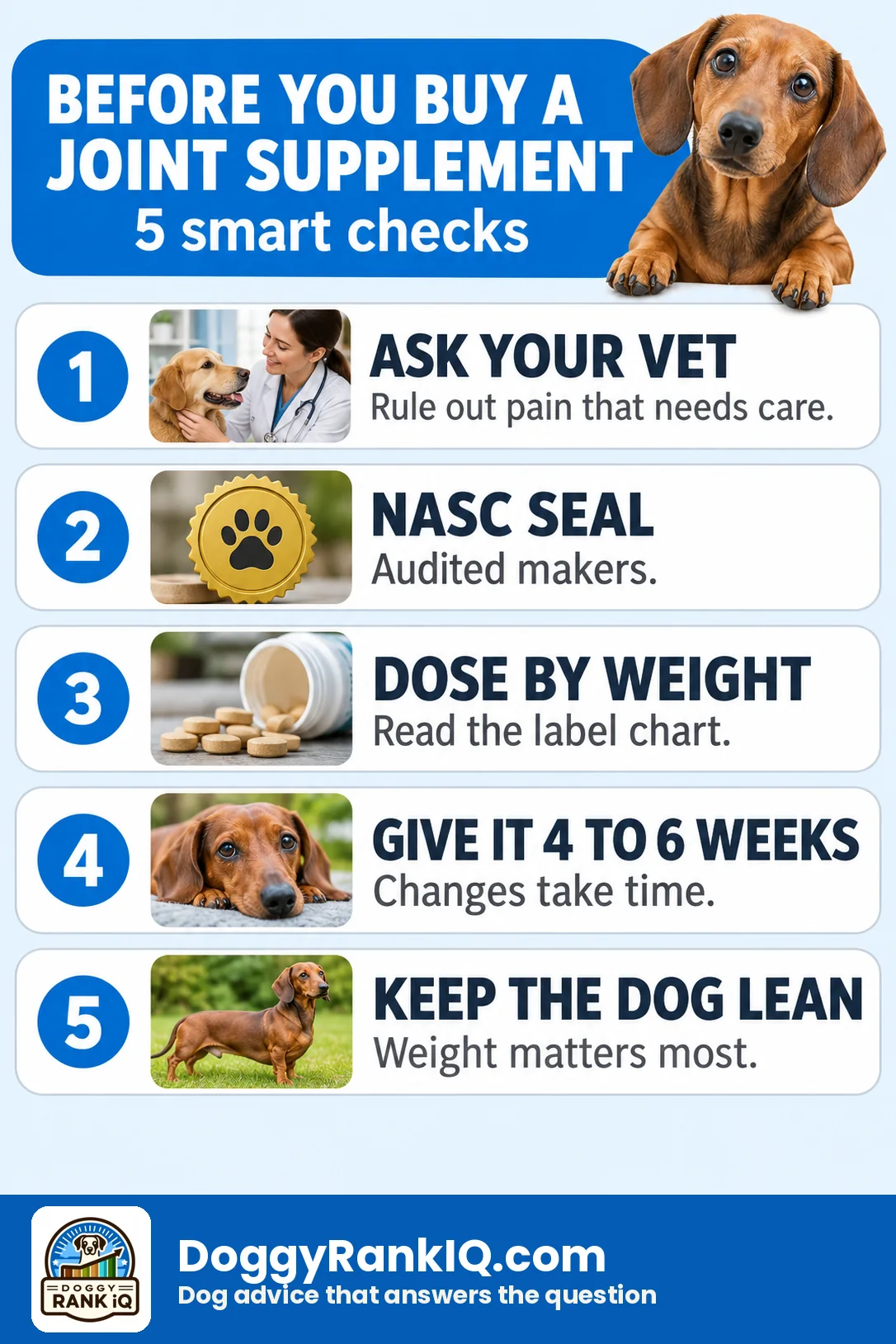
A vet recommended joint supplement for dogs is usually judged on ingredient evidence, dose accuracy, manufacturing quality, and the individual dog’s health status, not on marketing language. Dr. Erin Miscioscia of the University of Florida College of Veterinary Medicine recommends exactly this four-part screen before buying anything.
In practice, that means:
- Ingredient evidence first. EPA and DHA anchor the strongest recommendations; glucosamine-chondroitin is popular but poorly supported for pain relief specifically.
- Dose accuracy. The product should list a clear dosing chart by weight, not a vague “give as needed” instruction. PDSA’s guidance on joint supplements stresses matching the dose to the individual dog rather than guessing.
- Manufacturing quality. Look for the NASC Quality Seal or similar third-party quality marks, which indicate the company has passed an independent audit of its manufacturing process, even though the seal says nothing about whether the product reduces pain.
- The dog’s own health status. A dog with kidney disease, pancreatitis, or a bleeding disorder may need a different approach to omega-3 dosing, and a dog on NSAIDs already may not need a stacked multi-ingredient chew. This is where a veterinary exam matters more than a product review.
VCA Hospitals frames supplements as one part of a “complete joint care” plan for senior dogs, alongside weight control, moderate exercise, and, when needed, prescribed pain medication. That framing matters: a supplement is an addition to a care plan, not a stand-alone fix.
Edge case: dogs recovering from joint surgery often get a vet-specific protocol that differs from standard over-the-counter dosing. Always confirm with the surgeon or treating vet before starting a chew during recovery.
How long before a dog joint supplement starts working?
Most dog joint supplements take somewhere between 4 and 8 weeks to show a noticeable change in comfort or mobility, and some ingredients, like glucosamine, are often described as needing even longer before any effect (if one appears at all) becomes apparent. Fish oil tends to show measurable anti-inflammatory activity sooner than cartilage-building ingredients, though individual response varies by dog.
A practical way to track progress:
- Pick two or three specific behaviors to watch, such as willingness to jump into the car, speed getting up from a nap, or distance walked before slowing down.
- Write down a baseline before starting the supplement.
- Give the product consistently at the labeled dose for at least 6 to 8 weeks before judging results.
- Reassess with the same two or three behaviors, not a general impression.
- Bring the notes to the next vet visit if nothing has changed.
Common mistake: stopping a supplement after two weeks because nothing seems different. Most of the ingredients used in joint supplements, outside of fast-acting pain medication, are not designed to work that quickly.
⭐ Top 5 Features We Love
- Transparent chew counts. Every product in this guide lists exact tablet or chew counts, making the cost-per-day math possible without guessing.
- Marine omega-3 options. Products like VetIQ’s krill-based chew give owners a lower-cost entry point into the ingredient category with the strongest evidence (vet.cornell.edu, businessinsider.com).
- Multi-ingredient formulas. Dasuquin’s addition of ASU and several products’ inclusion of MSM reflect the current market trend toward combination formulas, even though Gaylord notes this makes it harder to know which ingredient is doing the work (veterinarypracticenews.com).
- Size-specific dosing. Dasuquin’s separate small/medium and large breed formulas reduce the risk of under- or over-dosing compared to one-size-fits-all chews.
- Wide price range. With picks from about $0.09 to $1.50 per chew, owners can match budget to their dog’s actual need rather than defaulting to the most expensive bottle on the shelf.
⚠️ Things to Look Out For
- Glucosamine-chondroitin’s weak pain evidence. The 2022 meta-analysis found no meaningful analgesic benefit from this combination, despite it being the most common formula sold (veterinarypracticenews.com).
- Flat dosing across sizes on cheaper products. Always check the label’s weight-based chart rather than assuming “give 1 daily” applies the same way to a 15-pound dog and a 90-pound dog.
- Omega-3 concentration varies by brand. A liquid fish oil’s actual EPA and DHA content differs enough between products that Dr. Frye’s teaspoon-per-20-pounds guidance is only a starting point, not a universal dose (vet.cornell.edu).
- No FDA efficacy approval. As of 2026, no canine joint supplement has received FDA approval for efficacy, since supplements are regulated differently than drugs.
- Shellfish-derived ingredients. Green-lipped mussel and krill come from shellfish and need a vet conversation if your dog has a known allergy.
When a supplement is not enough
A supplement is not enough when a dog shows limping, stiffness after rest, reluctance to jump, or a reduced activity level that lasts more than a few days. Those signs point toward diagnosed arthritis, which typically needs a combination of weight management, physical therapy, prescribed pain relief, and sometimes surgery, not a chew alone.
Cornell’s review notes that even strong supporters of fish oil, like Dr. Wakshlag, frame it as something that may reduce the NSAID dose needed, not something that replaces NSAIDs entirely in a diagnosed case (vet.cornell.edu). If your dog’s mobility has changed, read our breakdown of signs of arthritis in dogs and bring the specifics to your vet before adjusting any supplement routine.
A supportive sleep surface also matters more than owners expect. A dog getting up stiff every morning from a thin bed is fighting an uphill battle no chew can fix; see our guide to the best orthopedic dog bed options for joint support that works while the dog sleeps instead of while it eats.
Who should buy which
Choose Cosequin or Dasuquin if your vet already recommends the brand and you want the most widely studied glucosamine-chondroitin products on the market, understanding the pain-relief evidence specifically is weak (veterinarypracticenews.com).
Choose a fish oil or krill-containing product if you want the ingredient with the strongest research support and your dog tolerates fatty supplements without digestive upset (vet.cornell.edu, businessinsider.com).
Choose the cheapest glucosamine chew (PetNC or the 200-count budget option) if you’re testing whether your dog will even eat a daily chew before committing to a pricier formula.
Choose the green-lipped mussel large breed chew if your vet has specifically recommended that ingredient and cost per day is a secondary concern.
For owners weighing supplements against other supportive options, collagen for dogs covers a related ingredient category with its own separate evidence base worth understanding before adding another product to the routine.
FAQ
The bottom line
Joint supplements are not interchangeable, and the price tag tells you almost nothing about whether the ingredient inside actually has research behind it. Fish oil with EPA and DHA has the strongest support, glucosamine and chondroitin remain popular despite a thin pain-relief record, and green-lipped mussel sits somewhere in between. Work out the real cost per day using your dog’s actual label dose, not the bottle price alone, and bring the specific product to your veterinarian before starting anything new, especially if your dog already takes other medication.
Doggy Rank IQ is reader supported. As an Amazon Associate we earn from qualifying purchases, at no extra cost to you.