
Quick Answer
Dog blood donation is a program where a healthy, screened dog gives whole blood at a veterinary hospital, blood bank, or university clinic so veterinarians have fresh, typed blood ready for surgery, trauma, or illness. Most programs want dogs roughly 1 to 8 years old, weighing at least 40 to 62 lb depending on the clinic, calm enough to sit still for 15 to 30 minutes, and current on vaccines and parasite prevention. In exchange, donor dogs typically get free physical exams, bloodwork, parasite screening, and sometimes food, treats, or clinic credit. Mars reports BluePearl alone wants to source half its hospital blood supply from community donors by the end of 2026, which says a lot about how short the supply really is (bluepearlvet.com).
Key Takeaways: dog blood donation
- Dog blood donation helps dogs facing surgery, trauma, cancer, or immune disease get transfusions when shipped blood products run low.
- Requirements vary by clinic. Weight minimums run from 40 lb to 62 lb, and age windows range from about 1 to 9 years (vet.cornell.edu, smallanimal.vethospital.ufl.edu).
- A donation visit usually takes 15 to 30 minutes, often with no sedation, using the jugular vein, and treats the whole time.
- Free perks commonly include a physical exam, blood typing, bloodwork, parasite testing, and sometimes food or clinic credit (bluepearlvet.com).
- Dogs have more than a dozen blood group systems, and DEA 1 negative dogs are prized because their blood works for more recipients.
- Community donor dogs still supply a small share of total veterinary blood in places like California, less than 3%, with commercial colonies covering the rest [source cited in Today’s Veterinary Practice analysis].
- Programs almost always ask for a season or year-long commitment, not a one-time visit.
- There is no single national dog blood donation requirements standard. Always check the specific clinic’s page before assuming your dog qualifies.

Tell us about your dog
Tap an option to see the answer.
The short answer: how dog blood donation works
Dog blood donation moves whole blood or blood components from a healthy dog to a dog that needs a transfusion, usually within the same regional network of hospitals. The donor dog is screened, typed, and bled from the jugular vein, and the blood is either used fresh or stored for future emergencies.
Demand outpaces supply in a structural way, not a temporary blip. A 2026 analysis in Today’s Veterinary Practice estimated more than 3.4 million veterinary transfusions happen annually in the U.S., based on an assumption of about 60 transfusions per practice across nearly 56,000 veterinary businesses. The authors called this a rough, back-of-envelope figure, not an official count [source: Today’s Veterinary Practice 2026 analysis].
Two supply models exist side by side. Large commercial blood banks run colonies of dogs housed specifically for donation, and they supply the vast majority of product. Community programs, the kind an average pet owner’s dog might join, supply a smaller slice, but they matter because they can provide fresh, locally typed blood fast when a hospital runs low overnight. DoveLewis in Portland runs one of the more established community programs, supporting roughly 700 transfusions a year through donor dogs and cats recruited from the public (vetmed.vt.edu).
If your dog is big, calm, and healthy, that program gap is exactly where your dog’s blood donation would matter.
Who qualifies: dog blood donation requirements checklist
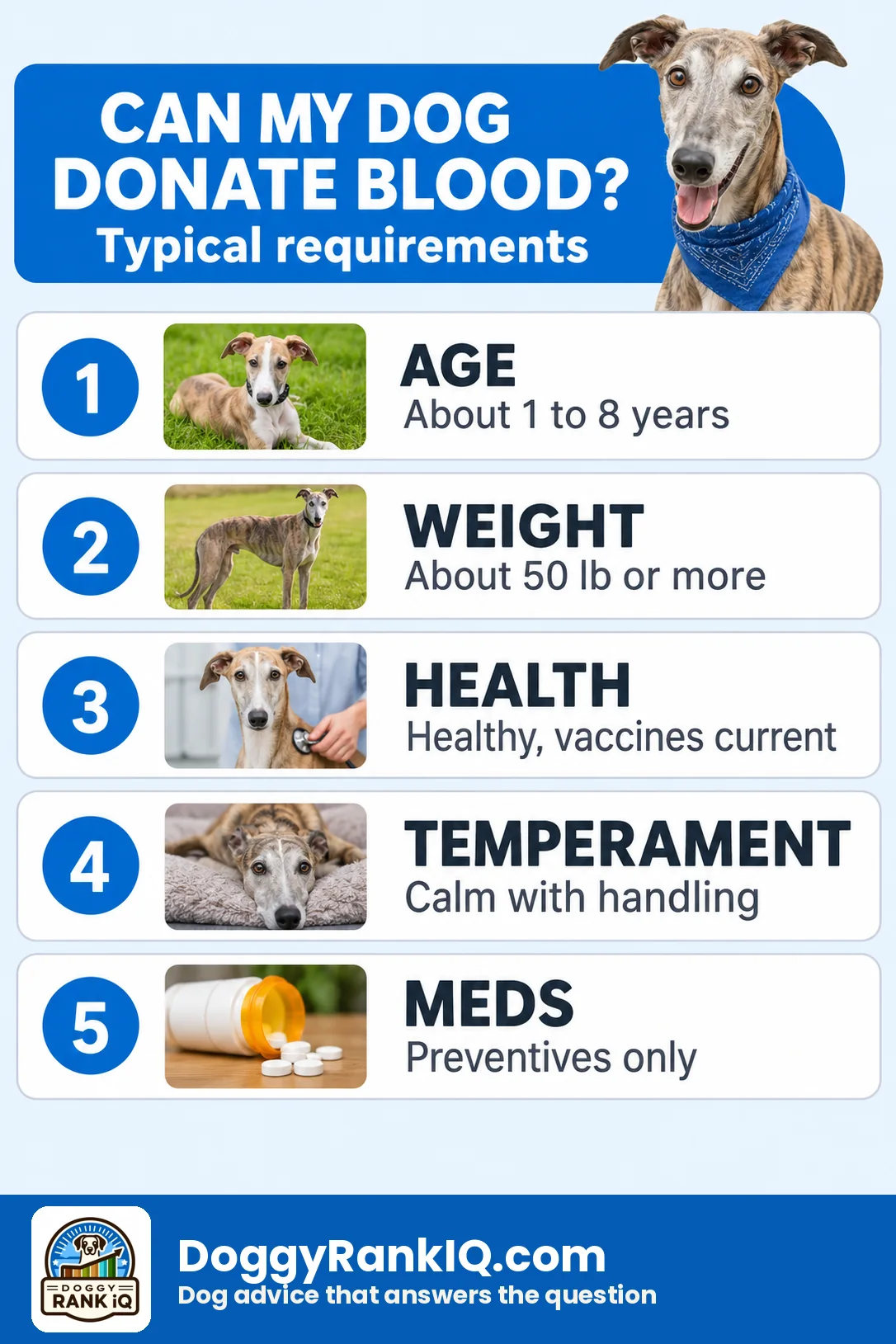
Dog blood donation requirements differ by clinic, but most programs are looking for a large, low-stress dog with a clean medical history. Think of this as the common ground across programs, not a guarantee for any one hospital.
Typical dog blood donor requirements include:
- Weight: usually at least 40 to 55 lb, though Cornell asks for roughly 62 lb and up (vet.cornell.edu)
- Age: commonly 1 to 8 years old; Cornell and Purdue cap it near 5, Tufts near 7, some programs go to 9 (vet.cornell.edu)
- Vaccines and prevention: current on core vaccines, flea, tick, and heartworm prevention
- Temperament: calm enough to lie still for a blood draw without heavy sedation
- Medical history: no current medications beyond preventives, and never received a blood transfusion themselves
- General health: no chronic illness, recent surgery, or pregnancy
Decision rule: if your dog is under the local weight minimum or over the upper age limit, do not assume disqualification across the board. Call the specific program, since a dog that misses one clinic’s cutoff might fit another’s.
Common mistake: owners assume any big dog qualifies. A nervous 80 lb dog that panics at the vet is a worse donor candidate than a relaxed 50 lb dog, because temperament affects whether the draw can happen safely without sedation.
Facts table: typical requirements and what programs give back
The pattern across every dog blood donation requirements page: nobody agrees on exact numbers, so check the local clinic directly before planning a visit.
Free perks donor dogs get
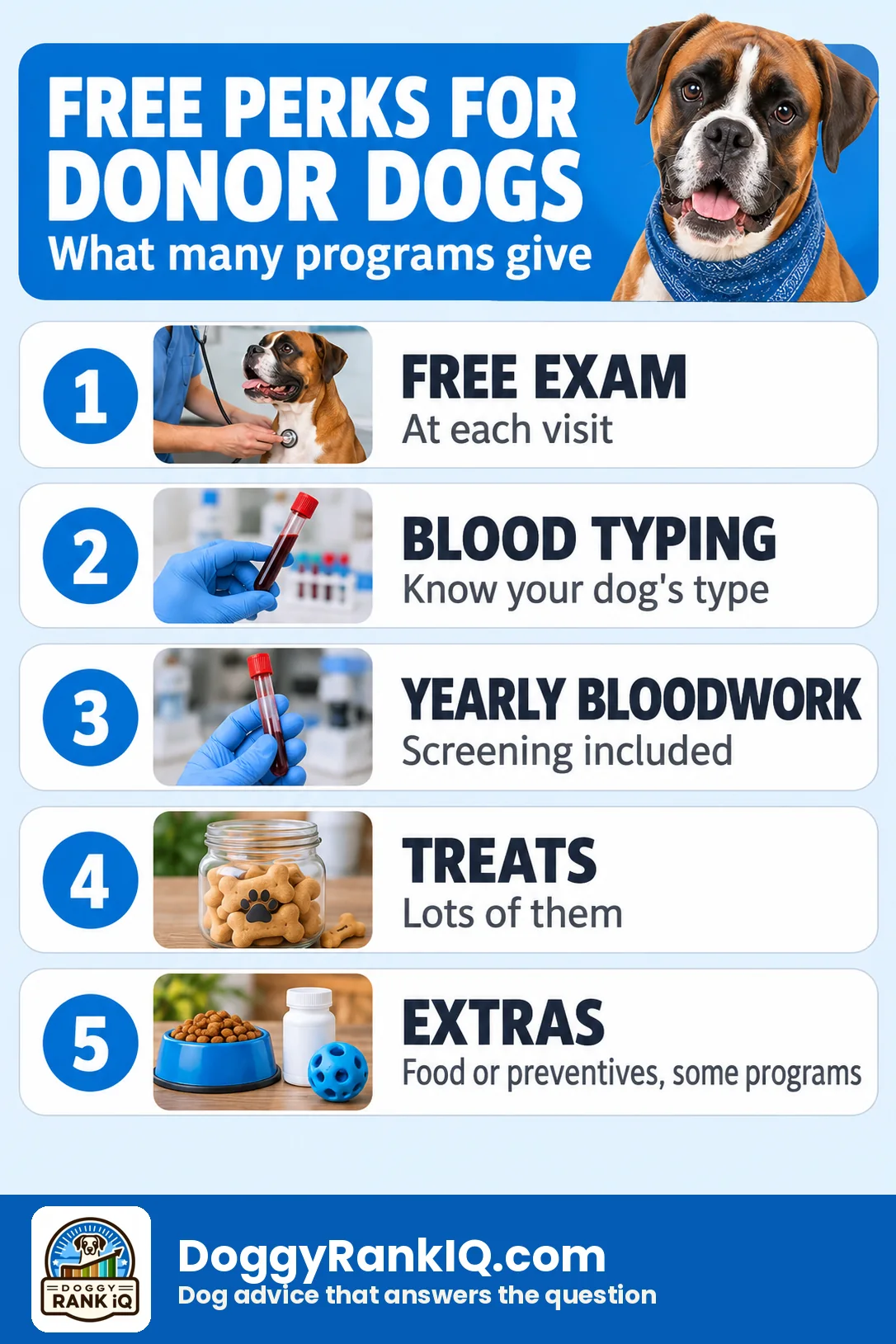
Dog blood donation programs cover the cost of keeping a donor dog healthy, which functions as a form of free, ongoing veterinary care. That is the main financial upside, even without direct payment.
Perks reported by named programs include:
- A full physical exam at every visit
- Blood typing and a complete blood count
- Annual bloodwork and infectious disease screening
- Chemistry panels, urinalysis, fecal testing, and heartworm testing in some programs [reference to K-State protocol]
- Treats and promotional items, as Mars describes for BluePearl donors (bluepearlvet.com)
- Food, clinic credit, or discounted services at some locations
Given how often owners ask why vets are so expensive, a program that covers a yearly exam and full bloodwork for free is a real benefit, not just a nice gesture. It will not replace pet insurance, but it can catch problems early at no cost.
Do dogs have blood types?
Yes. Dogs have more than a dozen recognized blood group systems, and DEA 1 is the one that matters most clinically. A dog’s DEA 1 status determines how safely its blood can be given to another dog.
DEA 1 negative dogs are considered universal-leaning donors because their blood is less likely to trigger a reaction in recipients, which is why blood banks actively recruit them. Greyhounds are frequently cited as strong donor candidates because many are DEA 1 negative and tend to carry higher red blood cell counts than average, though any individual dog’s suitability still needs veterinary confirmation rather than assumption based on breed alone.
Crossmatching still matters even with typing. A study of 149 transfusion-naïve dogs found that 17%, or 25 dogs, were incompatible with one or two of three potential donors during crossmatching, which is why hospitals test compatibility rather than relying on type alone [source: JAVMA crossmatch study].
What happens at a donation visit, step by step
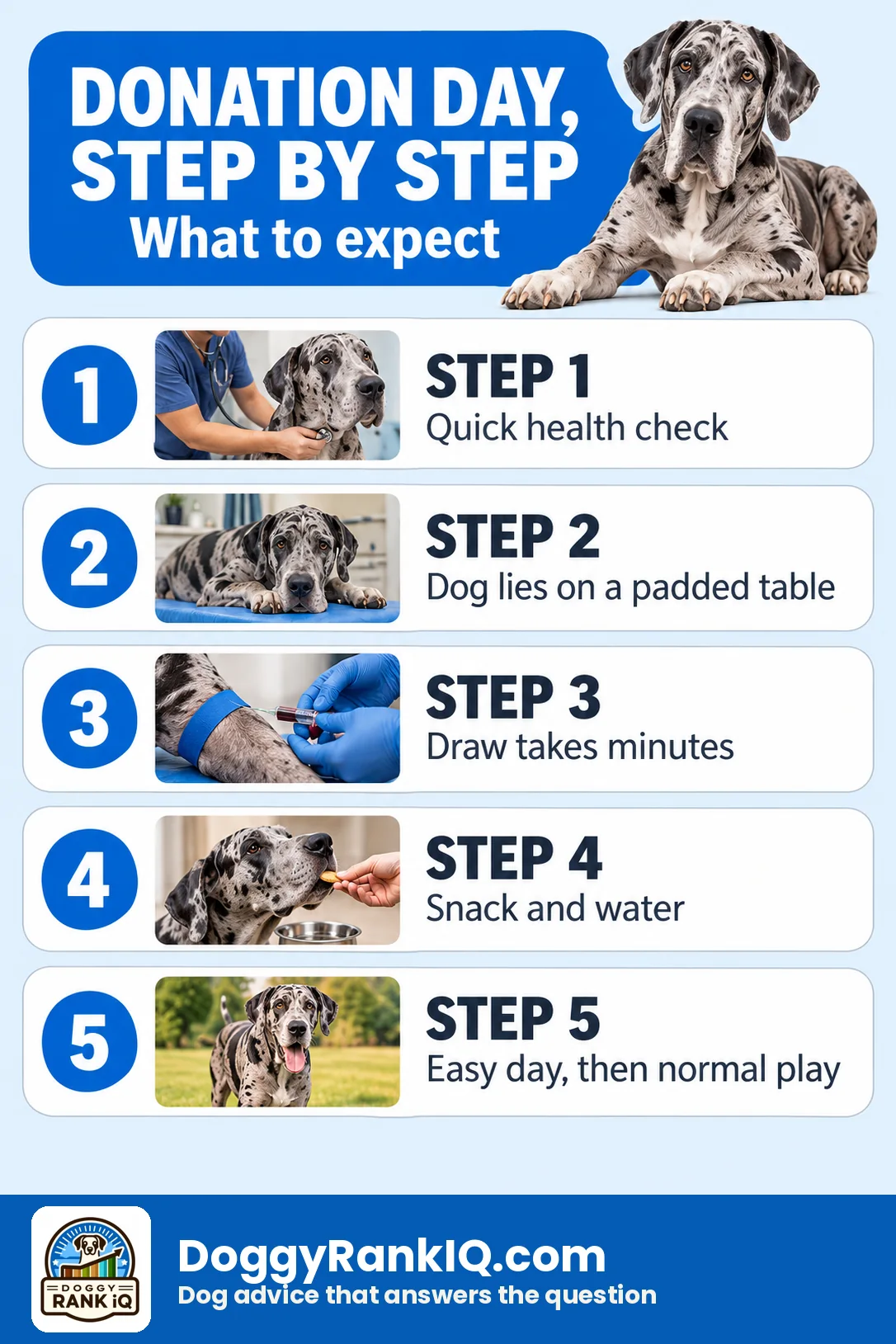
1Pre-screening and history review
Staff check weight, age, vaccine records, and current medications before scheduling the actual draw.
2Physical exam and blood typing
The dog gets a hands-on exam, and if it is a first visit, blood typing and baseline bloodwork, as described in K-State’s canine blood donor program protocol.
3Positioning and the draw
Most donations draw from the jugular vein, with the dog lying on its side or sitting calmly. Sedation is often unnecessary if the dog is relaxed.
4Treats throughout
Staff commonly give treats continuously during the draw to keep the dog comfortable and build a positive association for future visits.
5Short recovery and departure
The visit itself typically runs 15 to 30 minutes total, and most dogs go home the same day with no restrictions beyond a quiet afternoon.
Dog blood donation near me: how to find a program
The fastest way to find dog blood donation near me results is to search veterinary school hospitals and regional blood banks directly, since most clinics do not advertise heavily outside their own websites.
Named programs with public donor pages include Cornell’s Blood Donor Program (vet.cornell.edu), Tufts’ Blood Bank (vet.tufts.edu), the University of Florida Small Animal Hospital Blood Bank (smallanimal.vethospital.ufl.edu), Virginia Tech’s Veterinary Teaching Hospital blood bank (vth.vetmed.vt.edu), Colorado State University’s donation program (csuveterinaryhealth.org), BluePearl’s Blood Bank locations (bluepearlvet.com), and Premier Veterinary Group’s blood bank (premiervets.net). Cornell has also highlighted student-run donor recruitment efforts as part of expanding its supply (news.cornell.edu).
Community programs like DoveLewis in Portland show what a mature local model looks like, supporting around 700 transfusions a year from public donor dogs and cats (vetmed.vt.edu).
Dog blood donation cost: is there one?
There is no fee to donate. Dog blood donation cost concerns usually run the other direction: donating is free, and most programs actually give something back in the form of exams and testing.
The only real cost to the owner is time, since visits require driving to the clinic and a short wait, plus an ongoing commitment of multiple donations per year that most programs expect from enrolled dogs. There is no payment for the blood itself in the way human plasma donation sometimes works. Germany’s Palou platform, which has registered over 2,600 dogs and cats as potential donors, also runs on a voluntary, unpaid basis rather than a paid model [reference to Palou report].
🩸 Where the blood goes after your dog leaves
One donation rarely goes into one patient as collected. Most blood banks spin the bag in a centrifuge and split it into two products.
Packed red blood cells carry oxygen. They go to dogs who have lost blood in an accident or surgery, and to dogs whose own red cells are being destroyed, as happens in immune-mediated hemolytic anemia. Refrigerated, packed red cells last around five to six weeks depending on the storage solution, which is why banks need donors on a steady schedule and cannot stockpile for the year.
Plasma, the liquid part, carries clotting factors and proteins. Frozen soon after collection, it keeps for about a year. Vets reach for it when a dog has eaten rat poison that blocks clotting, in some liver conditions and in certain inherited bleeding disorders.
“One calm dog on a table for 20 minutes can end up helping two patients.”
So dog blood donation works like stocking a pharmacy. Your dog’s unit may sit in a clinic fridge 200 miles away for three weeks and then be used at 2 a.m. for a dog hit by a car.
🐾 The day after: what donors need
Programs send donors home with instructions, and they are short. Offer water and a normal meal. Skip hard exercise, swimming and rough play for the rest of the day. Leave the small bandage on for the time the staff tells you, then check the spot for swelling or bruising. A harness is kinder than a collar for the next walk if the sample came from the neck.
Most dogs act completely normal by evening. Call the program or your vet if your dog seems weak, has pale gums, refuses food the next morning or the needle site keeps oozing. Those reactions are uncommon, and a well-run program wants to hear about every one of them.
⭐ Top 5 Features We Love
1Free annual bloodwork
Programs like BluePearl’s bundle in annual lab testing that would otherwise cost owners real money at a standard vet visit (bluepearlvet.com).
2No sedation for most visits
Because the draw is quick and many donor dogs are naturally calm, sedation is often skipped, which means less risk and no groggy ride home.
3Blood typing included
Knowing your dog’s DEA 1 status is useful information on its own, and donor programs typically provide it as part of screening.
4A direct way to help without a donation jar
Unlike writing a check, donating blood gives owners a concrete, physical way to help other dogs survive surgery or trauma.
5 Community impact that is measurable
 Community impact that is measurable
DoveLewis’s roughly 700 transfusions a year is a specific, real number that shows what a well-run community program can support locally (vetmed.vt.edu).
⚠️ Things to Look Out For
1Iron depletion with frequent donation
A JAVMA study of 57 dogs found that donating about 13% of total blood volume every two months led to a measurable drop in iron stores over time, even though blood cell counts recovered within about 10 days. Programs should monitor iron-related bloodwork in long-term donors [source: JAVMA iron study].
2Inconsistent eligibility rules
Weight and age cutoffs genuinely differ by clinic. A dog rejected at one hospital may qualify at another nearby.
3Commitment expectations
Most programs want a dog to donate multiple times a year, not once, so this is not a casual one-visit favor.
4Temperament matters more than size
A large but anxious dog is a worse candidate than a calm medium dog. Clinics prioritize safety over simply meeting the weight minimum.
5Confirm with your veterinarian first
Before enrolling, talk to your own vet about whether your dog’s health history, including any medications or past illness, makes donation appropriate.
Helpful items for donation day
A few simple products can make donation visits and general health tracking easier, without being required by any clinic.
- Pet Health Record Book for Dogs keeps vaccine dates, weight, and donation visits in one place so you are not digging through old vet emails before an appointment. Check the current price (rel=”sponsored”). Price checked 2026: $8.49.
- Buddy Biscuits Trainers Soft and Chewy Training Treats work well for keeping a dog distracted and happy during the draw, similar to what clinics hand out on-site. Check the current price (rel=”sponsored”). Price checked 2026: $6.99.
- LUKITO Lick Mat for Dogs, 2 Pack can help a dog stay calm and occupied in the waiting room, and pairs well with the slow, repetitive licking motion many dogs find soothing (see our lick mat guide for more on why this works). Check the current price (rel=”sponsored”). Price checked 2026: $8.99.
- Dog First Aid Kit, Vet-Approved is a reasonable thing to keep in the car for the drive home, in case of minor irritation at the draw site. Check the current price (rel=”sponsored”). Price checked 2026: $34.95.
None of these are required by any donation program. They are just practical extras that fit the day.
FAQ
The bottom line
Blood donation gives large, calm, healthy dogs a real way to help other dogs through surgery, trauma, and illness, while the donor often receives free exams and bloodwork in return. Requirements vary enough by clinic that the only reliable next step is calling your nearest veterinary teaching hospital or regional blood bank and asking about their specific dog blood donor requirements. If your dog qualifies, ask about the commitment schedule before the first visit so there are no surprises about how often they will want your dog back.
Doggy Rank IQ is reader supported. As an Amazon Associate we earn from qualifying purchases, at no extra cost to you.