
Quick Answer
A dog dental chart records every tooth in a dog’s mouth using the modified Triadan system, a two or three digit code where the first number tells you the quadrant and the last two numbers tell you the tooth’s position counting from the front. A dog dental chart with pictures usually pairs these numbers with a drawing so owners can match tooth 108 or tooth 409 to an actual spot in the mouth. Adult dogs have 42 teeth across four quadrants, and the chart your vet hands you after a cleaning uses that same numbering no matter which clinic drew it up. Once you know the three-step pattern below, any dog dental chart stops looking like a secret code and starts looking like a simple map.
Key Takeaways: dog dental chart
- A dog dental chart uses the modified Triadan system: first digit is quadrant, last two digits are tooth position from the midline.1
- Quadrants run 1 (upper right), 2 (upper left), 3 (lower left), 4 (lower right), based on the dog’s own right and left, not the viewer’s.1
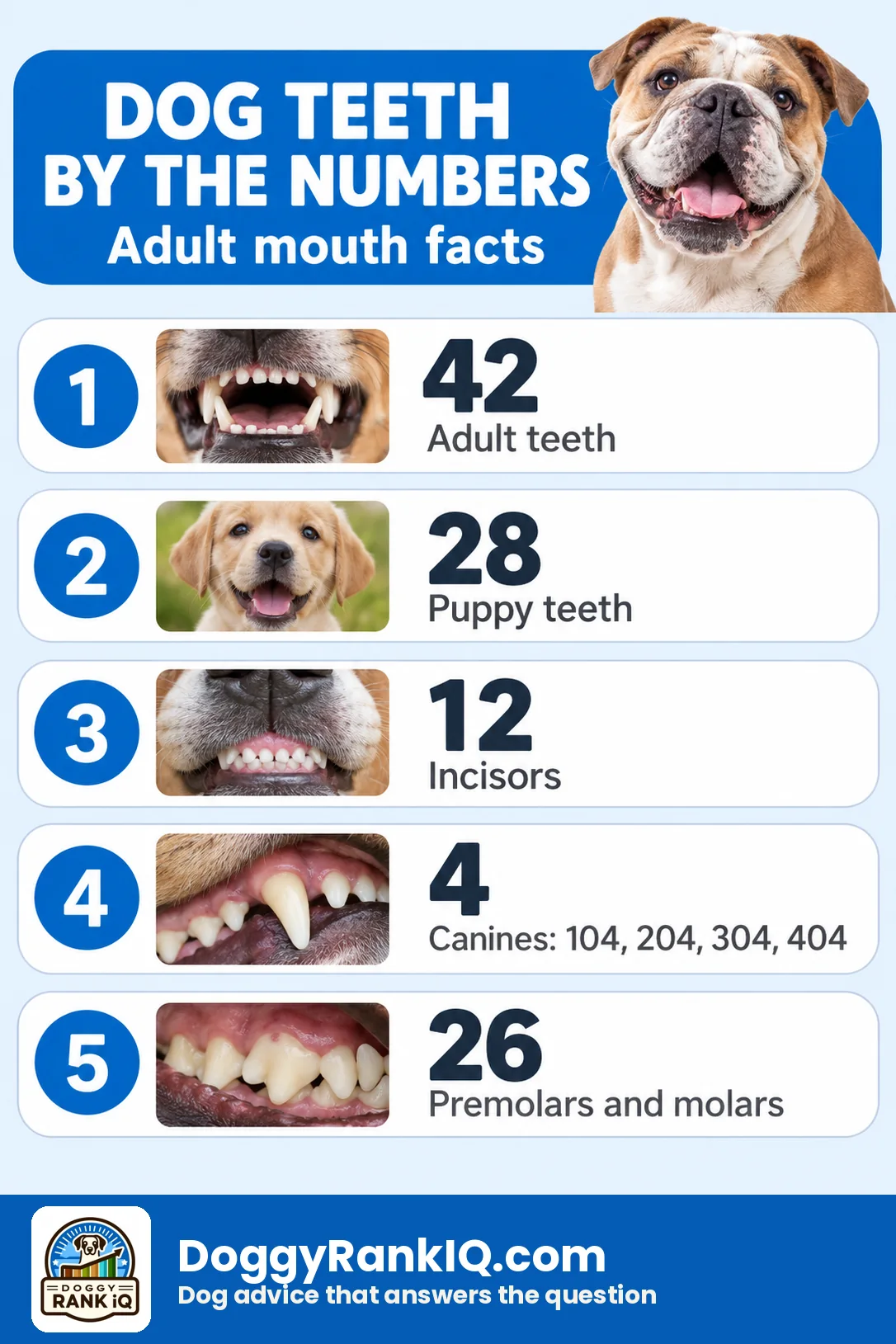
- Adult dogs have 42 permanent teeth; puppies have 28 baby teeth in quadrants 5 through 8.2
- The four canine teeth are always 104, 204, 304, and 404 in every dog, every chart.1
- Incisors and canines have 1 root, most premolars have 2, and the upper fourth premolar plus upper molars have 3.
- A dog dental chart pdf from your clinic and a free dog dental chart found online should use identical numbers, since the system is standardized.
- The upper carnassial tooth, 108 and 208, is the largest chewing tooth and a common fracture site.
- A cat dental chart uses the same Triadan logic but a different tooth count, since cats have 30 adult teeth, not 42.
- One pilot study in 2026 found ultrasonic toothbrushes did not remove visible calculus in a single session, reinforcing that home tools support but do not replace professional cleaning.5
Which tooth number is on your chart?
Tap an option to see the answer.
The short answer: how a dog dental chart works
A dog dental chart is a numbered map of every tooth, built so any vet, tech, or specialist can read it without translation. The modified Triadan system is the standard behind nearly every chart you will see, whether it’s a free dog dental chart from a veterinary school or the printed sheet stapled to your cleaning invoice.1
Each tooth gets a two or three digit number. Nothing about this changed heading into 2026. A 2026 review in the Merck Veterinary Manual, written by Alexandra Wright, DVM, DAVDC, confirms modified Triadan remains the common clinical notation for dentition.1 What has shifted is how clinics explain it. Recent chart resources lean harder into plain quadrant-based breakdowns instead of assuming owners already know veterinary shorthand.4
Here’s the part most charts skip explaining: the numbering is oriented to the dog, not to you. When you face your dog, the teeth on your left are actually the dog’s right side, and that’s quadrant 1.1 That one flip explains most of the confusion owners report after a cleaning.
A simple way to read tooth numbers: the Triadan system in 3 steps
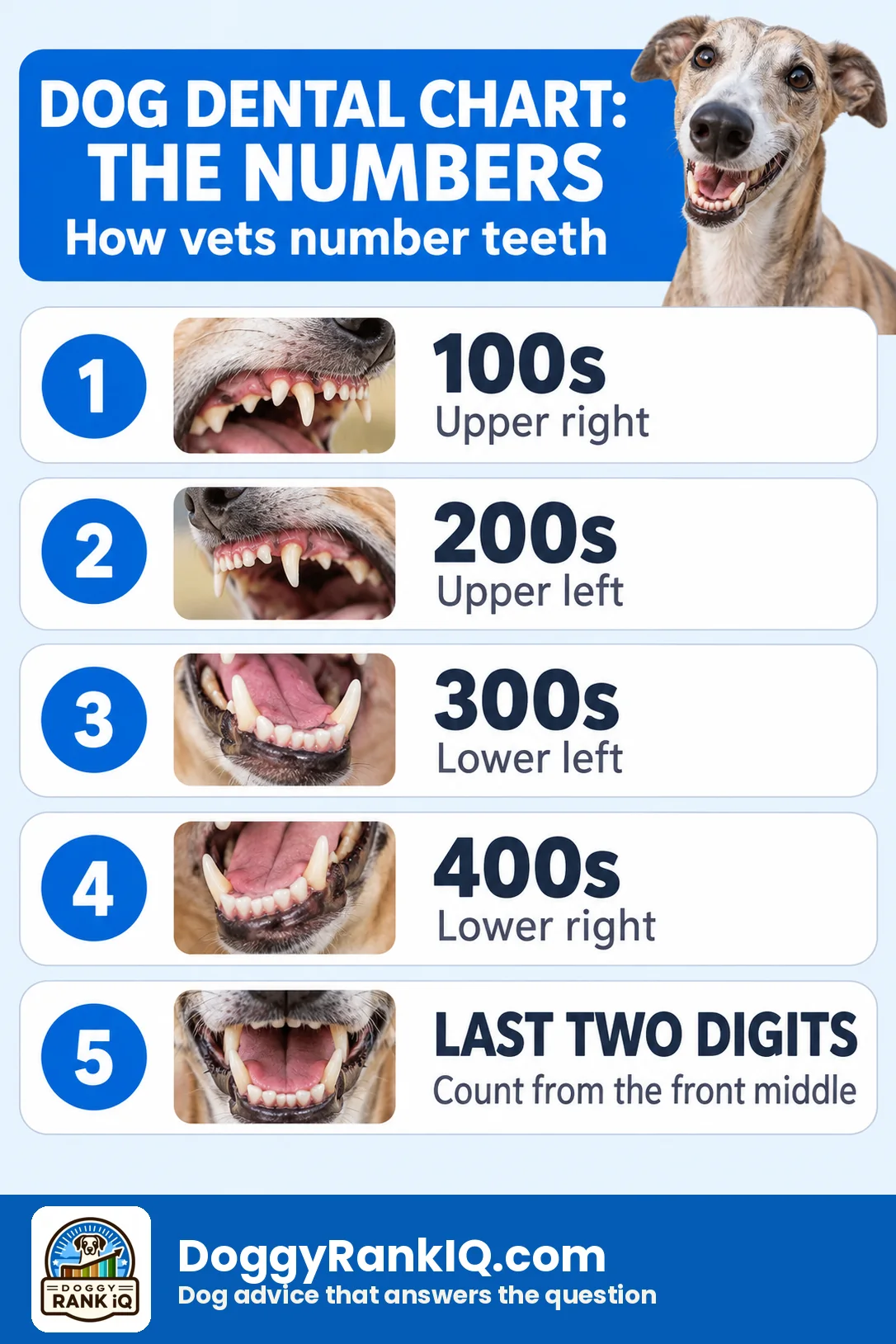
A dog dental chart becomes readable once you separate the quadrant digit from the position digits and apply them in order. Three steps cover nearly every number you’ll ever see on a chart.
1Find the quadrant (first digit)
The first digit tells you which quarter of the mouth you’re looking at, based on the dog’s orientation:
- 1 = dog’s upper right
- 2 = dog’s upper left
- 3 = dog’s lower left
- 4 = dog’s lower right
2Find the position from the midline (last two digits)
The final two digits count outward from the center of the mouth. Position 01 is the first incisor next to the midline, 04 is always the canine, and 09 marks the first molar.1 A handy pattern to memorize: 01 to 03 are incisors, 04 is the canine, 05 to 08 are premolars, and 09 onward are molars.3
3Put the two parts together
Combine quadrant and position. Tooth 309 means quadrant 3 (lower left) plus position 09 (first molar), which is the dog’s lower left first molar. Tooth 108 means quadrant 1 (upper right) plus position 08 (fourth premolar), the large upper right carnassial tooth. That’s the entire system. No decoder ring required.
Decision rule: if a chart number starts with 1 or 2, you’re looking at the upper jaw. If it starts with 3 or 4, you’re looking at the lower jaw. Memorize just that split and half your confusion disappears immediately.
Facts table: dog teeth number chart
The table below lays out the full dog tooth chart numbers for one side of the mouth, since the pattern repeats across all four quadrants.
The right maxilla alone spans 101 through 110, which is the full upper right quadrant in a permanent adult dog.1 Mandibular teeth run one number further, to 11, because the lower jaw carries a third molar that the upper jaw does not.3
Dog teeth formula: 42 adult teeth, 28 puppy teeth
An adult dog’s mouth holds 42 teeth, while a puppy’s baby set has 28.2 The dog teeth formula per side of the adult mouth breaks down as 3 incisors, 1 canine, 4 premolars, and 2 molars on top, and 3 incisors, 1 canine, 4 premolars, and 3 molars on the bottom. Multiply across both sides and both jaws and you land on 42.
Baby teeth follow a smaller formula, with no molars at all, and they get their own quadrant numbers: 5 (upper right deciduous), 6 (upper left deciduous), 7 (lower left deciduous), and 8 (lower right deciduous).2 So a puppy chart with a tooth labeled 504 isn’t a typo. It’s the baby version of the upper right canine, using the same logic as the adult chart with a shifted quadrant number.
Common mistake: assuming quadrant numbers above 4 mean something is wrong. They just mean you’re reading a puppy chart. For the full sequence of when those baby teeth come in and fall out, the puppy teething timeline breaks down each stage by week.
Dog dental chart roots: which teeth have 1, 2 or 3
Root count matters because it predicts how hard a tooth is to extract and how much bone support it needs. Dental chart roots generally follow a simple size rule: smaller front teeth have fewer roots, bigger back teeth have more.
- Incisors and canines: 1 root each, which is part of why canine extractions, while still a bigger procedure given the tooth’s length, involve a single root socket.
- Most premolars: 2 roots, with the upper and lower first premolars sometimes carrying just 1.
- Upper fourth premolar (108, 208) and upper molars (109, 110, 209, 210): 3 roots, making them the most structurally complex teeth to remove.
- Lower molars: generally 2 roots, except the lower third molar, which can have a single fused root.
A 2026 study following 87 healthy adult dogs through permanent-tooth extraction found that 17 dogs, about 19.5%, developed wound dehiscence, a partial reopening of the extraction site, by their first postoperative check.6 Multi-rooted teeth like the upper carnassial carry more surgical complexity than a single-rooted incisor, which is part of why that tooth gets flagged early when periodontal disease is already present.
How to read the marks on your vet’s chart
Beyond the numbers themselves, most charts use shorthand marks and abbreviations to flag a tooth’s condition. These marks differ slightly by clinic, which is exactly why you should ask your vet to walk you through their specific key.
Common marks you’ll run into:
- M or a strikethrough: tooth is missing
- FX or a jagged line: fractured tooth
- EXT or a circled number: tooth was extracted
- Stage 1 through 4: periodontal disease severity, with stage 1 being gingivitis and stage 4 being advanced bone loss
- Red shading: often marks calculus or active inflammation at that tooth
Vetstack and similar veterinary charting templates standardize these symbols so technicians across a practice mark things consistently.7 Still, one clinic’s circle is another clinic’s checkmark. Ask, don’t assume.
Quick example: if your chart shows “309, Stage 3” that means the lower left first molar has stage 3 periodontal disease, moderate bone loss that typically needs a deeper cleaning plan or possible extraction discussion. If you’re unsure whether your dog’s teeth even need professional attention yet, our guide on whether you need to brush your dog’s teeth covers the warning signs that tip the decision.
Dog dental chart vs cat dental chart
A dental chart and a cat dental chart share the same modified Triadan logic, but the numbers stop lining up once you count teeth. Dogs have 42 adult teeth; cats have 30.1 Cats are missing most premolars and have no third molar at all, so a cat chart’s numbers top out lower in each quadrant.
The quadrant numbering itself, 1 through 4 for adults and 5 through 8 for deciduous teeth, stays identical across both species.2 So a tech moving from a dog’s chart to a cat’s chart doesn’t need to relearn the whole system, just the shorter tooth count per quadrant. Choose this distinction to remember: same code, different word count.
🦷 When each tooth arrives: the puppy timeline
A dental chart for a puppy changes month by month, and the dates help you tell normal from late.
Baby teeth start breaking through at about three weeks. The incisors and canines come first, the premolars follow, and the full set of 28 is usually in by six to eight weeks. Puppies have no baby molars, which is the reason the count is so much lower than an adult’s.
The swap begins around three to four months. Adult incisors push in first. The canines and premolars change over between roughly four and six months, and the adult molars, which have no baby versions to replace, appear between about five and seven months. Most dogs have all 42 by seven months. During that stretch you may find rice-sized teeth on the carpet. More often you find nothing, because puppies swallow most of them.
“A baby canine and an adult canine standing side by side? Call the vet. Two teeth should not share one spot.”
That situation has a name: a persistent deciduous tooth. The baby tooth was supposed to loosen as the adult one came up beneath it, and it held on. It is most common with the canines in small breeds such as Yorkshire Terriers, Chihuahuas, Pomeranians and Maltese. The doubled teeth trap food and hair, crowd the bite and set up early gum disease. Vets usually remove the retained baby tooth, often at the same time as a spay or neuter so the puppy is only under anesthesia once.
On a Triadan chart, baby teeth get their own numbers. The quadrants are 5, 6, 7 and 8 in place of 1, 2, 3 and 4, so a puppy’s upper right baby canine is 504 and the adult tooth that replaces it is 104. If your vet’s notes say “704 persistent,” that is the lower left baby canine still in place.
📅 A two-minute home check, once a month
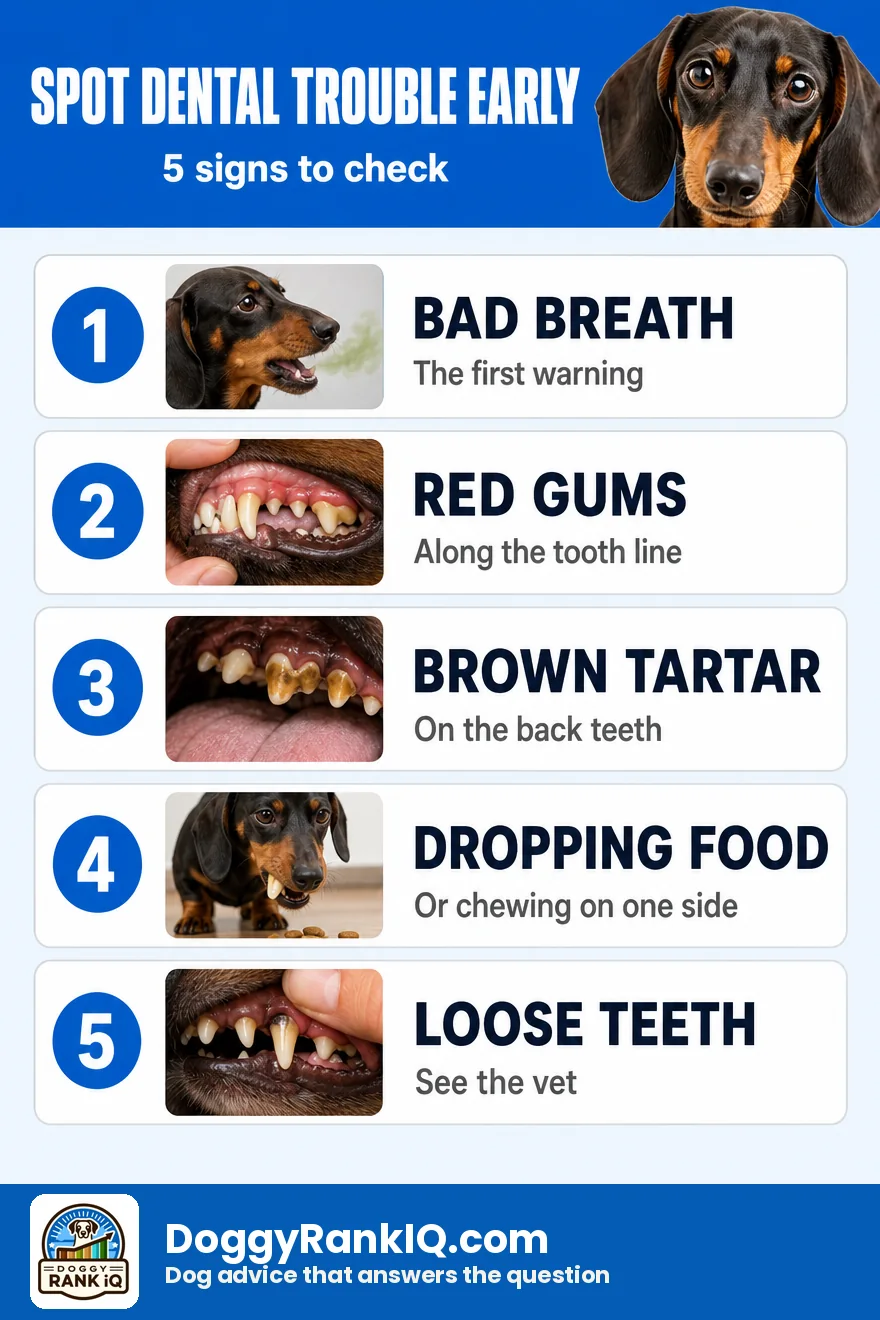
Lift the lip on each side and look at four things: the color of the gum line (pink is good, a red rim is early inflammation), brown buildup on the big upper cheek teeth, any tooth that is chipped or gray, and any swelling under an eye, which can point to a root problem in the tooth above. Sniff, too. A strong odor usually points to infection.
Write down what you see using the tooth numbers. “Tartar on 108 and 208, red gum at 204” tells your vet more than “bad teeth,” and it lets you compare from month to month. Products that carry the Veterinary Oral Health Council seal have shown in trials that they reduce plaque or tartar, so that seal is the quickest filter when you shop for chews.
⭐ Top 5 Features We Love
- One universal code. Learn it once and read any clinic’s chart, anywhere, including a dental chart pdf emailed from a specialist across the country.
- No guessing which side. The quadrant digit removes the left-right confusion that trips up new techs and anxious owners alike.
- Instant severity snapshot. Periodontal stages 1 through 4 give you a one-glance read on how urgent a tooth’s situation is.
- Works across species. The same logic carries over to a cat dental chart, so multi-pet households aren’t learning two systems.
- Pairs with pictures easily. A dental chart with pictures turns an abstract number like 108 into an actual tooth you can point at in your dog’s mouth.
⚠️ Things to Look Out For
- Bad breath that’s gotten noticeably worse, not just normal dog breath, but a sharp or rotten smell.
- Yellow or brown buildup along the gumline, which is calculus, hardened plaque that brushing alone can no longer remove.
- Bleeding gums when your dog chews a toy or during a gentle at-home check.
- Dropping food or chewing on one side only, a sign a specific tooth, maybe 108 or 309, is painful.
- Visible fracture or a tooth that looks shorter than its neighbors.
- Pawing at the mouth or reluctance to let you touch the face.
If you spot any of these, book a vet visit rather than waiting for the annual exam. For a deeper look at how plaque progresses into disease stages, see our guide to periodontal disease in dogs.
Free dog dental chart pdf and picture sources
A free dental chart pdf is useful for vet students, techs studying for certification exams, and curious owners who want the full-mouth diagram instead of individual tooth lookups. Veterinary education sites and exam-prep resources publish these charts with labeled diagrams showing every quadrant at once.48
When searching for a dental chart with pictures, look for ones that show both the Triadan number and a drawing of the tooth’s shape and root count side by side. That combination is what actually helps a number like “208” click into an image of the upper left carnassial tooth. VTNE study guides built for veterinary technician exams tend to be some of the clearest, since they’re designed for people memorizing the system from scratch.3
Helpful home dental care products
Knowing the chart is one thing. Keeping those numbered teeth healthy between cleanings is another. A few products consistently come up in owner routines and veterinary home-care guidance, including a recent discussion at the 2026 New York Vet Show where Kristin I. Scott, DVM, DAVDC, covered toothbrushing, dental chews, and technician-led home care counseling as the main levers owners actually control.4
- C.E.T. Enzymatic Toothpaste for Dogs and Cats, Poultry{rel=”sponsored”}, priced around $12.29 (price checked 2026), is an enzymatic formula designed to work alongside brushing rather than replace it.
- Vet’s Best Dog Toothpaste and Toothbrush Dental Care Kit{rel=”sponsored”}, around $15.13 (price checked 2026), bundles a brush and paste for owners just starting a routine.
- Arm and Hammer Dog Dental Kit, Toothbrush and Toothpaste{rel=”sponsored”}, around $7.69 (price checked 2026), is a budget-friendly starter kit.
- Dentalife Purina Daily Dental Chews for Large Dogs, 18 ct{rel=”sponsored”}, around $7.94 (price checked 2026), gives large dogs a chewing-based option on days brushing doesn’t happen.
Check the current price: C.E.T. Enzymatic Toothpaste{rel=”sponsored”}.
A reported 2026 pilot study found ultrasonic toothbrushes did not eliminate visible calculus after a single session and produced only minimal detachment on dental specimens, so these devices and chews should be treated as support tools, not replacements for professional cleaning.5 If brushing itself feels like a losing battle, our piece on cleaning dog teeth without a brush covers realistic alternatives, and if you’re weighing a cleaning method that skips anesthesia, read the risks first in our anesthesia-free dental cleaning guide. Always confirm any new dental product or routine with your veterinarian before starting it, especially for dogs with existing periodontal disease.
The bottom line
A dental chart is less intimidating once you separate it into two moves: read the first digit for quadrant, read the last two digits for position from the midline. That’s the whole modified Triadan system, the same one used from veterinary school exams to the chart stapled to your cleaning receipt.1 Adult dogs carry 42 teeth across four quadrants, puppies carry 28 in their own numbered set, and root counts climb the farther back you go in the mouth.
Next time your vet hands you a printout with numbers like 108 or 409 circled in red, you’ll know exactly which tooth they mean and roughly what kind of root structure you’re dealing with. That’s a useful thing to walk into a follow-up appointment already understanding.
Doggy Rank IQ is reader supported. As an Amazon Associate we earn from qualifying purchases, at no extra cost to you.