
Quick Answer
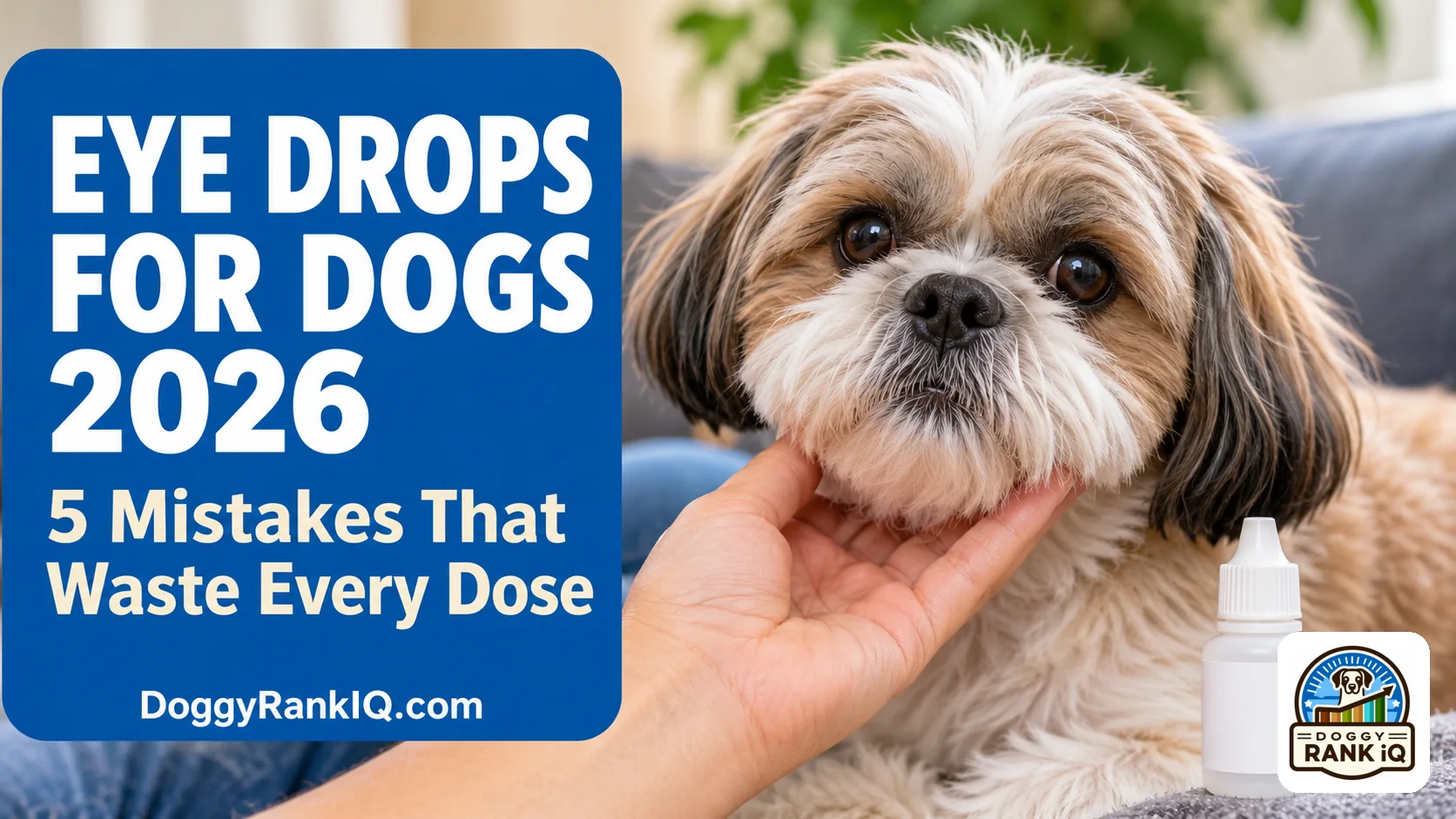
Eye drops for dogs fail most often because of timing, not product quality. Giving two drops too close together, storing them wrong, tilting the bottle at the wrong angle, or using a human product washes the dose right off the eye before it does anything. The fix is usually five minutes of technique, a timer, and knowing when a watery eye needs a vet instead of a bottle.
Key Takeaways: eye drops for dogs
- Eye drops for dogs only work if they stay on the eye long enough to absorb, which means spacing multiple drops 5 to 10 minutes apart according to VCA Animal Hospitals’ guidance on applying eye drops.
- Prescription eye drops for dogs treat a diagnosed problem (infection, ulcer, glaucoma, dry eye). Over the counter eye drops for dogs are mostly saline washes, not treatments.
- Human eye drops for dogs are risky. Redness-relief drops containing tetrahydrozoline or oxymetazoline can cause vomiting, tremors, or abnormal heart rate in dogs.
- A major 2026 recall of compounded veterinary eye medications, flagged by the FDA’s eye-drop recall notice, is a reminder to check lot numbers, not just expiration dates.
- Red, painful, squinting, or cloudy eyes need a same-day vet visit, not a wait-and-see OTC eye wash.
- A left eye/right eye dose log prevents the single most common mistake: double-dosing one eye and skipping the other.
- Steroid-containing drops should never be started before a vet checks for a corneal ulcer, because they can make an ulcer worse.
- Adherence research on canine eye drop therapy found that owners who understand the reason for treatment stick with the schedule longer, according to a study on adherence to eye drop therapy in dogs.

What is going on with the eye?
Tap an option to see the answer.
What are eye drops for dogs used for?
Eye drops for dogs are used to treat infections, relieve dryness, lower eye pressure in glaucoma, reduce inflammation, or simply rinse debris from the surface of the eye. The right drop depends entirely on what’s actually wrong with the eye, which is why a vet exam usually comes before the bottle.
Common reasons a dog ends up on eye drops:
- Bacterial conjunctivitis, often following allergies, dust exposure, or an upper respiratory infection, as described in VCA’s overview of conjunctivitis in dogs
- Corneal ulcers from scratches, trauma, or rubbing against furniture
- Chronic dry eye (keratoconjunctivitis sicca), which needs long-term tear-stimulating or lubricating drops
- Glaucoma, a true emergency requiring pressure-lowering medication
- Simple irritation from pollen, dust, or a stray eyelash, which may only need a saline rinse
Decision rule: if the eye looks irritated but the dog is acting normal, eating fine, and not pawing at the face, a wash may be enough. If there’s squinting, color change, or repeated pawing, treat it as a medical issue, not a cosmetic one.
Prescription vs over the counter eye drops for dogs: what each is for
Prescription eye drops for dogs treat a specific, vet-diagnosed condition. Over the counter eye drops for dogs are generally saline washes meant to rinse debris and support comfort, not cure infections, ulcers, or glaucoma.
That distinction gets blurry at the pharmacy counter, and it’s the reason half the bottles under people’s bathroom sinks don’t match what their dog actually needs.
Prescription drops typically include:
- Antibiotic drops for bacterial conjunctivitis or superficial ulcers, often dosed every 4 to 8 hours, with deep ulcers sometimes needing dosing as often as every 2 hours.
- Anti-inflammatory or steroid drops, which are contraindicated if a corneal ulcer hasn’t been ruled out with fluorescein staining.
- Glaucoma medications like dorzolamide or brinzolamide, which lower eye pressure in a true emergency condition.
- Immune-modulating drops like cyclosporine (commonly around 0.2% to 2%) or tacrolimus (around 0.02%) for chronic dry eye, usually given every 8 to 12 hours. Newer research on tacrolimus and hyaluronate for canine dry eye disease suggests combination therapy can improve tear film stability in some dogs.
- Non-steroidal anti-inflammatory ophthalmic solutions, though a study on topical ketorolac and diclofenac in dogs found measurable systemic absorption and some gastrointestinal side effects, which is a reminder that “topical” doesn’t always mean “local only.”
Over the counter eye drops for dogs typically include:
- Saline-based eye washes that rinse pollen, dust, or discharge.
- Artificial tear products that mimic natural tear film for mild, non-painful dryness.
A product like Vetericyn Plus Eye Wash (about $15.99, price checked 2026) falls into the wash category. It’s labeled to flush irritants and support comfort around the eye area. It is not labeled or positioned as a treatment for infection, and nothing in this article should be read as a substitute for that distinction. Check the current price.
Decision rule: if a vet has diagnosed anything (ulcer, infection, glaucoma, dry eye disease), use only what was prescribed. If the eye looks clear, the dog isn’t squinting, and you just want to rinse out a grass seed or morning gunk, an OTC wash is reasonable. If you’re not sure which situation you’re in, that uncertainty is itself a reason to call the vet.
Readers dealing with chronic tearing or dryness may also want the dry eye in dogs article, which goes deeper into the diagnosis side of this.
What’s the difference between vet-prescribed and OTC dog eye drops?
The core difference is intent: vet-prescribed eye drops for dogs target a diagnosed condition with an active medication, while OTC eye drops for dogs are formulated to clean and soothe without treating disease. Vet-prescribed products also require a specific dose, frequency, and duration set by an exam, while OTC products are labeled for general use without that oversight.
Another practical difference is cost and access. Prescription eye drops for dogs require a vet visit and often a recheck exam, while OTC washes can be bought anytime without a diagnosis. That convenience is exactly why OTC products get misused on infections they were never meant to treat.
Common mistake: assuming “gentle” or “natural” wording on an OTC label means it can substitute for a prescribed antibiotic. It can’t. A wash can keep debris off an already-healing eye, but it has no mechanism to kill bacteria or reduce intraocular pressure.
Can you use human eye drops on dogs?
Generally, no, not without a vet confirming the specific product is safe for the specific problem. Many human eye drops contain ingredients that are fine for people and genuinely dangerous for dogs if swallowed, which happens constantly since dogs lick their own faces.
Human redness-relief drops are the biggest offender. Ingredients like tetrahydrozoline, naphazoline, oxymetazoline, and xylometazoline can cause vomiting, weakness, abnormal heart rate, blood pressure swings, panting, tremors, or depression in dogs, with signs starting 30 minutes to 4 hours after exposure.
Even “gentle” or “preservative-free” labeling isn’t a safety guarantee. In 2025, one lot of Systane Lubricant Eye Drops Ultra PF single-use vials was recalled over fungal contamination or visible foreign material concerns. That’s a human product recall, included here because it shows that “preservative-free” doesn’t mean risk-free, and old vials sitting in a bathroom drawer are not a safe improvisation for a dog’s eye.
Common mistake: grabbing “just saline” or “just lubricant” drops from the medicine cabinet because the label looks harmless. Plain saline rinses made for contact lenses sometimes include preservatives not meant for repeated ocular use, and dosing strength isn’t formulated with a 20-pound dog in mind.
The decision rule that actually works: if the bottle was bought for a human eye and wasn’t specifically cleared by a vet for your dog, don’t use it. Call the vet, describe the product, and ask.
Why does my dog need eye drops?
A dog usually needs eye drops because of infection, inflammation, injury, or a chronic condition like dry eye or glaucoma that won’t resolve on its own. The eye is a fragile structure, and conditions that look minor (a little redness, some squinting) can progress quickly without treatment.
Some common triggers that lead a vet to prescribe eye drops:
- Scratches from branches, grass, or rough play that turn into corneal ulcers
- Allergies that cause chronic itching and secondary infection from rubbing
- Breed-specific anatomy (flat-faced breeds like Pugs and Bulldogs are more prone to corneal exposure and dry eye)
- Age-related tear production decline in senior dogs
Example: a dog that paws at one eye after a walk in tall grass may have a foreign body or a scratch. A vet exam with fluorescein stain can confirm an ulcer in minutes, which changes the treatment plan from a simple wash to an antibiotic drop on a strict schedule.
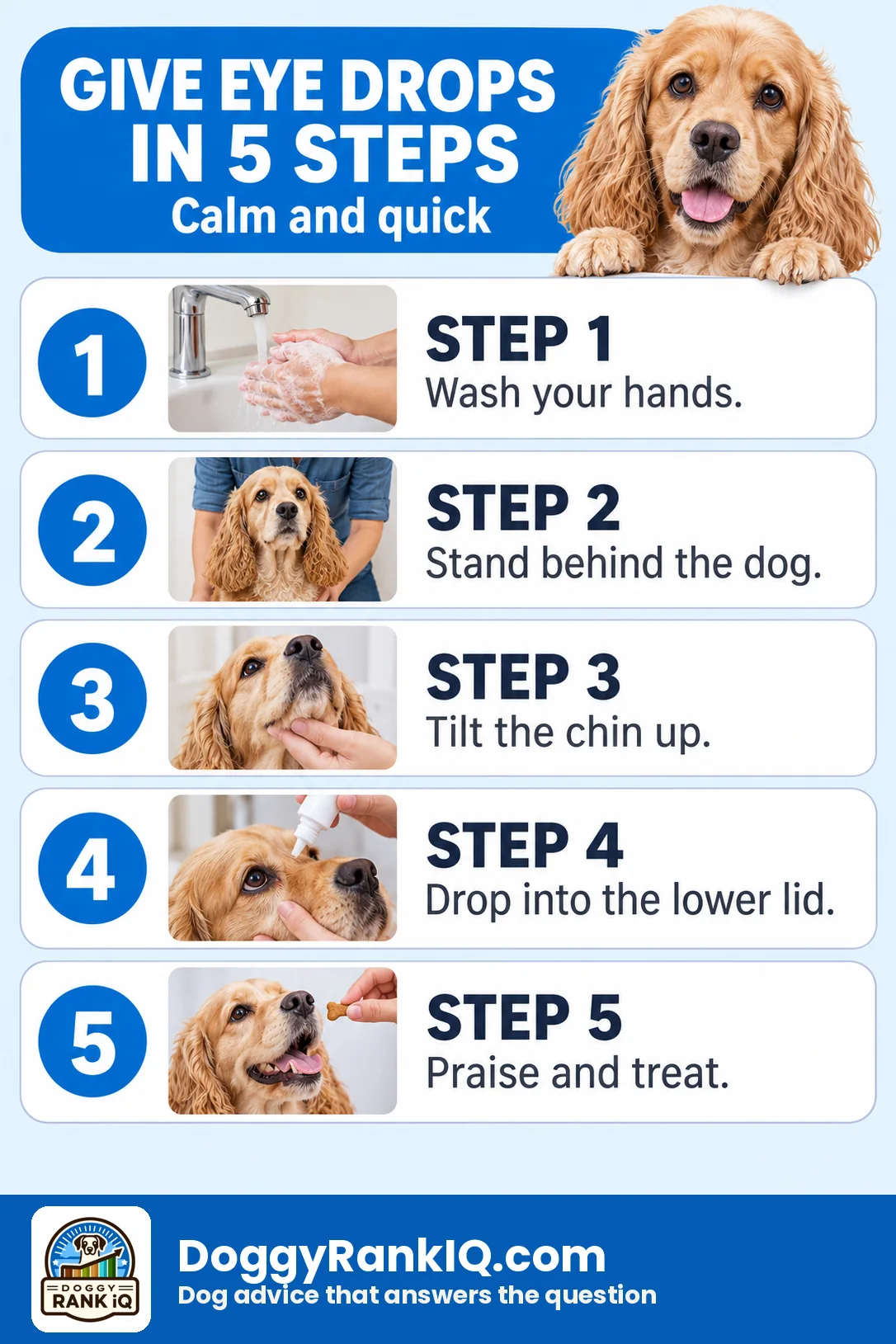
How do you apply eye drops to a dog’s eyes?
Getting a dose onto the eye, instead of onto fur, a paw, or the floor, comes down to positioning and a steady hand, not strength. Cornell’s veterinary pharmacy and VCA’s clinical guidance both describe a version of this same sequence.
- Wash your hands and have the bottle, a treat, and a towel ready before you touch your dog.
- Steady the head from above or behind, tilting the nose slightly upward. Approaching from behind the dog’s head (not head-on) tends to cause less flinching, per VCA’s step-by-step instructions.
- Rest your hand (holding the bottle) on the dog’s head or brow bone for stability, not directly over the eye where a sudden head jerk could cause contact.
- Pull the lower eyelid down gently with your other hand to create a small pocket.
- Drop the medication into that pocket, aiming for the white of the eye, not the center of the cornea.
- Let the dog blink. Blinking spreads the medication across the eye naturally; don’t force the eyelids closed.
- Wait before adding a second drop or a different medication. Space multiple products 5 to 10 minutes apart so the first one isn’t rinsed out by the second.
- Reward immediately with a treat and calm praise, every single time, even on hard days.
Edge case: dogs who flinch hard or have a painful eye may need two people, one to steady the body and one to apply the drop. Forcing a painful eye open is a reason to call the vet, not a reason to push harder.
My dog won’t let me put eye drops in, can I use alternatives?
If a dog consistently fights eye drops, the first step is adjusting technique (approaching from behind, using a towel wrap, or getting a second set of hands) rather than skipping doses. Alternatives like oral medication exist for some conditions, but they’re not a universal swap and need a vet’s input.
Practical options when a dog resists:
- Wrap the dog in a towel burrito-style to limit paw movement without restricting breathing
- Apply drops right after a meal or a walk, when the dog is calmer and more food-motivated for the follow-up treat
- Ask the vet whether an ointment (applied less often) could replace a drop that needs frequent dosing
- For chronic conditions, ask about longer-acting formulations that reduce daily handling
Common mistake: giving up after one failed attempt and skipping the dose entirely. A missed dose on an infection or ulcer can slow healing meaningfully, so it’s worth a second attempt, a helper, or a call to the vet for technique coaching rather than skipping outright. A study on adherence to canine eye drop therapy found that owner confidence and clear instructions were strongly tied to how consistently drops actually got administered.
How much do prescription dog eye drops cost?
Prescription eye drops typically run anywhere from $20 to over $100 depending on the medication, concentration, and whether it’s a standard manufactured product or a compounded formulation. Immune-modulating drops like cyclosporine or tacrolimus for chronic dry eye tend to sit at the higher end because they’re used long-term, sometimes for the rest of a dog’s life.
Cost factors to expect:
- Generic antibiotic drops are usually the least expensive option
- Glaucoma medications and immune-modulating drops cost more and are often refilled monthly
- Compounded formulations can vary widely in price and are the category most affected by the 2026 recall discussed below
- A recheck exam, often required before refills, adds to the overall cost of managing a chronic eye condition
Decision rule: if a prescription feels unexpectedly expensive, ask the vet whether a different formulation (same active ingredient, different concentration or base) is available before assuming the price is fixed.
How often should I give my dog eye drops?
Frequency depends entirely on the diagnosis: simple infections might call for drops every 4 to 8 hours, while deep ulcers can require dosing as often as every 2 hours, and chronic dry eye drops are often just twice a day. Never guess the schedule; follow exactly what’s written on the prescription label.
- Antibiotic drops for conjunctivitis: every 4 to 8 hours
- Antibiotic drops for deep ulcers: as often as every 2 hours in severe cases
- Immune-modulating drops (cyclosporine, tacrolimus): every 8 to 12 hours
- Lubricating or artificial tear drops: as needed, often 2 to 4 times daily for comfort
Common mistake: stretching out doses to make a bottle last longer. Underdosing an infection can let bacteria rebound and extend the total treatment time, which usually costs more in the end than finishing the bottle on schedule.
Best dog eye drops for allergies and itching
For allergy-related eye itching, vets commonly reach for lubricating or antihistamine-containing ophthalmic drops, while OTC saline washes can help rinse allergens like pollen from the surface of the eye between treatments. True itching with redness and swelling usually needs a vet exam to rule out infection before settling on a product.
- Mild seasonal watering with no squinting: an OTC saline wash may be enough to rinse pollen and dust
- Persistent itching with redness: a vet may prescribe an antihistamine or mild steroid drop (only after ruling out an ulcer)
- Chronic seasonal flare-ups: some dogs do best on a maintenance lubricant plus a short course of medicated drops during flare weeks
Example: a dog that squints and rubs its face on the carpet every spring, with clear discharge and no cloudiness, is a textbook allergy case. A vet-approved antihistamine drop paired with a saline rinse on high-pollen days often keeps symptoms manageable without daily medicated dosing.
My dog keeps getting eye infections, what should I use?
Recurring eye infections need a vet workup to find the underlying cause (anatomy, allergies, tear duct issues, or an untreated chronic condition) rather than repeated rounds of the same leftover antibiotic drop. Reusing an old prescription without a recheck is one of the most common reasons infections keep coming back.
Questions worth asking the vet:
- Is there an anatomical issue, like inverted eyelids or excess facial folds, trapping debris near the eye?
- Could allergies be the root cause of the recurring irritation that leads to infection?
- Does the dog need a tear-stimulating drop long-term rather than repeated short antibiotic courses?
- Would a culture and sensitivity test identify a resistant bacteria that the current drop isn’t treating?
Decision rule: if a dog needs antibiotic eye drops three or more times in a year, that’s a pattern, not bad luck, and it’s worth a referral to a veterinary ophthalmologist rather than another round of the same drop.
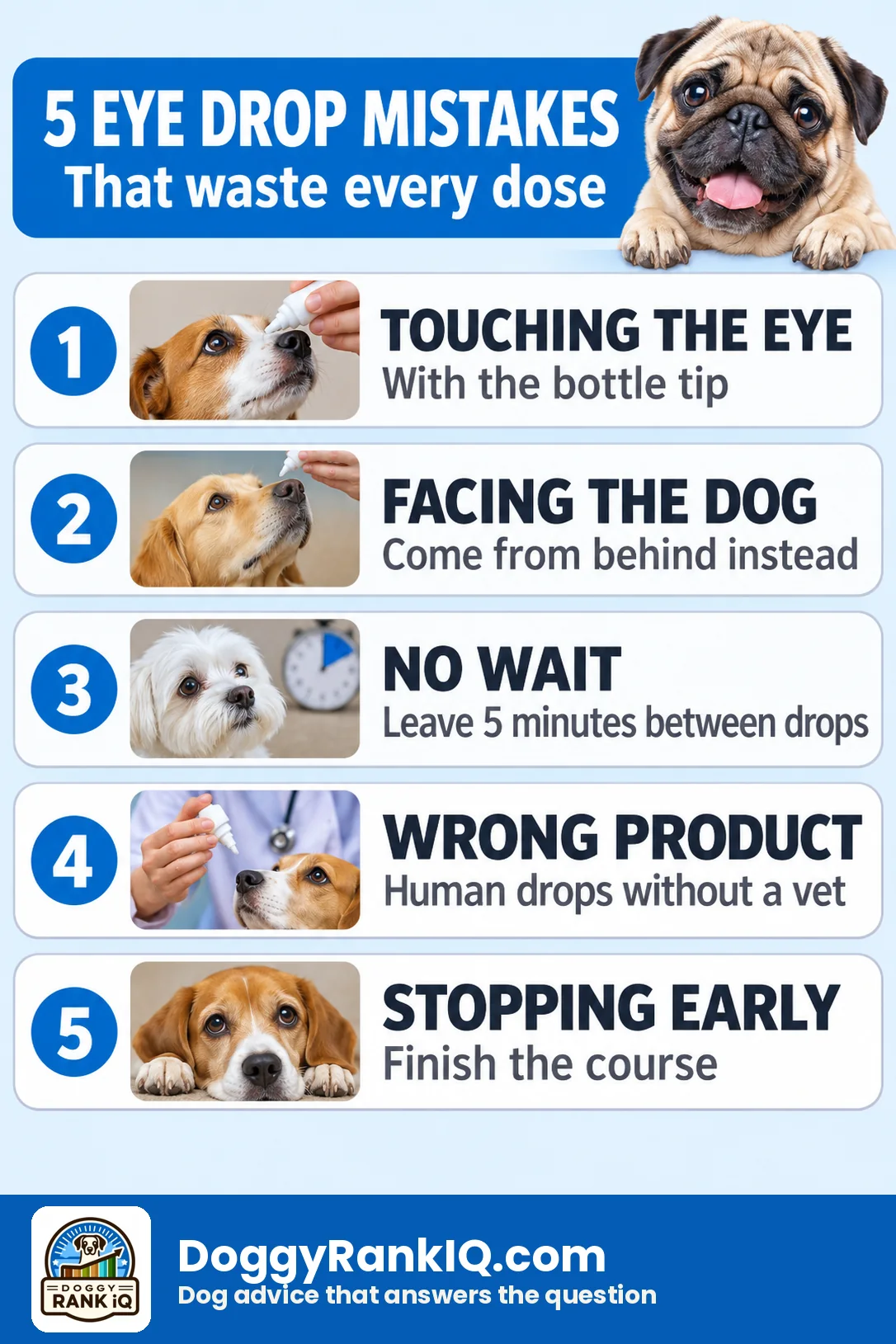
The 5 mistakes that waste a dose, numbered, each with the fix
Most wasted doses aren’t a product failure. They’re a timing or handling problem that’s easy to fix once it’s named.
1Giving two drops back to back with no gap
The mistake: putting in drop one, then immediately putting in drop two, assuming more medication absorbed means better coverage.
The fix: wait 5 to 10 minutes between different eye medications so the first has time to spread across the eye before the second washes over it. Set a phone timer. It feels slow. It’s the single biggest reason a $60 bottle of antibiotic drops runs out two weeks early with nothing to show for it.
2Aiming for the center of the eye instead of the lower lid pocket
The mistake: trying to land the drop directly on the cornea, which triggers a blink reflex before the medication even settles.
The fix: pull down the lower lid to form a pocket and aim there. The dog’s own blink does the distribution work.
3Storing drops somewhere warm, bright, or in the car
The mistake: tossing the bottle in a bag, a glovebox, or a windowsill, where heat and light can degrade the active ingredient before the bottle is even half used.
The fix: store at the temperature the label specifies (many go in the fridge), away from direct sun, and track the open date. Most prescription eye products are considered good for a limited window after opening, commonly around 28 days, though the exact number is on the label and varies by formulation; when in doubt, ask the pharmacy that filled it.
4Using the wrong drop for the wrong eye problem
The mistake: reaching for a steroid-containing drop or a leftover prescription from a past condition because “it worked last time.”
The fix: steroid drops are contraindicated if there’s an undiagnosed corneal ulcer, because they can inhibit healing and worsen the ulcer. Never reuse a leftover prescription without a vet confirming it still fits the current problem.
5Skipping the lot number check during an active recall
The mistake: assuming a compounded eye medication is fine because it hasn’t expired.
The fix: in 2026, Wedgewood Pharmacy recalled selected compounded veterinary medications, including ophthalmic ointments and solutions, after unreliable lab testing raised concern that products could be subpotent or superpotent, a concern echoed in the FDA’s own reminder about eye-drop recalls. Affected products shipped nationally between February 18 and 2026, and the recall reportedly covered nearly 4,000 product listings across concentrations, lots, and expiration dates. If your dog’s eye drops are compounded rather than a standard manufactured product, check the lot number against the pharmacy’s recall list before the next dose, not after a problem shows up. The FDA’s list of approved animal drug products is a useful reference for confirming whether a medication is a standard manufactured product or a compounded alternative.
Keeping a left eye and right eye log
A simple log prevents the most common real-world mistake: double-dosing one eye while the other gets skipped entirely, especially when two different medications are in rotation.
A basic version can be three columns on a notepad or phone note:
Veterinary shorthand uses OD for the right eye and OS for the left eye, which is worth learning if the prescription label uses it. Writing “right” and “left” works just as well if the abbreviations feel like one more thing to remember mid-chaos.
Why this matters for multi-drop routines: if a dog is on an antibiotic drop and a lubricant for the same eye, the log also tracks the 5 to 10 minute gap between them, so nobody has to guess whether the second drop already went in.
⭐ Top 5 Features We Love
- Single-use vials on some prescription drops reduce contamination risk compared to a multi-dose bottle touched daily near fur and eyelashes.
- Saline eye washes with a wide dropper tip, like the Vetericyn Plus Eye Wash, make it easier to rinse without poking at the eye itself.
- Clear dosing instructions printed directly on the label, including frequency and spacing, instead of a vague “as needed.”
- Refrigeration reminders on the cap or box for drops that lose potency at room temperature.
- Opened-date tracking stickers included with some prescriptions, which solve the “how old is this bottle really” problem.
⚠️ Things to Look Out For
- Compounded eye medications carry recall risk that manufactured products don’t carry in the same way. The 2026 Wedgewood recall is the clearest recent example.
- “Preservative-free” is not a safety label for dogs, even on human products pulled from a medicine cabinet in a pinch.
- OTC eye washes are not labeled for infections, and a cloudy or painful eye that gets rinsed instead of examined can get worse while waiting.
- Steroid drops started without ruling out an ulcer can cause the cornea to deteriorate rather than heal.
- Expired or recalled lots may be subpotent or superpotent, meaning the dose on the label may not match what’s actually in the bottle.
Confirm any new eye product, OTC or prescription, with your veterinarian before starting it, especially for puppies, senior dogs, or dogs with a known eye condition.
When an eye problem is an emergency
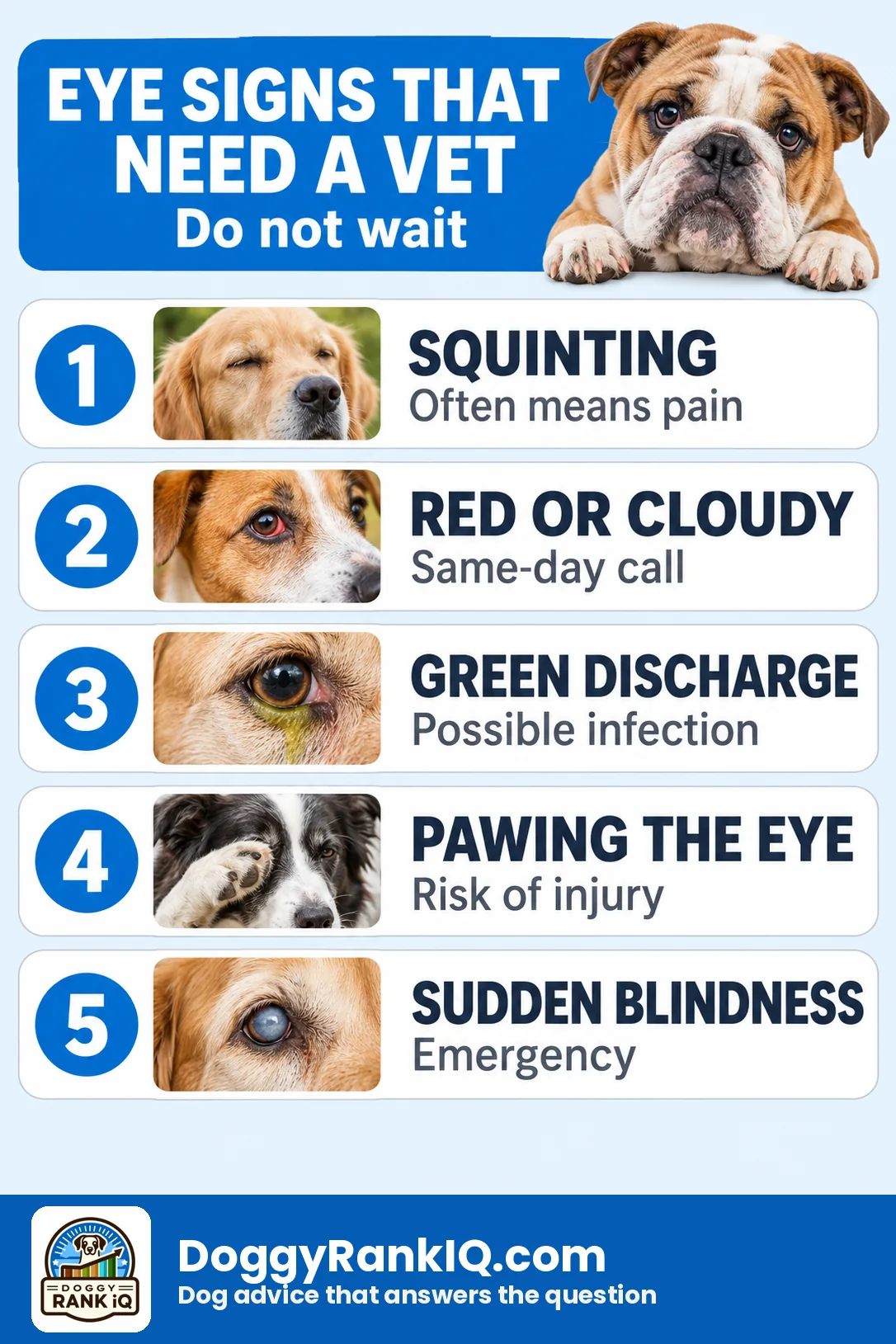
Red, painful, squinting, or cloudy eyes need a same-day vet visit, not an OTC wash and a wait-and-see approach. Some eye conditions progress by the hour, not the day.
Signs that mean “go now,” not “watch it”:
- Squinting or holding the eye closed
- Cloudiness or a visible film over the eye
- Sudden redness or visible blood vessels
- Unequal pupil size between the two eyes
- Bulging of the eye or visible swelling
- Thick, colored discharge (yellow or green)
- Pawing at the eye repeatedly
Glaucoma in particular is a true emergency. Rising pressure inside the eye can damage vision within hours, and treatment may require prescription pressure-lowering drops, systemic medication, or surgery. A dog showing sudden eye pain plus redness or a visibly enlarged eye should be seen immediately, not after trying a home remedy.
Compare that against a mild, non-painful, slightly watery eye with no squinting and clear fluid, which is more often the kind of situation where a vet might clear an owner to use lubricating drops at home. The difference between those two pictures is the whole decision.
For owners also managing general grooming and hygiene routines that affect eye health, the beginner’s guide to dog grooming covers trimming around the face, which reduces trapped debris near the eyes.
FAQ
The bottom line
Eye drops work when the timing, angle, and product match the actual problem, and most wasted doses trace back to one of the five mistakes above rather than a bad bottle. Space multiple drops 5 to 10 minutes apart, aim for the lower lid pocket, store the bottle the way the label says, confirm any compounded medication against current recall lists, and never reach for a human product without checking first. A dose log with left and right columns solves more routine mistakes than any new product ever will, and when the eye looks painful, cloudy, or red, a same-day vet visit beats another round of guessing with eye drops from the cabinet.
Doggy Rank IQ is reader supported. As an Amazon Associate we earn from qualifying purchases, at no extra cost to you.