
Quick Answer
A healthy dog’s resting respiratory rate usually falls between 15 and 30 breaths per minute while asleep or fully relaxed, according to VCA Animal Hospitals. If your vet is watching your dog for heart disease, a resting respiratory rate dog reading that stays above 30 to 35, or climbs 25% above your dog’s own baseline, is worth a same-day call. Count one full rise and fall of the chest as one breath, time it for 30 or 60 seconds, and recheck only when the dog is quiet and not panting. The number matters less than the trend, so track it the way your cardiologist asked.
Key Takeaways: resting respiratory rate dog
- Normal resting respiratory rate dog range: 15 to 30 breaths per minute during calm sleep or quiet rest.
- Some clinics use 35 or 36 as the alert threshold instead of 30, so ask your own vet which number applies to your dog.
- Count for 30 seconds and double it, or count a full 60 seconds. One breath equals one full chest cycle, not one inhale plus one exhale.
- A dog’s resting respiratory rate while sleeping is the most reliable reading because activity, heat, and excitement can’t inflate it.
- A rising trend, not one high reading, is the bigger warning sign for dogs with heart disease.
- Labored breathing, blue or grey gums, or collapse mean an emergency vet visit now, regardless of the counted number.
- Daily or weekly logging for a week establishes your dog’s personal baseline, which matters more than a textbook range.
- Dreaming, heat, pain, and excitement all push the number up temporarily, so recheck during deep, still sleep.

What number did you count?
Tap an option to see the answer.
The short answer: normal resting respiratory rate dog numbers
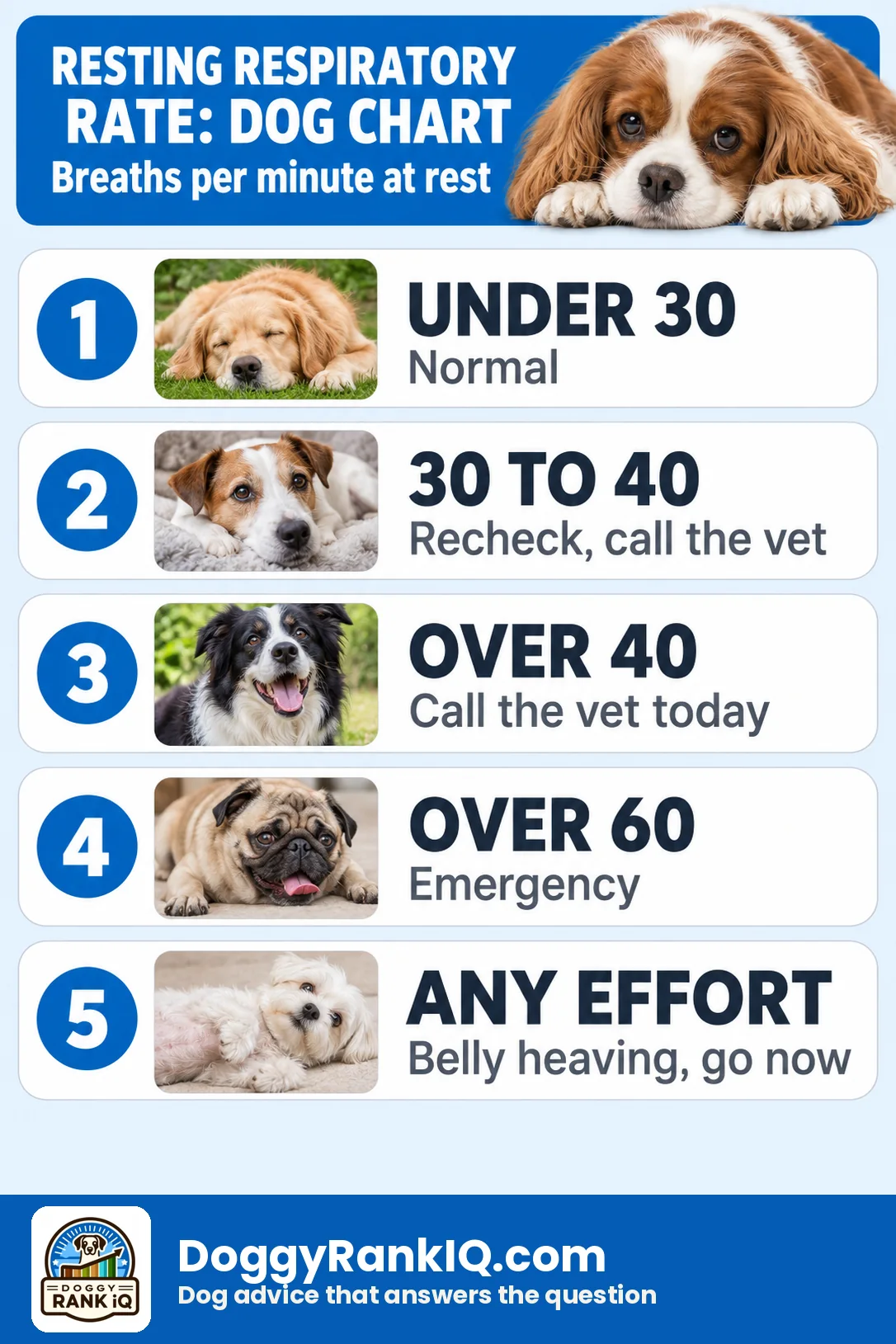
A normal resting respiratory rate dog reading sits somewhere between 15 and 30 breaths per minute, measured during quiet rest or sleep. That range comes from VCA Animal Hospitals and applies to healthy dogs, dogs with heart disease that isn’t causing symptoms yet, and dogs whose heart failure is already controlled with medication.
Not every clinic draws the line in the same place. The Merck Veterinary Manual lists reference ranges that overlap closely with the VCA numbers, while some cardiology programs flag an alert threshold closer to 35 or 36 breaths per minute for dogs already diagnosed with heart disease. None of this is a sign that anyone is wrong. It reflects real variation between individual dogs, measurement conditions, and how cautious a given clinic wants to be with a specific patient.
Choose your own dog’s number, not a single internet number. If your veterinarian gave you a target during a heart disease diagnosis, that number overrides anything in this article. Treated heart-failure patients often run 10 to 25 breaths per minute, with most staying under 30 once medication is working. A dog on furosemide running at 28 might be perfectly stable. A dog with no heart diagnosis running at 28 consistently is worth mentioning at the next visit.
Dog respiratory rate 60 or higher at rest is not a gray area. That’s double the top of the normal range and warrants a same-day call regardless of what else is going on.
What’s a normal resting respiratory rate for dogs?
A normal resting respiratory rate dog measurement falls between 15 and 30 breaths per minute for the large majority of healthy adult dogs, whether toy breeds or giant breeds. This figure is measured during true rest, not after play or on a hot afternoon.
Several factors shift where a given dog sits inside that range:
- Body temperature: dogs run naturally a bit warmer in summer and may breathe slightly faster even at rest.
- Sleep depth: light dozing produces a higher count than deep, motionless sleep.
- Recent activity: a dog that just settled down from zoomies five minutes ago hasn’t truly reached resting rate yet.
- Medication: diuretics and heart medications change baseline rates, sometimes lowering them into the 10 to 20 range.
A resting respiratory rate dog chart is a starting point, not a verdict. The number that matters most is how your own dog breathes on an ordinary, calm day, because that becomes the comparison point for every future count.
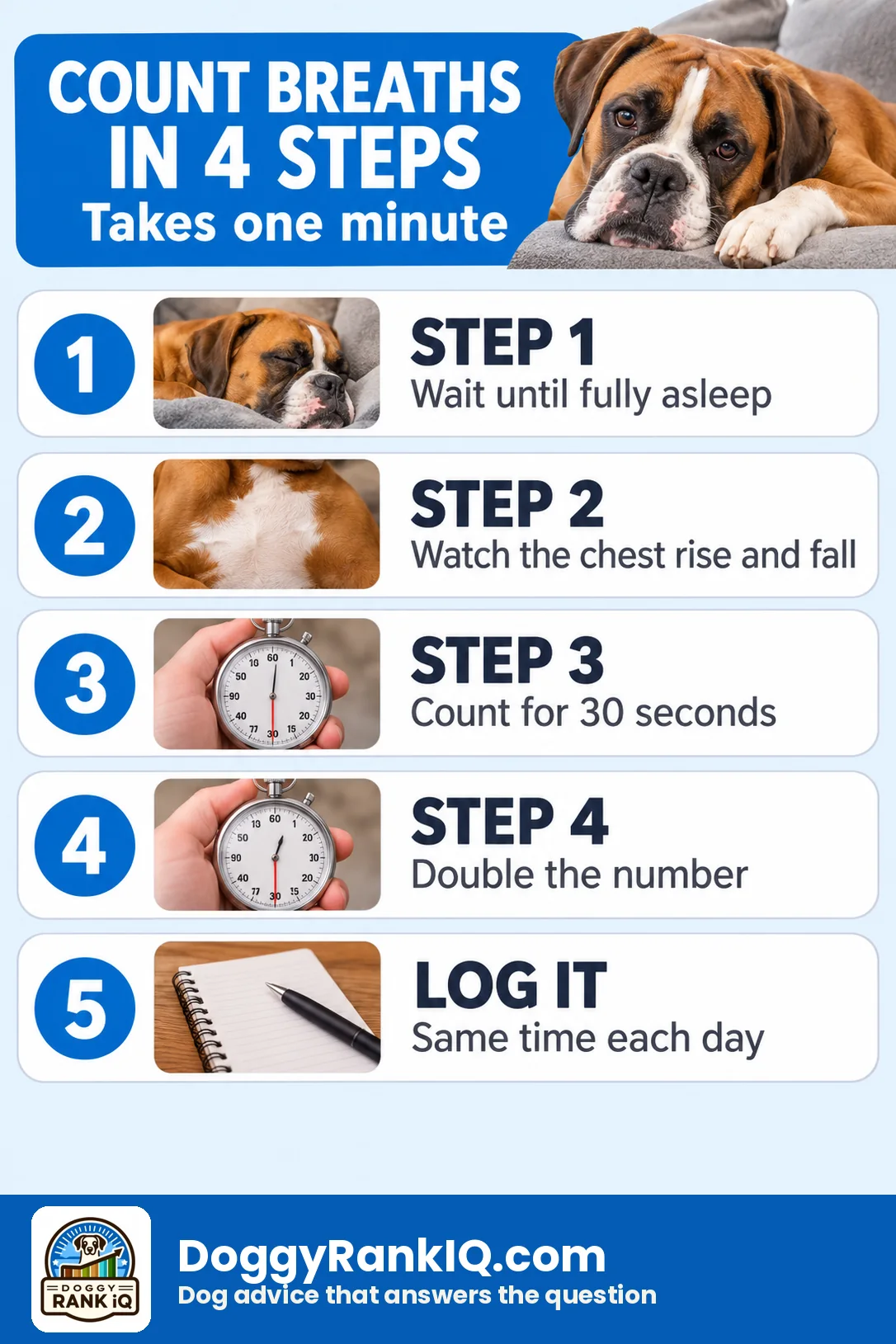
How do I measure my dog’s breathing rate at home? (A simple count: 4 steps)
Measuring a resting respiratory rate dog count at home takes under a minute and needs no equipment beyond a clock or phone timer. The process is the same whether your dog is perfectly healthy or already diagnosed with heart disease.
1Wait for the right moment
Count only when your dog is asleep or resting quietly in a comfortable room, not immediately after a walk, a meal, excitement, or time in the heat. Panting breaths don’t count toward a resting respiratory rate reading because panting is a cooling mechanism, not a measure of lung effort.
2Watch the chest, not the mouth
Find a spot where you can see or feel the ribcage move. One breath is one full cycle: the chest rises on the inhale and falls on the exhale. Counting the rise and the fall separately will double your number and send you chasing a problem that doesn’t exist.
3Time it and do the math
Count chest movements for 30 seconds and multiply by two, or count for a full 60 seconds if your dog stays still that long. A stopwatch app works fine. So does the second hand on a kitchen clock.
4Write it down before you forget
Log the number, the date, and whether the dog was asleep or just resting. A single reading tells you almost nothing. A week of readings tells your vet everything.
Quick example: you count 14 chest rises in 30 seconds. Multiply by two and you get a resting respiratory rate dog reading of 28 breaths per minute, which sits comfortably in the normal range.
Facts table: resting respiratory rate dog chart
| Breaths per minute | What it generally means | What to do |
|---|---|---|
| 10 to 25 | Normal, including most medicated heart patients | Keep logging as directed |
| 26 to 30 | Upper normal range | Watch for a rising trend |
| 31 to 35 | Increased, some clinics treat this as the alert line | Call your vet that day |
| Above 35, or 25% above baseline | Possible early fluid buildup from heart failure | Same-day veterinary call |
| Above 60, or labored breathing at any rate | Emergency | Emergency vet now |
Why is my dog’s respiratory rate higher than normal?
A resting respiratory rate dog reading can climb for reasons that have nothing to do with heart disease, so a single high count isn’t automatically a crisis. Common, usually harmless causes include heat, recent exercise, excitement, a full stomach, or a dream in progress.
More concerning causes include:
- Early congestive heart failure, where fluid starts collecting in or around the lungs.
- Respiratory infections or airway inflammation.
- Pain, which raises breathing rate the same way it raises heart rate.
- Anemia, since the body breathes faster to compensate for lower oxygen-carrying capacity.
- Fever, which pushes respiratory rate up alongside body temperature.
Decision rule: if the rate is high but the dog is calm, cool, and not panting, wait 15 minutes and recount. If it’s still high on a true at-rest check, log it and watch for a repeat the next day before assuming it’s a one-off.
Does dog breed or size affect resting respiratory rate?
Breed and size cause only minor shifts in a resting respiratory rate dog reading; the 15 to 30 breaths per minute range applies broadly across small, medium, and large breeds. Brachycephalic dogs (pugs, bulldogs, Boston terriers) are a partial exception because their airway anatomy can make breathing look and sound more labored even when the counted rate is technically normal.
A few breed and size notes worth knowing:
- Giant breeds sometimes rest at the lower end of normal, closer to 10 to 20 breaths per minute, because of slower metabolic rates.
- Small and toy breeds can run slightly higher within the normal range, especially when excited by household noise.
- Flat-faced breeds may show noisy or effortful breathing patterns that aren’t reflected in the number alone, so effort matters as much as the count for these dogs.
- Athletic working breeds generally settle into the same 15 to 30 range once truly at rest, though it may take them longer to downshift from activity.
If you own a brachycephalic breed, pay closer attention to effort and sound than to the raw number, since labored breathing at a “normal” count can still mean trouble.
What respiratory rate means I should call the vet?
A resting respiratory rate dog reading above 30 to 35 breaths per minute, or one that rises 25% above your dog’s personal baseline, means it’s time to call the vet the same day. A reading above 60, or any labored breathing at all, is an emergency regardless of the exact count.
Use this quick checklist:
- 26 to 30: normal upper range, keep watching.
- 31 to 35: call your vet that day to discuss.
- Above 35 or a 25% jump from baseline: same-day veterinary call.
- Above 60, or visible effort at any number: emergency vet now.
A common mistake is waiting for the number to hit a dramatic, obviously wrong figure before calling. Cardiologists want the call made on the trend, not the drama, because by the time breathing looks visibly distressed the underlying fluid buildup has often progressed further than owners realize.
Resting respiratory rate dog while sleeping vs awake
A resting breathing rate measurement taken during deep sleep is the most trustworthy number you can collect. Sleeping respiratory rate is generally preferred over an ordinary resting rate check because a dog that’s merely lying down awake can still be mildly excited, warm, or alert to sounds in the house.
Awake-but-resting counts aren’t useless, but they run higher and more variable than sleeping counts. If your vet asked for sleeping respiratory rate specifically, don’t substitute an awake count and assume it’s close enough. A dog twitching through a dream can also post a falsely high reading, so if you catch your dog mid-dream (paws paddling, soft yips), wait for true stillness before counting. For more on what’s happening during those twitchy moments, see our piece on what sleep studies reveal about dog dreaming.
Decision rule: if your cardiologist’s instructions say “sleeping respiratory rate,” count only during deep sleep. If they say “resting respiratory rate,” quiet wakefulness is acceptable, but note which condition you used each time so your log stays consistent.
Why does my dog breathe fast while sleeping?
A dog breathing fast while sleeping is often simply dreaming, which temporarily raises breathing rate along with twitching paws, soft vocalizing, or rapid eye movement under closed lids. This passes within a minute or two once the dream cycle ends.
Other, less common reasons for fast breathing during sleep include:
- A warm room or heavy bedding trapping body heat.
- Early stages of a respiratory or cardiac issue, especially if the fast rate persists through deep, still sleep rather than just twitchy dream phases.
- Anxiety-related sleep that isn’t fully restful, common in dogs that startle easily at household sounds.
Edge case: if a dog consistently breathes fast even during motionless, non-twitching sleep, that’s different from occasional dream-related spikes and is worth logging carefully for your vet, since it’s exactly the pattern cardiologists watch for in heart disease monitoring.
How to tell if your dog has breathing problems
Breathing problems in dogs show up as a combination of rate, effort, and sound, not the counted number alone. A resting breathing rate reading inside the normal range can still coexist with a breathing problem if the dog is working hard to move air.
Watch for:
- Exaggerated belly movement with each breath (abdominal breathing).
- An extended neck or open-mouth breathing while at rest.
- Noisy breathing such as wheezing, rasping, or a honking cough.
- Reluctance to lie down flat, or preferring to stand or sit to breathe more easily.
- Pale, blue, or grey gum color.
The Cornell University College of Veterinary Medicine notes that recognizing respiratory distress early, through a combination of rate, effort, and color changes, gives owners a better chance of getting ahead of a serious problem before it becomes an emergency.
Is panting normal when a dog is resting?
Panting while fully at rest, in a cool room, with no recent activity, is not normal and shouldn’t be counted as part of a resting breathing rate reading. Normal panting happens after exercise, in heat, or during excitement, and resolves within a few minutes once the dog cools down or calms down.
Signs that panting is not the harmless kind:
- It happens in a cool room with no obvious trigger.
- It doesn’t stop after 10 to 15 minutes of true rest.
- It’s paired with restlessness, pacing, or an inability to settle.
- It occurs at night during sleep rather than during the day after activity.
If a dog is panting, skip the respiratory count entirely and wait for the panting to stop completely before measuring, since panting breaths are shallow and rapid in a way that doesn’t reflect true lung effort.
What health conditions cause rapid breathing in dogs?
Several health conditions can cause a persistently rapid resting breathing rate reading, ranging from manageable to urgent. Congestive heart failure is the condition most often behind home monitoring requests, since fluid buildup in or around the lungs raises breathing rate before other symptoms appear, according to Invoxia’s overview of early heart failure detection.
Other conditions linked to rapid breathing include:
- Pneumonia or other lung infections.
- Pulmonary fibrosis or chronic airway disease.
- Anemia or significant blood loss.
- Fever from infection elsewhere in the body.
- Tumors affecting the chest cavity or airway.
- Anxiety disorders or pain from an unrelated injury.
A dog with any chronic condition on this list benefits from the same at-home counting routine described throughout this guide, since a rising trend is often the first measurable clue that something has changed, as discussed in Invoxia’s guide to fast breathing in dogs.
How does a puppy’s respiratory rate compare to adult dogs?
Puppies generally breathe a bit faster than adult dogs at rest, often landing at the higher end of or slightly above the standard 15 to 30 breaths per minute range, because of their faster metabolism and smaller lung volume. This difference narrows as puppies mature into adulthood, typically by 12 to 18 months depending on breed size.
Practical notes for puppy owners:
- A puppy resting at 30 to 35 breaths per minute isn’t automatically abnormal the way it might be in a senior dog with known heart disease.
- Puppies sleep in short, active bursts, so catching true deep sleep for a count can take more patience.
- If a puppy shows labored breathing, blue gums, or persistent rates above 40 at rest, that still warrants a vet call regardless of age, since the emergency signs apply at any life stage.
If you’re newly raising a puppy and tracking health basics alongside training milestones, our guide to essential commands every puppy should learn covers the early-months basics that pair well with health monitoring habits.
Low resting respiratory rate dog readings: is that a problem?
A low resting breathing rate reading, generally under 10 breaths per minute, is unusual but isn’t automatically alarming on its own. Very deep, very relaxed sleep can occasionally dip this low in a healthy dog for brief stretches.
What matters more is the complete picture:
- Is the dog easy to rouse and behaving normally when awake?
- Are gums a healthy pink, not pale or grey?
- Has the breathing pattern always looked like this, or did it change suddenly?
A sudden, sustained drop paired with lethargy, weakness, or trouble waking the dog is different from a dog who simply breathes slowly and deeply during a nap. If you’re uncertain which one you’re looking at, call your vet and describe exactly what you counted and for how long. Guessing from a blog post is never as good as a vet hearing your specific numbers.
Why vets ask heart patients to track it
Cardiologists ask owners to track resting breathing rate numbers because a rising rate can show up before any outward symptom does. A creeping sleeping rate is one of the earliest home-detectable clues that fluid is starting to build up in the lungs from left-sided heart disease, as described in VCA Animal Hospitals’ home breathing evaluation guide.
That’s the whole point of the exercise. By the time a dog is visibly struggling to breathe, the fluid has already progressed. Catching the trend a few days earlier, while the dog still looks and acts fine, can mean a medication adjustment instead of an emergency room visit.
This is why your cardiologist probably didn’t hand you a single magic number. They want your dog’s own baseline, built from a week of counts, so a 20% or 25% rise means something concrete rather than vague. Tracking trends over time is also the basis for newer wearable monitoring approaches: a 2025 study published in Frontiers in Veterinary Science on AI collar monitoring examined how continuous sensor-based tracking could detect respiratory and heart rate changes in dogs, pointing toward technology that may someday supplement manual counting rather than replace the basic habit of watching the chest and keeping a log. If your dog’s cardiac workup included diet changes too, our guide on grain-free diets and heart disease covers what the nutrition side of that conversation usually involves.
⭐ Top 5 Features We Love
- It costs nothing. No equipment is required to count breaths, just a watch and a quiet room.
- It catches problems early. A rising trend can appear days before visible symptoms show up.
- It’s fast. A full count takes 30 to 60 seconds.
- It travels well. Owners can do it on vacation, at a relative’s house, or the night before a storm when a dog might be anxious.
- It gives the vet real data. A week of logged numbers is far more useful on a phone call than “he seemed a little off.”
⚠️ Things to Look Out For
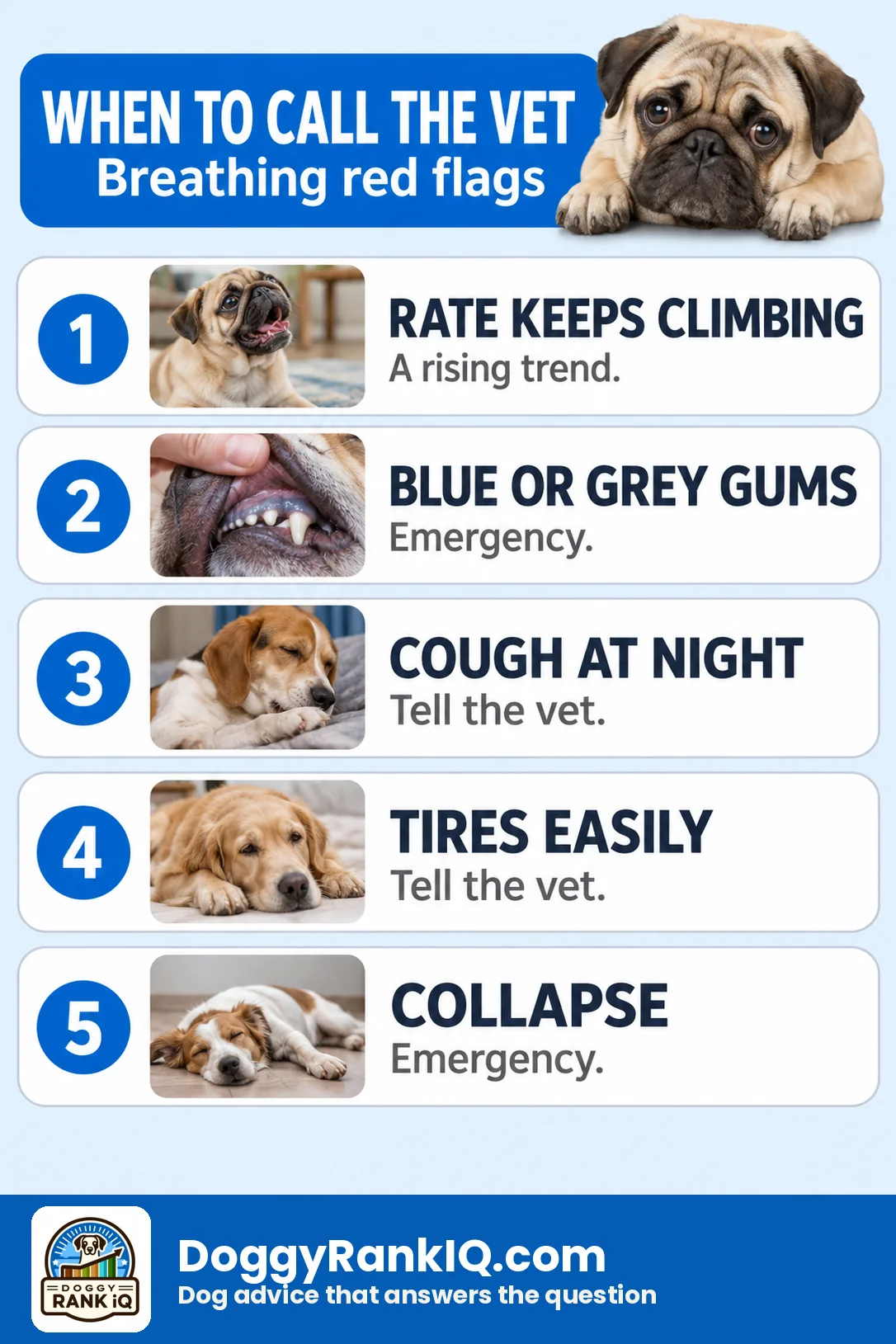
- Labored breathing: visibly forceful belly movement, an extended neck, or open-mouth breathing at rest, even if the counted rate isn’t extreme.
- Blue or grey gums: a sign oxygen isn’t getting where it needs to go.
- Collapse or extreme weakness: don’t wait to count breaths first, go straight to the emergency vet.
- Rate above 60 at rest: this is well outside any clinic’s normal range.
- A sudden jump of 25% or more above your dog’s usual baseline: even if the absolute number still looks “fine” on paper.
Watching effort alongside the number itself matters just as much as the count. A dog can be in real trouble with a rate that isn’t sky-high if the breathing looks forced. If you keep a prepared kit on hand for health scares in general, our pet emergency kit checklist and dog first aid kit guide cover what’s worth having before you need it.
Apps and logs that make it easy
A phone timer works for the count itself, but a dedicated log makes the trend visible at a glance. Free printable charts from veterinary cardiology departments exist for exactly this purpose, and some owners prefer a simple paper log kept on the fridge. The goal is consistency, not fancy software.
Whatever format you choose, record four things every time: the date, the time of day, whether the dog was asleep or awake, and the counted rate. A pattern across a week tells your cardiologist more than any single dramatic-sounding number. Tracking a resting breathing rate log alongside grooming and feeding routines also helps spot patterns tied to daily habits, such as a rate that’s always a bit higher right after dinner.
Helpful tracking tools
These are owner-reported helpers for the logging and comfort side of monitoring, not medical devices and not a replacement for your vet’s instructions. Confirm any supplement, bedding change, or monitoring routine with your veterinarian before relying on it for a cardiac patient.
- Good Harbor Veterinary Stethoscope ($27.99, price checked 2026): some owners use a basic stethoscope to listen for breath sounds alongside a visual count, though hearing a heartbeat or lung sound clearly takes practice and isn’t a diagnostic substitute for a vet’s exam. Check the current price.
- Pet Health Record Book for Dogs ($8.49, price checked 2026): a simple paper log for owners who’d rather write numbers by hand than rely on an app that might get deleted or lost in a phone update. Check the current price.
- Dog First Aid Kit, Vet-Approved ($34.95, price checked 2026): the manufacturer documents this as a general at-home first aid kit; it won’t treat heart disease, but having basic supplies ready matters for any dog with a medical condition. Check the current price.
- Bedsure Calming Donut Dog Bed, Medium ($38.24, price checked 2026): owners report using a consistent, comfortable sleeping spot to make it easier to catch a dog in true deep sleep for an accurate count, rather than napping half-alert on a hard floor. Check the current price.
None of these products treat or diagnose heart disease. They support the measuring and logging habit your vet asked you to build.
FAQ
The bottom line
A resting breathing rate count is one of the cheapest, fastest health checks available, and it can flag heart trouble before your dog shows a single outward sign (vcahospitals.com). The exact cutoff varies a little between clinics, somewhere between 30 and 36 breaths per minute, but the trend matters more than any single number (vcahospitals.com, elearning.asc.edu.ag). Count for a week to build your dog’s baseline, log it consistently, and call your vet the same day for a sustained rise or anything above 35. Save the emergency room trip for labored breathing, blue gums, or collapse. For readers managing a cardiac diagnosis in a breed prone to it, our guide to Cavalier King Charles Spaniel health covers the breed-specific heart concerns that make this habit especially worthwhile.
Doggy Rank IQ is reader supported. As an Amazon Associate we earn from qualifying purchases, at no extra cost to you.