Quick Answer
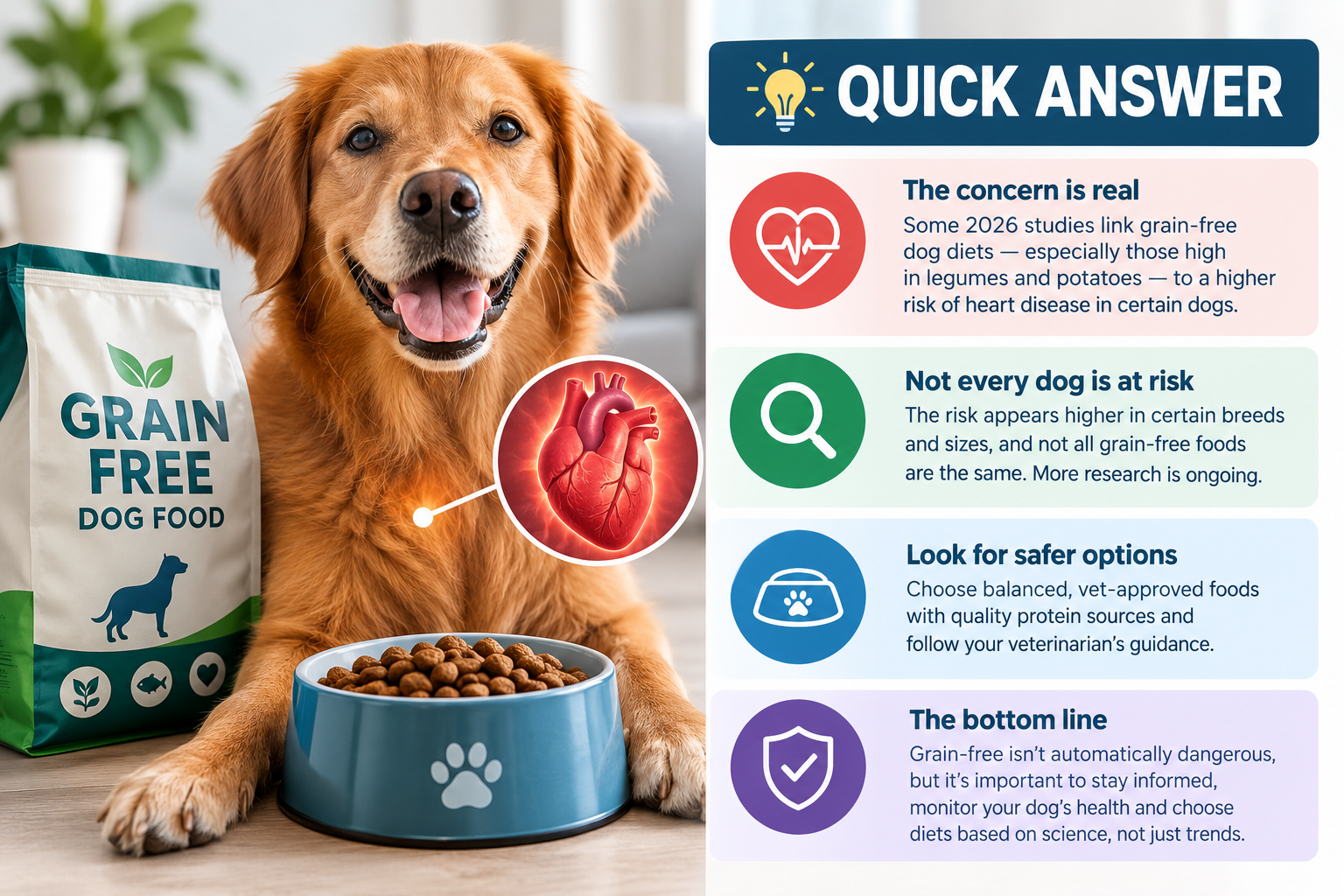
The link between grain free dog food heart disease reports and actual heart damage is weaker and stranger than the 2018 headlines suggested. The strongest current signal points at diets high in pulses (peas, lentils, chickpeas, dry beans), not at the absence of grain, and pulse-heavy formulas exist in both grain-free and grain-inclusive bags. A large 2026 analysis of the Dog Aging Project cohort found no statistically significant association between grain-free feeding and new owner-reported cardiac diagnoses. The sensible move is not panic. It is checking your dog’s ingredient panel, the manufacturer behind it, and your dog’s breed risk with your vet.
Key Takeaways: Grain Free Dog Food Heart Disease
- Grain free dog food heart disease concern started as an adverse-event signal, not a proven cause. The FDA logged 1,382 reports of canine DCM between January 1, 2014 and November 1, 2022, and has not declared grain-free food categorically unsafe.
- More than 90% of reported products were labeled grain-free and 93% contained peas and/or lentils, according to the FDA investigation page. Reports also involved grain-containing foods.
- Tufts shifted the language in June 2026 from “grain-free” to “high-pulse” diets, because the pattern tracks with pulse content rather than grain exclusion.
- A September 2026 Dog Aging Project analysis found an odds ratio of 1.05 for grain-free diet status (95% CI 0.91 to 1.21, p = 0.52) in an adjusted incident-only model.
- Taurine deficiency does not explain most cases. A 2025 controlled 18-month trial in 60 healthy adult dogs found taurine stayed in normal range across all four diets tested.
- Breed matters. Dobermans, Great Danes, Boxers, Irish Wolfhounds and a handful of others carry inherited DCM risk that has nothing to do with the food bowl.
- Diet-associated DCM can improve. Tufts reports some dogs get better after a diet change plus cardiac treatment, though improvement is not guaranteed.
- Signs to act on today: coughing, fast or labored breathing at rest, fainting or collapse, exercise intolerance, poor appetite, swollen belly. Those are vet-now symptoms, not wait-and-see ones.
What is DCM, and why was grain-free dog food linked to it?
Dilated cardiomyopathy (DCM) is a disease where the heart muscle stretches, thins and loses pumping strength. The chambers get bigger, the squeeze gets weaker, and blood backs up. Some dogs are born genetically predisposed to it. The controversy from 2018 onward concerns a second group: dogs without the classic genetics who developed DCM while eating a particular style of food.
)
Why food entered the conversation at all: cardiologists started seeing DCM in breeds that rarely get it. Whippets. Miniature Schnauzers. Mixed breeds of no particular cardiac reputation. When those owners were asked what was in the bowl, the answers clustered. Boutique brands. Exotic proteins. Grain-free formulas built on peas and lentils. The early shorthand became “BEG diets,” and the grain-free label took the blame because it was the most visible word on the bag.
The bag was the wrong place to look. Grain exclusion is a marketing decision. Replacing that grain with large quantities of pulses is a formulation decision, and the two are related but not the same thing. A food can be grain-inclusive and still be loaded with peas and lentils. A food can be grain-free and built mainly on potato or tapioca.
DCM is a diagnosis made with an echocardiogram by a vet. No ingredient list diagnoses a heart.
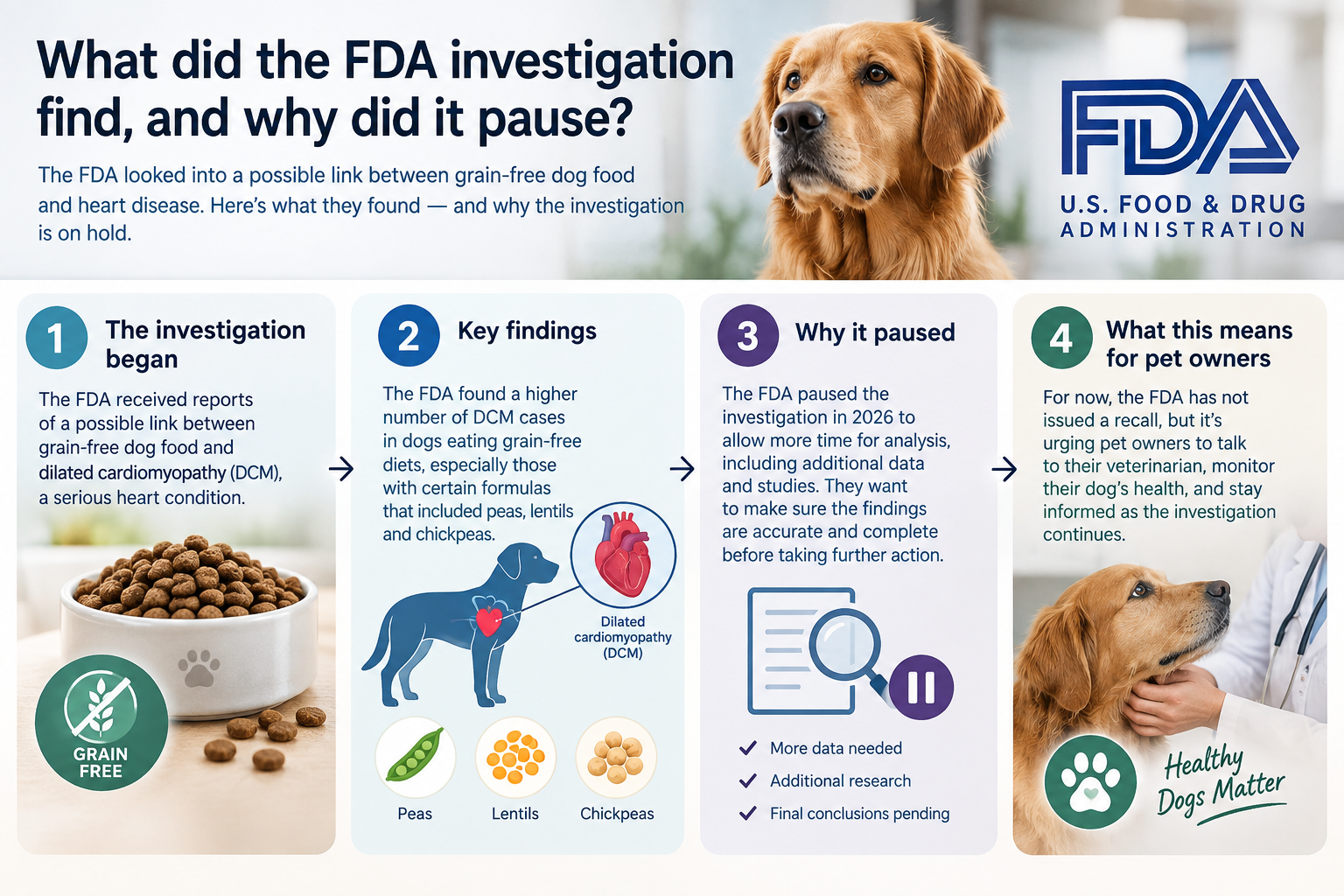
What did the FDA investigation find, and why did it pause?
The FDA investigated, published a brand list in 2019, held a scientific forum, and then stopped issuing routine updates after December 2022 because the agency said it would only report again if meaningful new science appeared. It never issued a recall and never declared grain-free food unsafe.
)
The numbers behind the famous “16 dog foods” list came from case reports, which is where the misunderstanding lives. The FDA tallied which product names appeared most often in reports it received. That ranks reporting frequency. It does not rank danger, and a brand with high market share will naturally appear more often than a niche one. The agency itself draws a line between an adverse-event signal and proof of causality, notes that reports involved both grain-free and grain-containing formulations, and points out that pulses have been used in pet food for years without evidence they are inherently dangerous.
What the FDA did establish, per its investigation page:
- 1,382 reports of canine DCM from January 1, 2014 through November 1, 2022.
- More than 90% of reported products carried a grain-free label.
- 93% contained peas and/or lentils.
- Reports were voluntary, unverified in many cases, and lacked a comparison group of healthy dogs eating the same foods.
That last bullet is the one that decides how much weight the rest deserves. Without knowing how many millions of dogs ate those same foods and stayed healthy, a report count cannot produce a risk rate. If you want a plain walkthrough of what the panel on your bag actually commits a company to, our guide on how to read a dog food label and what AAFCO means covers the parts that matter.
What does 2026 research say about grain free dog food heart disease?
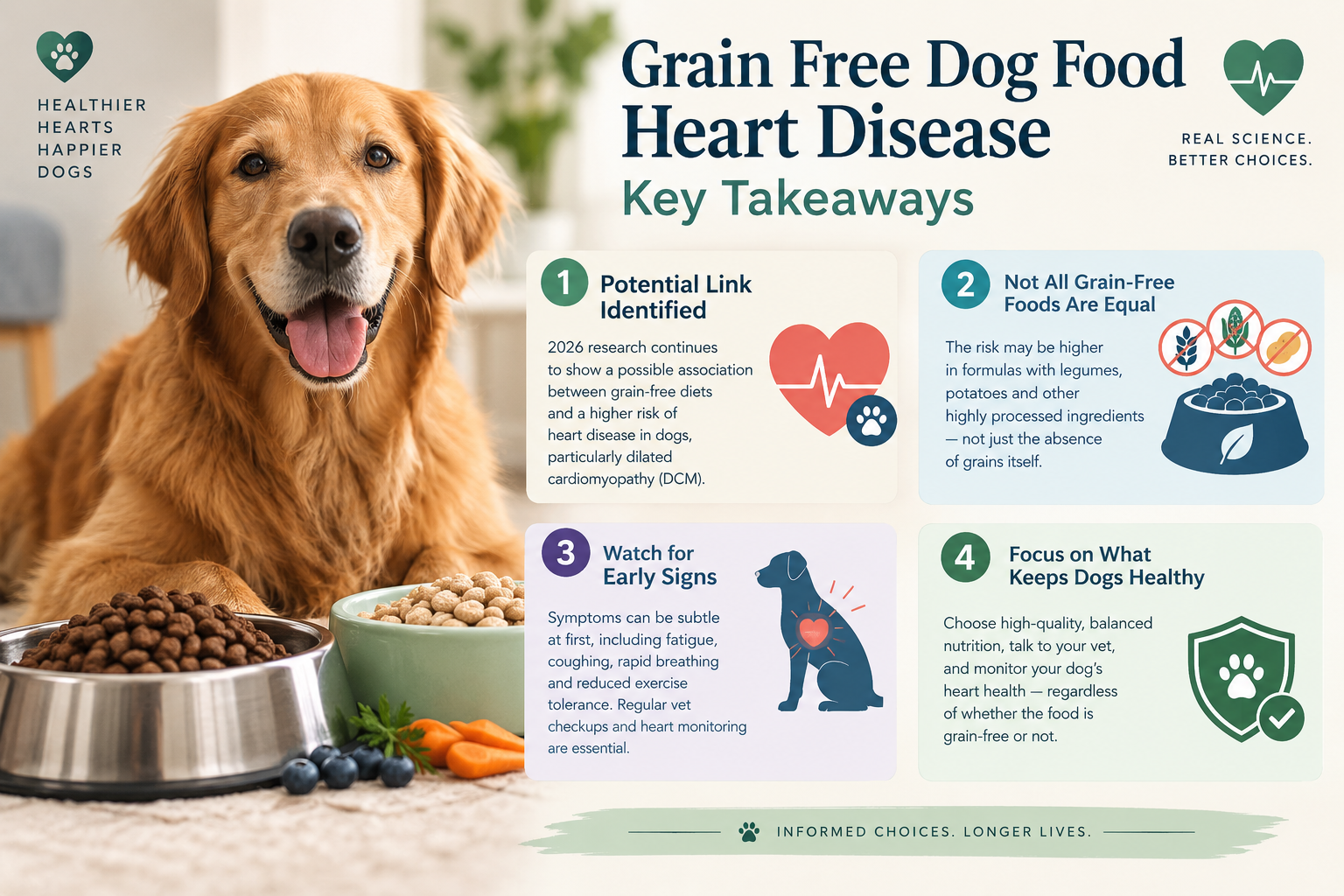
The 2026 picture is less alarming and more specific than 2019. A large observational analysis found no significant association with grain-free feeding, while the leading clinical research group now frames the problem around pulse-heavy formulation and is chasing a possible cellular mechanism.
)
On September 16, 2026, an analysis using prospectively collected Dog Aging Project data reported an odds ratio of 1.05 for grain-free diet status in an adjusted incident-only model, with a 95% confidence interval of 0.91 to 1.21 and p = 0.52. The authors concluded any effect of grain-free status on owner-reported new cardiac disease was likely minimal or absent. The same paper, published through Wiley, flagged substantial owner misclassification of diet, which is exactly the kind of candid limitation worth reading twice. Owners are not always sure what they are feeding. Modeling suggested that mislabeling probably did not change the estimate much.
Then came the June 22, 2026 Tufts update. Lisa M. Freeman, DVM, PhD, DACVIM, and colleagues wrote that diet-associated DCM appears linked to diets high in pulses, including peas, lentils, chickpeas and dry beans, and that this includes grain-free and grain-inclusive foods alike. Their current clinical review states the disease does not appear to result simply from missing grain or from a straightforward taurine deficiency, and that more than 30 scientific studies now exist on the subject without a confirmed cause.
Key studies compared
The 2025 trial deserves a note about who paid for it. It was conducted by researchers associated with Hill’s Pet Nutrition and ran 18 months in 60 healthy adult dogs, published in the Journal of Animal Science. Industry funding does not make results wrong. It does mean the design choices deserve a closer look, and 60 healthy dogs on four controlled diets cannot speak for every breed, every disease state, or the hundreds of formulas on a pet store shelf.
How does grain-free dog food cause heart problems in dogs?
Nobody has shown that it does, and the honest answer in October 2026 is that the mechanism is unproven. The most interesting lead is phospholipidosis.
Between December 2025 and March 2026, Freeman’s team reported elevated urinary di-22:6-bis(monoacylglycerol)phosphate, shortened to di-22:6-BMP, in dogs with DCM eating pulse-rich diets. That biomarker is consistent with phospholipidosis, an abnormal buildup or handling of phospholipids inside cells. The work earned the 2025 AKC Canine Health Discovery of the Year, described by Tufts Veterinary Medicine and covered in detail by dvm360.
A biomarker is a footprint. It is a very good footprint. It still is not the animal.
The older taurine theory has been downgraded rather than deleted. Some affected dogs do have low taurine and some respond to supplementation, particularly certain breeds. Tufts’ 2026 review says nutritional deficiency does not appear to explain most cases, and the 2025 trial found whole-blood and plasma taurine within normal ranges on all four diets.
Are all grain-free dog foods linked to heart disease, or just some brands?
Not all of them, and brand name is a poor proxy. Two grain-free foods from the same shelf can have very different pulse loads, protein sources and quality-control histories behind them.
Three things separate the formulas that have shown up in reports from the ones that have not:
- Pulse position and quantity. Peas, pea protein, pea starch, lentils, chickpeas and dry beans appearing repeatedly in the top ten ingredients is a different food from one where a single pulse appears eighth.
- Ingredient splitting. “Peas, pea flour, pea protein, pea fiber” spread across four slots can total more than the named meat at the top.
- Who formulated it and who tests it. A company with a full-time veterinary nutritionist, feeding trials and its own plants is making different bets than a brand that outsources everything to a co-packer.
Which dogs are most at risk? Breed predisposition versus diet-associated DCM
Two separate risks share one diagnosis. Inherited DCM concentrates in specific large and giant breeds. Diet-associated DCM is the one that has turned up in breeds with no cardiac history, often alongside high-pulse diets.
)
Breeds with recognized inherited DCM predisposition include Doberman Pinschers, Great Danes, Boxers, Irish Wolfhounds, Saint Bernards, Newfoundlands and Cocker Spaniels. For those dogs, cardiac screening is part of normal preventive care regardless of what is in the bowl. A Doberman eating a grain-inclusive food is still a Doberman.
Diet-associated cases have been reported in Golden Retrievers, Whippets, Miniature Schnauzers, Shih Tzus, Labradors and plenty of mixed breeds. Golden Retrievers show up often enough in the taurine-responsive subset that cardiologists treat them as a group worth testing specifically.
How do I know if my dog is at risk for grain free dog food heart disease?
You cannot know from a bag. You can build a short list of factors that make the conversation with your vet worth having sooner rather than at the next annual visit. Use the sheet below to assemble that list, then take it with you.
The numbers worth remembering
What are the symptoms of heart disease in dogs eating grain-free food?
The symptoms are the same whatever the food. Early DCM is often silent, which is the part owners find hardest to accept.
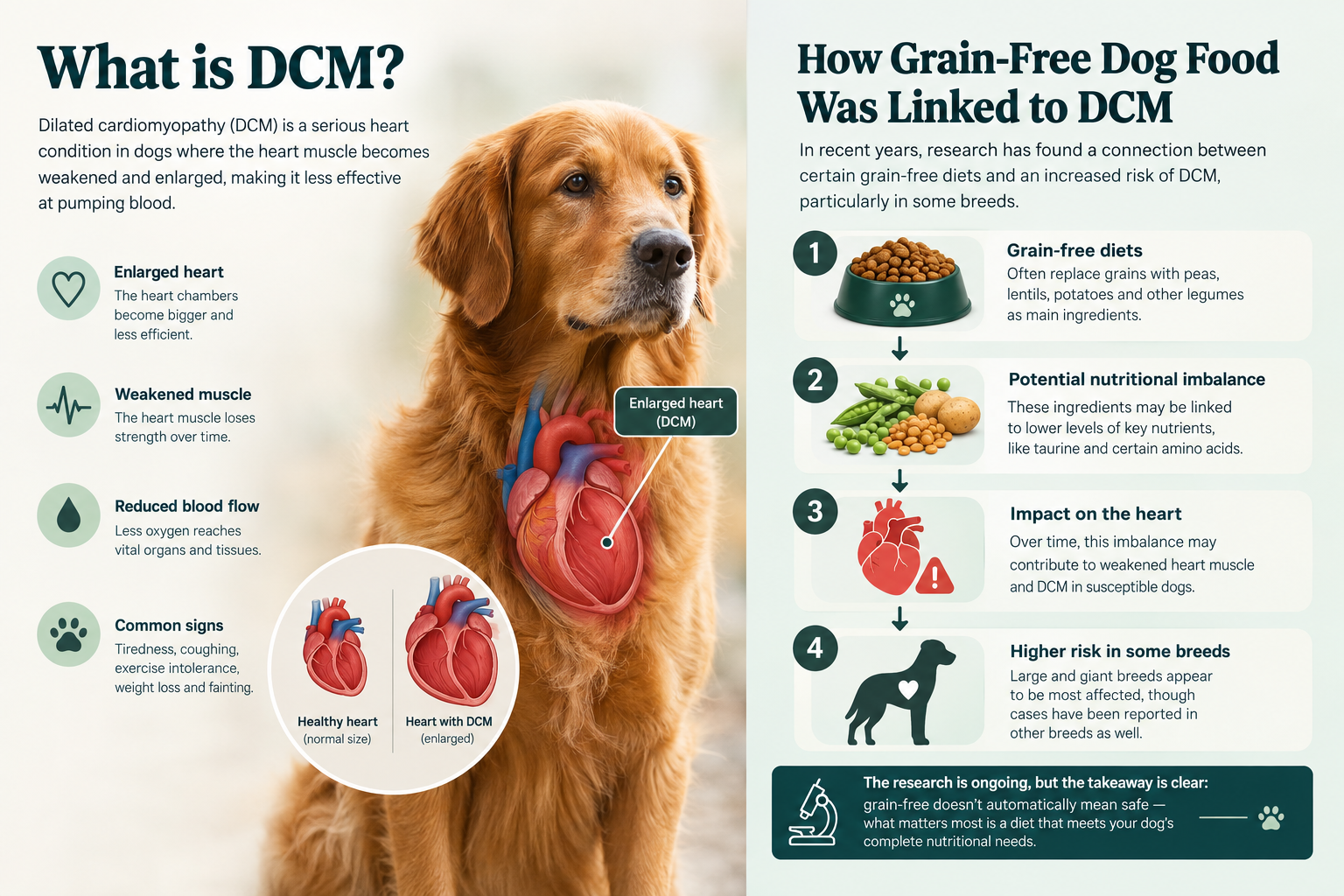
Signs that warrant a vet appointment:
- Coughing, especially at night or after lying down
- Fast or labored breathing at rest (counting resting breaths at home is genuinely useful; most healthy sleeping dogs sit comfortably under about 30 breaths per minute, and a rising trend over days matters more than a single count)
- Fainting or collapse, which is an emergency
- Tiring quickly on a walk the dog used to handle easily
- Reduced appetite or weight loss without a diet change
- A swollen or distended belly
One thing not to do: read “low energy” and conclude the heart. Dogs sleep a staggering amount by human standards, and normal rest is not a symptom. Our piece on why dogs sleep so much and what the research found sets a useful baseline before you start worrying about a change.
Should I switch my dog off grain-free food?
If your dog is currently healthy and the food comes from a company with real nutritional expertise and modest pulse content, there is no evidence-based reason to change today. If the food is pulse-heavy, from a brand that cannot tell you who formulated it, or your dog is an at-risk breed, a switch to a well-established complete diet is a reasonable, low-cost decision. Make it with your vet, not with a search bar.
A decision rule that holds up:
- Switch if peas, lentils or chickpeas dominate the first ten ingredients, or the company cannot name a veterinary nutritionist and describe its quality control.
- Discuss first if your dog is a Doberman, Great Dane, Boxer, Irish Wolfhound, Cocker Spaniel or Golden Retriever, whatever you feed.
- Stay put if the food is grain-free for a documented medical reason, your dog is thriving, and your vet is comfortable. Then recheck at the annual exam.
- Go to the vet now, not the pet store, if any symptom above is present. Changing food does not treat heart failure.
When you do change, change slowly. Abrupt swaps buy you a week of digestive drama for no benefit, and our walkthrough on how to switch dog food without upsetting their stomach covers the pacing.
Does my dog actually need grain-free food?
Most dogs do not. Grain allergy exists but is uncommon, and beef, dairy and chicken are far more frequent culprits in food-allergic dogs than wheat or corn.
Texas A&M’s veterinary nutrition guidance points out that dogs are omnivores and that grains supply energy, fiber, fatty acids, vitamins and minerals. Remove them and those nutrients must come from somewhere else. The school’s discussion of grains and pet nutrition is a useful counterweight to the shelf talkers. If itching or gut upset drove you to grain-free in the first place, the actual diagnostic path is an elimination trial, not a label swap, and our guide to dog food for sensitive stomachs and food allergies explains how that works. For the straightforward question of whether grains are safe at all, see can dogs eat grains and dairy.
What’s the difference between grain-free and regular dog food for heart health?
Functionally, the difference is what replaced the grain. That is the whole story.
| Feature | Grain-free formula | Grain-inclusive formula |
|---|---|---|
| Main carbohydrate | Often peas, lentils, chickpeas, potato or tapioca | Often rice, corn, barley, oats |
| Pulse content | Frequently high, sometimes across several ingredient slots | Varies; can also be high in some boutique recipes |
| DCM report frequency | Over 90% of FDA-reported products | Present in reports, less frequently |
| Medical reason to choose it | Rare, specific cases | Standard for most healthy dogs |
A grain-free bag is not automatically pulse-heavy, and a grain-inclusive bag is not automatically safe. Read the ingredient panel instead of the front of the bag.
What do vets recommend instead of grain-free dog food?
Most veterinary nutrition guidance skips the label debate entirely and asks about the manufacturer. The World Small Animal Veterinary Association’s global nutrition guidance recommends choosing a food that is complete and balanced for your dog’s life stage, made by a company with appropriate quality control and accessible nutritional expertise, with the assessment done for the individual dog rather than off a “grain-free,” “natural” or “premium” claim.
In practice that means asking a company four questions: who formulated this recipe and what are their credentials, do you own your plants, do you run feeding trials, and can you send me the full nutrient profile. Companies with good answers give them quickly. Companies without good answers send you a paragraph about passion. Our breakdown of what vets actually look for in a dog food goes through the same checklist, and what makes a dog food good covers the six factors worth weighing before price.
Can switching back from grain-free food reverse heart disease in dogs?
Sometimes, partly, and only with cardiac treatment alongside the diet change. Tufts reports that some dogs with diet-associated DCM improve after a diet change combined with medication, occasionally enough that heart measurements return close to normal. Other dogs do not improve, and some die of the disease.
That split is the most important practical fact in this whole topic. It is why the advice is to see a vet rather than quietly change bags and hope. A dog in heart failure needs medication and monitoring now. The diet change is part of the plan, not the plan.
Typical management after a diet-associated DCM diagnosis involves an echocardiogram to confirm and measure, a switch to a diet your cardiologist or veterinary nutritionist specifies, sometimes taurine testing and supplementation, cardiac medications, and repeat imaging after a few months to see which way the numbers moved.
What ingredients should I look for if my dog has a heart condition, and what is the best dog food for dogs with heart disease?
There is no single best food for dogs with heart disease. The right diet depends on the stage of disease, whether your dog is losing weight, sodium tolerance, kidney function and medications, which is why cardiologists so often refer to a veterinary nutritionist.
What usually goes into that decision:
- Named animal protein at adequate levels. Dogs with heart disease lose muscle, and protein restriction is rarely the goal.
- Moderate sodium, matched to the stage of disease, not a self-selected “low salt” food.
- Modest pulse content, following the current Tufts position on high-pulse diets.
- Adequate calories your dog will actually eat, because appetite falls as heart disease progresses.
- Taurine and carnitine considered on an individual basis after testing, not supplemented blindly.
- A complete and balanced AAFCO statement for the right life stage, from a manufacturer that can answer the four questions above.
Royal Canin’s veterinary education material on diet and canine dilated cardiomyopathy is written for vets and worth skimming if you like reading primary clinical material, keeping in mind it comes from a manufacturer. For condition-specific feeding more broadly, see our notes on vet recommended dog food for specific health problems.
How much does heart disease treatment cost for dogs?
Costs vary widely by country, region and clinic, and anyone quoting you one global figure is guessing. What is predictable is the shape of the bill, so ask for a written estimate before you agree to the workup.
Expect line items for:
- Consultation, general practice or cardiology referral
- Echocardiogram, the test that actually diagnoses DCM, usually the largest single item
- Chest radiographs and ECG, depending on symptoms
- Bloodwork, sometimes including taurine, which is sent to an outside lab
- Daily medication, ongoing, often for life
- Recheck imaging, typically a few months after starting treatment and periodically after
Two cost-control moves worth knowing: ask whether your general practice vet can do the bloodwork and radiographs before the cardiology referral, and ask whether a veterinary teaching hospital in your region offers cardiology at lower cost. Pet insurance taken out before any symptom appears covers much of this. Taken out after, it will not.
FAQ
Does grain-free dog food cause heart problems?
No study has shown that removing grain causes heart disease. The research signal on grain free dog food heart disease now points at diets high in pulses such as peas, lentils and chickpeas, which appear in both grain-free and grain-inclusive foods. The 2026 Dog Aging Project analysis found no significant association with grain-free feeding itself.
Why do some vets not recommend grain-free dog food?
Because most dogs gain nothing from it and some of the formulas that showed up repeatedly in FDA DCM reports were grain-free and pulse-heavy. The objection is usually to unnecessary formulation risk and weak manufacturer oversight, not to the word “grain-free” on its own.
What are the 16 dog foods linked to heart disease?
The FDA’s 2019 list named the brands that appeared most often in DCM reports it received. The agency has repeatedly said this reflects reporting frequency rather than proven risk, and it has not issued a recall. Treating that list as a danger ranking misreads what it measured.
Is there a grain-free dog food without legumes?
Yes. Some grain-free formulas use potato, sweet potato or tapioca as the main carbohydrate instead of peas and lentils. Check the first ten ingredients for every form of pulse, including pea protein, pea starch and pea fiber, since those can be split across several slots.
How do I know if my dog is at risk?
Risk rises with an at-risk breed, a pulse-heavy diet, a manufacturer that cannot answer basic formulation questions, and any cardiac symptom. None of those is a diagnosis. An echocardiogram is the only way to assess the heart muscle itself.
Can a blood test detect diet-associated DCM?
Blood biomarkers like NT-proBNP can raise or lower suspicion, and taurine testing matters for certain breeds, but they do not replace imaging. Tufts’ urinary di-22:6-BMP finding is research, not a routine clinical test you can order today.
Is grain-free good for dogs with allergies?
Rarely the answer. Food-allergic dogs more often react to animal proteins than to grains, so an elimination trial supervised by your vet identifies the trigger far better than a grain-free swap does.
Conclusion
The 2026 evidence on grain free dog food heart disease is more reassuring and more specific than the 2019 version. The grain-free label by itself does not look like the problem. Pulse-heavy formulation still looks like something worth taking seriously, the mechanism remains unproven, and over 30 studies in, nobody can yet name the cause.
Three next steps that are worth the ten minutes:
- Read your bag’s first ten ingredients. Count every pulse, including split forms. Write them down.
- Fill in the talk sheet above and bring the list to your next vet visit, or today if any symptom is ticked.
- Ask your food’s manufacturer who formulated the recipe, whether they own their plants, and whether they run feeding trials. The speed of the answer tells you most of what you need.
Guidance in this article was checked in October 2026. Research on diet-associated DCM is still moving, so if your dog is an at-risk breed, ask your vet at each annual exam whether anything has changed.