
Quick Answer: Is a Cavalier King Charles Spaniel Right for You?
A cavalier king charles spaniel suits you if you want a small, affectionate lap dog, can commit to yearly cardiac checks, and are prepared for a breed where heart disease is the leading cause of death. The Cavalier King Charles Spaniel Club’s health study recorded heart-related disease as the reported cause of death in 126 of 279 dogs, about 45 percent, with an average age at death around 10 to 11 years.
That number is not a reason to avoid the breed. It is a reason to buy from a breeder who heart-tests, learn the sleeping breathing count, and budget for cardiology. Skip the breed if an unexpected $1,200 echocardiogram would sink you, or if the dog would be alone nine hours a day.
Key Takeaways: Cavalier King Charles Spaniel
- Heart disease dominates. 126 of 279 deaths (45.2%) in the CKCSC health study were heart-related. Mitral valve disease (MVD) is the main culprit.
- Lifespan is honest, not rosy. Dogs in that survey averaged roughly 10 to 11 years, lower than the 12 to 15 years quoted in general profiles like WebMD’s breed page.
- Screening has a schedule. The Royal Kennel Club heart scheme applies to breeding dogs over 18 months, repeated every two years, with testing suggested around 2, 4 and 6 years.
- Size is small and consistent. Adults stand 12 to 13 inches and weigh 13 to 18 pounds, per the AKC breed standard.
- Research is active. A March 2026 study of 302 Cavaliers with preclinical MMVD found a median time to endpoint of 1,548 days, so many dogs live years after diagnosis.
- Temperament is the selling point. The breed standard calls for “gay, friendly, non-aggressive” dogs with no nervousness or shyness.
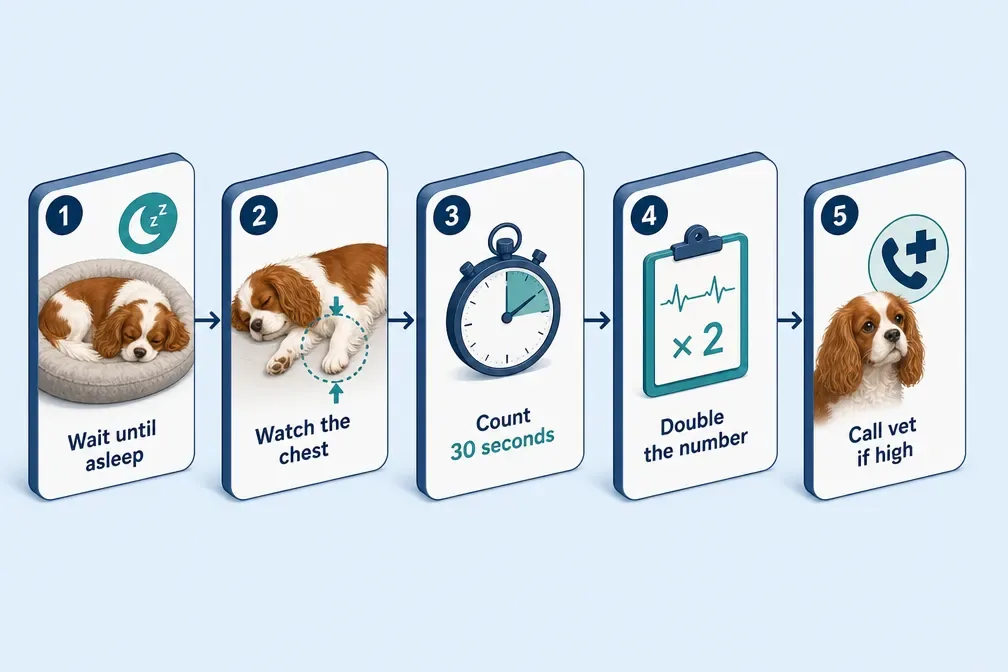
- One free home test matters. Counting sleeping breaths takes 30 seconds and can catch fluid building up before a crisis.
Where Does the Cavalier King Charles Spaniel Come From?
The cavalier king charles spaniel descends from the small toy spaniels painted into 16th and 17th century European portraits, and takes its name from King Charles II of England, who kept them at court in numbers that reportedly annoyed his advisers. Britannica traces the type through that royal association.
Then the face changed. Through the 1800s, crossing with flat-faced Asian toy breeds shortened the muzzle and domed the skull, producing what is now the separate King Charles Spaniel (called the English Toy Spaniel in the United States).
The revival came in the 1920s, driven by an American named Roswell Eldridge, who offered prize money at Crufts for spaniels of the old long-nosed type shown in the paintings. Breeders took the money. The resulting dogs were named “Cavalier” King Charles Spaniels to separate them from the flat-faced version. The AKC recognized the breed in 1995, which makes it young in registry terms and old in portrait terms.
That history explains two things. The longer muzzle means Cavaliers breathe better than most flat-faced toys. And the narrow founding population, rebuilt from a small number of dogs in one short window, is part of why inherited heart disease runs so high today.
What Makes the Cavalier King Charles Spaniel So Special (and So Cute)?
The appeal is a specific combination: a sporting spaniel’s build and energy packed into a toy dog’s size, with a face engineered by selective breeding to look permanently delighted to see you.
The AKC describes the breed as blending the attentiveness of a toy with the athleticism of a spaniel. In practice that means a dog who will do a three-mile hike and then flatten itself across your knees for four hours.
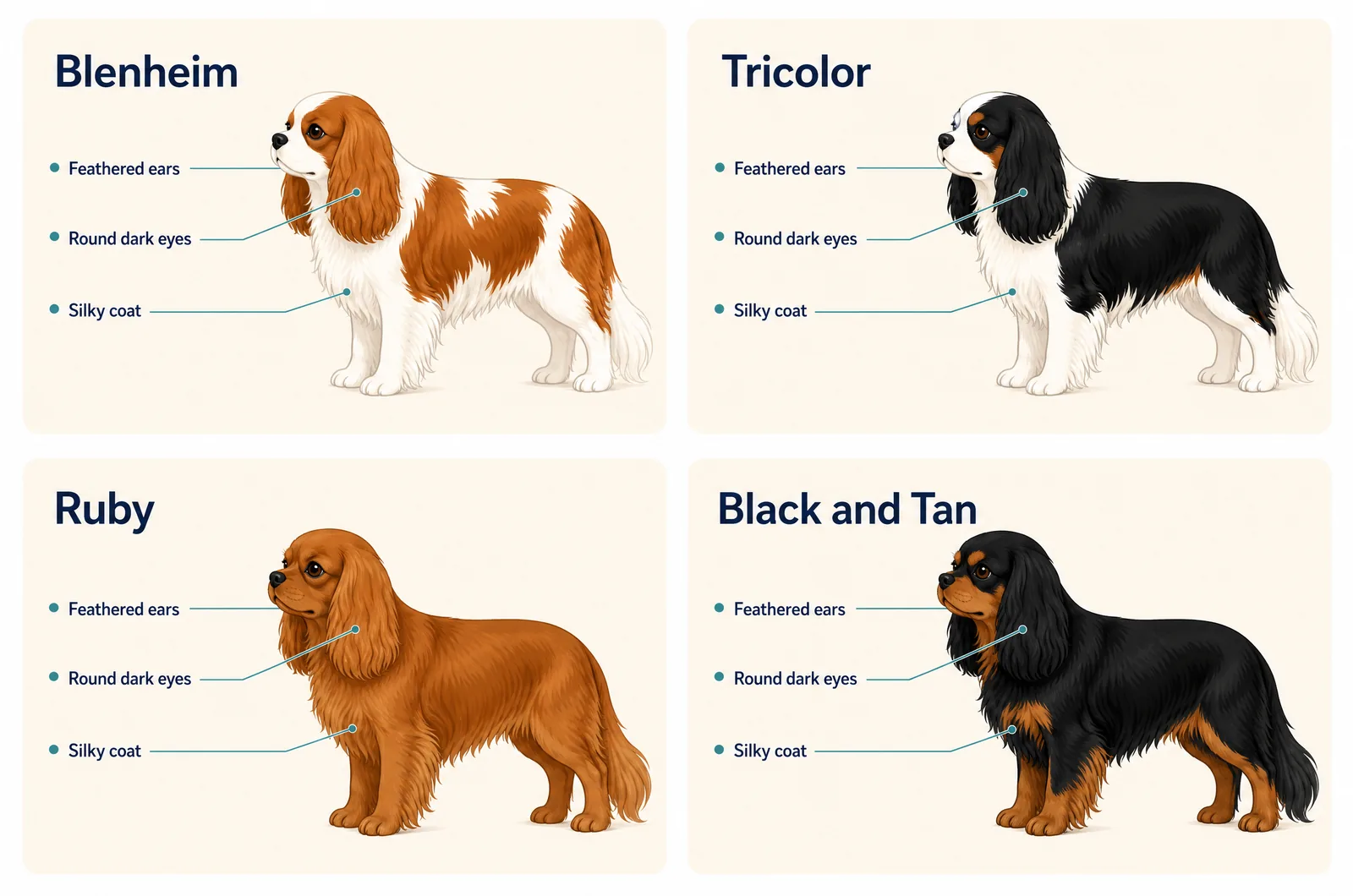
The cuteness is not accidental. Large, round, dark eyes set wide. A rounded skull. Long feathered ears that frame the face. Those are the features human brains read as infantile, which is why people describe themselves as obsessed rather than fond. Four color varieties are recognized:
| Color | Description |
|---|---|
| Blenheim | Chestnut markings on pearly white, often with the “Blenheim spot” on the skull |
| Tricolor | Black and white with tan points over the eyes and under the tail |
| Ruby | Solid rich red |
| Black and Tan | Black with tan markings |
No color is healthier than another. Ignore any breeder charging a premium for one. If you want more on breeds built for close contact, see our guide to the most affectionate dog breeds.
Cavalier King Charles Spaniel Size, Weight and Lifespan
A cavalier king charles spaniel stands 12 to 13 inches at the shoulder and weighs 13 to 18 pounds, with very little difference between males and females compared to most breeds.
| Measure | Male | Female |
|---|---|---|
| Height | 12 to 13 in | 12 to 13 in |
| Weight | 14 to 18 lb | 13 to 17 lb |
| Typical lifespan | ~10 to 11 yrs (survey average at death) | ~10 to 11 yrs |
That lifespan figure deserves care. General breed profiles quote 12 to 15 years. The CKCSC health study found dogs that had died averaged roughly 10 to 11 years. Both can be true: survey data captures dogs who died, including young cardiac deaths, which pulls the average down. A well-bred Cavalier from heart-screened lines who reaches age 10 without heart failure signs may well see 13 or 14.
What changes the outcome: parentage (heart-clear parents and grandparents), body condition (keep ribs easily felt), dental care, and whether the murmur is caught and staged early enough for treatment to matter.
A common mistake is buying a Cavalier marketed as “oversized” or “miniature.” Both are outside the standard and usually signal a breeder ignoring the standard entirely, which often means ignoring the health protocols too.
What Is the Cavalier King Charles Spaniel Temperament Like?
Sweet, people-focused, and genuinely low in aggression. The AKC breed standard demands temperament that is “gay, friendly, non-aggressive,” with no nervousness or shyness, and reputable breeders select for that as hard as they select for coat.
What that looks like at home:
- Follows you room to room. The bathroom is not excluded.
- Greets strangers as unmet friends, which makes them poor guard dogs and good therapy dogs.
- Rarely resource guards or snaps, though individual variation exists and no breed is a guarantee.
- Keeps spaniel instincts: squirrels, birds and rustling bushes still get a reaction. Many Cavaliers have no road sense at all. Leash or fence, always.
The flip side is attachment. AKC guidance notes Cavaliers thrive on human interaction and often struggle when left alone for long stretches. Socially easy is not the same as independent. If your household is empty 9 to 6 with no dog walker, separation distress is a real risk, not a small one.
Decision rule: choose a Cavalier if someone is home most days or you can arrange midday company. Choose a more self-contained breed if you cannot.
Are Cavalier King Charles Spaniels Good With Kids and Other Pets?
Yes, with a size caveat. Cavaliers are among the better small breeds for families, tolerant with children and usually relaxed around cats and other dogs.
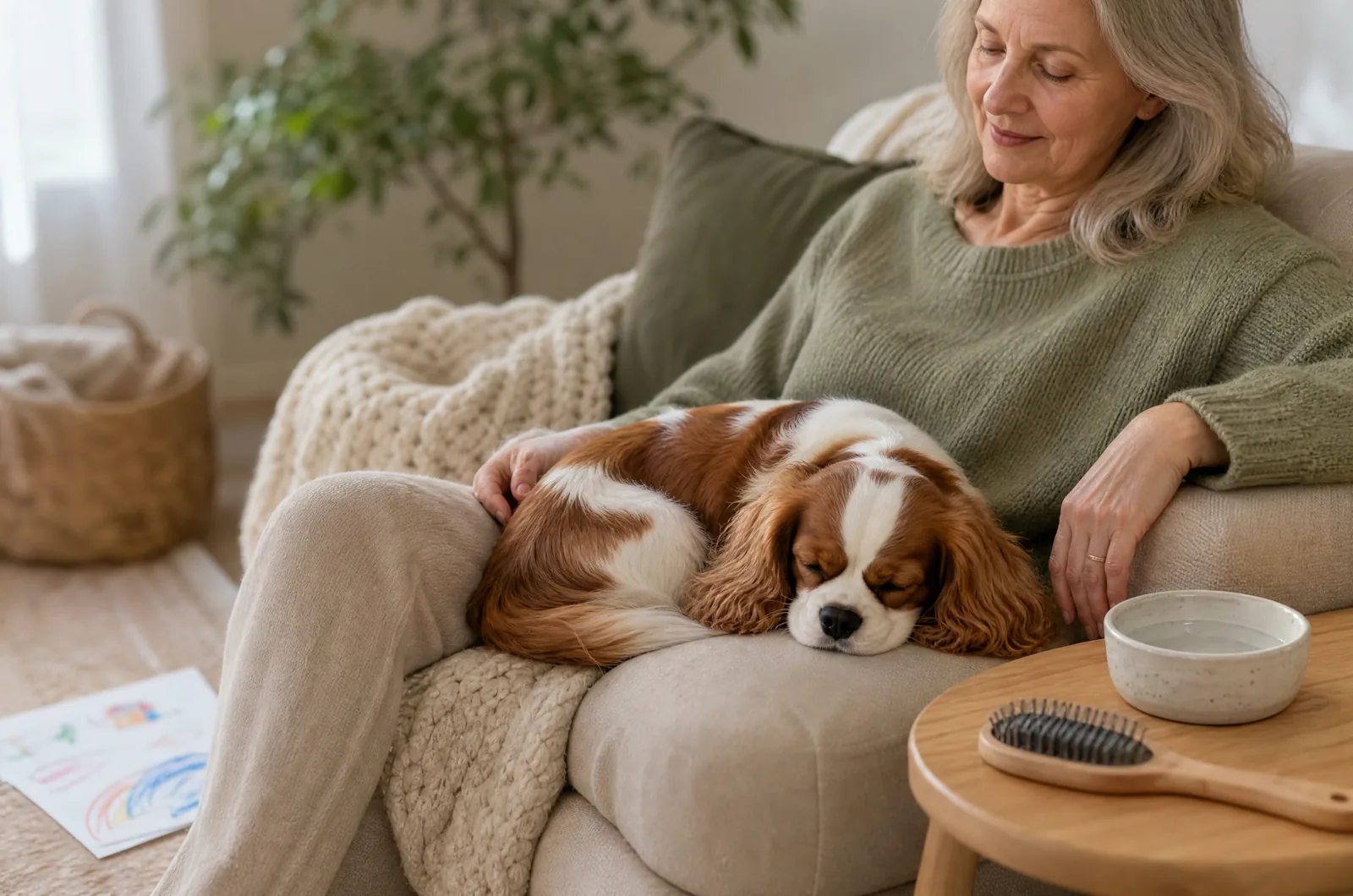
The risk runs the other way: a 15-pound dog with a delicate build can be injured by a toddler who falls on it or picks it up badly. Teach the “four on the floor” rule, that the dog gets petted where it stands.
Practical setup that works:
- Give the dog a raised bed or crate in a quiet corner that children are taught not to enter.
- Use a dog gate sized to your actual doorway to create a child-free zone rather than relying on supervision alone.
- Supervise all interactions under age six, no exceptions.
- Learn the early stress signals. Our guide to dog body language warning signals owners miss covers the lip licks and head turns that come long before a growl.
With cats, most Cavaliers coexist happily. With small animals in cages, the spaniel prey drive can switch on, so keep hamsters and birds out of reach.
Who Is the Cavalier King Charles Spaniel Made For, and Who Should Skip It?
The cavalier king charles spaniel suits apartment dwellers, retirees, first-time owners with a vet budget, and families with school-age children who want a gentle dog that does not need a yard.
Good fit if you:
- Live in an apartment or small home. They are quiet by small-dog standards and adapt well. See our picks for apartment-friendly dog breeds.
- Want a dog on the sofa, in the bed, and in the car.
- Can commit to annual cardiac auscultation from year one and insurance or savings for cardiology.
- Are home often, or work from home.
- Are a first-time owner who wants an easy temperament. Cavaliers appear on most best breeds for first-time owners lists for good reason.
Skip it if you:
- Cannot absorb a $1,000 to $3,000 veterinary year. Heart disease is common and treatment is ongoing.
- Need a dog that copes alone all day.
- Want a watchdog or a hiking partner that will cover 15 miles.
- Hate vacuuming. They shed year-round.
Similar breeds with different health profiles worth comparing: Papillon (small, bright, generally long-lived), Bichon Frise (low-shedding, sociable), Havanese, and Miniature Poodle. Against the Cocker Spaniel, the Cavalier is smaller and less prone to chronic ear disease, but the Cocker does not carry the same breed-level MVD burden. Neither is a clean win. Cockers bring their own eye and ear issues.
Cavapoos (Cavalier crossed with Poodle) are often sold as the healthier compromise. That is a marketing claim, not a tested one. A Cavapoo can still inherit MVD. Ask whether the Cavalier parent was heart-cleared, and if the breeder cannot answer, walk.
How Much Exercise Does a Cavalier King Charles Spaniel Need?
About 45 to 60 minutes a day for a healthy adult, split across two walks, plus sniffing time and indoor play.
They are more athletic than they look and will happily do more, which is where owners get caught out. A Cavalier will keep walking past the point of sense in heat, and will keep chasing a ball while coughing. Set the limit yourself.
A realistic daily plan:
- Morning walk, 20 to 30 minutes, with time to sniff rather than march.
- Short indoor training session, 5 minutes, which tires them more than another lap of the block.
- Evening walk, 20 to 30 minutes.
- A snuffle mat or food puzzle at one meal for enrichment.
Adjust for heart status. A dog in Stage B2 or in treated heart failure still benefits from gentle, regular walks, but your cardiologist sets the ceiling. Stop immediately and call your vet if your dog has breathing trouble, collapses, or cannot recover after a few minutes of rest. Labored breathing is an emergency, not a wait-and-see.
Leash manners matter more in a dog that may develop a cough. Pulling on a collar is worse for a coughing dog, so use a Y-front harness and work on loose leash walking early.
Cavalier King Charles Spaniel Grooming and Shedding
Cavaliers shed moderately year-round and need brushing three or four times a week, with no clipping required. The silky coat has no undercoat mat problem of a double-coated breed, but the feathering collects everything.
Weekly routine:
- Brush ears, chest, legs and tail feathering with a pin brush, then a comb to catch starting mats. Behind the ears is where mats form first.
- Check ears every week. Drop ears plus hair equals trapped moisture. Red, smelly or painful ears need a vet, not a home remedy.
- Trim the hair between the paw pads so the dog does not skid on wood floors.
- Bathe every four to six weeks, or sooner if they roll in something. If your dog has itchy skin, our guide on what to check on a sensitive-skin dog shampoo label is more useful than the bottle’s front panel.
- Teeth matter more in this breed than most. Small mouths crowd, periodontal disease is common, and dental infection is a worry in a dog with valve disease. Our piece on whether you need to brush your dog’s teeth covers the routine.
Nails every three to four weeks. Black fabric is no longer an option in your wardrobe. That is the deal.
Common Cavalier King Charles Spaniel Health Problems
Mitral valve disease is the headline problem. Secondary concerns are syringomyelia, episodic falling, eye conditions, luxating patella and ear disease.
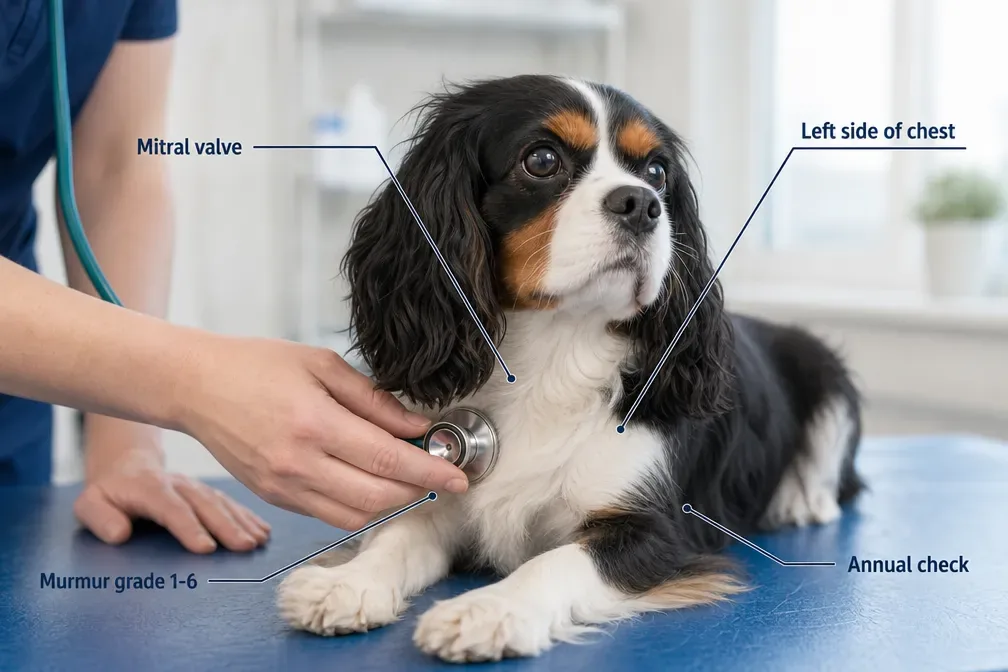
Myxomatous mitral valve disease (MMVD). The mitral valve thickens and leaks, the heart enlarges to compensate, and in some dogs it eventually fails. PDSA guidance notes Cavaliers develop it earlier and more often than most breeds. The first sign is almost always a murmur heard at a routine checkup, with no symptoms at all.
Later signs, in rough order of appearance:
- A soft cough, often at night or after lying down
- Faster breathing at rest or while asleep
- Reduced stamina on walks
- Panting out of proportion to activity
- Lethargy, reduced appetite, fainting
Call a vet the same day for a resting breathing rate consistently over 30 breaths per minute, open-mouth breathing at rest, blue or grey gums, or collapse.
Is a murmur a death sentence? No. A grade 2 murmur in a six-year-old may stay quiet for years. The March 2026 study of 302 Cavaliers with preclinical MMVD reported a median time to endpoint of 1,548 days, over four years. That study also found associations with chest shape, with thoracic length linked to faster progression (hazard ratio 1.97). Those are associations for researchers, not something you can measure with a tape at home.
If your dog is diagnosed with MVD: ask for staging. Stage B1 means a murmur with no heart enlargement, and usually means monitoring. Stage B2 means enlargement is present, and since January 2026 the FDA has approved oral pimobendan solution for delaying congestive heart failure in Stage B2 dogs, with diagnosis based on examination, radiographs and echocardiography. That requires an echo, not just a stethoscope. Ask for the referral.
Syringomyelia and Chiari-like malformation. Fluid-filled cavities form in the spinal cord, often linked to a skull too small for the brain. Signs include scratching at the neck and shoulder without contacting skin (“air scratching”), yelping when picked up, sensitivity around the head and neck, and scoliosis. It is diagnosed by MRI. The Royal Kennel Club has backed a five-year project aimed at reducing syringomyelia in the breed, and Royal Veterinary College work on neuropathic pain in MRI-confirmed cases is ongoing. Pain management helps many dogs; surgery is reserved for severe cases.
Also watch for: episodic falling syndrome (a DNA-testable condition), dry eye/curly coat syndrome (also DNA-testable), cataracts, retinal problems, luxating patella, and middle ear effusion.
Screening schedule to ask for:
| Age | Check |
|---|---|
| Puppy to 2 yrs | Annual auscultation by your vet |
| 2, 4, 6 yrs | Cardiologist auscultation (RKC-recommended intervals for breeding dogs) |
| From 6 yrs | Annual exam; echo if a murmur appears or changes |
| Any murmur found | Discuss echocardiography and staging |
A note on diet and hearts: grain-free diets have been investigated in connection with dilated cardiomyopathy, a different disease from MVD. Read our explainer on grain-free dog food and heart disease before switching a Cavalier onto a boutique grain-free formula.
Pet insurance deserves a serious look before any murmur exists, because a diagnosed heart condition becomes a pre-existing exclusion fast. Our breakdown of whether pet insurance is worth it runs the math.
What Do Cavalier King Charles Spaniels Love to Eat? Favorite Foods and Feeding
Feed a complete small-breed adult food measured by weight, split into two meals, and keep your Cavalier lean. Excess weight makes every heart and joint problem worse, and this breed begs with world-class conviction.
Typical adult intake is roughly 1/2 to 1 cup of dry food per day depending on calorie density and activity. Check the bag, then adjust to body condition, not to the chart.
Treats most Cavaliers love, in moderation:
- Plain cooked chicken breast, shredded small
- Green beans, carrot sticks, cucumber (good for dogs on a diet)
- Blueberries and small apple pieces, no seeds
- Plain pumpkin puree, a teaspoon
- A dental chew sized for a small breed
Keep treats under 10 percent of daily calories. For what matters on a label, see our guide to the top ingredients every dog food should have and the overview of dog food for specific needs.
Never feed: grapes and raisins, onion and garlic, chocolate, xylitol (in peanut butter, check the label), macadamia nuts, cooked bones, alcohol, or anything heavily salted. Salt matters doubly in a dog with heart disease, so skip cheese, deli meat and most human snacks.
If your dog has heart disease: do not put them on a low-sodium prescription diet on your own. Dietary sodium restriction is staged with the disease, and a dog in early MVD with a poor appetite needs calories more than it needs restriction. Ask your cardiologist what stage-appropriate feeding looks like, and keep weight loss on the radar, since muscle wasting late in heart disease is a real problem.
How to Train a Cavalier King Charles Spaniel
Cavaliers train easily with food and praise and shut down under harsh correction. Short sessions, high value rewards, humane training only.
Priority list for the first year:
- House training. This is the single most common Cavalier complaint online, especially in apartments. Take the puppy out every hour while awake, after every nap, meal and play session. Reward outside within two seconds of finishing. Do not punish accidents. Clean with an enzymatic cleaner so the spot does not become a marker.
- Marking. Intact males are the usual culprits, but spayed females mark too. Interrupt calmly, supervise or confine when you cannot watch, clean thoroughly, and talk to your vet about timing of neutering. Washable pee pads help in apartments but should be a bridge, not a destination.
- Alone time. Build it deliberately from week one. Leave for 30 seconds, then two minutes, then ten. A dog that has never been alone at six months is much harder to teach at two years.
- Recall and basics. Start with the essential commands every puppy should learn. Keep recall on a long line outdoors. The spaniel nose wins arguments.
- Handling. Practice ear checks, mouth checks and standing still on a table. This pays off at every cardiac exam for the next decade.
Five-minute sessions, two or three a day, beat one long slog. Mental work tires a Cavalier as much as a walk does, which is useful on days when exercise is restricted.
Try It: Cavalier Sleeping Breath Counter
Counting your Cavalier’s breaths while it sleeps is a free, 30-second home check that can spot fluid building in the lungs before a crisis. Use the tool below: count chest rises for 30 seconds while your dog is genuinely asleep, enter the number, and see where it sits.
Doggy Rank IQ Tool
Cavalier Sleeping Breath Counter

Heart disease (mitral valve disease) is common in Cavaliers. Counting breaths while your dog sleeps is a simple home check many vets recommend. Count breaths for 30 seconds, then enter the number.
How Much Does a Cavalier King Charles Spaniel Cost?
Expect $2,500 to $4,500 for a puppy from a health-testing breeder in the US, roughly $3,000 to $5,000 in the first year including setup, and $1,500 to $3,000 a year after that.
| Cost | Typical US range |
|---|---|
| Puppy from a screening breeder | $2,500 to $4,500 |
| Rescue or rehoming fee | $300 to $900 |
| First-year total (puppy, vaccines, neuter, crate, gear, training) | $3,000 to $5,000 |
| Annual ongoing (food, preventives, exam, grooming) | $1,500 to $3,000 |
| Cardiology echocardiogram | $500 to $800 per visit |
| Specialist auscultation screening | $50 to $150 |
| MRI for suspected syringomyelia | $2,000 to $4,000 |
Price ranges are market estimates, not published figures, and vary widely by region.
How to tell a good breeder from a backyard breeder:
- They show you cardiology certificates for both parents, dated, with the examining cardiologist named, not “vet checked.”
- They follow a breeding protocol based on heart status and age, in line with the breed-specific requirements that call for heart testing after 18 months and repeat testing every two years.
- They have DNA results for episodic falling and dry eye/curly coat.
- They ask you more questions than you ask them, and take the dog back if things go wrong.
- They do not have multiple litters available this week, do not meet in parking lots, and do not take payment before you have seen the mother with the puppies.
Rehoming a Cavalier is also a real option. Breed-specific rescues place adults regularly, often with known health history, and an adult heart status is information a puppy cannot give you.
Cavalier King Charles Spaniel Puppy Tips for the First 90 Days
Set up three things in week one: a confinement area, a toileting schedule, and a short daily alone-time routine. Everything else follows.
Days 1 to 14
- Crate or pen beside your bed. Carry the puppy out for toileting rather than letting it walk and get distracted.
- Vet visit within 72 hours. Ask the vet to listen to the heart and write the result in the file. That is your baseline.
- Keep the first week quiet. No parties, no dog parks.
Days 15 to 45
- Socialize carefully within your vet’s advice on vaccination status: carry the puppy to see traffic, umbrellas, bicycles, wheelchairs.
- Start alone-time practice daily, 30 seconds growing to 15 minutes.
- Handle ears, paws and mouth every day. Teething is coming; our puppy teething timeline tells you what to expect and when.
Days 46 to 90
- Puppy class with a trainer using reward-based methods.
- Fix a grooming routine so brushing is boring by six months.
- Start the sleeping breath count once a week. You are building a baseline for a dog you will own for a decade.
- Decide on insurance now, before any murmur appears.
Common first-90-days mistakes: free-feeding (makes toilet timing unpredictable), never leaving the puppy alone (builds separation distress), and skipping the collar-to-harness switch (a Y-front harness is kinder to a small trachea).
What Cavalier King Charles Spaniel Owners Say
Owner reports line up with the research on temperament, and with the worry about cost.
“I love how sweet and snuggly they are”
That is from an owner on Reddit in a thread about how expensive Cavaliers are. The snuggling is the breed working as designed. The cost question in that same thread is the honest other half: price the cardiology before the puppy, not after.
“I’ve never met a dog as sweet and caring as my Charlie.”
Posted by an owner on Reddit saying goodbye to their Cavalier. Grief posts in that subreddit are common, and many involve heart disease. The practical response is not to avoid the breed, it is to catch the murmur early, get the echo, and use the staging. Dogs in Stage B2 now have an approved option to delay heart failure.
“Have had Willow for 8 days now and well… I’m smitten”
From an owner on Reddit posting about their first Cavalier. Day eight is exactly the right moment to start alone-time training, while the puppy is still flexible and before the attachment hardens into panic at the door.
Cavalier King Charles Spaniel FAQ
What is the difference between a Cavalier and a King Charles Spaniel? The Cavalier has a longer muzzle, a flatter skull and is slightly larger. The King Charles Spaniel (English Toy Spaniel in the US) has a short, pushed-in face. They are separate breeds with separate standards.
Can a Cavalier live a normal life with a heart murmur? Often yes, especially with a low-grade murmur and no heart enlargement. A 2026 study of 302 Cavaliers with preclinical MMVD reported a median time to the study endpoint of 1,548 days. Staging by a cardiologist tells you where your dog actually sits.
How often should a Cavalier get heart screening? Annual auscultation from the first year, with specialist checks around ages 2, 4 and 6 in line with kennel club screening guidance, and echocardiography once a murmur is heard.
How long do Cavaliers really live? Breed club survey data put the average age at death at roughly 10 to 11 years, lower than the 12 to 15 years quoted in general profiles. Individual dogs from screened lines can exceed that.
Are Cavaliers good for first-time owners? Yes on temperament, with one condition: you need a veterinary budget and a willingness to learn cardiac monitoring. The dog is easy. The health management is not optional.
Which breeds are similar to Cavaliers but with fewer health problems? Papillon, Bichon Frise, Havanese and Miniature Poodle are commonly suggested alternatives for owners who want a small, affectionate companion with a different health profile. Every breed has its own risks, so research the specific conditions for each.
Do Cavaliers shed a lot? Moderately, year-round. They are not hypoallergenic. Brush three or four times a week and expect hair on dark clothing.
What should I do if my Cavalier is diagnosed with MVD? Ask for staging (B1, B2, C or D), request referral for an echocardiogram if one has not been done, start a weekly sleeping breathing count at home, and ask your vet whether medication is indicated at your dog’s stage.
The next step is small and free: tonight, when your Cavalier falls asleep, count the chest rises for 30 seconds and write the number down. Do that weekly and you will notice a change long before it becomes an emergency.