
This post contains affiliate links. If you buy through one we may earn a commission at no extra cost to you. As an Amazon Associate I earn from qualifying purchases.
Quick answer: Washable pee pads for dogs work best when the pad’s usable surface, not the printed box size, matches or exceeds your dog’s full stance plus pivot room. Look for TPU or polyurethane-laminate backing, wash them every day or two with enzymatic detergent, and expect a properly cared-for pad to last somewhere between 150 and 300 washes before the waterproof layer gives out.
Key Takeaways
- A 36 x 41 inch pad like the Eterish 2-pack gives roughly 10 square feet of coverage per pair, enough for most standard wire playpens.
- Chewy’s current pad roundup lists sizes from 18 x 24 inches up to 63 x 63 inches, which shows coverage is now sorted by dog size rather than one standard measurement.
- Disposable pads run about $0.18 to $0.88 per pad depending on size, according to Petful’s comparison.
- A reusable pad can cost $14 to $60 depending on brand and backing quality, and that cost only pays off after repeated washes.
- Trainers generally recommend shrinking the pad gradually during outdoor transition, so a pad that cannot be trimmed or relocated easily adds friction to training.
- Pad size labels like “large” or “XL” are not standardized across brands, so matching inches to your playpen matters more than the label on the package.
- Most households find two to four washable pee pads for dogs in rotation keeps one clean while another dries.
Washable Pee Pads for Dogs
Washable pee pads for dogs are reusable mats with an absorbent top layer, a waterproof middle barrier, and usually a non-slip bottom, built to catch urine, stay in place, and survive repeated laundering without losing their waterproof layer. Reusable pad coverage runs from roughly 2.5 square feet (an 18 x 24 inch pad) to over 27 square feet (a 63 x 63 inch pad), and the right pick depends on your dog’s adult size and the footprint of the containment area, not the puppy standing in front of you today, according to Chewy’s size breakdown.

The category covers more ground than most buyers expect. Washable pee pads for dogs now get built for puppy training, senior incontinence, whelping boxes, crates, car seats, and permanent protection under feeding or water stations. A pad bought for one job is not automatically right for another. A whelping pad needs a soft top layer for newborn pups, while an incontinence pad for a senior dog needs a thicker absorbent core since older dogs tend to lie directly on the pad rather than stand and walk off it, a distinction WebVet’s senior incontinence guide points out clearly.
The sizing mistake is predictable and avoidable. A dog does not urinate standing dead center on a pad. Front paws land near the middle, the dog pivots, and the stream lands near an edge or just past it. Petful’s buying guide flags this directly: pads should be sized for the dog’s expected adult size with extra coverage built in, because dogs often straddle or stand partly off the mat while going. Buy for the paws and the pivot, not just the body length.
Playpens compound the problem. A standard wire exercise pen panel runs about 24 inches wide, and four panels in a square need roughly 24 x 24 inches of floor minimum, often more once a water bowl or bed takes up a corner. If the washable pad doesn’t reach the panel edges, urine finds the gap and lands on tile or carpet instead. Check the dimensions against your actual pen before ordering, including any corner you plan to leave open for a bed or crate door. For owners still deciding on a breed and setup, the guide to best dogs for first-time owners is worth a look before building out a training area.
What’s the difference between washable and disposable pee pads for dogs?
Disposable pads are single-use, cheaper per unit, and get thrown away after one accident, while washable pee pads for dogs cost more upfront but get reused hundreds of times before replacement. The real difference shows up in long-term cost, landfill waste, and how each handles a dog who stands off-center or scratches at the surface.
Disposable pads run about $0.18 to $0.88 each depending on size, per Petful’s October comparison, and most come with a plastic backing that doesn’t hold up to a dog digging or pawing at the surface before settling. Washable pee pads for dogs cost more per unit (often $12 to $30 each) but spread that cost over 150 or more washes, which usually drops the per-use price well below a disposable pad once the break-even point is reached. Disposable pads also generate continuous trash, while a washable pad generates laundry instead, a trade some owners prefer and others find like extra chore work.
Choose disposable if you need something for travel, a short-term illness recovery period, or a dog sitter situation where washing isn’t practical. Choose washable pee pads for dogs if the pad will see daily use for months, such as apartment training, a permanent elderly-dog setup, or a whelping box that needs frequent changes without constant repurchasing.
Doggy Rank IQ Tool
Washable Pee Pad Cost per Use Calculator

Count the wash cycles and the break even point shows up fast.
Are washable pee pads worth the money?
Washable pee pads for dogs are worth the money for anyone using them daily for more than two or three months, since the per-use cost usually drops below disposables within six to twelve weeks of regular washing. They are less worth it for short-term, occasional, or travel use where a box of disposables solves the problem without a laundry commitment.
The math depends on three variables: pad price, wash frequency, and lifespan. A $40 pad washed four times a week with a 200-wash rated life comes out to about $0.20 per use, close to a disposable pad’s upper price range, so the savings aren’t dramatic unless the pad lasts closer to its full rated life. Where washable pee pads for dogs clearly win is households with multiple dogs, a permanent elderly-dog station, or anyone who finds disposable pad waste genuinely bothersome. Where they lose is households that wash inconsistently, let pads sit damp (which breeds odor and shortens lifespan), or need a pad only a few times a month, since idle pads don’t offset their higher upfront cost.
How often do you wash washable dog pee pads?
Daily washing is fine for most TPU-backed washable pee pads for dogs, and many owners wash every one to two days depending on how many pads are in rotation. Manufacturers generally recommend cold or warm water rather than hot, since heat degrades waterproof laminate faster than it degrades the fabric itself.
A two-pad rotation usually means washing every other day: one pad in use, one drying or waiting. A four-pad rotation stretches that to every two or three days. Waiting longer than that risks ammonia odor setting into the fibers, which becomes harder to remove the longer it sits. Can you wash dog pee pads with regular laundry? Washing them separately, or with old towels rather than clothing, avoids transferring pet waste residue to garments and keeps lint off the absorbent surface.
Can you put washable pee pads in a regular washing machine?
Yes, most washable pee pads for dogs are designed for a standard home washing machine, though front-loaders with lower water levels sometimes need an extra rinse cycle to fully clear waste residue. Can you put washable dog pee pads in the dryer? Many brands allow low-heat tumble drying, but high heat is the single fastest way to crack a waterproof backing, so check the care tag rather than assuming the usual dryer setting is safe.

A few machine-specific notes worth knowing:
- Top-loaders with an agitator can be rougher on seams over time than high-efficiency machines.
- Washing two or three pads together in one load is fine, but overloading the drum reduces rinse quality and leaves ammonia residue behind.
- Air drying on a rack extends backing life compared to any dryer cycle, even on low heat, if time allows.
Best washable pee pads for senior dogs or dogs with incontinence
Senior dogs with incontinence need a pad with a thicker absorbent core and a wider surface area than a standard puppy training pad, since older dogs often lie down directly on the pad rather than stand and walk off quickly. WebVet’s guide to senior incontinence care notes that absorbency and quick-wicking matter more for this group than for puppies, since prolonged skin contact with urine raises the risk of irritation and urine scald.
For this use case, the LOOBANI 36 x 48 inch mat (see the comparison table below) fits better than a smaller pad, since larger dogs with mobility issues need more surface to lie across without an edge cutting under them. A rubberized non-slip bottom also matters more here than for an active puppy, since a senior dog pushing up to stand needs the pad to stay anchored rather than slide. Pair the pad with a washable or disposable dog diaper for overnight use if accidents happen outside of pad-supervised hours, something Disabled Dog Care’s guide covers in more detail for mobility-limited dogs.
Fit, Backing and Wash Load
What size washable pad fits a standard playpen? For a typical 24 x 24 inch to 36 x 36 inch pen, look for pads in the 30 x 34 to 41 x 41 inch range so the pad reaches the panel edges with margin, a range that matches sizing seen across Paw Inspired, Caldwell’s, and Green Lifestyle pads currently listed on Chewy.
Fit has three parts: the printed dimensions, the shrinkage after washing, and the actual usable surface once hems and borders are subtracted. A pad advertised at 36 x 41 inches rarely delivers the full inch count of absorbent surface, since most designs build in a non-absorbent border to stop edge leaks. Buy slightly larger than the bare minimum measurement rather than exactly to size.
Backing material decides whether the pad stays put or migrates across the floor during a middle-of-the-night bathroom trip. TPU (thermoplastic polyurethane) and polyurethane-laminate backings resist strike-through better than basic PVC coatings, and a textured or rubberized non-slip bottom keeps the pad from bunching when a dog paws at it before settling. Smooth plastic backing on hardwood or tile is the complaint that shows up repeatedly in product feedback: the pad slides, the dog’s weight shifts it, and urine lands past the edge anyway, a point echoed in the Wirecutter review of a reusable pad design.
Wash load is the part owners skip researching until the pad already smells. Why do washable dog pee pads smell after washing? Residual ammonia crystals bind to fabric fibers and survive a quick rinse. A pre-rinse in cold water, a wash with enzymatic pet-specific detergent, and skipping fabric softener (which coats fibers and blocks absorbency) solves most lingering odor complaints. Fabric softener is also the quiet reason a pad that used to absorb well suddenly starts pooling liquid on top.
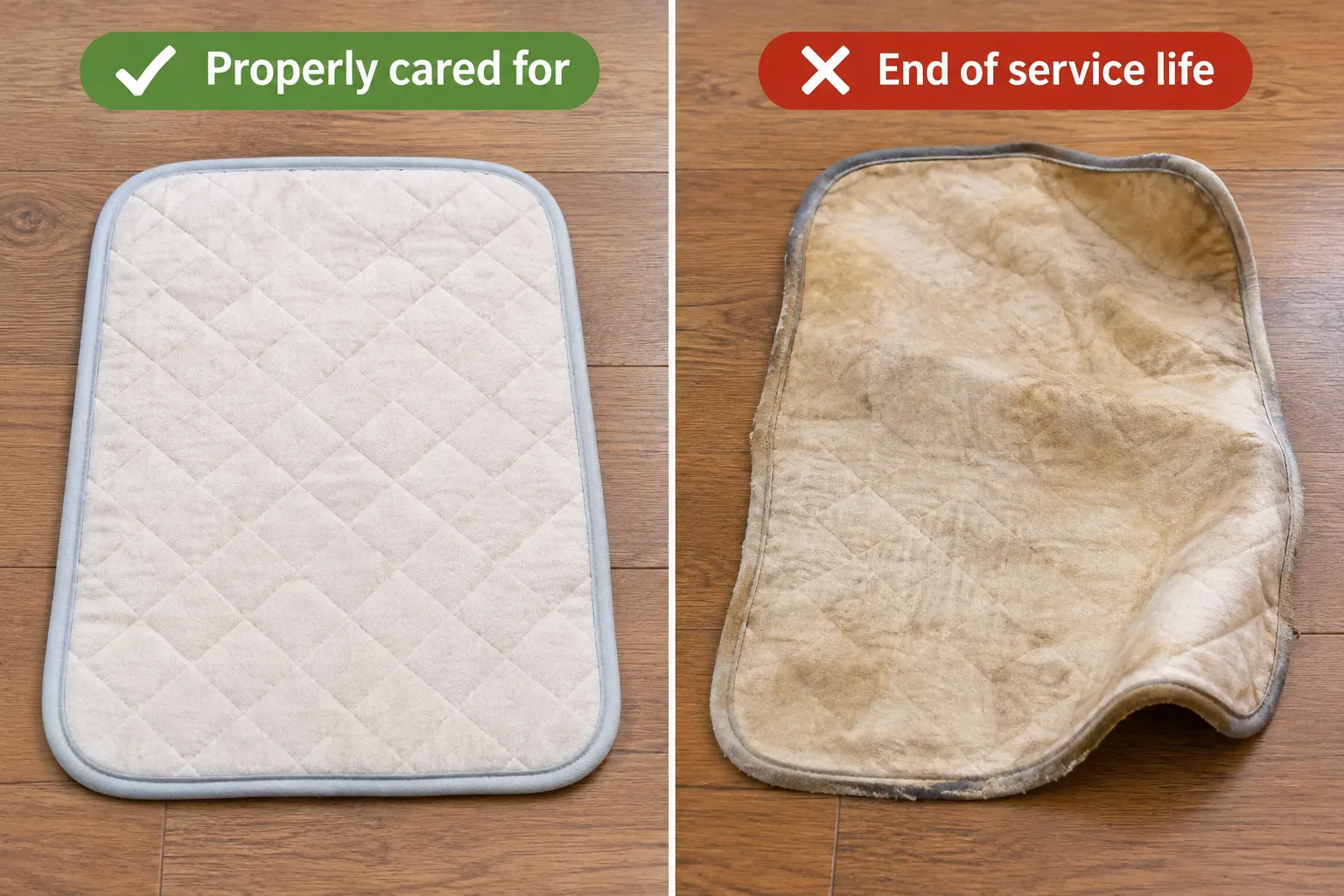
Does water leak through washable pee pads for dogs to the floor underneath? A properly rated waterproof backing should not leak under normal use, but seams, repeated folding creases, and backing worn thin from dryer heat are the common failure points. A damp outline on the floor after months of use is the backing telling you it’s near the end of its service life, not a one-off accident.
Why won’t my dog use a pee pad?
Dogs usually avoid a pee pad because of texture aversion, pad placement in a high-traffic or exposed area, or a prior accident that was cleaned with a scented product that didn’t fully remove the odor the dog can still smell. Puplr’s guide to puppy pad training notes that dogs rely heavily on scent memory, so a spot that smells faintly of urine but isn’t the pad itself can pull a dog away from the pad entirely.
Common fixes, in order of how often they solve the problem:
- Move the pad to a quieter, less trafficked corner, since dogs often avoid eliminating somewhere they feel exposed.
- Clean accident spots near the pad with an enzymatic cleaner, not a surface spray, since regular cleaners mask odor rather than breaking it down.
- Check the backing for slip. A pad that shifts under a dog’s paws teaches avoidance fast.
- Reduce the size gradually rather than switching cold from a large pad to a tiny one, which the AKC’s house training guidance style approach of gradual change supports.
A dog who was pad-trained for months and suddenly stops using the pad may be signaling a medical issue, such as a urinary tract infection, rather than a training lapse. A vet visit is worth ruling out before assuming it’s behavioral.
Washable pee pads vs just taking your dog outside more
Washable pee pads for dogs work best as a bridge or backup, not a permanent replacement for outdoor potty breaks, except in specific situations like high-rise apartments, extreme weather, senior dogs with mobility limits, or very young puppies who can’t yet hold it long enough for a full outdoor schedule. For a healthy adult dog with yard access, taking the dog outside more often solves the root problem rather than managing the symptom.
The decision comes down to logistics. An owner on the 20th floor of an apartment building, or someone working long shifts without a midday break option, benefits more from a reliable pad setup than from attempting four outdoor trips a day that aren’t realistic. A homeowner with a yard and flexible schedule usually gets a faster, more complete house-training result by skipping the pad and going outside consistently, since pads can sometimes confuse a dog about where elimination is acceptable long-term. For owners building a full routine around a new puppy, the guide to essential puppy commands pairs well with a potty training plan, since recall and basic cues make outdoor trips faster and more reliable.
How long do washable dog pee pads actually last?
Most washable pee pads for dogs are rated for 150 to 300 total washes before the waterproof backing starts to fail, though actual lifespan depends heavily on water temperature, dryer heat, and detergent choice. A pad washed in cold water and air-dried will usually outlast one run through a hot dryer cycle every time.

Signs a pad is near the end of its life:
- A damp spot appears on the floor underneath after use, even though the pad looks intact.
- The backing feels brittle or cracked when flexed by hand.
- Absorbency drops noticeably, with liquid pooling on top instead of soaking in.
- Seams start to separate or fray at the corners.
Replacing a pad at the first sign of backing failure, rather than waiting for a full leak-through, saves carpet and flooring cleanup costs that quickly outweigh the price of a new pad.
What size pee pad do I need for my dog?
The right size for washable pee pads for dogs depends on adult weight and stance, not current puppy size: small dogs under 25 pounds generally do fine with an 18 x 24 to 24 x 36 inch pad, medium dogs from 25 to 60 pounds need something closer to 30 x 34 to 36 x 41 inches, and large or giant breeds over 60 pounds need 36 x 48 inches or larger to cover a full pivot and stance.
Buying for the adult size from the start avoids a mid-training resize, especially for breeds that grow fast in the first six months. If you’re still researching which breed fits your household and living space before building out a training setup, the guide to best dog breeds for apartment living and the guide to best dogs for first-time owners both cover size and space considerations that affect pad sizing down the line.
Washable pee pads for apartment training vs house training
Apartment training with this washable pee pads usually means a permanent or semi-permanent indoor station, since outdoor access requires an elevator ride or a longer walk than a young puppy can manage. House training with a yard typically uses pads only as a short-term bridge during the first few weeks, phasing them out as the dog learns to signal and wait for outdoor trips.
In apartments, pad placement matters more since there’s no yard to fall back on if the dog avoids the spot. A consistent, quiet corner away from food and water bowls works best, and a larger pad size reduces the odds of near-misses on hard flooring. In houses with yard access, a pad placed near the door the dog will eventually use for outdoor trips helps the transition, since the dog associates the exit point with elimination from the start rather than learning a separate indoor habit that has to be unlearned later.
Do washable pee pads work for crate training dogs?
Generally no, and for a specific reason: most trainers treat a crate as a den a dog should keep clean, and placing an absorbent pad inside can undercut that instinct. Pads work better just outside the crate door or in an attached playpen rather than inside the crate itself.
A dog who learns that accidents inside the crate get absorbed by a pad loses the natural motivation to hold it, which is the exact instinct crate training relies on. If a dog must be crated longer than it can physically hold its bladder (common with very young puppies), a better fix is a shorter crate interval or a dog walker, not a pad inside the den space.
How do I keep washable pee pads from smelling?
Odor control for this washable pee pads comes down to three habits: rinse before washing, use an enzymatic pet-specific detergent, and skip fabric softener entirely. Ammonia crystals bind to fabric fibers and survive a quick rinse cycle, so a cold pre-rinse followed by a full wash cycle clears residue that a single wash alone leaves behind.
Fabric softener coats fibers and blocks absorbency, which is also the quiet reason a pad that used to absorb well suddenly starts pooling liquid on top instead of soaking it in. Air drying in direct sunlight when possible adds a natural odor-reducing effect that a dryer alone doesn’t provide. Pads left damp in a hamper for more than a day tend to develop a mildew smell on top of the ammonia issue, so moving a washed pad to a dryer or drying rack promptly matters as much as the wash itself.
Washable pee pads for multiple dogs or large breeds
Multiple-dog households need more pads in rotation than a single-dog household, typically four to six this washable pee pads rather than two to four, since simultaneous use means less time for washing and drying between uses. Large breeds need pads sized at 36 x 48 inches or bigger, since a bigger dog’s stance and pivot radius simply take up more floor space.
For large or giant breeds, the LOOBANI 36 x 48 inch mat (detailed in the comparison table below) spreads cost over more coverage per wash cycle, which matters when a dog’s actual stance needs the extra inches rather than just looking larger on the shelf. In multi-dog homes, staggering pad placement across separate areas, rather than expecting all dogs to share one pad station, reduces the odds of territorial avoidance, where one dog refuses a spot another dog has already used.
Top 5 Features That Decide the Purchase
- Waterproof backing material. TPU-laminated backing, used in pads like the LOOBANI 36 x 48 inch mat, is the single feature separating a pad that survives daily use from one that leaks within a month.
- Non-slip grip bottom. A textured or rubberized underside stops the pad from sliding when a dog paws at it, a problem common with basic plastic-backed pads on hard flooring.
- Usable absorbent surface area. The printed inch dimensions of a pad like the Eterish 36 x 41 inch 2-pack matter less than the actual absorbent zone once borders are subtracted.
- Wash and dry tolerance. A pad rated for machine washing and low-heat tumble drying, as most PUPIBOO listings describe, holds its waterproof layer longer than hand-wash-only designs.
- Edge and seam construction. Reinforced stitching around the border, visible on multi-layer pads, prevents the seam separation that causes slow leaks after repeated laundering.
Coverage and Cost-Per-Use Worksheet
The table below compares three this washable pee pads by size, backing type, and best use case, based on specs listed by the brands and current Chewy and Amazon listings.
| Model | Size | Backing | Price Band | Best For |
|---|---|---|---|---|
| Eterish Reusable Washable Pee Pads, Large/XL 2 Pack | 36″ x 41″ | Waterproof, non-slip | around $35 to $50 | Standard playpens, whelping boxes |
| PUPIBOO This washable pee pads and Cats | Mid-size, multiple packs | 100% waterproof, leak-proof, non-slip | around $25 to $40 | Crate liners, smaller dogs, cats |
| LOOBANI 2 Packs Extra Large Reusable Dog Mat | 36″ x 48″ | Non-slip, fast absorbent, waterproof | around $40 to $60 | Large/giant breeds, incontinence, big playpens |
Which Pick Fits Which Dog and Owner?
The Eterish 36 x 41 inch 2-pack suits owners managing a medium dog in a standard wire playpen, or a whelping setup where two pads can rotate through wash cycles without leaving a gap. The size matches common pen dimensions closely enough that most buyers won’t need a third pad to patch corners, and the waterproof, non-slip combination handles daily accidents without constant repositioning.
The PUPIBOO This washable pee pads and Cats work as the budget pick for owners with a smaller dog, a cat, or a crate liner need rather than a full-room setup. The smaller footprint means a lower per-pad price, but also less margin for a dog who stands off-center, so this fits apartment dwellers and smaller breeds better than giant dogs or multi-dog households.
The LOOBANI 36 x 48 inch mat fits owners with large or giant breeds, senior dogs with incontinence, or anyone covering a sizable playpen or under-bed area. The larger surface costs more upfront but spreads that cost over more coverage per wash cycle, which matters if a dog’s stance genuinely needs the extra inches rather than just looking impressive on the shelf.
Things to Watch Out For
How many this washable pee pads do I actually need? Most households find two to four pads in rotation strikes the right balance: enough that one is always clean while another washes and dries, without owning so many that storage becomes its own problem. Fewer than two means a gap in coverage during a wash cycle, which defeats the purpose.
Other common mistakes worth avoiding:
- Buying the smallest size available to save money, then discovering the dog’s stance overruns the edges within a week.
- Using fabric softener, which coats fibers and kills absorbency over time.
- Drying on high heat, which is the fastest way to crack a waterproof backing.
- Skipping the pre-rinse step, which leaves ammonia residue that builds up wash after wash.
- Placing the pad inside a crate rather than just outside it, which can undercut den-clean instincts.
Who Should Skip Washable Pee Pads for Dogs
Owners with consistent yard access, a flexible schedule, and a healthy adult dog who can hold a bladder for four to six hours generally don’t need this washable pee pads at all, since direct outdoor training reaches a faster, cleaner result. Pads also aren’t a good fit for owners unwilling to commit to a wash routine, since a pad left unwashed for days becomes an odor and bacteria problem worse than a quick outdoor trip would have been.
Dogs with severe anxiety around indoor elimination, or dogs who have already formed a strong outdoor-only habit, sometimes do worse with a pad reintroduced later, since it can create confusion about where elimination is acceptable. In those cases, sticking with an outdoor routine and consulting a trainer for anxiety-related issues works better than adding a pad to the mix.
FAQ
What’s the difference between washable and disposable pee pads for dogs? Washable pads cost more upfront but get reused for 150 or more washes, while disposable pads cost $0.18 to $0.88 each and get thrown away after one use. This washable pee pads generally win on long-term cost and waste reduction for daily use, while disposables win for travel or occasional use.
How often do you wash washable dog pee pads? Most owners wash every one to two days depending on rotation size, using cold or warm water rather than hot to protect the waterproof backing.
Are washable pee pads worth the money? Yes, for daily use lasting more than two or three months, since the cost per use typically drops below disposables within six to twelve weeks of regular washing.
Can you put washable pee pads in a regular washing machine? Yes, most are designed for standard home machines, though front-loaders sometimes need an extra rinse cycle to clear waste residue fully.
Why won’t my dog use a pee pad? Common reasons include texture aversion, placement in a high-traffic spot, lingering odor near the pad from a prior accident, or a backing that slips underfoot. A sudden stop in pad use after months of success can also signal a urinary tract infection worth checking with a vet.
How long do washable dog pee pads actually last? Most are rated for 150 to 300 total washes, though cold-water washing and air drying extend that lifespan compared to hot water and high-heat drying.
What size pee pad do I need for my dog? Small dogs under 25 pounds generally fit an 18 x 24 to 24 x 36 inch pad, medium dogs need 30 x 34 to 36 x 41 inches, and large or giant breeds need 36 x 48 inches or larger.
Do washable pee pads work for crate training dogs? Generally no, since crates work best as a clean den space, and a pad inside the crate can undercut that instinct. Place pads just outside the crate door instead.
How do I keep washable pee pads from smelling? Pre-rinse in cold water, wash with an enzymatic pet-specific detergent, skip fabric softener, and dry promptly rather than leaving a washed pad damp in a hamper.
Are washable pee pads good for multiple dogs or large breeds? Yes, with adjustments: multi-dog households typically need four to six pads in rotation rather than two to four, and large breeds need pads sized 36 x 48 inches or bigger to cover their full stance.