Quick Answer
Stop-and-go stalls because standing still only tells your dog what does not work. It never shows them what does. Loose leash walking improves fastest when you pay the dog for the exact behavior you want, slack line, a glance back, walking near your leg, while also managing the environment so pulling stops paying off. The 2022 Veterinary Record review by Townsend, Dixon and Buckley recommends reward-based, least-aversive training plus equipment that fits, and professional help when pulling is severe. Guidance checked October 2026.
Key Takeaways: Loose Leash Walking
- Loose leash walking means the leash stays slack while the dog moves at your pace. The dog can sniff, look around, and change sides. Heel is a tighter, more formal position.
- Stop-and-go fails most often when the walk restarts the second the leash loosens, because forward motion toward the smell still rewards the pull.
- Pulling is often self-reinforcing. A 2024 JAVMA review describes reaching a wanted location as a behavior that rewards itself.
- The five fixes that hold up: a paid reinforcement zone, pattern games, separate decompression walks, an equipment check, and choosing easier environments.
- Equipment helps control, not education. A 2024 strain-gauge comparison of 23 shelter dogs found no clear welfare winner among four devices, and prong collars were not significantly better than a front-clip harness.
- Expect weeks of short daily reps, not one heroic Saturday. There is no published average timeline, so treat any specific number you see as a guess.
- Lunging, barking, and freezing at triggers are arousal and emotion problems first. Train distance and feelings before you train position.
What is loose leash walking, and how is it different from heel?
Loose leash walking means the leash stays slack and the dog walks at a pace you can both keep. The dog is allowed to sniff, scan, and drift a little. Heel is a precise position, usually at your left side with the dog’s shoulder near your leg and attention on you.
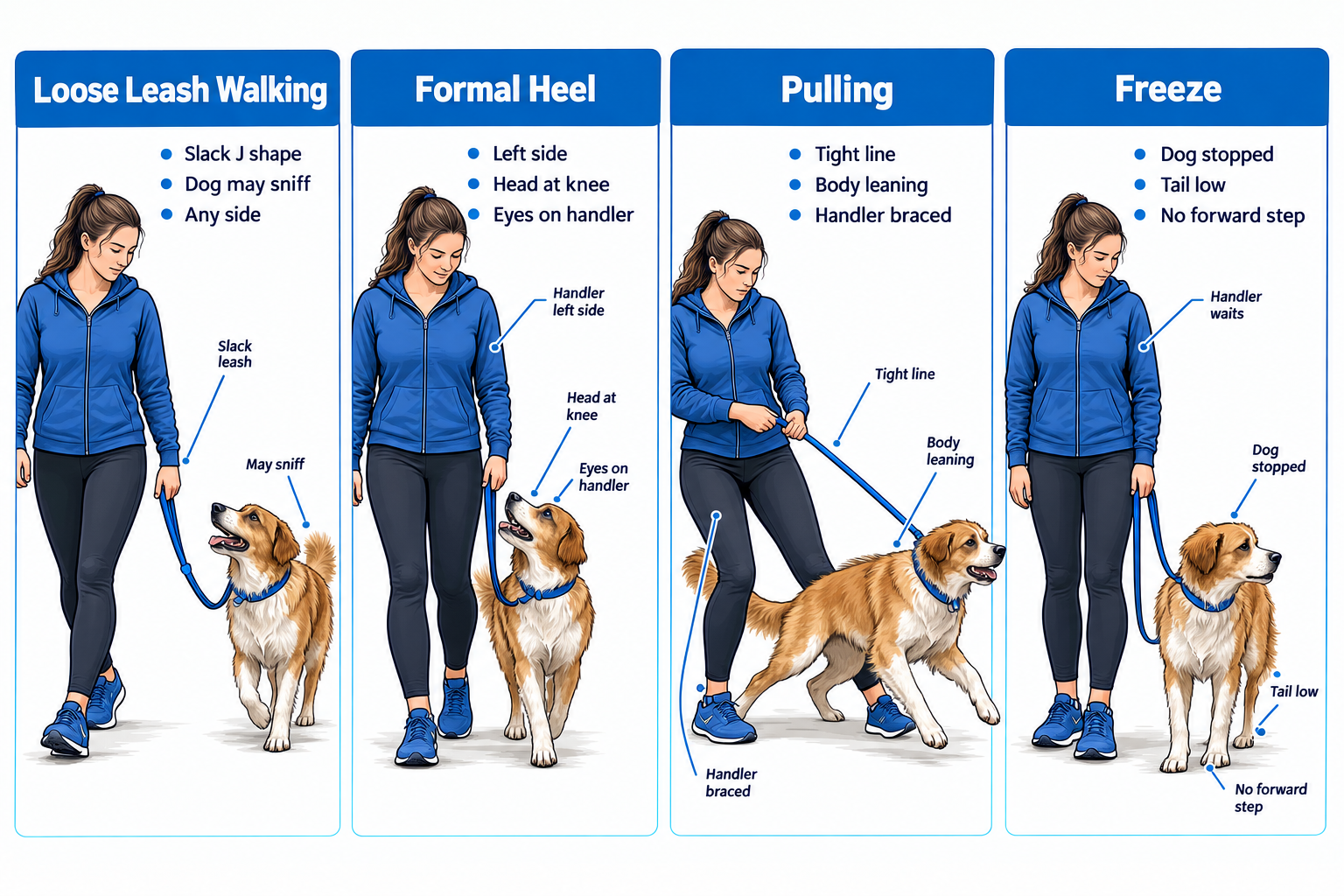
The difference matters because owners often train the harder skill by accident, then feel like failures when it collapses outside the kitchen.
| Skill | What it looks like | Where it belongs |
|---|---|---|
| Loose leash walking | Slack line, dog sniffs and moves naturally | Daily walks, errands, pavements, vet waiting rooms |
| Heel | Dog glued to one side, head up, high attention | Crossing a busy road, weaving through a crowd, competition work |
Heel is expensive for the dog. It takes concentration, and concentration runs out. A dog who can heel for 30 seconds through a doorway and then walk on a loose leash for the next 20 minutes is doing exactly what most households need.
Why bother at all? Because the 2022 Veterinary Record review notes that persistent pulling can shorten walks, cut down sniffing and social contact, raise arousal and frustration, and strain the relationship between dog and owner. Shorter walks mean less enrichment. Less enrichment often means a dog who pulls harder next time. For apartment dwellers especially, the walk is the day’s main event, which is part of why apartment-friendly breeds still need a leash plan rather than a smaller dog and good luck.
Why does stop-and-go loose leash walking stall?
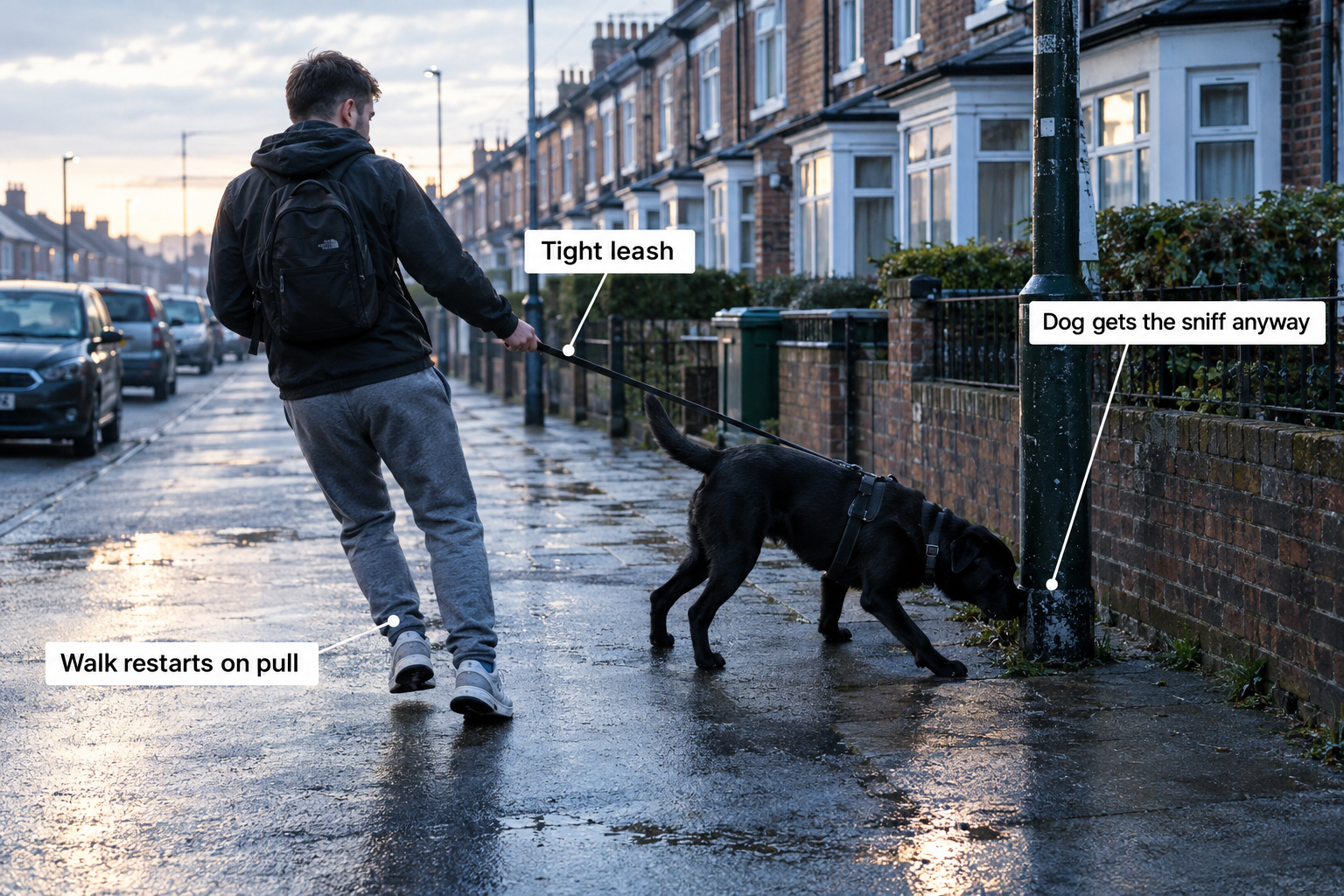
Stop-and-go stalls because the consequence is clear and the lesson is not. The leash tightens, the walk pauses, the leash loosens, the walk resumes. From the dog’s side, the sequence that ends with reaching the lamppost still includes pulling.
Four things go wrong in practice.
1. The destination pays the pull. You stop, the dog eases off for half a second, you step forward, and three steps later the dog is sniffing the thing it wanted. The pull got there. The pause was a toll, not a dead end.
2. Nothing gets paid. Stopping removes a reward. It does not add one. Dogs repeat what works, so a slack leash needs to produce something good: food, praise, a sniff you chose to allow, permission to move on.
3. The dog is at the wrong temperature. A dog ten minutes into the day, bladder full, squirrels in session, is not in a learning state. You are doing calculus at a rock concert.
4. Pulling already has a long history. The 2024 JAVMA review by Rosa and Buckley describes reaching a desired location as a self-reinforcing behavior. If your dog has practiced that for two years, four stops on a Tuesday will not outvote it.
There is also a plain mechanical issue. Many dogs simply walk faster than we do. Asking a young spaniel to match a human stroll is a real request, not a formality.
Stopping tells your dog the brakes exist. It never tells them where the accelerator is.
What are the 5 fixes that work?
The five fixes are: build a paid reinforcement zone, use pattern games for predictability, give separate decompression walks, check the equipment and the fit, and pick environments your dog can actually cope with. Run them together rather than in sequence.
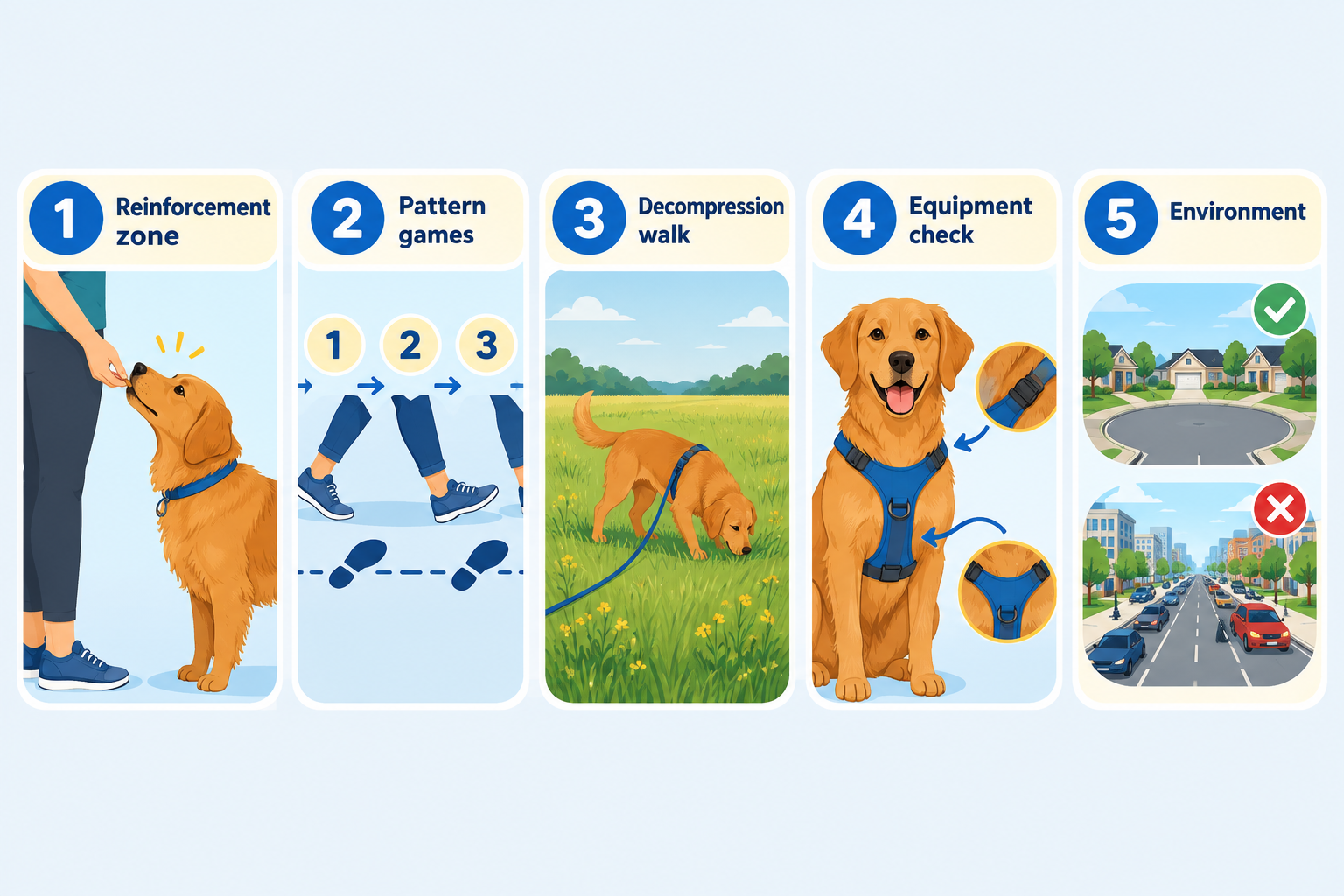
Fix 1: Pay the reinforcement zone
Pick a zone: beside your leg, roughly from your knee to your hip, either side. When the dog is in it with a slack leash, something good happens. Mark with a word (“yes”) or a clicker, then feed low at your seam so the dog’s head stays down and forward, not bouncing up at your hand.
- Start indoors or on a driveway for two minutes, not a 40 minute walk.
- Feed often at first. Ten rewards a minute is normal early on.
- Pay the dog’s own good choices: the check-in, the turn back to you, the loose line after a distraction passed.
Trainer Emily Larlham, who publishes free training videos as kikopup, teaches this style of marking and feeding in position rather than correcting the pull. That is a trainer method, widely used and consistent with reward-based guidance, not a protocol with its own published trial.
Fix 2: Pattern games
Trainer Leslie McDevitt’s pattern games give the dog a predictable rhythm to fall back on. Her Up and Down and 1-2-3 patterns are the ones most owners find usable on a pavement: you count “one, two, three” out loud and deliver a treat on three, every time, same cadence.
Predictability lowers the guesswork. A dog who knows what happens next scans less, and a dog who scans less pulls less. Again, label this correctly: it is a respected trainer framework used by many certified professionals, not a finding from a controlled study.
Fix 3: Separate decompression walks from training walks
If every outing is a training session, both of you will quit. Split them.
- Training walk: 5 to 10 minutes, quiet route, treats, lots of marking. Short and boring by design.
- Decompression walk: a long line of 15 to 30 feet in open space where it is safe and legal, and the dog sniffs where it likes. No leash position criteria at all.
Trainers often credit this split to Sarah Stremming, who popularized the decompression walk concept. The practical logic is simple: a dog who gets to sniff somewhere else has less reason to drag you to the one patch of grass on your street. Sniffing is real enrichment, not a delay.
Fix 4: Check the equipment, then check the fit
Gear does not teach anything, but bad gear makes teaching harder. A collar that slides up under the jaw, a harness that digs into the shoulder, a retractable lead that rewards constant tension: all of these work against you. Check the dimensions, then check the fit again after a week of use. Two fingers under every strap, no rubbing behind the elbow, no riding up the throat.
The equipment table below covers the main options.
Fix 5: Choose the environment on purpose
Most “my dog ignores me outside” problems are environment problems. You do not train a dog to read in a library by starting at a stadium.
- Train on the quietest route you have, even if it is dull.
- Drive to a boring car park if your street is a parade.
- Walk at 6am for two weeks if that is when your road is empty.
- Set a rule: if the dog cannot take food, the environment is too hard. Add distance.
Which harness or collar works best for loose leash walking?
There is no single best device. Choice should follow your dog’s size, strength, build, health, and your own handling ability. A non-tightening front-clip harness is a reasonable default for a dog who pulls hard, because it gives you control while you train, without pressure on the throat.
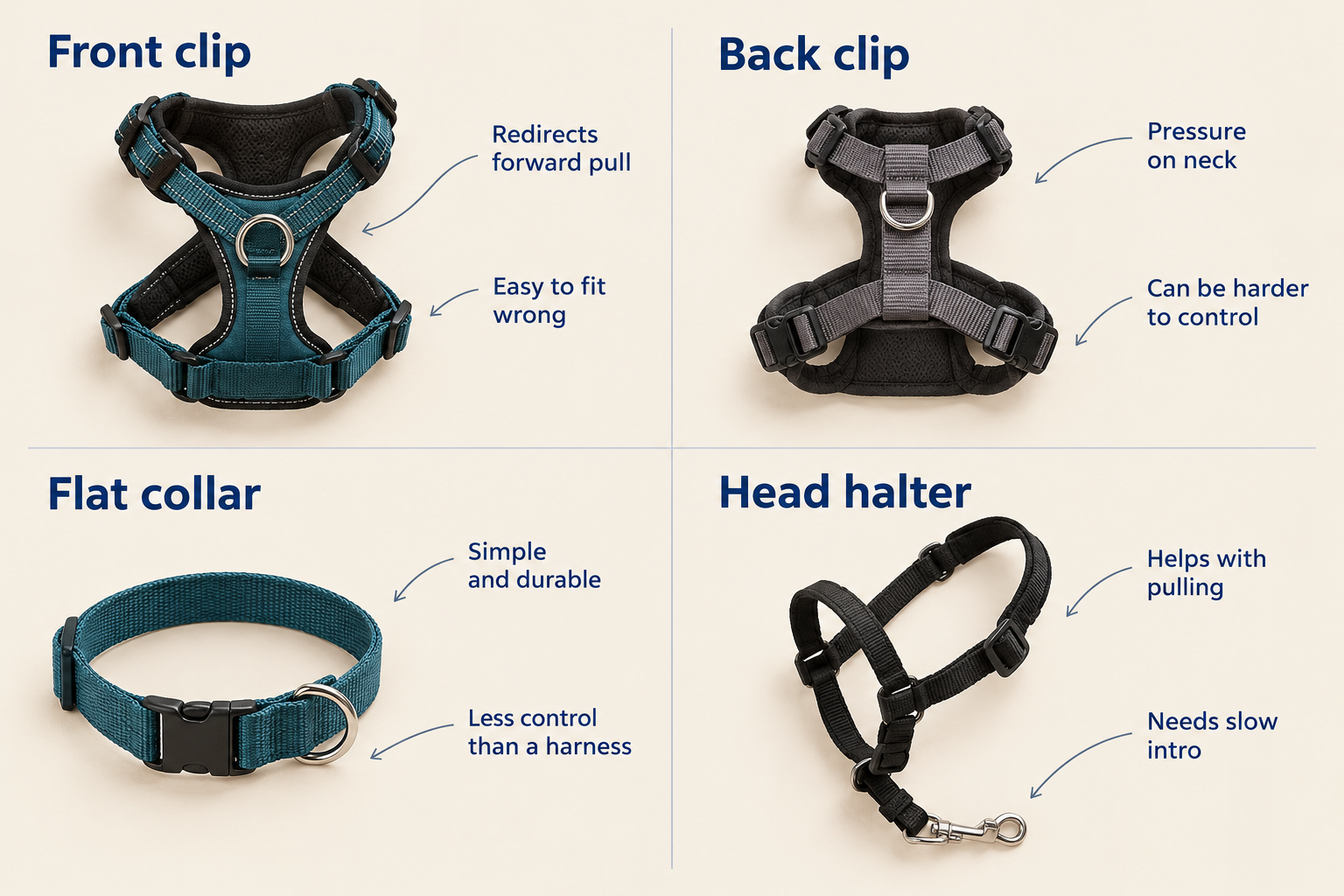
| Equipment | Effect on pulling | Comfort notes | Training notes |
|---|---|---|---|
| Front-clip harness | Redirects forward pull sideways, so pulling gets less productive | No neck pressure; watch for straps across the shoulder joint | Useful while you teach. Not a substitute for training |
| Back-clip harness | Little braking effect; can make leaning into the leash easier | Usually comfortable, popular with small dogs | Fine for dogs who already walk nicely, or for long-line sniff walks |
| Flat collar | No mechanical help; strong pullers put force on the neck | Avoid for heavy pullers, brachycephalic dogs, or any airway concern | Good for ID tags and for dogs with an established loose leash |
| Head halter | High control of head direction for large powerful dogs | Many dogs dislike it at first; needs slow, rewarded introduction | Best used with coaching. Sudden leash jerks risk neck strain |
What about prong collars? A 2024 PeerJ study by Johnson and Wynne put a strain gauge on the leash and tested 23 shelter dogs for five minutes each on a martingale collar, a front-clip harness, a polymer prong-style collar, and a metal prong collar. Pulling differed across devices, but the only significant differences were between the martingale and each of the other three. Prong, polymer, and front-clip harness did not differ significantly from each other.
That is a meaningful result, and the authors were careful about its limits: small sample, shelter dogs, five minute walks, fixed order of equipment, and a handler who added very little leash pressure. It is not evidence that aversive equipment is safe for routine household use. A 2024 literature review in the same research line documents that electronic collars are banned or restricted in several countries, and prong collars are banned in some European jurisdictions, New Zealand, and Victoria, Australia. Check your local rules.
The professional consensus points the same way. AVSAB, the British Small Animal Veterinary Association, the Canadian Veterinary Medical Association and the Australian Veterinary Association all recommend reward-based or minimally aversive training. The 2022 Veterinary Record review warns that punitive methods can suppress pulling while increasing fear, stress, aggression, or avoidance.
How do you stop a dog from lunging on walks?
Start with distance, not correction. Lunging at bikes, cars, dogs, or joggers is usually arousal, startle, or chase motivation, and the dog cannot learn new leash manners while in that state. Increase the gap until your dog can eat food, then work there.
A workable sequence:
- Manage first. Change route, change time, cross the road early, use a parked car as a visual block.
- Pay the alternative. Reinforce looking at the trigger and then back at you, repeatedly, from a distance that stays under threshold.
- Add a cue the dog already knows. A solid turn-and-come is worth more than any gadget. If your recall is shaky, build it separately in the garden before you need it at 30 feet. Our training hub covers foundation cues in more depth.
- Get help early. Lunging that involves barking, growling, or snapping warrants a certified trainer or a veterinary behaviorist. Pain also drives reactivity, so a vet check belongs on the list.
Common mistake: practicing at the distance where the dog already exploded last week. Edge of threshold, not middle of the fire.
What should you do when your dog stops and won’t move?
Stop pulling on the leash and work out which of four things is happening: fear, pain, confusion, or an unmet need. Dragging a frozen dog forward makes the leash a predictor of pressure, which is the opposite of loose leash walking.
- Fear or startle: a bin lorry, a drain, a new surface. Give slack, step back to where the dog is comfortable, feed, and let them approach in their own time.
- Pain or heat: sore feet, hot pavement, stiff joints, an older dog who has reached their limit. Check paws and pace, then call your vet if it repeats.
- Learned stopping: sniffing is the destination, or standing still has previously ended a walk the dog did not want. Reward movement, keep sessions short.
- Puppy shutdown: very young puppies often sit down on walks. Carry them part way, keep outings tiny, and pair the harness with food at home first.
Decision rule: if your dog freezes in the same spot twice in a week, treat it as information, not stubbornness.
Is loose leash walking good for all breeds and can you teach an old dog?
Yes to both, with adjustments. Every dog benefits from a slack leash, and older dogs can learn it, although arthritis, hearing loss, and reduced stamina change how you train. Expect shorter sessions and more rest.
Breed tendencies shift the difficulty, not the possibility. Sled-type dogs were bred to pull into pressure. Scent hounds follow their nose with impressive commitment. Terriers notice movement before you do. None of this predicts your individual dog, and breed stereotypes have a poor record as behavior predictors. Individual variation wins.
Size matters for equipment and risk. A 9 pound dog pulling is annoying. A 120 pound dog pulling can hurt somebody, which is worth planning for if you are looking at the larger and giant size categories. For senior dogs, rule out pain first. Older dogs also sleep a great deal, which is normal and not laziness, as covered in our piece on why dogs sleep so much.
Loose leash walking for reactive dogs: what changes?
For reactive dogs, the emotional response comes first and the leash skill comes second. Position training in the presence of triggers teaches a dog to look obedient while still feeling terrible, and that fragile calm tends to break.
What changes in practice:
- Pick routes for visibility and escape options, not for scenery.
- Keep the leash loose on purpose. Tension travels down the line and adds to arousal.
- Use one simple pattern game and one turn-away cue. Two tools, well practiced.
- Involve a qualified professional. The 2022 Veterinary Record authors specifically recommend referral when pulling is severe, alongside equipment desensitization.
- Accept that progress is non-linear. A bad Tuesday after a good Monday is normal.
How often should you practice, and what are the most common mistakes?
Practice little and often: 2 to 5 minutes, once or twice a day, beats one long weekly session. Short reps protect the dog’s concentration and your patience.
Common mistakes that stall loose leash walking:
- Treating a stop as the whole method and never rewarding slack.
- Rewarding the release of tension instead of the dog’s position, which can teach a pull-then-ease loop.
- Training on the hardest route you own because it is the one outside your door.
- Making criteria stricter before the current step is easy.
- Switching tactics every three days. New plan, same dog, no history.
- Expecting the walk to double as the training session every single time.
- Using the walk as the only exercise and enrichment the dog gets.
If loose leash walking is not working, run this short audit: Is the dog eating treats on the walk? Is the leash slack getting paid within one second? Are you under 5 minutes per session? Is the environment quiet enough? Has a vet ruled out pain? Four “no” answers explain most plateaus.
How long does loose leash training take?
Honest answer: nobody has published a reliable average, so treat any precise figure with suspicion. Most dogs show visible improvement on a quiet route within 2 to 4 weeks of short daily sessions, and need several months before a slack leash holds up near dogs, bikes, and squirrels. That range is a practical estimate from common trainer guidance, not a study result.
Three things shift the timeline more than breed does: how long the dog has practiced pulling, how reinforcing the environment is, and how consistently every person in the household applies the same rules. One family member who lets the dog pull to the park can keep a plateau going for months.
23 dogs
Shelter dogs tested on four walking devices for five minutes each with a leash strain gauge. Johnson and Wynne, PeerJ, 2024
1 of 6
Only the martingale differed significantly from the other three devices; prong, polymer and front-clip harness did not differ from each other. PeerJ, 2024
Self-reinforcing
Reaching a wanted location can reward pulling on its own, which is why management matters alongside training. JAVMA review, 2024
Least aversive
Veterinary reviewers recommend reward-based training and warn that punitive methods can increase fear and stress. Veterinary Record, 2022
How do you teach loose leash walking to a puppy?
Start indoors with no leash at all. Reward the puppy for being near your leg, then add the harness, then add the leash as a loose decoration, then add three steps. Puppies have no pulling history to undo, which is the single biggest advantage you will ever have.
A simple first week:
- Day 1 to 2: Feed the puppy for standing beside your leg at home. Ten reps, twice a day.
- Day 2 to 3: Put the harness on, feed, take it off. Build a good association before it means anything.
- Day 3 to 4: Clip the leash, let it drag indoors under supervision, feed for staying close.
- Day 4 to 5: Three steps, mark, feed. Then five. Then stop while it is still easy.
- Day 5 to 7: Move to the driveway or hallway. Same game, harder room.
Then keep the first outdoor walks absurdly short. A puppy who gets 90 seconds of calm walking and then goes home has had a win. A puppy who gets 25 minutes of dragging has had a lesson, just not the one you wanted. For the wider picture on early training order, see our guide to the best ways to train your puppy.
One more note on treats. Walk rewards count toward daily food, especially for small breeds. Our guide to how much treat food is safe in a day explains the sums. Use small, soft, pea-sized pieces, and adjust dinner.
FAQ
Does stopping when your dog pulls ever work?
It can work as part of a plan, but rarely on its own. Pair the stop with reinforcing slack and orientation toward you, and make sure the walk does not immediately deliver the thing the dog was pulling toward.
Is a front-clip harness the best choice for loose leash walking?
A non-tightening front-clip harness is a sensible default for dogs who pull hard, because it adds control without neck pressure. It works partly by making forward pulling less comfortable, so keep teaching the skill rather than relying on the gear forever.
Are prong collars more effective than harnesses?
The available controlled comparison does not support that claim. In the 2024 PeerJ strain-gauge study, prong, polymer prong-style and front-clip harness conditions did not differ significantly from each other, and the sample was small with five minute walks.
How many minutes a day should I train?
Two to five minutes, once or twice daily, on a quiet route. Short sessions keep the dog’s concentration and your consistency intact better than a weekend marathon.
Can an older dog learn loose leash walking?
Yes. Older dogs learn new leash habits, though you should rule out joint pain or other discomfort first and keep sessions short. Expect slower progress if the dog has pulled for years.
My dog walks nicely in the garden and pulls on the street. What am I doing wrong?
Nothing unusual. Behavior does not transfer across contexts automatically. Retrain the same steps in the new location at an easier level, and add difficulty only when the dog can still eat and check in with you.
Should I let my dog sniff on walks?
Yes. Sniffing is real enrichment, and the 2022 Veterinary Record review links persistent pulling to reduced sniffing and social contact. Use separate decompression walks on a long line so sniffing is not something the dog has to drag you toward.
Conclusion
Stop-and-go is not wrong, it is incomplete. It names the problem and never pays the solution. Loose leash walking improves when the dog gets reinforced for slack and orientation, when the environment stops rewarding the pull, and when the gear fits properly instead of silently working against you.
Next steps, in order:
- Pick one quiet route and commit to 3 minutes a day for two weeks.
- Decide today what a slack leash earns: food, a sniff break, permission to move on.
- Check your harness fit, two fingers under every strap, with no shoulder interference.
- Add one pattern game and practice it in your kitchen before your pavement.
- Book a certified trainer or veterinary behaviorist if lunging, growling, or freezing is part of the picture.
Guidance here was checked October 2026 against current veterinary reviews and the professional position statements listed above. Where the evidence is thin, this article says so. Dog Advice That Actually Answers the Question works better when it also admits where the facts end.