Quick Answer
No. If you are asking should i shave my husky to keep him cooler, the answer from veterinary and breed-club guidance checked in October 2026 is don’t do it. A Husky’s double coat traps a layer of cooler air near the skin, blocks ultraviolet light, and slows heat transfer in both directions. Shaving it removes that buffer, exposes pale skin to sunburn, and can leave the coat growing back patchy or woolly. The American Kennel Club lists Siberian Huskies among breeds that should not be shaved. Brush instead. Shave only on a veterinarian’s instruction for a medical reason.
Key Takeaways: Should I Shave My Husky?
- Shaving does not cool a Husky. Hillsborough County, Florida summer pet guidance from June 23, 2026 warns that shaving double-coated breeds may have the opposite effect of cooling them.
- The coat is a two-part system. Long guard hairs shed water and block sun. The dense undercoat insulates. Clippers cut both to the same blunt length and the system stops working as designed.
- Regrowth is the risk owners underestimate. AKC notes the undercoat can grow back faster than the slower guard hairs, which can leave an altered texture or colour, and in some dogs growth is delayed or incomplete.
- Sunburn becomes a real concern. Both AKC and the ASPCA warn that removing coat layers raises the risk of sunburn and overheating.
- Shaving does not stop shedding. It shortens the hair you find on the sofa. The follicles keep working.
- What groomers recommend instead: regular brushing, undercoat combing, and a professional deshedding blowout during a coat blow.
- Heatstroke is a temperature emergency, not a grooming problem. Know the warning signs and act fast.
- There are legitimate exceptions. Severe matting, surgery, skin treatment, or wound care can all justify clipping on veterinary advice.
- Still asking should i shave my husky because the hair is everywhere? The shedding fix is a schedule and a decent rake, not a clipper.
How does a Husky’s double coat work?
A Husky’s coat is two coats stacked together, and each does a different job. The outer layer is made of longer, coarser guard hairs that repel water, carry the colour pattern, and block a good share of ultraviolet light. Underneath sits a soft, dense undercoat that traps air against the skin.
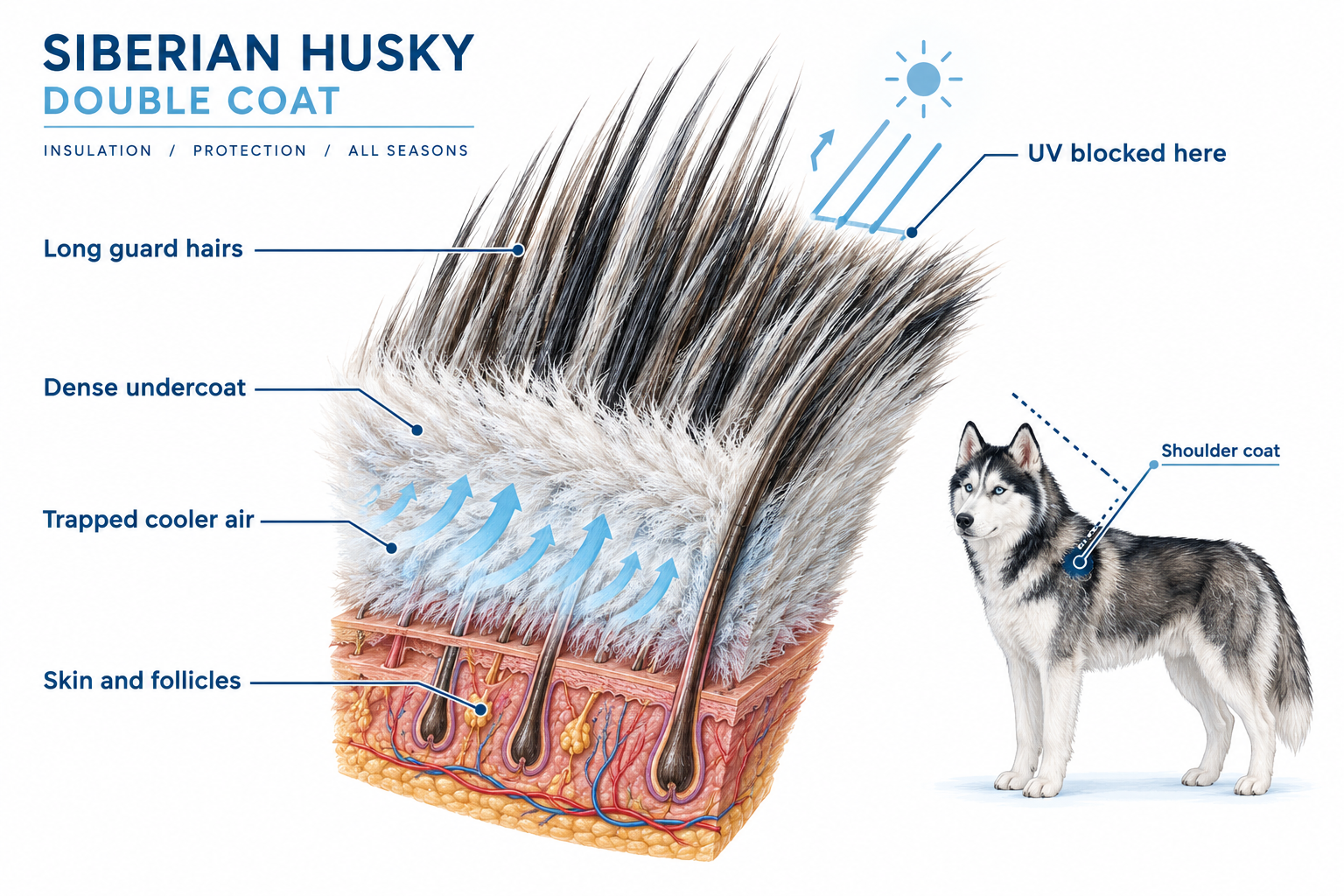
Trapped air is the part people miss. Still air is a poor conductor of heat, which is why double glazing works and why a wool jumper keeps you warm without being warm itself. Veterinary guidance from Texas A&M explains the same mechanism in dogs: Dr. Navarrette describes how the thick coat of Huskies and similar breeds can create a barrier of cooler air near the skin and help with thermoregulation. She recommends brushing, combing, or blowing out the loose undercoat rather than fully shaving the dog.
So the coat slows heat moving in as well as heat moving out. In January it holds body warmth close. In July, when the air and the pavement are hotter than the dog, it slows that heat reaching the skin.
The Siberian Husky Club of America breed standard is unusually blunt about this. It describes the coat as double and medium in length, and says trimming fur anywhere other than permitted areas, such as the feet and the whiskers, should not be condoned. The club’s breed description goes further and characterises the Husky as needing no clipping or trimming in ordinary care, while noting the breed sheds at least once a year, often far more conspicuously during a seasonal coat blow.
One thing the coat does not do is replace cooling. Dogs lose heat mainly by panting, not through the skin. A dense coat helps buffer the skin. It does not run the air conditioning. That distinction matters for the next section.
What about huskies in hot climates?
Huskies live in Phoenix, Dubai, and Brisbane. They manage, with planning. Owners in hot regions report shifting walks to dawn and dusk, keeping the dog indoors through the afternoon, running fans, and brushing far more often because the coat cycles differently in a warm climate. If you are still choosing a breed and the climate worries you, our guide to picking a dog breed that fits your life covers that trade-off honestly, and the low maintenance dog breeds comparison is worth a look if grooming time is your constraint.
What are the 4 reasons groomers say no to shaving a husky?
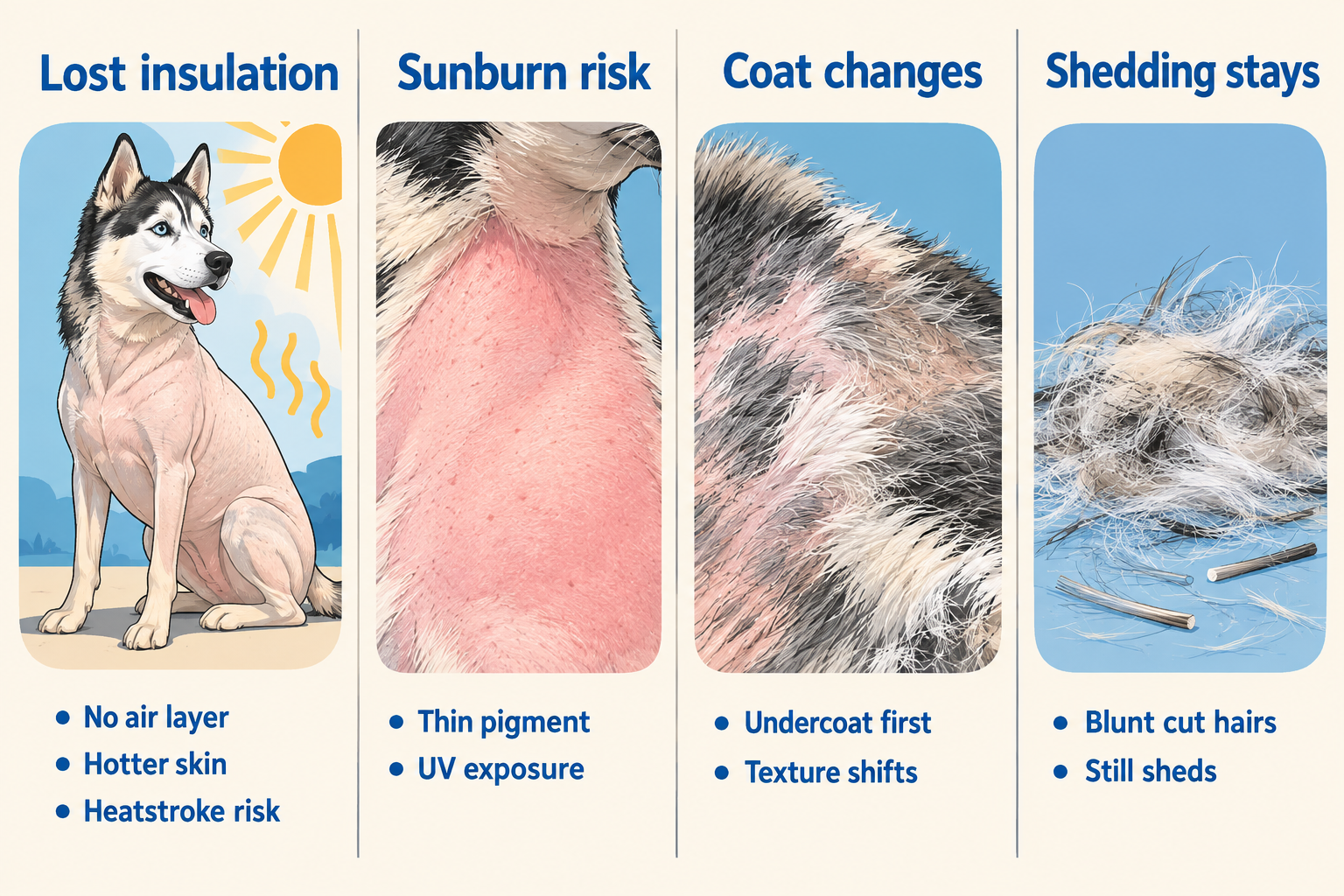
Groomers refuse Husky shaves for four reasons: lost insulation, sunburn risk, unpredictable regrowth, and the fact that shaving does not solve shedding. None of these are aesthetic objections. Each one changes something physical about the dog.
Reason 1: You remove the insulation, not the heat
AKC Chief Veterinary Officer Dr. Jerry Klein states that shaving a double coat can remove insulation and increase a dog’s susceptibility to heatstroke. The dog feels lighter. The skin is now taking direct sun and direct hot air. The cooler air layer near the skin is gone.
Owners sometimes report that their shaved Husky “seemed happier.” Possibly. A dog can also seem happier after a good brush-out, which removes the dead undercoat that was genuinely trapping heat without removing the working structure. Those two outcomes get confused constantly.
Decision rule: if your goal is a cooler dog, remove dead hair, not living coat.
Reason 2: Sunburn on skin that has never seen the sun
Husky skin under the coat is pale and pigment-poor in many dogs. Strip the coat in June and the skin gets exposure it has never had. AKC and the ASPCA hot weather safety guidance both warn that removing coat layers can raise the risk of sunburn as well as overheating.
Sunburn is painful in the short term. Repeated exposure on unprotected skin is a longer-term concern worth raising with your vet, especially in high-UV regions.
Reason 3: The coat may not come back the way it left
This is the reason groomers talk about most and owners hear about least. AKC warns that after clipping, the undercoat can grow back faster than the slower guard hairs, producing a patchy or altered texture and colour, and that in some dogs coat growth is delayed or incomplete. Dr. Klein also links shaving to improper hair growth and follicle damage.
A Husky can go in looking like a Husky and come out, eight months later, looking like a differently coloured dog made of felt.
Reason 4: Shaving does not stop shedding
The follicle decides when hair releases. Cutting the shaft shorter does not change that schedule. What changes is the hair you find: short, blunt, needle-like fragments that weave into upholstery and car seats more stubbornly than long guard hairs.
Owners discussing this in the r/grooming community thread “Help! How do I convince my friend to NOT shave his Husky?!” land on the same practical point that groomers do. The shed does not stop. It just gets harder to vacuum. Treat that as documented owner discussion rather than a study, but it matches the mechanism.
Will husky fur grow back if shaved?
Usually yes, but not always the same, and not always on the original schedule. Most shaved Huskies regrow a full coat. A minority regrow unevenly, and some develop slow or incomplete growth over the clipped area, a problem widely discussed under the term post-clipping alopecia.
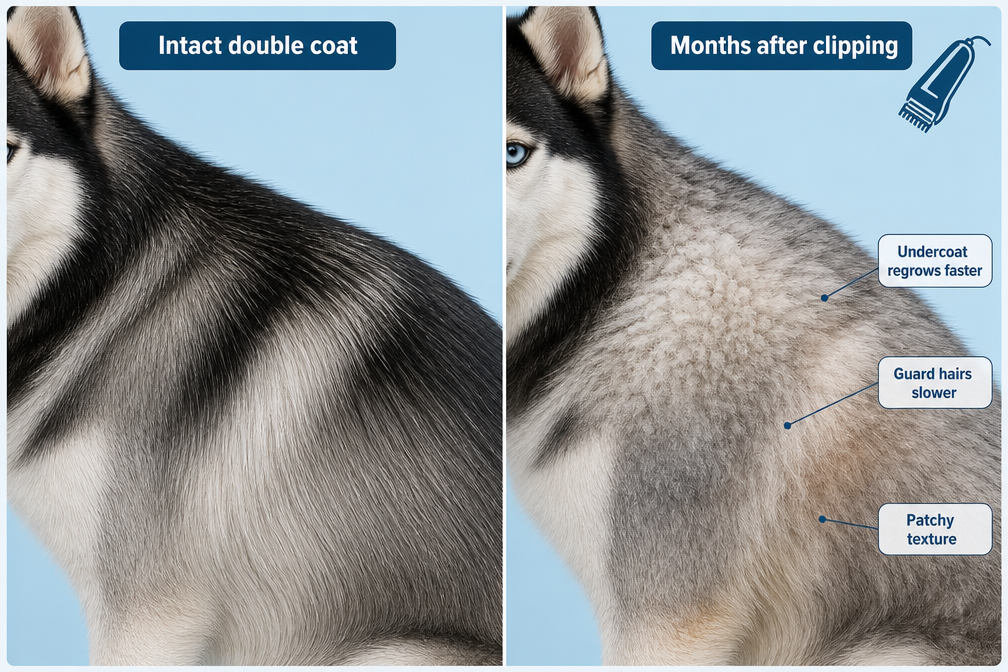
Here is the pattern groomers describe and AKC’s guidance supports. The soft undercoat tends to come back first and fast. The guard hairs are slower. For a stretch of months the dog carries mostly undercoat, which reads as woolly, cottony, or dull, and it can pick up a different shade because the pigmented guard hairs that carried the colour pattern are not back yet. Texture can stay changed even after full regrowth. AKC also raises improper hair growth and follicle damage as possible outcomes.
How long does a husky’s coat take to grow back after shaving?
There is no single verified figure for Huskies, and anyone quoting one precisely is guessing. What the available guidance supports is this: undercoat regrowth is relatively quick, guard hair regrowth takes considerably longer, and the full coat structure can take a shedding cycle or more to re-establish. In dogs with post-clipping alopecia, regrowth can remain patchy for an extended period and sometimes needs veterinary investigation, since slow regrowth can also point to hormonal or skin problems unrelated to the clip.
If the coat has not meaningfully regrown after several months, that is a conversation with your veterinarian, not a second trip to the clippers.
Can shaving a husky damage their coat permanently?
Permanent damage is possible but not typical. The honest framing: a single shave on a young, healthy Husky most often regrows acceptably, with some texture change. Repeated shaving raises the odds of lasting changes to texture and follicle health. AKC’s warning about follicle damage is the reason groomers treat repeat shaves as a different risk from a one-off medical clip.
What is the difference between shaving and trimming a husky?
Shaving means running clippers over the body, cutting guard hairs and undercoat to a uniform short length and removing the insulating structure. Trimming means scissoring small, defined areas while leaving the body coat intact. The Siberian Husky Club of America’s standard permits tidying the feet and whiskers and objects to trimming elsewhere. Tidy paw fur for traction and hygiene. Leave the jacket alone.
| Option | Effect on heat | Effect on coat | Cost and time | When to use |
|---|---|---|---|---|
| Full body shave | Removes insulation and sun protection; AKC links it to higher heatstroke susceptibility | Risk of patchy regrowth, texture and colour change, follicle damage | Salon rates vary by region; ask for a written quote | Only on veterinary instruction |
| Scissor trim (feet, whiskers) | Neutral | No structural change; permitted under the SHCA standard | Minutes at home with blunt-tip scissors | Paw hygiene, grip on floors, debris between pads |
| Undercoat rake and comb at home | Improves airflow by removing dead hair, keeps guard coat intact | Protective; this is the method Texas A&M guidance recommends | One-off tool purchase, then 10 to 20 minutes per session | Year-round, more often during a coat blow |
| Professional deshedding blowout | Clears loose undercoat in bulk, no loss of guard hairs | Protective; fastest way to clear a heavy shed | Priced per session and per dog size; confirm before booking | Seasonal coat blows, dogs who resist home brushing |
How do you keep a husky cool in summer?
Shade, moving air, cool water, timing, and a brushed-out coat. Not clippers. Huskies stay cool mainly by panting, by seeking cooler surfaces, and by having the dead undercoat removed so air can reach the skin.
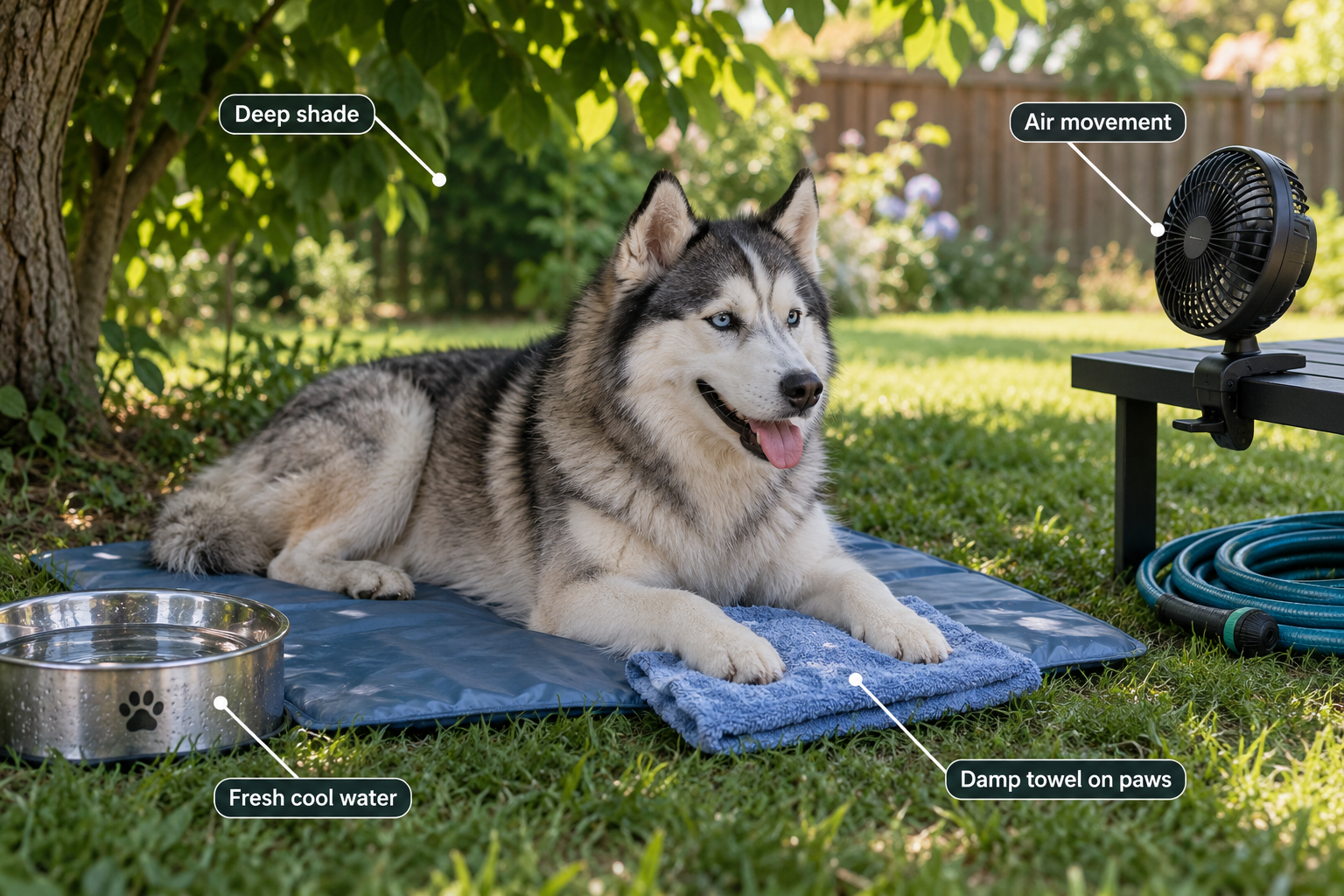
During the United Kingdom heatwave of July 20, 2026, the RSPCA advised avoiding dog exercise during the hottest part of the day. The BBC reported that window as roughly 08:00 to 20:00 BST, and the advice paired it with shade, fans, refreshed water, and cool damp towels rather than a haircut. That is the whole strategy in one sentence: change the environment and the schedule.
What that looks like in practice:
- Move walks to the coolest hours. Early morning and late evening. Test the pavement with the back of your hand for several seconds.
- Give real shade. A tree or a solid structure, not a hot car or a plastic kennel baking in the sun.
- Add air movement. A fan near a resting spot helps panting work better.
- Offer cool water constantly, refreshed often. Some dogs drink more when ice is added.
- Use damp towels on paws, belly and groin. Cool, not ice cold, and never wrapped tightly over the body where it blocks airflow.
- Brush out the dead undercoat. This is the grooming part of cooling.
- Let the dog pick the floor. A tile hallway beats a plush bed in July. Dogs sleep plenty in heat, and that is normal behaviour, as our piece on why dogs sleep so much explains.
Heatstroke warning signs
Heat emergencies are about body temperature, not coat length. VCA describes hyperthermia above 103°F (39.4°C) as abnormal and notes temperatures above 106°F (41.1°C) are commonly associated with heatstroke.
Signs that need action now: frantic or noisy panting, thick drool, very red or purple gums, vomiting or diarrhoea, wobbling, confusion, glazed eyes, collapse, or seizures. Move the dog to shade, start cooling with cool (not ice) water, and call a veterinarian immediately. Do not wait to see if it settles.
Read the mortality figure carefully. It applies to dogs who already have heatstroke. It is a reason to prevent the emergency, not a reason to panic at normal panting.
How often should you groom a husky instead of shaving?
Weekly brushing most of the year, and most days during a seasonal coat blow. That is the schedule groomers and veterinary guidance point to, and it is the actual answer for anyone wondering should i shave my husky because the grooming feels unmanageable.
A workable routine:
- Weekly, year-round: a slicker brush over the top coat, then an undercoat rake or wide-tooth comb through the dense layer on the shoulders, hips, chest, and behind the ears.
- During a coat blow: short sessions most days. The Siberian Husky Club of America notes the breed sheds at least once a year, often far more conspicuously at these times.
- Seasonally: a professional deshedding blowout, which uses forced air to push loose undercoat out faster than any hand tool.
- Monthly: nails, paw pad fur, and a skin check for hot spots, flea dirt, or dry patches.
- Bathing: only as needed, with a thorough dry. A damp undercoat left to sit can cause skin trouble.
If you are new to any of this, start with our beginner’s guide to dog grooming for technique and tool basics.
How do you manage husky shedding without shaving?
Catch the hair before it lands. The practical version:
- Brush outdoors or on a hard floor you can sweep.
- Use two tools, not one. A rake for the undercoat and a comb to check your work.
- Vacuum on a schedule rather than in response to despair. A machine with a motorised pet head earns its keep in a Husky household.
- Use washable throws on sofas and car seats. Wash them weekly during a coat blow.
- Keep a rubber squeegee or lint roller by the door for clothing.
- Keep the diet and skin health sound, since poor coat condition can worsen hair loss. Ask your veterinarian before changing food.
Apartment residents deal with this at close quarters. If you are weighing a Husky against your floor plan, our notes on the best dog breeds for apartment living are worth reading before the coat blow, not during it.
What do professional groomers recommend for husky grooming?
Groomers and veterinary sources converge on the same list: regular brushing, undercoat combing, forced-air deshedding, bathing only as needed, trimming limited to feet and whiskers, and no body shave without a medical reason.
One extra thing to ask about when you book. Several 2026 reports have covered dogs harmed by heat while in grooming care, including a September 24, 2026 report of a Memphis groomer facing charges after multiple dogs allegedly died from heatstroke while in care. That is not evidence that shaving causes heatstroke. It is a reason to ask any salon directly about ventilation, temperature monitoring, whether dogs are left under heated dryers unattended, and what the emergency procedure is.
When is shaving a husky medically necessary?
Clipping a Husky is appropriate when a veterinarian needs access to the skin or when the coat itself has become a health problem. In those cases the clip is treatment, and the coat consequences are an accepted trade-off.
Legitimate reasons include:
- Surgical preparation at an incision or catheter site.
- Wound, abscess, or burn care where fur traps discharge.
- Severe, painful matting that cannot be combed out safely. Dense mats pull the skin and hide sores.
- Skin disease treatment where topical medication must reach the skin.
- Maggot or heavy parasite infestation, or contamination with a substance that cannot be washed out.
- Senior or mobility-limited dogs with soiling that cannot be managed by washing alone, usually clipped only in the hygiene area.
Even then, ask for the smallest area possible, ask what to expect from regrowth, and ask about sun protection for the exposed skin while it recovers. For broader behaviour and care questions as your dog ages, our dog behavior section covers the ground around grooming tolerance and handling.
What is not a medical reason: your own comfort with vacuuming, a wedding photo, or a hot forecast. The forecast is handled by shade, timing, water, and a brush.
FAQ
Is it harmful to shave a husky?
It can be. AKC guidance states that shaving a double coat can remove insulation, increase susceptibility to heatstroke, expose the dog to sunburn, and contribute to improper hair growth or follicle damage. A single medical clip is usually tolerated. Routine shaving carries the higher risk.
Should i shave my husky in the summer to keep him cool?
No. Hillsborough County’s June 2026 summer pet guidance warns that shaving double-coated breeds does not cool them and may do the opposite. Remove dead undercoat by brushing, and manage heat with shade, airflow, water, and walk timing.
Does shaving a husky ruin its coat?
Not always, but it can change it. The undercoat tends to regrow faster than the guard hairs, which can leave altered texture and colour. Some dogs regrow slowly or incompletely. Repeated shaving raises the risk.
Can you trim a husky at all?
Yes, in limited areas. The Siberian Husky Club of America standard permits tidying the feet and whiskers and objects to trimming elsewhere on the body. Scissors, not clippers, and leave the body coat intact.
What dog breeds should never be shaved?
Double-coated breeds as a group, with AKC naming Siberian Huskies among them. Similar logic applies to other northern and double-coated breeds such as Malamutes, Samoyeds, German Shepherds, Chow Chows and Pomeranians. Ask your veterinarian about your individual dog.
Do huskies regrow fur after being shaved, and how long does it take?
Most do. There is no reliable single timeline, and precise claims should be treated with caution. Undercoat returns relatively quickly, guard hairs take considerably longer, and full coat structure may need a shedding cycle or more. Slow or absent regrowth warrants a veterinary check.
What are the signs of post-clipping alopecia?
Hair that fails to regrow over a clipped area, patchy regrowth, or regrowth that stays woolly and discoloured well beyond the expected period. Because hormonal and skin conditions can look similar, a veterinary assessment is the right next step.
Is it ever worth shaving just a little, like a summer haircut?
Partial clipping still cuts guard hairs and reduces sun protection in the clipped area. A deshedding blowout gives the airflow benefit without that cost, which is why groomers offer it instead.
Conclusion
The short version has not changed in October 2026: if you are asking should i shave my husky, the coat is doing a job that clippers cannot replace. Guard hairs block sun and slow heat transfer. The undercoat holds a cooler air layer against the skin. Shaving removes both at once, invites sunburn, risks patchy or altered regrowth, and does not stop a single hair from shedding.
Three things to do this week:
- Buy or find an undercoat rake and a wide-tooth comb, then brush for ten minutes and see how much dead hair comes out. That volume is your real cooling tool.
- Set a summer schedule, not a haircut. Walks outside the hottest hours, deep shade, a fan by the resting spot, water refreshed often, damp towels on paws and belly.
- Book a professional deshedding blowout before the next coat blow, and ask the salon about ventilation, temperature monitoring, dryer supervision, and emergency procedure before you hand over the lead.
And if a veterinarian says this particular dog needs clipping for this particular reason, follow that advice without guilt. Medical clipping is a treatment. The summer shave is a myth with a vacuum cleaner problem attached.
For more practical care breakdowns, browse the Doggy iQ Hub.