
Quick Answer
Both tools can hurt a dog, and neither one is automatically safer. The dog nail grinder vs clipper decision changes the type of mistake you can make: a clipper’s error is one cut that is too deep, and a grinder’s error is holding the spinning band on one nail too long, which builds heat. VCA Animal Hospitals advises grinding in bursts of only one to two seconds because the nail can warm up and become uncomfortable. The painful mistake is not buying the wrong tool. It is lingering on one nail.
Guidance in this article was checked in October 2026.
Key Takeaways: Dog Nail Grinder vs Clipper
- A grinder removes tiny slivers, so you get more chances to stop before the quick. A clipper removes length fast, so one bad angle can reach the quick immediately.
- The American Kennel Club says both dog specific clippers and grinders can be used safely, and recommends taking only small amounts with a grinder while keeping long coat hair away from the rotating head.
- The quick contains nerves and blood vessels. VCA suggests stopping about 2 to 3 mm from the quick on light nails and removing 1 to 2 mm at a time on dark nails.
- Heat is the grinder’s signature risk. One to two second passes, then a quick touch test with your finger.
- Noise and vibration are the grinder’s other cost. A dog who flinches at an electric toothbrush is not going to love a motor near his toes.
- Guillotine style clippers get a specific warning from VCA: a single blade can crush the nail instead of cutting it cleanly.
- Price gap is real. Basic scissor clippers were listed around $9 to $24 in a September 2026 comparison, while a well known grinder sat near $59 to $66 at retail on October 3, 2026.
- Dark, thick nails usually favour a grinder. Wriggly dogs and fast trims usually favour clippers.
- Desensitization beats hardware. If your dog trembles, drools, growls or snaps, VCA says stop and get professional help rather than pushing on.
What is the difference between a dog nail grinder and clippers?
A clipper cuts the nail in one action with a blade. A grinder sands the nail away with a rotating abrasive band, removing a fraction of a millimetre per pass. Same goal, completely different error margin.
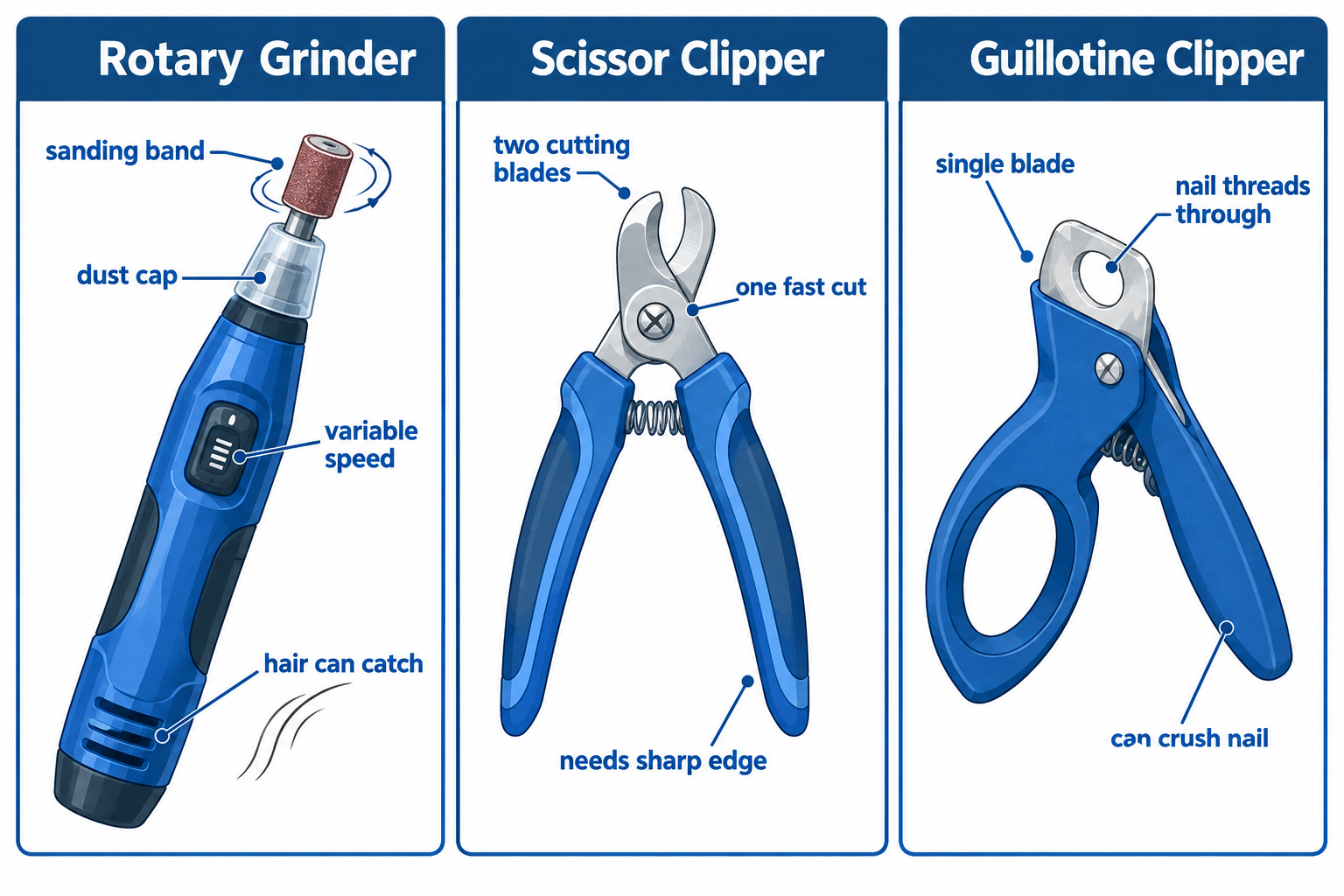
Clippers come in two common shapes. Scissor or plier style clippers use two curved blades that close around the nail. Guillotine clippers thread the nail through a hole, and a single blade pushes up through it. VCA’s handling guidance warns that some guillotine clippers may crush the nail rather than cut it, which is uncomfortable even when you never touch the quick.
Grinders are rotary tools with a sanding drum. Pet versions usually add a plastic guard with a slot that limits how much nail reaches the band, plus a dust cap on newer models.
)
| Tool | Speed | Risk to the quick | Noise and feel | Best for | Price range checked Oct 2026 |
|---|---|---|---|---|---|
| Rotary grinder | Slow, several passes per nail | Lower per pass, but heat builds if you linger | Motor buzz plus vibration through the toe | Dark nails, thick nails, nervous beginners | About $18 to $42 basic; around $59 to $66 for the Dremel PawControl 7760-PGK |
| Scissor or plier clipper | Fast, one cut per nail | Higher per cut, no heat | Quiet, brief pressure, one click | Light nails, squirmy dogs, long overgrown nails | About $9 to $24 |
| Guillotine clipper | Fast once the nail is threaded | Higher, plus a crushing risk if the blade is dull | Quiet, more squeeze on the nail | Small to medium nails, experienced handlers | Usually the cheap end of the clipper range |
Prices come from a September 2026 clipper and grinder price comparison and Wirecutter’s grinder reviews, checked October 3, 2026. Regional pricing and promotions move these numbers.
Can you use a regular nail grinder on dogs?
A general purpose rotary tool can grind a dog’s nail, and pet versions of these tools are often the same motor in a different housing with a guard added. The problem is speed and shielding. High RPM settings generate heat faster, and a bare sanding drum with no guard will catch coat hair. The AKC specifically warns that grinders can become hot and snag hair.
Choose X if logic: use a pet model with a guard and a low speed setting if you are new to grinding. If you already own a variable speed rotary tool, run it at its lowest speed, fit a fine sanding band, and tape back the coat hair with a toe hold. Never use a wood drill, a flap wheel, or a tool with no speed control.
Is a nail grinder better than clippers for dogs?
A grinder is better for control. A clipper is better for speed. Neither is better in general, and the honest answer for most households is that the two tools solve different parts of the same job.
Grinding gives you a fresh look at the nail’s cut face after every pass, which is the whole argument when you cannot see the quick. Clipping gets a dog with overgrown nails back to a reasonable length in two minutes, which matters for a dog who tolerates about ninety seconds of paw handling before he decides he has somewhere else to be.
Dog nail grinder pros and cons
Grinder strengths
- Removes material in slivers, so you can stop early and check often.
- Leaves a smooth, rounded edge, which is kinder to furniture and shins.
- Easier on thick, hard nails that resist a clipper blade.
- Helpful on dark nails where the quick is guesswork.
Grinder drawbacks
- Heat. This is the main one, and it is the reason for short bursts.
- Noise and vibration, which some dogs genuinely hate.
- Coat hair can wrap around the rotating band.
- Nail dust everywhere, and the smell is distinctive.
- Slower, so a restless dog may run out of patience.
- Costs more, and the battery eventually stops holding charge.
Dog nail clipper mistakes to avoid
Most clipper pain comes from four habits:
- Cutting straight across a long nail. The quick grows out with the nail. One deep cut on a long nail is the classic injury. Shorten in small bites instead.
- Using dull blades. Petful’s clipper guidance and tool reviews both point at sharpness; a blunt blade crushes and tears.
- Wrong size tool. Small clippers on a mastiff nail will twist the nail instead of cutting it.
- Chasing a perfect length in one session. The ASPCA recommends cutting a very small amount at a time and watching for the start of a circular area on the cut surface, then stopping as you approach the quick.
And the one nobody admits to: trimming during a wrestling match. If the paw is moving, put the tool down.
Which is safer for the quick? The painful mistake to avoid
Neither tool is safe for the quick. The quick is living tissue with nerves and blood supply, and both a blade and a sanding band will reach it if you go far enough. The difference is how quickly you get there, and how much warning you get on the way.
With clippers, there is no warning. One cut, and either you were short of the quick or you were not. With a grinder, you can stop just before the colour changes. That is a real advantage, not proof that grinders cannot cause pain.
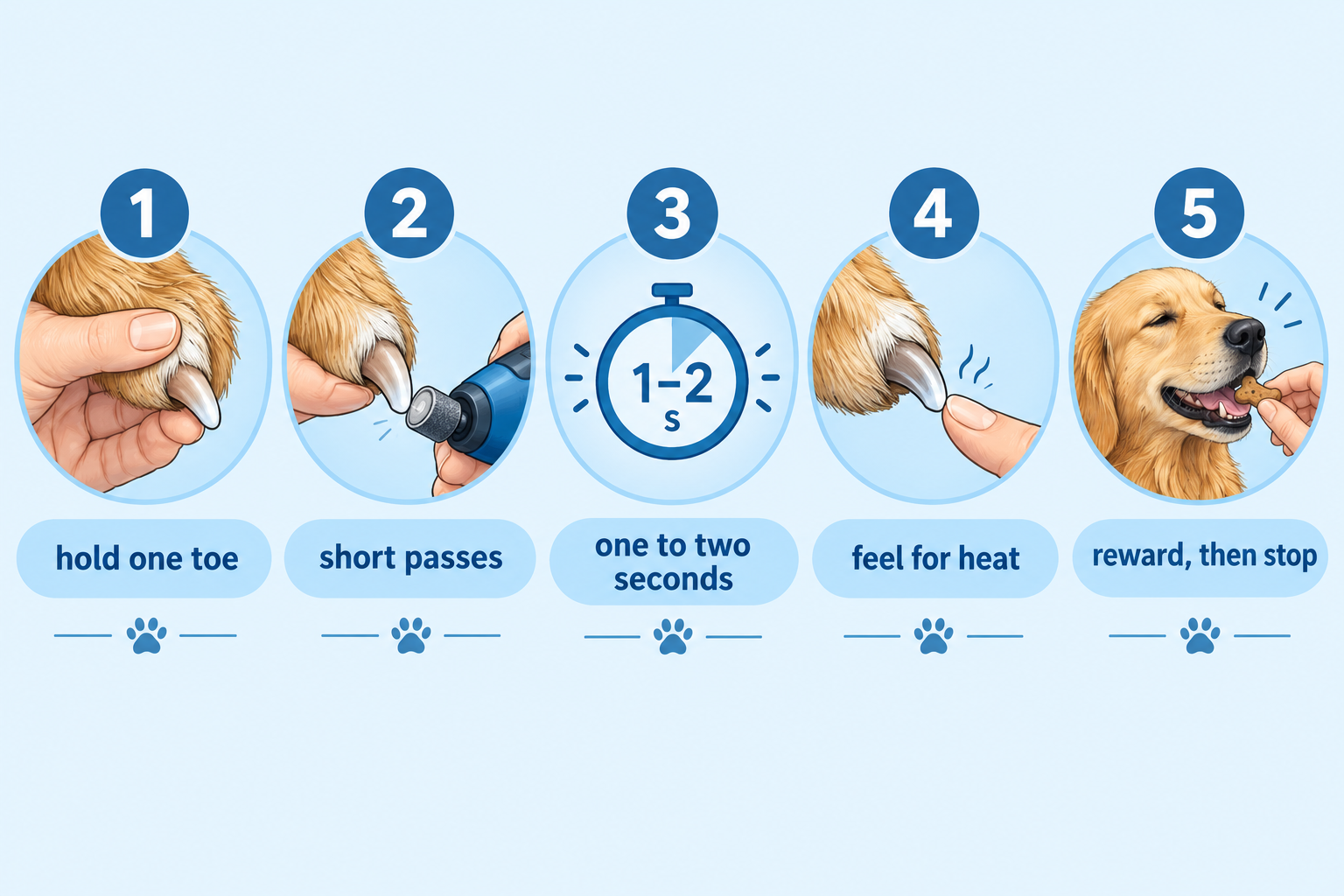
The mistake that hurts dogs is not the tool. It is time on the nail. Two seconds of grinding is technique. Six seconds is a burn risk.
Can a dog nail grinder cause burns?
Yes, friction from the rotating band heats the nail, and the nail is attached to living tissue. VCA recommends grinding for only one to two seconds at a time for exactly this reason, and the AKC also warns that grinders get hot.
Owner content lines up with that. One comment under a TikTok nail grinding video from the account @leo_lionz_, with 6,833 likes, warns other owners not to grind too long in one spot. That is an owner observation rather than veterinary guidance, and it happens to match what the clinical sources already say.
Three practical heat rules:
- Count the pass out loud. One, two, off.
- Touch the nail with your fingertip between passes. If it feels warm to you, it is warm to him.
- Move around the paw in rotation instead of finishing one nail at a time. Each nail gets cooling time.
How do you use a dog nail grinder safely, step by step?
Short passes, one toe at a time, and a hand that stops before the dog does. The sequence below follows AKC and VCA handling guidance rather than any single manufacturer’s manual.
- Introduce the noise first. Switch the grinder on across the room, feed a treat, switch it off. Repeat over several short sessions until the sound is boring. VCA says desensitization should be gradual and never forced. Our beginner’s guide to dog grooming covers the same slow build for brushes and bath time.
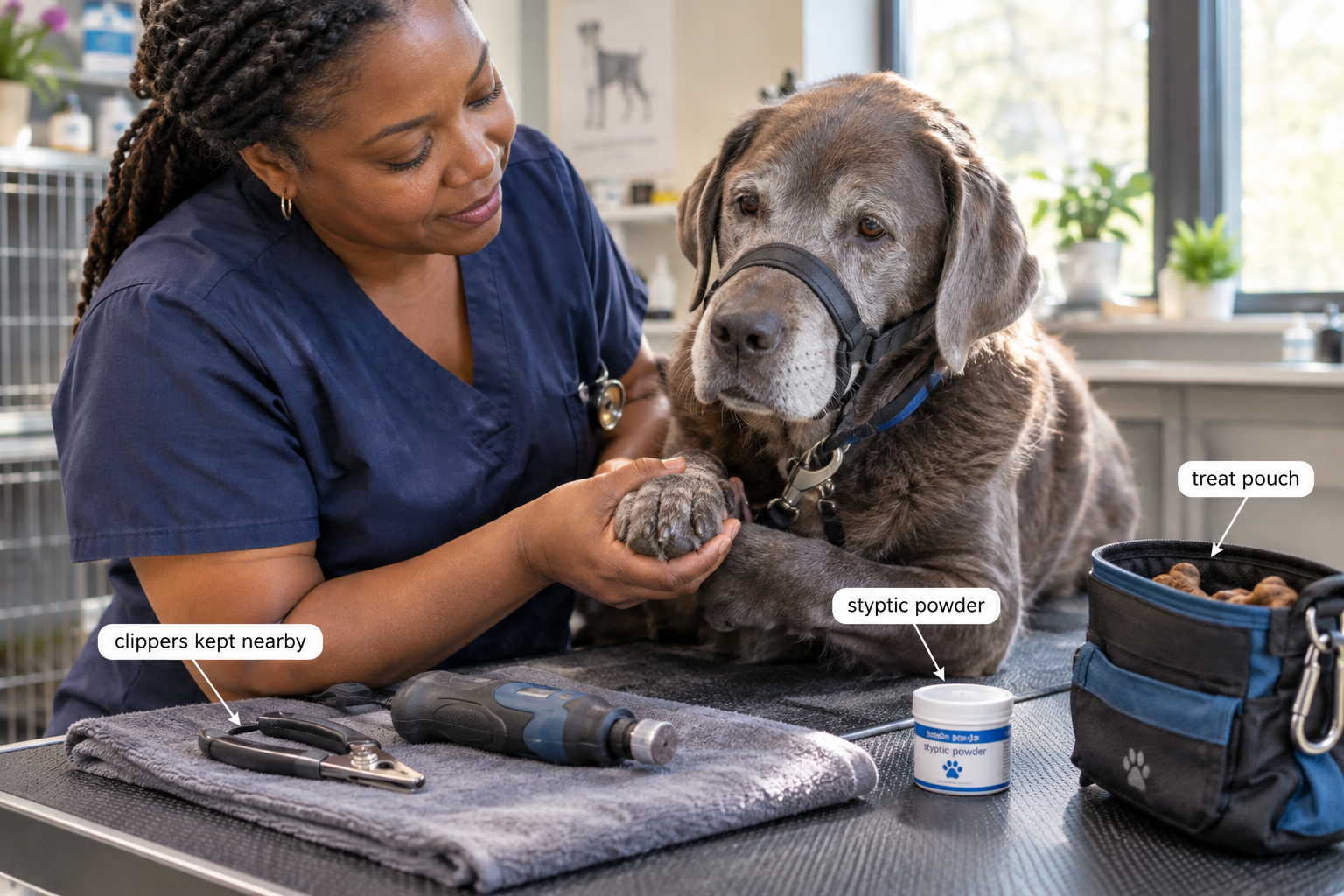
- Set up before you fetch the dog. Grinder charged, fine sanding band fitted, towel down, treats out, styptic powder open. Clippers nearby as backup.
- Hold one toe gently. Isolate a single toe and push the coat hair back with your fingers. Long hair plus a spinning band is the tangle you only make once.
- Use the lowest speed that cuts. More speed means more heat, not better results.
- Touch the tip at a slight angle, one to two seconds, then lift. Look at the cut face. Repeat.
- Rotate through the nails. Pass one on every nail, then pass two. Nails cool while you work elsewhere.
- Stop early and smooth the edges. Shorter than you wanted is fine. You can trim again next week.
- Finish with something good. Food, a game, a walk. Whatever your dog actually rates.
If the dog is trembling, drooling heavily, panting, growling or snapping, stop the session and talk to a vet or a qualified behaviour professional. Those are not signs to work through. Dogs who struggle with handling often do better with the kind of short, reward based practice described in our guide to the best ways to train your puppy.
)
Are nail grinders loud, and will my dog be scared?
Most pet grinders sit in the range of a quiet conversation, but advertised decibel numbers are close to useless for comparing products. A September 2026 veterinary oriented review reported manufacturer figures of 46.25 dB for the Dremel 7760-PGK and 50.93 dB for the 7350 family, and an Amazon new release listing dated October 3, 2026 advertises a grinder at 40 dB with a maximum of 11,000 RPM. Those are manufacturer or retailer claims, measured under conditions nobody published. Noise also changes with distance, speed setting, and whether the band is touching a nail.
What usually bothers dogs more is the vibration travelling up the toe, plus being held still. A dog who is fine with a hair dryer may still object to the buzz against his nail. Test the sound and the feel separately.
Choose X if: if your dog leaves the room when you plug anything in, start with clippers and build grinder tolerance on the side.
How do you clip dark dog nails without hitting the quick?
Take 1 to 2 mm at a time and read the cut face after every pass. On black nails you are not looking for pink, you are looking for a change in texture at the centre.
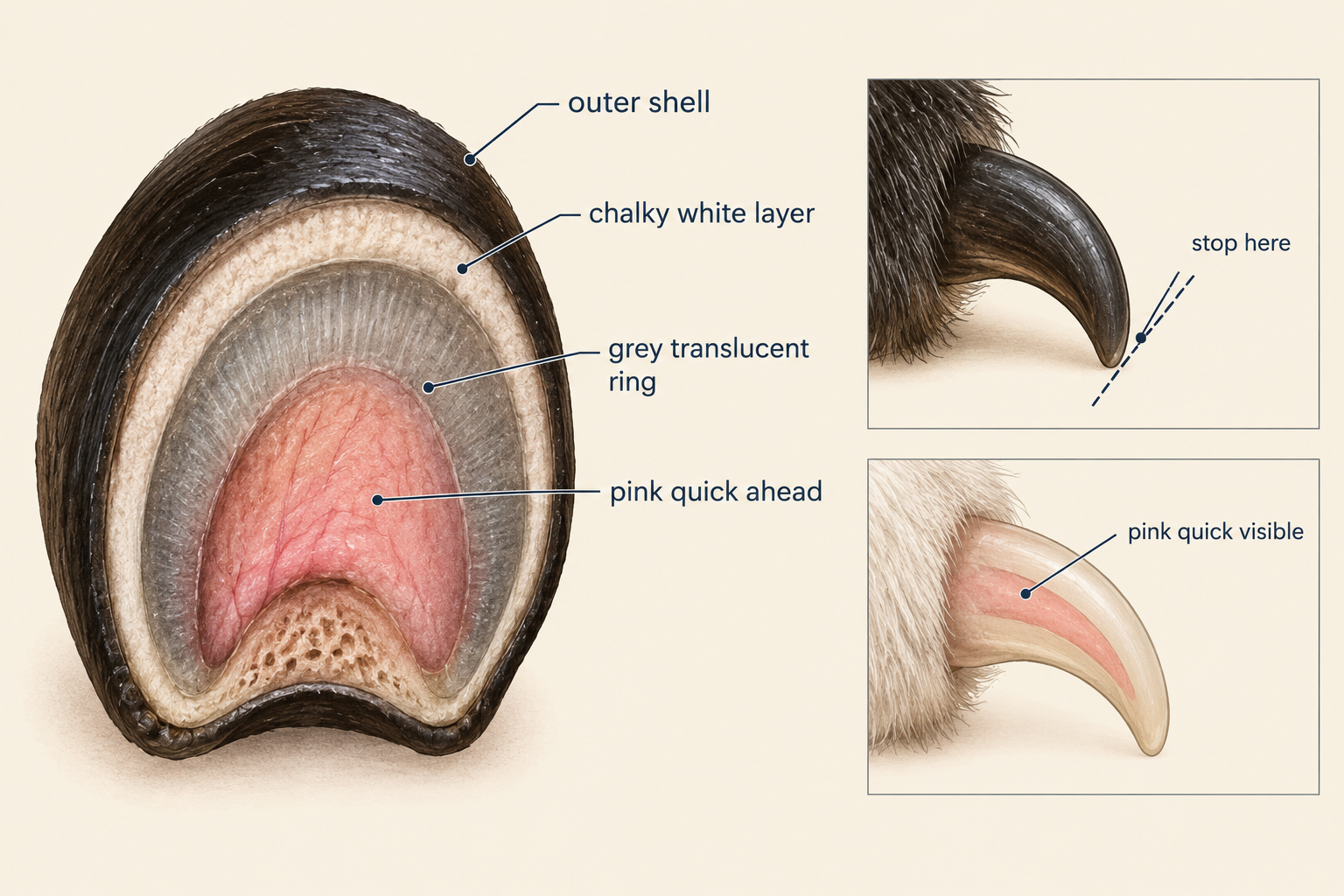
As you shorten a dark nail, the cross section usually goes through three stages. A chalky white or grey outer layer. Then a small grey or translucent circle appearing in the middle. That circle is your stop sign, because the quick is directly behind it. VCA recommends removing only 1 to 2 mm at a time on dark nails, and the ASPCA describes watching for the beginning of a circular area on the cut surface.
Two extra tricks that cost nothing: trim in bright light, and look at the nail from underneath. The underside often shows where the solid nail ends before the top does.
)
Thick or black nails: which tool wins?
Grinder, in most cases. Thick nails resist a clipper blade and can split or crush under pressure, and black nails hide the one landmark you most want to see. Grinding solves both problems at once by going slowly and showing you the cross section each time.
The exception is a very overgrown nail. Sanding 8 mm off a Rottweiler’s nail with a grinder takes a long time, and your dog is unlikely to volunteer. Clip the bulk in small bites first, then grind the last millimetre and smooth the edge.
Do vets recommend grinders or clippers for dog nails?
Veterinary guidance checked in October 2026 does not pick a winner. It picks a technique. The AKC’s updated trimming page says dog specific clippers and grinders can both be used safely, and VCA’s handling material suggests keeping clippers available even if you prefer a grinder, while cautioning against guillotine clippers that crush rather than cut.
What the sources agree on is the method: small increments, calm handling, stop before the quick. That consensus is much better supported than any recommendation to buy a particular device.
No regulatory action or safety recall specific to dog nail grinders or clippers appeared in the October 2026 searches used for this article. That is a limit of what was found, not proof that none exists in every market.
)
Best dog nail grinder brands: what the published reviews name
Review method for this section: published editorial reviews, retailer listings, and manufacturer specifications compared on October 3, 2026. No hands-on testing was performed for this article.
- Dremel PawControl 7760-PGK. The model Wirecutter lists in its dog nail grinder reviews, cordless, with a guard. Price checked October 3, 2026: roughly $59 to $66 depending on retailer.
- Dremel 7350 family. Cheaper and simpler. Manufacturer noise figures reported higher than the 7760 in the Webvet grinder review.
- Unbranded cordless grinders. Plenty of them, often with impressive spec sheets. The Amazon pet supplies new release listings show the current pattern: variable speed, dust caps, LED lights, long battery claims. Treat the decibel and RPM figures as marketing until someone independent measures them.
For clippers, buy for size and sharpness rather than brand. Petful’s clipper comparisons and Webvet’s clipper roundup both sort options by dog size, which is the thing that actually changes the cut. Looking for somewhere to buy locally? Our guide to the best pet shops is a starting point.
Affiliate disclosure: some links on Doggy Rank IQ earn a commission. Products named here come from published reviews and retailer listings, and commission does not decide the verdict. See our disclosure page.
Dog nail grinder vs clipper: how much does each cost?
Clippers are cheaper up front and have no battery to die. A September 2026 price comparison put ordinary scissor clippers around $9 to $24 and rotary grinders around $18 to $42, while the well reviewed Dremel PawControl sat near $59 to $66 at retail on October 3, 2026. Regional pricing varies.
Running costs matter too. Grinders need replacement sanding bands, and the battery degrades over years of use. Clippers need either sharpening or replacing once the blades dull, which happens faster on a large dog.
Either way, buy styptic powder or a clotting pencil at the same time. It costs a few dollars and it is the only item on the list you will be glad to own at the worst possible moment.
Can you use a nail grinder on senior dogs or puppies?
Yes for both, with adjustments. Puppies have thin, soft nails that need almost nothing removed, so short grinder passes work well and the sessions double as handling practice. VCA’s puppy nail trim guidance treats early, gentle, frequent sessions as the goal rather than a tidy result.
Senior dogs are a different problem. Older nails are often thicker and more brittle, which favours a grinder, but arthritic joints mean the paw cannot be stretched or held in odd positions. Work with the leg where it naturally rests, keep sessions under a couple of minutes, and split the paws across different days. A dog with hip pain will tolerate two nails at a time far better than sixteen.
Edge case worth knowing: dogs with diagnosed pain, clotting disorders, or diabetes should have nail care discussed with their vet first. Our health and care section has more on everyday care decisions that deserve a professional opinion.
How often should you trim your dog’s nails?
Most dogs need a trim every two to four weeks, and the real test is whether the nails touch the floor when the dog stands square. If you hear clicking on hard floors, you are already late.
A few things change the interval:
- Surface. Dogs walking daily on pavement wear their own nails down. Grass and carpet dogs do not.
- Nail growth rate. Individual variation here is large, even within a breed.
- The dewclaw. It touches nothing, so it grows unchecked and curls. Check it every time.
- Breed and build. Heavier dogs load their toes differently. Coat type also affects how easily hair tangles in a grinder, which is one reason low maintenance breeds are not always low maintenance at the paws.
Frequent, tiny trims shrink the quick back over time, which makes every future session safer. That is the slow win nobody advertises.
FAQ
Is a nail grinder better than a nail clipper?
For control, yes. For speed, no. Grinders remove less per pass so you can stop sooner, while clippers finish faster, which suits dogs with short patience. AKC guidance treats both as usable when the technique is right.
Do dog nail grinders really work on thick nails?
Yes, and thick nails are where grinders perform best, because a blade can crush or split a hard nail. Expect multiple passes and plan cooling breaks of a few seconds between them.
Do dog nail clippers with a sensor actually detect the quick?
Some clippers are marketed with sensors or lights that claim to show the quick. Those are manufacturer claims, and no independent veterinary evidence confirming their accuracy appeared in the sources checked for this article in October 2026. Use the 1 to 2 mm rule regardless of what the tool says.
What should I do if I hit the quick and it bleeds?
Apply styptic powder or a clotting pencil with firm, steady pressure for a few minutes and keep the dog calm and still. The AKC describes a nick to the quick as painful and capable of bleeding. Call your vet if bleeding continues, the nail is split, or the dog is limping later.
What is the quietest option for a noise sensitive dog?
Clippers are near silent, so they are the safer starting point. If you want a grinder, look for a low speed setting and introduce the sound separately from the nail work. Advertised decibel numbers are not comparable between brands.
Which dog nail grinder vs clipper setup suits a first time owner?
Both. A basic scissor clipper for length plus a guarded grinder for the last millimetre gives you a backup when one tool stalls. VCA’s handling guidance suggests keeping clippers on hand even for grinder users.
How long should one grinding session take?
Usually two to five minutes for a cooperative dog, and less for a nervous one. Stop when the dog’s body language changes rather than when the paw looks finished.
Can I grind nails if my dog has already had a bad experience?
Start over at the noise stage with food and no contact, and work in very short sessions. If the dog trembles, drools, growls or snaps, VCA advises stopping and consulting a professional rather than pushing through.
Conclusion
The dog nail grinder vs clipper argument is less about hardware than it sounds. Clippers fail fast with one deep cut. Grinders fail slowly with heat and lingering. Both failures are preventable with the same two habits: remove very little at a time, and stop before you want to.
Practical next steps:
- Look at your dog’s nails in good light. Are they light, dark, thin, or thick? That decides the tool.
- Buy for the dog’s nails, not the review score. Clippers sized correctly, or a guarded grinder with a low speed setting.
- Put styptic powder in the same drawer as the tool, today.
- Spend one week on the sound and the paw handling before you shorten anything.
- Set a recurring reminder for every two to three weeks, and trim a tiny amount each time.
Then go check the dewclaw. It has been growing while you read this.