
Quick Answer: Is a Yorkshire Terrier Right for You?
A yorkshire terrier suits you if you want a bold, affectionate, seven-pound companion and you can commit to daily coat care, patient potty training and routine dental work. This is a working ratter in a silk coat, not a decorative lap ornament. Yorkies do well in apartments, travel easily and live a long time: the Royal Veterinary College’s VetCompass study of 28,032 Yorkshire Terriers found a median age at death of 13.56 years. Skip the breed if barking would ruin your lease, or if nobody is home to take a puppy out every couple of hours.
Key Takeaways: Yorkshire Terrier
- Lifespan: 13.56 years median in the RVC VetCompass data, against 12.00 years for UK dogs overall, roughly 1.5 extra years.
- Size: 7 pounds or under per the AKC breed standard, with males and females close in size (females often slightly lighter).
- Dental disease is the number one issue. The RVC study flagged periodontal disease, retained baby teeth and patellar luxation as the leading breed concerns.
- Airway risk is real but not universal. A May 2026 single-hospital review of 11,061 Yorkies in the Journal of Veterinary Internal Medicine found severe tracheal collapse in 6.7% and congenital liver shunts in 0.8%.
- Use a step-in harness, not a neck collar. Pressure on a small trachea is a preventable risk you control for free.
- Potty breaks every two hours for a new puppy, plus after sleeping, eating and playing. Tiny bladder, slow progress, normal.
- Grooming is near-daily for a long coat. A short puppy cut every 6 to 8 weeks drops that to a quick brush a few times a week.
- Expect roughly $1,200 to $3,500 for a well-bred puppy from a health-tested litter in the US, with first-year costs often doubling that.
Where Does the Yorkshire Terrier Come From?
The yorkshire terrier came out of the mills and mines of northern England in the mid 1800s, bred by Scottish workers who moved south into Yorkshire and brought small terriers with them. The job was rats. Cotton mills, woolen mills and coal pits all had them, and a dog small enough to squeeze behind machinery and bold enough to go in after vermin earned its keep.
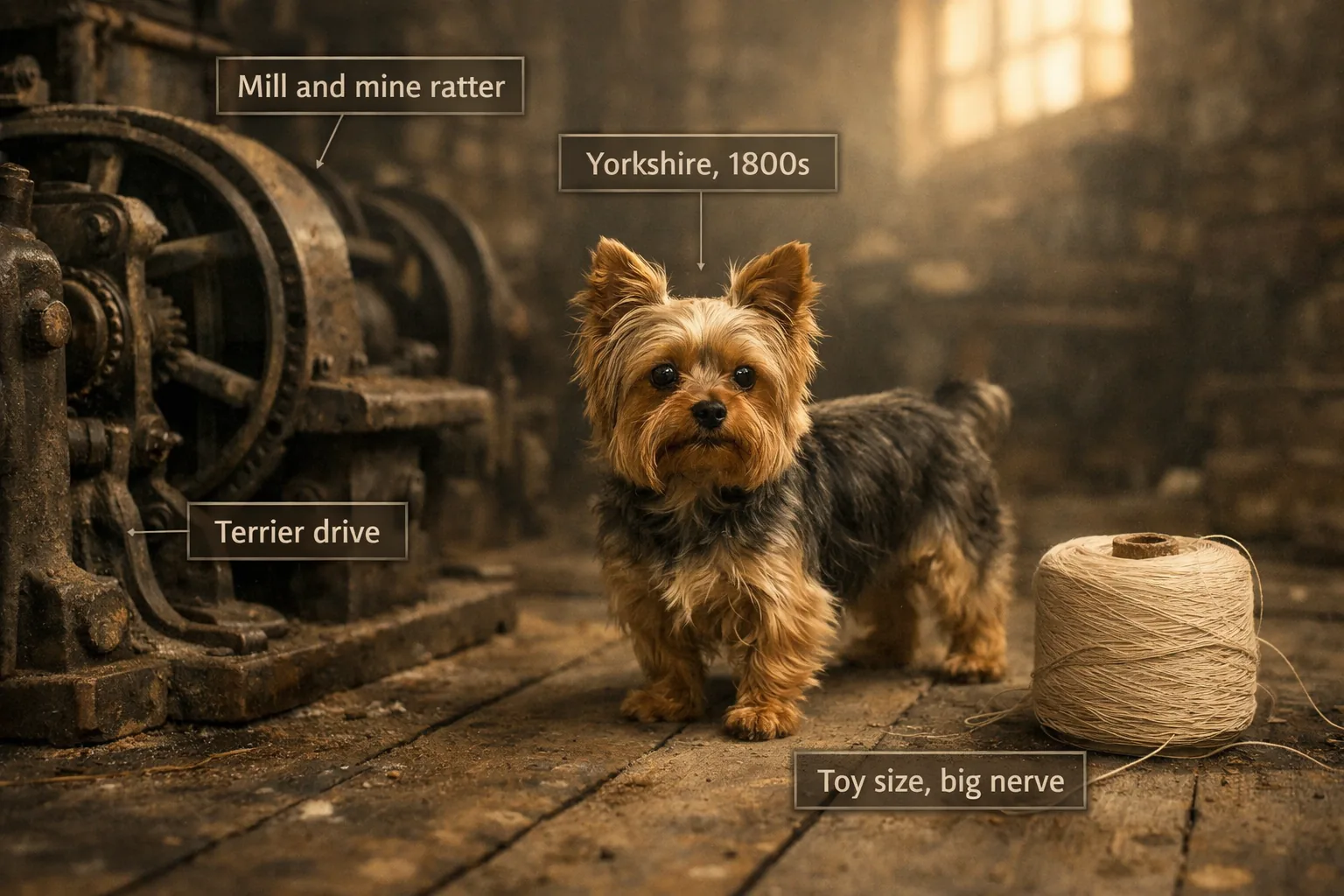
Those working ancestors were crossed into a type that stabilized fast. By the 1870s the breed had the Yorkshire name and had already made the jump from factory floor to Victorian parlor, where the silky blue-and-tan coat did most of the persuading. The American Kennel Club recognized the breed in 1885.
That history explains almost everything odd about the dog in your living room. The AKC describes the Yorkie as a feisty old-time terrier, and the traits that made a good ratter (alertness, persistence, a willingness to argue with something four times its size) did not get bred out when the breed moved indoors. They just got smaller.
So when your Yorkie loses its mind over a plastic bag moving on the balcony, that is not a flaw in the dog. That is the resume.
What Makes the Yorkshire Terrier So Special (and So Cute)?
Two things: the hair and the personality mismatch. A Yorkie grows hair rather than typical fur, which is why the coat hangs in a fine, straight, slightly glossy curtain instead of puffing out, and why it keeps growing instead of blowing out in seasonal clumps.
The cuteness is partly geometry. Big dark eyes set in a small head, a short muzzle relative to skull size, ears that stand up like antennae. Those proportions trip the same response in people that human infant faces do, which is why a Yorkie standing in a doorway looking personally betrayed is funnier than it has any right to be.
But owners rarely lead with looks. They lead with the drama. A Yorkie will carry a grudge about a closed bathroom door, escort you from room to room, announce the mail carrier like a security breach, then collapse into your lap mid-sentence and fall asleep. Fourteen different opinions in a seven-pound body.
The coat gets the attention. The personality is what keeps people on their second and third Yorkie.
Three things owners consistently love: the theatrical, quirky behavior, the velcro-level affection, and the fact that the whole dog fits in a carry-on sized bag. If you want a dog you can genuinely take places, this is one of the better apartment-friendly breeds on the list.
Yorkshire Terrier Size, Weight and Lifespan
A yorkshire terrier should weigh 7 pounds or less under the AKC standard, typically standing 7 to 8 inches at the shoulder. Sex differences are small compared with most breeds. Lifespan is a real strength: 13.56 years median in the RVC data, with an interquartile range of 11.30 to 15.15 years.
| Measure | Male Yorkie | Female Yorkie | Breed note |
|---|---|---|---|
| Height at shoulder | 7 to 8 in | 7 to 8 in | No standard height split by sex |
| Weight | 4 to 7 lb | 4 to 7 lb (often at the lower end) | AKC standard caps at 7 lb |
| Median lifespan | ~13.5 yrs | ~13.5 yrs | RVC: 13.56 yrs across 3,308 reviewed dogs |
| Adult size reached | ~10 to 12 months | ~10 to 12 months | Coat keeps changing until 2 to 3 years |
A note on “teacup” Yorkies. There is no teacup variety. The term describes dogs bred deliberately under about 4 pounds, usually by breeding the smallest available adults together. Those dogs carry higher rates of low blood sugar, fragile bones, dental crowding and anesthetic risk. If a breeder’s main selling point is how tiny the dog will stay, that is a reason to walk, not a reason to pay more.
Decision rule: choose a Yorkie at the 5 to 7 pound end if you have stairs, kids, or a household where a dog could get stepped on.
What Is the Yorkshire Terrier Temperament Like?
Terrier first, toy second. The AKC describes Yorkies as friendly, affectionate, energetic and adaptable, while also noting stubbornness and independence. That combination makes a dog who is cuddly at home and extremely opinionated everywhere else.
What that looks like day to day:
- Alert and vocal. Barking at doors, hallways, elevators and delivery sounds is the breed doing its old job.
- Confident past the point of sense. Many Yorkies will square up to a Labrador. You are the one who has to be realistic about that.
- Attached. Follows you around, prefers to be touching you, notices when you put on shoes.
- Smart and selectively obedient. Learns fast, complies when the deal is good.
Some Yorkies get labeled mean or aggressive. In most cases the behavior is fear, resource guarding, pain (sore knees, sore teeth) or a dog who was picked up every time it growled and learned that growling gets louder results. A genuinely under-socialized toy dog becomes defensive because the world is enormous and nobody asked permission before grabbing it. Fix it by letting the dog approach rather than be approached, rewarding calm choices, and getting a vet exam first if the snapping is new.
Separation distress is the other common issue. Yorkies bond hard, and separation-related barking, pacing and destruction are frequent complaints. Build alone time deliberately: short absences, a stuffed food toy on exit, no emotional goodbyes, gradually longer gaps.
Are Yorkshire Terriers Good With Kids and Other Pets?
Yorkshire terriers can be good with children aged roughly 8 and up, and are a risky match for toddlers. The danger runs mostly in one direction: a 6-pound dog can be badly injured by a falling child, a closing door, or a well-meaning hug. Dogs who have been hurt by rough handling learn to defend themselves early.
What makes it work:
- Kids sit on the floor; the dog comes to them.
- No picking the dog up unless an adult is supervising.
- The dog gets a child-free space (crate, covered bed, raised spot) that nobody raids.
- Hands off while eating or chewing.
With other dogs, Yorkies often do fine with calm housemates and poorly with boisterous large dogs who play by body-slamming. Size mismatch injuries are the issue, not personality. With cats, it varies. Many Yorkies live happily with cats raised alongside them; some keep a lifelong interest in chasing. Prey drive toward hamsters, birds and rabbits is usually high enough that separate housing is the safe default.
If you are shopping breeds around young children, compare against the options in our guide to family-friendly dog breeds for kids.
Who Is the Yorkshire Terrier Made For, and Who Should Skip It?
The Yorkshire terrier fits people who want a small, portable, deeply attached companion and who are home enough to manage frequent potty breaks and daily grooming.
Good fit if you:
- Live in an apartment or small home and want a dog you can carry.
- Travel and want a dog who fits airline cabin rules (always check the carrier dimensions first).
- Are retired or work from home, or can split the day with someone.
- Enjoy grooming, or are happy to pay a groomer every 6 to 8 weeks.
- Want a long-lived dog and accept dental and knee costs as part of the deal.
Skip it if you:
- Are out of the house 9 or 10 hours straight with no midday break. A Yorkie left alone all day will bark, soil indoors, or both. Most adults can manage 4 to 6 hours; longer needs a walker or daycare.
- Have a strict noise-sensitive building and no appetite for barking training.
- Have toddlers, or a home where a small dog will get underfoot constantly.
- Want a low-maintenance coat. This is not that dog.
- Are hoping for a dog who happily self-entertains for hours.
Breeds worth comparing: Maltese (softer, less terrier edge, similar coat workload), Miniature Schnauzer (terrier attitude, sturdier, more dog to handle), Shih Tzu (lower prey drive, flatter face, easier temperament for families), Toy Poodle (sharper trainability, similar clipping schedule). If you want help narrowing it down, the Doggy Rank IQ breed matchmaker walks through household fit.
How Much Exercise Does a Yorkshire Terrier Need?
Plan on 30 to 45 minutes of daily activity for an adult yorkshire terrier, split into two or three short outings, plus deliberate mental work. The body is small; the brain is not.
A workable day:
- Morning walk, 15 to 20 minutes. Let the dog sniff. Scent work tires a terrier faster than pace does.
- Midday potty break and a 5 minute game. Flirt pole, hallway fetch, find-the-treat.
- Evening walk, 15 minutes, ideally a different route for new smells.
- One enrichment item daily. Snuffle mat, frozen stuffed toy, a cardboard box with kibble scattered in it.
Two cautions. Heat is dangerous for a small dog close to hot pavement; in summer, walk early or late and watch for frantic panting, bright red gums or stumbling. Those are heatstroke signs and a reason to call a vet immediately. And avoid repeated jumping off sofas and beds, which stresses already-vulnerable knees. Pet steps are cheap insurance.
Under-exercised Yorkies do not nap politely. They bark, dig at furniture and invent projects.
Yorkshire Terrier Grooming and Shedding
Yorkshire terriers shed very little, because the coat is hair-type and grows continuously rather than cycling out in bulk. Low shedding does not mean low maintenance. A full-length coat needs brushing most days or it mats at the armpits, behind the ears and under the collar line.
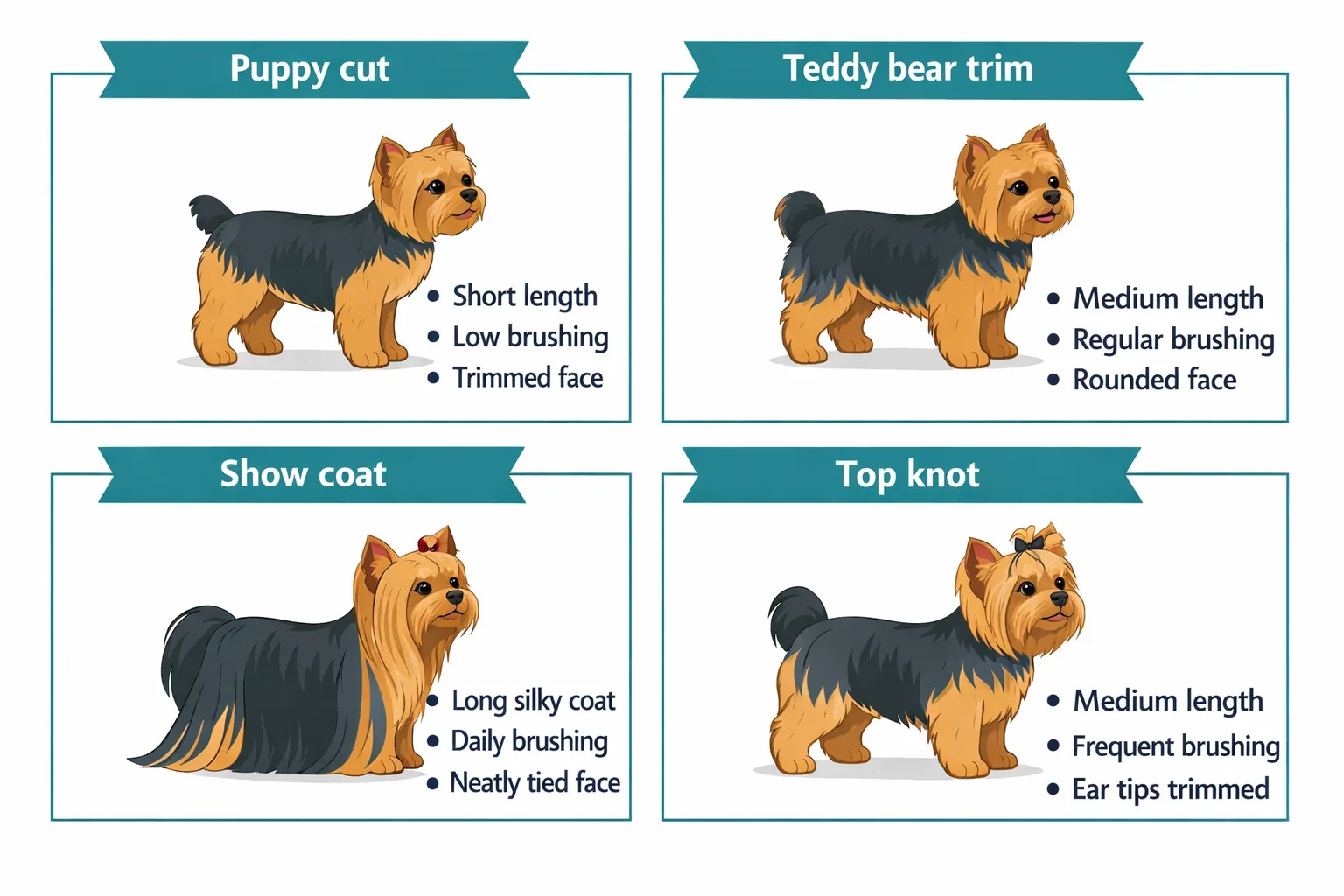
Realistic options:
| Style | Brushing | Groomer visit | Who it suits |
|---|---|---|---|
| Show / floor-length coat | Daily, plus wrapping | Every 4 weeks | Owners who enjoy coat work |
| Puppy cut (1 to 2 in) | 2 to 3 times a week | Every 6 to 8 weeks | Most apartment and travel owners |
| Teddy bear trim | 2 to 3 times a week | Every 6 to 8 weeks | Owners who want a rounder face |
| Short summer clip | Weekly | Every 8 weeks | Hot climates, active dogs |
The rest of the routine: bathe every 3 to 4 weeks with a gentle shampoo, dry thoroughly, trim the hair around the eyes so it does not scratch the cornea, keep the sanitary area short, clip nails every 2 to 3 weeks, and check ears weekly. New to any of this? Start with our beginner’s guide to dog grooming.
No dog is truly hypoallergenic, but the low shedding means less dander spread around the room. Some allergy sufferers do better with a Yorkie. Some do not. Spend time with one before committing.
Common Yorkshire Terrier Health Problems
Yorkshire terriers are generally long-lived with a few concentrated weak points: teeth, knees, windpipe, and in a small minority, liver shunts and low blood sugar as puppies.
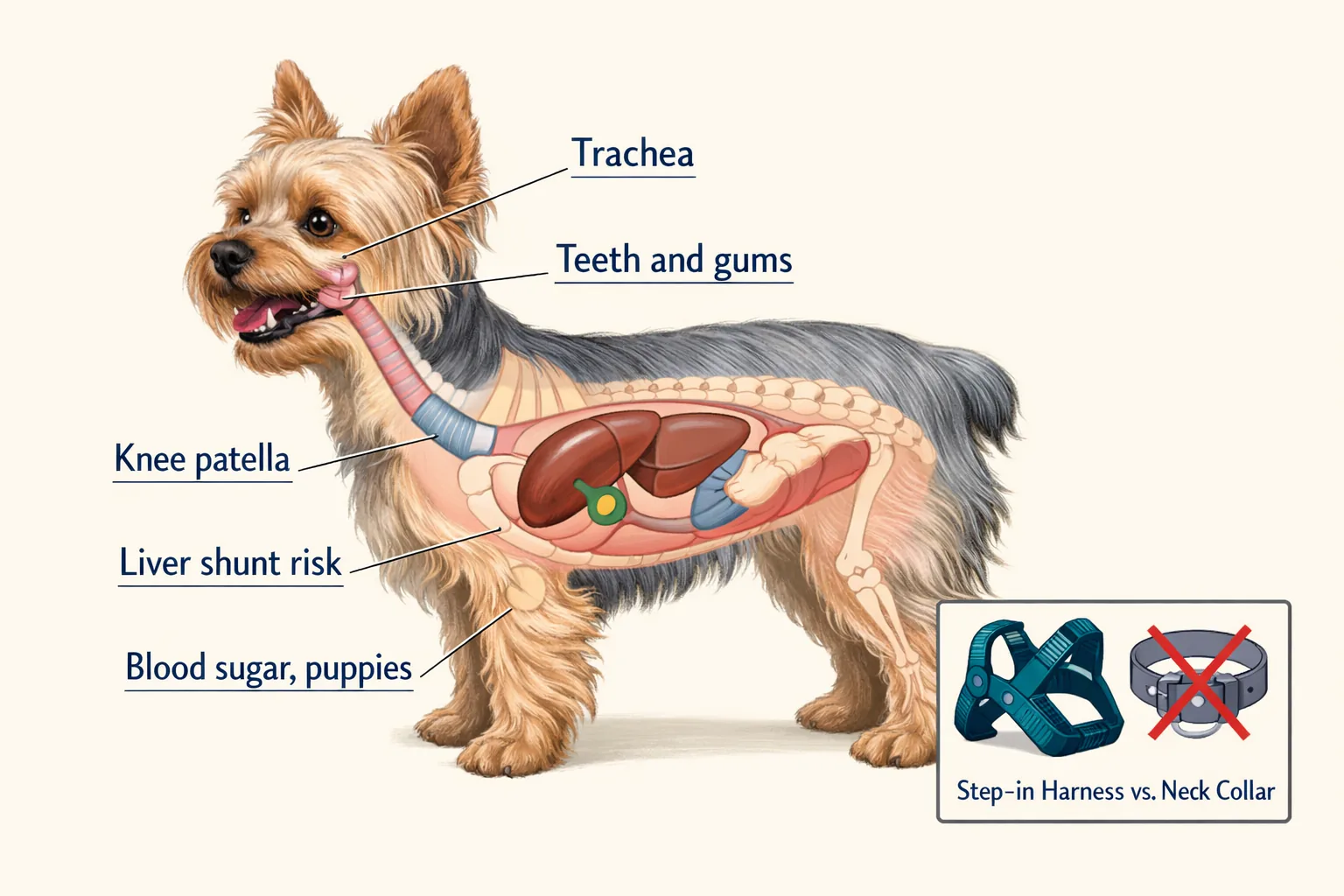
Dental disease. The biggest one by frequency. The RVC VetCompass work singled out periodontal disease and retained baby teeth as leading breed concerns. Small jaws crowd teeth, plaque builds fast, and by middle age many Yorkies need extractions. Brush daily if you can, and read our take on whether you really need to brush your dog’s teeth and how to clean dog teeth without brushing if your dog fights the toothbrush.
Collapsing trachea. The May 2026 JVIM single-hospital review of 11,061 Yorkshire Terriers found severe tracheal collapse syndrome in 6.7% of dogs. That is one hospital’s caseload, not a universal rate, but it is the most specific recent figure available. The classic sign is a dry, honking cough, worse with excitement or collar pressure. Use a step-in harness. Keep weight down. Breathing distress, blue-tinged gums or collapse means emergency vet, now.
Luxating patella. Kneecaps that slip out of the groove. You see a skip-step, a brief three-legged hop, then normal walking. Mild cases are managed with weight control and muscle conditioning; severe cases need surgery.
Portosystemic shunt. Congenital liver shunts appeared in 0.8% of the same 11,061-dog review. Signs in puppies include poor growth, vomiting, disorientation after meals. Treatable, often surgically, and worth asking a breeder about.
Hypoglycemia in tiny puppies. Low blood sugar in dogs under about 4 months is a genuine emergency: wobbliness, glassy eyes, collapse. Feed small meals every 3 to 4 hours, keep a glucose gel on hand, and call a vet if your puppy becomes limp or unresponsive.
Eye and neurological conditions. The AKC’s breed-specific DNA testing recommendations list Yorkshire Terrier-type L-2-hydroxyglutaric aciduria, progressive retinal atrophy variants, primary lens luxation and intervertebral disc disease risk factors, among others. A DNA panel is useful but does not replace a physical exam or eye and knee screening.
Ask any breeder for: patella evaluation, an ophthalmologist eye exam, and relevant DNA results on both parents.
What Do Yorkshire Terriers Love to Eat? Favorite Foods and Feeding
A healthy adult yorkshire terrier eats roughly 150 to 250 calories a day, usually split into two or three meals of a small-breed complete food. Small kibble size matters because crowded little jaws struggle with large pieces.
Practical feeding guidance:
- Pick a food with an AAFCO statement for the right life stage. Our guide to reading a dog food label and what AAFCO means covers how to check.
- Measure with a scale, not a scoop. At this size, an extra tablespoon a day shows up on the scale within weeks.
- Puppies under 4 months eat every 3 to 4 hours to keep blood sugar steady.
- Dry kibble has a slight mechanical cleaning benefit, but it does not replace brushing.
- Treats stay under 10% of daily calories. At 200 calories a day, that is about 20 calories of treats. Half a dental chew can blow the budget.
Treats Yorkies tend to go for: tiny freeze-dried chicken or liver pieces, a few blueberries, green beans, plain cooked pumpkin, small training pellets broken into crumbs. Soft treats are kinder on worn teeth.
Foods to avoid entirely: grapes and raisins, xylitol (in peanut butter and sugar-free products), chocolate, onions and garlic, macadamia nuts, cooked bones, alcohol, and heavily salted human snacks. For small dogs, toxic doses are reached fast.
If you are switching brands, do it over 7 to 10 days. See how to switch dog food without upsetting their stomach.
How to Train a Yorkshire Terrier
Train a yorkshire terrier with short, high-value, positive reinforcement sessions. The AKC specifically notes Yorkies respond well to patience and positive methods, and their independence makes repetitive drilling or harsh correction counterproductive.
What works:
- Sessions of 3 to 5 minutes, two or three times a day. Stop while the dog still wants more.
- Payment that matters. A crumb of chicken beats a biscuit.
- Train at the dog’s level. Sit on the floor. Looming over a toy dog suppresses behavior instead of teaching it.
- Socialize early and gently. New surfaces, sounds, people and calm dogs between 8 and 16 weeks, without forcing contact.
Barking. Treat it as information, not misbehavior. Note the trigger (hallway footsteps, doorbell, the window), then change the picture: block the sightline, add white noise, and teach a competing behavior. “Go to mat, get paid” works better than yelling, which the dog hears as backup singing.
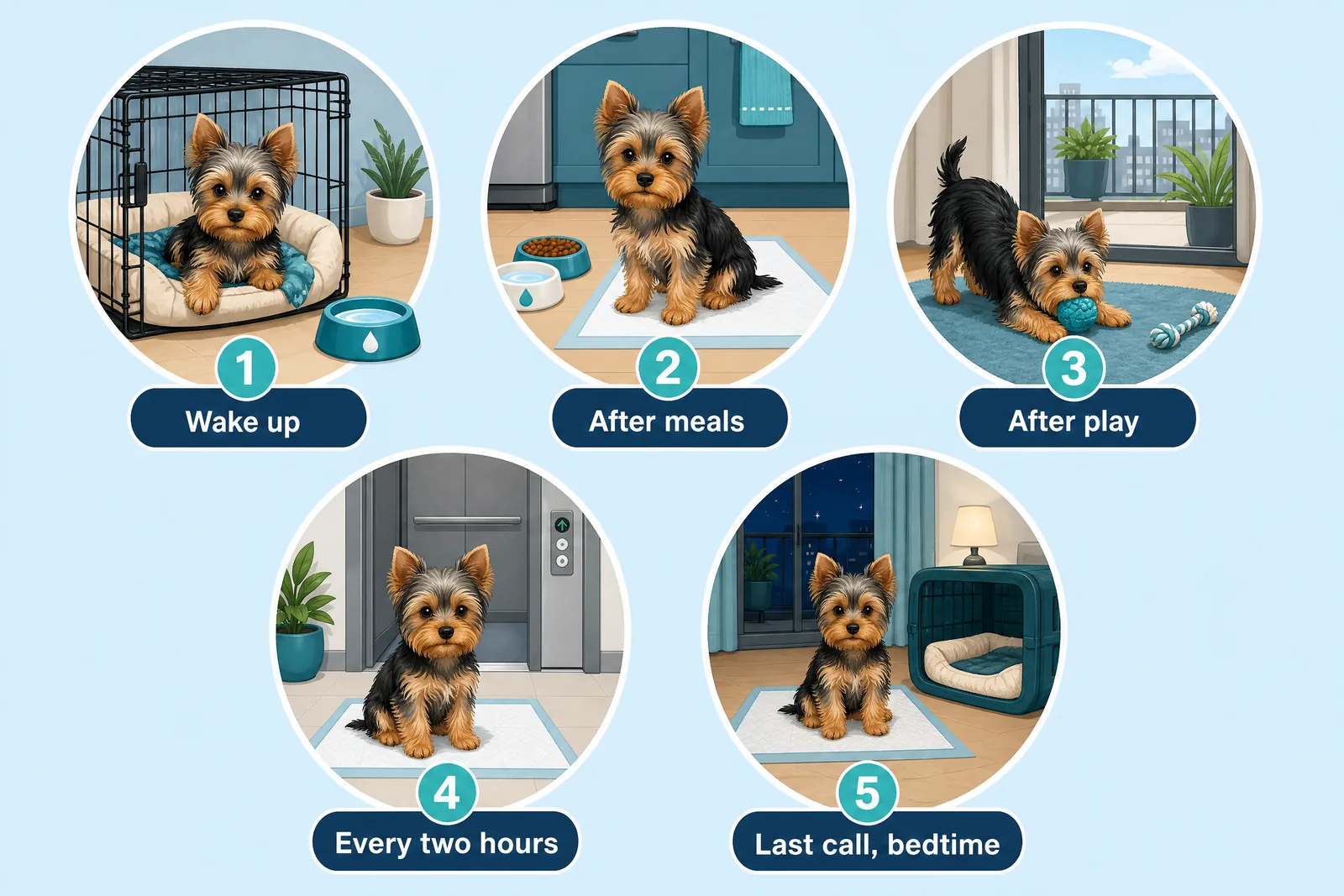
Potty training. This is where owners struggle most, and the bladder is genuinely tiny. A new puppy goes out after waking, after meals, after play, and roughly every two hours. Reward outdoors within three seconds of finishing. Clean accidents with an enzymatic cleaner, never ammonia. Expect reliability somewhere between 4 and 8 months, later than a larger breed.
Indoor pads are a legitimate choice for high-rise and winter-climate owners, but pick one system and stay with it. Switching halfway is what creates a dog who goes anywhere.
If an adult Yorkie who was reliable starts having accidents, stop training and book a vet visit. Urinary infections, stones, diabetes, kidney disease and cognitive decline all present this way.
Try It: Yorkie Potty Schedule Builder
Enter your puppy’s age and wake-up time, and this tool lays out the day’s potty breaks, including the extra ones after meals, naps and play. Tiny bladders make Yorkie house training slow, so the schedule is the single thing that changes your accident count.
Doggy Rank IQ Tool
Yorkie Potty Schedule Builder

Tiny bladders make Yorkie potty training slow. Enter your puppy's age and day to get a break schedule that sets you up for fewer accidents.
Yorkie Potty Schedule Builder
Add an extra break after every meal, nap and play session. Persistent accidents in an adult Yorkie need a vet visit, not more training.
How Much Does a Yorkshire Terrier Cost?
Expect roughly $1,200 to $3,500 for a yorkshire terrier puppy from a US breeder who health tests, with show-prospect lines running higher. Rescue adoption typically costs $150 to $500. Prices under about $800 usually mean no parental screening, which tends to show up later as a dental or orthopedic bill.
First-year budget (US estimate, varies widely by city):
| Item | Typical range |
|---|---|
| Puppy purchase or adoption | $150 to $3,500 |
| Vaccines, exams, spay or neuter | $400 to $900 |
| Crate, harness, bed, carrier, pen | $200 to $400 |
| Food and treats | $250 to $450 |
| Grooming (6 to 8 visits) | $400 to $800 |
| Training class or private sessions | $150 to $600 |
Ongoing yearly costs usually land between $1,200 and $2,500 once the puppy phase ends, with the two swing factors being professional grooming and dental work. A dental cleaning with extractions under anesthesia commonly runs several hundred to well over a thousand dollars. Pet insurance taken out before any condition appears is worth pricing out for this breed specifically.
These are planning estimates drawn from typical US veterinary and grooming pricing, not survey data. Call two local clinics and one groomer for real numbers in your zip code.
Yorkshire Terrier Puppy Tips for the First 90 Days
The first three months set the pattern for barking, house training and handling tolerance. Work on all three at once.
Weeks 1 to 2
- Feed every 3 to 4 hours. Watch for hypoglycemia signs (wobbly, glassy-eyed, limp) and call a vet immediately if they appear.
- Crate or pen from night one, next to your bed so night-time whining is a potty request you can answer.
- Potty breaks on the two-hour clock, plus after every sleep, meal and game.
- Handle paws, ears and mouth for 10 seconds a day, paired with a treat. This is grooming insurance.
Weeks 3 to 6
- Start brief alone-time reps: leave the room for 30 seconds, return calmly, build up.
- Begin gentle socialization once your vet clears it. Carry the puppy through busy environments before walking it there.
- Introduce the brush and a toothbrush as games, not procedures.
- Fit a step-in harness and let the puppy wear it indoors before you attach a leash.
Weeks 7 to 12
- First groomer visit around 12 to 16 weeks, even if it is just a bath, nail trim and face tidy.
- Add pet steps to the sofa and bed. Repeated jumping down is hard on small knees.
- Enroll in a small-dog or mixed puppy class. Yorkies need positive dog-dog experience early.
- Expect a regression in house training around 4 months. It passes.
What Yorkshire Terrier Owners Say
Owners are blunt about this breed in a way breed brochures are not, and the honesty is useful.
“We all know yorkies bring the drama”
That is from an owner posting in r/Yorkies, listing the week’s grievances. The practical read: the drama is mostly harmless, but grumbling at the same triggers every day is worth logging. If the list is “the vacuum, the mail, a bird,” that is a terrier being a terrier, and sightline management plus a reward-the-quiet routine will shrink it. If it is “being lifted, being touched near the back, being approached while eating,” that is worth a vet exam before it becomes a bite.
“Disobedient, Anger Issues, Greedy, Manipulative, love him”
From another owner in the same subreddit. Funny, and also a decent description of an under-stimulated smart terrier. Greedy and manipulative are training assets in disguise: a food-motivated dog learns fast. Put that appetite to work. Hand-feed half the daily ration through short training reps, stop free-access snacking, and set one clear household rule everyone enforces. Disobedience in Yorkies is usually inconsistency in humans, not defiance in the dog. Anger that involves actual snapping, though, gets a vet check for pain and a certified behavior consultant, not a tougher approach.
Yorkshire Terrier FAQ
How long do Yorkshire Terriers live? Median age at death was 13.56 years in the RVC VetCompass study of UK primary-care records, with most dogs falling between 11.3 and 15.2 years. That is about 1.5 years longer than the 12.00-year median for UK dogs overall.
Do Yorkshire Terriers shed? Very little. The coat is hair-type and grows continuously instead of shedding in seasonal waves. You will find the occasional strand, not tumbleweeds. Low shedding also means more brushing, since loose hair stays in the coat and mats.
Why do Yorkies need to pee so much? Small bladder, small body, fast metabolism. A Yorkie puppy physically cannot hold urine as long as a Labrador puppy. Plan on two-hour breaks early on. Sudden frequent urination in an adult Yorkie needs a vet visit to rule out infection, stones, diabetes or kidney disease.
Are Yorkshire Terriers good apartment dogs? Yes, with one condition: barking. Their size, indoor exercise tolerance and portability suit apartments well. The watchdog instinct toward hallway noise is the thing you have to actively train, ideally starting the week the dog arrives.
Can you leave a Yorkshire Terrier alone all day? Not comfortably. Most adults manage 4 to 6 hours. Eight to ten hours alone commonly produces barking, indoor accidents and separation distress. A midday walker, a neighbor, or daycare closes the gap.
Is a Yorkshire Terrier a good first dog? It can be, for an attentive owner in a quiet household who is home often. It is a harder first dog than a Shih Tzu or Cavalier because of the grooming load, slower house training and barking tendency.
What’s the difference between a teacup Yorkie and a standard Yorkie? There is no recognized teacup variety. “Teacup” describes dogs bred under about 4 pounds, which raises risks of hypoglycemia, fragile bones, dental crowding and anesthesia complications. A standard Yorkie under the AKC breed standard is 7 pounds or less.
Which dog breeds are similar to Yorkies? Maltese, Silky Terrier, Shih Tzu, Miniature Schnauzer and Toy Poodle overlap on size or coat type. Silky Terriers are the closest relative; Shih Tzus are generally the easier family option.