
Quick Answer: Is an Australian Shepherd Right for You?
An australian shepherd suits active households that can give a smart herding dog a real job, not just a backyard. These dogs were developed on American ranches, not in Australia, and they still behave like working stock dogs: alert, attached, physically tough, and quick to invent their own tasks when bored. Expect 12 to 15 years of companionship, daily exercise plus structured mental work, and a shedding coat. Skip the breed if your week has no room for training, sniffing, and an actual outlet for a dog built to think.
Key Takeaways: Australian Shepherd
- Lifespan: Dogs Australia and Dogs Victoria both put the typical range at 12 to 15 years.
- MDR1 drug sensitivity is the single most important test. Washington State University’s veterinary pharmacology lab identified the MDR1 mutation in herding breeds, and the Australian Shepherd Club of America recommends testing every Aussie and Aussie mix because certain common drugs can cause severe neurological reactions.
- Energy is the deal breaker. ASCA states plainly that many Aussies are not content as couch dogs and will redirect unused energy into digging, chewing, and barking.
- Size: roughly 20 to 23 inches at the shoulder for males and 18 to 21 inches for females, with weight usually between 40 and 65 pounds.
- Reserve toward strangers is normal; fear and aggression are not. Dogs Victoria draws that line explicitly in its breed profile.
- Health screening beats guesswork: hereditary cataracts, MDR1, prcd-PRA DNA tests, plus hip, elbow and eye exams on both parents.
- Merle to merle breeding is a known risk for deafness and eye defects. A responsible breeder never pairs two merles.
Where Does the Australian Shepherd Come From?
The australian shepherd is an American breed. It was developed and refined on ranches in the western United States during the 1800s and early 1900s, working cattle and sheep in California, Colorado, Idaho and beyond. The name appears to trace back to Basque and other shepherds who arrived with Australian-bred sheep, and the label stuck to the dogs that came along with them.
What matters for you is not the naming confusion. It’s what ranchers selected for: a dog that could work all day in heat and altitude, make decisions at a distance from its handler, move stubborn cattle without help, and guard the camp overnight. Nobody was breeding for a calm apartment companion.
Rodeo and western horse culture pushed the breed into the public eye through trick-dog performances in the mid-1900s. The Australian Shepherd Club of America still defines the breed first as a working dog with herding and guardian instincts, and only then as an exceptional companion. Read that order again before you fall for a puppy photo.
The practical upshot: the instincts that made a great ranch dog in 1920 are still in your living room in 2026. The herding, the circling, the nipping at ankles, the opinion about where everyone in the family should be standing. None of that is a defect. It’s the breed doing its homework without an assignment.
What Makes the Australian Shepherd So Special (and So Cute)?
Owners fall for two things: the face and the brain. The merle coats, the copper points, the odd-colored or split eyes, the ridiculous feathered trousers. Then the dog learns a new cue in four reps and you realize you’ve adopted a colleague.
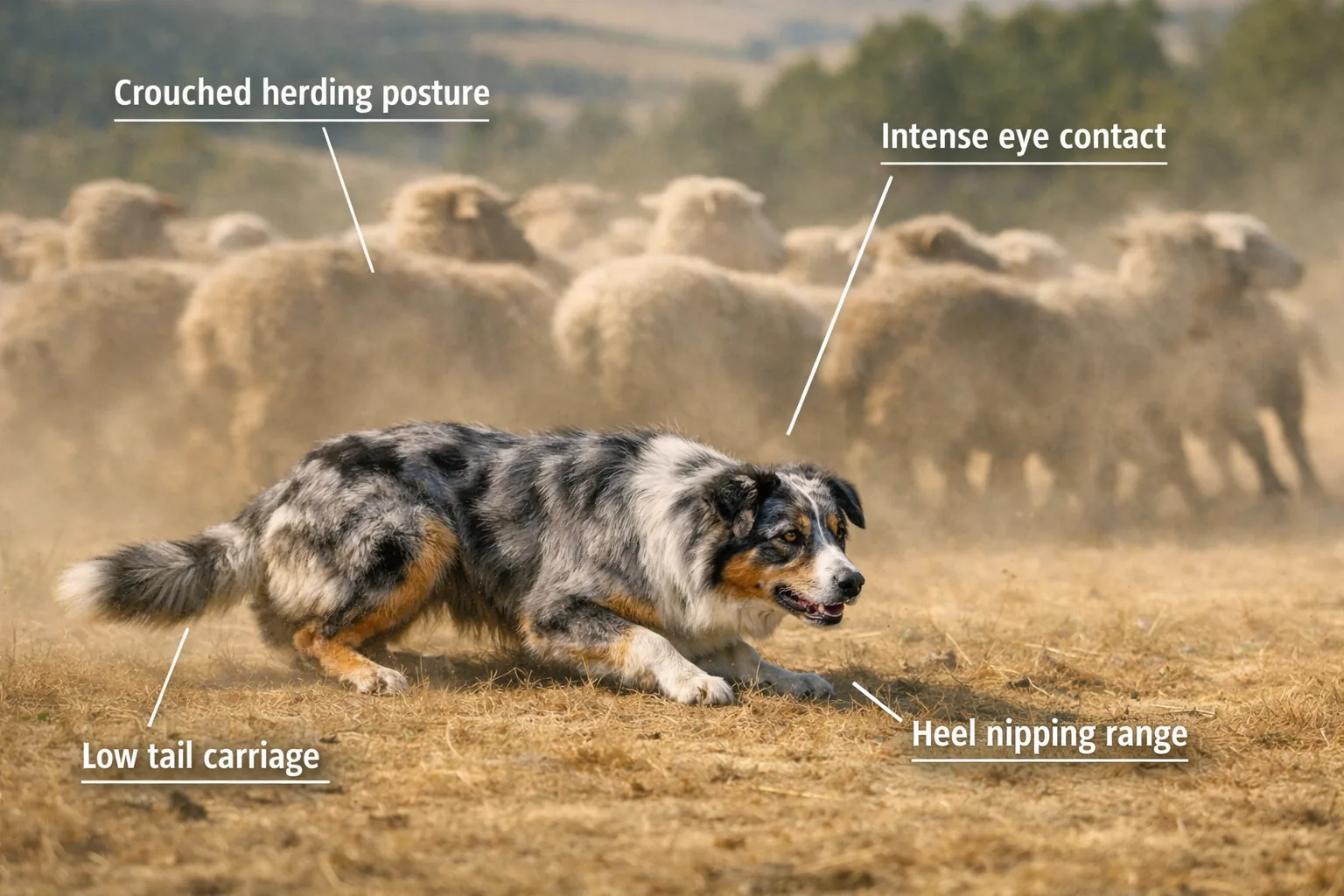
The intelligence is the part people underrate before they buy and brag about afterward. Aussies pick up long cue vocabularies, read household routines fast, and often figure out sequences you never trained. If you want the broader picture on what canine intelligence actually means and how it’s measured, our guide to how smart dogs really are separates the research from the marketing.
The attachment is the other hook. Aussies tend to be velcro dogs. Yours will likely follow you from the kitchen to the bathroom to the garage, then supervise. Owners describe this as the best and the most exhausting feature, often in the same sentence.
A bored Aussie does not sit quietly waiting for you to notice. It writes its own job description, and the job is usually chewing something load-bearing.
Then there are the individual quirks. One dog hoards shoes in a corner. One herds the vacuum. One stares at the cupboard where the frisbee lives until you lose the staring contest. These oddities are what make people breed-loyal for life.
A caution on the coat: merle is a color pattern, not a quality mark. Breeding two merle dogs together substantially raises the risk of deafness and serious eye defects in the puppies. Ask any breeder directly whether both parents are merle. If the answer is yes, walk away.
Australian Shepherd Size, Weight and Lifespan
A standard Australian Shepherd is a medium dog: males are generally 20 to 23 inches tall and 50 to 65 pounds, females 18 to 21 inches and 40 to 55 pounds. Median lifespan sits in the 12 to 15 year window reported by Dogs Victoria, with recent large-scale lifespan modeling placing the breed near 13.7 years.
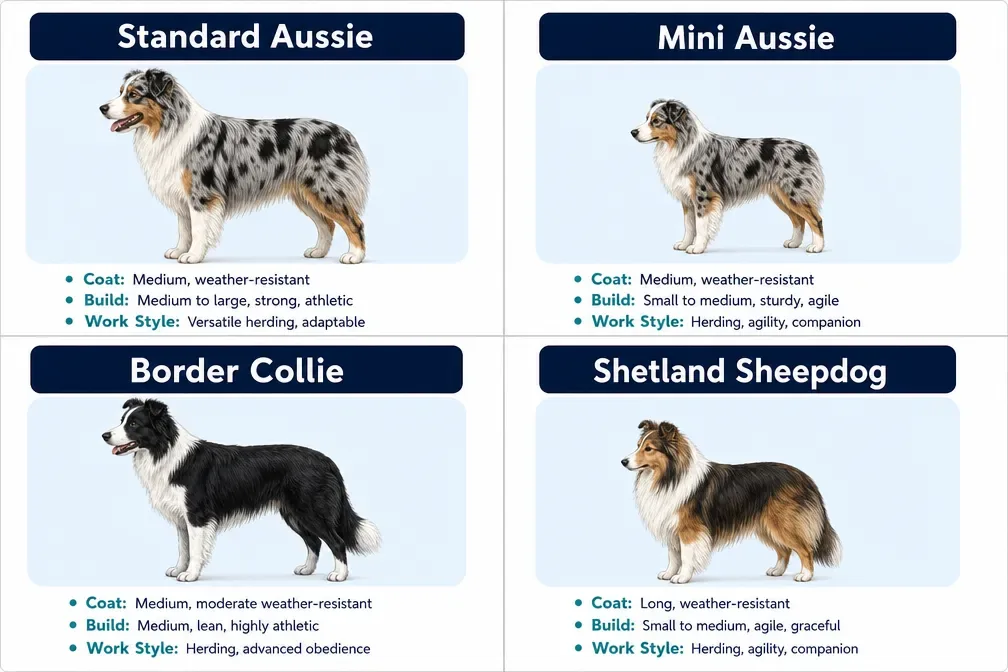
The Miniature American Shepherd, often sold as a “mini aussie” or “miniature australian shepherd,” is now a separate recognized breed. It is smaller in body only. The energy and the brain come in the same strength.
| Dog | Height | Weight | Typical lifespan |
|---|---|---|---|
| Australian Shepherd, male | 20 to 23 in | 50 to 65 lb | 12 to 15 yrs |
| Australian Shepherd, female | 18 to 21 in | 40 to 55 lb | 12 to 15 yrs |
| Miniature American Shepherd (mini aussie) | 13 to 18 in | 20 to 40 lb | 12 to 15 yrs |
| Border Collie (for comparison) | 18 to 22 in | 30 to 55 lb | 12 to 15 yrs |
Toy and “teacup” Aussies are not recognized by the major registries. Extreme downsizing can bring structural and health problems, and the sales pitch is usually priced accordingly.
If you’re weighing this breed against bigger dogs, our dog size classification guide explains where medium ends and large begins.
What Is the Australian Shepherd Temperament Like?
Loyal, watchful, busy, and opinionated. The australian shepherd temperament is best described as a working partner who wants instructions. Confident with family, often reserved with strangers, and highly reactive to movement, which is simply the herding wiring doing its thing.
Dogs Victoria is direct about the boundary: reserve toward strangers is acceptable in this breed, but fearfulness or aggression is not. That distinction should guide how you socialize a puppy. The goal is a dog who can watch a stranger walk past and then relax, not a dog forced into greeting every person on the sidewalk.
Common temperament patterns owners report:
- Motion sensitivity. Bikes, skateboards, running kids, cars. Teach a trained alternative early rather than suppressing the dog after the fact.
- Noise reactivity. Barking at delivery drivers is a guardian trait, not spite.
- Strong handler focus. Great for training. Means the dog notices your stress.
- Slow-building reactivity. Many owners say problems escalated between 8 and 18 months. That’s adolescence plus unmet needs, not a personality change.
Reading early stress signals matters more than any obedience cue here. Our dog body language guide covers the whale eye, the freeze, and the lip lick that usually arrive long before a growl.
If reactivity is escalating despite good management, that is the point to involve a veterinary behaviorist rather than a fourth YouTube method.
Are Australian Shepherds Good With Kids and Other Pets?
Often yes, with active supervision and early teaching, because the same instinct that moves cattle can turn into circling and heel-nipping at running children. Aussies are frequently devoted family dogs. They are also, by design, inclined to manage movement.
Practical fixes that work:
- Teach the dog a trained “park yourself on the mat” during chaotic kid moments. Pay it generously.
- Give running children a rule: when the dog gets intense, stop running and stand still. Boring humans are boring to herd.
- Redirect the chase urge into a flirt pole or a herding ball, twice daily if needed.
- Supervise toddlers fully. Not “in the same room.” Watching.
With other dogs, Aussies usually do well when socialized sensibly, though some adults prefer a few known friends over dog parks. With cats, success depends mostly on whether the cat runs. Slow introductions and a management gate are worth more than optimism.
Families comparing options can start with our roundup of family friendly breeds for kids, which sets the Aussie alongside lower-maintenance alternatives.
Who Is the Australian Shepherd Made For, and Who Should Skip It?
This breed suits people who already exercise and want a dog along for it. It frustrates people who want a handsome dog that settles quietly with minimal input.
Good fit if you:
- Run, hike, bike, ski, or train dog sports weekly, not seasonally
- Enjoy training and will keep doing it past the puppy class graduation
- Work from home or can break up the day
- Want a dog that notices everything about you
Think hard if you:
- Are a first-time owner with a full-time office schedule and no training support
- Live in a small apartment with no plan for daily off-property enrichment
- Want a dog that tolerates long alone time quietly
- Have very young children and limited supervision bandwidth
First-time owners can succeed with an Aussie. Plenty do. The ones who struggle usually underestimated the adolescent phase and had no outlet ready when the puppy cuteness wore off and the chewing started.
Apartment living is possible but demanding. An Aussie in a one-bedroom needs two real outings, a sniff walk, and a daily thinking task. The limiting factor is barking at hallway noise, not square footage. Our apartment dog breed picks list easier candidates if you’re on the fence.
How Much Exercise Does an Australian Shepherd Need?
Plan on 1.5 to 2 hours of activity daily for a healthy adult, split between physical movement and brain work. Roughly 60 to 90 minutes of exercise plus 20 to 30 minutes of training, scent games, or problem-solving.
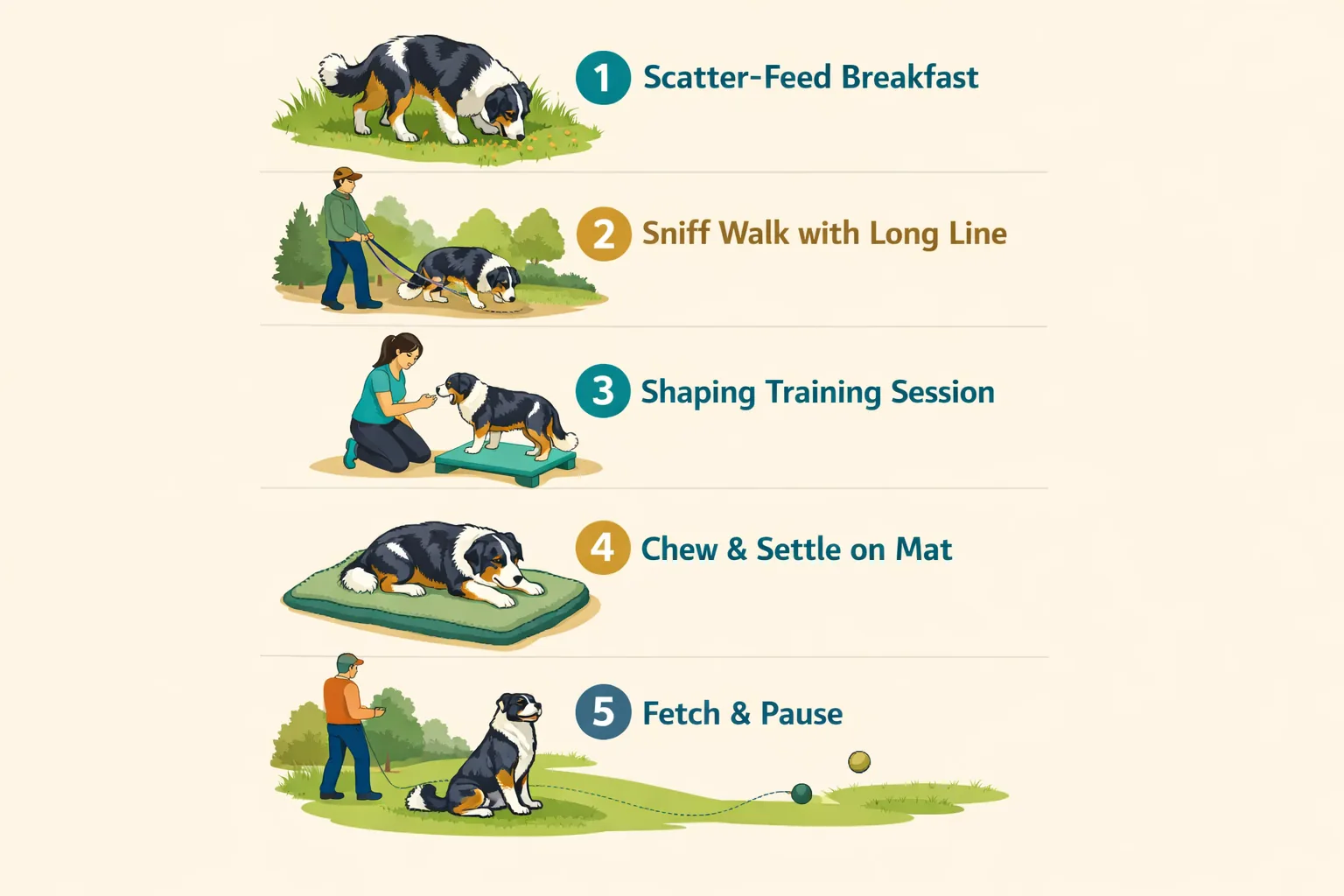
Mileage alone backfires. Running an Aussie five miles every day builds a fitter dog who now needs six. The mix matters more than the distance.
A workable weekday shape:
- Morning: 30 to 45 minute brisk walk or jog, with sniffing allowed
- Midday: 10 minute training session or a food puzzle
- Evening: 20 to 30 minutes of fetch, flirt pole, or a dog sport session, ending with a settle cue
- Night: a chew, on a mat, with the house quiet
Mental work that genuinely tires an Aussie: scent searches for hidden treats, shaping new tricks with a clicker, trick chains, treibball, agility foundations, or a long-line sniff walk on grass. Twenty minutes of nose work often does more than an hour of ball throwing.
One common mistake: fetch addiction. Endless ball chasing builds arousal and can cement an obsessive loop. Alternate fetch with low-arousal sniff work, and finish every session with a calm ending so the dog learns that excitement has an off switch.
Australian Shepherd Grooming and Shedding
Aussies shed year round and blow their undercoat heavily twice a year, usually spring and fall. Budget two brushing sessions a week normally, and daily during the heavy weeks.
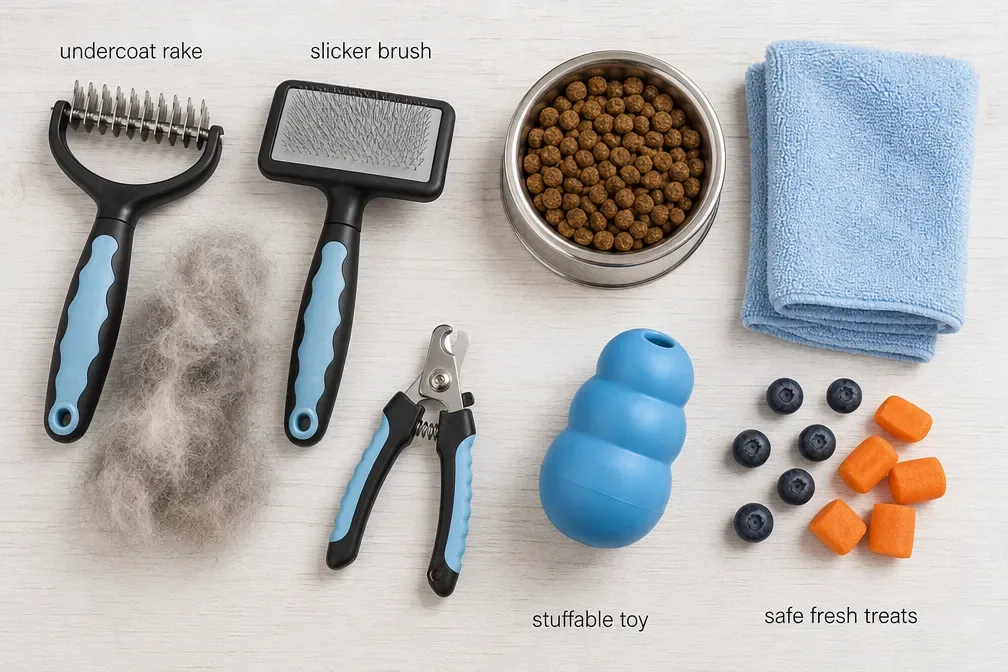
Your working kit: an undercoat rake for the dense layer, a slicker brush for the feathering behind the legs and the pants, and a metal comb to catch mats behind the ears and under the collar. Bathe every six to twelve weeks, or after the mud.
Do not shave an Australian Shepherd for summer. The double coat insulates against heat as well as cold, and regrowth after shaving is often patchy. Trim tidy-up areas only: paw pads, sanitary area, and feathering that drags.
Other routine care: nails every three to four weeks, ears checked weekly, teeth brushed most days. New owners can start with our beginner’s dog grooming guide for technique basics.
Edge case worth knowing: mats behind the ears and in the armpits form fast on feathered coats and hurt. If a mat is tight to skin, cut it out with care or let a groomer handle it. Do not yank.
Common Australian Shepherd Health Problems
The priority list is MDR1 drug sensitivity, hereditary cataracts and other eye conditions, hip and elbow dysplasia, and epilepsy. Most of these are managed through parental screening rather than treatment after the fact.
MDR1 (multidrug resistance 1). Dogs carrying this mutation can react severely to certain common medications including some antiparasitics, sedatives and chemotherapy agents. Reactions can be neurological and, in serious cases, fatal. Washington State University’s veterinary college developed the standard test and maintains the drug list. ASCA states that about half of Australian Shepherds may carry at least one copy, and recommends testing every Aussie and Aussie mix. Reported frequencies vary widely between study populations, which is exactly why a test on your individual dog beats a breed-wide percentage. Put the result in your vet file.
Eyes. Hereditary cataracts, collie eye anomaly and prcd-PRA are all screened by DNA test or by an eye exam through a recognized scheme. Both parents should have current results.
Hips and elbows. Scoring is widely performed in the breed. Ask for the actual numbers on both parents, not “fully health tested.”
Epilepsy. Occurs in the breed and typically appears between one and five years. Manageable in many dogs, but it needs a vet, not a supplement.
Allergies and skin. A 2026 review of 3,247 Australian Shepherd telehealth consultations found allergies the single most common reason owners called, at 17.5%, ahead of parasite questions and anxiety. Consultation frequency is not disease prevalence, so treat that as a signal about owner concerns rather than a population statistic.
Call a vet immediately, not in the morning, if you see: a bloated hard abdomen with unproductive retching, collapse or disorientation after a new medication, heatstroke signs after exercise, or sudden hind-limb weakness. Those are emergencies.
Screening reduces risk. It does not guarantee a healthy dog, and any breeder who promises otherwise is selling confidence rather than data. If you want genetic clarity on a rescue Aussie, our Embark vs Wisdom Panel comparison explains which test actually reports MDR1.
What Do Australian Shepherds Love to Eat? Favorite Foods and Feeding
Feed a complete, AAFCO-compliant diet matched to life stage, and use part of the daily ration for training instead of adding extra treats. Most adult Aussies eat somewhere between 1.5 and 2.5 cups of quality kibble daily, split into two meals, adjusted by activity and body condition.
Treats this breed tends to go hard for:
- Freeze-dried single-ingredient meat or liver
- Plain cooked chicken, turkey or lean beef
- Carrot sticks, cucumber, blueberries, apple slices without seeds
- Plain canned pumpkin, frozen in a stuffable toy
- Small cheese cubes, used sparingly
Foods to keep off the menu entirely: grapes and raisins, onion and garlic, xylitol, chocolate, macadamia nuts, cooked bones, and anything heavily salted.
Practical feeding notes for an active Aussie: feed at least an hour before hard exercise, weigh food rather than scooping by eye, and check ribs monthly. Working-line dogs in winter often need more calories; a desk-adjacent Aussie in July needs fewer. Puppies should stay on a growth-appropriate food until roughly 12 months.
Label reading is where most owners get lost. Our walkthrough on how to read a dog food label and what AAFCO means gives you the three lines on the bag that actually matter.
How to Train an Australian Shepherd
Train in short, frequent, reward-based sessions, and prioritize an off switch as highly as any obedience cue. An australian shepherd learns fast enough that your mistakes get learned just as quickly as your wins.
Five training mistakes that show up constantly in this breed:
- Teaching cues but never teaching settle. Build a mat behavior from week one. Reward calm lying down, in increasing durations, including when the house is busy.
- Overusing arousing games as reinforcement. A ball throw after every sit creates a dog permanently at a seven out of ten.
- Punishing the nipping instead of redirecting it. Puppy mouthing in Aussies is intense. Carry a tug toy, swap the arm for the toy, end the session when teeth escalate. Suppression without an outlet pushes the behavior elsewhere.
- Flooding a reserved puppy with strangers. Let the dog observe from a distance and choose to approach. Confidence is built, not forced.
- Dropping training at ten months. That’s precisely when adolescence makes everything wobble.
Build these early: a reliable recall paid with high-value food, a leave-it, a settle on a mat, a hand target for redirection, and calm crate time so alone-time is a trained skill rather than a crisis.
Puppy blues are extremely common with this breed. A smart puppy with needle teeth and no off switch can make a competent adult feel like a failure by week three. It usually improves markedly between 16 and 20 weeks if the dog is getting enough sleep. Under-slept Aussie puppies look hyperactive. Many need 16 to 18 hours of sleep a day and need help getting it.
Try It: Aussie Boredom Buster Plan
An under-employed Aussie invents its own jobs, and the job is usually chewing, barking or herding the kids. Enter your dog’s current day below and the tool builds a plan that burns the body and the brain in the time you actually have.
Doggy Rank IQ Tool
Aussie Boredom Buster Plan
An under-employed Aussie invents its own jobs, usually chewing, barking or herding the kids. Enter your Aussie's day to get a plan that burns body and brain.
How Much Does an Australian Shepherd Cost?
Expect roughly $1,000 to $3,000 for a well-bred puppy from a health-tested litter in the United States, with rescue adoption typically $150 to $500. First-year total ownership usually lands between $2,000 and $4,000, and ongoing years around $1,200 to $2,500.
| Cost item | Typical US range |
|---|---|
| Puppy from health-testing breeder | $1,000 to $3,000 |
| Rescue or breed-rescue adoption | $150 to $500 |
| First-year vet, vaccines, neuter/spay | $600 to $1,200 |
| Gear, crate, long line, puzzles | $300 to $600 |
| Food per year | $500 to $900 |
| Training classes or sports | $300 to $1,500 |
Breeder prices well below that range usually mean missing health testing, and that saving can reverse fast with one eye surgery. Ask to see MDR1, eye and hip results for both parents, in writing, with the dogs’ registered names on the certificates. “Vet checked” is not a health clearance.
Pet insurance is worth pricing before the first vet visit, since pre-existing conditions get excluded quickly in a breed with known hereditary issues.
Australian Shepherd Puppy Tips for the First 90 Days
Spend the first three months building sleep, settle, bite redirection and confident exposure, in that order. Obedience polish can wait. An australian shepherd puppy who learns to switch off is a dramatically easier two-year-old.
Weeks 1 to 2. Crate or pen as a resting default. Six to eight short potty trips a day. Hand-feed part of every meal for name response and eye contact. Expect night waking.
Weeks 3 to 6. Start calm exposure: car rides, different surfaces, the sound of the vacuum at a distance, people seen from across a street. Observation, not greeting. Begin a recall game indoors with real meat.
Weeks 7 to 10. Introduce short absences, two minutes at first, building up. Add a food puzzle at breakfast. Start mat settle work with the family watching TV.
Weeks 11 to 13. Long-line sniff walks. First puppy class. Keep sessions to five minutes, three times a day.
Bite management, specifically: Aussie puppies bite hard and often. Keep a tug toy within reach in every room, swap the toy in before the arm gets interesting, and call it a nap when the biting goes frantic. Frantic biting is usually overtiredness, not aggression.
If you feel flattened by week four, that’s ordinary. Most owners report the turn somewhere between 16 and 20 weeks.
What Australian Shepherd Owners Say
Owners describe both ends of the breed in the same breath: the dog who learns to self-regulate, and the dog who vocalizes for hours because nothing in the day asked anything of its brain.
One new owner on Reddit wrote about being impressed by “her ability to just chill out, and decide herself to nap” (r/AustralianShepherd thread).
That is the goal state, and it is partly genetics and partly practice. If your dog does not do this yet, train it directly: reward the moment the dog lies down on its own, add duration slowly, and avoid ending every calm stretch with an exciting event. Dogs who only get attention when they are up and busy learn to stay up and busy.
Another owner, struggling, described a dog who “he just whines and whines for HOURS out of boredom” (r/AustralianShepherd thread).
Hours of whining is a workload problem first and a sleep problem second. Before adding more exercise, log the day: if the dog is awake and stimulated for 12 hours straight, more walking will make it worse. Try a covered pen for enforced rest after each activity block, a frozen stuffed toy as the rest-time cue, and one 20 minute scent search in place of a second walk. If the whining happens only when you leave, that may be separation distress rather than boredom, which is a different problem and a reason to involve a qualified behavior professional.
Australian Shepherd FAQ
Are Australian Shepherds good for first time dog owners? They can be, if the owner trains consistently and has a genuinely active schedule. A first-time owner working long office hours with no training plan is the combination that most often ends in rehoming.
What’s the difference between an Australian Shepherd and a Border Collie? Border Collies are generally more intensely focused on livestock and more sensitive to small handler cues. Aussies tend to be sturdier, more physically assertive with stock, more protective of home, and somewhat more reserved with strangers. Both need heavy daily physical and mental work.
Do Australian Shepherds shed a lot? Yes. They shed year round and blow coat heavily twice a year. Two brushings a week minimum, daily during shedding season, and never shave the double coat.
How long do Australian Shepherds live on average? Twelve to fifteen years according to Dogs Victoria and Dogs Australia, with recent lifespan modeling placing the median near 13.7 years.
Can an Australian Shepherd live in an apartment? Yes, with two real outings daily, a long sniff walk, and a daily thinking task. Barking at hallway noise is usually the bigger obstacle than space.
Why is my Australian Shepherd anxious or reactive? Common drivers are unmet exercise and mental needs, chronic under-sleeping, adolescence, and insufficient early confidence building. Rule out pain with a vet exam, then work with a qualified trainer or veterinary behaviorist on a distance-based plan.
What is a mini aussie, and is it a real breed? The Miniature American Shepherd, often marketed as a miniature Australian Shepherd or mini aussie, is a separate recognized breed. It is smaller in body but has comparable energy and training needs.
What health tests should an Australian Shepherd breeder have done? MDR1, hereditary cataracts and prcd-PRA DNA tests, plus hip, elbow and current eye exams on both parents. Ask for certificates, not verbal assurances, and confirm the pairing is not merle to merle.