
This post contains affiliate links. If you buy through one we may earn a commission at no extra cost to you. As an Amazon Associate I earn from qualifying purchases.
Quick Answer
A dog gate works only when its mounting type matches where it goes: pressure-mounted gates suit flat doorways and hallways, while hardware-mounted gates are the safer call anywhere a fall could happen, like the top of a staircase. Measure the opening at three heights before buying, and match the gate’s rated width range to that number with a couple inches of margin.
Key Takeaways
- The Carlson 29-36.5″ Extra Wide Walk-Thru Dog Gate fits doorways up to roughly 36.5 inches without extensions, price band around $50-$70.
- The MYPET Wire Mesh Dog Gate expands from 29.5 to 50 inches, pressure mounted, no tools required, price band around $40-$60.
- Hardware mounting is the recommended choice anywhere a loose gate could cause a stair fall, according to testing cited by Business Insider.
- Retractable and pressure gates can develop gaps near the floor over time; the federal safety standard update for gates and enclosures addresses entrapment risk specifically.
- Measuring a doorway at the top, middle, and bottom matters because walls are rarely perfectly parallel; a half-inch difference should push buyers to the widest number plus about 2 inches of adjustment room.
- A dog gate is not the same product as a child-safety gate, and households with both toddlers and dogs need a gate built to child-safety standards for areas where a toddler could reach a staircase.
- Freestanding and pressure-mounted gates work fine in open rooms but should not be the only barrier at a stair landing.
What is a dog gate used for
A the gate is a barrier installed across a doorway, hallway, or stairway opening to keep a dog confined to or excluded from part of a house. It is used for three main jobs: keeping a dog away from a staircase, blocking access to a kitchen or nursery, and separating two pets during meals, recovery from surgery, or introductions.
Common real-world uses include:
- Keeping a senior dog with joint issues off a slick staircase where a fall could cause injury
- Blocking a puppy from a room with exposed cords, trash cans, or a Christmas tree
- Separating a resident dog from a new build or rescue dog during the first few weeks
- Creating a safe recovery zone after surgery, when a dog needs to avoid jumping on furniture or climbing stairs
- Keeping a dog out of a home office or nursery without having to shut a door completely
Empty nesters and owners of mid-life dogs tend to buy a the gate for one of two reasons: stair safety for an aging dog, or general containment in a kitchen or guest room. Those are different jobs with different mounting requirements, which is the whole reason mounting type gets its own section below.
Measure the Doorway and Check the Mount
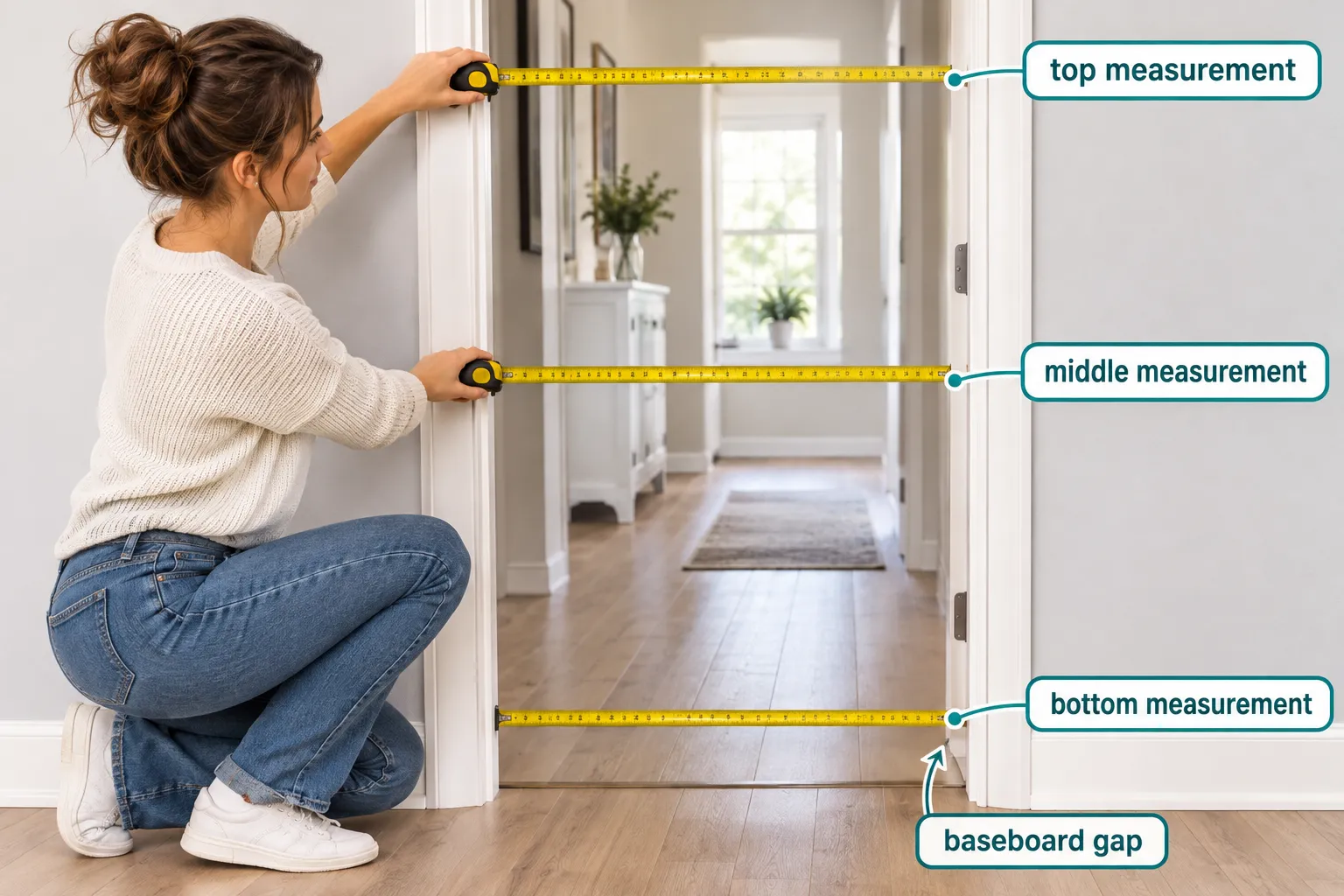
Measure the opening at three heights, top, middle, and bottom, because door frames and hallway walls are rarely perfectly parallel. Write down the widest reading, add about 2 inches of margin for trim and adjustment hardware, then compare that number to the gate’s stated width range before buying.
The “mount” half of the job is where most buyers cut corners. A the gate can be the correct width and still fail if the wall behind it has no solid backing. Before ordering anything:
- Locate wall studs at the planned mounting height with a stud finder
- If the gate’s screw holes do not land on a stud, plan to install a horizontal mounting board across two studs first
- Check for uneven surfaces, trim, or banister posts that the mounting cup needs to clear
- Note the floor type, since pressure mounts can slip on tile or uneven hardwood more than on carpet
A gate rated for “29 to 50 inches” does not mean every inch in that range performs the same. Landing near the middle of a gate’s rated range, rather than stretching it to the maximum, keeps the panel from losing holding strength and bulk, a point echoed in buying guides from Chewy’s pressure-mounted gate roundup. A 42-inch opening on a gate rated to 50 inches is a comfortable fit. That same opening on a gate rated to 43 inches is pushing the hardware past its design margin.
The riskier version of this mistake is a pressure-mounted the gate installed at the top of a staircase. Pressure gates hold position through friction against two walls. A hard lean, a dog jumping against the panel, or months of vibration can shift it loose. At a flat doorway, a shifted gate is annoying. At a stair landing, it is a fall risk for the dog and anyone walking past it.
Doggy Rank IQ Tool
Dog Gate Opening and Placement Checker

Top of the stairs is the one place a pressure gate must never go. Measure the opening and check placement.
How to install a dog gate
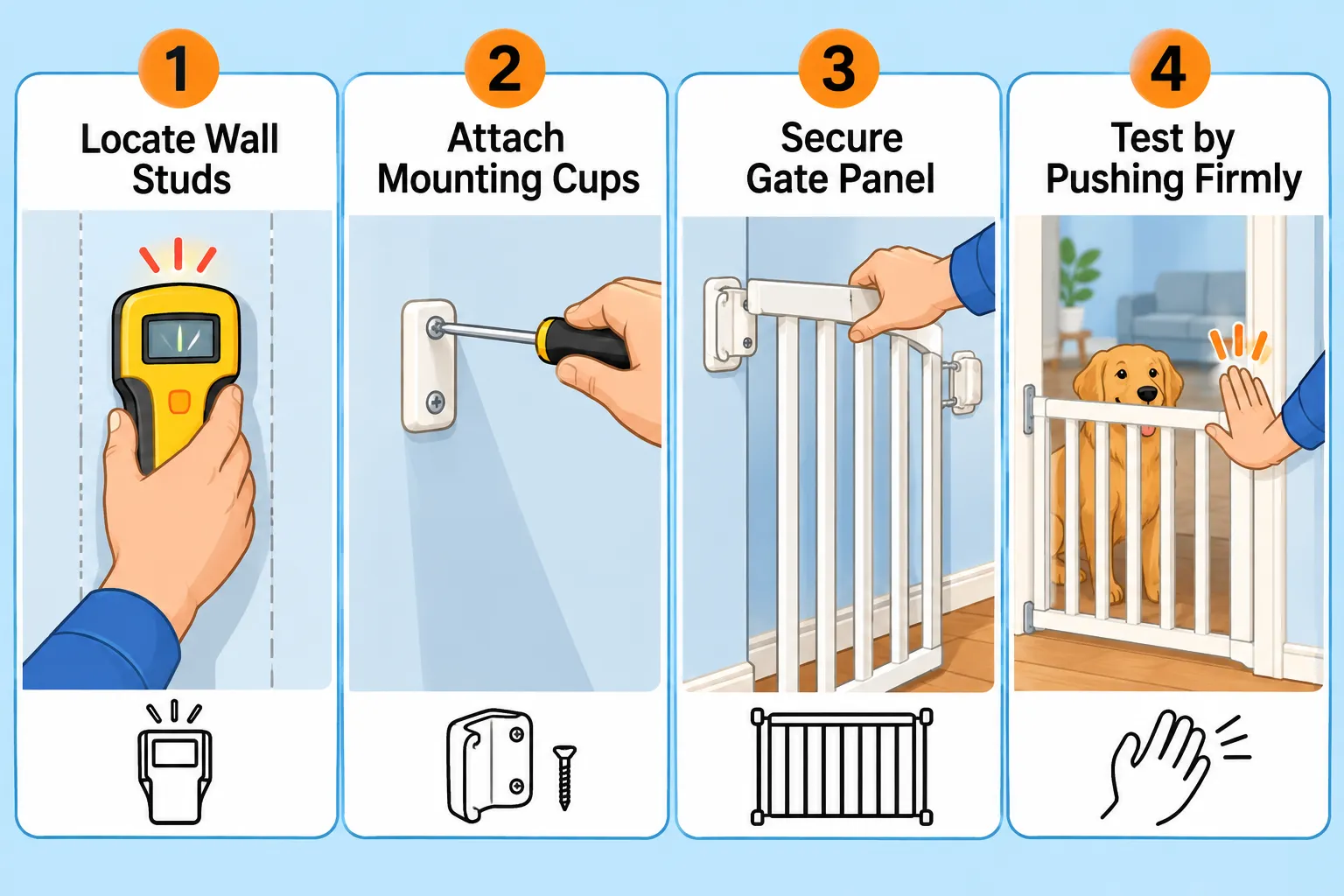
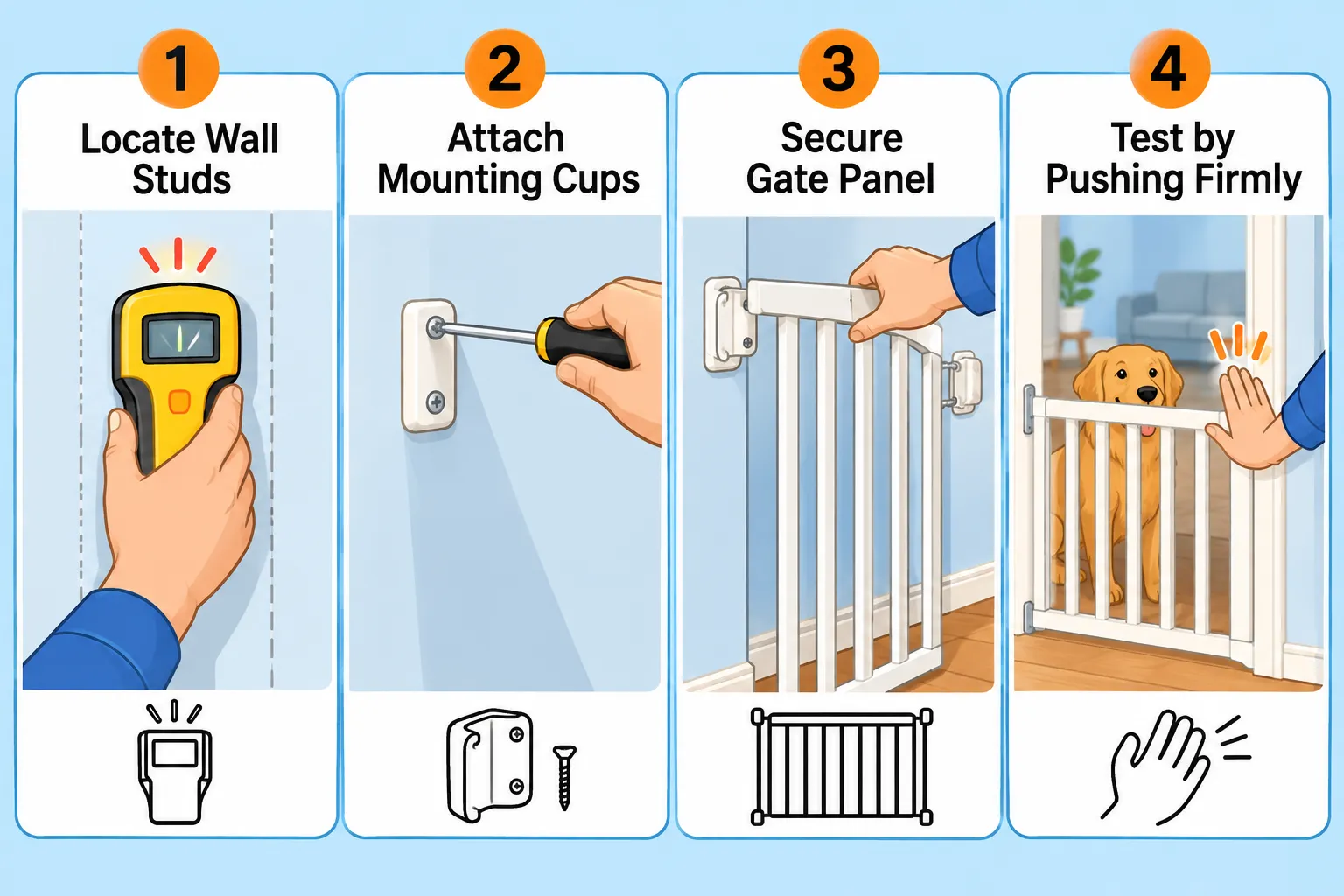
Installing a the gate properly takes about 20 to 40 minutes for a hardware-mounted model and under 10 minutes for a pressure-mounted one. The process differs by mount type, but both start with the same measurement and stud-check steps covered above.
For a pressure-mounted the gate:
- Measure the opening at the exact height the gate will sit, not just at the floor.
- Attach any extension panels needed to reach the opening width.
- Position mounting cups against each wall and twist the tension knob until the gate feels firm with no wobble.
- Test by pushing on the panel from both directions with moderate force, similar to what a leaning dog would apply.
- Recheck tension every few weeks, since cups can loosen with repeated use.
For a hardware-mounted the gate:
- Find studs on both sides of the opening with a stud finder.
- Mark bracket positions level with each other on both walls.
- If brackets don’t align with studs, mount a horizontal board across two studs and attach the brackets to that board instead.
- Pre-drill pilot holes to avoid cracking trim or drywall.
- Screw brackets into studs or the mounting board, then attach the gate panel and check that it swings or lifts smoothly.
A common mistake at this stage is mounting into drywall alone with hollow-wall anchors. Anchors can hold light shelving but are not rated for the repeated, sudden force of a 60-pound dog pushing against a gate. If no stud lines up with the gate’s holes, add blocking first rather than trusting an anchor.
Can you use a baby gate for a dog
A baby gate can work for a dog in many doorway situations, but it was not designed with dog-specific stress in mind, and some models have horizontal slats that double as a ladder for a climbing dog. Baby gates built to ASTM F1004 standards tend to have tighter mesh or vertical bars and sturdier locking mechanisms, which also makes many of them suitable for dogs.
The difference that actually matters:
- Baby gates are tested against a toddler’s climbing and pushing behavior, not a dog’s jumping or body-slam behavior.
- A large or athletic dog can generate more sudden force against a gate than a toddler typically does, so a baby gate rated for children may still fail under repeated dog pressure.
- Horizontal slat designs, common in older baby gate models, give a dog visible footholds. A mesh or vertical-bar design avoids this.
Choose a baby gate for a dog if the dog is small to medium, calm, and the gate will see light use in a flat doorway. Skip it for a large, jumpy dog or a stair landing, where a purpose-built the gate with a hardware mount is the safer pick.
Dog gate vs dog crate: which is better
A the gate restricts a dog to a room or hallway while still allowing movement, while a dog crate confines a dog to a small enclosed space. The two solve different problems and many households end up using both.
Choose a the gate when:
- The goal is keeping a dog out of one room or off a staircase while it still has run of the rest of the house
- The dog is housetrained and does not need den-style confinement
- Multiple pets need separation during meals without full isolation
Choose a dog crate when:
- Housetraining a puppy, since a crate limits the space enough to curb accidents
- The dog needs to stay fully contained during travel, vet recovery, or when left alone for safety reasons
- A dog has separation anxiety and does better in a smaller, enclosed space than an open room
A lot of owners use a crate for the first year of training and shift to a the gate once the dog is reliable with house manners. For guidance on setting training expectations early, see this breakdown of essential commands every puppy should learn.
Top 5 Features That Decide the Purchase
- Mounting type matched to location. The MYPET Wire Mesh The gate is pressure mounted with no tools, which suits doorways and hallways, not stair landings.
- Usable width range with margin. The MYPET gate’s 29.5 to 50 inch range covers most standard and wide openings without buying a second extension kit separately.
- Walk-through access. The Carlson Extra Wide Walk-Thru The gate includes a small pet door built into the panel, letting a cat or small dog pass while keeping a bigger dog contained.
- Height for jumpers. A gate under 30 inches tall is a suggestion to an athletic dog, not a barrier. Check the panel height against the specific dog’s front-paw reach.
- Portability without wall contact. The Free Standing The gate Indoor needs no mounting at all, which matters for renters or rooms where drilling is not an option.
Best dog gates for small dogs
Small dogs under 25 pounds generally do fine with shorter panels (24 to 29 inches) and tighter mesh or narrow bar spacing that prevents squeezing through. Height matters less for small dogs than gap width, since most small breeds are not strong jumpers but can wriggle through wide bars or loose mesh.
Look for:
- Bar spacing under 2.5 inches, or solid mesh panels, to prevent a small dog from pushing through
- A bottom clearance close to the floor, since toy breeds can slide under a gate with a one-inch gap
- Lightweight pressure mounts, since small dogs apply far less force than large breeds, making a pressure mount a reasonable choice for most doorway locations
The MYPET Wire Mesh The gate’s mesh panel design works well here because it eliminates the wide bar gaps some metal gates have.
Best dog gates for stairs
The best the gate for a staircase is a hardware-mounted model bolted into wall studs, not a pressure-mounted gate, because a pressure mount relies on friction that can loosen with repeated contact. This applies at both the top and bottom of a staircase, though the consequences of a failure at the top are more serious.
What to look for specifically:
- A hardware mount with bracket holes that line up with standard stud spacing (16 inches on center in most U.S. homes)
- A tall panel, at least 30 inches, for medium to large dogs
- A model with a walk-through door and a one-handed latch, so a person carrying laundry or a baby doesn’t have to climb over
- Extra bottom support bars for stair gates, since a dog pushing downward against gravity applies different stress than at a flat doorway
The Business Insider testing of 13 gates with a veterinary behaviorist specifically flagged hardware mounting as a requirement anywhere a fall from a dislodged gate could hurt a dog or person, which is the clearest industry-level confirmation of this rule.
Extra tall dog gate for large breeds
Large and athletic dogs, especially jumpers like Labradors, German Shepherds, and hounds, often clear a standard 29 to 31 inch gate without much effort. An extra tall the gate, typically 32 to 40 inches, closes that gap for dogs that can jump higher than expected.
Signs a standard gate is too short:
- The dog places both front paws on top of the gate during normal interaction with people on the other side
- The dog has cleared a similar-height barrier before, such as a low fence or baby gate
- The dog is over 50 pounds and known to be an active jumper, regardless of breed
For these dogs, prioritize a hardware-mounted extra tall panel over a taller pressure-mounted one, since taller pressure gates have more use working against the friction mount and are more prone to tipping.
Are dog gates safe for puppies
The gates are generally safe for puppies when the gap spacing, bottom clearance, and panel height match the puppy’s current size, but a gate sized for an adult dog can leave gaps a puppy squeezes through. Puppies also test gates differently than adult dogs, chewing on bars and pushing with their whole body weight while learning boundaries.
Puppy-specific checks:
- Confirm bottom clearance is under an inch, since puppies can wedge through gaps adult dogs cannot
- Avoid gates with wide horizontal bars that double as a climbing ladder once the puppy grows a bit
- Expect to replace or resize the gate as the puppy grows past 6 months, when jumping ability increases sharply
- Supervise early interactions with the gate, since some puppies panic if a paw gets caught in mesh or bar spacing
Chewy’s guide to gates for puppies recommends checking gap spacing specifically for growing breeds, since a gate that fits a 10-pound puppy may need replacing by the time that puppy hits 40 pounds.
Dog gate that doesn’t need installation
A freestanding the gate needs no wall mounting, no screws, and no stud-finding, which makes it the right pick for renters, apartment dwellers, or anyone unwilling to drill. These panels stand on their own folding base and can be moved from room to room.
Tradeoffs to know before choosing one:
- Freestanding gates are easier to tip over than hardware-mounted gates, since nothing anchors them to the wall
- They work best in open rooms, not narrow hallways or stair landings, where a determined dog could push the whole unit over
- Weighted bases or wide folding feet improve stability but do not match the security of a true wall mount
The Free Standing The gate Indoor fits this category directly and is covered in the comparison table below.
Comparison Table: Mounting Type and Location Safety
| Model | Price Band | Mount Type | Best Location |
|---|---|---|---|
| Carlson 29-36.5″ Extra Wide Walk-Thru The gate | around $50-$70 | Pressure or hardware (dual option) | Doorway, hallway |
| MYPET Wire Mesh The gate, 29.5″-50″ | around $40-$60 | Pressure mounted | Flat doorway or wide hallway only |
| Free Standing The gate Indoor, Foldable | around $45-$65 | None, freestanding panel | Open rooms, not true stair control |
How much does a dog gate cost
Most the gates run between $30 and $120, with basic pressure-mounted models at the low end and extra-wide, extra-tall, or hardware-mounted gates with walk-through doors at the high end. Specialty configurations, like custom-cut wood gates or multi-panel playpens, can run $150 or more.
Rough price bands based on type:
- Basic pressure-mounted mesh or wire gates: $30 to $60
- Extra-wide or extra-tall walk-through gates: $50 to $90
- Hardware-mounted stair gates with swinging doors: $60 to $110
- Freestanding folding panels: $45 to $80
Chewy’s the gate buying guide lists a similarly wide spread across brands, confirming that width, height, and walk-through features drive most of the price difference rather than brand name alone.
Which Pick Fits Which Dog and Owner?
A the gate decision comes down to location first, dog behavior second. For a flat kitchen doorway with a calm mid-size dog, the MYPET Wire Mesh The gate covers a wide range without tools and works well as a budget pick in the $40-$60 band.
For a household that wants a cat or small dog to pass freely while blocking a larger dog, the Carlson 29-36.5″ Extra Wide Walk-Thru The gate solves that with its built-in pet door, and its dual mounting option means it can go hardware-mounted at a stair landing when needed.
For renters, apartment dwellers, or anyone who does not want to put a single screw in a wall, the Free Standing The gate Indoor works in an open room, though it should not be the only barrier at the top of a staircase, since nothing anchors it to the structure.
Owners researching a tall the gate for a jumper should check panel height against the dog’s actual reach, not just the box label. A gate at 29 inches is a guideline for a 20-pound dog and a suggestion for a 70-pound retriever. For general home-safety planning alongside gate use, the beginner’s guide to choosing dog food and other household routines on the blog can round out a new-dog setup checklist.
Dog gate falling over, how to fix it
A the gate that falls over usually has loosened tension (pressure mount), is missing a stud connection (hardware mount), or sits on an uneven or slippery floor surface. Fixing it starts with identifying which of those three causes applies.
Troubleshooting steps:
- For pressure mounts: retighten the tension knob fully, check that rubber mounting cups are flush against both walls, and add a floor-level stabilizer bar if the gate includes one
- For hardware mounts: confirm screws are anchored in studs, not drywall alone; if the gate wobbles at the hinge, tighten bracket screws or replace stripped ones
- For slippery floors: add a non-slip pad under pressure-mount feet, since tile and polished hardwood reduce the friction a pressure gate depends on
- If the gate still rocks after these fixes, the opening may be slightly out of square; recheck the three-point measurement and consider a hardware mount instead
A gate that falls over repeatedly at the same spot despite retightening is a sign the location needs hardware mounting, not a stronger pressure gate.
Why my dog won’t stay behind the gate
A dog that won’t stay behind a gate is usually jumping over it, pushing through a gap, or has learned the gate can be knocked loose. Each cause has a different fix.
- Jumping over: Switch to a taller panel, 32 inches or higher for large or athletic breeds, and consider hardware mounting so the dog can’t add momentum by leaning into it first.
- Squeezing through gaps: Check bar spacing and bottom clearance; a gap over an inch at floor level is enough for many small to medium dogs to push under.
- Knocking it loose: This is common with pressure mounts under repeated pressure. Retighten tension regularly or switch to a hardware mount if the dog consistently leans or jumps against the panel.
- Learned behavior: Some dogs test a gate daily until it gives even slightly. If a dog has previously succeeded in moving a gate, it will keep trying. Pairing a secure hardware mount with basic training reduces this over time.
Alternatives to dog gates for pet safety
The gates are not the only containment option, and some situations call for a different approach. Exercise pens, closed doors, crate training, and room dividers all solve similar problems with different tradeoffs.
- Exercise pens (playpens): Good for temporary containment in an open area, like a yard or living room, without needing a doorway to mount against.
- Closed doors: The simplest option for permanent room restriction, though it removes airflow and visual contact that many dogs find reassuring.
- Crate training: Better for housetraining and short-term confinement than room-level containment. See the comparison section above for when a crate outperforms a gate.
- Furniture placement: Some owners block a stairway with a couch or bookshelf temporarily, though this is a stopgap, not a long-term safety solution, especially for jumpers.
- Fenced outdoor runs: For yard access control rather than indoor room separation.
None of these fully replace a the gate in doorway or hallway situations where airflow, visibility, and quick access matter, but they’re worth considering for temporary setups or unusual room shapes.
Things to Watch Out For
The single biggest and most repeated mistake is putting a pressure-mounted gate at the top of a staircase. The second most common mistake is measuring once at floor level and ignoring that baseboards and trim can narrow the actual usable width by an inch or more.
Other issues to check before buying:
- Bottom gap. The federal gates and enclosures safety standard update addresses entrapment risk from gaps between a gate and the floor, a risk that applies more to toddlers than dogs but is worth checking on any budget retractable model.
- Mesh or bar gaps wide enough for a small dog or cat to pass through, which defeats the point of containment if a smaller pet needs to stay separated too.
- Mounting into drywall with no stud behind it, which eventually pulls loose under repeated pressure. If the gate’s screw holes don’t land on a stud, add a horizontal board across two studs first.
- Uneven surfaces, trim, or banister posts that prevent a mounting cup or bracket from sitting flush.
Who Should Skip This
- Owners who need true child-safety certification should not rely on a dog-only gate. A the gate is not automatically built to the same ASTM F1004 child-safety standard, so households with both toddlers and dogs need a gate rated for children in any area a toddler could reach a staircase.
- Households with a determined climber or counter-surfer dog may find a 29 to 31 inch gate insufficient regardless of mount quality.
- Anyone unwilling to locate studs or add blocking should not install a hardware-mounted gate at a stair landing on faith alone; a pro installer or a different barrier style, like a half-door, may fit better.
- The freestanding option is the honest budget pick, but it is not a stair-safety solution. Skip it for any stair landing where a fall is possible.
Dog gate reviews, which brand is best
No single brand wins every category; the best the gate depends on opening width, mount type needed, and whether a walk-through door matters. Across review sources like AKC’s the gate guide, Dogster’s gate roundup, and Chewy’s hardware-mounted gate list, a few patterns repeat: Carlson models are consistently praised for dual mounting flexibility, wire mesh gates from brands like MYPET score well for budget-conscious buyers who only need a flat doorway, and freestanding folding panels from various brands get credit for portability but lower marks for stair safety.
Rather than chasing a single “best overall” label, match the brand and model to the specific opening and dog behavior covered throughout this guide. A gate that scores well in a general review roundup may still be the wrong choice for a particular staircase or a particularly athletic dog.
FAQ
Q: What is the best the gate for the top of stairs? A hardware-mounted gate bolted into wall studs, not a pressure-mounted gate, since a pressure mount can shift under repeated contact and cause a fall at a stair landing.
Q: Can you use a pressure mounted gate at the top of stairs? It is not recommended. Pressure gates rely on friction against walls, and a loosened gate at a stair landing creates a fall risk for the dog or a person walking past it.
Q: What the gate fits an extra wide opening? Look for a model with extension panels, like the MYPET Wire Mesh The gate’s 29.5 to 50 inch range, and measure at the widest point of the opening before choosing.
Q: How tall should a the gate be for a jumper? Most standard gates run 29 to 31 inches. An athletic or large dog may need a taller panel closer to 32 inches or higher to avoid clearing it.
Q: Are retractable the gates sturdy enough for big dogs? Many retractable mesh gates are built for lighter containment and convenience, not sustained pressure from a large dog leaning or jumping. Check the manufacturer’s weight rating before relying on one for a dog over 50 pounds.
Q: Can a the gate replace a crate for a puppy? Not usually during the first few months. A crate limits space enough to support housetraining, while a the gate gives a puppy room to roam, which can slow potty training progress. Many owners use a crate first and switch to a gate once the puppy is reliable.
Q: How do I stop my the gate from falling over? Retighten the pressure mount fully, confirm both mounting cups sit flush against the wall, add a non-slip pad on slick floors, or switch to a hardware mount if the gate keeps loosening despite adjustments.
Q: Do the gates work for cats too? Some do, but many dogs’ gates have bar or mesh spacing wide enough for a cat to slip through. If keeping a cat contained matters, choose a gate with tight mesh and minimal bottom clearance.